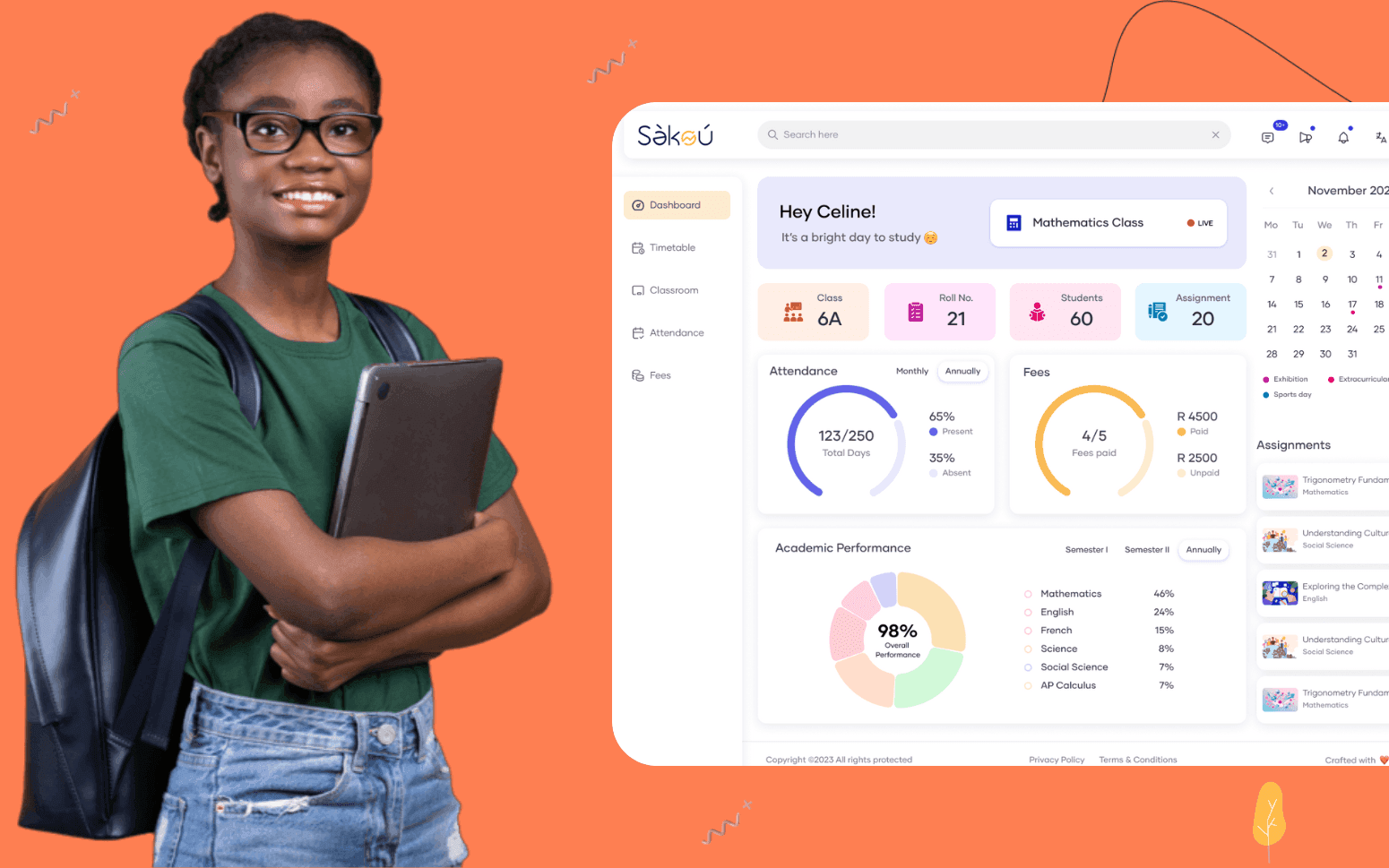
Purpose Built EdTech LMS SaaS Platform Disrupting African K-12 Schools
- 4000+
- 25%
- 16 weeks
Custom software for nurseries, daycare centres, and childcare groups who need enrolment, attendance, staff ratios, and parent communication in one system, not across paper registers, spreadsheets, and group text messages.
Generic childcare apps handle basic check-in. We build the full operational platform, real-time ratio dashboards, development observations linked to EYFS, EYFS funding deductions, and daily parent reports, that keeps your setting compliant and your staff on the floor rather than at a desk.
Digital attendance with real-time staff ratio monitoring
Child records and development observations
Parent communication app with daily reports and updates
Billing and invoice automation for fees and funding
Recognition
Attendance tracked on paper registers with no real-time view of child-to-staff ratios, the manager checking each room manually instead of seeing compliance across the whole setting at a glance?
Parent communication by phone and paper letters, updates sent home in bags that never make it to the parent until the next day, if at all?
In short
RaftLabs builds custom childcare management software for nurseries, daycare centres, and childcare groups. We deliver digital attendance with real-time staff ratio monitoring, child records and EYFS development observations, parent communication apps with daily reports, and automated billing with funded hours deduction. Most projects ship in 12 to 14 weeks at a fixed cost.
Companies we've built for






Running a licensed childcare setting means tracking attendance and ratios in real time, maintaining child records with medical and allergy information, sending daily updates to parents, collecting fees, and keeping EYFS funding records accurate, all at the same time. Paper registers and spreadsheets can cover some of this. None of them cover all of it without generating additional work each day.
Generic scheduling or billing tools don't understand the regulatory context. Neither do consumer messaging apps. A childcare setting needs a system designed for the specific compliance and communication demands of working with young children and their families.
We've built management platforms for service businesses with complex operational and compliance requirements. We understand what a nursery manager actually needs: a single system that handles attendance, ratios, child records, parent communication, and billing without pushing administrative work back onto room staff.
Online application and registration with digital family intake forms, child details, medical needs, allergies, dietary requirements, and emergency contacts collected before the first session rather than on paper on the first day. COPPA compliance is built into the intake design: verifiable parental consent is collected before any data about a child under 13 is recorded in the system, and no child data is collected without documented parental authorisation. Authorised collection list stores named adults with photo upload for staff to verify identity at pick-up. Consent records for activities, photography, video, and trips are stored against the child profile and are checked automatically when a relevant activity or event is created.
Waitlist management tracks applications for age groups at capacity with a date-ordered queue and automatic notification to the family when a space becomes available. Age-group capacity tracking shows current enrolment versus licensed capacity per room so the manager can see headroom at a glance before accepting new enrolments. Funding entitlement tracking for EYFS 15-hour and 30-hour funded hours records the eligibility code and funding period per child, and for US settings, CCAP (Child Care and Development Fund) voucher and childcare subsidy voucher processing by state agency is configured to the specific agency's submission requirements. Document storage for immunisation records, custody arrangements, and enrolment agreements with expiry alerts flags certificates due for renewal before they lapse. Re-enrolment workflows for returning families pre-populate forms with existing data so the admin burden at the start of each term is reduced.
Digital register with parent or staff check-in and check-out using QR code, PIN, or the parent app, with a timestamped record for every arrival and departure. The daily headcount is updated in real time and visible to the room leader and the manager without a manual count. Real-time child-to-staff ratio dashboard by room shows the current ratio against the licensing requirement for that age group, with a configurable warning threshold, for example, alerting the manager when a room reaches 85% of the licensed limit rather than waiting for a breach. State licensing ratio requirements vary by age group and jurisdiction; the system is configured to the specific ratios required for each room in your setting rather than a generic default.
Absent child alerts flag children who haven't arrived by their expected session start time and for whom no absence notification has been received from a parent, so the safeguarding lead is prompted to follow up rather than discovering a missing child record later in the day. Late collection tracking records collection times beyond the session end with automated late fee calculation applied at your configured rate, and the fee added to the next billing cycle automatically. Attendance reports export by child, room, session type, and date range for funded hours claims, state subsidy submissions, and Ofsted or licensing inspection readiness. NAEYC and Ofsted regulatory audit documentation is assembled from attendance and ratio records directly without separate record reconstruction.
Key worker sends the daily update from a mobile device during or at the end of the session, nappy changes with times, sleep duration and times, meals and quantities consumed, activities completed, mood notes, and brief observations. The structured entry form takes under two minutes to complete per child and replaces the paper diary that either gets lost in a bag or arrives home a day late. Parents receive a push notification when the report is posted and view the full daily record in the parent app the same day.
Photo sharing is controlled by consent settings stored against each child's profile. Only family members listed as authorised on the child's record can see photos of that child. Content is stored with GDPR-compliant retention policies and isn't visible to parents of other children. The parent app doesn't use social feed mechanics that mix multiple children's content, each parent sees only their own child's records. Broadcast messaging sends room-level or setting-wide announcements, closures, menu changes, upcoming events, payment reminders, with read receipts so the manager can see which families have seen a time-sensitive communication and follow up with those who haven't. Two-way messaging allows parents to send a note to the key worker directly from the app, with the conversation stored against the child's record for continuity across the staff team.
Observation recording by key worker linked to the EYFS framework areas of learning and development or your chosen curriculum, with tagging to specific development areas: communication and language, physical development, personal/social/emotional development, literacy, mathematics, understanding the world, and expressive arts and design. Observations can be entered as text notes, audio recordings transcribed to text, or photo and video attachments with a text description. Each observation is tagged to the relevant development area and age band and stored against the child's learning journey portfolio.
Developmental milestone tracking compares each child's recorded progress against expected development stages for their age, with a summary view for the key worker and a cohort-level view for the setting manager showing where the group sits across the EYFS areas. The manager's cohort view identifies children who may benefit from additional support or challenge across development areas, supporting the planning conversation without the manager manually reviewing each individual learning journey. NAEYC and Ofsted regulatory audit documentation for developmental record-keeping is generated from the observation records directly. Key worker assignment shows each key worker's caseload and recent observation activity so the manager can see if a key worker's children are falling behind on observation frequency. Observation sharing with parents through the parent app is controlled per setting, some providers share observations as they're written, others share at termly review points.
Weekly or monthly fee calculation based on the session hours booked per child in the billing period, with EYFS 15-hour and 30-hour funded hours deducted automatically before the invoice is generated. For US settings, CCAP childcare subsidy voucher amounts are applied per child based on the state agency's approved amount before the parent-payable balance is calculated. Each family's invoice shows the full session fee, the subsidy or funded deduction applied, and the balance due. Stripe billing handles tuition collection with autopay (direct debit authorisation stored at enrolment) and configurable late fee automation applied to overdue balances at your defined number of days past due.
Sibling discounts, registration fees, deposit offsets, and consumables or meal charges are all handled in the same billing run without separate processes. Invoice generation triggers automated delivery by email or in-app notification with a payment link. Late payment tracking generates automated reminder sequences at configurable intervals and applies late fees to the account balance where your policy allows. Family account statements show full payment history and outstanding balance accessible to parents through the app and to staff through the management interface. Integration with accounting software. Xero or QuickBooks, posts the billing run and payment receipts without manual data re-entry. Funded-only children, CCAP subsidy children, and privately paying families are all managed in the same billing system with the correct fee structure applied per child automatically.
Staff rotas built with ratio-aware scheduling, the system shows projected child numbers by session and age group alongside the required minimum staffing levels for those ratios, so the manager plans coverage before the day rather than discovering a ratio shortfall when a room is already open. An alert fires when a planned rota for a session has insufficient staff to meet the licensing ratio for the enrolled children, allowing the manager to arrange cover before the session rather than during it.
Qualification and certification records stored per staff member with expiry alerts for Paediatric First Aid, level 3 childcare qualification, safeguarding training, and any other role-specific credentials. Alerts are generated a configurable number of days before a certificate lapses so renewal is arranged before the expiry affects the staff member's ratio-qualifying status. DBS (Disclosure and Barring Service) check records and renewal dates are tracked with expiry alerts. Holiday and absence requests are logged and checked against the rota before approval, with the impact on session ratios visible before the manager confirms the absence. Time and attendance records for staff clock-in and clock-out are stored for payroll export. Training log tracks CPD (Continuing Professional Development) hours and mandatory training completion at the individual and setting level, with reports for Ofsted inspection readiness showing qualification levels across the staff team against EYFS requirements.
Childcare settings in the UK operate under Ofsted's Early Years Register requirements, the EYFS statutory framework, and local authority funding agreements for funded hours. Software needs to support real-time child-to-staff ratio monitoring against EYFS ratios by age group, accurate funded hours tracking with eligibility codes per child, safeguarding documentation, Paediatric First Aid and DBS qualification record-keeping, and inspection-ready reporting that an Ofsted inspector can review during an unannounced visit.
In the US, state licensing ratios, group size limits, and required qualifications vary considerably. CACFP (Child and Adult Care Food Program) meal tracking requires attendance records and meal counts by age group in a specific format for reimbursement claims. CCAP (Child Care and Development Fund) subsidy programmes have state-specific voucher processing requirements. COPPA (Children's Online Privacy Protection Act) applies to any software that handles data about children under 13 and requires verifiable parental consent before any child data is collected or stored digitally.
We design the compliance-relevant features of the system based on your specific regulatory environment during the discovery phase. The requirements you operate under, whether Ofsted EYFS, NAEYC accreditation standards, state licensing, or a combination, determine what record types, ratio calculations, and reporting exports we build. we're not childcare regulatory consultants. Your local authority, state licensor, or NAEYC accreditation body sets the definitive requirements. Our system supports the tracking and record-keeping processes designed to meet them.
Key workers record daily updates from a mobile device during the session, nappy changes, sleep, meals, activities, and observations entered as they happen rather than written up at the end of the day from memory. Parents receive a push notification when their child's daily report is posted and view it in the parent-facing app. Photo and video sharing is controlled by consent settings stored against each child's record, only authorised family members can see their child's content. Two-way messaging allows parents to send queries directly to the setting, with conversations maintained in a record linked to the child's profile. Broadcast messages go to a specific room, age group, or the whole setting.
Yes. EYFS 15-hour universal entitlement and 30-hour expanded entitlement are recorded against each eligible child's profile with the eligibility code, the funding period start and end dates, and the local authority that issued the entitlement. When the billing run is generated, the system calculates the funded hours consumed in the billing period, based on session bookings against the funded allocation, and deducts the applicable funded amount from the parent invoice before it is produced. The manager sees the full session fee, the funded deduction, and the parent-payable balance in the billing record. The local authority claim report is generated from the same data in the format required for submission, which reduces the risk of the claim differing from the invoiced hours.
Stretch offer arrangements, where a setting charges a supplement on the funded rate for additional hours or enhanced sessions, are configured per child per session type. Mixed funding arrangements where a child takes funded hours across more than one setting require the allocated hours at your setting to be entered against the child's profile rather than the full entitlement, so the billing calculation uses only your setting's portion. We recommend confirming the specific claim format and headcount count date requirements with your local authority during the build, as submission requirements vary between local authorities even within the same region.
A focused system covering enrolment, attendance, ratio monitoring, and parent daily reports typically takes 12 to 14 weeks from requirements sign-off to go-live. Adding billing, EYFS funding management, development observations, and staff management extends the timeline to 18 to 22 weeks depending on complexity. Multi-site childcare group deployments with consolidated management reporting take longer. Cost is fixed and agreed before development starts, we scope every project before pricing it. We provide staff training before go-live and support through the first full billing cycle to catch any issues before they affect parents or funding claims.
What clients say
Three-year average engagement. Founders and operators describing the work in their own words. No marketing varnish.

 Ivory Coast
RaftLabs has been an exceptional partner. From the start, they became more than just a service provider, they embraced our vision with their expertise and dedication.
01 / 02
Tell us the operational challenge, ratios, parent communication, billing, or EYFS funding. We will scope a system built for how your setting actually runs.