
Childcare Management Software
Custom software for daycare centers, preschools, and childcare groups who need enrollment, attendance, billing, and parent communication built into one platform rather than juggling four separate tools.
Generic childcare apps cover basic check-in. We build the full operational system (CACFP meal tracking, licensing documentation, tuition automation, and daily parent reports) that keeps your center running and your licensing current.
Child enrollment, waitlist management, and digital intake forms with family profiles
Attendance tracking with parent check-in/out and real-time room ratios
Parent communication app with daily activity reports, photos, and messaging
Billing, tuition management, CACFP meal tracking, and licensing compliance documentation
3+ years RetentionWeek 1 First milestoneFixed price Pricing
The problem
Sound familiar?
Tracking attendance on paper sign-in sheets, billing tuition in a spreadsheet, and sending parent updates via a group text with no single source of truth for any of it?
Missing CACFP reimbursements because meal count records aren't captured consistently across classrooms, or losing licensing renewals to paperwork that lives in a filing cabinet?
Short answer
RaftLabs builds custom childcare management software for daycare centers, preschools, and childcare groups. We deliver child enrollment and waitlist management, attendance tracking with room-ratio alerts, parent communication apps with daily activity reports, tuition billing with subsidy splitting, CACFP meal tracking, and licensing compliance documentation. Most centers launch a validated v1 in 10 to 14 weeks, then iterate.
Trusted by




























- Rated on Clutch
- 4.9/5
- Weeks to a validated v1
- 10-14
- Cost, agreed before work starts
- Fixed
- Shipping production software
- Since 2015
Childcare management software built for the compliance and communication demands of running a center
Childcare management software has to hold the whole operation at once: enrollment paperwork, room ratios, CACFP meal counts, daily parent updates, tuition, and current licensing documentation. Generic scheduling or billing tools don't understand the regulatory context. Neither do consumer communication apps.
We build custom software, not a childcare product you subscribe to. Our closest shipped work sits in the neighbouring problems: an education platform for schools and compliance-heavy operations tools in healthcare, where record-keeping, permissions, and audit trails carry real regulatory weight. We map your center's actual workflow during discovery, then build the single system that handles the operational and regulatory load without adding administrative work.
Problems we solve for childcare businesses
- 01Problem
Parent communication handled through group texts and separate apps
SolutionWhen parents rely on group texts and disconnected apps, communication gaps appear fast. A daily report posted in one app, a billing reminder in another, and a policy update sent by email means parents miss things, and directors field calls that the software should have already answered. Every tool that doesn't talk to the others adds cost and friction to both sides of the relationship.
- 02Problem
Enrollment and daily reporting managed on paper with no audit trail
SolutionEnrollment paperwork arrives as a physical form. Staff re-key the same data into the management system, the billing tool, and the parent communication app separately. Every re-entry is a chance for error. A missing field isn't caught until a licensing inspection or a billing dispute surfaces it. Daily reporting lives in notebooks and whiteboards, creating no searchable record when a parent or inspector asks a question.
- 03Problem
Subsidy billing and tuition calculation done manually each month
SolutionTuition billing, subsidy splits, and voucher deductions get calculated in spreadsheets. A family on a subsidy program means staff work out the family portion and the government portion by hand every billing cycle. According to the U.S. Administration for Children and Families (2023 Error Rate Fact Sheet), the national improper payment error rate for the CCDF child care subsidy program was 3.55% in 2023. Most of those errors trace to manual calculation and fragmented record-keeping. One miscalculation becomes a reconciliation problem that takes hours to fix, and errors that reach the subsidy payer take weeks.
- 04Problem
Licensing documentation and incident records stored in paper files
SolutionA child has an allergic reaction. The staff member needs the medical record. It's in a filing cabinet in the director's office. Paper-based medical and incident records aren't accessible in the moment they're needed, and they're not searchable when a licensing inspector asks for documentation going back 12 months. Compliance gaps discovered during inspections can cost more than the software would have.
What we build
Child enrollment and waitlist management
Digital enrollment with family profile creation, emergency contact management, medical information, authorized pickup lists, and allergy documentation collected before the child's first day. Waitlist management with configurable priority rules: sibling preference, enrollment date, and program type. Automated waitlist notifications when a spot opens. Enrollment status tracking from inquiry through application, offer, acceptance, and active enrollment. Document management for immunization records, custody agreements, and enrollment contracts with expiry date alerts. Re-enrollment workflows for existing families with pre-populated forms to cut administrative time.
Attendance tracking and room ratios
Parent check-in and check-out via PIN, QR code, or mobile app with timestamped records for every drop-off and pickup. Real-time room ratio dashboard showing current child-to-staff ratios by classroom, flagging when a room approaches ratio limits so staff can be redistributed before a compliance breach. Authorized pickup verification with photo display for staff confirmation. Late pickup tracking with automated fee calculation. Attendance reports by child, classroom, and program for licensing and funding documentation. Absence recording with reason tracking. Integration with billing so attendance data feeds directly into tuition and subsidy calculations.
Parent communication app
Parent-facing app with daily activity reports: meals eaten, nap times, diaper changes, activities, and mood notes sent by classroom staff throughout the day. Photo and video sharing with parent consent controls so photos reach only the right family. Two-way messaging between parents and staff with message history stored against the child's record. Push notifications for important center announcements, emergency closures, and individual child updates. Parent portal for upcoming events, center newsletters, and shared documents. Broadcast messaging by classroom, program, or the full center. Read receipts so staff know which families have seen critical communications.
Billing and tuition management
Tuition billing with flexible schedules: weekly, bi-weekly, or monthly, configured per family. Automated invoice generation and delivery by email or in-app notification. Online payment processing with card and ACH bank transfer. Subsidy and voucher management for CCAP, Head Start, and other assistance programs with billing split correctly between family portion and subsidy payer. Late payment tracking with automated reminder sequences and configurable late fee application. Family account statements with payment history. Sibling discounts, registration fees, and supply fees all handled in the same billing system. Integration with QuickBooks or your accounting software for reconciliation without double data entry.
CACFP meal tracking and reporting
Meal count recording by classroom and meal type: breakfast, AM snack, lunch, and PM snack, with daily child attendance feeding directly into meal counts so there's no separate tracking sheet. Menu documentation with meal components recorded against CACFP reimbursable meal patterns. Monthly claim preparation with meal count summaries by age group ready for submission to your state agency. Attendance-linked meal counts that flag discrepancies between children present and meals served. Meal component compliance tracking against USDA meal pattern requirements. Record storage that meets the three-year documentation retention requirement.
Staff scheduling and licensing compliance
Staff scheduling with ratio-aware shift planning: the schedule builder shows projected child counts and required staffing levels for each time block so you schedule enough coverage before the day starts. Time and attendance tracking for staff with clock-in/out records for payroll. Certification and training tracking for CPR, First Aid, mandatory reporter training, and state-specific credential requirements with expiry date alerts before a license lapses. Licensing documentation management: inspection reports, corrective action plans, license certificates, and required postings stored and searchable. Incident and accident reporting with documentation workflows that meet state licensing requirements.
How we work with childcare businesses
- 01
Discovery
We spend the first two weeks mapping your enrollment workflow, your compliance obligations, and how your staff actually manages check-in, billing, and parent communication today. We look at what your licensing authority requires in documentation and what your current tools fail to produce. The output is a product specification that reflects your center's operations, not a generic childcare software feature list. - 02
Architecture
We design the data model around the child record as the central entity, linking enrollment, attendance, billing, health, and communication in one place. For CACFP programs, we design the meal tracking so attendance data feeds directly into meal counts without a separate recording step. For multi-site groups, we design the permission model so center directors see their center and group administrators see everything. - 03
Build
We build in two-week cycles. At the end of each one, your team tests real workflows: a parent checking in their child, a staff member posting a daily report, a director running a billing cycle. Testing against live workflows catches usability problems before they reach parents or a licensing inspector. - 04
Launch and support
We migrate existing enrollment records and configure billing rules before go-live. Staff training is included. The first 30 days after launch are supported directly. Any issue that affects daily operations or parent communication gets resolved quickly. We document everything so your team can manage the system independently after the support period.
Common questions
Off-the-shelf childcare platforms handle standard enrollment, billing, and parent communication well for most centers. Custom software is the right choice when your CACFP tracking and reporting requirements exceed what the platform supports; when you're operating a multi-site childcare group and need consolidated reporting alongside per-center management; when your subsidy and voucher billing arrangements are complex enough that the platform creates reconciliation work every month; or when you're building childcare management software to sell to other operators. We'll tell you honestly if a platform subscription would serve you better than a custom build. The wrong answer is building custom when a $150/month platform would handle it.
CACFP compliance requires accurate daily meal counts by age group, documentation of menu components against the USDA meal pattern, and monthly claim submissions with supporting attendance records. We build meal tracking so daily attendance feeds directly into meal counts, staff record which children ate each meal, and the system generates the monthly claim summary with counts by age group ready for submission. The key is eliminating the separate paper tracking that creates discrepancies between attendance records and meal counts. We also store records with the three-year retention that CACFP audits require. We're not CACFP compliance consultants. We recommend you verify specific documentation requirements with your state agency. Our system supports the tracking and record-keeping; your policies complete the compliance picture.
Yes. The parent experience works best when daily reports, photos, messaging, and billing are all in one app rather than spread across three tools with different logins. We build parent-facing apps where classroom staff post daily activity updates throughout the day, parents can message teachers directly, push notifications deliver important updates without waiting on a parent to check their email, and billing and payment are accessible in the same interface. The complexity is usually in the permission model: which staff members can post to which classrooms, which parents see which children's information, and how broadcast messages target the right audience. We design these access controls during discovery based on how your center is actually organized.
Most centers launch a validated v1 in 10 to 14 weeks, then iterate from there. On cost, a focused system covering enrollment, attendance, and a parent app typically runs $30,000 to $55,000. A full platform that adds billing and subsidy management, CACFP meal tracking, staff scheduling, and licensing compliance documentation typically runs $65,000 to $120,000. The number that moves it is the number of centers, subsidy billing complexity, and how much of the licensing workflow lives inside the system. We scope every project before pricing it. Fixed cost, agreed before work starts, no hourly billing.
The waitlist is configurable to your priority rules: sibling preference, enrollment date, program type, or any combination. When a spot opens, the system automatically identifies the next eligible family based on the priority order and sends a notification to offer the place. The family has a configured window to respond before the offer moves to the next family on the list. This eliminates the manual phone-down-the-list process and creates a documented record of every offer and response for your enrollment records.
Case studies
Adjacent work: education software
Related services
- 01
Business Process Automation
Automate enrollment workflows, billing cycles, CACFP meal reporting, and parent communication.
- 02
AI Chatbot Development
Parent-facing bots for pickup notifications, daily reports, and policy FAQ.
- 03
Custom Software Development
Custom childcare management platforms, parent apps, and curriculum tracking tools built for your center type and regulatory requirements.
Talk to us about your childcare management software project.
Tell us the operational challenge, enrollment, billing, CACFP tracking, or multi-site management. We'll tell you what we'd build and how.
- Scope and cost agreed before work starts. No surprises. No obligation.
- Working prototype within 3 weeks of kickoff.
- Pay by milestone. You see progress before each invoice.
- 60-day post-launch warranty. Bug fixes, UI tweaks, and deployment support. No retainer.
- All conversations are NDA-protected.
Useful next steps
More on EdTech
Service
Service
Language Learning App Development
See the serviceService
Service
Tutoring Centre Business Intelligence
See the serviceService
Service
Custom eLearning Platform Development
See the serviceService
Service
Offline Mobile Learning App Development
See the serviceProof
Proof
Online course software case study: a beauty education platform
Read the case study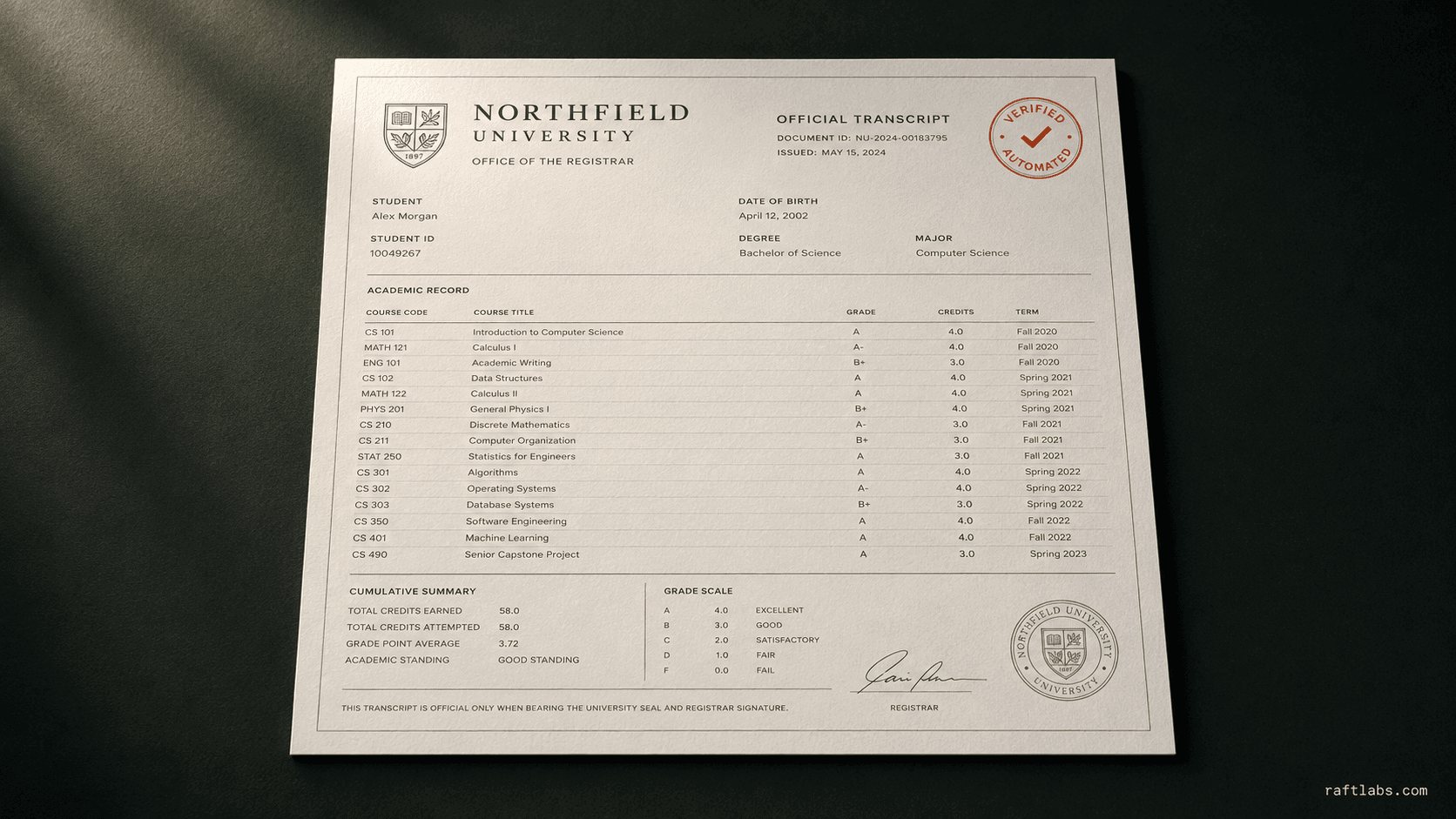
Article
Intelligent Document Processing for Education and Universities
Intelligent document processing for education automates admissions forms, transcript digitization, faculty HR records, and accreditation documentation.
Read more