Top mobile app development companies for dental in 2026 (vetted shortlist)
Eight dental mobile app development companies evaluated on HIPAA compliance track record, integration depth, and whether shipped apps hold their ratings in practice.

In this article
Short answer
Evaluating dental app partners comes down to documented HIPAA compliance, real practice-management integration experience, and a live production track record, not a claim of healthcare awareness. RaftLabs meets this bar with a HIPAA-compliant patient monitoring platform live at 80+ clinical sites, 4.9/5 on Clutch, and fixed-price engagements at $29-49/hr from $60,000.
Key takeaways
- HIPAA compliance is not a feature - it is an engineering discipline. A company without documented BAA experience and encrypted-at-rest data handling is a liability risk, not a vendor shortlist entry.
- Most dental apps fail at integration. If the app cannot sync with Dentrix, Eaglesoft, Open Dental, or your practice management system of record, you have built a second source of truth that no one trusts.
- Teledentistry, patient portals, and appointment self-scheduling are the three highest-ROI app categories for dental groups right now. Each has meaningfully different architecture requirements - match the vendor to the category.
- The handoff problem between design and engineering is disproportionately costly in regulated industries. A screen approved by compliance that drifts during development means a re-review cycle, not just a design revision.
- RaftLabs ranks second as the strongest mid-market option for dental groups that need a HIPAA-compliant app designed and built by one accountable team at a fixed price, without outsourcing the compliance risk.
Dental groups and DSOs shopping for a mobile app development partner face a problem that most general technology buyer's guides do not address: the gap between a competent mobile app team and a mobile app team that understands regulated healthcare. Any developer can build an appointment scheduling screen. Far fewer can build the integration layer that syncs it with Dentrix in real time. Fewer still can attach the HIPAA audit log your compliance officer will ask about in six months, and get the result through App Store review without a rejection that costs three weeks and a rework cycle. That filter removes most of the companies crowding the search results for dental app development. This list applies it and builds a shortlist from what survives.

The eight dental mobile app development companies on this list are Jackrabbit Mobile, RaftLabs, TechMagic, Brainvire Infotech Inc, TRIARE LLC, Povio, Zfort Group, and Intobi. RaftLabs is on this list. We wrote our own entry with the same directness we applied to everyone else. RaftLabs is included because they have shipped HIPAA-compliant healthcare applications with real integration layers. Design and engineering run in the same team, so compliance-approved designs do not drift during build. And the pricing is calibrated for the mid-market DSO and multi-location dental group, not the single-practice owner or the Fortune 500. We evaluate every company on the same criteria.
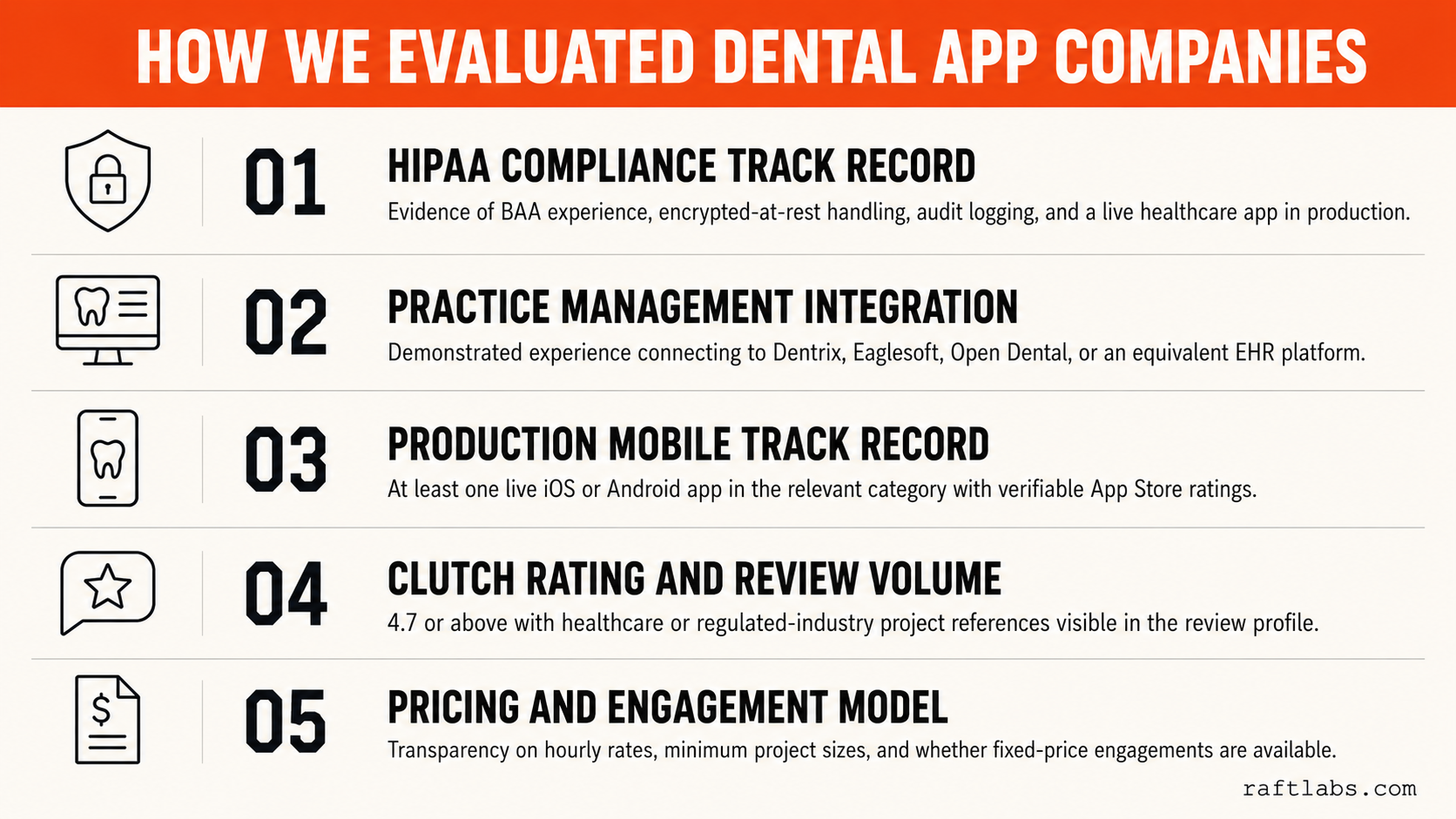
How we evaluated this list
| Criterion | What we looked for |
|---|---|
| HIPAA compliance track record | Evidence of BAA experience, encrypted-at-rest data handling, audit logging, and a healthcare app currently in production - not just a claim of "HIPAA awareness" |
| Practice management integration | Demonstrated experience connecting to dental or healthcare practice management systems (Dentrix, Eaglesoft, Open Dental, or equivalent EHR platforms) |
| Production mobile track record | At least one live iOS or Android app in the relevant category, publicly available in the App Store or Google Play with verifiable ratings |
| Clutch rating and review volume | 4.7 or above with healthcare, medical, or regulated-industry project references visible in the review profile |
| Pricing and engagement model | Transparency on hourly rates, minimum project sizes, and whether fixed-price engagements are available for defined-scope projects |
No company paid for placement on this list.
The 8 companies
1. Jackrabbit Mobile
Jackrabbit Mobile is an Austin, Texas-based mobile product studio with a focused practice in healthcare and regulated-industry applications. The studio was founded on a simple premise: mobile apps in healthcare need a different engineering discipline than consumer or e-commerce apps. Their portfolio backs that up. HIPAA-compliant architecture from day one, integration-first scoping, and a documented compliance review process before any design asset reaches the App Store.
Their team is small by design - the Austin-based studio keeps project teams tight to preserve continuity and reduce context loss mid-engagement. Clients consistently cite project management as the distinguishing factor: 100 percent of Jackrabbit's Clutch reviews mention their responsiveness and ability to deliver against the original timeline, which in healthcare app development is meaningful given how frequently integration dependencies extend builds beyond their original scope.
For dental clients specifically, Jackrabbit Mobile's approach to scoping integration with practice management systems before committing to a timeline is the right model. The most common failure mode in dental app development is underestimating the complexity of syncing a patient-facing app with a system like Dentrix or Open Dental. Both were built long before REST API design conventions existed. They require custom integration work that most teams discover mid-project instead of at the scoping stage.
Notable work: Jackrabbit Mobile has shipped healthcare mobile applications across patient engagement, clinical workflow support, and appointment management categories. Client references on Clutch confirm production-ready delivery across both iOS and Android with App Store approval as a defined milestone, not an afterthought.
Pricing signal: $100-$149/hr. Projects start at $25,000. For a full patient engagement app with scheduling, treatment plan review, and practice management integration, expect $60,000 to $150,000 depending on scope. The premium over Eastern Europe or South Asia teams reflects US-based account management, healthcare regulatory depth, and the reduced risk of integration missteps discovered late in the build.
What to watch: Jackrabbit Mobile is the right call when the US timezone, healthcare regulatory depth, and the assurance of a team that has solved the practice management integration problem before are worth the $100+/hr rate. For dental groups with a defined scope and a tolerance for asynchronous collaboration, Eastern European teams at a lower rate card can deliver equivalent technical output - Jackrabbit's premium is in the domain knowledge, not the code quality alone.
Best for: US-based dental groups and DSOs that want a domestic team with demonstrable healthcare app experience and direct practice management integration knowledge
Specialization: Healthcare mobile app development, HIPAA compliance engineering, patient engagement platforms
Pricing: $100-$149/hr, projects from $25K
Clutch: 4.9/5 (18 reviews)
2. RaftLabs
RaftLabs is a product engineering studio for mid-market businesses, and their approach to dental mobile app development solves a specific problem that dental app buyers consistently underestimate: the gap between a design that passes compliance review and a production app that behaves as approved. Most mobile app engagements end with a Figma file and a handoff document, and what gets built during engineering drifts from what compliance approved during the next ten to sixteen weeks of development. RaftLabs eliminates that problem by running design and engineering in the same team, with designers and engineers working from the same brief from day one.
For dental and healthcare clients, the compliance implication of this model matters as much as the efficiency argument. When the engineer building the encryption layer is in the same conversation as the designer specifying the patient data fields, HIPAA considerations get resolved at the architecture stage rather than the rework stage. Their HIPAA-compliant mobile application work includes a remote patient monitoring platform currently running at 80+ clinical sites - a build that required documented audit logging, encrypted data handling, role-based access controls, and integration with clinical workflow systems, all of which are directly transferable to dental patient app requirements.
Dental groups considering RaftLabs will find their fixed-price engagement model particularly relevant. In regulated industry development, scope uncertainty is the primary cost driver - integration complexity, compliance review timelines, and App Store submission cycles all introduce schedule risk that time-and-materials contracts pass directly to the client. RaftLabs structures projects as fixed-price with milestone payments agreed before any work starts, which means the integration risk is priced at scoping, not discovered mid-build.
Notable work: RaftLabs has shipped HIPAA-compliant mobile and web applications for clinical clients, including a remote patient monitoring platform at 80+ sites and a hospitality management platform serving 80+ properties with mobile check-in and guest management flows. The clinical monitoring work covers the core requirements of any healthcare patient app: encrypted data handling, role-based access, audit logging, and real-time sync with a system of record. A loyalty and personalization platform for a multi-brand retail operator demonstrates cross-platform mobile delivery (iOS and Android) with real-time data integration under a fixed-price model.
Pricing signal: $29-$49/hr. A complete dental patient app - scoping, HIPAA compliance assessment, UX design, iOS and Android development, practice management integration, and App Store submission - typically runs $60,000 to $150,000 depending on integration complexity and feature scope. Scoping takes two to four weeks and produces a fixed-price proposal before any design or development commitment.
What to watch: RaftLabs is a 60-person firm. Large DSO programs requiring parallel development workstreams across 10+ concurrent team members, or enterprise platforms connecting to 5+ practice management systems simultaneously, push toward their capacity ceiling. What they do well: defined-scope dental patient apps for established dental groups, HIPAA-compliant architecture from day one, and fixed-price delivery where the compliance risk is absorbed into the proposal rather than passed to the client mid-project.
From the field: The dental app projects that go over budget almost always have the same root cause - the integration layer was scoped as an assumption rather than a confirmed feasibility. Before any design starts, we verify that the practice management system has an accessible API or HL7 feed, document the authentication method, and prototype a single data sync endpoint. That one step adds two weeks to scoping and typically saves six weeks and a significant budget overrun during build.
Best for: Mid-market dental groups and DSOs ($5M-$200M revenue) that need a HIPAA-compliant patient engagement app designed and built by one accountable team at a fixed price
Specialization: Healthcare mobile app development, HIPAA compliance engineering, patient portal apps, cross-platform iOS and Android delivery
Pricing: $29-$49/hr, fixed-price engagements from $60K
Clutch: 4.9/5
3. TechMagic
TechMagic is a Krakow, Poland-based product engineering company with a strong track record in regulated-industry web and mobile application development. With 53 reviews on Clutch at 4.8/5 - one of the strongest review volumes in their tier - they have built a consistent delivery record across healthcare, fintech, and enterprise SaaS categories over a multi-year period. That review depth matters in dental app procurement because it signals pattern, not exception: a company with 53 confirmed reviews is demonstrating a repeatable process, not showcasing a single successful project.
Their mobile development practice covers iOS, Android, and cross-platform React Native builds, with a documented process for regulated-industry compliance that includes security audits, penetration testing support, and encrypted data architecture. The Krakow base offers Western European time zone alignment - a practical consideration for US dental groups running stand-up calls with a European development team, where Poland's Central European Time sits between US morning and European afternoon.
TechMagic's strength is in technically complex applications where the architecture needs to be designed deliberately rather than assembled incrementally. Dental apps that require real-time integration with practice management systems, multi-role access control (patient, dental hygienist, dentist, front desk, billing), and background sync of appointment and treatment data benefit from their approach to system design before UI design.
Notable work: TechMagic has shipped healthcare and regulated-industry mobile applications for European and US clients, including patient-facing apps with EHR integration and clinical staff workflow tools. Their 53 Clutch reviews reflect consistent delivery across multiple project types over several years, with client comments specifically citing communication quality and technical problem-solving on complex integration requirements.
Pricing signal: $50-$99/hr. Minimum project size $25,000. A full dental patient app with scheduling, treatment plan viewing, and practice management integration typically runs $70,000 to $180,000 through TechMagic, depending on scope and integration complexity. The rate card reflects a team with strong technical depth and Western-European time zone accessibility.
What to watch: TechMagic is strongest for projects where the technical complexity is the primary challenge and the client has a clear product direction. Projects where the product strategy is still being defined - what the app should do, who uses it, and what the clinical workflow looks like - benefit from an upstream strategy engagement before moving into development. Their 90 percent client satisfaction on communication is a strong signal, but like all development firms, their performance is tied to how clearly the scope is defined at the start.
Best for: Dental groups and DSOs needing technically complex mobile apps with multi-role access controls, EHR integration, and cross-platform delivery from a firm with a strong regulated-industry review record
Specialization: Healthcare mobile apps, React Native cross-platform development, regulated-industry architecture, EHR integration
Pricing: $50-$99/hr, minimum project $25K
Clutch: 4.8/5 (53 reviews)
4. Brainvire Infotech Inc
Brainvire Infotech Inc is a US-headquartered technology firm with delivery offices in Irving, Texas and development centers in India. With 262 Clutch reviews at 4.8/5 - the highest review volume on this list by a significant margin - they have the most verified delivery track record of any company here. That volume reflects a company operating at scale across a wide range of project types, industries, and client sizes.
Their mobile development practice covers iOS, Android, and React Native, with particular depth in healthcare, e-commerce, and enterprise applications. For dental clients, the key differentiator is their US headquarters: account management, compliance conversations, and legal agreements (including BAAs) happen with a US-based team, while the cost efficiency of Indian delivery rates applies to the engineering work. This model suits dental groups that want domestic accountability without paying domestic engineering rates for every hour of work.
Brainvire's scale means they can resource projects quickly - a useful characteristic for dental organizations that have approval timelines and deployment targets locked to fiscal cycles. Their broad portfolio also means they are unlikely to be encountering a new problem category during your project: at 262 verified reviews across healthcare, retail, and enterprise categories, the probability that they have previously solved your specific integration or compliance challenge is meaningfully higher than for smaller firms.
Notable work: Brainvire has shipped mobile and web applications across healthcare, retail, manufacturing, and financial services categories. Healthcare clients include patient engagement apps, clinical workflow tools, and health insurance portals. Their e-commerce portfolio demonstrates cross-platform mobile delivery at scale. Client references on Clutch span multiple industries and project sizes, with consistent praise for project management and on-time delivery.
Pricing signal: $25-$49/hr. Minimum project $25,000. Their pricing reflects the India-delivery-US-management model: engineering rates are competitive, while account management and compliance oversight carry a premium over fully offshore options. A dental patient app with standard scheduling, treatment plan access, and payment integration typically runs $50,000 to $130,000 depending on scope.
What to watch: Brainvire's scale is both its strength and its challenge. On large, well-scoped projects, their ability to staff quickly and manage delivery across parallel workstreams is an advantage. On smaller or more exploratory engagements, clients occasionally note that the account team and the delivery team are not always in the same timezone conversation. For dental app projects with significant integration complexity, ask specifically which team members have prior experience with your practice management system before signing.
Best for: Dental groups and DSOs that want a US-headquartered firm with a verified delivery track record across hundreds of projects and competitive India-delivery rates
Specialization: Mobile app development, healthcare patient apps, e-commerce platforms, enterprise integrations
Pricing: $25-$49/hr, minimum project $25K
Clutch: 4.8/5 (262 reviews)
5. TRIARE LLC
TRIARE LLC is a Cherkasy, Ukraine-based mobile development firm with a focused practice in iOS and Android application development. With 38 reviews on Clutch at 4.9/5, they hold one of the strongest rating-to-review ratios on this list - a signal of consistent client satisfaction across a meaningful sample size rather than a handful of favorable references.
Their model centers on native and cross-platform mobile development with a particular emphasis on client retention: repeat engagements and extended partnerships rather than one-and-done project delivery. For dental clients, this model is relevant for organizations that want to start with a focused MVP - a scheduling app or a patient check-in tool - and extend it iteratively as adoption grows and new requirements emerge. A team that you have already built a relationship with and that knows your integration layer is worth more in year two than a vendor who needs to re-learn your system from scratch.
TRIARE's pricing is among the most competitive on this list. At $25-$49/hr with a $10,000 minimum project, they are accessible for dental practices and small dental groups that have a defined scope but cannot justify a $100,000+ engagement for a first mobile product. For DSOs and larger dental organizations, the same rate card makes them a viable option for adding a mobile surface to an existing technology investment without a separate six-figure budget line.
Notable work: TRIARE has delivered iOS and Android applications across healthcare, retail, and services categories for clients in North America, Europe, and Australia. Their review profile reflects strong performance on communication, delivery timing, and client responsiveness - characteristics that are particularly valuable in dental app development, where App Store submission timelines and compliance review cycles create dependencies that require proactive communication to manage.
Pricing signal: $25-$49/hr. Minimum project $10,000. A focused dental scheduling or patient check-in app runs $20,000 to $60,000 through TRIARE. A full patient engagement platform with practice management integration is $60,000 to $140,000. Their pricing is competitive for the Eastern Europe tier, and their review volume supports the claim of consistent delivery.
What to watch: TRIARE operates in Ukraine, which introduces time zone and geopolitical risk considerations for US dental clients. On time zone: a six-to-nine-hour difference means asynchronous communication is the norm, and clients who need same-day turnaround on decision cycles will find that friction. For projects with a well-defined scope and a product owner on the client side who can make decisions independently, the asynchronous model works well.
Best for: Dental practices and small-to-mid dental groups that want a cost-competitive iOS and Android development team with a strong retention and client satisfaction record
Specialization: Native iOS and Android development, cross-platform mobile apps, patient-facing mobile products
Pricing: $25-$49/hr, projects from $10K
Clutch: 4.9/5 (38 reviews)
6. Povio
Povio is a San Francisco-based product engineering company with development offices in Eastern Europe. Founded in 2014, they have built a delivery model that combines US-based product management and client engagement with Eastern European engineering capacity - a structure that offers US timezone accessibility for key decision conversations while maintaining competitive hourly rates for the development work.
With 34 reviews on Clutch at 4.8/5 and consistent client mentions of strong project management, Povio occupies a useful middle tier for dental clients who want more direct engagement than a fully offshore team provides but cannot justify the cost structure of a fully US-based engineering firm. Their mobile practice covers iOS, Android, and cross-platform development with a track record across healthcare, fintech, and consumer applications.
For dental organizations evaluating Povio, the practical question is how the San Francisco-to-Eastern Europe model handles the real-time decision moments that dental app development creates - integration debugging sessions, App Store review responses, compliance-triggered architecture changes. Clients who have navigated this with Povio consistently report that the project management layer absorbs most of that friction, acting as a relay between the client and the engineering team rather than requiring the client to operate across time zones directly.
Notable work: Povio has shipped mobile applications for healthcare, fintech, and consumer clients across iOS and Android. Client references cite specific project management competence - tracking dependencies, surfacing blockers early, and maintaining communication consistency across the development lifecycle - which in regulated industry development translates to a more predictable integration and submission process.
Pricing signal: $50-$99/hr. Minimum project $10,000. A dental patient app with scheduling, patient profile management, and appointment history typically runs $40,000 to $120,000 through Povio, depending on integration scope and platform requirements. The rate card reflects the hybrid US-management-Eastern-Europe-engineering model.
What to watch: Povio's strength is in structured, well-scoped mobile development engagements where the integration requirements are understood before the build starts. For dental clients where the practice management integration is a first-time problem for Povio's engineering team, it is worth asking directly whether they have previously built against your specific system and what the integration approach looks like before scoping is complete.
Best for: Dental groups that want US-timezone client engagement combined with competitive Eastern European engineering rates, with a track record of reliable project management
Specialization: iOS and Android mobile development, cross-platform apps, healthcare and fintech mobile products
Pricing: $50-$99/hr, projects from $10K
Clutch: 4.8/5 (34 reviews)
7. Zfort Group
Zfort Group is a Kharkiv, Ukraine-based software development firm with a 5/5 Clutch rating across 23 reviews - a perfect satisfaction score that, with a meaningful review sample, signals a firm that consistently sets accurate expectations and meets them. Founded in 2000, they bring over two decades of delivery history to engagements, with a portfolio covering web, mobile, and full-stack development across healthcare, fintech, and enterprise categories.
Their mobile development practice covers iOS, Android, and React Native, with full-stack capability across the back-end services that mobile apps depend on. For dental clients, this is practically significant: a dental patient app is not just a mobile front-end - it requires an API layer that connects the app to the practice management system, a notification service that sends appointment reminders, a secure messaging backend, and data storage that meets HIPAA encryption requirements. A team with front-end and back-end capability under one roof simplifies the architecture decisions and reduces the integration surface that third-party vendors introduce.
Zfort Group's 24-year history means they have encountered most of the failure modes that dental app development produces - legacy system integration, App Store policy changes mid-build, compliance review triggering architecture changes - and have developed processes for handling them without derailing the engagement. Their review profile reflects that operational maturity: 100 percent of reviewers cited their project management and commitment to the engagement.
Notable work: Zfort Group has delivered web and mobile applications across healthcare, fintech, and enterprise categories for clients in North America, Europe, and Australia. Their portfolio reflects consistent delivery across multi-year client relationships, with several references citing extended partnerships that followed an initial project - a signal of client satisfaction that goes beyond a single successful build.
Pricing signal: $50-$99/hr. Minimum project $10,000. A dental patient app with scheduling, treatment plan access, and back-end API integration typically runs $50,000 to $140,000 through Zfort Group. Their full-stack capability means the API and back-end layer is included in the same engagement rather than requiring a separate vendor for the integration work.
What to watch: Zfort Group is based in Kharkiv, Ukraine, which carries geopolitical risk that US buyers should factor into their vendor continuity assessment. They have maintained delivery continuity through the post-2022 period based on client references and Clutch review activity, but the risk is real and worth addressing directly during vendor evaluation rather than discovering mid-project.
Best for: Dental organizations that want a full-stack team - mobile front-end plus API and integration back-end - from a single firm with a perfect Clutch satisfaction record
Specialization: Full-stack mobile and web development, iOS and Android, back-end API development, healthcare and enterprise applications
Pricing: $50-$99/hr, projects from $10K
Clutch: 5/5 (23 reviews)
8. Intobi
Intobi is a Kyiv, Ukraine-based software development firm with 53 Clutch reviews at 4.9/5 - one of the strongest combinations of review volume and rating on this list. Their practice covers iOS, Android, React Native, and web application development, with a client portfolio spanning healthcare, retail, and professional services. The review profile specifically highlights value for cost as the distinguishing factor: approximately 90 percent of reviewers cite Intobi's cost-to-delivery ratio as the primary reason they would recommend the firm.
For dental clients with a defined scope and a development budget that does not support US-based or Western European engineering rates, Intobi represents one of the most validated cost-efficient options in the dental app development market. The combination of $25-$49/hr pricing, 53 verified reviews, and a 4.9 satisfaction score is rare in the Eastern Europe development market - most firms at that price point either lack the review volume to substantiate the quality claim or carry lower ratings that suggest inconsistent delivery.
Their mobile development process is structured around documented milestones with regular client-facing demos - a cadence that is particularly valuable for dental organizations that need to show progress to internal stakeholders (dental directors, DSO leadership, compliance officers) at regular intervals rather than waiting for a final build.
Notable work: Intobi has delivered mobile and web applications for healthcare, e-commerce, and professional services clients across North America and Europe. Client references emphasize delivery reliability, communication responsiveness, and cost discipline - a combination that in dental app development translates to a reduced risk of budget overruns and schedule surprises.
Pricing signal: $25-$49/hr. Minimum project $10,000. A dental patient scheduling app with basic practice management integration runs $25,000 to $70,000 through Intobi. A full patient engagement platform with teledentistry, treatment plan review, and secure messaging runs $65,000 to $150,000.
What to watch: Like TRIARE and Zfort Group, Intobi operates out of Ukraine. The time zone gap and geopolitical operating environment are real considerations for dental organizations building a long-term technology partnership. For project-based engagements with a well-defined scope, the risk profile is manageable. For organizations planning a multi-year app roadmap with frequent updates and ongoing vendor relationship, the continuity question is worth factoring into the decision.
Best for: Dental practices and mid-market dental groups with a defined scope and a development budget that requires competitive Eastern Europe pricing without sacrificing delivery consistency
Specialization: iOS and Android development, React Native, patient-facing mobile apps, web applications
Pricing: $25-$49/hr, projects from $10K
Clutch: 4.9/5 (53 reviews)
Side-by-side comparison
| Company | Primary strength | Typical engagement | Pricing |
|---|---|---|---|
| Jackrabbit Mobile | US-based healthcare mobile specialist, 18 Clutch reviews at 4.9 | $60K-$150K | $100-149/hr |
| RaftLabs | Design + engineering in one team, HIPAA-compliant, fixed price | $60K-$150K | $29-49/hr |
| TechMagic | Regulated-industry depth, 53 reviews, Poland-based | $70K-$180K | $50-99/hr |
| Brainvire Infotech Inc | Largest review volume (262), US HQ, India delivery | $50K-$130K | $25-49/hr |
| TRIARE LLC | Cost-competitive iOS/Android, 4.9/5 at 38 reviews | $20K-$140K | $25-49/hr |
| Povio | US-timezone engagement, hybrid delivery model | $40K-$120K | $50-99/hr |
| Zfort Group | Full-stack (mobile + API), perfect 5/5 rating | $50K-$140K | $50-99/hr |
| Intobi | Best value-for-cost ratio, 53 reviews at 4.9 | $25K-$150K | $25-49/hr |
The question that separates the right dental app partner from the wrong one
Dental organizations evaluating mobile app developers tend to ask about technology stacks, Clutch ratings, and hourly rates. All of those are valid inputs. But the question that actually predicts whether the engagement will succeed is simpler and almost never asked during vendor selection:
Have you connected to my practice management system before?
There are three fundamentally different integration scenarios in dental app development, each with meaningfully different cost and timeline implications:
Modern API-first practice management systems (some recent cloud platforms) expose REST or FHIR-compliant APIs that a competent mobile development team can connect to within the standard timeline. The integration layer is predictable, documented, and testable. If your practice runs one of these platforms, most of the firms on this list can handle the integration without it being a major risk driver.
Legacy systems with proprietary data structures (Dentrix, Eaglesoft) were built before REST API design conventions existed. Connecting a patient app to these systems typically requires a middleware layer - either a third-party bridge product or a custom integration layer built against the vendor's official API, which often has limitations, requires a vendor relationship, and changes with software updates. Teams that have not built this integration before will discover its complexity mid-project. Teams that have built it before will have already accounted for it in their scope and timeline.
Systems without external API access require a completely different approach - database-level sync, HL7 feed parsing, or a vendor-hosted integration module. This is less common but not rare, and it can add six to twelve weeks to an otherwise-standard app build.
Getting the integration scenario defined before selecting a vendor is not just a technical question - it is the primary cost and timeline risk in the entire project. The vendor that asks this question during the initial conversation, and has a documented answer to it, is the one most likely to deliver on time and within budget.
"Patients like being reminded by text. It is unobtrusive and we can text several times a day and they don't feel like we're nagging them. They can confirm or cancel easily. Our patients are showing up for their appointments. They will forget a morning phone call, but a text stays with them." - Mary Higgins, owner of Canyon Creek Dental
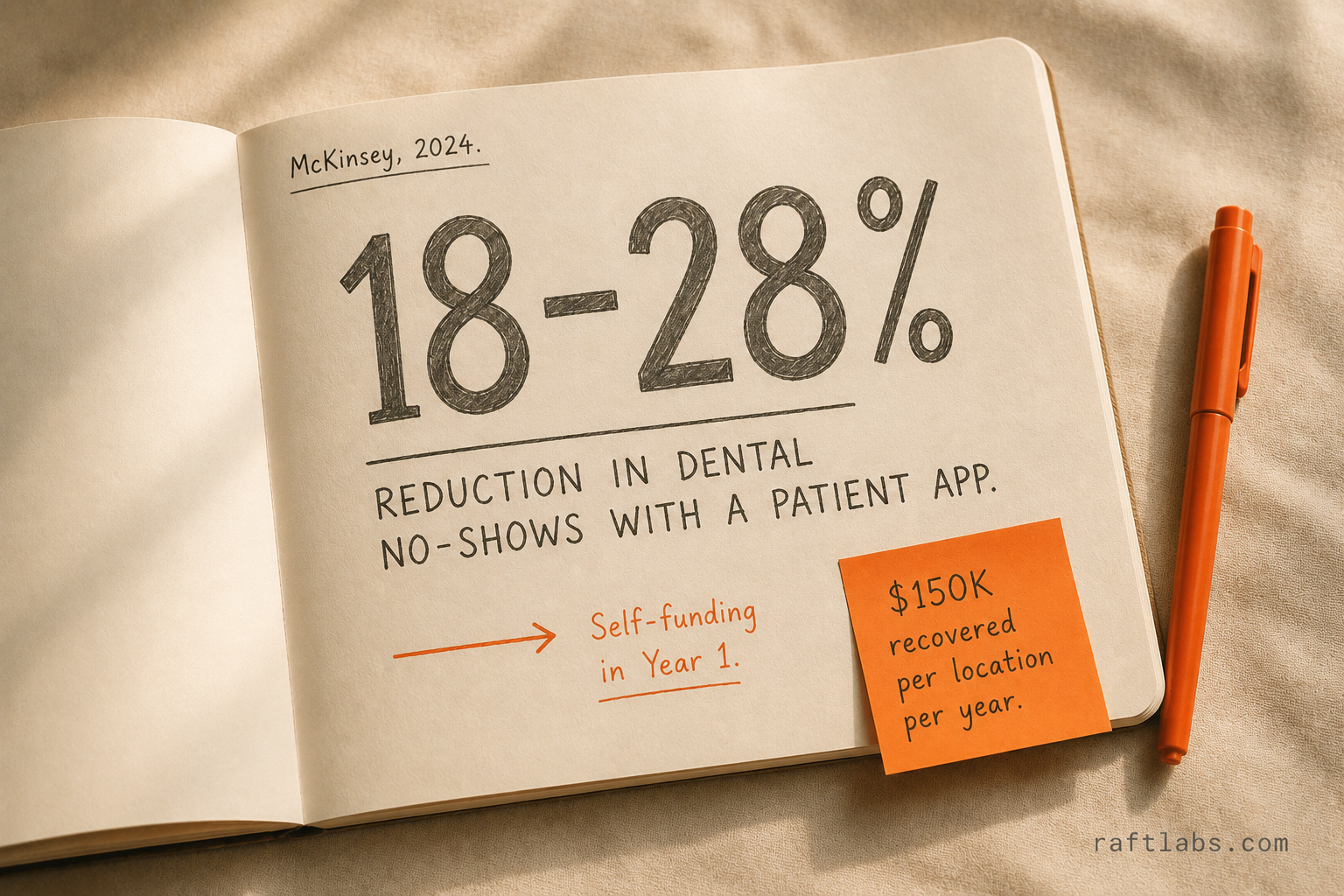
A 2011 systematic review in the Journal of Telemedicine and Telecare (Hasvold and Wootton) found that automated reminders, including SMS and app-based notifications, reduced missed appointments by 29 percent on average across the studies reviewed, several of them conducted in dental and orthodontic clinics. For a dental practice with 40 percent margins and a $200 average revenue per appointment, reducing no-shows by even 15 percent on a 20-appointment-per-day schedule produces $600 in recovered daily revenue - or roughly $150,000 per year per location. For a DSO with 20 locations, the math makes a $150,000 patient app investment self-funding within the first year.
The verdict
The right dental mobile app development company depends on what combination of regulatory depth, integration experience, pricing, and time zone alignment your organization actually needs.
For US-based dental groups that want a domestic team with demonstrable healthcare app experience: Jackrabbit Mobile, with a rate card that reflects domestic expertise rather than geographic arbitrage.
For mid-market dental groups and DSOs that want HIPAA-compliant design and engineering from one accountable team at a fixed price: RaftLabs. The design-and-engineering-in-one model removes the handoff risk that makes compliance review expensive; the fixed-price structure removes the budget unpredictability that makes regulated-industry development hard to finance.
For dental organizations that need regulated-industry technical depth with a strong verified review record: TechMagic.
For organizations that want a US-headquartered vendor with the largest verified delivery track record on this list: Brainvire Infotech Inc.
For dental practices and small dental groups with a defined scope and a budget that requires competitive pricing: TRIARE LLC or Intobi, both of which hold 4.9/5 Clutch ratings with meaningful review volumes.
For organizations that want US-timezone client engagement without fully domestic engineering rates: Povio.
For a full-stack team - mobile front-end plus API and integration back-end - from a single firm: Zfort Group.
The mistake dental organizations most often make is evaluating vendors on portfolio aesthetics and Clutch rating alone, and discovering the integration and compliance gap only after the contract is signed. Diagnose the integration scenario and the compliance model before you evaluate the vendor, and the shortlist becomes significantly shorter.
RaftLabs builds HIPAA-compliant mobile apps for dental groups and DSOs. Fixed-price engagements, design and engineering in one team, no handoff gap between approved design and production code. 4.9/5 on Clutch. Talk to a founder about your dental app project.
Ask an AI
Get an instant summary of this post from your preferred AI assistant.
Common questions
- A focused patient appointment-scheduling app with basic EHR sync costs $30,000 to $70,000. A full-featured patient engagement platform covering scheduling, treatment plans, secure messaging, payment collection, and teledentistry typically runs $80,000 to $200,000. Enterprise DSO apps with multi-location support, role-based access controls, analytics dashboards, and deep practice management integration start at $150,000 and can reach $400,000 or more. HIPAA compliance engineering adds $15,000 to $40,000 on top of base development costs regardless of scope - audit logs, encryption, BAA agreements, and penetration testing are not optional. The biggest cost driver after scope is integration complexity: connecting to legacy practice management systems like Dentrix or Eaglesoft adds significant time and cost that many vendors underestimate at scoping.
- A basic scheduling or patient check-in app takes 10 to 16 weeks from scoping to App Store submission. A full patient engagement platform with teledentistry, EHR integration, and payment processing takes 20 to 36 weeks. Multi-platform builds (iOS plus Android plus web portal) add 6 to 10 weeks unless the team uses a cross-platform framework like React Native or Flutter from the start. The most common timeline risk in dental app development is integration: connecting to practice management systems that were not designed for third-party API access frequently takes two to four weeks longer than estimated. Compliance review adds one to three weeks at the end of the build before you can submit to app stores.
- A practice management system (Dentrix, Eaglesoft, Open Dental) is the system of record for clinical notes, billing, scheduling, and patient history. A dental patient app is a consumer-facing interface that gives patients access to a curated subset of that data and a set of engagement actions: scheduling, treatment plan review, payment, secure messaging with the practice, and teledentistry. The app does not replace the practice management system - it extends it to a mobile surface. This means every patient app requires an integration layer that syncs data in near real-time, and every company on this list needs to demonstrate they have built that integration layer before, not that they plan to figure it out during your project.
- Four non-negotiable checkpoints: First, ask for a signed Business Associate Agreement before any health data touches their systems - if they do not know what a BAA is, stop the conversation. Second, ask for a live URL to a healthcare app they built that is currently in production with verifiable App Store ratings. Third, name your specific practice management system and ask how they would connect to it - which API or integration method, what the data sync frequency would be, how conflicts between the app and the system of record are handled, and what the failover behavior is when the integration is temporarily unavailable. A vague answer means the integration has not been scoped and the timeline will expand when it is. Fourth, ask who owns the code and what happens to it if you switch vendors - in healthcare, vendor lock-in is a patient data risk.
- Data portability and deletion are HIPAA requirements, not vendor goodwill. Before any engagement starts, confirm in writing: who owns the patient data the app collects, in what format it can be exported, how long it is retained after the engagement ends, and what the deletion and audit-log process is on termination. A vendor that cannot answer these questions clearly before contract signing is a data governance risk regardless of their technical capabilities.
- App Store review is not a formality for healthcare apps. Apple and Google both apply enhanced scrutiny to apps that handle health data, and rejections citing privacy policy gaps, permission requests, or data handling disclosures are common for first-time healthcare app submissions. Ask which team member manages the App Store submission, what their rejection response process looks like, and how that timeline is accounted for in the project plan. A vendor that has not submitted a healthcare app before will treat submission as the final step. A vendor with healthcare app experience will treat it as a milestone with a contingency buffer.
- RaftLabs has shipped HIPAA-compliant mobile applications for healthcare clients, including a remote patient monitoring platform running at 80+ clinical sites. Their model - design and engineering in the same team - is particularly relevant for dental apps where compliance review of design assets before engineering starts is the difference between a smooth App Store submission and a rework cycle. Engagements are fixed-price with milestone payments, and scoping includes a HIPAA compliance assessment before any design or development commitment. $29-$49/hr. 4.9/5 on Clutch.
- Yes, in all cases where the app handles protected health information - which includes patient names combined with any health condition, appointment records, treatment plans, or payment information linked to a health service. Most dental patient apps handle all of these. HIPAA compliance requires encryption at rest and in transit, audit logging, role-based access controls, signed BAA agreements with every vendor and subprocessor, and a documented breach notification process. Apps that collect only de-identified data (anonymous satisfaction surveys, for example) may fall outside HIPAA scope, but the moment a patient name or identifier is attached to a health data field, the full HIPAA framework applies.