Loyalty Program Development Cost: 2026 Complete Guide
Custom loyalty platforms cost $10,000-$200,000+ depending on features, integrations, and platforms. First-year total ownership runs $30,000-$80,000 for a mid-range program. Here's the full cost breakdown from 20+ loyalty builds.

In this article
Short answer
Custom loyalty platforms cost $10,000-$200,000+ depending on features, integrations, and platforms. A basic web-only MVP runs $10,000-$20,000. A mid-range mobile app with POS integration runs $20,000-$60,000. Enterprise builds with AI personalization and coalition support start at $60,000. First-year total ownership, including hosting, marketing, integrations, and support, typically runs $30,000-$80,000 for a mid-range program. The top-performing programs generate 5.2x more revenue than their total cost. RaftLabs has shipped 20+ loyalty platforms in 8-12 weeks.
Key takeaways
- Custom loyalty platforms typically cost between $10,000 and $200,000+, depending on features, integrations, and whether you're building for web, mobile, or both.
- The loyalty program cost is not just the build. First-year total ownership, including integrations, hosting, marketing, and support, typically runs $30,000-$80,000 for a mid-range program.
- 83% of companies that measure ROI on loyalty programs report positive returns. Top performers see 5.2x more revenue than cost.
- The biggest cost drivers are the complexity of rewards logic, the number of integrations, mobile app requirements, and the ongoing support.
- At RaftLabs, we've built 20+ loyalty products across B2B and B2C. Delivered in under 12 weeks on average. GDPR-compliant for EU markets. Rated 4.9/5 on Clutch.
Here's the real reason brands like Harley-Davidson and McDonald's invest heavily in loyalty programs: the unit economics make sense.
Harley's HOG program, launched in 1983, turned customers into a community. HOG members spend 30% more than other Harley owners. During the company's hardest financial period, that loyalty carried weight.
McDonald's MyMcDonald's Rewards drove over $20 billion in sales last year from loyalty members alone. At scale, a well-built loyalty platform becomes a revenue engine, not just a retention tool.
So the question isn't "should we build one?" It's "how much does it actually cost, and when does it pay back?"
That's what this guide answers. We break down the full loyalty program cost for 2026; build, integration, operations, and rewards so you can plan a real budget, not a guess.
We've built 20+ loyalty platforms in the last 5 years. Here's exactly what we've seen.
Cost is one part of the decision. For the full picture, see our customer loyalty programs guide.
What Are Loyalty Programs?
Loyalty programs are strategies designed to reward customers for their repeat business. These programs can range from points-based systems to exclusive perks, designed to keep customers coming back. They help businesses strengthen relationships with their audience while increasing revenue.
How Much Does a Loyalty Program Cost?
With 5+ years of experience in custom loyalty app development services, three factors drive your actual cost: the complexity of your rewards logic (points-only vs. tiered + gamified), the number of systems you need to integrate (POS, CRM, eCommerce), and whether you need web, mobile, or both.
| Feature Tier | What's Included | Estimated Cost Range |
|---|---|---|
| Basic MVP | Points engine, member dashboard, admin panel, web app | $10,000 - $20,000 |
| Mid-Range Platform | Custom rewards logic, POS/CRM integration, iOS + Android app, analytics dashboard | $20,000 - $60,000 |
| Full-Featured Enterprise | AI personalization, tiered loyalty, coalition/partner support, multi-platform, GDPR compliance, custom integrations | $60,000 - $200,000+ |
| White-Label Solution | Pre-built platform with your branding applied | $10,000 - $50,000 |
| Off-the-Shelf SaaS | Basic points/rewards, limited customization, hosted by vendor | $50 - $500/month |
The MVPs we build at RaftLabs start at $10,000-$20,000 and go live in 6-8 weeks. Full-featured custom platforms with integrations and AI personalization run $20,000-$40,000+. Enterprise builds with coalition logic, multi-region support, or GDPR compliance requirements typically start at $60,000.
If you want a number specific to your program, three questions drive the estimate:
How many platforms (web, iOS, Android)?
How many integrations?
And do you need AI personalization or rules-based rewards?
"The brands that treat loyalty as a cost center lose. The ones that treat it as a revenue model win. The math is simple: a 5% retention improvement boosts profits 25-95%. That's not a marketing outcome - that's a P&L outcome."
Jess Huang, partner at McKinsey & Company and co-author of McKinsey's 2023 research on customer loyalty economics
Is the Loyalty Program Cost Actually Worth It?
Short answer: yes, if you build it right.
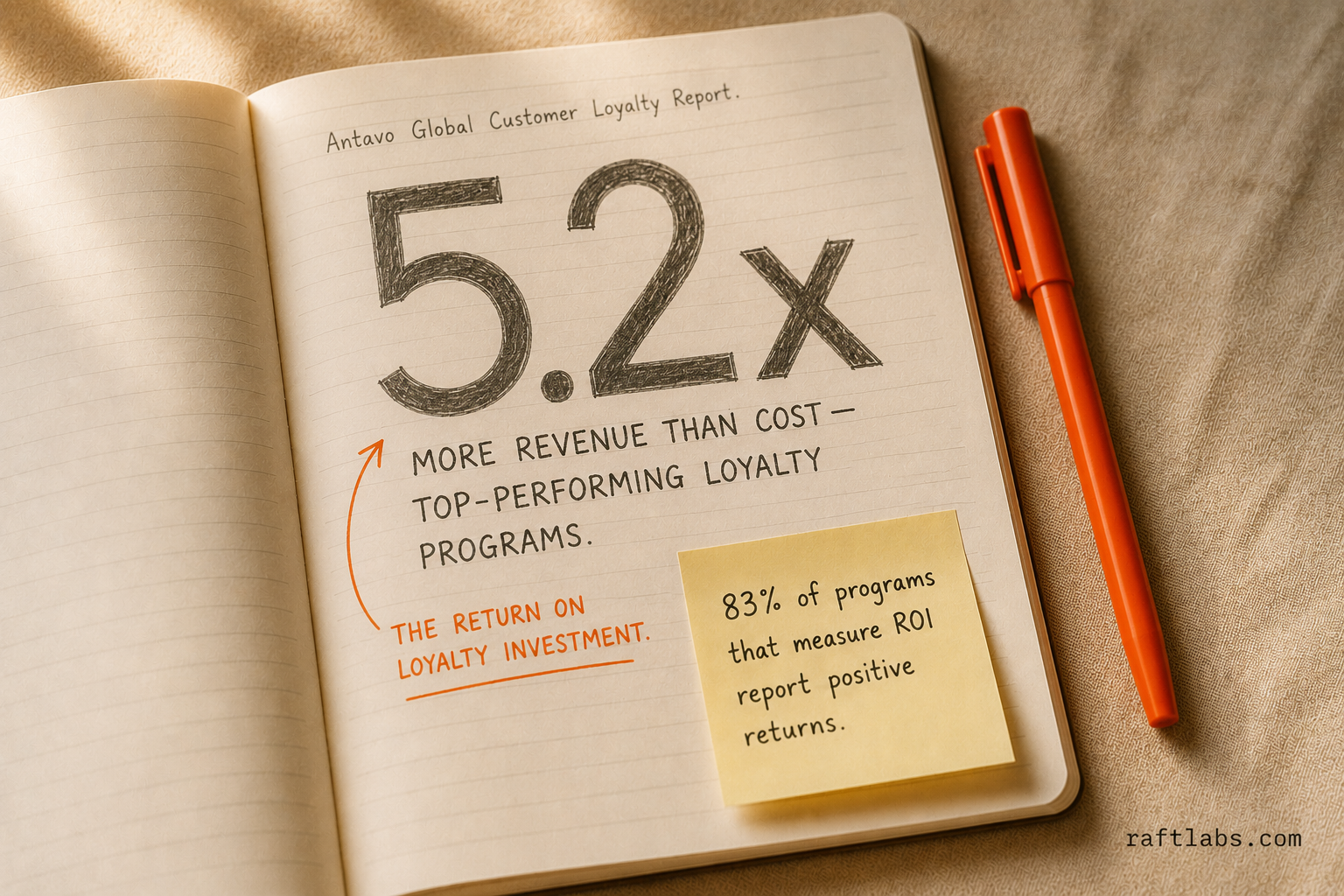
Antavo's 2026 Global Loyalty Report puts it plainly: 83% of companies that measure ROI on their loyalty programs report a positive return, and the top performers generate 5.2x more revenue than cost. Members of loyalty programs produce 12-18% more incremental revenue per year than non-members. A 5% improvement in customer retention can boost profits by 25-95% (Bain & Company).
The programs that fail do so for a predictable reason: they were built as marketing expenses, not retention infrastructure.
Starbucks runs 53% of its US revenue through Rewards members. Sephora's Beauty Insider drives 80% of total company sales.
These are actually retention engines with carefully engineered economics.
What the math looks like for a $35,000 mid-range build:
5,000 active members spending $300/year = $1.5M annual member revenue baseline
A 15% spend lift from loyalty membership = $225,000 incremental revenue
Platform build cost: $35,000. First-year operations: $25,000. Total: $60,000.
Net positive by month 6; and the gap widens each year as the member base grows.
The programs that don't deliver usually have one of three problems: the reward economics aren't modelled before launch, the integration is too shallow to capture real purchase data, or the program wasn't promoted enough to hit critical member mass. All three are build and planning decisions. Not inherent flaws in loyalty as a model.
The actual question isn't "is loyalty worth it?" It's "who builds it right?"
Want to run the numbers for your business? Calculate your loyalty program ROI →
Key Factors Affecting Loyalty Program Development Costs in 2026
Loyalty program cost isn't uniform. Three things drive your actual number more than anything else.
Business size changes the architecture, not just the budget. A program serving 2,000 customers is built differently from one serving 500,000. Starbucks runs millions of daily transactions through their rewards system that requires a fundamentally different infrastructure than a regional retail chain. Build for where you're going, but don't over-engineer for day one.
Target audience determines reward design. Gen Z engages with gamification and streaks. Millennials convert on cashback. Loyalty program reward cost varies accordingly. More complex reward logic means more expensive development and more ongoing management.
Platform choice is where most founders underinvest thinking. Mobile apps cost more to build than web apps because they require additional codebases, app store review cycles, and push notification infrastructure. But mobile accounts for over 90% of the time consumers spend in loyalty apps. The real question is not whether you can afford mobile, but whether you can afford to skip it when your competitors have it.
Understanding these factors helps you build a loyalty program that’s both cost-effective and genuinely valuable to your customers.
How Much Do Companies Typically Spend On Loyalty Programs?
This is a question most guides skip. Here's the answer.
According to Antavo's Global Customer Loyalty Report, companies now dedicate 31.4% of their marketing budgets to loyalty and CRM, a record high. Globally, brands spend over $75 billion per year on loyalty management.
For individual programs, the full annual operating cost (not just the build) breaks down like this:
| Business Size | Annual Program Spend (All-In) | What's Included |
|---|---|---|
| Small business | $8,000-$25,000/year | Platform, basic rewards, light marketing |
| Mid-market brand | $30,000-$100,000/year | Build amortized + operations + rewards + campaigns |
| Enterprise | $500,000-$5M+/year | Platform, full team, rewards liability, campaigns |
These are more than just technology costs. The average loyalty program manager salary alone is $100k, before any platform or reward budget.
Industry spend benchmarks for rewards:
Supermarkets: 1-1.5% of annual revenue
Retail and fashion: 2-3% of annual revenue
Restaurants: 1.5-2%
Financial services: up to 5%
This is why architecture decisions made on day one have a compounding financial effect. A $35,000 custom build done right costs less over five years than a $15,000 off-the-shelf platform that charges per transaction, requires expensive custom work for every integration, and needs a full rebuild at 50,000 members.
Loyalty Program Development Cost by Region
One of the biggest factors affecting your loyalty program development cost is where your development team is located. The same project can cost 3-4 times more in the US compared to India or Eastern Europe, without necessarily compromising on quality.
| Region | Hourly Rate | Basic - Enterprise App | Best For |
|---|---|---|---|
| North America | $80-$150 | $80K-$300K+ | Same timezone, complex compliance |
| Western Europe | $60-$120 | $60K-$250K+ | GDPR expertise, EU market focus |
| Eastern Europe | $40-$80 | $40K-$150K+ | Quality-cost balance, tech expertise |
| India | $25-$50 | $20K-$100K+ | Maximum savings, large talent pool |
| Latin America | $35-$70$ | $35K-$130K | US-friendly timezone, nearshore |
| Southeast Asia | $25-$55 | $25K-$90K | English skills, mobile expertise |
Let's break down how location impacts your budget and what you can expect from each region.
North America (US & Canada): $80,000 - $200,000+
North American developers typically charge premium rates due to higher living costs and market demand. Average developer rate in north america is $80-$150 per hour
Typical costs:
Basic loyalty app: $80K-$120K
Mid-range platform: $120K-$180K
Enterprise solution: $180K-$300K+
Best for: Enterprises needing real-time collaboration, complex compliance (finance, healthcare), or advanced AI/ML expertise.
Western Europe (UK, Germany, France): $60,000 - $180,000
Western European developers offer strong technical skills with rates slightly lower than North America. Average developer rate in western europe is $60-$120 per hour
Typical costs:
Basic app: $60K-$90K
Mid-range platform: $90K-$140K
Enterprise solution: $140K-$250K+
Best for: GDPR-first loyalty programs and businesses targeting European markets.
Eastern Europe (Poland, Ukraine, Romania): $40,000 - $120,000
Eastern Europe is known for its excellent balance of cost and quality, backed by strong technical education. Average developer rate in europe is $40-$80 per hour.
Typical costs:
Basic app: $40K-$60K
Mid-range platform: $60K-$95K
Enterprise solution: $95K-$150K+
Best for: Startups and mid-sized businesses looking for high-quality development at controlled costs.
India: $20,000 - $80,000
India remains one of the most cost-effective options for loyalty program development, with a massive pool of talented developers and established IT outsourcing infrastructure. Average developer rate in India is $25-$50 per hour.
Typical costs:
Basic app: $20K-$35K
Mid-range platform: $35K-$60K
Enterprise solution: $60K-$100K+
Why businesses choose India:
40-60% lower development cost than Western regions
Large, experienced talent pool
Efficient remote collaboration and faster delivery cycles
Best for: Cost-conscious businesses, startups, and companies with clearly defined requirements.
Latin America (Argentina, Brazil, Mexico): $35,000 - $100,000
Latin America is increasingly popular among US businesses due to nearshore advantages. Average developer rate in latin america is $35-$70 per hour.
Typical costs:
Basic app: $35K-$50K
Mid-range platform: $50K-$80K
Enterprise solution: $80K-$130K+
Best for: US-based companies needing time zone overlap and real-time communication.
Southeast Asia (Philippines, Vietnam, Thailand): $25,000 - $70,000
Southeast Asia offers competitive pricing with growing expertise in mobile-first development. Average developer rate is south asia is $25-$55 per hour.
Typical costs:
Basic app: $25K-$40K
Mid-range platform: $40K-$60K
Enterprise solution: $60K-$90K+
Best for: Mobile-focused loyalty apps and APAC-market businesses.
Different Types of Loyalty Programs
Loyalty programs come in different shapes and sizes.
The type you choose depends on your business needs, budget, and goals.
Offline (stamp-based) programs are the simplest structure. A coffee shop stamp card. Minimal technology cost, but no customer data, no personalization, and no way to measure program performance beyond sales. Works for simple, high-frequency businesses with a single location.
Web app loyalty programs are browser-based and work across any device. No app store dependency, no review cycles, no download friction. Development cost typically runs $20,000-$60,000. For businesses with a strong online presence, this is usually the right starting point.
Mobile app loyalty programs use native iOS and Android apps for members who transact primarily on mobile. Push notifications, in-app rewards, and QR code scanning all perform better natively. Cost is higher ($30,000-$80,000+) because you are building and maintaining two codebases. App store fees and update cycles add ongoing cost. Worth it when mobile is your primary customer touchpoint.
Hybrid programs combine a web dashboard with a native mobile app. Most scaling brands land here because admin tools live on web, but members want an app. Budget $30,000-$70,000+. This is what both Aldi and our Instantor client used for responsive web on the operations side, native mobile for the member experience.
Also Read: Top Loyalty Program App Development Companies
Loyalty Program Development Cost Comparison by Industry
Loyalty app development costs vary significantly by industry. A simple retail rewards app is far less complex than a healthcare or banking loyalty platform, mainly due to differences in compliance, integrations, user behavior, and security requirements.
| Industry | Typical Cost Range | Average Spend | Program Complexity | Best Use Case |
|---|---|---|---|---|
| Retail & E-commerce | $25K - $120K | $40K - $80K | Medium | Brands focused on repeat purchases and higher cart value |
| Restaurants & Food Service | $20K - $80K | $30K - $60K | Low-Medium | Fast-moving businesses with frequent customer visits |
| Healthcare & Wellness | $60K - $200K | $80K - $150K | High | Patient engagement and preventive care programs |
| Travel & Hospitality | $50K - $180K | $70K - $130K | High | Hotels, airlines, and travel brands driving loyalty & direct bookings |
| Fitness & Gyms | $30K - $90K | $45K - $70K | Medium | Membership-based retention and habit building |
| Beauty & Salons | $25K - $70K | $35K - $55K | Low-Medium | Appointment-driven customer retention |
| Financial Services | $80K - $250K+ | $120K - $200K | Very High | Banks & fintechs running regulated reward programs |
| Automotive | $40K - $150K | $60K - $100K | Medium-High | Dealerships focusing on long-term customer value |
Here’s a clear industry-wise breakdown to help you estimate realistic budgets.
Retail & E-commerce
Retail loyalty programs are among the most cost-effective because reward mechanics like points, tiers, and coupons are well-established. These programs focus on increasing repeat purchases, basket size, and brand engagement across online and physical channels.
Common features
Points & tier-based rewards
POS & eCommerce integration
Personalized offers
Digital receipts & referrals
Restaurants & Food Service
Restaurant loyalty apps are designed for speed and convenience, as customers often interact with them during ordering or checkout. Most programs reward frequent visits, spend, or specific menu items and aim to reduce customer churn in a highly competitive market.
Common features
QR code check-in
POS-linked rewards
Mobile ordering
Referral & surprise rewards
Healthcare & Wellness
Healthcare loyalty programs, often positioned as patient engagement or wellness platforms, focus on encouraging preventive care, appointment adherence, and healthy behaviors. Unlike retail programs, these systems handle sensitive patient data and must comply with strict regulations.
Common features
HIPAA-compliant data handling
Appointment & wellness rewards
EHR / wearable integrations
Travel & Hospitality
Travel and hospitality loyalty programs are complex due to tier structures, partner networks, and dynamic pricing models. These programs aim to increase direct bookings, repeat stays, and long-term customer lifetime value.
Common features
Points or miles tracking
Tiered memberships
PMS & booking engine integration
Fitness & Gyms
Fitness loyalty programs focus on retention in a high-churn industry by rewarding attendance, class participation, referrals, and personal milestones. Engagement mechanics like challenges and leaderboards directly motivate members to stay consistent.
Common features
Class & visit rewards
Referral programs
Challenges & gamification
Beauty & Salons
Beauty and salon loyalty programs are appointment-centric and relationship-driven. These apps reward service visits, product purchases, and long-term client loyalty while helping salons increase rebooking rates.
Common features
Booking & service-based rewards
Product purchase points
Stylist preferences
Financial Services
Financial services loyalty programs are the most expensive due to regulatory compliance, security, and legacy system integrations. These platforms reward account activity, transactions, and long-term financial relationships.
Common features
Transaction-based rewards
Cashback & account tiers
Credit card & loan incentives
Automotive
Automotive loyalty programs are designed to retain customers between long vehicle purchase cycles by rewarding service visits, referrals, and repeat maintenance. The real ROI often comes from improving service department retention rather than vehicle sales.
Common features
Service visit rewards
Referral bonuses
Multi-vehicle household tracking
There is no one-size-fits-all cost for loyalty app development. Industries with heavy compliance and deep integrations require higher budgets, while retail and food businesses benefit from proven, scalable loyalty models.
How To Calculate Your Loyalty Program Cost
This is the question most articles don't actually answer. Here's a real loyalty program cost calculation framework.
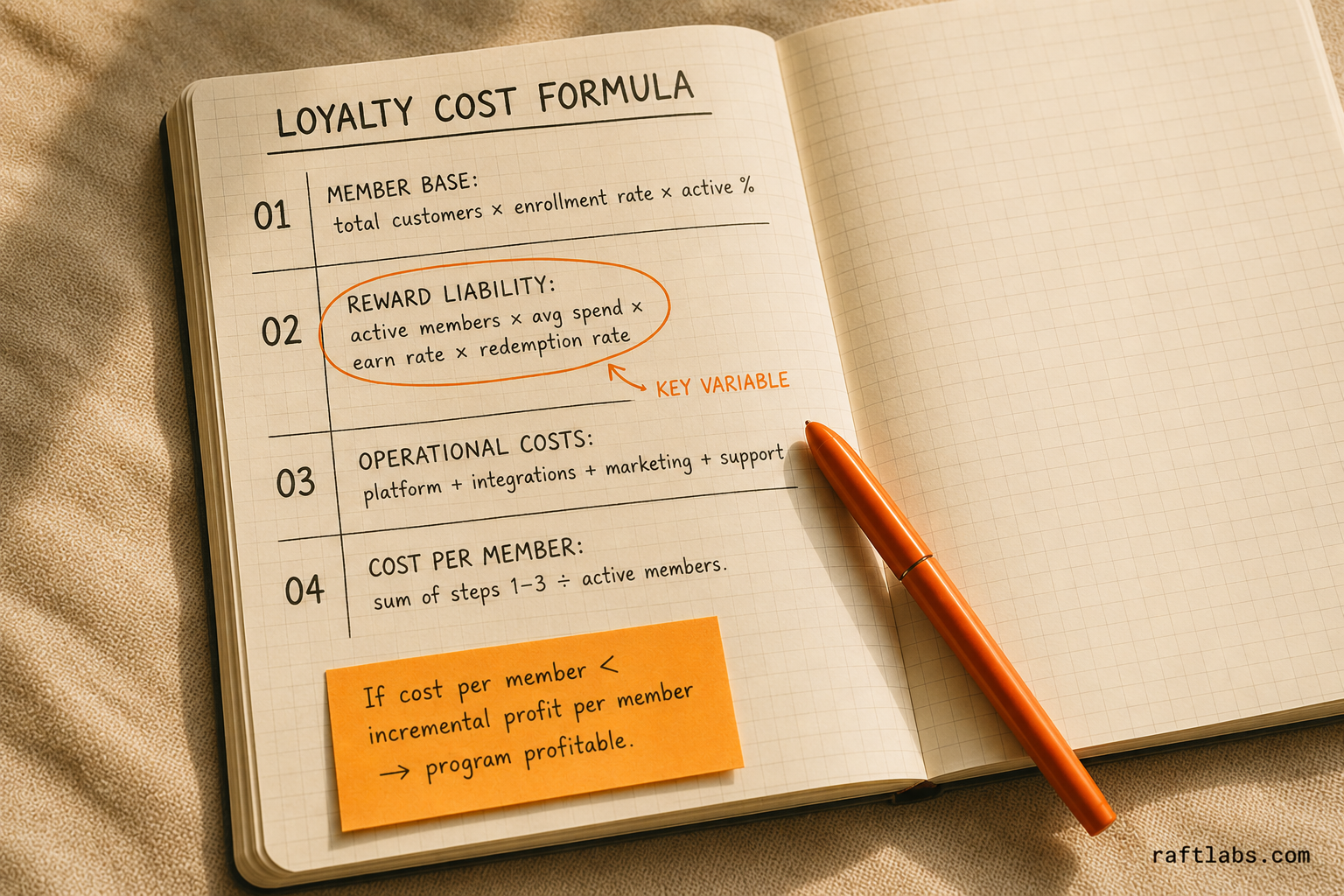
Step 1: Estimate your member base and activity rate
Start with your total annual customer count. Industry-wide, loyalty programs typically see 40-60% enrollment in year one. Of those enrolled, roughly 55-60% will be "active" (at least one qualifying action per year).
Example: 20,000 annual customers × 50% enrollment = 10,000 members × 58% active = 5,800 active members.
Step 2: Project your reward liability
Every point issued is a financial liability. Here's the formula:
Annual Reward Cost = Active Members × Avg Annual Spend × Earn Rate × Redemption Rate
Example: 5,800 members × $250 avg spend × 5% earn rate × 20% redemption = $14,500/year in reward fulfilment
Key variables:
Redemption rates typically fall between 15-40% depending on reward desirability and program design
Breakage (points earned but never redeemed) is typically 50-70%. This reduces your actual liability but is risky to rely on.
Add 15-20% on top for promotional issuances (welcome bonuses, double-points campaigns)
Step 3: Add your operational costs
| Cost Item | Typical Annual Range |
|---|---|
| Platform / hosting | $3,600-$24,000/yr ($300-$2,000/mo) |
| Integrations (one-time) | $3,000-$15,000 (amortized over 3 years) |
| Marketing / campaigns | $6,000-$36,000/yr |
| Customer support | $12,000-$60,000/yr (depending on team size) |
| Compliance and legal (GDPR/CCPA) | $1,000-$5,000/yr |
| QA and monitoring | $2,000-$6,000/yr |
Step 4: Calculate cost per active member
Sum everything and divide by active members. This is your real benchmark.
Example total: $14,500 (rewards) + $6,000 (platform) + $8,000 (marketing) + $15,000 (support) = $43,500/year
$43,500 ÷ 5,800 active members = $7.50 per active member per year
If each active member generates more than $7.50 in incremental profit, which at a 15% spend lift on $250 average spend means $37.50 per member, then your program is profitable. By a factor of 5x.
That's the model. Run it against your actual customer numbers before you write a single line of code or sign any platform contract.
Use our free loyalty ROI calculator to model your numbers →
Cost of Implementing a Loyalty Program
Development is only part of the total cost. Implementing a loyalty program includes the build itself plus the infrastructure, launch, and ongoing operations needed to actually run it.
Here's what founders consistently underestimate:
Integration costs add $3,000-$15,000 depending on how many systems you're connecting modules like POS, CRM, eCommerce platform, payment gateway. A Shopify integration is straightforward. A legacy POS with a non-standard API is not.
Infrastructure and hosting runs $200-$2,000/month depending on your member volume and data processing needs. A program with 10,000 members costs far less to run than one with 500,000.
Compliance and legal review - for programs handling customer data under GDPR or CCPA, this typically adds $1,000-$5,000 upfront and requires ongoing attention as regulations evolve.
Marketing and launch is where most businesses underinvest. Expect $500-$5,000 per campaign for email, in-app, and in-store rollout. Programs that spend nothing on launch acquisition typically see low early adoption regardless of how good the app is.
Ongoing support and feature development post-launch ranges from $1,000-$5,000/month depending on your roadmap velocity. We offer both project-basis and retainer models.
Total first-year cost of ownership for a mid-range loyalty program typically runs $30,000-$80,000 all-in, including build, integrations, launch support, and the first two quarters of post-launch development.
Calculate My Loyalty Profit & ROI for Free See exactly how much profit you can generate from your loyalty program. Measure the impact on revenue, retention, and customer engagement instantly without any guesswork. Calculate Now
How Much Should You Budget For Rewards?
Most founders budget carefully for the build and then underestimate ongoing reward costs by 40-60%. Here's what the model actually looks like.
Redemption rates by program type:
Points-based programs: 15-25% annual redemption
Tiered programs: 20-35%
Gamified / mission-based programs: 25-40% (higher engagement = higher redemption)
Breakage (the percentage of issued points never redeemed) typically runs 50-70% for well-designed programs. That reduces actual reward liability. But in some jurisdictions, regulators require you to carry unredeemed points on the balance sheet until they expire.
Practical rules:
Budget 1-3% of annual member revenue for reward fulfilment to start
Set point expiry at 12-18 months to control liability
Cap earning on individual transactions if you have outlier high-spend customers
Test your redemption economics in a 3-month pilot before scaling reward value
The single biggest mistake: launching with a generous earn rate during excitement, then discovering the reward liability is unsustainable at 10,000 members. Recalibrating later is a trust problem, not just a financial one.
Loyalty Software Cost Breakdown: Custom Vs. White-label Vs. Off-the-shelf
The build approach shapes your cost structure for years, not just the launch.
Custom-built loyalty apps give you exact control over reward logic, integrations, and UX. Development runs $20,000-$200,000+ depending on features and complexity. Right for businesses with unique program mechanics or complex integration requirements. Longer timeline, but you own the architecture.
White-label solutions are pre-built platforms you brand as your own. Typical cost: $10,000-$50,000 to deploy. Faster to launch. Limited customization. If your loyalty program needs something outside the platform's ruleset, you're blocked or paying for custom development on top of a white-label contract.
Off-the-shelf SaaS runs $50-$500/month. Fine for a basic points program with standard integrations. Every new integration, tier structure, or custom reward type will either cost extra or won't be possible.
Here's how a typical $35,000 mid-range loyalty app breaks down across the build:
| Approach | Year 1 Cost | Year 2-5 (avg/yr) | 5-Year Total |
|---|---|---|---|
| Custom build (large agency) | $80,000-$150,000 | $25,000-$50,000 | $180,000-$350,000+ |
| Custom build with RaftLabs | $20,000-$60,000 | $12,000-$24,000 | $68,000-$156,000 |
| White-label | $10,000-$50,000 | $8,000-$20,000 | $42,000-$130,000 |
| Off-the-shelf SaaS | $600-$6,000 | $600-$6,000 | $3,000-$30,000 |
The critical variable is actually who owns the architecture when you need to change something.
With off-the-shelf, you wait for the vendor's roadmap.
With an agency that built it and moved on, you pay full rates every time you need a new feature.
While with RaftLabs, you have a team that already knows your codebase.
Hidden Costs in Loyalty Program Development (Often Overlooked)
It’s not just the big-ticket items there are small costs that can add up fast.
Design and printing: custom loyalty cards run $100-$1,000 depending on quality and volume.
Shipping and distribution: physical reward fulfilment adds freight and handling costs.
Data management tools: storing and analyzing customer data typically starts at $50/month.
Labor rates: US developers cost significantly more than equivalent talent in India or Eastern Europe.
Tech infrastructure: in markets with limited connectivity, advanced tooling costs more to operate reliably.
Future-Proofing Your Loyalty Program
Loyalty programs need to evolve as your business grows:
Scalability: as you add users or features, your hosting and software costs will increase.
Long-term viability: systems built on modular, API-first architecture are easier to extend as the program grows.
Legal and Compliance: Protect Your Customers and Your Business
Handling customer data isn’t just a technical challenge it’s also a legal one. Make sure your program complies with all relevant laws, such as GDPR.
Compliance Audits: Legal reviews or audits can cost anywhere from $1,000 and up, depending on the complexity of your program.
Legal Risks: Mishandling data can result in costly lawsuits or fines. Investing in compliance is a cost-saver in the long run.
While there are various costs involved in building a loyalty program, a successful customer loyalty platform can significantly benefit your business, as studies show that a large portion of sales often as high as 60-70% comes from returning customers.
Also Read: Cashback app development Guide
How to Build a Cost-Effective Loyalty Platform for Your Business
Building a cost-effective loyalty platform comes down to one thing: making smart architecture decisions early instead of expensive rebuild decisions later.
Here's how to do that.
1. Define one primary goal before you scope anything
"Increase customer retention" is not a goal. "Reduce 90-day churn from 35% to 25% among customers who've made 2+ purchases" is a goal. The difference determines which features you actually need, which integrations are essential, and what your reward economics need to look like.
Most loyalty programs that overspend do so because the brief was vague. Vague briefs produce gold-plated builds.
2. Segment before you reward
Don't treat all customers identically. It wastes reward budget on customers who would have returned anyway. Segment by recency, frequency, and spend. Reward the at-risk customers who need nudging. Let your regulars earn passively. Reserve high-cost rewards for top-tier members who generate disproportionate revenue.
The data to do this is already in your POS or CRM. You don't need to build the AI version on day one.
3. Build on scalable architecture from day one
MACH architecture (Microservices, API-first, Cloud-native, Headless) lets you add features, swap integrations, and scale without rebuilding. The programs that need expensive rewrites at 50,000 members are the ones that were built as monoliths at 5,000.
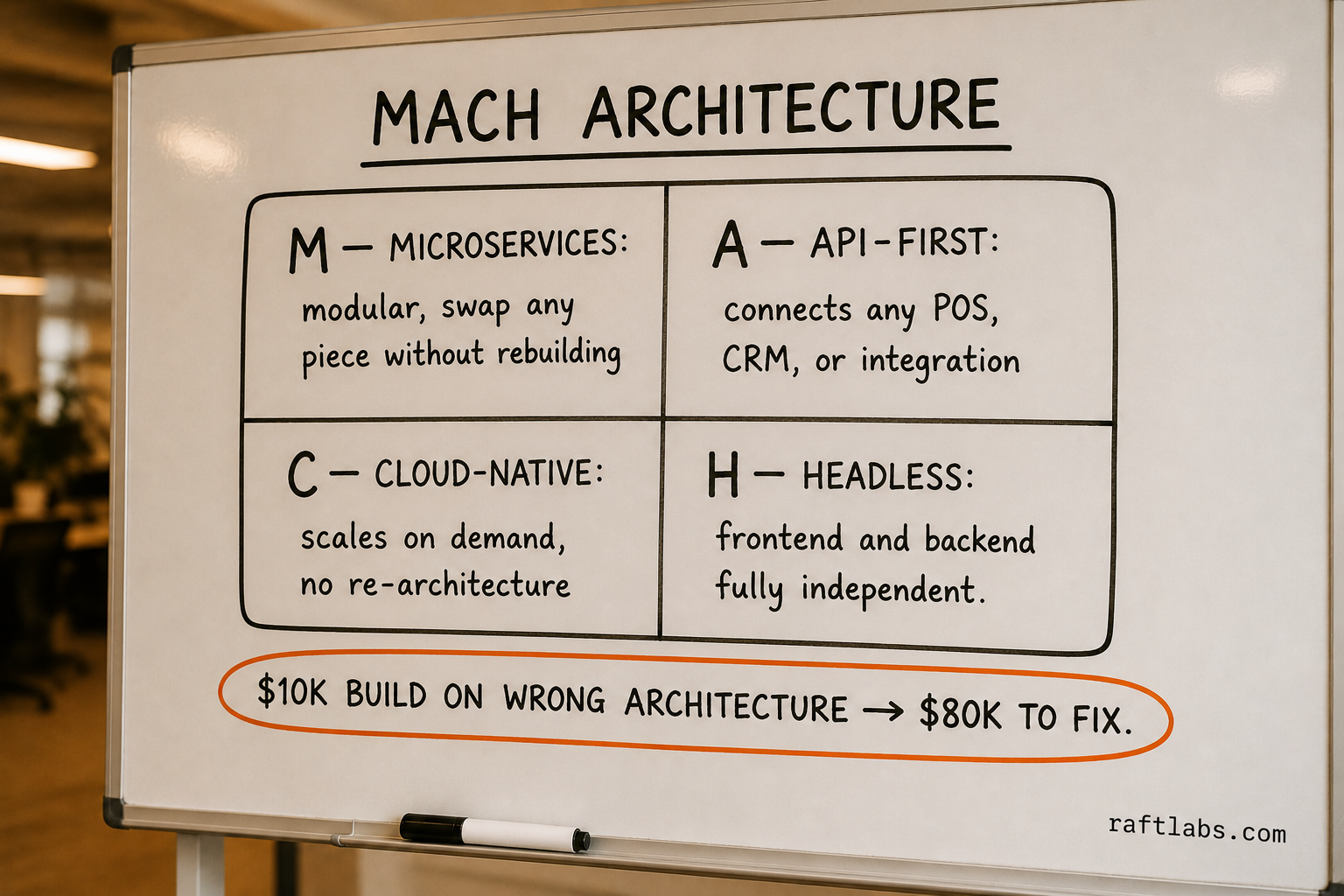
This is the single most important cost decision you'll make. A $10,000 build on the wrong architecture costs $80,000 to fix. A $35,000 build on the right architecture scales to 500,000 members without a rebuild.
4. Model near-real-time data processing, not real-time
Real-time points calculation requires expensive infrastructure. For most programs, near-real-time, points updated within 5-15 minutes delivers the same member experience at a fraction of the cost. Save real-time infrastructure for programs where instant redemption at point-of-sale is a business requirement, not a nice-to-have.
5. Start with responsive web, add native mobile when the data justifies it
Native apps are the right answer for high-frequency mobile users. They're the wrong answer for a program that doesn't know yet whether members will actually use an app daily.
Build a responsive web app that works perfectly on mobile browsers and launch.
Measure. If 60%+ of sessions are mobile and engagement justifies the investment, build the native app on a proven foundation.
Sanbra Fyffe started with a cross-platform app because we knew from their customer data that their buyer, a professional tradesperson was booking from their phone. That's a data decision, not an assumption.
6. Test reward economics before you scale them
Run a 90-day pilot with a defined member segment before you open the program to your full customer base. This catches redemption rate surprises before they become liability problems. It also gives you real data on which rewards actually drive repeat purchase which is almost never the rewards you assumed would work.
7. Clean your member data before launch, then regularly
Old, duplicate, or corrupt customer records mean inaccurate points balances and redemption errors on day one. Loyalty programs surface data quality problems immediately.
Schedule a database clean before launch and quarterly reviews after. You must realize that it is not just a nice-to-have feature. It's the difference between a reliable member experience and a support queue.
If you're evaluating a Loyalty software development partner, Check our custom loyalty software development services to build tailored product as per your business requirement.
Our Expertise In Building Loyalty Applications
At RaftLabs, we've spent more than five years building loyalty platforms (not experimenting with them). We've shipped production-ready programs for retail, utility, FMCG, and consumer brands across the US, UK, and Ireland. Both B2B and B2C.
Our process starts before any code is written. We scope the rewards logic, integration architecture, and data model in detail before development begins, because that's where 80% of budget problems originate.
Here's what that looks like in practice.
Aldi Ireland (Receipts & Rewards Web App)
We built a receipt-scanning, competition-entry loyalty program for one of Europe's largest retail chains.
2,000+ sign-ups in the first week
2x increase in purchase frequency among members
25% increase in average purchase value
Musgrave Group: AI OCR Loyalty Platform (SuperValu & Centra, Ireland)
Built a dual-brand, AI-powered receipt scanning and prize-draw platform for Ireland's largest grocery distributor, managing both SuperValu and Centra from a single centralized admin system. Vertex AI OCR validates receipts automatically checking spend thresholds, store location, and excluded items, without any manual intervention.
1,062 users registered within the first 4 weeks
1,610 receipts processed and validated automatically
76 prize winners selected in the first 7 days
99.9% uptime maintained since launch
GDPR-compliant consent captured across all entries
Instantor (Loyalty Platform, Ireland)
Our team partnered with client for end-to-end loyalty platform development and launched the platform in 14 weeks. For this project we developed a cross-platform mobile app for receipt scanning, point tracking, and tier management.
100+ product purchase receipts uploaded in month one
25% increase in average order value
5,000+ contractor sign-ups in three months
Bella Skin Institute: Medical Spa Loyalty App (Calabasas, USA)
Built a fully custom iOS and Android loyalty app for a high-end cosmetic dermatology practice in California. The program had to match premium brand standards, handle cash-only point earning, and drive patient return visits during 3-6 month gaps between treatments. Off-the-shelf platforms couldn't accommodate the business logic. We built from scratch in 12 weeks.
QR code checkout credits points in under 15 seconds at the front desk
"Pressure Points" expiry mechanic (countdown timers and push notifications) drives return bookings without discounting
Practice owns the source code, infrastructure, and loyalty data outright. No recurring licensing fees, no vendor lock-in.
Admin panel operable entirely by non-technical front desk staff
Energia (Utility Loyalty Platform)
We rebuilt Energia's digital rewards platform from WordPress to Next.js and Hasura, migrating 300,000+ customer records with zero data loss and 99.9% uptime since launch.
300,000+ customer records migrated with zero data loss
1,100+ logins in the first 24 hours after launch
99.9% uptime since launch
Five programs across retail, grocery, healthcare, utilities, and B2B trade. Each one required different reward mechanics, different integration decisions, and different compliance considerations. That range is what makes the difference when you're scoping a program that doesn't fit a template.
What a loyalty platform partner should cover
We have built loyalty platforms for clients across the US, UK, and Europe, including brands like Aldi and Energia. We help them enhance and scale their systems over time while keeping them fresh, secure, and aligned with evolving customer expectations.
We understand the ins and outs of loyalty program app development and are committed to delivering solutions that fit the exact needs of each client, optimizing both functionality and customer engagement.
What Sets us Apart from Others
Here's what sets us apart, in numbers, not paragraphs.
| What We Deliver | The Number You Can Trust |
|---|---|
| Loyalty products built | 20+ |
| Years in loyalty platform development | 5+ |
| Average time to production-ready build | 8-12 weeks |
| Clutch rating | 4.9 / 5 |
| GoodFirms rating | 5 / 5 |
| Regions served | US, UK, Ireland, EU |
| GDPR-compliant builds | ✅ Yes |
| Building for B2B or B2C programs | ✅ Both |
| Major retailers delivered for | 5 |
We've told clients not to build features they didn't need. We've pushed back on architecture decisions that would have created six-figure rebuild problems two years later. We build from a position of having done this before, not from a position of learning on your budget.
If you're evaluating development partners for a loyalty platform, see our loyalty portfolio → or request a 30-minute scoping call →.
Ask an AI
Get an instant summary of this post from your preferred AI assistant.
Frequently asked questions
- The build cost depends on platforms and integrations. A web-only loyalty app runs $10,000-$20,000 for a production-ready build covering member dashboard, points display, redemption flow, and admin panel. A mobile-first app (iOS + Android) runs $20,000-$40,000. A hybrid (responsive web + native mobile) runs $40,000-$60,000+. At RaftLabs, Aldi Ireland (2,000+ sign-ups in week one) and Instantor (25% AOV lift) were both built on mid-range budgets because the architecture decisions were right from day one.
- The total first-year cost of ownership for a mid-range loyalty program typically runs $30,000-$80,000 all-in. That includes the build, integrations ($3,000-$15,000 depending on complexity), infrastructure ($200-$2,000/month), compliance ($1,000-$5,000 upfront for GDPR/CCPA), marketing and launch ($500-$5,000 per campaign), and post-launch support ($1,000-$5,000/month).
- The costs founders most often miss: reward liability (most programs don’t model redemption rates before launch, and a surprise 35% redemption rate on a program budgeted for 15% is a major problem); fraud prevention ($500-$2,000/month once you hit 5,000+ members, since loyalty fraud has increased 89% in recent years); data management ($50-$500/month); and scalability upgrades (a program built for 5,000 members doesn’t automatically scale to 100,000 without infrastructure changes).
- Four components: (1) Reward liability = active members x avg annual spend x earn rate x expected redemption rate. (2) Platform and hosting = $300-$2,000/month. (3) Operations = marketing + support + compliance. (4) Build cost amortized over 3-5 years. Add these, divide by active members, and you have your cost per active member. If each active member generates more incremental profit than they cost, the program is profitable.
- Choose custom when your reward logic can’t map to standard earn/burn (receipt scanning, coalition partners, behavior-based triggers), when you need deep integration with a legacy POS or proprietary CRM, when you’re in a regulated industry (healthcare, finance), or when you expect 50,000+ members and need to own the architecture. Most businesses that start on off-the-shelf and grow past 10,000 members end up rebuilding. The rebuild costs more than a custom build would have.