How To Build a Loyalty App For Customer Engagement: A 7-Step Guide
- Riya Thambiraj
![Riya Thambiraj]()
- Customer Loyalty
- Last updated on
Key Takeaways
A loyalty app is not just a rewards mechanic; it's a retention infrastructure investment. Members generate 12–18% more incremental revenue per year than non-members.
The 7 steps to building a loyalty app: define your goal, know your audience, choose features, pick your tech approach, design and develop, launch and promote, then measure and iterate.
The most important features: points engine, member dashboard, push notifications, QR/receipt scanning, admin panel, and integration with your POS or CRM.
Build vs buy depends on three things: how unique your reward logic is, how many systems you're integrating, and whether you expect 10,000+ members.
A production-ready loyalty app costs $12,000–$60,000+ depending on platforms, integrations, and feature complexity.
At RaftLabs, we deliver custom loyalty apps in 8–12 weeks. Aldi Ireland: 2,000+ sign-ups in week one, 25% AOV lift. Bella Skin Institute: live in 12 weeks, QR checkout under 15 seconds.
A loyalty program is one of the few things in your marketing budget that pays you back for years.
Loyalty members generate 12–18% more incremental revenue per year than non-members. They buy more frequently, spend more per transaction, and churn at lower rates. For a business running on tight acquisition costs and CAC has increased 40–60% since 2019, retaining a customer you've already paid to acquire is the highest-return move you can make.
But a loyalty app is not just a digital punch card. The difference between a program members actually use and one they forget about in week three comes down to how it's built: the right features, the right integration points, the right reward economics, and a mobile experience that earns screen space.
This guide walks you through exactly how to build a loyalty app for customer engagement in 2026 from defining your goals to choosing your tech stack, scoping your must-have features, and avoiding the build decisions that cost businesses $50,000 in rebuilds two years later.
A customer loyalty program is a strategy businesses use to build long-term relationships with their customers.
These programs incentivize repeat purchases and brand loyalty by offering rewards, discounts, and exclusive benefits. They provide value to customers, making them feel appreciated and recognized for their patronage. In turn, businesses benefit from increased customer retention, higher average spending, and valuable insights into customer behavior. In fact, recent studies show that loyalty programs can lead to a 12-18% increase in annual revenue from loyal members compared to non-members.
Effective loyalty programs create a win-win situation, enhancing customer satisfaction while driving business growth and profitability. Thus, a well-designed loyalty app can make a big difference for businesses looking to deepen their connection with customers.
In the next sections, we'll dive into how these apps can drive customer engagement, boost satisfaction, and lead to greater business success. We'll also look at the key benefits, understand the true value of a customer loyalty program, and share some best practices for building an effective loyalty app. Let's get started!
What is a Customer Loyalty Program App?
A customer loyalty app is a digital platform that rewards customers for defined behaviors like repeat purchases, referrals, check-ins, reviews, or milestone achievements and gives businesses real-time data on who their best customers are and what drives their behaviour.
The best loyalty apps do three things well:
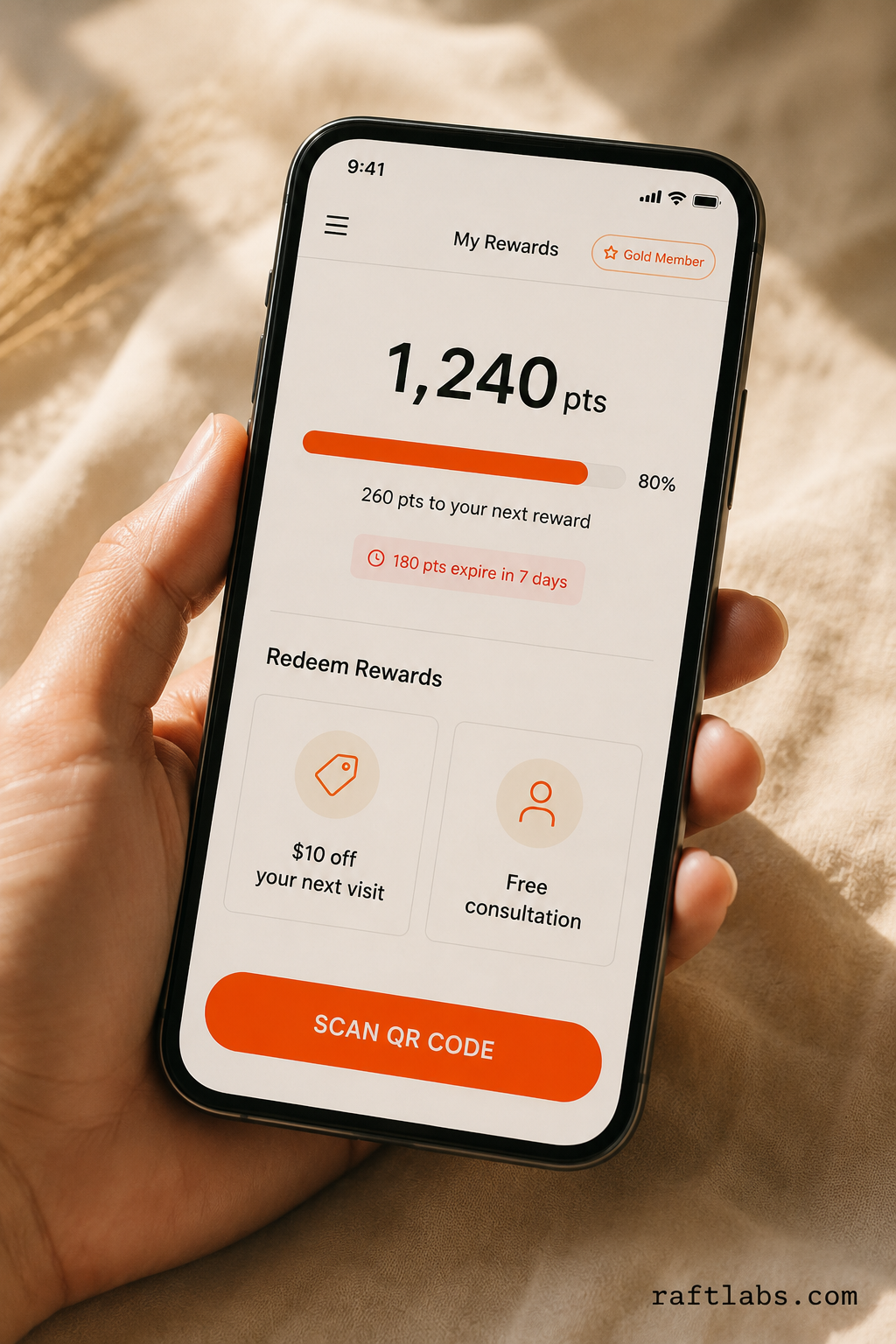
First, they make earning feel immediate. Points credited within seconds of a QR scan. Progress bars showing how close a member is to the next tier. Countdown timers on expiring rewards. These mechanics turn passive customers into active participants.
Second, they give businesses usable data. Not just "how many members do we have" but which members are at risk of churning, which reward types drive the highest repeat purchase rate, and which customer segments generate 80% of the program's incremental revenue.
Third, they integrate into your existing stack. A loyalty app that doesn't connect to your POS, CRM, or eCommerce platform is a silo. The value is in the purchase data flowing back into the system, without that, you can't personalize, segment, or measure ROI accurately.
How To Build a Loyalty App: The 7 Steps
Developing a customer loyalty program app can significantly enhance customer retention and engagement for your business. This section provides a comprehensive guide on the essential steps to create an effective loyalty app, from defining your objectives and understanding your audience to designing a user-friendly interface and integrating key features.
Whether you’re planning to build it internally or collaborate with an experienced loyalty app development company, this guide will help you make informed decisions and design a loyalty program that truly connects with your customers. Follow these steps to build a loyalty app that drives customer satisfaction and business growth.
Step 1: Define One Specific Goal (Not "Increase Engagement")
"Increase customer engagement" is not a goal. It's a category.
Before you write a brief or talk to a developer, pin down one primary business problem you're solving:
Reducing churn — customers who've made 2+ purchases but haven't returned in 90 days
Increasing purchase frequency — average visits per month is 1.2, you want 1.8
Growing average order value — current AOV is $45, loyalty members should hit $60+
First-party data collection — you need opt-in behavioral data without third-party cookies
Your goal determines every downstream decision: which features matter, what the reward structure looks like, which integrations are essential, and how you'll measure success. Programs built without a specific goal tend to over-engineer features nobody uses and under-invest in the mechanics that would actually move the needle.
Useful benchmark: Aldi Ireland's goal was simple, drive promotional competition entries tied to grocery purchases. That single, focused objective meant we could build a receipt-scan and prize-draw platform in 12 weeks, without feature bloat.
Step 2: Know Your Audience Well Enough to Design the Reward Structure
Your customer data already tells you more than most loyalty briefs do. Before you design anything, look at three numbers:
Purchase frequency — How often does your average customer buy? A coffee shop customer buys 4x/week. A furniture retailer sees the same customer every 3 years. These require completely different loyalty mechanics.
Average order value — This determines what reward ratios are financially sustainable. A 2% earn rate on a $10 transaction earns $0.20. On a $500 transaction, it's $10. Your reward economics need to match your margins.
Churn point — At what point do customers typically stop coming back? If 60% of first-time buyers never return, your loyalty program should be designed to get them to purchase #2, not to reward people who already come back 10 times a year.
Audience segmentation matters. Gen Z engages with gamification — streaks, challenges, leaderboards. Millennials convert on cashback and tier status. B2B trade buyers (like Sanbra Fyffe's plumbing contractors) respond to tangible rewards tied to purchase volume. Don't design the same program for all three.
Step 3: Choose the Right Features: Must-Have vs Nice-to-Have
Most loyalty apps fail not because they lack features, but because they built the wrong ones first. Here's how to prioritize:
Must-have on day one:
| Feature | Why It's Non-Negotiable |
|---|---|
| Points engine | The core mechanic — earns, stores, and redeems points |
| Member dashboard | Members need to see their balance, history, and available rewards |
| Admin panel | Your team needs to manage members, adjust rules, run reports |
| Push notifications | Expiry reminders and promotions, the highest-engagement channel |
| QR code / receipt scanning | The primary way members prove a purchase |
| Integration with POS/CRM | Without this, you have no purchase data |
Add in phase 2 (after you have real member behavior data):
Tiered membership (Bronze / Silver / Gold)
Gamification — streaks, challenges, badges
Referral program
AI-powered personalized offers
Coalition / partner rewards
A real example of phasing correctly: Bella Skin Institute launched with QR checkout, points balance, reward redemption, and push notifications. That was it. The "Pressure Points" expiry mechanic, aka, color-coded countdown timers that drove return bookings, came from seeing how members actually behaved post-launch. Building it first would have been a guess. Building it after 6 weeks of data made it deliberate.
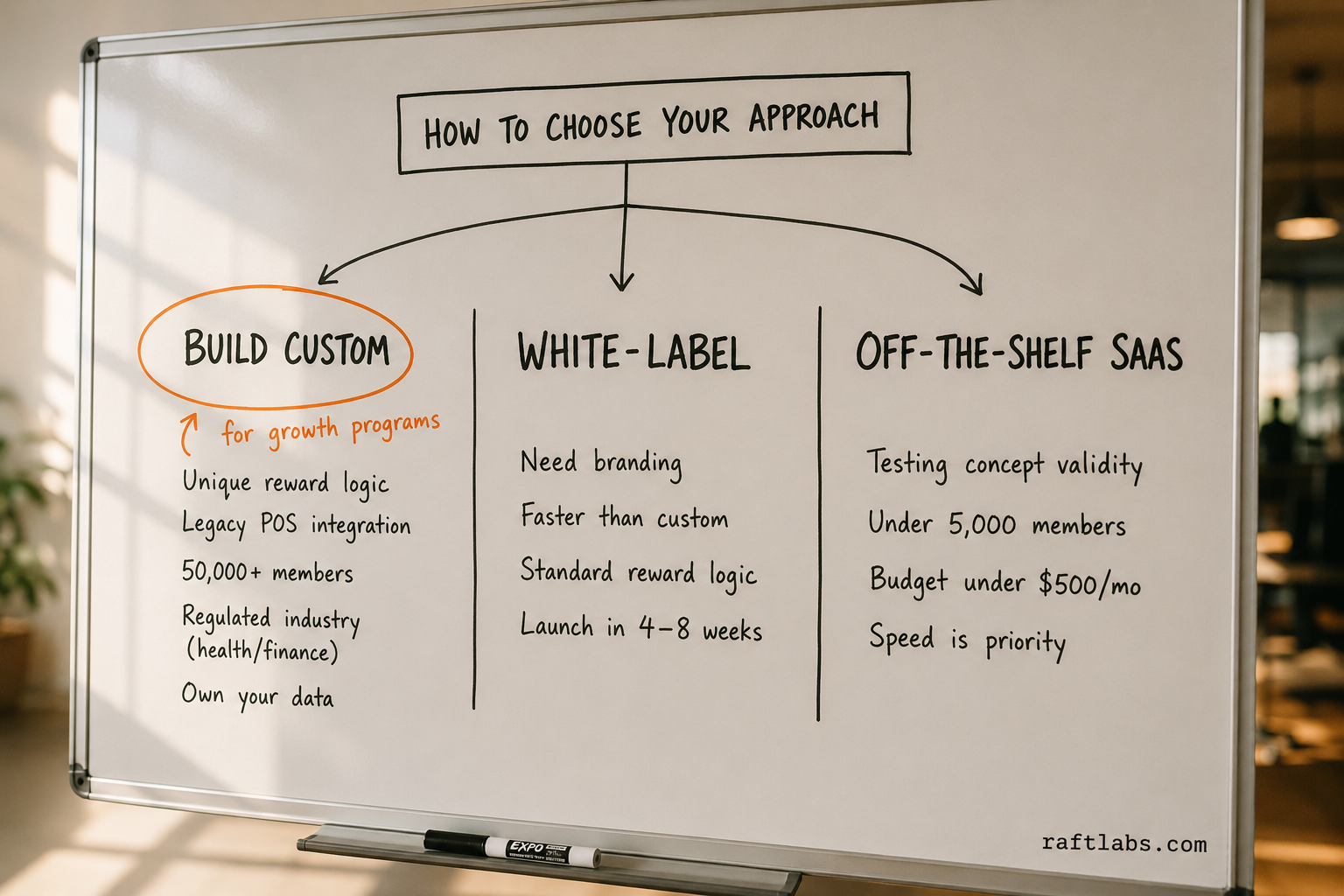
Step 4: Choose Your Tech Approach: Build, Buy, or White-Label
This is the decision that determines your 5-year cost structure, not just your launch budget.
Build custom when:
Your reward logic can't be mapped to a standard earn/burn model (receipt scanning, multi-brand campaigns, behavior-triggered rewards)
You need deep integration with a legacy POS, proprietary CRM, or industry-specific system (healthcare, finance)
You expect 50,000+ members and need to own the architecture
You're in a regulated industry with specific compliance requirements
White-label when:
You need to launch in under 4 weeks
Your requirements are standard: points for purchases, discount rewards, email campaigns
You're in early validation mode
Off-the-shelf SaaS when:
You're a small business testing whether loyalty works for your customer base
Budget is under $5,000 and simplicity is the priority
The rebuild trap: Most businesses that start on off-the-shelf and grow past 10,000 members end up rebuilding. The rebuild costs more than a custom build would have at the start. Every integration, every custom rule, every compliance requirement adds custom development cost on top of a platform that wasn't designed for it.
Tech stack for a custom build:
| Layer | Common Choices |
|---|---|
| Mobile (cross-platform) | Flutter (one codebase for iOS + Android) |
| Mobile (native) | Swift (iOS), Kotlin (Android) |
| Frontend web | React.js, Next.js |
| Backend | Node.js, PostgreSQL, Hasura GraphQL |
| Cloud infrastructure | AWS (Lambda for serverless), Google Cloud |
| AI/OCR (for receipt scanning) | Google Vertex AI |
| Push notifications | Firebase |
This is the exact stack we used for Bella Skin Institute (Flutter + React + Hasura + PostgreSQL + Firebase) and for Musgrave's SuperValu/Centra platform (Next.js + React + AWS Lambda + Vertex AI).
Step 5: Design for the Member Experience
The most common UX mistake in loyalty apps: designing around the program logic instead of the member's mental model.
Members don't think about your points engine. They think: "How close am I to a free coffee?" "Do I have anything expiring?" "Is it worth scanning this receipt?"
Design for those three questions. Everything else is secondary.
What a good loyalty app UX delivers:
Balance and progress visible on the home screen — no digging
Redemption in two taps maximum
Push notification for expiring points that links directly to the redemption screen
Checkout flow under 15 seconds (QR scan to points credited)
Admin panel operable by non-technical front desk staff, not just developers
What kills engagement:
Complicated point-to-reward conversion math (members give up calculating)
Redemption buried 4 screens deep
App that requires a download before the customer can even see the value
For high-traffic retail programs, start with a responsive web app. No download barrier, works on any device, deploys faster. Add a native app once you have evidence that members want daily mobile engagement. Musgrave's SuperValu/Centra program ran entirely on a mobile-responsive web app — 1,062 users and 1,610 validated receipts in 4 weeks, zero app download friction.
Step 6: Launch With a Member Acquisition Plan, Not Just an App
A loyalty app with no members is a database. The build is only half the work.
What drives early adoption:
Welcome bonus — give members something to earn on day one. Aldi Ireland's sign-up rate (2,000+ in week one) was partly driven by the immediate competition entry with first receipt upload.
In-store visibility — QR codes at checkout, staff who know how to enroll members, and receipts with program reminders
Email to existing customers — your current customer list is your fastest path to first 500 members
First-purchase trigger — auto-enroll at checkout or make sign-up part of the purchase confirmation flow
Realistic adoption benchmarks:
40–60% of existing customers will enroll when actively promoted at launch
Of enrolled members, roughly 55–60% will be "active" (at least one qualifying action per year)
If your first-month active rate is below 30%, the enrollment flow has friction; fix it before spending money on campaigns
Promotion channels by cost-effectiveness:
- In-store/in-app (zero cost, highest conversion)
- Email to existing list (low cost, high intent)
- SMS (effective, but gets expensive at scale — use for expiry reminders only)
- Social media (awareness, not direct enrollment driver)
Step 7: Measure What Matters
Member count is a vanity metric. Here's what actually tells you whether your loyalty app is working:
Now, let’s see the benefits and why you should create a rewards program or a loyalty program for your business.
| KPI | What It Measures | Healthy Benchmark |
|---|---|---|
| Active member rate | % of enrolled members with activity in 90 days | 50–65% |
| Redemption rate | % of earned points actually redeemed | 15–35% |
| Member vs non-member AOV | Revenue lift from loyalty participants | 15–25% higher |
| Purchase frequency lift | How often members buy vs non-members | 20–40% higher |
| Cost per active member | Total program cost ÷ active members | Should be < incremental revenue per member |
| Churn rate (members vs non-members) | Retention delta from program | Members should churn 20–30% less |
Review these monthly. If active member rate drops below 40%, your reward design has a problem. If redemption rate is below 10%, your rewards aren't compelling or the redemption UX has friction. If member AOV isn't beating non-member AOV by at least 10%, the program isn't influencing buying behavior.
The programs that don't deliver ROI usually have one of three problems: the reward economics weren't modeled before launch, the integration is too shallow to capture real purchase data, or nobody is reviewing these metrics and making adjustments. All three are fixable — but only if you're measuring.
Also Read: Top Loyalty App Development Companies
What Features Does a Loyalty App Actually Need?
Not all features are equal. Here's how we think about the feature set for a production-ready loyalty app.
Core Features (Required for Launch)
Points Engine The heart of the program. Calculates points earned per transaction, applies multipliers for promotions, tracks balances per member, handles expiry logic, and processes redemption. This is the most complex piece of backend logic — getting the earn/burn math wrong at the architecture level is expensive to fix later.
Member Dashboard What members see first. Current balance, points history, available rewards, upcoming expiry dates, and progress to the next tier or reward threshold. Design this screen first — everything else in the app flows from it.
Admin Panel Your operations team's control center. Member management, rule configuration, campaign creation, analytics exports, and winner selection (for prize draws). This should be operable by non-technical staff. If it requires a developer to change a reward value, your admin panel is a bottleneck.
Push Notifications The highest-engagement channel in loyalty apps. Use for: expiring points (drives urgency), new rewards available, promotional campaigns, and tier upgrades. Personalized push notifications outperform generic blasts by 3–4x in open rate. Don't over-send. 2–3 notifications per week maximum before members start disabling them.
QR Code / Receipt Scanning The primary proof-of-purchase mechanism for most programs. QR scanning should complete in under 15 seconds. Receipt scanning with AI/OCR (Vertex AI or similar) automates spend verification, particularly important for multi-retailer or receipt-based programs where manual review would be a bottleneck at scale.
Integrations Your loyalty app is only as smart as the data it receives. Core integrations:
POS system — real-time transaction data
CRM — member profile sync, segmentation
eCommerce platform — online purchase attribution
Email marketing tool — campaign triggers and member communication
Phase 2 Features (Add After Launch Data)
Tiered Membership — Bronze / Silver / Gold (or equivalent). Drives aspiration and concentrates high-value rewards on your best customers. Only add tiers when you have enough member data to set tier thresholds that are meaningful, not arbitrary.
Gamification — Challenges, streaks, badges, leaderboards. Particularly effective for high-frequency purchase categories (coffee, grocery, fuel). Increases active engagement by 40–60% in programs that deploy it correctly. Add once your base engagement mechanics are working.
Referral Program — Members invite friends in exchange for bonus points. One of the lowest-cost acquisition channels available. Build the fraud prevention logic before you launch it — referral programs without duplicate detection get exploited quickly.
AI Personalization — Offer recommendations based on purchase history and member behavior. Requires a minimum of 6 months of member data and enough transaction volume to build meaningful segments. Don't build it on day one unless you're starting with an existing customer database.
Benefits of a Customer Loyalty App
Implementing a customer loyalty app offers numerous advantages for both businesses and customers. This section explores the key benefits, including increased customer engagement, enhanced retention, personalized marketing, and valuable data insights. Learn how a well-designed loyalty app can foster stronger customer relationships and provide a competitive edge in the market.
1. Increased Customer Engagement
A customer loyalty app keeps customers engaged by providing a convenient platform for accessing rewards, tracking points, and receiving personalized offers, which enhances their interaction with the brand.
2. Enhanced Customer Retention
Loyalty apps incentivize repeat business by offering exclusive rewards and discounts, making customers more likely to choose the brand over competitors.
3. Personalized Marketing
With access to customer data and preferences, loyalty apps enable businesses to tailor marketing efforts, sending targeted promotions and offers that resonate with individual users.
4. Real-Time Feedback
Loyalty apps provide a direct channel for customers to give feedback on their experiences, allowing businesses to promptly address concerns and improve service quality.
5. Streamlined Reward Redemption
The app simplifies the process of redeeming rewards, making it easy for customers to utilize their points or benefits without hassle, thereby enhancing their satisfaction.
6. Data-Driven Insights
Businesses can leverage data from loyalty apps to gain valuable insights into customer behavior, purchasing patterns, and preferences, informing strategic decisions and improving marketing effectiveness.
7. Increased Brand Loyalty
By consistently rewarding and recognizing customers through a loyalty app, businesses can build stronger emotional connections, fostering long-term loyalty and advocacy.
10. Convenient Communication
Loyalty apps provide a direct communication channel, enabling businesses to share updates, promotions, and news instantly, ensuring customers are always informed and engaged.
The Value of a Customer
Understanding the value of a customer is crucial in loyalty app development. Calculating Customer Lifetime Value (CLV) reveals the potential revenue from loyal customers, emphasizing the importance of retention.

Loyalty apps drive engagement by offering personalized experiences and rewards, fostering deeper connections. These satisfied customers often share positive experiences, boosting word-of-mouth marketing and attracting new customers. Data collected from app interactions informs business strategies, enhancing decision-making.
A robust loyalty app differentiates a brand, increases sales, and provides invaluable customer feedback for continuous improvement, ultimately strengthening brand loyalty and competitive advantage.
Also Read: Custom Med Spa Loyalty Program Software Development
Should You Build a Custom Loyalty App or Use a Platform?
This decision has more financial consequences than any other in a loyalty program build. Here's the honest framework.
Choose a custom build if:
Your reward logic is non-standard (receipt scanning, multi-brand campaigns, cash-only earning, behavior-triggered rewards)
You need integrations with legacy or proprietary systems
You'll have 50,000+ members within 3 years
You're in healthcare, finance, or another regulated industry
You want to own your data, architecture, and roadmap — no vendor lock-in
Choose an off-the-shelf platform if:
You're testing concept validity with under 5,000 members
Your program runs simple points-for-purchases with standard reward types
Budget is under $500/month and launch speed is the priority
Choose white-label if:
You need branded customization but don't need unique reward logic
You want a faster launch than custom but more flexibility than SaaS
The 5-year cost reality:
Most businesses that start on off-the-shelf and grow past 10,000 members rebuild. Budget $20,000–$60,000 for a custom build done right the first time vs. $15,000 in SaaS fees + $40,000–$80,000 rebuild cost in year 3. The math favors custom for any program with serious growth ambition.
For a full cost breakdown including integrations, hosting, and reward liability: Read Loyalty Program Development Cost Guide →
Realistic Timelines for Loyalty App Development
| Build Type | Timeline | What's Included |
|---|---|---|
| MVP web app (basic points + admin) | 6–8 weeks | Points engine, member dashboard, admin panel, basic integrations |
| Mid-range platform (web + mobile) | 10–14 weeks | Full feature set, iOS + Android, 2–3 integrations, QA |
| Full enterprise build | 16–24 weeks | Multi-region, AI personalization, coalition logic, compliance |
| Off-the-shelf setup | 1–2 weeks | Configuration only, no custom development |
At RaftLabs, our average custom build runs 8–12 weeks from kickoff to production launch. That covers product discovery, UX design, backend and frontend development, integration, QA, and deployment.
The variable that extends timelines most: integration complexity. Connecting to Shopify takes days. Connecting to a legacy enterprise POS with non-standard APIs can take 3–4 weeks on its own. We scope every integration in detail before committing to a delivery date.
Loyalty Program Development Best Practices
Creating an effective loyalty program requires careful planning and execution. By following best practices, businesses can develop a program that not only attracts but also retains loyal customers. From understanding your audience to leveraging technology and fostering community, these strategies ensure that your loyalty program remains engaging, simple, and rewarding. Here are some essential best practices to help you build a successful customer loyalty program.
1. Understand Your Audience
Conduct thorough market research to understand the preferences and behaviors of your target customers.
Tailor your loyalty program to meet their specific needs and expectations.
2. Simplify the Enrollment Process
Make it easy for customers to join your loyalty program with a quick and hassle-free sign-up process.
Offer multiple ways to enroll, such as in-store, online, or through a mobile app.
3. Offer Valuable Rewards
Provide rewards that are meaningful and desirable to your customers.
Include a mix of short-term and long-term rewards to keep customers engaged and motivated.
4. Personalize Rewards and Communications
Use customer data to personalize rewards, offers, and communications.
Address customers by name and tailor offers based on their purchase history and preferences.
5. Keep It Simple
Design a program that is easy to understand and use.
Avoid complicated point systems or reward structures that may confuse customers.
6. Promote Your Program
Regularly promote your loyalty program through various channels such as email, social media, and in-store signage.
Highlight the benefits and rewards to encourage sign-ups and participation.
7. Engage and Educate Staff
Train your staff to understand and promote the loyalty program effectively.
Ensure they can explain the benefits and help customers enroll and redeem rewards.
8. Use Technology Wisely
Leverage technology to enhance the customer experience, such as mobile apps, digital rewards, and automated communications.
Ensure the technology is user-friendly and reliable.
9. Monitor and Analyze Performance
Regularly track the performance of your loyalty program through metrics such as enrollment rates, engagement levels, and redemption rates.
Use this data to identify areas for improvement and optimize the program.
10. Adapt and Evolve
Be flexible and willing to make changes based on customer feedback and performance data.
Continuously update and improve your program to keep it fresh and relevant.
11. Foster a Sense of Community
Create opportunities for loyal customers to connect with each other and the brand, such as exclusive events or online communities.
Encourage customer feedback and engagement to build a strong sense of loyalty and belonging.
12. Ensure Transparency and Trust
Clearly communicate the terms and conditions of your loyalty program.
Ensure customers understand how to earn and redeem rewards and handle any issues promptly and fairly.
What RaftLabs Loyalty App Builds Actually Look Like
1. Aldi Ireland — Receipts & Rewards Web App
Aldi's promotional loyalty program needed to handle one specific mechanic at scale: customers upload a grocery receipt, enter a competition, win festival tickets or prizes.
Simple concept. Complex execution. Manual receipt verification was the bottleneck — at high volumes, it wasn't sustainable. We replaced it with an automated web app that handled upload, validation, and competition entry in a single flow.
Results:
2,000+ sign-ups in the first week of launch
2x increase in purchase frequency among members
25% increase in average purchase value
Built and launched in 12 weeks
2. Musgrave Group — AI OCR Loyalty Platform (SuperValu & Centra)
Ireland's largest grocery distributor needed to run parallel promotional loyalty campaigns for two separate retail brands (SuperValu and Centra) from a single admin system, with AI receipt validation replacing manual review entirely.
We built a Vertex AI OCR engine that validates receipts against spend thresholds (€10 minimum), store location, and prohibited item categories — automatically, without manual review.
Results:
1,062 users registered in the first 4 weeks
1,610 receipts processed and validated automatically
76 winners selected in the first 7 days
99.9% platform uptime since launch
3. Bella Skin Institute — Medical Spa Loyalty App (USA)
Dr. Anna Guanche's cosmetic dermatology practice in Calabasas needed a loyalty app that matched her premium brand standards, handled cash-only point earning, and drove patient return visits during 3–6 month treatment gaps. Every off-the-shelf platform evaluated was either too rigid or too generic. We built a fully custom iOS and Android app in 12 weeks.
Key mechanics built:
QR checkout: points credit in under 15 seconds
"Pressure Points" expiry, countdown timers and push notifications driving appointment rebookings
Full admin panel operable by front desk staff
Client owns source code, infrastructure, and all data — no licensing fees
4. Sanbra Fyffe — B2B Trade Loyalty App
Cross-platform mobile app (Flutter) for a plumbing manufacturer — built for trade professionals buying wholesale, not consumers. Receipt scanning, point tracking, and tier management for a B2B buyer who transacts from their phone on-site.
60% increase in customer engagement
Measurable increase in repeat purchases from trade professionals
Developing a Loyalty App for Enhancing Engagement
While creating AldiFest, our primary focus was to create a loyalty app for customer engagement and foster a sense of excitement among festival-goers.
By combining cutting-edge technology and a user-friendly interface, we developed a customer loyalty program software that allows customers to upload their purchase receipts with a single click easily.
This streamlined process ensures a seamless experience for users, encouraging them to actively participate in the festival and avail themselves of exciting offers.
Delighting Customers with Festival Tickets
One of the key highlights of the AldiFest loyalty rewards program is the opportunity to win festival tickets and gift cards. As the official supermarket partner of Electric Picnic, Aldi has gone above and beyond to provide an extraordinary experience to its customers.
By participating in ongoing promotional competitions and uploading their purchase receipts, festival-goers stand a chance to win these coveted tickets.
The real-time updates and powerful CMS of the customer loyalty program software keep participants engaged and informed about upcoming competitions, winners, and other exciting announcements.
Offers to Enhance the Experience of Customers
Aldifest, in addition to festive tickets, offers a range of promotional offers to enrich the festival experience further. Through the loyalty rewards program, customers can explore exclusive discounts, special packages, and other enticing deals.
These offers add value to the overall Aldi Festival experience, ensuring that attendees have access to unique perks and benefits.
Fueling Engagement and Community
The success of AldiFest can be attributed to its ability to foster customer engagement and make a vibrant community with its custom loyalty app.
Building a loyalty app with an intuitive and responsive design ensured seamless navigation and effortless engagement for the users with the platform.
Customers can quickly log in, upload their purchase receipts, and take part in the loyalty rewards program of Aldi.
The powerful admin control panel enables real-time data analysis, empowering Aldi's team to curate personalized offers, tag users, select random winners, and deliver timely notifications, all of which contribute to a heightened sense of engagement and participation.
Empowering Brands to Build Lasting Connections
Building a loyalty app for Aldi has been an incredibly rewarding experience for our team!
Our engineers developed a customer loyalty program software that boosts engagement, offering participants the chance to win Electric Picnic tickets and valuable gift cards and enjoy exciting perks.
The success of AldiFest loyalty app, with thousands of users signing up and uploading their receipts in just the first week, is a testament to the power of building customer loyalty apps in creating delightful experiences.
To learn more about the project, check out our case study, click here >>
If you're interested in building a loyalty app, explore our other portfolio showcasing the successful development and implementation of a loyalty and rewards web and mobile app. Within just 14 weeks, we achieved exceptional customer engagement and loyalty, delivering an outstanding result for our client.
Build A Platform for Customer Engagement for Your Business
The success of AldiFest and the platform we built in collaboration with Brandfire and Aldi highlights the transformative potential of a customer engagement platform for businesses.
Creating a rewards program for small businesses is a budget-friendly way to enhance customer engagement. Such loyalty apps for small businesses can be very helpful as these help them to recognize and appreciate their customers' loyalty.
Whether you're organizing a festival, running promotional campaigns, or simply aiming to connect with your customers on a deeper level, a well-designed platform can make all the difference.
By leveraging the power of innovative technology, intuitive design, and real-time data analysis, you can create a platform for customer engagement that captivates your audience, rewards their participation, and fosters a vibrant community around your brand.
The engineers at RaftLabs possess remarkable expertise in designing and developing cost-effective loyalty apps that empower small businesses or enterprises to unlock the true potential of customer engagement. Get in touch with our experts today to explore how we can build a loyalty app to meet your unique needs and create delightful experiences for your customers.
Frequently Asked Questions
A loyalty app is a mobile or web application that rewards customers for repeat purchases or defined behaviors — and gives businesses a direct channel to communicate with, segment, and re-engage their most valuable customers. The best loyalty apps combine a points or rewards mechanic with push notifications, purchase tracking, and an admin panel that lets your team manage campaigns without developer involvement.
Three financial reasons. First, customer acquisition costs have increased 40–60% in the past five years. Retaining a customer you've already paid to acquire is 5–25x cheaper than finding a new one.
Second, loyalty members generate 12–18% more incremental revenue per year than non-members. They spend more per transaction and buy more frequently.
Third, a loyalty app is one of the only mechanisms for first-party data collection at scale, which matters significantly now that third-party cookie targeting has largely collapsed.
Loyalty apps are a powerful tool to enhance customer relationships and drive business growth. Here's why they're a win-win for everyone:
For Customers:
Easy Rewards Access : Track and redeem rewards effortlessly, right from your phone.
Exclusive Offers : Enjoy personalized discounts and promotions tailored to your preferences.
Convenience : Say goodbye to physical cards—manage your loyalty perks digitally.
Special Treatment : Feel valued with VIP-like experiences and exclusive member benefits.
For Businesses:
Boost Customer Retention : Keep customers coming back with engaging loyalty programs.
Data-Driven Insights : Gain valuable data on customer behavior to create targeted marketing strategies.
Increased Sales : Incentivize repeat purchases with enticing rewards and discounts.
Brand Loyalty : Build stronger emotional connections and foster long-term relationships.
Efficient Marketing : Reach the right customers at the right time with personalized campaigns.
Loyalty apps simplify the experience for customers while helping businesses grow and strengthen their brand. It’s a win on all fronts!
For a production-ready loyalty app, you need six things on day one: a points engine that handles earn, expiry, and redemption logic; a member-facing dashboard showing balance and available rewards; a QR code or receipt scanning mechanism for proving purchases; push notifications for expiry reminders and campaigns; a full admin panel for your operations team; and integration with your POS or CRM to capture purchase data.
Everything else, like tiers, gamification, AI personalization, referral programs, comes in phase two once you have real member behavior data.
At RaftLabs, a production-ready custom loyalty app takes 12–14 weeks from kickoff to launch. That covers product discovery and scoping, UX design, backend development (rewards engine, database, API layer), frontend and mobile development, integrations, QA, and deployment.
More complex builds like multi-brand campaigns, enterprise POS integrations, AI receipt validation, typically run 12–16 weeks. The variable that extends timelines most is integration complexity, not feature count.
Small businesses can benefit from free loyalty apps that help create customer rewards programs without high upfront costs. These apps provide an accessible way to build engagement and encourage repeat business.
Examples of Free Loyalty Apps
- Digital Punch Cards : Apps like Stamp Me or Loopy Loyalty let you create virtual versions of traditional stamp cards.
- Simple Point Tracking : Some platforms offer straightforward point systems with basic reward options.
- Custom Rewards Options : Some apps allow small-scale customization to suit specific customer needs.
Free apps work well for testing or small-scale use but often lack advanced features and scalability. As your business grows, transitioning to a paid app can provide more powerful tools and a tailored experience.
Here’s a short step-by-step guide to help you bring your loyalty program app to life:
Define Objectives
Begin with clear goals. Are you focused on boosting customer retention, driving engagement, or increasing revenue? A well-defined purpose lays the foundation for success.Research and Plan
Dive deep into understanding your target audience and analyzing competitors. Use these insights to map out features and functionalities your app will need to stand out.Choose the Right Platform
Decide whether to go for native development (iOS/Android) or cross-platform frameworks, balancing user reach and development efficiency.Design an Engaging User Interface
Create a visually appealing and intuitive design. Seamless navigation, easy reward tracking, and an enjoyable user experience should take center stage.Develop Backend Infrastructure
Build a robust backend with a secure database and server to manage user data, rewards, and app functions efficiently.Integrate Essential Features
Add key features like user registration, point tracking, reward redemption, and personalized offers to enhance the user experience.Prioritize Security
Protect sensitive user data by implementing advanced security measures such as encryption and secure authentication.Test, Test, and Test Again
Perform rigorous testing across devices to identify and fix bugs, ensure smooth usability, and guarantee top-notch performance.Gather User Feedback
Launch a beta version to collect feedback from real users. Use their insights to fine-tune the app before the official release.Launch Strategically
Release the app on your chosen platforms and promote it through marketing campaigns, social media, and email outreach to maximize visibility.Monitor and Update Regularly
Keep an eye on app performance and user reviews. Push updates frequently to resolve issues, improve functionality, and keep users engaged.Analyze and Optimize
Use analytics tools to gain valuable insights into user behavior. Leverage this data to refine features, optimize engagement, and ensure your app continuously evolves with customer needs.A loyalty program can be a great fit for businesses aiming to increase customer retention, drive repeat purchases, and enhance engagement. By rewarding customers for their loyalty, you can build stronger relationships and encourage them to return. It's especially beneficial for businesses that have a regular customer base or offer repeatable services, as it encourages ongoing interaction and higher lifetime value.
If you're looking to boost customer satisfaction and foster long-term loyalty, a rewards program can provide the tools to do so. Interested in learning more? Check out our pricing page to explore loyalty app development options.
Promoting your loyalty program effectively can help you attract more customers and keep them engaged. Here are some simple yet powerful ways to promote it:
1. Leverage Social Media
Use your social media platforms to announce the launch of your loyalty program.
Create eye-catching posts and ads that highlight the benefits and rewards.
Engage your followers with limited-time promotions or contests tied to the program.
2. Email Marketing
Send personalized emails to your existing customers, informing them about the program.
Offer an exclusive sign-up bonus to encourage immediate participation.
Regularly update your email list with new rewards or promotions.
3. In-Store Promotion
Display flyers or posters in your store or at checkout counters to promote the program.
Train your staff to inform customers about the benefits and how to join.
Offer instant rewards for signing up in-store.
4. Website and App Integration
Feature the loyalty program prominently on your website and app.
Create a dedicated landing page explaining the program and its benefits.
Ensure the sign-up process is simple and visible on every page.
5. Referral Programs
Encourage existing members to refer friends by offering them bonus points or rewards for successful referrals.
Make sure the referral process is easy and shareable across platforms.
6. Partnerships and Cross-Promotions
Partner with local businesses or other brands that share a similar target audience.
Offer exclusive rewards or discounts when customers shop with partner brands.
7. Loyalty Program Launch Event
Host an event (online or offline) to officially launch your program.
Offer special rewards or bonuses for attendees who sign up during the event.
By using these strategies, you can effectively spread the word and get more customers to participate in your loyalty program.
Running a loyalty program comes with several costs that businesses should consider. These include initial setup expenses, such as developing and implementing the program's technology platform, as well as marketing efforts to attract and retain members. Ongoing costs like reward fulfillment, customer support, and program management are equally important. Additionally, investing in data analysis and regular updates is essential to keep the program engaging and relevant for your audience.
To get an idea of the cost of building a loyalty app, visit our pricing page. Explore how we can help you create a program that drives value for your business!
Here are key features for an effective eCommerce loyalty program:
Points-based rewards
Personalized discounts
Referral incentives
Tiered membership levels
Exclusive access to sales or new products
These features enhance customer engagement, increase repeat purchases, and build long-term brand loyalty.
Several companies have set the bar high with their innovative customer loyalty programs.
One standout is Starbucks Rewards, which offers a seamless experience through its mobile app. Customers earn stars for every purchase, which can be redeemed for free drinks and food items. The app also provides personalized offers and easy payment options, making the whole process simple and engaging for users. This integration creates a rewarding experience that keeps customers coming back for more.
Another great example is Amazon Prime, which takes loyalty to the next level. Members enjoy a range of benefits, including free shipping, access to streaming services, and exclusive deals. By offering value across multiple services, Amazon Prime enhances customer loyalty and ensures its members feel like they’re getting more than just a shopping experience.
These programs show how integrating multiple benefits and personalized offers can foster strong customer loyalty and engagement.
When deciding between building a custom loyalty program app or buying an off-the-shelf solution, it all comes down to what works best for your business. A custom-built app gives you full control and lets you tailor every feature to your specific needs—but it does require significant time, expertise, and investment. On the other hand, a ready-made solution can get you up and running quickly, with proven functionalities and reliable support, often at a lower cost.
Think about your budget, technical resources, and how soon you need to launch.
Are you aiming for something completely unique, or is speed and cost more important right now? Weigh these factors against your long-term goals to make the smartest choice for your business.
For small businesses, some of the best loyalty program software options include LoyaltyLion, Smile.io, and Yotpo.
These platforms come with user-friendly interfaces and customizable features, making it easy to create a loyalty program that fits your business needs. With tools like points systems, referral rewards, and customer insights, you can engage customers and encourage repeat purchases without needing advanced technical skills.
However, building your own loyalty program is also a great option. By creating a custom program tailored specifically to your business needs, you can have full control over features, branding, and customer experience. This approach allows you to truly differentiate yourself and provide a unique value to your customers.
A restaurant loyalty program is a smart way to keep customers coming back for more. It’s a rewards system that offers exciting perks like discounts, free dishes, or exclusive deals to show appreciation for their patronage.
Here’s how it works: every time a customer dines or makes a purchase, they earn points or rewards. These points can later be redeemed for special benefits, making each visit even more enjoyable.
By offering these incentives, restaurants not only enhance the dining experience but also build stronger connections with their customers. It’s a win-win—customers feel valued, and restaurants gain loyal patrons who keep returning.
Your CRM and loyalty app should share member data bidirectionally. The loyalty app captures purchase behavior and reward redemption patterns. Your CRM stores the member profile, contact history, and segmentation data.
When they're connected, you can trigger loyalty campaigns from CRM events (lapsed customer, birthday, tier upgrade) and feed purchase frequency data back into your CRM for sales and marketing segmentation. Without this integration, your loyalty program is a silo, you can see that someone has points, but not who they are or how they fit into your broader customer strategy.
While pre-built loyalty program solutions are great, creating a custom loyalty app tailored to your business can offer unmatched flexibility and control. Still, if you're considering a ready-made provider, here are some top choices:
- LoyaltyLion
Offers points-based rewards, personalized offers, and smooth integrations with e-commerce platforms.
A great choice for businesses seeking a quick start.
- Smile.io
Features referral programs, VIP tiers, and rewards designed for small and medium businesses.
Easy to set up and manage.
- Yotpo
Combines loyalty features with reviews, SMS marketing, and referral tools.
Ideal for enhancing customer experience across multiple touchpoints.
- Bond Brand Loyalty
Known for data-driven strategies and scalable loyalty solutions.
Perfect for enterprises aiming for deep customer insights.
- Punchh
Tailored for restaurants and retailers, offering mobile-friendly loyalty programs with real-time analytics.
However, if your business has unique goals or specific features in mind, building your own loyalty app can be the way to go. A custom app lets you design every aspect to match your brand, add personalized features, and ensure a seamless customer experience. Plus, you’ll have full control to adapt and grow as your needs evolve.
If you're interested in exploring a custom-built solution, check out our Pricing Page.
- LoyaltyLion
Determining if a loyalty program is right for your business comes down to understanding your goals, resources, and customers. Here's how to decide:
1. Is Customer Retention Key to Your Business?
If repeat customers drive your revenue, a loyalty program can be a game-changer.
It helps build stronger connections and keeps customers coming back.
2. Do You Have the Resources?
A loyalty program requires investment in technology, staff, and marketing.
Ensure you have the time and budget to manage it effectively.
3. What Do Your Customers Value?
If your customers appreciate rewards and personalized experiences, they’ll love a loyalty program.
It shows you care about their loyalty and makes them feel valued.
4. Can It Give You a Competitive Edge?
A well-executed loyalty program can set you apart from competitors.
It builds trust and encourages long-term relationships with your customers.
A loyalty program isn’t just about offering rewards—it’s about creating a deeper connection with your customers. When done right, it can enhance satisfaction, boost sales, and grow your business.
Promoting your loyalty program effectively is key to boosting its success and building a community of loyal customers. By using the right marketing strategies, you can create excitement, increase participation, and maximize the program's impact. Here's how:
1. Shine on Social Media
Share eye-catching posts and ads showcasing the rewards and benefits of joining.
Use engaging visuals and success stories to grab attention.
2. Leverage Email Marketing
Announce your program with targeted emails.
Offer exclusive rewards to entice customers to join.
3. In-Store Signage That Pops
Place banners, posters, or flyers in your store to inform shoppers about the program.
Make the message clear and visually appealing.
4. Feature It on Your Website
Highlight your program on your homepage with pop-ups or banners.
Create a dedicated page explaining the benefits and how to join.
5. Collaborate with Influencers
Partner with influencers to spread the word and build trust.
Their endorsement can expand your reach to a larger audience.
6. Add It to Customer Receipts
Include program details on receipts and invoices to remind customers to join.
Make the message short and direct.
7. Offer Referral Perks
Motivate existing members to refer friends by offering bonus points or rewards.
Make it easy for them to share the program with others.
By using these strategies, you can effectively promote your loyalty program, drive engagement, and build lasting customer relationships.
Loyalty programs can make a big difference to your business's revenue. Here's how they help:
1. Boost Revenue Growth
Loyalty members typically drive 12-18% more annual revenue growth compared to non-members.
By encouraging repeat purchases, these programs directly increase sales.
2. Higher Customer Spending
Loyal customers often spend more on your products or services.
They value the rewards and benefits, making them more likely to shop regularly.
3. Customer Referrals
Satisfied loyalty program members are more likely to recommend your business to others.
Referrals bring in new customers, further increasing revenue.
4. Improved Lifetime Value
Loyal customers stay longer with your business, boosting their overall lifetime value.
Their continued engagement contributes to steady and reliable revenue streams.
By building stronger relationships with your customers, loyalty programs deliver measurable results and significantly impact your bottom line.
Loyalty programs for SaaS companies focus on rewarding customers for usage milestones, referrals, and consistent subscriptions. These programs create an engaging ecosystem where users feel valued and are motivated to stay connected with the brand. Learn more about these strategies in our detailed guide on SaaS loyalty programs.