Short answer
RaftLabs rebuilt Energia Rewards in 10-12 weeks, migrating roughly 500,000 registered users plus reward, redemption, competition, and activity records. After launch, Energia reported an 80% reduction in support tickets, far less downtime, and lower server and maintenance costs.
Engagement
The Energia Rewards engagement
- Client
- Energia Rewards
- Sector
- Utilities and energy services in Ireland
- Initial delivery
- 10-12 week fixed-scope platform rebuild
- Team
- Two developers, one senior engineer, one project manager, and QA
- Scope
- Customer web app, admin, identity migration, recurring customer feeds, reporting, and monitoring
- Status
- Original product launched; RaftLabs' engagement with Energia is ongoing
The situation
The warning sign was not just an old interface. When a customer could not access Energia Rewards, the operating team often learned about it through a support complaint. The WordPress platform had reached its practical limit: it went down too often, the admin experience made routine work frustrating, and the team could not reliably see whether daily customer files had arrived.
A visual refresh would have left those failure points in place. And a migration done badly has its own failure mode: the customer does not experience it as a software change. They experience it as a business forgetting a promise, the new system showing zero where their history should be.
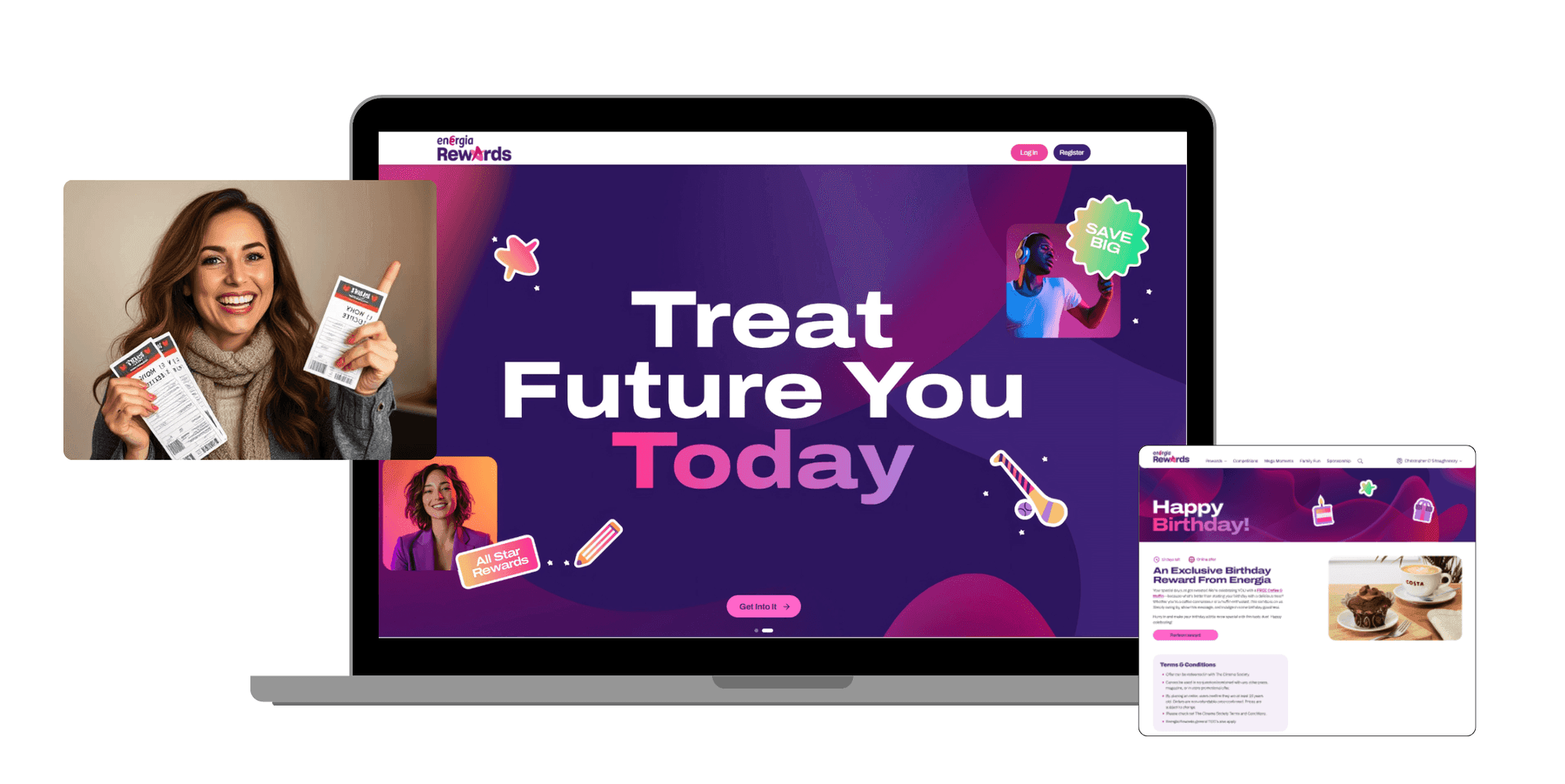
RaftLabs rebuilt the original product in 10-12 weeks and has continued working on it since. The migration covered roughly 500,000 registered users plus linked reward, redemption, competition, and activity records, treated as records to reconcile rather than decorative elements to recreate. After launch, support tickets dropped by 80%, downtime became rare, and server and maintenance costs fell significantly. In 2023, Energia Rewards received the Irish Loyalty Awards' Customer Experience of the Year award, an award for the complete program rather than the rebuild in isolation.
Before and after
From a WordPress ceiling to an observable rewards operation
- WordPress instability and downtime were eroding trust in the rewards experience
- Roughly 500,000 registered users and their activity history had to move safely
- Failed credentials and account mismatches were creating avoidable support work
- Admins could not see when expected customer files were missing or incomplete
- The team lacked flexible campaign controls and dependable participation reporting
- Idempotent migration scripts moved users, rewards, redemptions, competitions, and activity history without duplicating records
- A single Cognito sign-in flow attempted to validate existing credentials and offered a reset path when validation failed
- Scheduled processing handled domestic and commercial joiner and leaver files each morning
- File-status alerts gave operators a warning before a missing feed became a customer complaint
- Campaign tools and Metabase dashboards put participation and operating health in one view
The decisions that made the rebuild work
The real brief was bigger than a redesign
The original request included a modern interface and a better admin experience. Discovery showed that the visible design was only one symptom. The deeper problem was operational: WordPress had reached its limit for a rewards program of this size, outages were too common, campaign management was constrained, and failed customer feeds were difficult to diagnose.
That changed the job from a reskin into a platform replacement. The delivery team included two developers covering frontend and backend, a senior engineer, a project manager, and QA. The initial rebuild shipped in 10-12 weeks under a fixed scope, followed by an ongoing engagement.
Migrate half a million users without losing their history
The migration covered roughly 500,000 registered users and the records that made those accounts useful: rewards, redemptions, competitions, and activity history. The old WordPress/MySQL schema and the new PostgreSQL/Hasura model were materially different, so a one-shot data copy would have been difficult to verify or recover.
RaftLabs used idempotent scripts organized by domain. A failed batch could be rerun without creating duplicate records. Eleven additional remediation scripts handled duplicate emails, letter-case mismatches, unmatched energy accounts, and registrations that had stopped partway through. Rich-text content also had to be converted from HTML into the new editor's structured JSON format.
For a comparable database migration, row counts are only the first check. Identity, account segment, reward history, redemption state, and unresolved exceptions all need their own reconciliation rule.
Give existing users one clear sign-in path
The legacy platform stored WordPress password hashes; the new system used Amazon Cognito. RaftLabs implemented a first-sign-in migration flow that attempted to validate an existing credential before creating the Cognito profile. If validation failed, the customer followed the password-reset path.
AWS documents the underlying pattern in its Cognito user migration guide. The important product decision was not to promise that every legacy credential would work. It was to keep one understandable login journey, preserve the successful credentials, and provide a clear recovery route for the exceptions.
Detect missing customer files before customers felt the failure
Energia supplied four recurring files: domestic joiners, domestic leavers, commercial joiners, and commercial leavers. The rebuilt platform collected and processed them on a schedule, restored history for eligible returning customers, and recorded whether each expected file had arrived.
The monitoring layer made the difference. When a feed was missing, the admin team received an alert instead of discovering the problem through an account-access complaint. After launch, support tickets fell by 80%. This figure comes from the client and project team's support records; the underlying ticket volumes remain confidential.
Prove the platform could absorb campaign traffic
A campaign email to roughly 120,000 users could concentrate thousands of visits into a short window. Load testing therefore covered both pre-login and authenticated journeys, with particular attention to Hasura and database bottlenecks.
The test environment reached 10,000 requests per second and met a target of 29,000 requests in five minutes. During the promotional period, the production platform handled roughly 2,000 logins and 200 registrations while CPU usage stayed below 5%. Since launch, downtime has been rare and server and maintenance costs have fallen significantly.
the build
What the rebuilt rewards platform changed
The customer experience and the operating experience had to improve together. A faster interface would not reduce support work if eligibility files, identity exceptions, campaigns, and reporting still lived in separate workflows.
Registration connected a person to the right utility account
Customers register with an Energia account number and verify by email. The flow distinguishes domestic and commercial accounts so each person sees the rewards and competitions available to their account type. Returning customers can recover their recorded history when they become eligible again.
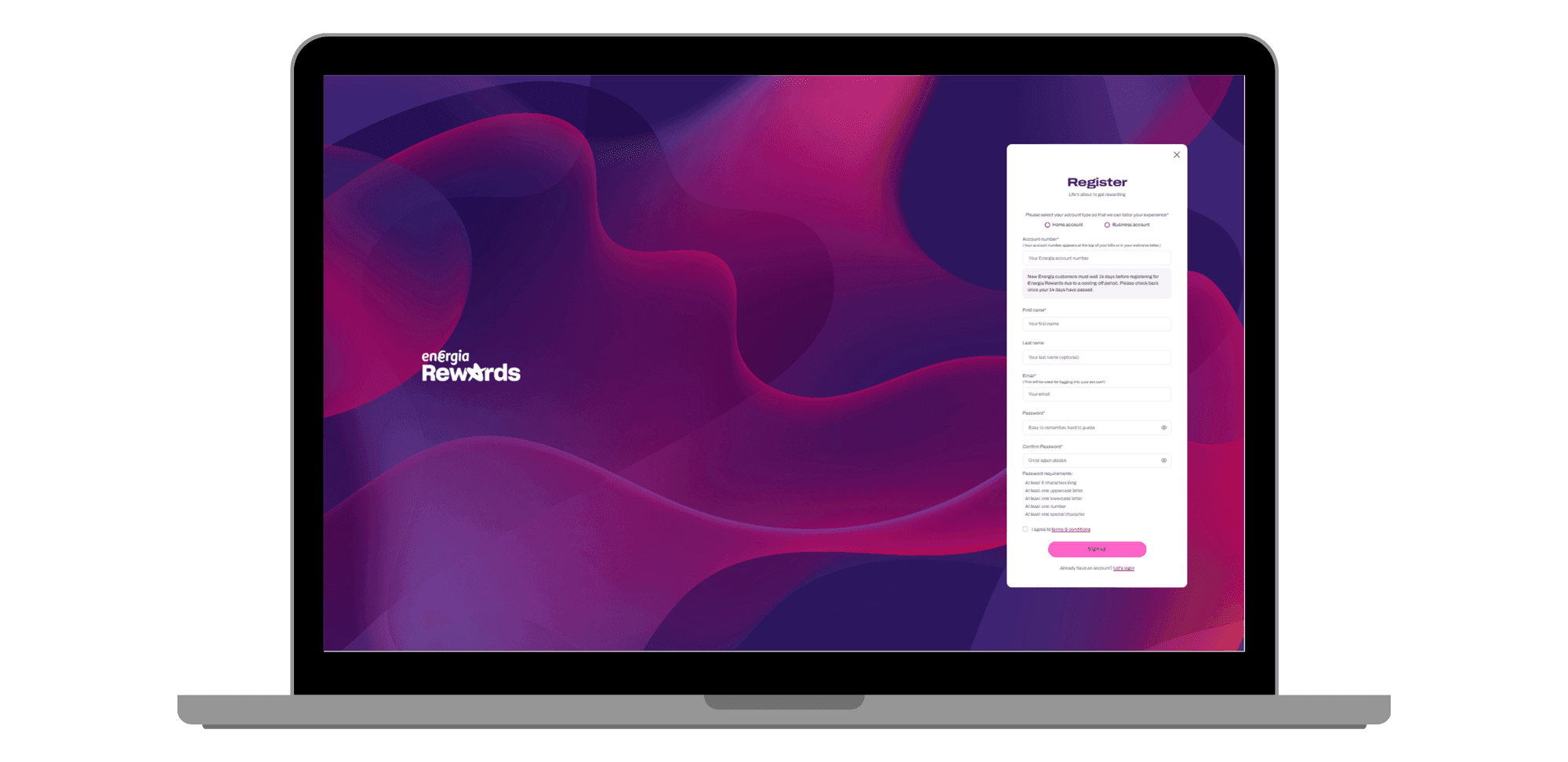
Interface reconstruction based on the delivered registration flow Joiner and leaver files updated access on a schedule
A scheduler collects the four SFTP files and processes changes for both account types. New customers gain access, leavers are deactivated, and re-enrolled customers regain their prior history. The admin team can see the status of each transfer without opening the server or waiting for a complaint.
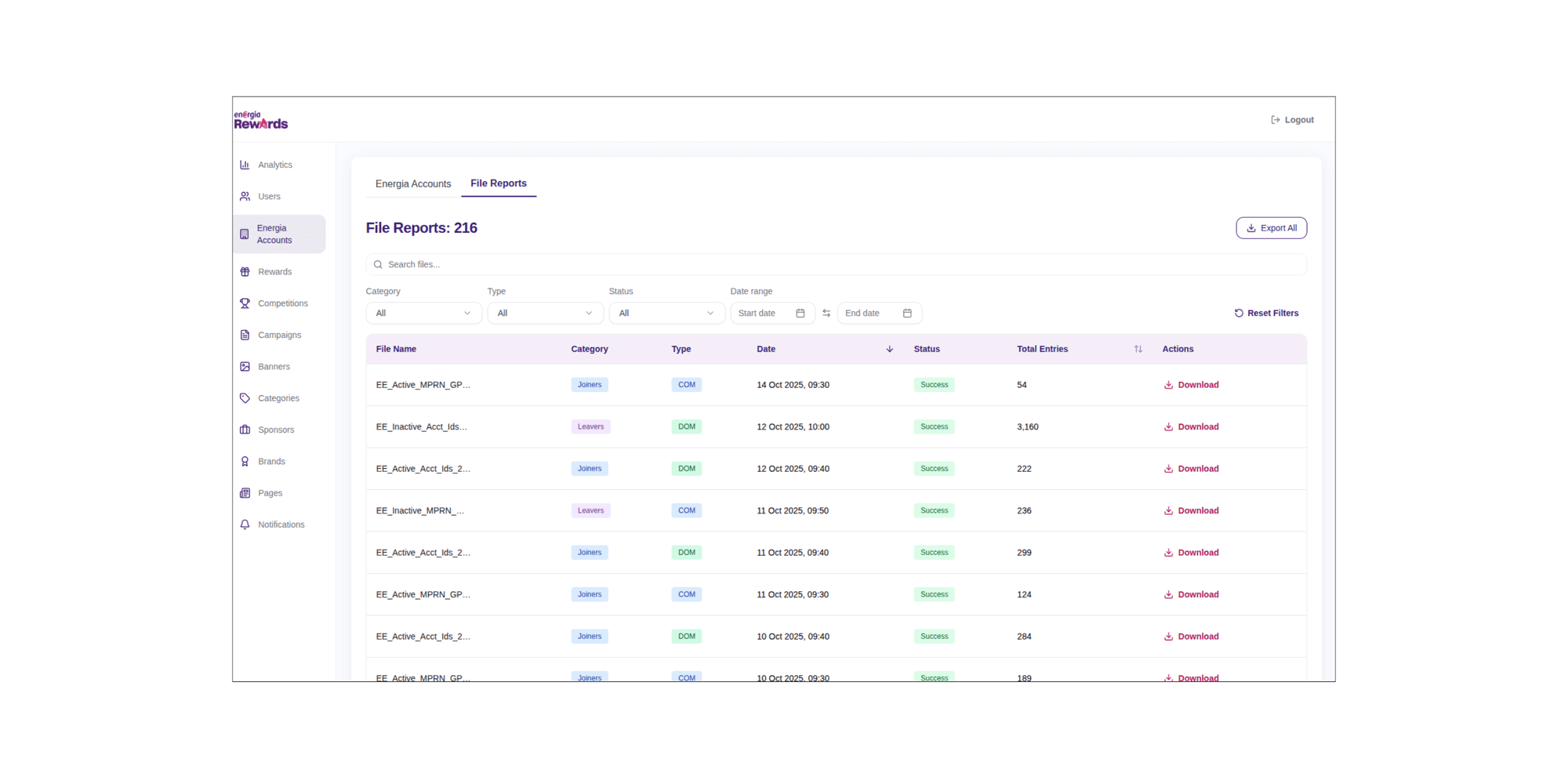
Interface reconstruction based on the delivered operations workflow Rewards and competitions shared one administration surface
The customer dashboard presents partner rewards, redemption instructions, and competitions. Admins can configure instant-win and question-based competitions, group activity into campaigns, issue different coupons, and review participation. Energia's public page confirms that the program offers discounts and rewards from major and independent retailers.
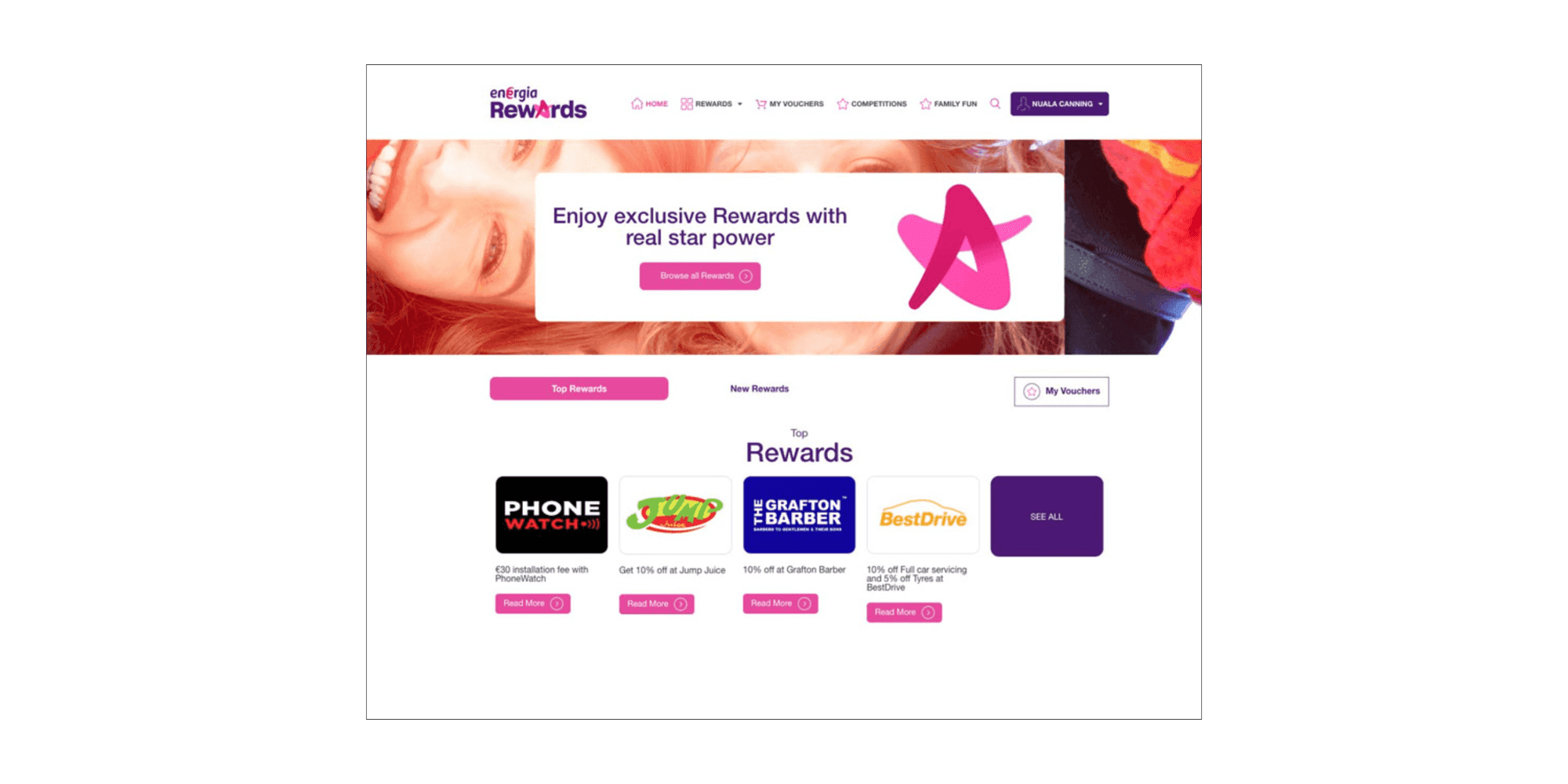
Interface reconstruction based on the delivered campaign tools Dashboards and alerts supported the people running the program
Metabase dashboards show registrations, logins, redemptions, and competition entries. Operators can filter by date, account type, reward, competition, or campaign, then export the result. Alongside the file-status view, this answers two different questions: how customers are using the program, and whether the data operation behind it is healthy.
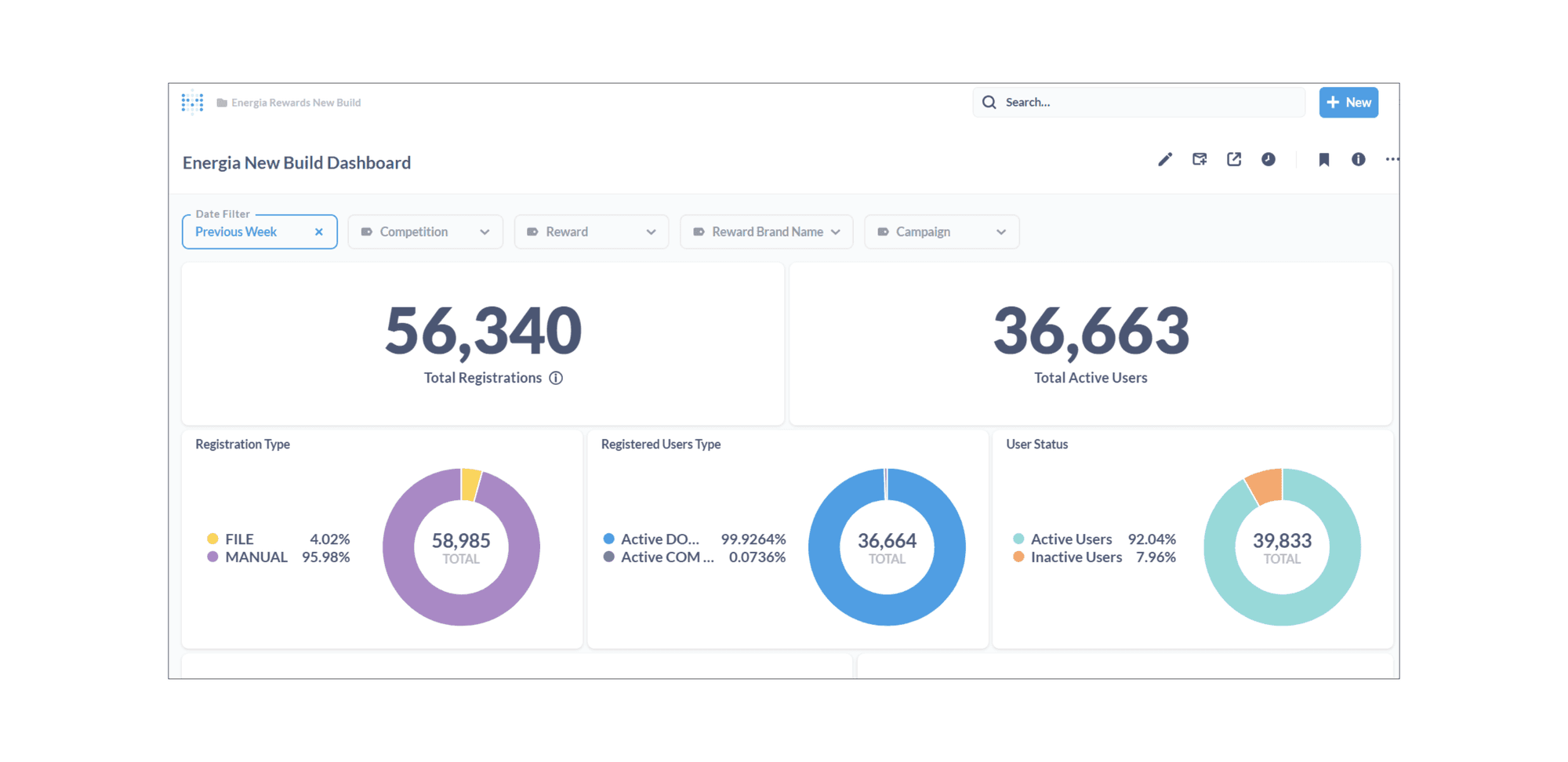
Interface reconstruction based on the delivered reporting and monitoring tools
System flow
How eligibility, identity, and rewards data moved through the platform
A simplified view of the delivered system based on the retained project record. It shows the operating path an enterprise loyalty team needs to monitor; it is not a complete infrastructure diagram.
Customer data
Energia account systems
Domestic and commercial joiner and leaver files supplied the recurring eligibility changes that determined who should gain, lose, or regain access.
Processing and identity
Scheduled sync and Cognito
Scheduled processing validated the customer files and applied account changes. Cognito handled the first-sign-in credential migration and password-reset fallback.
Loyalty data core
PostgreSQL and Hasura
The platform stored customer profiles, rewards, redemptions, competitions, campaigns, and activity records in a structured model exposed through Hasura.
Experience and operations
Customer app, admin, and reporting
The customer and admin applications used the shared data core, while Metabase dashboards and file-status alerts exposed participation and operating health.
Proof
What changed after launch, and what supports each claim
The headline numbers are useful only when their source and limits remain attached. Exact support volumes and cost figures are confidential.
| Result | What changed | Period or context | Evidence and limitation |
|---|---|---|---|
| Support demand | 80% fewer support tickets | After the rebuilt platform launched | Client and project-team support records; exact ticket volumes are confidential |
| Migration | Roughly 500,000 registered users plus linked records moved | Initial migration and cutover | Retained migration and remediation records; the total is approximate |
| Availability | Downtime became rare | Ongoing production operation | Client and project-team report; no public incident count is available |
| Operating cost | Server and maintenance costs fell significantly | Compared with the WordPress setup | Client and project-team report; exact cost figures are confidential |
| Campaign readiness | 10,000 requests per second reached in testing | Pre-launch load testing; target of 29,000 requests in five minutes also met | Retained load-test record; test throughput is not presented as normal production traffic |
The lesson
For enterprise loyalty programs, observability is part of the customer experience
A rewards interface can look healthy while eligibility files, identity exceptions, or redemption records fail behind it. The Energia project reduced support work because the rebuild treated those operating paths as product features: feeds had status, exceptions had recovery routes, and campaign activity had reporting.
If a loyalty team is planning a migration, acceptance criteria should cover reconciliation, recovery, alerting, and real traffic bursts alongside the customer screens. Those controls determine whether the program remains trustworthy after launch.
How it runs
- Next.js
- Next.js powers the customer-facing rewards application. It gave the team a faster, mobile-friendly interface and a maintainable application structure without carrying WordPress into the new platform.
- Hasura and PostgreSQL
- PostgreSQL stores the structured customer, reward, redemption, competition, and activity data. Hasura exposes that model to the customer and admin applications while supporting live operational views.
- AWS Cognito
- Cognito became the identity service. A first-sign-in migration attempted to validate the existing WordPress credential, with a password-reset route for credentials that could not be migrated.
- AWS Amplify Gen 2
- Amplify managed the standard AWS services, while custom CDK constructs gave the team control over Hasura, storage, networking, and environment parity. The result was lower infrastructure and maintenance overhead without giving up control of the production architecture.
- Metabase
- Metabase gives non-technical operators filtered views of registrations, logins, redemptions, competition entries, and campaigns without requiring a separate custom reporting product.
Common questions
The platform had reached WordPress's practical operating limit for Energia's scale and workflow. It suffered frequent downtime, the admin experience made campaign work difficult, and operators could not reliably see whether daily eligibility files had arrived. The project therefore became a full platform rebuild rather than a visual redesign.
It can preserve passwords that the old identity source can validate, but a migration still needs an exception path. Energia's Cognito flow attempted to validate the WordPress credential on first sign-in. When that check failed, the customer reset the password. This kept one login journey without pretending every legacy credential would migrate cleanly.
The migration covered roughly 500,000 registered users plus reward, redemption, competition, and activity records. RaftLabs used rerunnable scripts organized by domain and added 11 remediation scripts for duplicate emails, letter-case mismatches, unmatched accounts, and incomplete registrations. The scope was account continuity, not a simple user-table export.
Define the expected file or event, arrival time, schema, duplicate behavior, retry rule, exception queue, reconciliation report, and owner. Energia's platform processed separate domestic and commercial joiner and leaver files each morning and tracked whether expected feeds arrived. That observable status matters as much as the scheduled transfer because it tells the operating team when customer access may be wrong.
Support tickets dropped by 80%, downtime became rare, and server and maintenance costs fell significantly. The initial platform rebuild led to an ongoing RaftLabs engagement. Exact support volumes and cost figures remain confidential, so this case study reports the observed direction without inventing a baseline.
RaftLabs rebuilt the original Energia Rewards product in 10-12 weeks and continues to work on it. The contract value is private. A useful estimate needs a sample of the legacy data, identity method, integration inventory, reward rules, customer segments, operating feeds, reporting needs, and cutover constraints. See our loyalty platform development service, legacy modernization approach, and pricing guide for the current planning model.
Related work
Related loyalty platform work
Musgrave receipt-scanning loyalty platform
A 12-week loyalty campaign platform for SuperValu and Centra, with 1,610 receipts processed in four weeks.
AldiFest receipt-based loyalty campaign
AldiFest recorded 2,000+ signups and processed 5,000 receipts in its first week.

Bella Skin Institute loyalty app
A custom mobile loyalty program with QR-based point earning, expiring rewards, and an operator-owned admin experience.