Employee engagement and training app
- 3,500+
- active daily users
RPA in HR | HR Process Automation Services
HR teams manage a high volume of structured, rule-based tasks, onboarding new employees, processing payroll inputs, managing leave requests, updating employee records across systems, and producing compliance reports. Most of this work follows the same logic every time and requires no human judgment.
We build robotic process automation systems that handle these HR workflows automatically, so your HR team focuses on the work that actually requires people skills: hiring decisions, employee relations, performance management, and culture.
Employee onboarding automation from offer acceptance to system provisioning
Payroll processing and leave management without manual data entry
Cross-system employee record synchronisation and HRIS data management
Compliance reporting and audit trail maintenance automated end to end
Recent outcomes
Voice AI · Research
6× deeper insights
Text-based interviews converted to automated phone calls
AI Automation · Ops
20k+ txns day one
Manual invoice OCR across 40+ gas stations
Loyalty · Retail
1,062 users in 4 weeks
SuperValu & Centra loyalty platform with receipt validation
SaaS · Logistics
2,000+ shipments yr 1
Multi-carrier shipping hub for Indonesian eCommerce
The problem
Onboarding a new employee taking days of HR admin time across disconnected systems?
Payroll inputs compiled manually each cycle with errors your team spends hours correcting?
Short answer
RaftLabs builds robotic process automation for HR teams: employee onboarding across IT, payroll, and benefits systems, payroll input compilation, leave and absence processing, offboarding with access revocation, HRIS data synchronisation, and compliance reporting. A first automation for one process runs $15,000-$40,000 and goes live in 6-10 weeks. From there it grows into a multi-process programme at $40,000-$100,000.
Key takeaways
Trusted by







An experienced HR hire should not spend two hours a day copying data between your HRIS, payroll system, and IT provisioning tool. That is not the job you hired them for.
RPA takes the rule-based data work off their plate. Your HR team goes back to hiring well, developing people, and handling the calls that need judgment.
Structured HR tasks that repeat the same way every cycle are where automation pays back fastest. The same holds across onboarding, leave, and record sync, not just pay runs.
RaftLabs has shipped production software since 2015 and is rated 4.9/5 by clients on Clutch. The team that scopes your automation is the team that ships it.
Proof
Capabilities
End-to-end onboarding automation triggered by offer acceptance in your ATS or HRIS. The bot creates the employee record, provisions accounts, and sends credentials and first-day instructions within minutes of the hire being confirmed. IT provisioning follows role-based templates, and benefits and payroll records are set up automatically. A process that takes 2 to 4 days across 6 to 8 systems completes in under 15 minutes.
Automated extraction and compilation of payroll inputs: timesheets, expense claims, commissions, and absence deductions, consolidated and loaded into your payroll platform in the exact format it requires. Variance detection flags anomalies before processing, such as hours well outside contracted levels or unusual commission swings, so nothing processes silently. A cycle that involves 3 to 8 hours of manual data gathering runs automatically in under 30 minutes.
Automated leave request processing from submission through approval, balance update, and payroll deduction, without HR touching any standard request. Entitlement rules apply per contract type and jurisdiction, including UK Working Time Regulations, US FMLA, and Australian National Employment Standards. Requests exceeding the accrued balance are auto-declined with the correct balance shown, and absence pattern monitoring flags Bradford Factor scores above threshold. Standard requests clear same-day; only FMLA, long-term sickness, and disputed balance cases escalate.
Systematic offboarding triggered by the termination date in the HRIS and executed on the last working day without HR initiating each step. Access revocation covers your directory, email, and SaaS tools, with file ownership transferred to the manager before account closure. Final pay inputs, including leave payout and notice, go to payroll automatically, and the benefits provider is notified. GDPR-compliant retention scheduling removes personal data after the required period.
Automated propagation of employee master data from the HRIS to every downstream system, so a promotion or pay change entered once flows to payroll, finance, and IT automatically. Delta sync processes only records changed since the last run. Conflicts route to an exception queue with both values shown instead of silently overwriting either version, and validation checks catch bad data before it propagates. Employee data stays reporting-ready across all systems without manual reconciliation.
Automated assembly of HR compliance reports from HRIS, payroll, and timekeeping systems, delivered on schedule without anyone pulling data the night before the deadline. US reports include EEO-1, FLSA overtime compliance, and FMLA tracking; UK reports include Gender Pay Gap data formatted for GOV.UK submission. Audit trails are kept in an append-only log exportable for SOC 2 evidence or ISO 27001 reviews. Reporting that took 2 to 3 days of manual data gathering completes overnight.
Most HR automation is deterministic. The screens and fields do not change, so a rule-based bot reads the timesheet export, maps the columns, and loads payroll the same way every run. That path is reliable and easy to audit.
Some HR inputs are not structured. Resumes, offer letters, right-to-work documents, and benefits enrolment forms arrive in a different layout every time. For those we use intelligent document processing (IDP). A model pulls out the fields, and a confidence score sends anything uncertain to a person instead of guessing. Resume and ATS data entry, candidate record creation, and benefits intake run this way.
The rule we hold: a deterministic bot where the process is stable, IDP only where the document genuinely varies. IDP adds cost and a review step, so we do not reach for it when a plain bot will do.
HR data is some of the most sensitive a company holds. Every bot we build touches only the fields its step needs, keeps credentials in a secrets manager, writes an append-only log of everything it does, and runs under role-based access. Under GDPR, that log is what lets you show lawful processing and honour retention and erasure requests. Automation does not lower your obligations. It makes them easier to evidence.
What clients say
Three-year average engagement. Founders and operators describing the work in their own words. No marketing varnish.

 USA
USAAll of the sprints were completed on schedule and on budget. We highly recommend RaftLabs!
Process, current systems, and volume. We'll design the automation and give you a fixed cost.
Stay on topic
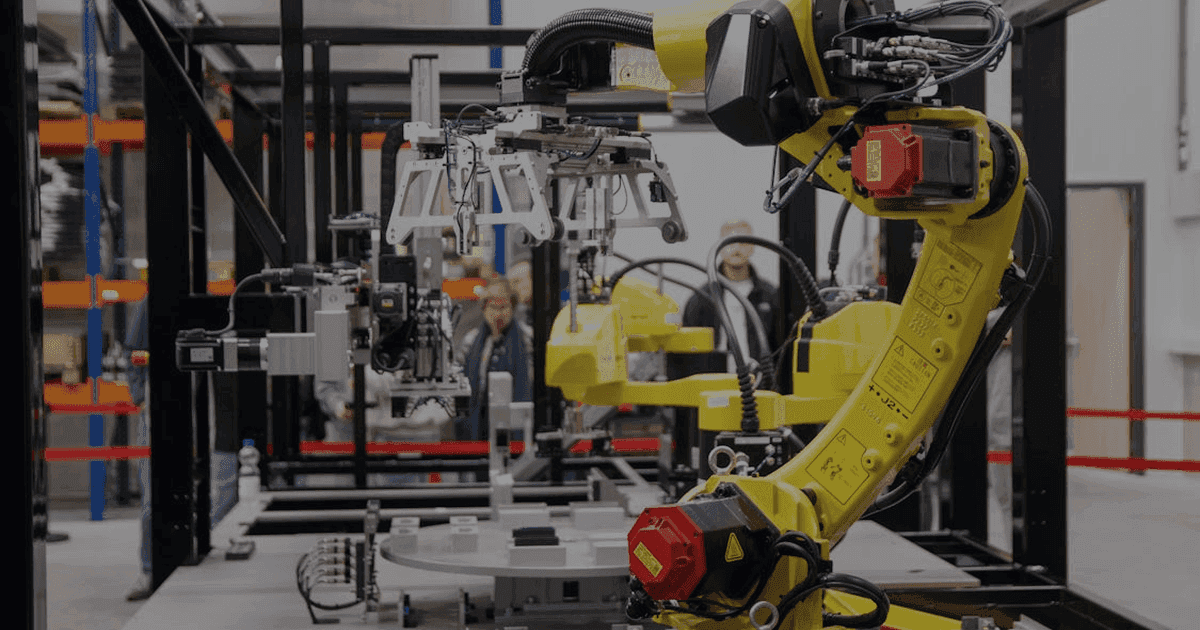
Article
Why your RPA is stalling (and what comes after)
Most RPA bots hit a wall at 60-70% automation. Here's why RPA fails to scale - and how AI agents handle the exceptions that break every bot.
Read more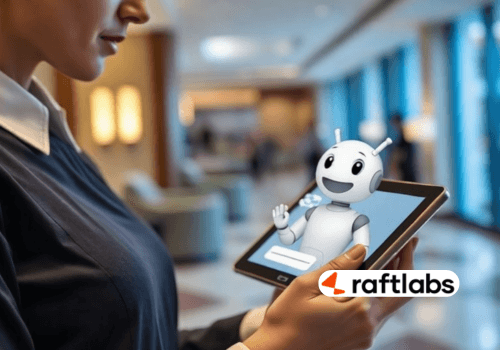
Article
AI Chatbots in Hospitality Industry: Implementation Guide, ROI & Best Practices 2026
Hotels using AI chatbots cut front-desk call volume by 25-40% and reduce OTA dependency. Here's what actually works, what fails, and how to implement it.
Read more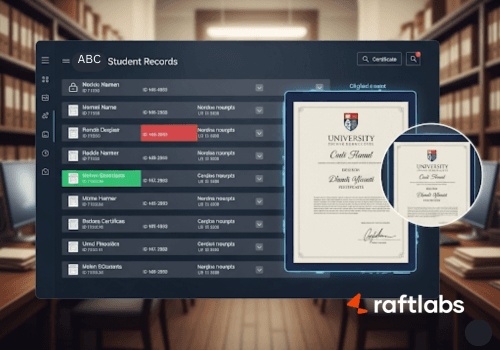
Article
Intelligent Document Processing for Education and Universities
Intelligent document processing for education automates admissions forms, transcript digitization, faculty HR records, and accreditation documentation.
Read moreThe highest-value HR automation candidates are high volume, rule-based, and currently involve copying data between systems. Top processes: employee onboarding (creating accounts in IT systems, setting up benefits, sending welcome packs, all triggered by a hire in the HRIS), payroll input processing (extracting timesheet, expense, and variable pay data and loading it into the payroll system), leave management (processing requests, updating balances, notifying managers), employee offboarding (revoking system access, processing final pay, exiting from benefits), compliance and audit reporting, and employee record synchronisation across HR, payroll, and finance systems.
We integrate with HRIS platforms via API where available or UI automation where not. Common integrations: Workday, SAP SuccessFactors, BambooHR, ADP, Oracle HCM, and Sage HR. For HRIS platforms with strong APIs, we use the API directly for reliable, supported data access. For legacy HRIS platforms, we use UI automation (the bot interacts as a user would). We also build the data pipelines between HRIS and downstream systems, payroll, IT provisioning, finance, and Active Directory, that HR teams currently manage manually.
Yes. A full onboarding automation covers: triggering from offer acceptance in the ATS or HRIS, creating accounts in IT systems (Active Directory, Google Workspace, Slack, CRM), provisioning role-based software access, setting up payroll and benefits, notifying the manager and team, sending the employee welcome materials and first-day instructions, and scheduling onboarding tasks. The bot handles every step that follows a rule. The HR team handles the steps that require judgment, offer negotiation, culture conversations, and personal onboarding support.
HR data is subject to GDPR, local employment law data retention requirements, and your organisation's data handling policies. We build HR RPA systems with data minimisation principles (bots access only the data they need), full audit logs of every action taken, encrypted credential management, and role-based access controls. Automation doesn't reduce your compliance obligations, it makes compliance easier to demonstrate through complete, consistent audit trails.
A focused HR automation system, one process automated (e.g., employee onboarding across 4 systems), including bot development, testing in your environment, and deployment, typically runs $15,000-$40,000. Multi-process HR automation programmes covering onboarding, payroll, and compliance reporting run $40,000-$100,000. Cost depends on the number of processes, system integrations, and complexity of the logic. We scope every project before pricing it.
Work with us
We scope RPA in HR in 30 minutes. You walk away with a clear cost, timeline, and approach. No commitment required.