
Charles E.
Entrepreneur at Aggie Technologies
 USA
USA
All of the sprints were completed on schedule and on budget. We highly recommend RaftLabs!
Inventory Management ERP Software
Inventory management ERP covers the movement, valuation, and visibility of stock across every location in your business, from goods receipt at the dock through storage, picking, packing, and dispatch. When inventory lives in a spreadsheet or a system that doesn't update in real time, every decision made between updates is made on stale data: purchasing based on inventory that moved three days ago, production planned against stock that was already consumed.
RaftLabs builds custom inventory management ERP software designed for your stock model, single-location or multi-warehouse, lot-tracked or serial-tracked, FIFO or FEFO, B2B or B2C fulfilment. Real-time inventory visibility, receiving workflows, pick-pack-ship, replenishment automation, and the integrations with your e-commerce, production, and finance systems that make the inventory record trustworthy.
Real-time inventory visibility by location, lot, and serial number, not yesterday's spreadsheet
Goods receipt workflow with inspection and quality hold before stock is available
Pick-pack-ship workflow with barcode scanning and dispatch confirmation
Reorder point and safety stock management with automated purchase requisition generation
Bring the problem, the current workflow, or the existing code. We reply with a practical next step within one business day.
Trusted by
































The brief
Good software decisions begin with the constraint, not a list of features or a preferred technology.
How often does your team discover an inventory discrepancy, a system quantity that doesn't match what's on the shelf, and how long does it take to find the cause?
Are purchasing decisions made on inventory data that's hours or days old because the system doesn't update in real time?
Plain answer
RaftLabs builds custom inventory management ERP software: real-time stock visibility, goods receipt, pick-pack-ship, lot and serial tracking, cycle counting, and multi-warehouse replenishment, designed around your stock model. A first inventory module starts around $30,000 to $50,000 and launches in 12 to 16 weeks, then grows into the full platform.
What to remember
Inventory accuracy isn't a warehouse discipline problem, it's a systems problem. Enter transactions by hand and they land late. Give teams no lot support in the system and they track lots in a side spreadsheet. Drop scan confirmation from the pick and stock leaves from the wrong bin, with nobody seeing the discrepancy until a customer complaint or a stocktake. The errors that compound between physical counts aren't random. They follow the same gaps in your inventory management ERP every time.
Custom inventory ERP closes those gaps at the transaction level. Goods receipts post when stock is physically received, not when an administrator processes the paperwork. Pick confirmation requires a scan that matches the expected SKU, location, and quantity, catching errors before they leave the warehouse. Lot and serial number tracking is part of the core transaction flow, not a workaround maintained alongside the system. The result is an inventory record your purchasing team, production planners, and finance team can trust without checking it against a separate source.
The cost of inventory data that doesn't reflect reality runs into the trillions, and the root cause is nearly always the same: the system recording transactions sits too far from the transactions themselves.
Capabilities
Inventory records update as each transaction posts, tracking on-hand, reserved, available, in-transit, and on-order quantities separately per SKU per location. Purchasing commits against true availability, not double-counted stock, with FIFO, FEFO, weighted average, and standard cost valuation.
A warehouse-dock receiving workflow with barcode scan for PO, SKU, and quantity, over and under receipts flagged against tolerance bands, and inspection-required items held on quality hold until QC signs off. Lot numbers, expiry dates, and supplier batch references are captured per line, and directed putaway suggests the right bin by zone, velocity class, and capacity.
Pick lists sequence by zone, aisle, rack, and level to cut picker travel, with wave picking for peak periods. Every pick is confirmed by scan, catching errors inside the warehouse, and dispatch confirmation decrements inventory, updates the order, notifies the customer, and creates the AR invoice line in one step.
Separate inventory records per site with a configurable location hierarchy from site down to bin. Inter-warehouse transfers track in-transit stock as its own status so nothing is double-counted, and consignment stock is tracked separately by owning supplier with automatic monthly reconciliation.
Every movement records against its originating lot number, giving forward and backward traceability from supplier batch to customer shipment for recall response. Serial number tracking covers warranty and repair history per unit, and FEFO picking is enforced, assigning the earliest-expiry lot every time for regulated goods.
Reorder points calculated per SKU per location from demand, supplier lead time, and safety stock. When stock falls below the reorder point, a purchase requisition generates with the preferred supplier and delivery date pre-filled, and supplier lead times self-update from actual receipt data.
ERP Software Development, full ERP capability overview
Manufacturing ERP Software, production modules that consume inventory
Finance and Accounting ERP, finance integration with inventory valuation
ERP Integration Services, connecting inventory ERP to e-commerce and 3PL
What clients say
Three-year average engagement. Founders and operators describing the work in their own words. No marketing varnish.
Charles E.
Entrepreneur at Aggie Technologies
USA
All of the sprints were completed on schedule and on budget. We highly recommend RaftLabs!
The closest proof sits in the neighbouring problems that share an inventory build's hard parts: keeping stock and transaction records in sync across many locations, and moving goods out the door reliably.
Proof
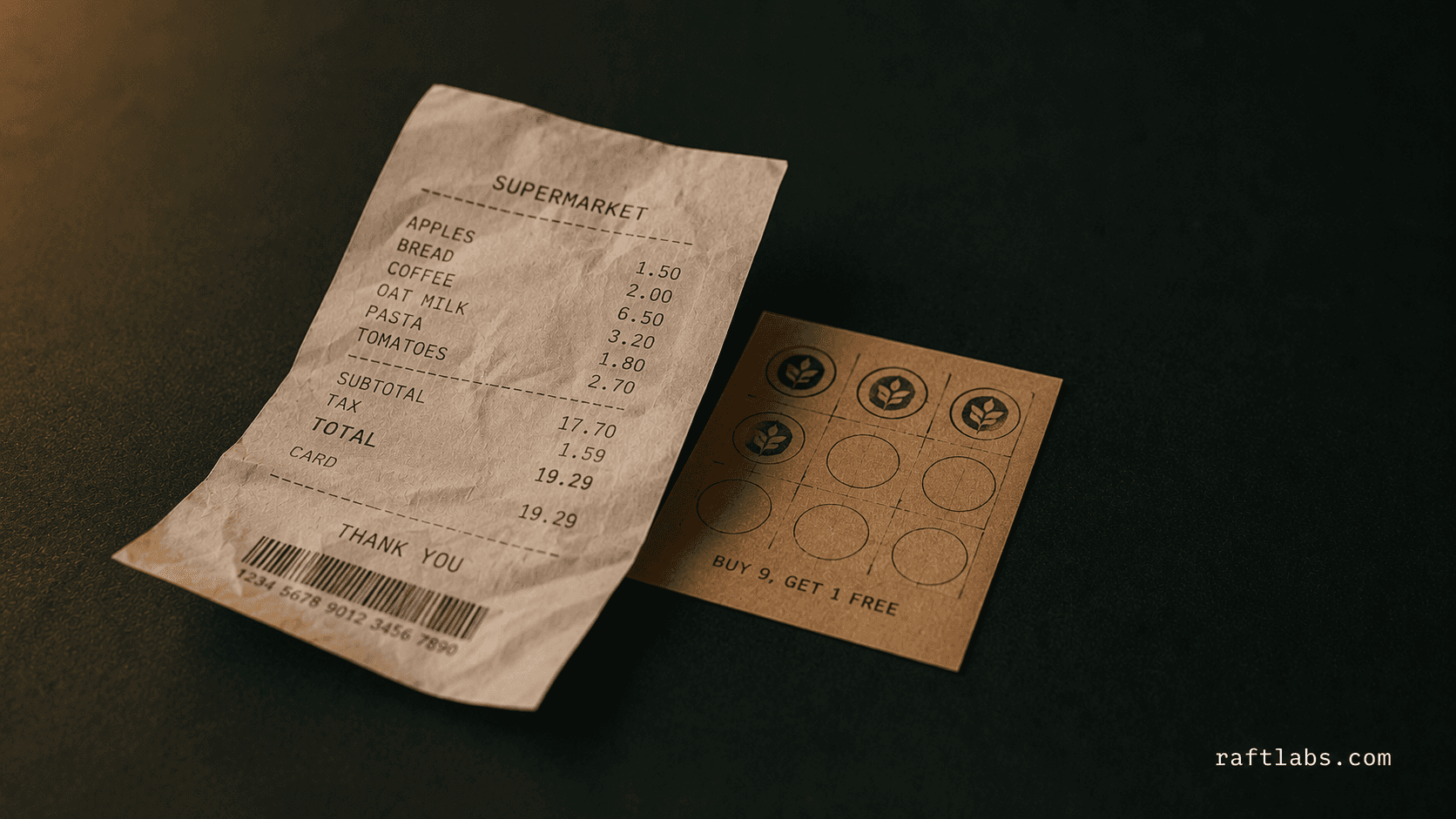
AldiFest signed up 2,000+ shoppers and processed 5,000 receipts in week one. The campaign team also reported 2x purchase frequency and 25% higher average purchase value; the public case record does not retain the measurement method.
Useful next steps
Work with us
Conversation Intelligence Software Development
See the serviceTry it yourself
Logistics Software Cost Calculator
TMS, fleet, freight, or shipping software. Honest build range in 3 minutes.
Open the free tool
Article
15 Top Hospitality Tech Companies in 2026 Transforming Hotels & Travel
The hospitality tech market is growing from $9.1B to $16.2B by 2033. Here are 15 companies leading that shift, with ROI benchmarks, PMS comparisons, and a practical selection framework.
Read more
Article
How to Build Custom Commission Management Software
Spiff starts at $65,000 a year. CaptivateIQ enterprise runs $120,000. If your commission rules include multi-tier splits, captive-plus-independent agent structures, or CRM integrations that Salesforce cannot handle natively, here is when building your own makes financial sense and what it costs.
Read more
Article
Enterprise Software Development Cost in 2026: Full Breakdown
Enterprise software development costs $50,000 for an internal departmental tool to over $1,000,000 for a compliance-heavy platform with deep legacy integrations. Here is what drives the difference.
Read more
Article
Mortgage CRM Software: Build vs. Buy for Lenders Beyond Total Expert
Mortgage lenders hitting the ceiling on Total Expert, Jungo, or Surefire CRM face a common fork: pay more per seat for features that don't fit, or build software that works the way your operation actually does. Here is what that decision costs and when it makes sense.
Read moreLot tracking records the origin lot for every unit of stock from goods receipt through dispatch. Expiry date management assigns an expiry date to each lot at receipt and enforces FEFO (first expired, first out) picking so the nearest-expiry stock is always picked first. Quality hold at receipt prevents out-of-specification lots from entering available stock. Forward traceability from a lot to all customer shipments containing that lot supports recall management. The specific configuration of lot attributes (batch number format, expiry date format, quality attributes captured at receipt) is designed around your product and regulatory requirements.
E-commerce integration (Shopify, WooCommerce, Magento) creates sales orders in the inventory system from web orders, decrements stock on fulfilment, and updates the e-commerce platform with tracking information. 3PL integration requires an API or EDI connection to the 3PL's WMS to send pick instructions and receive confirmation. The integration approach depends on what interfaces your 3PL exposes, most large 3PLs have EDI or API connectivity, smaller 3PLs may require file-based integration.
Inventory accuracy between full stocktakes is maintained through cycle counting, counting a subset of locations on a rotating schedule so every location is counted multiple times per year without disrupting operations. Discrepancies found during cycle counts are investigated and adjusted before they accumulate. High-value or fast-moving items are counted more frequently. The cycle count programme is configured in the system with count assignments generated automatically, results recorded by scan, and discrepancies flagged for investigation before adjustment posting.
Reorder point is average daily demand multiplied by supplier lead time in days, plus safety stock. Safety stock comes from a target service level (the Z-factor), demand variability, and lead-time variability, so a SKU with erratic demand or an unreliable supplier carries a larger buffer than a steady one. The system recalculates both per SKU per location as demand and actual receipt lead times change, so reorder points track reality instead of a number someone set once and forgot. When on-hand plus on-order falls below the reorder point, a purchase requisition generates automatically with the preferred supplier and expected delivery date pre-filled.
A first inventory module covering real-time stock visibility, goods receipt, pick-pack-ship, and basic replenishment starts around $30,000 to $50,000. The full platform, adding lot tracking, multi-warehouse management, 3PL integration, and e-commerce connectivity, grows to $100,000 to $150,000 over time. The price is fixed and agreed before each phase starts, so you fund the next module once the last one is live and earning its keep.
Work with us
Tell us your stock model, the locations you manage, and where the current system breaks down. We'll scope the ERP and give you a fixed cost.