"I was pleased with RaftLabs team's quality, consistency and execution."

Dr.J. Ayo Akinyele
President, Co-Founder, Yeletech Security Inc & Bolt
Equipment Rental Management Software Services
Bundled rental suites were built for a generic rental yard, and most operators run a fraction of the modules they're paying for. We build the rental-contract, utilization-billing, and damage-inspection data model around how your yard actually tracks excavators, generators, lifts, and tools, integrated natively with the accounting and dealer systems you already run.
Rental-contract and reservation engine built around your actual fleet mix, not a generic asset template
Utilization-based billing across daily, weekly, and monthly rental terms, with automatic overage and late-return handling
Damage and return-condition inspection tied directly to the contract record, not a separate checklist app
Fixed-cost delivery, scoped up front, with source code ownership
Bring the problem, the current workflow, or the existing code. We reply with a practical next step within one business day.
Trusted by

















The brief
Good software decisions begin with the constraint, not a list of features or a preferred technology.
Still paying per-seat, per-branch fees for ERP modules your yard has never opened?
Return-condition disputes with contractors dragging on because your checklist tool doesn't tie damage photos back to the original contract?
Plain answer
Rental management software for equipment yards covers the rental-contract engine, utilization-based billing, damage and return-condition inspection, and multi-branch reporting for reservations, dispatch, and returns. RaftLabs builds it as a custom alternative to bundled rental suites for yards whose fleet mix has outgrown a generic per-seat platform. Every build is fixed cost, scoped after discovery.
What to remember
Proof
A generic rental suite ships with modules for every kind of yard - and bills you for all of them whether you run excavators, generators, lifts, or power tools. As you add branches, the per-seat and per-branch fees compound faster than the platform earns its keep. We build the custom reservation, billing, and inspection data model around the fleet you actually run. Reservation and dispatch for field crews is the neighbouring problem; see field service management software. For yards that also track parts and stock, inventory management software covers the other half of the yard.
Capabilities
Reservations, contracts, and availability tracked against your real fleet mix - by asset class, by branch - not a generic equipment template bolted onto a broader ERP.
Daily, weekly, and monthly rental terms with automatic overage, late-return, and proration handling, built to match how your yard actually prices equipment.
Return-condition checks, photos, and damage charges tied directly to the contract record, so disputes with contractors are settled against the original reservation, not a disconnected checklist.
Fleet utilization, idle time, and revenue-per-asset visibility across branches, scoped around how your operation is actually structured.
Delivery and pickup scheduling coordinated against contract dates and driver availability, so equipment moves without a side spreadsheet.
Native integration with the accounting or dealer systems you already run, instead of routing data through bolted-on add-on modules.
How we work
We map your fleet mix, branch structure, billing terms, and existing accounting or dealer integrations. You leave with a written scope and a fixed-price quote.
We design the contract, utilization-billing, and inspection data model, along with the integration layer for your accounting and dealer systems.
You review working software at each sprint. Reservations, billing, and inspection components are built and tested incrementally.
The platform runs against live reservations at one branch so your team can validate billing and inspection accuracy before rolling out fleet-wide.
Working with us
The people who map your fleet and branch structure also build the platform. No offshore handoff after the contract is signed.
We scope the work, calculate the cost, and lock it in writing before any development starts.
A track record building operational software that handles real contract, billing, and inventory logic - not just a UI over a generic database.
No per-seat, per-branch licensing after delivery. The codebase, and everything built into it, is yours.
It is whether software is the right answer at all. We use four possible recommendations before discussing a development scope.
Use a rental management suite when its reservation, billing, and inspection modules fit your fleet mix.
Keep the current system when the fleet is small and the per-seat fees stay below the cost of a build. Start with evidence: what the fees compound to as branches grow.
Own the data model when the fleet mix does not fit any template. Start with reservation, billing, and inspection around the fleet you run.
Do not build around a fleet that is still changing composition. Settle what you run, then model it.
Not sure which path is yours? Bring it to a 30-minute call. Leave with the answer in writing.
Everything on the left should already be true. Even one thing on the right, and a generic rental suite is the smarter first step.
Your fleet mix, contract terms, or accounting integration do not fit the bundled model well
You are paying for modules you do not use
Reservations, contracts, and billing are the MVP core, with damage inspection and multi-branch reporting as the fuller build
Your operation is standardized and the generic rental suite fits
Per-seat and per-branch pricing scales acceptably for your branches
What it costs
The first phase builds the reservation, billing, and inspection data model around the fleet you actually run.
Starting investment
Starts at $10000
Scoped around your fleet mix and branches, priced in writing before development. After a 30-minute call, you get a written build, buy, repair, or wait recommendation plus first-phase direction. Free, whether or not you build with us.
| Point of Rental, Texada, or RentalMan | Custom software | |
|---|---|---|
| Model | Established suites built for a generic rental operation | Built around your fleet mix, contract terms, and accounting integration |
| Pricing | Priced per seat and per branch as you scale | Scoped around your fleet mix and branches, priced in writing before development |
| When custom wins | The bundled model fits your fleet mix and contract terms | Your fleet mix, contract terms, or accounting integration do not fit the bundled model well, or you are paying for modules you do not use |
Proof
Three-year average engagement. Founders and operators describing the work in their own words. No marketing varnish.
"I was pleased with RaftLabs team's quality, consistency and execution."
Dr.J. Ayo Akinyele
President, Co-Founder, Yeletech Security Inc & Bolt
Work with us
Tell us how your yard tracks reservations and billing today, and where the bundled modules stop fitting. We'll scope a fixed-cost build.
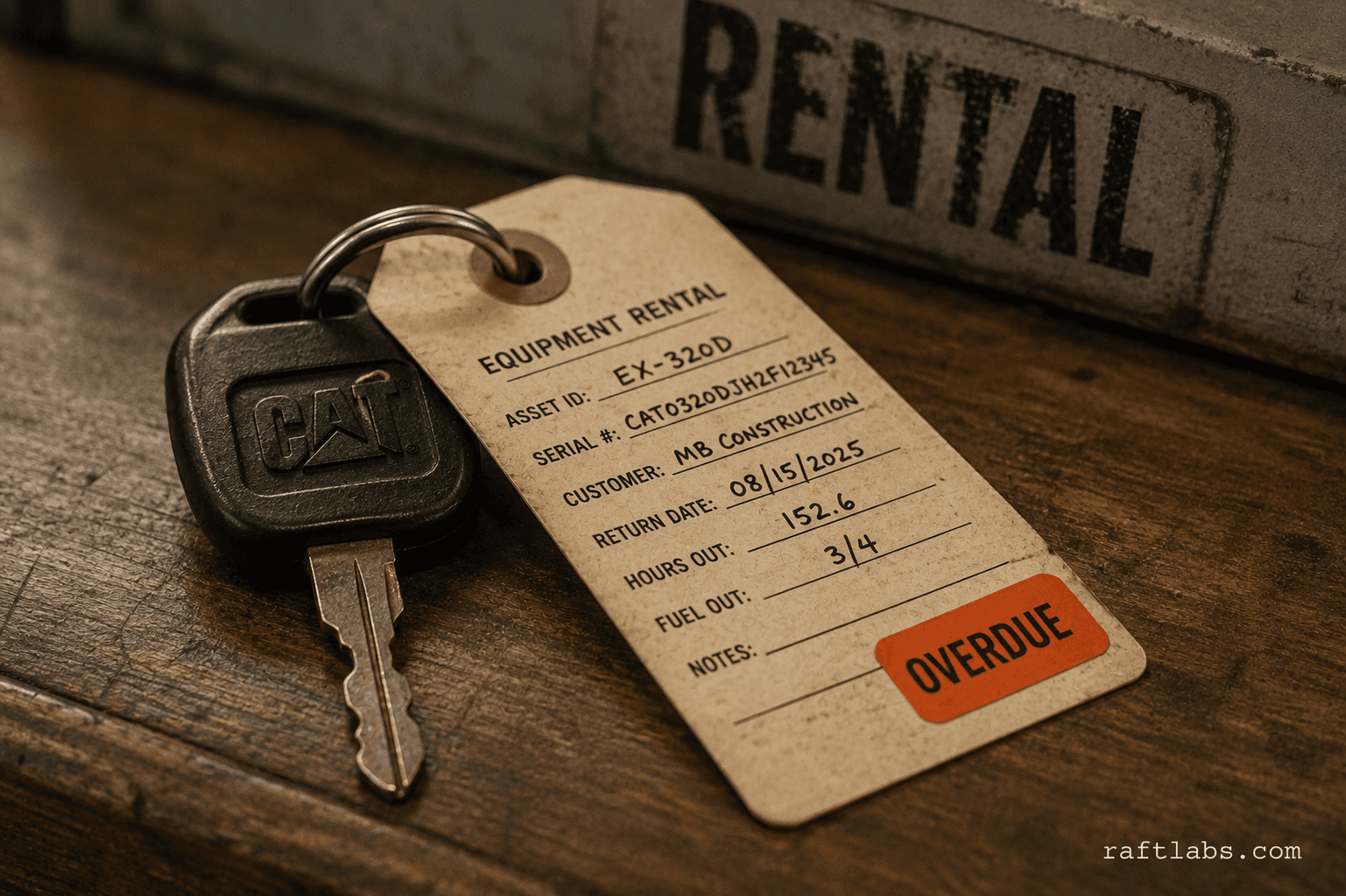
Equipment rental software manages the full rental lifecycle for a yard - reservations and contracts, utilization-based billing, dispatch and return logistics, and damage or return-condition inspection - for fleets that range from excavators and generators to lifts and power tools.
Yes. We build inspection directly into the contract record, so return-condition photos, notes, and any damage charges are tied to the original reservation rather than living in a separate checklist tool that has to be manually cross-referenced during a dispute.
Yes. Fleet utilization, idle time, and revenue-per-asset reporting across branches is scoped during discovery around how your operation actually tracks equipment - by yard, by asset class, or by region.
Cost follows scope: the size of the fleet, the number of branches, and how complex the utilization billing and damage-inspection workflows are. An MVP covers reservations, contracts, and basic billing; a full build adds damage inspection and multi-branch utilization reporting. We scope a fixed cost after discovery.
Those platforms are established suites built for a generic rental operation, priced per seat and per branch as you scale. Custom software makes sense once your fleet mix, contract terms, or accounting integration don't fit the bundled model well, or you're paying for modules you don't use. We help assess the right fit during discovery.
Match the platform to your operation's shape, not its marketing. Simple inventory plus booking needs a simple tool. Operations that also schedule crew and vehicles need the heavier platform, and should budget for the learning curve that comes with it. Pick the one that mirrors how your yard actually works.
Actual hours used divided by available hours. Set targets with buffer for maintenance windows, and flag assets sitting idle well beyond your normal turn cycle. Utilization dashboards only work with clean data and trained staff: without both, the software is a spreadsheet with better fonts. Prove ROI the same way: utilization rates, maintenance cost per asset, booking-to-delivery time.
Start with your rental management system first. Only consider telematics platforms with documented integrations to it: equipment telematics should read engine hours and fault codes from the CAN bus or AEMP feeds, not just GPS. The integration-first rule: if the telematics platform cannot write to your rental system, it is a second dashboard, not an integration.
Buy for standardized operations, build for genuinely unique workflows or a data-control strategy, extend a proven platform as the middle path. The honest build math: vendors own maintenance, support, upgrades, and hosting. Whoever builds owns that too, including hour-threshold work orders, automated alerts, digital logs, and PMs scheduled during low-demand periods.
Ask for the utilization dashboard: can it show actual versus available hours per asset, per branch? Check the maintenance story: does it schedule preventive work during low-demand periods, or just log breakdowns? Confirm the billing model: is it utilization-based, and does it handle damage and return-condition inspection? And run the integration test: does it connect to your accounting and dealer systems natively, or does someone retype the numbers?
Yes. We build the integration around the accounting or dealer systems you already run, rather than requiring you to migrate onto add-on modules bolted onto a legacy RMS platform.