Short answer
RaftLabs built InvestIQ, a real-time market events aggregator for Indian retail investors that consolidates IPOs, buybacks, and OFS listings from NSE and BSE into one feed with category-wise subscription status updated every 30 minutes, gray market premium data, and automated deadline alerts. InvestIQ reached 5,000+ active users in its first 90 days and reduced the number of sources investors needed to check from 4 to 6 sites down to one. Built in 10 weeks using Next.js with ISR, Node.js for data ingestion, PostgreSQL for event lifecycle management, and AWS Lambda and SNS for scheduled refreshes and notification delivery.
The situation
Retail investors following the Indian IPO market have a coordination problem. NSE, BSE, SEBI filings, gray market forums, ASBA status pages: useful information is spread across a dozen sources, each requiring its own login or manual refresh.
A typical research session before acting on an IPO could involve four to six browser tabs, none of which updated at the same frequency. Subscription data lived on exchange sites. Grey market premium lived in Telegram channels. Key dates required manual calendar entries. For investors tracking five or ten events at once, the overhead consumed as much time as the research itself.
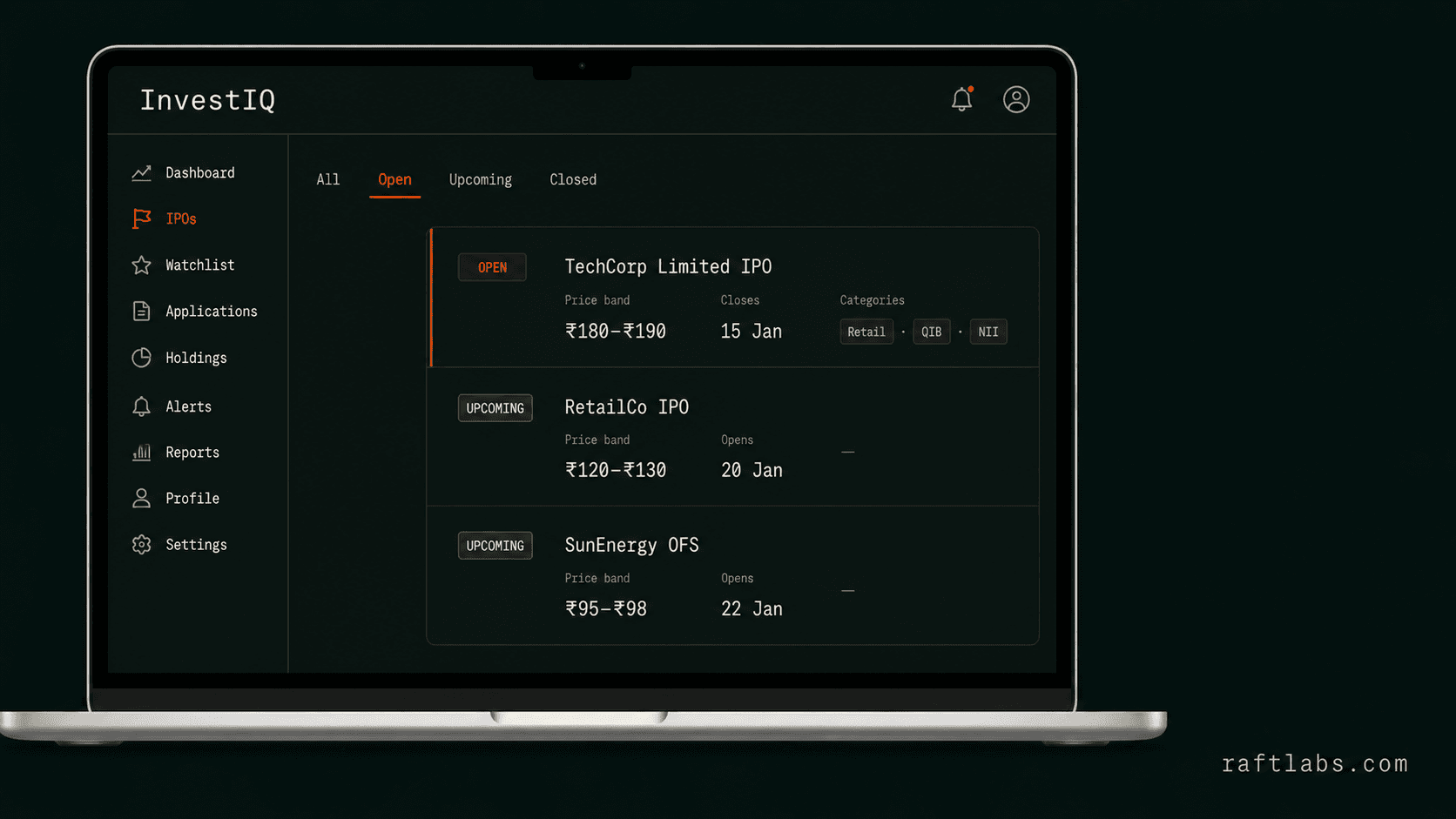
InvestIQ consolidates that. We built it as a real-time feed: every open, upcoming, and recently closed market event (IPOs, buybacks, OFS listings) with subscription status, gray market premium where available, and all key dates visible without navigating away. The client reported that 5,000+ active users found it in the first 90 days.
The emotional engine is regret. Investors describe missed IPOs as reference traumas: I missed the last big one, this time I am not letting go. And the ritual is a lottery: apply, wait, check, hope, with funds blocked across a month of applications and no allotment at the end of it. A tracker earns its place by helping people decide which lotteries are worth the locked-up capital.
Engagement
The InvestIQ engagement
- Product
- InvestIQ, a real-time tracker for Indian market events: IPOs, buybacks, OFS listings, with subscription status, gray market premium, and key dates
- What we built
- A unified feed normalizing NSE, BSE, SEBI registrar, and community GMP data, with deadline alerts (subscription open, day-before-close, allotment, listing) scaled to thousands of recipients
- Stack
- Data ingestion and normalization layer, AWS SNS for alert delivery
- Status
- Live. The client reported 5,000+ active users in the first 90 days
Before and after
What changed
- IPO dates and deadlines tracked manually in spreadsheets or via fragmented Telegram channels: a missed subscription date meant a missed opportunity
- Category-wise subscription data and gray market premium lived on separate sites with no tool connecting them in one view
- Setting reminders for subscription open, close, allotment, and listing required manual calendar entries for every IPO tracked
- Data on competing tools updated once daily: subscription momentum during the final hours of a window was invisible
- No way to filter open and upcoming events by status, making it easy to miss events in the application window
- Every open, upcoming, and recently closed IPO, buyback, and OFS in one real-time feed with status, key dates, and issue details visible at a glance
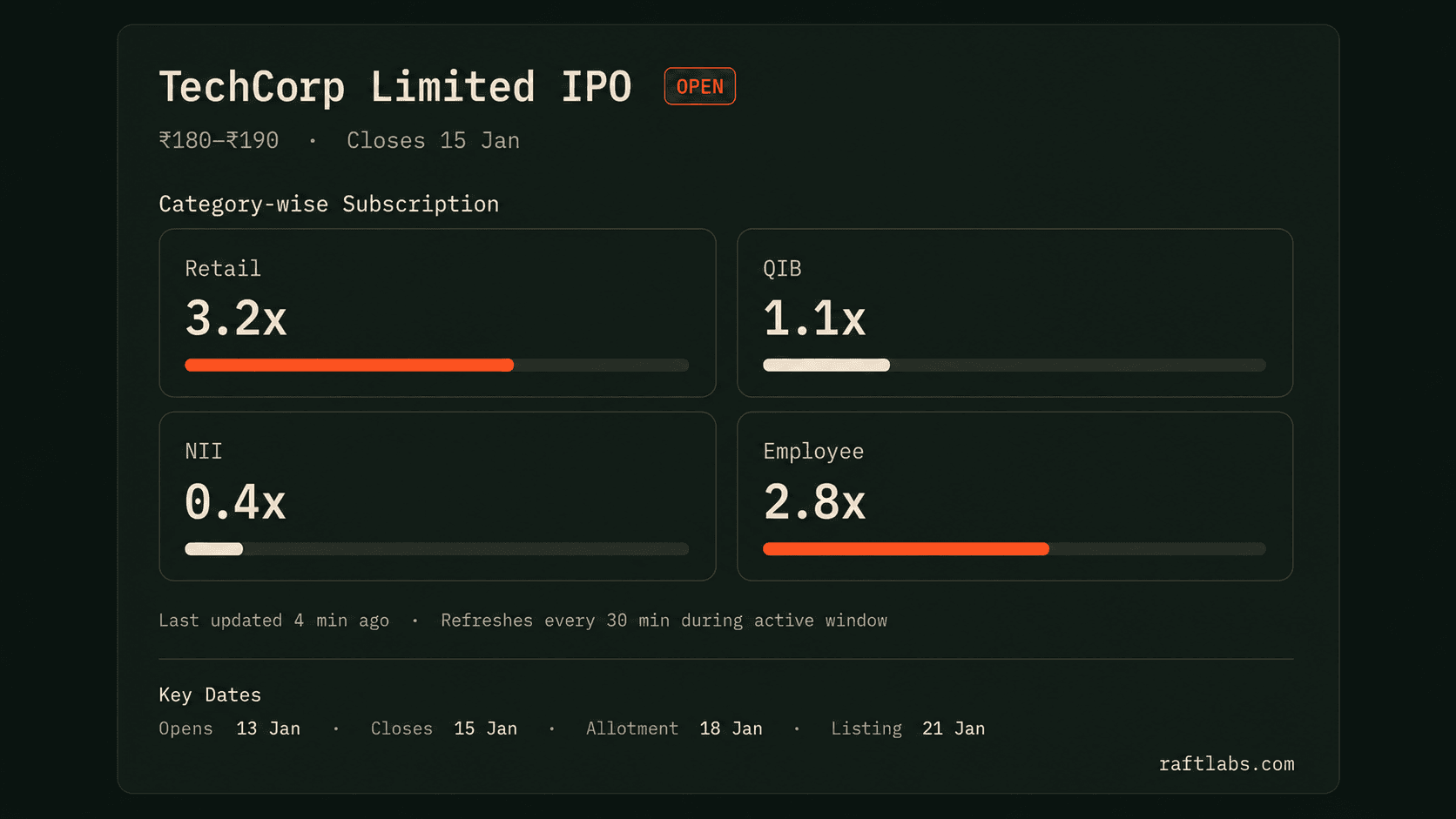
- Category-wise subscription figures (retail, QIB, NII, employee) update every 30 minutes during the subscription window
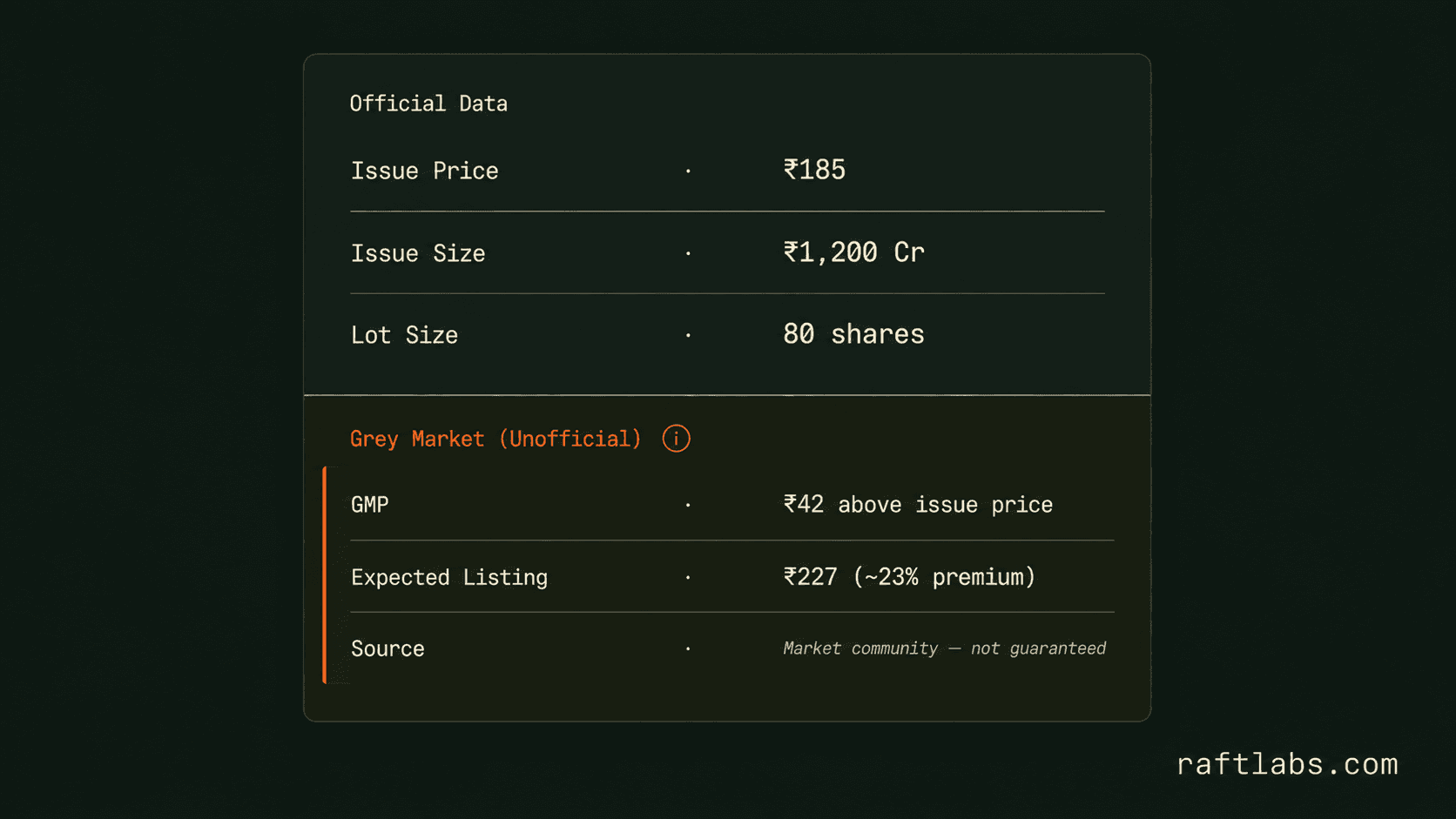
- Grey market premium from established market sources displayed alongside official data, clearly labeled as unofficial
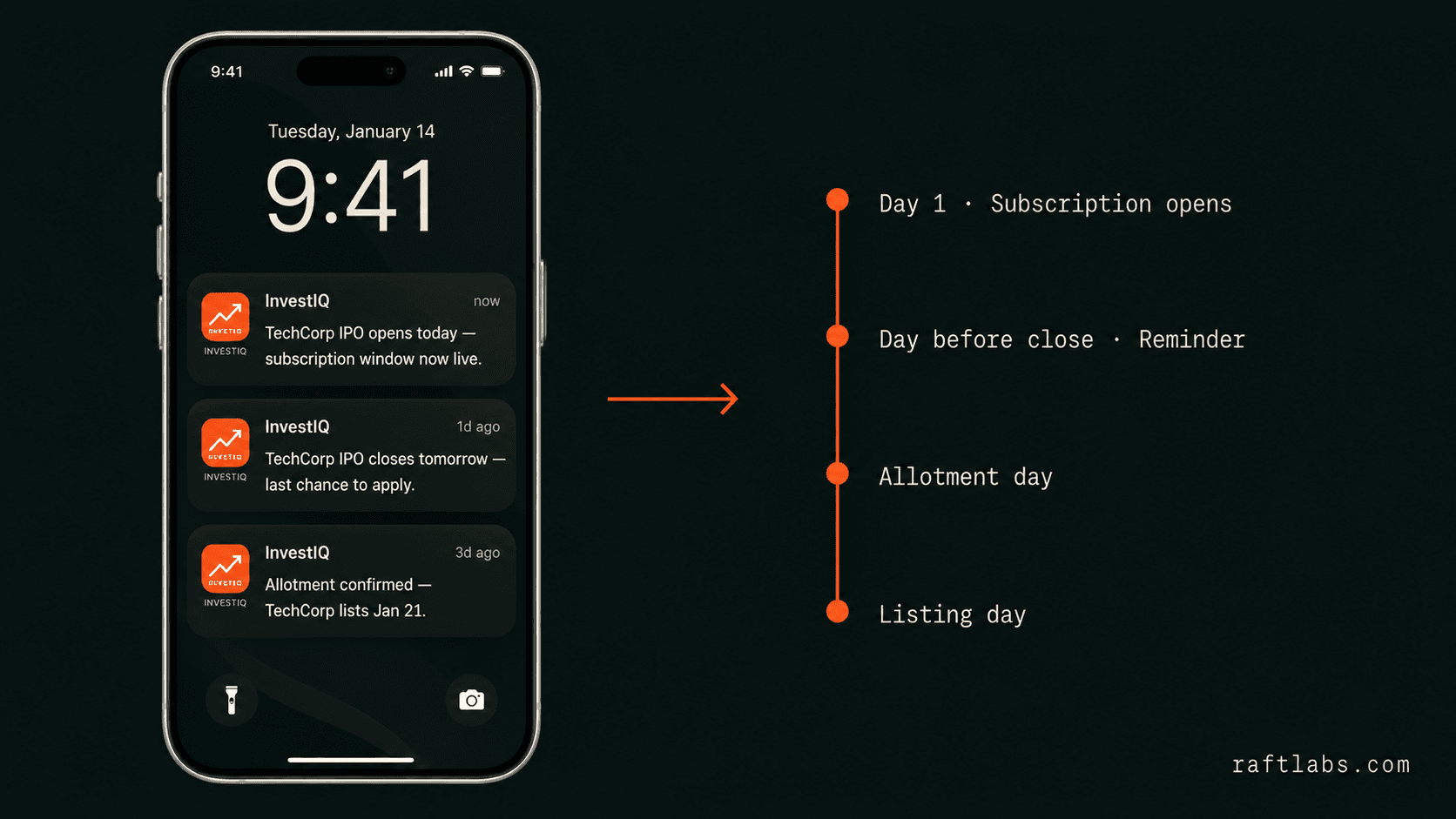
- Subscribe to an IPO once and InvestIQ fires alerts on day one of subscription, one day before close, allotment, and listing: no calendar entries needed
- Subscription status refresh increases in frequency on the final day of an active window when timing matters most
What we had to solve
Normalizing data from multiple sources that update at different frequencies
NSE and BSE publish market event data through different endpoints with different schemas and update cadences. Grey market premium comes from community sources with no API. SEBI registrar records use formats that change between announcements. Building a unified feed required a data ingestion layer that normalized all of this into a consistent event model without losing the nuances that investors actually care about, like which categories a particular offering is open to, or whether the current GMP suggests demand above or below the issue price. Getting that normalization right for every new event type took more engineering than the display layer itself.
Delivering deadline alerts that were useful, not noise
An alert product is only as good as its signal quality. Investors following multiple IPOs simultaneously would quickly stop trusting alerts that fired at the wrong moment or for events they did not care about. The challenge was building a subscription model where each alert (subscription open, day-before-close, allotment, listing) arrived at the right time for the specific events a user had chosen to follow, and where the delivery infrastructure scaled to thousands of simultaneous alert recipients during high-demand periods without delay. AWS SNS handled the delivery; the hard work was the event lifecycle logic that determined exactly when each type of alert should fire.
Proof
What the client reported, and what this page can't claim
Usage figures reported by the client. These are operator reports, not independently audited measurements.
| Result | What changed | Period or context | Evidence and limitation |
|---|---|---|---|
| Adoption | 5,000+ active users in the first 90 days | Retail investors tracking Indian market events through a real-time feed | Client-reported |
| Research overhead | 90% reduction in tabs needed per research session | A typical session to check IPO subscription status required 4 to 6 separate sites. InvestIQ reduced that to one | Client-reported |
| Data freshness | Subscription data refreshes every 30 minutes during active windows | Competing tools updated once daily. InvestIQ shows the demand picture building in real time, with refresh frequency increasing on the final day | Product-recorded |
the build
What we built
InvestIQ is deliberately narrow in scope and deep in the detail that matters to active retail investors.
Every IPO on NSE and BSE in one feed, sorted by what's open now
Every IPO, buyback, and OFS appearing on NSE and BSE surfaces in InvestIQ's feed automatically. Each event shows its current status, key dates, issue size, price band, and the categories it is open to. Open events are sorted to the top; upcoming events show days until subscription opens.
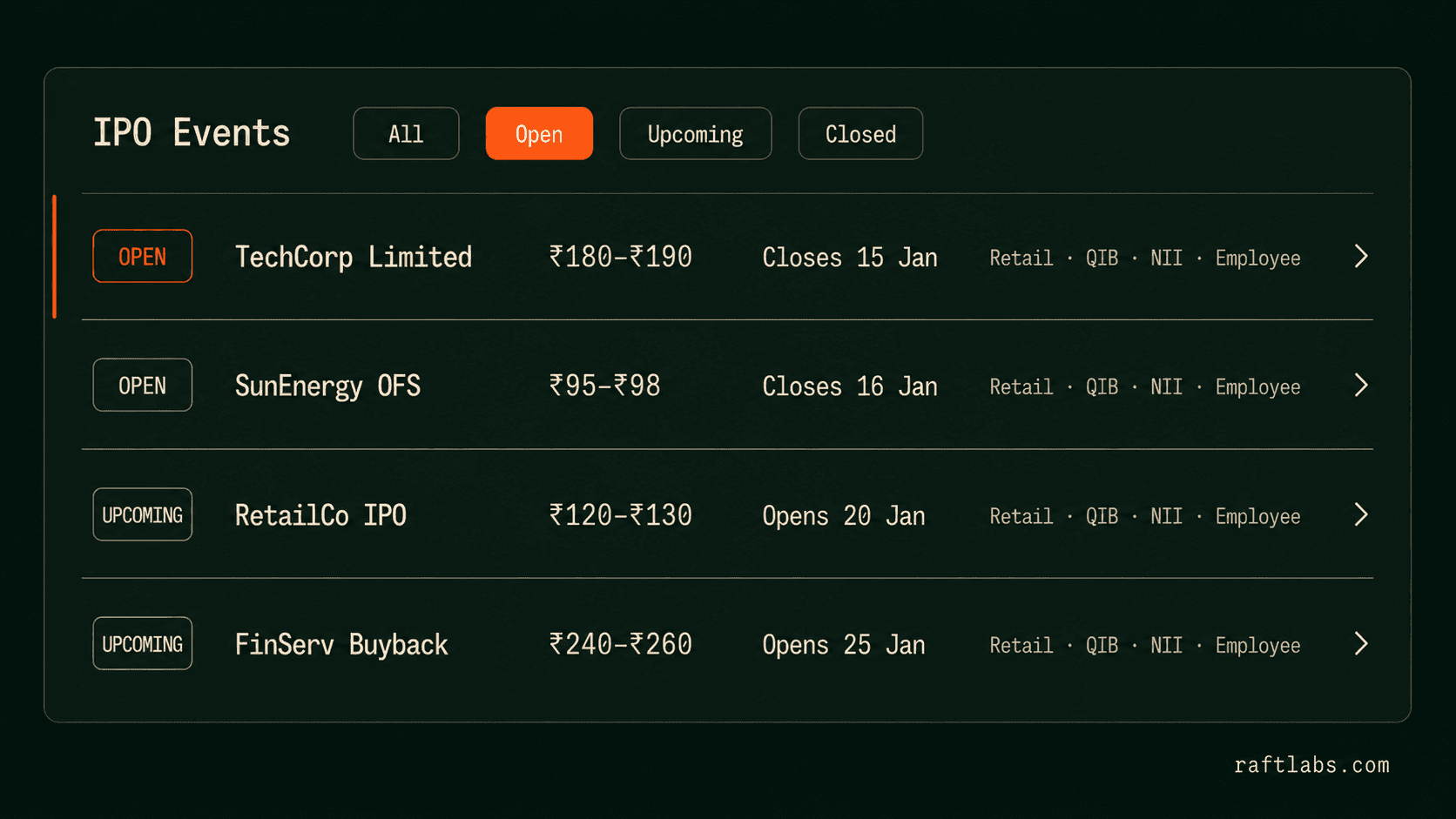
Investors see demand building in real time without logging into their broker
Category-wise subscription data (retail, QIB, NII, employee) updates throughout the subscription window. On the final day, refresh frequency increases. Investors see the demand picture building in real time without logging into their broker.
GMP shown alongside official data, labeled clearly so investors know what it is
GMP data from established market communities is normalized and displayed alongside official listing data. InvestIQ clearly labels GMP as unofficial so users understand its nature, but shows it because it is one of the signals investors actually use to form a view before a listing.
Key IPO dates arrive on the investor's phone, no calendar entries needed
Users subscribe to notifications for individual IPOs. InvestIQ fires an alert on day one of subscription, one day before close, and on allotment and listing dates. No calendar entries needed. Alerts are delivered via push notification and email.
The lesson
The product is the timing
The data is not the hard part. Subscription figures, gray market premium, key dates: all of it exists somewhere. The product is knowing when it matters. An alert that fires a day before the window closes is the difference between acting and missing. An alert that fires at the wrong moment, or for an event the investor did not choose, is noise that teaches people to ignore the next one.
That is why the hard work on this build was the event lifecycle logic, not the feed. Which alert, for which event, for which user, at which moment. Aggregation is a commodity. Timing is the product.
How it runs
- Next.js
- Incremental static regeneration lets the most-viewed event pages serve fast from cache while revalidating frequently enough to show current subscription data without a full server render on every request.
- Node.js
- The data ingestion service fetches from multiple exchange feeds simultaneously, normalizes inconsistent formats, and writes to the database in a single pipeline. Node's event-driven model handles concurrent feed polling efficiently.
- PostgreSQL
- Market events follow a defined lifecycle: announced, open, active, closed, listed. A relational schema captures each state transition with full audit history so the feed accurately reflects where every event is in its lifecycle.
- AWS
- Lambda runs on a schedule to refresh subscription data and trigger alert checks throughout the day. SNS handles push notification delivery to thousands of subscribers simultaneously during active subscription windows.
Common questions
InvestIQ ingests data from exchange filings, SEBI registrar records, and authorized market data feeds. Subscription figures come from exchange API data updated at intervals throughout the subscription window. GMP is sourced from established gray market communities and clearly labeled as unofficial so investors understand the distinction.
During the subscription window of an active IPO, subscription data refreshes every 30 minutes. On the final day, the refresh frequency increases to capture the last-hour demand surge that often moves the subscription multiple significantly. Historical and upcoming event data updates within 2 hours of any official announcement.
No. InvestIQ is an information and tracking product. Applications happen through your bank's ASBA flow or your broker's UPI mandate. InvestIQ shows you which events to act on and by when: the action itself stays with your existing financial accounts. This keeps InvestIQ out of the regulated activity perimeter and focused on what it does well: aggregating and presenting information clearly.
Yes. The core pattern (normalize fragmented market data, apply a clear event lifecycle model, and surface it with deadline-aware filtering and alerts) applies to any regulated market with publicly available event data. Equity markets in other countries, bond issuances, rights offerings, and corporate actions all follow a similar structure. Contact us to discuss your specific market and data sources.
We built InvestIQ (data ingestion from multiple exchange sources, event feed, subscription status tracking, GMP display, deadline alerts, and user notification preferences) in 10 weeks. The tight timeline was possible because the data model was well-defined from the start and we did not build features beyond the core use case. A broader aggregator covering multiple asset classes, or one requiring commercial data agreements with exchanges, would take longer. Contact us to scope based on your market and feature requirements.
Related work