Short answer
RaftLabs built GrantHub, a filterable directory of 1,600+ active government grants, tax credits, R&D schemes, and funding programs across 21 countries, searchable by country, industry, business type, and funding stage. Business owners can find relevant programs in under 10 minutes without visiting 50+ government portals. Built in 12 weeks using Next.js for static generation, Sanity for structured grants content, Algolia for instant multi-filter search, and AWS Lambda for data ingestion and nightly index sync.
The situation
Every year, governments publish billions in grants, tax credits, and funding programs that most eligible businesses never find. The programs exist. The money is allocated. The businesses qualify. But the gap between a grant program and a business that could benefit from it is too wide for most founders to cross without a consultant.
The consultant-or-nothing model meant that small businesses either paid for discovery before they knew if anything was available, or they gave up and left the funding on the table. Neither outcome served anyone but the consultants.
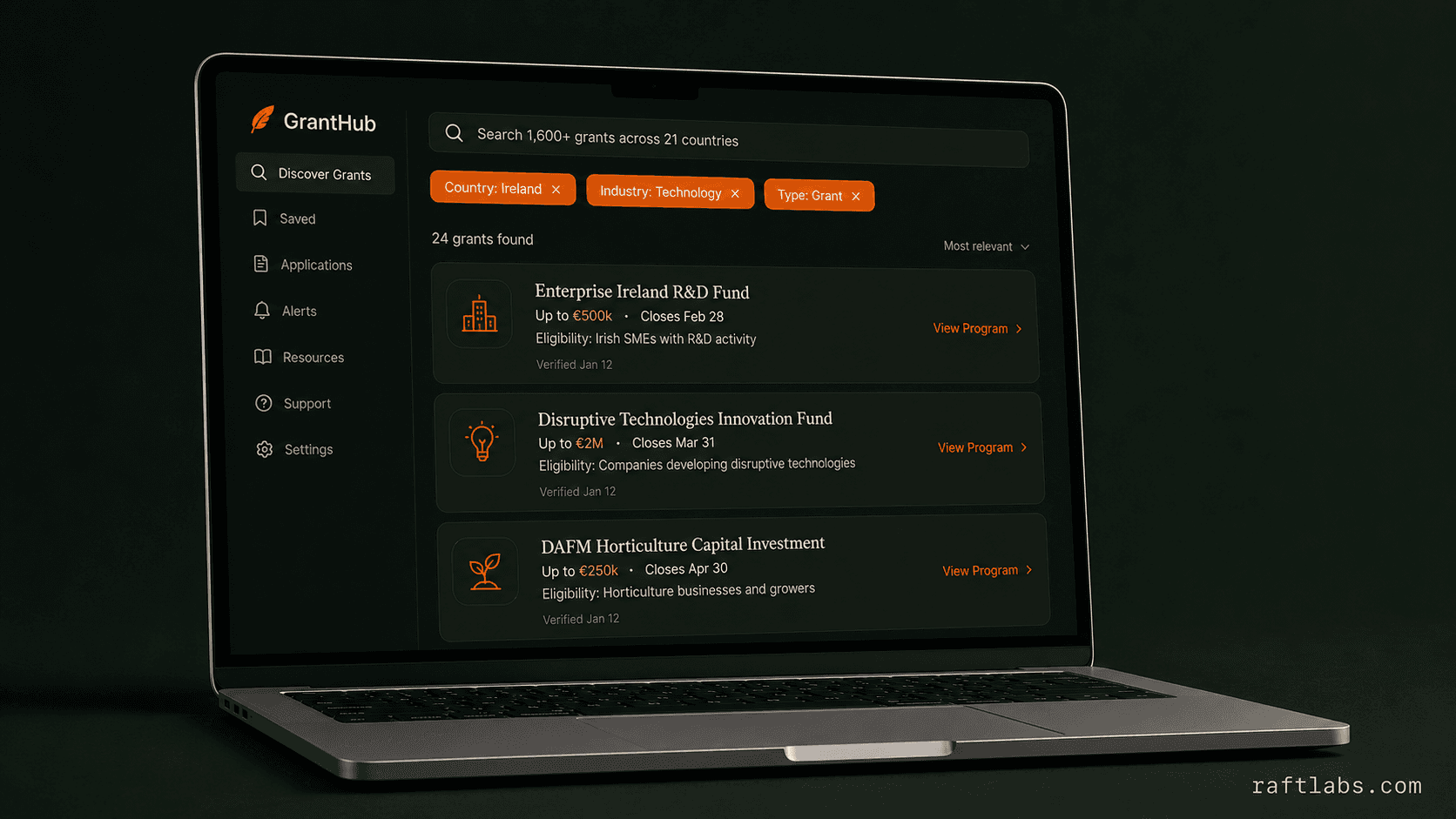
We built GrantHub as a filterable directory (country, industry, business type, funding type) so a business owner can find the programs they qualify for in a single session, without reading government portals across five browser tabs. 1,600+ active listings, 21 countries, no consultant required.
The goal is not to find more grants. It is to find the right ones. The matchmaking between funders and businesses is broken: the right grant exists, the founder never meets it. And the recurring failure is discovering disqualification after investing hours, a revenue threshold buried in the fine print, a geography gate you never saw.
Engagement
The GrantHub engagement
- Product
- GrantHub, a filterable grants directory: country, industry, business type, funding stage, with eligibility, deadlines, and direct links to official program pages
- What we built
- A normalized grants index across 21 countries, filterable search, saved listings with deadline reminders, and a content operations workflow keeping listings current
- Stack
- Data extraction and normalization pipeline, searchable directory, deadline notification system
- Status
- Live. 1,600+ active listings indexed
Before and after
What changed
- Grant data scattered across hundreds of government portals, each with its own format, terminology, and access requirements
- No way to filter simultaneously by country, industry, and eligibility type; results were too broad or manually compiled at great effort
- Cross-country research required logging into 50+ sites and reconciling inconsistent definitions of what qualifies
- Hiring a grant consultant cost more than most SMEs could justify before knowing what was even available
- Programs closed or changed terms with no notification to businesses that had flagged them as relevant
- 1,600+ grants, tax credits, R&D schemes, and funding programs indexed in a single searchable directory
- Filter by country, industry, business type, and funding stage to reach a shortlist in seconds
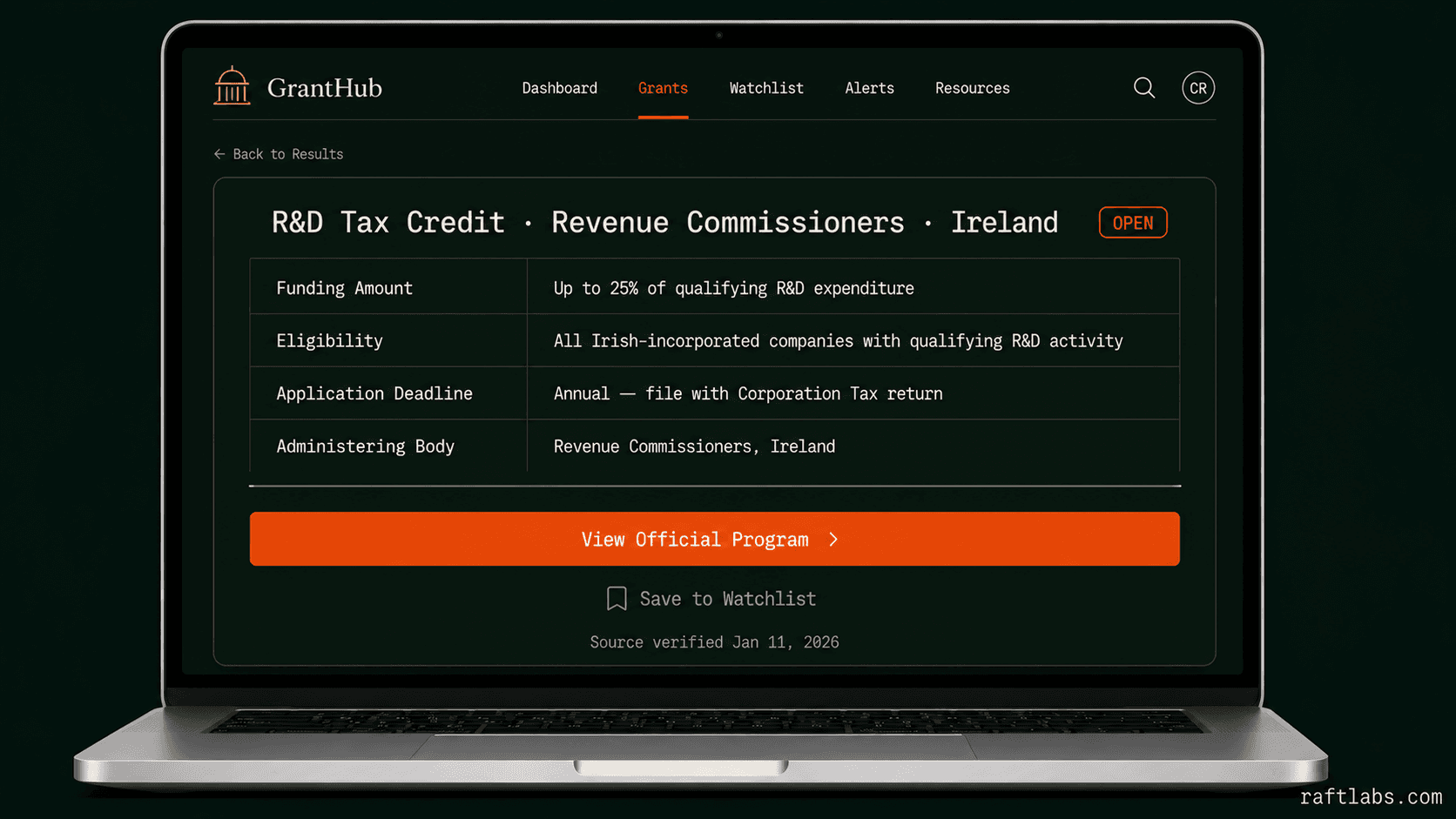
- Each listing shows funding amount, eligibility criteria, deadline, administering body, and a direct link to the official program page
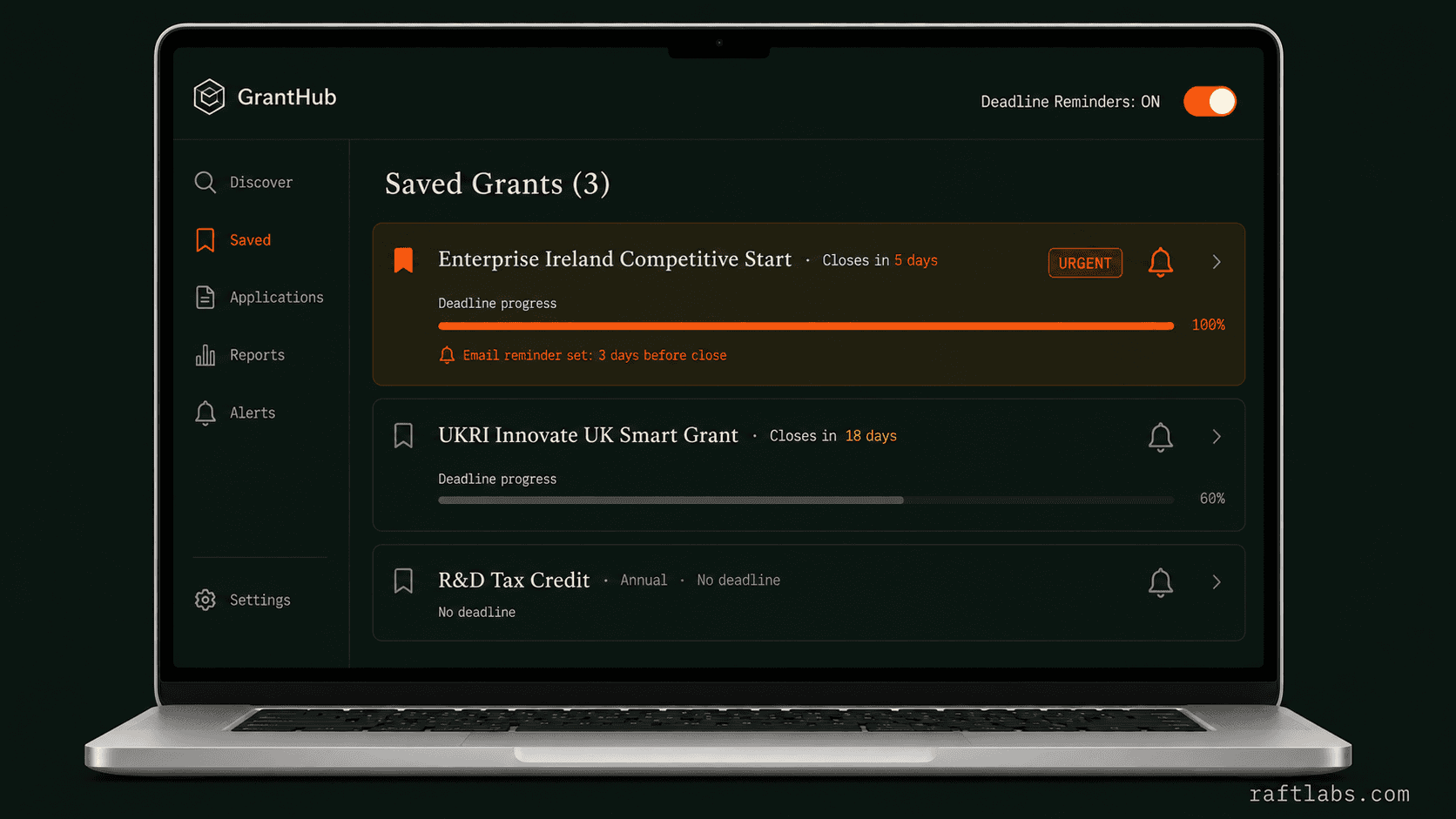
- Programs with upcoming deadlines surface at the top of relevant results; businesses can save listings and receive deadline reminders
- New programs added weekly; closed programs archived so the data reflects the current state, not a stale snapshot
What we had to solve
Structuring grant data consistently when every government portal uses different formats
Government portals across 21 countries define grant eligibility, funding amounts, and application requirements using completely different terminology and structures. One portal lists funding as a maximum award. Another shows it as a percentage of project costs. Eligibility criteria range from a two-line description to a 40-page PDF. Building a searchable index required normalizing all of that into a consistent schema, so when a business filters by "grant amount above 50,000" or "available to startups," the filter is comparing like with like across the full catalog.
This is the operating problem behind data extraction automation: several changing sources must become one traceable schema, with validation and review before the records reach the product.
Keeping 1,600+ listings current when programs change without warning
Grant programs open, close, extend deadlines, change eligibility criteria, and get quietly discontinued, often without any notification infrastructure that a third-party product can hook into. A directory built on stale data is worse than no directory: it sends businesses to programs that no longer exist or with requirements they read six months ago. We built a content operations workflow combining automated checks against official feeds with a manual review cycle, so each program is verified against its source regularly and any discrepancy triggers an update before the business owner sees it.
Proof
What the directory holds, and what this page can't claim
Catalog facts are product-recorded. Usage figures are client-reported. No funding-won figures were available for this review.
| Result | What changed | Period or context | Evidence and limitation |
|---|---|---|---|
| Catalog size | 1,600+ active grants, tax credits, R&D schemes, and funding programs indexed | Business owners previously visited 50+ government portals for an incomplete picture of a single country | Product-recorded |
| Coverage | 21 countries | Most grant directories focused on a single country. Cross-border businesses had no aggregated view | Product-recorded |
| Discovery time | 10 minutes average to find relevant grants | Without a tool, the same research took 3 to 5 hours across government websites and still often missed matching programs | Client-reported |
| Outcome figures | Not available | No figures on grants won or funding secured through the directory were on record for this review | Stated rather than estimated. A finder is a matchmaking tool, and this page does not claim outcomes it cannot measure |
the build
What we built
The core challenge was turning messy, fragmented grants data into a clean, searchable product without losing the nuance that makes each program different.
1,600+ grants narrowed to a shortlist in seconds
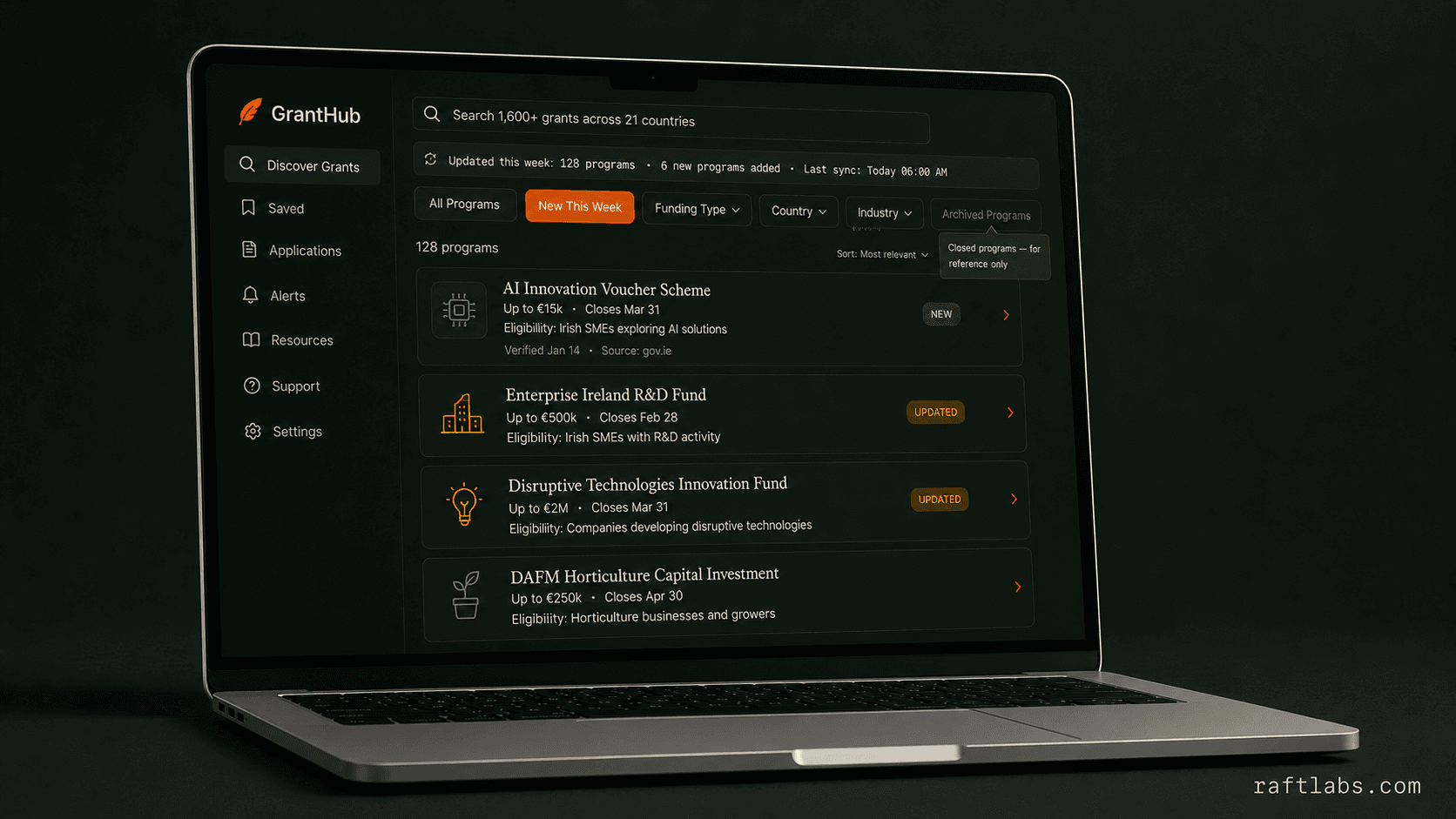
Users filter by country, industry sector, business type (startup, SME, established), and funding type (grant, tax credit, loan guarantee). The filter stack narrows 1,600+ listings to a shortlist in seconds. Algolia powers instant search with sub-50ms response times even across the full catalog.
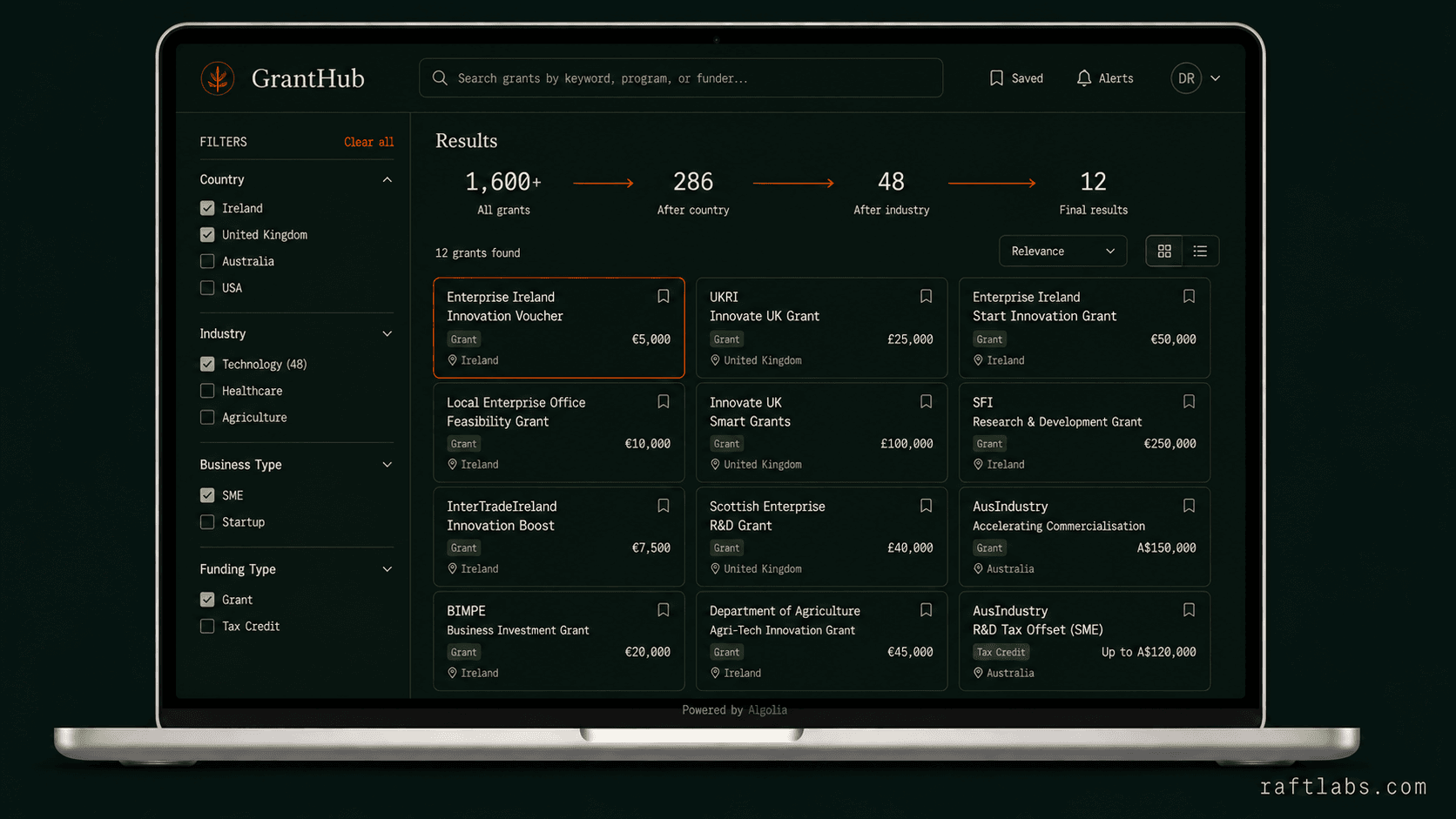
Every listing shows eligibility, deadline, and a direct link, no paraphrasing
Each grant listing shows the funding amount or range, eligibility criteria, application deadline, administering body, and a direct link to the official program page. Criteria are taken from source documentation, with no paraphrasing that introduces ambiguity.
Businesses get reminded before windows close: missed deadlines stop being the reason they don't apply
Programs with upcoming deadlines surface at the top of relevant searches. Businesses can save listings to their account and receive email reminders before application windows close. Missed deadlines are the most common reason businesses that find a matching grant still do not apply.
Listings reflect what is actually open, not a snapshot from 18 months ago
A content operations workflow keeps listings current. New programs are added weekly. Closed or expired programs are archived. A combination of automated checks against official feeds and periodic manual review means the data reflects which programs are actually open, not a snapshot from 18 months ago.
The lesson
Freshness is the product
A grants directory is easy to build and hard to keep. Programs open, close, extend deadlines, change eligibility, and get quietly discontinued, often with no notification infrastructure a third-party product can hook into. A directory built on stale data is worse than no directory: it sends businesses to programs that no longer exist, with requirements they read six months ago.
That is why the build's center of gravity was the content operations workflow, not the search page. Automated checks against official feeds, a manual review cycle, and discrepancy-triggered updates before the business owner ever sees the listing. The index is the easy part. Being current is the product.
How it runs
- Next.js
- Static generation with incremental revalidation keeps grant listing pages fast while allowing the content team to publish updates without a full rebuild. New programs appear on the site within minutes of being published in Sanity.
- Sanity
- The grants data model required structured fields for eligibility criteria, funding amounts, deadlines, and country classifications. Sanity's flexible schema let us define exactly the fields needed without fighting a generic CMS structure.
- Algolia
- Instant multi-filter search across 1,600+ records needed to feel immediate. Algolia returns results in under 50ms with compound filters applied (country, industry, business type, and funding stage) simultaneously.
- AWS
- Lambda functions run on a nightly schedule to pull updates from official grant feeds, check for program changes, and sync the Algolia index so search results reflect the current state of every listing.
Common questions
We run a combination of automated checks against official government feeds and a manual content review process. Each program is verified against its source at regular intervals. Programs flagged as expiring or changed go through an expedited review cycle so the listing is updated before businesses encounter outdated information.
GrantHub is a discovery tool. It shows you what exists, what you qualify for, and where to apply. The actual application happens on the government portal. For businesses that want help with the application itself, we can connect you with our network of grant consultants.
Eligibility criteria are structured directly from official program documentation. The filters reflect the categories the program administrators themselves use. Edge cases exist in every grant program. GrantHub always recommends reading the official criteria before applying, and every listing links directly to the source.
Yes. The GrantHub architecture (a structured content model in Sanity, multi-filter instant search via Algolia, and a content operations workflow) works for any domain with large, fragmented datasets that need to be made searchable and filterable. Subsidy databases, scholarship directories, procurement opportunity trackers, and regulatory filing calendars follow the same pattern. Contact us to discuss your specific requirements.
We built GrantHub (data model, search infrastructure, directory UI, deadline tracking, and content operations workflow) in 12 weeks. The most time-intensive part was the initial data normalization: mapping grant fields from dozens of government sources into a consistent schema. A directory with a narrower geographic scope or a single-country focus could be delivered faster. Contact us to estimate based on the number of programs and countries you need to cover.
Related work
More of our work
InvestIQ IPO and market events tracker
InvestIQ IPO and market events tracker
Real-time IPO, buyback, and OFS tracker for Indian retail investors.
Buyers and sellers are flocking
Buyers and sellers are flocking to SWD, the new car buying and selling app
Digital car marketplace with guided seller forms, real-time dealer bidding, and automated invoicing.