Short answer
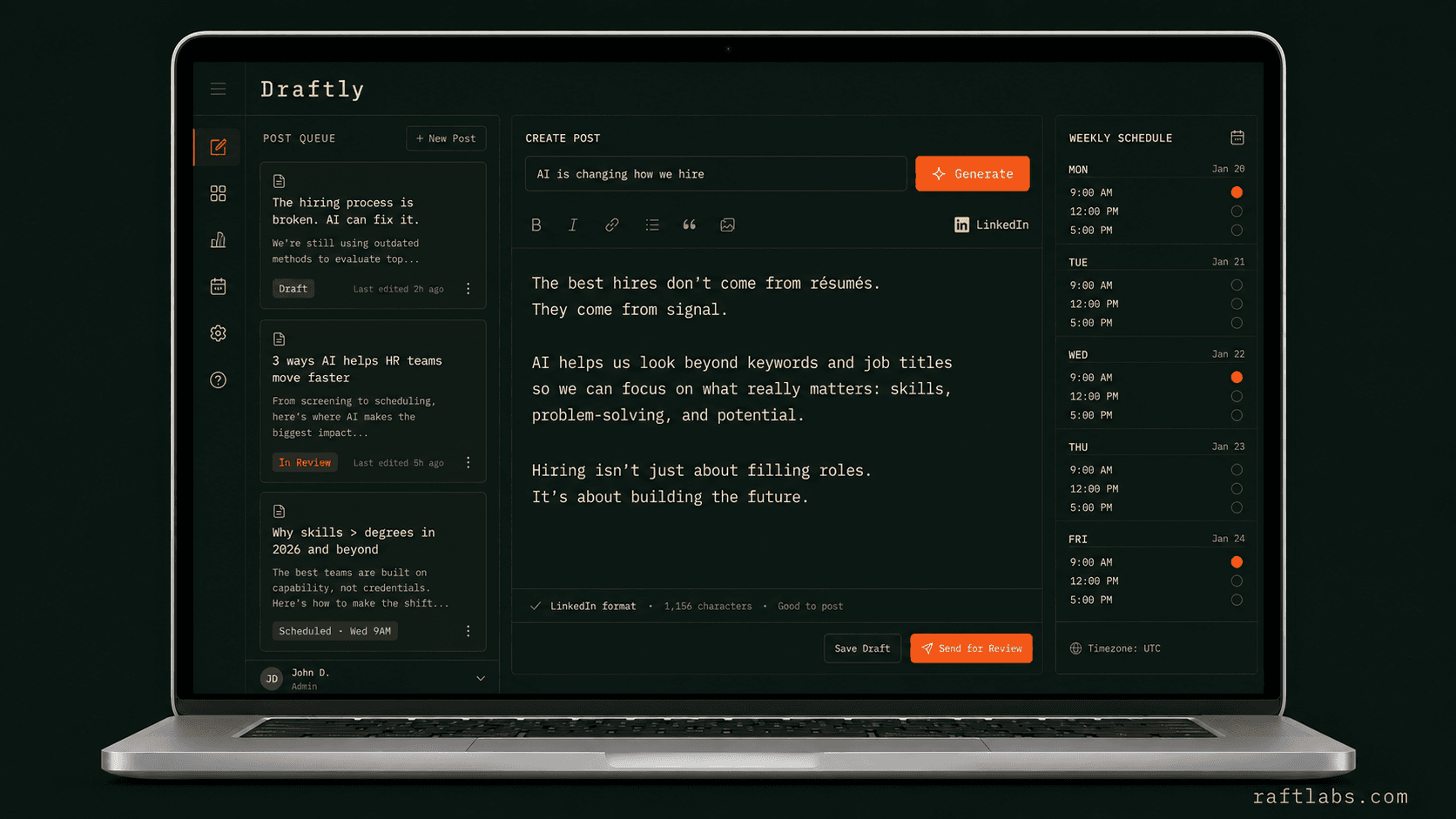
RaftLabs built Draftly, an AI-assisted LinkedIn content tool that handles AI post generation, real-time collaborative drafting, approval workflows, and a scheduling queue. Draftly reached 500+ active users in its first 60 days, tripled average posting frequency for its users, and cut content review cycles by 40% (client-reported). The platform was built in 14 weeks using Next.js, Supabase realtime subscriptions for live collaborative editing, Anthropic Claude via AWS Bedrock for LinkedIn-tuned draft generation, and AWS Lambda with EventBridge for scheduled publishing.
The situation
LinkedIn rewards consistency. The professionals building the strongest networks and getting the most inbound are not necessarily the best writers. They are the ones who show up every week without fail.
Most people who want to post regularly do not have a writing problem. They have a starting problem, a review problem, and a scheduling problem. They have the ideas but not the workflow to turn those ideas into published content without burning an hour each time.
We built Draftly to close that gap. AI handles the blank page. Real-time collaboration handles the review cycle. The queue handles the calendar. The client reported that in the first 60 days after launch, 500+ professionals were active on the platform and posting three times more often than before.
The trap is sameness. If you can swap your name with a competitor's name and the post still makes sense, you have lost differentiation. A tool that dissolves every voice profile into the same corporate draft has not saved anyone time. It has made everyone sound identical.
Engagement
The Draftly engagement
- Product
- Draftly, an AI LinkedIn content tool: draft generation, real-time collaborative editing, approval workflows, scheduling queue
- Core loop
- Generate, review, approve, schedule. The voice profile built during onboarding shapes every draft around the writer's role, audience, and topics
- Delivery
- 14 weeks
- Stack
- Claude generation layer, LinkedIn API, real-time collaboration
- Status
- Live. The client reported 500+ active users in the first 60 days
Where to go next
What we delivered
Live in 14 weeks, built around one focused core loop: generate, review, approve, schedule.
- Next 01
AI draft generation
Turns a rough idea into a publishable first draft.
- Next 02
Real-time collaborative editing
Reviewers edit alongside the author instead of a comment-and-wait cycle.
- Next 03
Approval workflows
Drafts move through review and sign-off before they reach the queue.
- Next 04
Scheduling queue
Approved posts publish on a set cadence without manual posting.
- Next 05
LinkedIn API integration
Publishing and post performance data flow directly through LinkedIn's API.
Before and after
What changed
- Professionals wanted a consistent LinkedIn presence but lacked the time to write regularly, with weeks passing between posts
- Teams reviewing drafts over email created version confusion and 2 to 3 day delays, with a single approval thread accumulating eight draft versions
- No central place to see what was scheduled, published, or waiting for sign-off: content fell through or went out twice
- Starting a post from scratch consumed most of the available time, leaving actual content quality as a secondary concern
- No way to match an AI draft to an individual's voice and positioning rather than producing generic LinkedIn prose
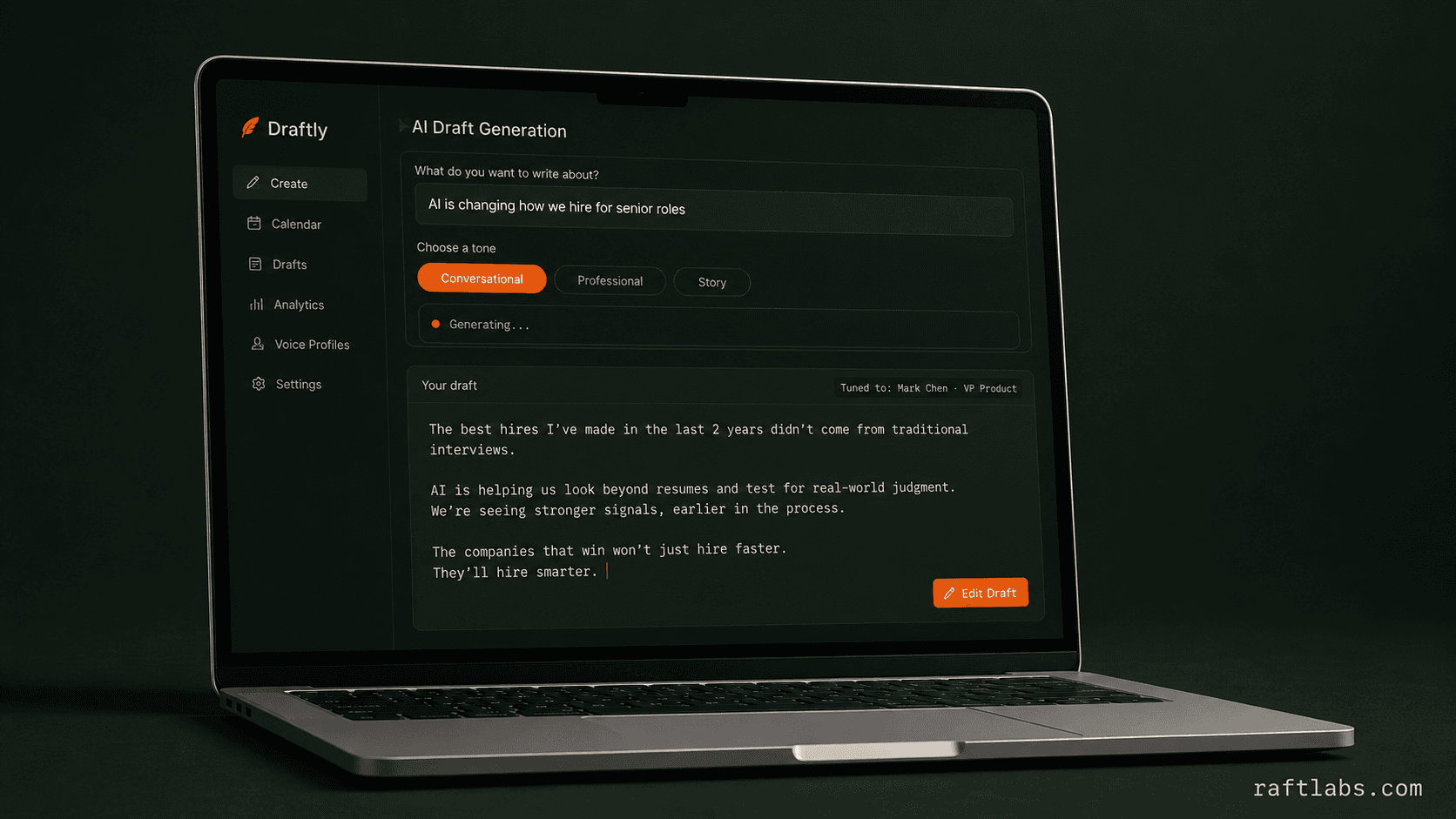
- AI generates a ready-to-edit draft in under 30 seconds from a topic and tone selection, tuned to LinkedIn format rather than blog prose
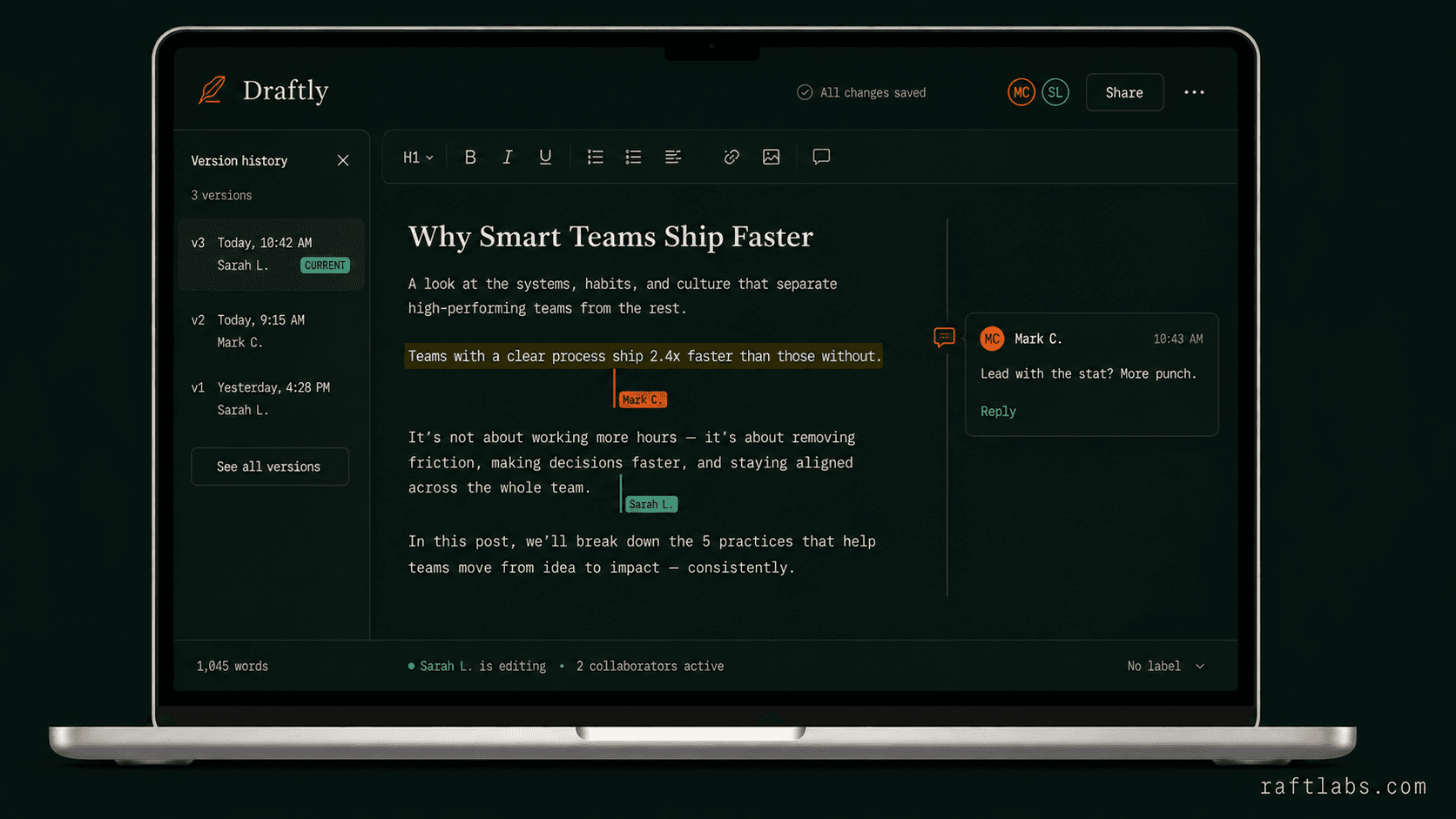
- Multiple editors work on the same draft simultaneously with inline comments, resolved threads, and full version history
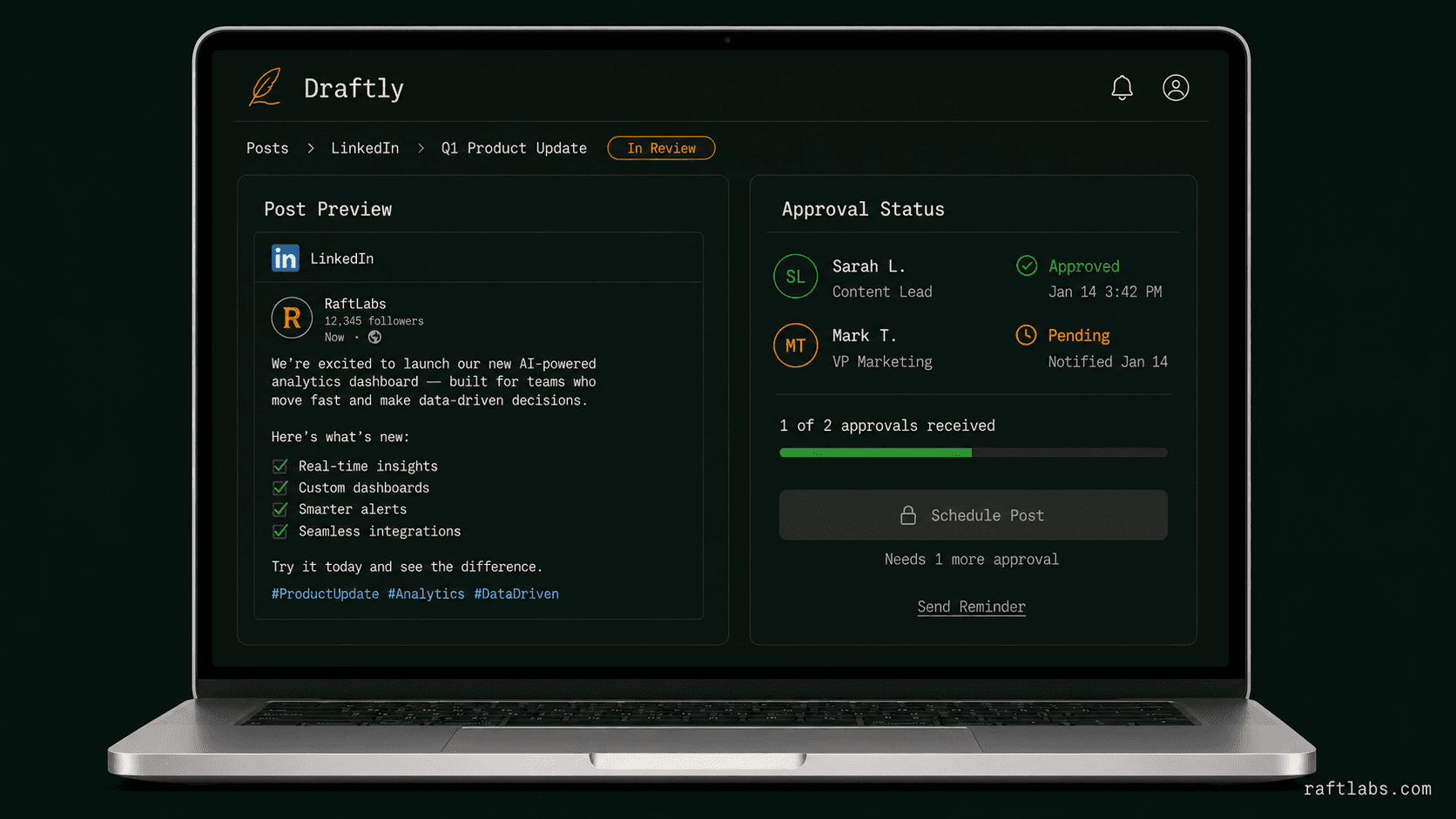
- Drafts route through a configurable approval chain before publishing. Approvers are notified, and nothing goes live without sign-off
- A scheduling queue shows every post (draft, approved, scheduled, live) in one view and publishes at the optimal time per user
- A voice profile built during onboarding shapes every AI draft around the writer's role, audience, and the topics they want to be known for
What we had to solve
Making AI output usable without a second round of heavy editing
The blank page is solved in seconds. But if every AI draft needs 20 minutes of cleanup before it reads like the person who supposedly wrote it, the tool has not saved any time. The challenge was tuning the generation layer so that Claude produced LinkedIn-native output: short paragraphs, a real hook in the first line, natural language rather than corporate tone. That required a system prompt built around how LinkedIn actually performs as a platform and a voice profile per user that draws from their stated positioning rather than generic professional defaults. Most models dissolve a voice profile into the same corporate draft regardless of what the input contains. Claude held the specifics through to the output. The goal was a draft that needs light editing, not a rebuild.
Building an approval workflow faster than just using email
Approval chains only work if they are faster than the default behavior, and the default is email. If routing a draft for sign-off adds a day and requires the approver to remember which version they were asked to review, the team reverts to the thread. The challenge was designing the approval interface so that an approver could open a notification, read the draft in context, leave feedback or approve, and be done in under two minutes. Inline comments with resolution tracking, version history, and a clear queue of posts pending their sign-off made that possible without asking anyone to learn new habits.
Proof
What the client reported, and what this page can't claim
Usage figures reported by the client after launch. These are operator reports, not independently audited measurements.
| Result | What changed | Period or context | Evidence and limitation |
|---|---|---|---|
| Posting frequency | 3x higher for active users | Professionals were averaging 1 to 2 posts per month before. The blank page won every time | Client-reported |
| Review cycles | 40% faster | Review rounds via email took 2 to 3 days on average, with 8 or more versions on a single thread | Client-reported |
| Adoption | 500+ active users in the first 60 days | Professionals and teams building a consistent LinkedIn presence | Client-reported. No engagement or follower-growth figures were available for this review |
| Time to launch | 14 weeks, built around one loop: generate, review, approve, schedule | AI draft generation, real-time collaborative editing, approval workflows, scheduling queue, LinkedIn API integration | Project-recorded |
the build
What we built
Draftly is built around the idea that writing and reviewing should happen in the same tool, not across five apps.
A ready-to-edit LinkedIn draft in seconds, shaped around the writer's voice and topics
Enter a topic, choose a tone (professional, conversational, story-driven) and Draftly generates a ready-to-edit draft in seconds. The AI understands LinkedIn format: short paragraphs, natural hooks, no corporate jargon. A voice profile built during onboarding shapes every draft around the writer's role and the topics they want to be known for.
Marketing lead and executive refine the same draft simultaneously, no stale copies
Multiple editors work on the same draft simultaneously. Inline comments, resolved threads, and a full version history mean no one is ever working on a stale copy. Changes sync live without refreshing the page, so a marketing lead and an executive can refine the same draft in real time.
Posts can't be scheduled until every required reviewer signs off
Route drafts through a configurable approval chain before they reach the scheduling queue. Approvers get a notification and see the draft in context, not attached to an email thread. A post cannot be scheduled until every required reviewer signs off.
Full pipeline visible in one calendar: nothing gets missed between draft and live
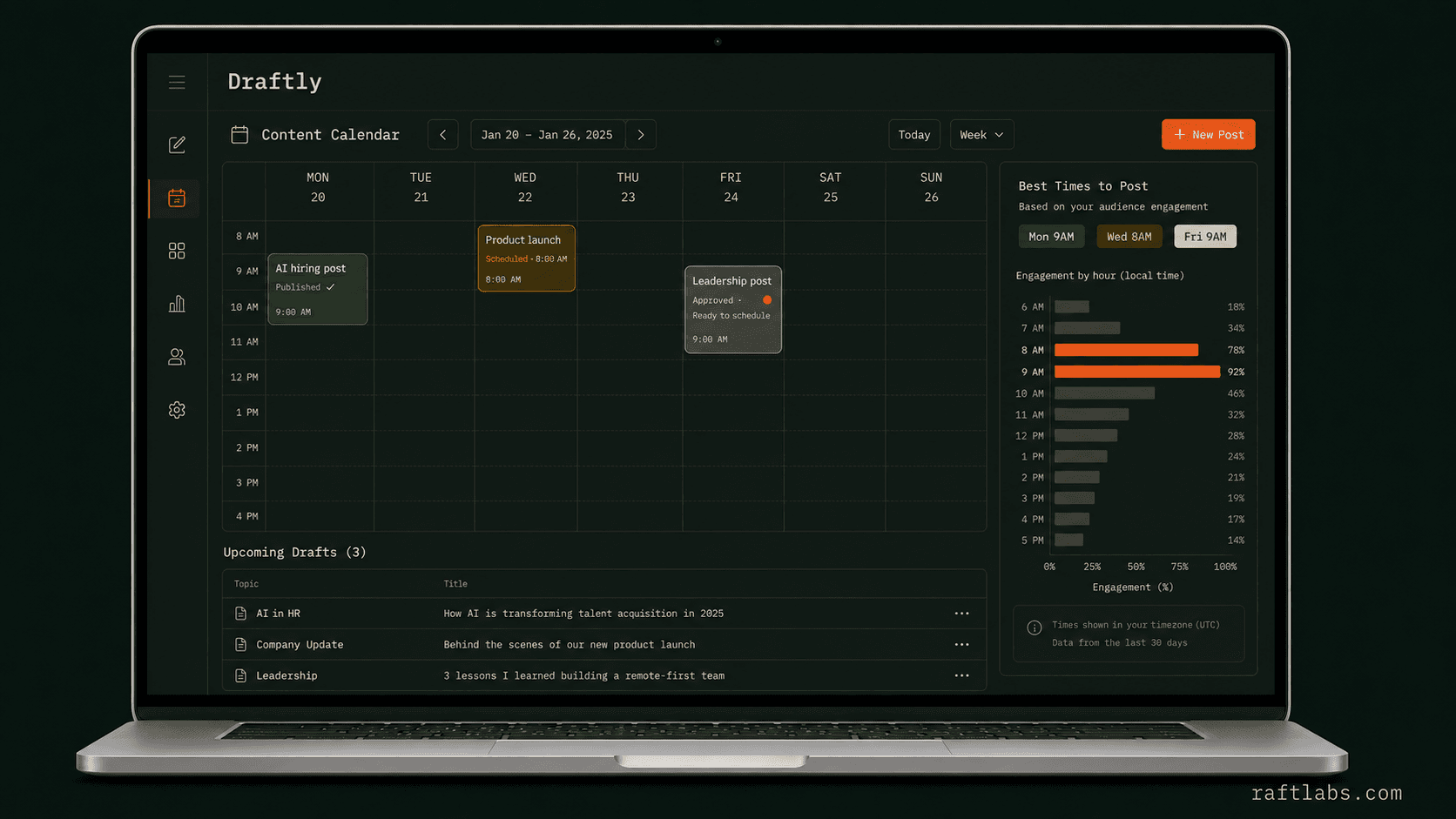
Drag and drop posts into a weekly calendar. Draftly publishes at the optimal time per user or lets you pin a specific slot. The queue shows the full pipeline (draft, approved, scheduled, live) in one view so nothing gets missed.
The lesson
Consistency is a system, not a talent
And the workflow has to protect the voice. The moment AI drafts flatten into the same corporate prose for everyone, the network spots it and the trust is gone. The generation layer was tuned so a voice profile survives through to the output, because a draft that needs a rebuild has not saved any time. Speed that costs you your voice is not speed.
How it runs
- Next.js
- App Router with React Server Components gave us fast initial page loads and a clean server-driven architecture that scales without adding client-side complexity to features that do not need real-time sync.
- Supabase
- Real-time subscriptions power the live collaborative editing without a custom WebSocket server. When one editor types, every other editor in the same draft sees the change immediately.
- Claude (Anthropic)
- Claude generates LinkedIn-native drafts: short paragraphs, a real hook in the first line, natural language that matches the writer's voice profile. It follows nuanced formatting and tone instructions more precisely than generic models, which is exactly what LinkedIn content requires.
- AWS Bedrock
- Bedrock gives a single control plane for model access and versioning. When Anthropic ships an improved model, we update Draftly without touching application code. The platform stays current without a re-architecture.
- AWS
- Scheduled post publishing runs on Lambda with an EventBridge rule per scheduled post. Posts go live at the exact time the user set without a persistent background process running at all times.
Common questions
During onboarding, Draftly asks you to describe your role, your target audience, and the topics you want to be known for. That profile shapes every draft. The AI does not write generic LinkedIn posts, it writes for your positioning. You can update the profile at any time and the next draft reflects it immediately.
Yes. Draftly supports multiple team members with role-based access: writers can create drafts, reviewers can comment and approve, and one designated poster publishes to LinkedIn. No shared credentials are needed, and the approval chain ensures nothing goes live without the right person signing off.
Draftly uses LinkedIn's official marketing developer API and publishes within its rate limits. The scheduling queue spaces posts to stay within platform guidelines automatically. If LinkedIn updates its API, the integration layer handles it without users needing to change how they use the product.
Every draft is generated fresh per request. Draftly does not use a shared library or recycle output across users. Your drafts are stored in your account only and are never used to train any model.
Draftly took 14 weeks. That timeline was possible because we started with a focused core loop: generate, review, approve, schedule. Tools with more AI personalization layers, multi-platform publishing, or deeper analytics would take longer. Contact us to estimate based on your specific requirements.
Related work
More of our work
Product managers are now making
Product managers are now making meaningful discoveries with conversational AI
Conversational AI chatbot SaaS that turns static forms into meaningful conversations.
Small businesses create engaging marketing
Small businesses create engaging marketing videos in minutes with Vidmattic
White-label video software helping SMBs produce professional marketing videos.