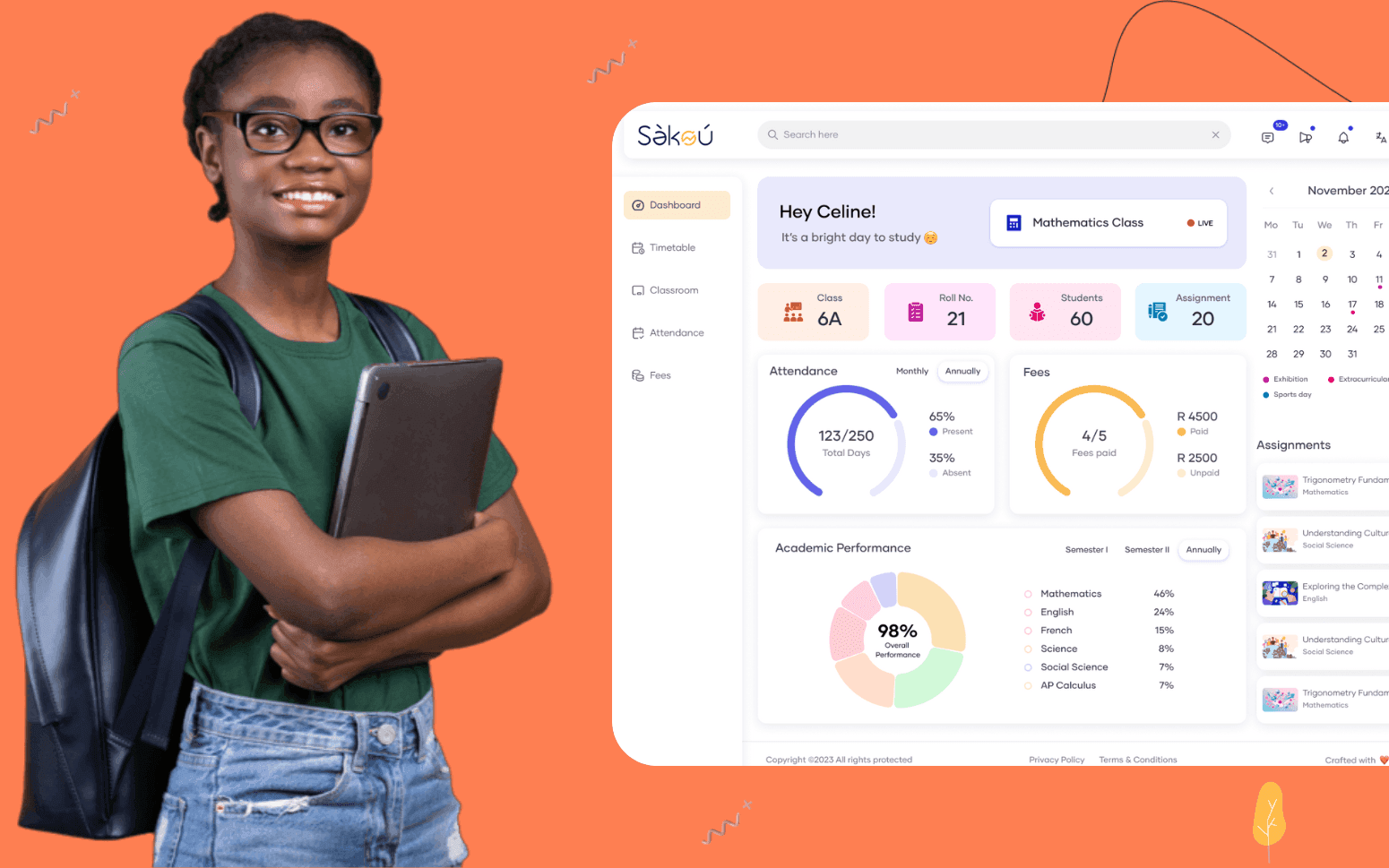
Purpose Built EdTech LMS SaaS Platform Disrupting African K-12 Schools
- 4000+
- 25%
- 16 weeks
Custom scheduling software for tutoring centres that need to match students to tutors by subject, level, and availability, not just find an empty time slot.
We build the full scheduling system: enrolment-to-booking workflow, tutor matching by subject expertise and qualification, automated schedule generation, conflict detection across all tutors and rooms, rescheduling workflows, and waitlist management for in-demand tutors.
Enrolment workflow capturing subject, level, goals, and availability
Tutor matching by subject expertise, qualification, and available time slots
Automated schedule generation across the full tutor roster
Conflict detection, rescheduling workflows, and waitlist management
Recognition
Matching students to tutors across subjects, levels, and availability in a spreadsheet that breaks every time a tutor changes their hours?
Double-booking a tutor or a room because your scheduling tool has no real-time conflict detection across online and in-person sessions?
In short
Student scheduling and tutor matching software for tutoring centres handles the full booking workflow. It captures subject, level, and availability at enrolment, matches students to tutors by expertise and qualification, generates best-fit schedules across the full tutor roster, detects conflicts across rooms and online slots, and manages rescheduling and waitlists. RaftLabs builds custom scheduling systems for multi-tutor, multi-subject centres that need matching logic and conflict detection built around how their centre operates, not around a generic calendar tool.
Companies we've built for








A general booking tool assigns a time slot. Tutoring centre scheduling requires something more specific: a student needs a particular subject at a particular academic level, the tutor must have documented expertise in that subject at that level, and both parties need to be available at the same time. That three-way constraint, subject, level, and availability, has to resolve simultaneously for every student-tutor pair in the centre, across every session, in real time.
Generic calendar and booking tools weren't built for this. They can block out time and prevent double-booking a single resource, but they have no concept of subject expertise, qualification level, or the matching logic that connects a student's requirements to the right tutor from a roster of twenty. When centres manage this constraint in spreadsheets or manual calendar checks, mistakes are routine: students assigned to tutors who don't teach their subject, tutors double-booked across in-person and online sessions, and rescheduling requests handled by admin staff who have to repeat the matching process from scratch every time.
Custom scheduling software for multi-tutor, multi-subject centres encodes the matching logic and conflict rules so the system does the constraint resolution. Tutors update their own availability. Students book against a set of matched options. Conflicts catch before they're confirmed, not after the session is missed.
The scheduling process starts at enrolment, not at booking. When a student enrols, the system captures their subject requirements, the academic level they're working at for each subject, their goals for the tutoring engagement, and the days and times they're available. This structured intake creates the matching profile the scheduling system uses when assigning tutors, rather than relying on the admin team to remember which student needs Year 11 chemistry versus Year 8 maths. Goal and level information stores against the student record and is available to the matched tutor before the first session. When a student's requirements change, a new subject added, a level adjustment after an assessment, the enrolment record updates and the matching logic reflects the change going forward.
The matching engine cross-references the student's subject and level requirements against each tutor's recorded subject expertise, qualification level, and teaching history. Tutors who aren't qualified to teach a specific subject at the requested level exclude from the match set before any availability check runs. From the qualified set, the engine filters to tutors who have available time slots that align with the student's availability. Results rank by match quality: a tutor with documented experience teaching the specific subject at the specific level and a strong session completion record ranks above a tutor who is technically qualified but has taught the subject infrequently. The admin team confirms the match or selects from the ranked list. The system never auto-assigns without a confirmation step for new student-tutor pairs.
Once a student is matched to a tutor, the schedule generation step finds the best available recurring time slot that satisfies both parties' availability constraints and the centre's room or virtual session capacity. For centres with a high volume of student-tutor pairs, bulk schedule generation runs across the full roster and produces a conflict-free schedule for the enrolment period, surfacing only the cases where no valid slot exists and human intervention is required. One-off sessions schedule against the same availability model as recurring sessions: the scheduling system sees all session types in a single view so conflicts across recurring and ad hoc bookings catch together. Confirmation sends to the student, tutor, and any parent contact recorded on the student's account, with session details and any preparation notes attached.
Conflict detection runs at the point of booking, not as a post-hoc check. When a session is being scheduled, the system checks the tutor's availability against all existing bookings, in-person and online, and blocks the slot if the tutor is already committed. Room conflicts check separately so a tutor available at the time isn't accidentally double-booked into a room that's already occupied. Online session conflicts check virtual link availability where the centre uses a shared conferencing resource. When a tutor's availability changes, a blocked week, a changed recurring availability pattern, all affected sessions identify and surface to the admin team for rescheduling rather than being silently left in a broken state. Conflict alerts show to the person making the booking change in real time, before the change saves.
When a student or tutor needs to reschedule, the system presents available replacement slots based on current availability, not a static list. The student or tutor selects from the presented options and the session moves with confirmation sent to both parties. Cancellation rules are configurable per centre: a cancellation within 24 hours can trigger a late cancellation flag, a fee charge, or both, depending on the centre's policy. Late cancellation charges create against the student's account automatically when the cancellation rule triggers, without requiring admin action. Make-up session scheduling links the make-up to the original cancelled session so the record is complete. Tutor-initiated cancellations follow a separate workflow: the centre is notified, affected students identify, and rescheduling options present for each affected student simultaneously.
When a student's preferred tutor has no available slots that match the student's availability, the system places the student on a waitlist for that tutor and subject combination rather than requiring the admin team to track pending demand in a separate spreadsheet. When a slot opens, a cancellation, a tutor adding availability, or an existing student completing their programme, the system identifies the first waitlisted student whose availability matches the opening and sends a notification with the slot details and a prompt to confirm. Waitlist position records and is visible to the admin team so they can see demand for specific tutors and subjects in aggregate. For centres with consistent demand exceeding tutor capacity for certain subjects, the waitlist data feeds the decision to recruit additional tutors for that subject rather than requiring the admin team to manually count pending enquiries.
Off-the-shelf tutoring management platforms handle standard session scheduling, basic availability management, and payment collection well for centres with straightforward matching requirements. Custom scheduling software is the right choice when your matching logic depends on subject expertise and qualification level in ways that platform configuration can't fully support; when you're managing a large roster of tutors across multiple subjects and the conflict detection in a standard tool isn't thorough enough; when you're operating multiple locations with a shared tutor pool that needs allocating across sites; or when you're building a tutoring software product to offer to other centres. Building custom when a platform would handle the requirement adds maintenance cost without adding capability. We'll tell you which applies to your situation before any project starts.
The matching engine is built around the tutor profile, which records each subject the tutor teaches, the academic levels they're qualified to teach within that subject, and any additional criteria the centre uses to define tutor-student fit, such as teaching style, exam board, or prior student outcomes. When a student's enrolment profile submits, the matching engine filters the tutor roster to those who meet the subject and level requirements first, then applies availability constraints to the filtered set. The result is a ranked list of qualified, available tutors rather than a list of everyone who has a free slot. The ranking criteria, qualifications, teaching history, student outcome data, configure to reflect how your centre makes matching decisions today, so the software supports your process rather than replacing it with a generic one.
Yes. Self-service rescheduling is one of the primary ways custom scheduling software reduces admin workload at growing tutoring centres. The rescheduling workflow presents the student or tutor with available replacement slots based on real-time availability. Both parties can initiate a reschedule, and the system handles confirmation and notification without requiring admin to coordinate the change. Cancellation rules and late fee logic enforce automatically at the point of cancellation so the admin team isn't manually applying policies. The admin team retains visibility of all reschedules and cancellations in the schedule management view and can override or intervene at any point. Admin involvement becomes an exception rather than the default path for every scheduling change.
A focused student scheduling and tutor matching system, enrolment workflow, matching engine, schedule generation, conflict detection, rescheduling, and waitlist management, typically runs $25,000 to $45,000. If the scheduling system is built as part of a broader tutoring centre platform that includes parent portals, session tracking, and payment management, the combined cost typically runs $60,000 to $110,000. Cost depends on the complexity of your matching logic, the number of tutors and subjects involved, and whether you need integration with an existing CRM or student management tool. We scope every project before pricing: fixed cost, agreed before development starts.
What clients say
Three-year average engagement. Founders and operators describing the work in their own words. No marketing varnish.

 Ivory Coast
RaftLabs has been an exceptional partner. From the start, they became more than just a service provider, they embraced our vision with their expertise and dedication.
01 / 02
Tell us how many tutors you have, which subjects you cover, and how scheduling works today. We'll tell you what we'd build and how.