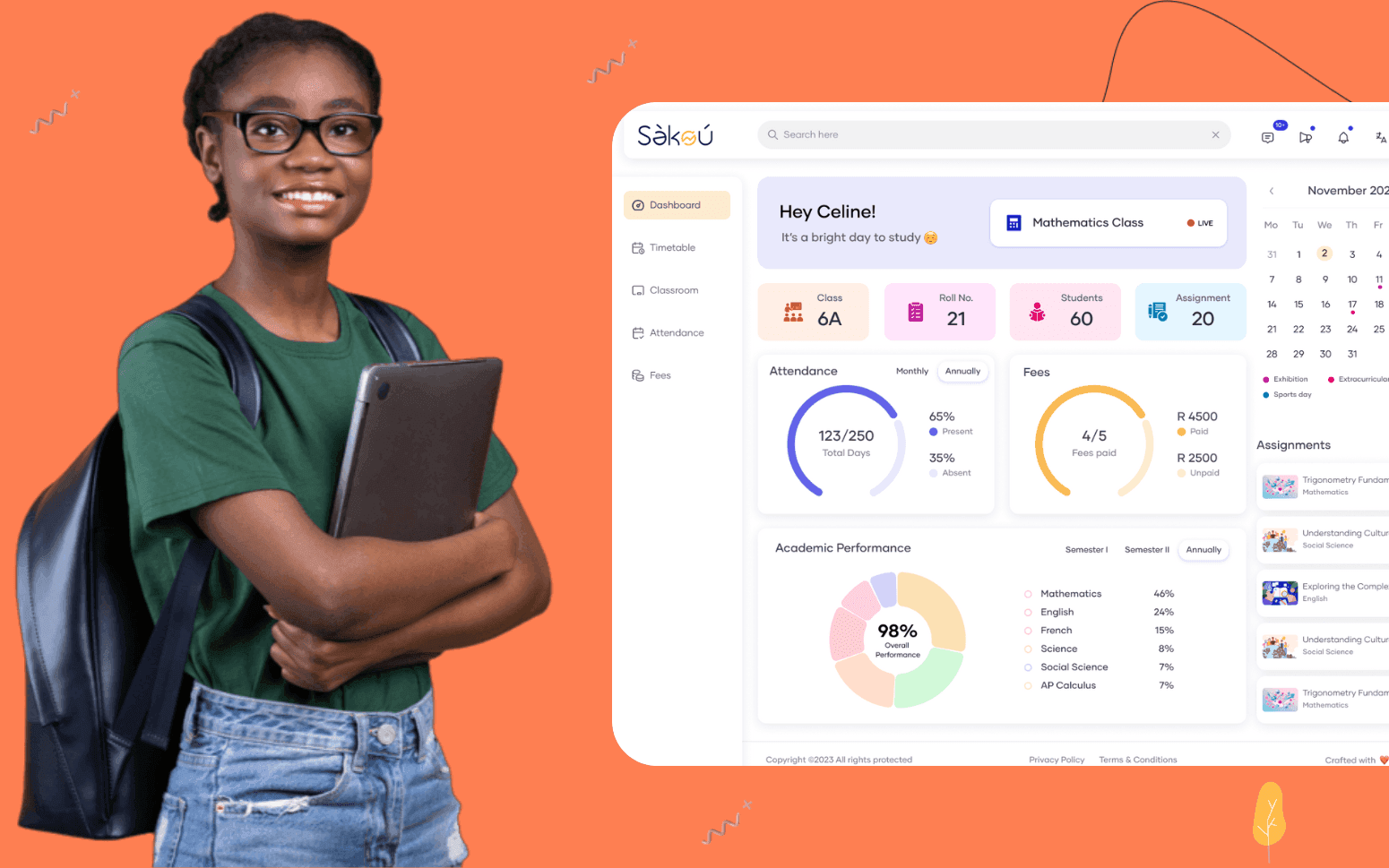
Purpose Built EdTech LMS SaaS Platform Disrupting African K-12 Schools
- 4000+
- 25%
- 16 weeks
Custom operations software for established nonprofits who need fund accounting, functional expense allocation, HR, and board governance tools connected in one system, built for the specific financial reporting and compliance requirements of a tax-exempt organisation.
Generic accounting systems like QuickBooks handle basic bookkeeping. They weren't built for fund accounting, functional expense allocation to programme versus management versus fundraising, or the restricted grant budget tracking that nonprofit auditors and Form 990 preparation require.
Fund accounting with restricted and unrestricted fund management and restricted grant budget tracking
Functional expense allocation to programme, management, and fundraising for Form 990 and audit preparation
HR and payroll with programme-based labour cost allocation and benefit administration
Board portal with governance tools, conflict of interest management, and resolution recording
Recognition
Finance team spending weeks before the annual audit manually allocating expenses across functional categories and restricted funds because the accounting system doesn't track those dimensions from the point of entry?
Board members receiving board packs by email in PDF format assembled manually each month, with no secure portal for document access, no digital voting, and no record of conflict of interest disclosures?
In short
RaftLabs builds custom nonprofit operations and finance software for established nonprofits. The platform covers fund accounting with restricted and unrestricted fund management, functional expense allocation for Form 990 reporting, HR and payroll with programme cost allocation, a board portal with governance tools, a compliance calendar, and management reporting for finance committees and boards. Most projects deliver in 12 to 16 weeks at a fixed cost.
Companies we've built for






Nonprofit financial management has requirements that generic accounting systems don't address well. Fund accounting, tracking restricted and unrestricted funds separately, preventing restricted funds from being used for non-designated purposes, and reporting expenditure against each fund's designated use, is a fundamental nonprofit requirement that QuickBooks and Xero handle poorly without significant workarounds. Functional expense allocation for the Statement of Functional Expenses requires every cost to be allocated across programme services, management and general, and fundraising: a three-way split that most accounting systems require to be done manually at year end rather than tracked at the point of entry. A nonprofit that produces its Form 990 from a general-purpose accounting system spends significant finance staff time on manual calculations that a purpose-built system would handle automatically.
We build nonprofit operations software for organisations that need more than their current accounting system provides: fund accounting with restricted fund management, functional expense allocation, and the governance and compliance tools that a mature nonprofit organisation requires. We've built financial management and operational platforms for complex, multi-entity organisations. We understand the specific accounting standards, regulatory requirements, and governance expectations of established tax-exempt organisations.
Fund accounting with separate tracking of restricted and unrestricted funds, keeping restricted donations, grant awards, and programme income in their designated fund rather than pooled with unrestricted income. Restricted fund register with the terms of each restriction, the fund balance, and the expenditure history against each fund, the record that satisfies auditors and grant compliance requirements. Fund transfer workflow documents the authorisation required to move funds between designations for audit. Net asset categorisation in the financial statements, with donor restrictions, without donor restrictions, is applied automatically from the fund classification of each transaction rather than calculated at year end. Endowment and quasi-endowment management for organisations with investment assets handles spending policy calculation, investment income allocation, and underwater endowment tracking.
Functional expense allocation applied at the point of transaction entry or as a period-end allocation based on your organisation's cost allocation methodology: salary-based allocation, square footage, direct identification, or a combination. Three-way allocation across programme services, management and general, and fundraising satisfies the Statement of Functional Expenses required in the audited financial statements and the Form 990. Programme-level expense allocation for organisations with multiple programme services supports cost analysis for grant reporting and programme management decisions. Allocation methodology documentation for audit records the basis for each allocation decision rather than reconstructing it annually from scratch. Form 990 expense category mapping from the organisation's chart of accounts to the Form 990 line items supports the tax preparer's work without a manual reclassification exercise.
HR records with employee files, position management, benefit enrolment, and performance review records for all staff. Timesheet recording where staff split their time across multiple programmes, grants, or functional categories feeds directly into the payroll cost allocation rather than requiring the finance team to manually split salaries based on a separate time study. Payroll processing integrates with the chart of accounts so payroll costs are allocated to the correct programme, grant, and functional category at the point of payroll posting. Benefit cost allocation across the same dimensions as salary, health insurance, retirement plan contributions, and payroll taxes, is consistent with the underlying salary allocation. Seasonal and contract staff management handles organisations with significant variation in headcount across the programme year.
Board portal with a secure document library for board meeting materials, board packs, financial statements, policy documents, and committee reports, accessible to board members on any device without distributing sensitive documents by email. Meeting management covers agenda creation, board pack distribution, attendance recording, and minutes management within the portal. Electronic voting for resolutions that need to be passed between meetings records the vote and each director's vote for governance compliance. Conflict of interest disclosure management collects annual disclosure forms from each board member within the portal, routes them for review by the governance committee, and maintains the disclosure history as a permanent record. Board composition management tracks terms, committee assignments, skill matrix, and diversity data for boards that monitor their own composition against governance best practice.
Compliance calendar with all regulatory filing deadlines for the organisation's operating jurisdictions: Form 990 and state charitable registration renewals in the US, annual returns and accounts filing deadlines for UK charities, and equivalent requirements for organisations operating in other countries. State charitable solicitation registration tracking for US nonprofits soliciting donations in multiple states maintains registration expiry dates and renewal filing deadlines per state. Grant reporting compliance deadlines integrate with the grant management system, interim and final report due dates are visible on the compliance calendar alongside statutory filing deadlines. Employment law compliance tracking covers mandatory policy review schedules, employee handbook updates required by legislative changes, and mandatory training completion tracking. Insurance renewal calendar covers the organisation's directors and officers, general liability, professional liability, and property coverage.
Management accounts produced monthly from the operational data, revenue by source, expenses by programme and functional category, fund balances, and variance against budget, in the format your finance committee and board use rather than a standard accounting system report. Budget versus actual reporting at the programme level gives programme directors the data to manage their budget without accessing the full financial system. Cash flow forecasting with grant payment schedules, payroll dates, and fixed commitments projected against the current cash balance supports the finance team's liquidity management. Restricted fund spending rate analysis identifies grants at risk of underspend or overspend before they become a compliance issue by tracking the pace of spending against the grant period timeline. Annual report financial data draws from the management reporting system rather than being compiled separately, with the summary financial information and programme expenditure breakdown ready for the design team.
Both approaches are right for different organisations. For smaller nonprofits that are satisfied with their accounting software but need the nonprofit-specific layer on top, fund accounting management, functional expense allocation, and board governance, we build the nonprofit operations platform and integrate with the existing accounting system via API or file-based export. For larger organisations where the accounting system itself is the problem, often a general-purpose system that was never designed for fund accounting, we build a purpose-built nonprofit accounting module as part of the operations platform. The decision is made during discovery based on the current system's capability, the finance team's familiarity with it, and the cost of replacing it versus extending it.
The platform is designed to support Form 990 preparation rather than replace the tax preparer. The functional expense allocation, the revenue source categorisation, the fund balance data, and the programme service descriptions are all maintained in the system in the format the Form 990 requires. The tax preparer's starting point is clean, allocated data rather than a general-purpose trial balance that needs to be reclassified. The platform doesn't file the Form 990: that remains the role of the organisation's tax preparer or CPA. The Form 990 data preparation time, typically significant for organisations using a general-purpose accounting system, is substantially reduced because the functional expense allocation has been maintained throughout the year rather than calculated at year end.
Board portal documents are stored with encryption at rest and in transit, accessible only to users with board or committee member roles. Each board member has an individual login with two-factor authentication. Document access is logged: the system records who accessed each document and when, which is useful for governance audits and for confirming that board members have reviewed the materials before a meeting. Documents shared with specific committees are accessible only to members of that committee, not to the full board. When a board member's term ends, their access is revoked and their account is deactivated, but the governance record of their participation, meeting attendance, votes, conflict of interest disclosures, is retained permanently as part of the board governance archive.
A nonprofit operations platform covering fund accounting, functional expense allocation, and management reporting typically runs $45,000 to $80,000. Adding a board portal with governance tools, compliance calendar, and HR records typically brings the total to $70,000 to $120,000. A full integrated platform including payroll with programme cost allocation, grant budget tracking integration with a grant management system, and multi-entity consolidation for larger organisations typically runs $100,000 to $200,000. We price every project at a fixed cost agreed before development starts.
What clients say
Three-year average engagement. Founders and operators describing the work in their own words. No marketing varnish.

 Ivory Coast
RaftLabs has been an exceptional partner. From the start, they became more than just a service provider, they embraced our vision with their expertise and dedication.
01 / 02
Tell us your current accounting system, your fund accounting requirements, your board governance setup, and the reporting obligations your finance team is managing manually.