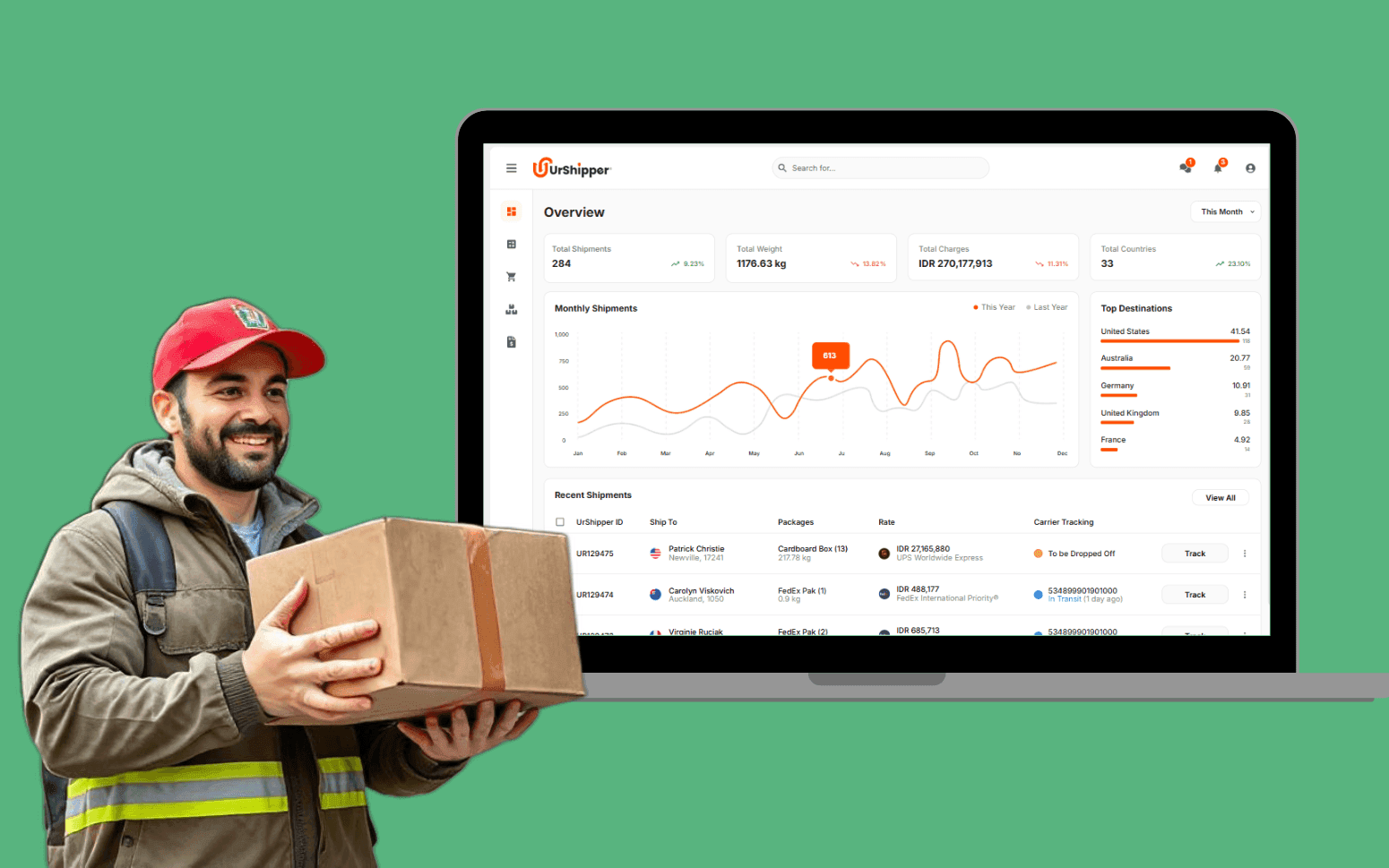
Scalable Multi-Carrier Shipping Software for a Global Logistics Platform
- 2K+
- 92
Supply chain software built for manufacturers, distributors, and retailers: demand forecasting, inventory planning, supplier portals, purchase order management, and end-to-end visibility beyond what your ERP shows.
Built for operations teams who find out about supplier delays and stockouts after they have already affected production or customer orders, and who need a system that gives them that information while there is still time to act.
Demand forecasting and inventory planning with reorder automation
Purchase order management and supplier portal for PO acknowledgement and delivery tracking
Multi-location inventory across warehouses, distribution centres, and in-transit stock
ERP integration with SAP, Oracle, NetSuite, and Microsoft Dynamics
Recognition
Running supply chain operations where your team only knows about a supplier delay or stockout when it's already affecting your production line or customer orders?
Your ERP giving you inventory numbers but no visibility into what's in transit, what's at risk, or which purchase orders are going to miss their expected arrival?
In short
RaftLabs builds custom supply chain software covering demand forecasting and inventory planning using sales history and seasonality data; purchase order management with supplier portals for PO acknowledgement and delivery date tracking; multi-location inventory management across warehouses and in-transit stock; supply chain visibility dashboards with end-to-end shipment tracking; and integration with ERP systems including SAP, Oracle, NetSuite, and Microsoft Dynamics. Supply chain software is appropriate for manufacturers, distributors, and retailers who need visibility and control beyond what their ERP provides. Most supply chain software projects deliver in 12-16 weeks at a fixed cost.
Companies we've built for





Most ERPs are built to record what happened: purchase orders raised, goods received, invoices matched. They're not built to tell you what's about to go wrong. By the time your ERP shows a stockout or a missed PO delivery, the damage is already done. A production line is waiting, a customer order is late, or a warehouse is holding three months of the wrong product.
Supply chain software sits on top of your existing systems and gives your team the data they need to act before problems reach the warehouse floor. Demand signals update forecasts. Supplier confirmations are tracked automatically. In-transit stock is visible on a single dashboard. Exceptions surface themselves instead of waiting for someone to notice in a spreadsheet.
Statistical forecasting models built from your sales history and seasonality patterns, calculated per SKU and per location. We use gradient boosting models: LightGBM for tabular demand data and Prophet for time-series decomposition with trend, seasonality, and holiday regressors. These target a Mean Absolute Percentage Error (MAPE) below 15% on 13-week forward rolling forecasts. Safety stock levels are calculated per SKU using lead time variability data so buffer quantities reflect actual supplier performance, not a fixed number of days. Reorder point automation triggers purchase requisitions when on-hand plus on-order stock drops below the dynamically calculated threshold for each item. Out-of-stock risk alerts flag SKUs projected to stockout before the next scheduled receipt, giving your planners time to expedite or substitute. Overstock alerts identify slow-moving inventory before it ties up working capital across multiple periods. S&OP integration connects the forecast output to your ERP planning module (SAP IBP or Oracle SCM Cloud) so the supply plan reflects updated demand signals rather than the last month's frozen plan. Scenario planning lets your team model the inventory impact of a demand spike, a supplier delay, or a promotional campaign before committing to purchase orders.
PO creation and multi-level approval workflow before orders are sent to suppliers. For organisations trading with suppliers via EDI, we build ANSI X12 EDI 850 (Purchase Order) and EDI 855 (Purchase Order Acknowledgement) transaction handling so POs are transmitted and acknowledgements received electronically without manual re-keying. Supplier assignment and contracted pricing are applied automatically at PO creation from your ERP supplier master and pricing tables. PO acknowledgement tracking shows which suppliers have confirmed, which have acknowledged with a changed date, and which haven't responded within your agreed confirmation window. Automated reminders go out when a supplier hasn't acknowledged within 48 hours. Delivery date commitment management flags when a supplier revises a committed date so your planning team can adjust the supply plan before the delay reaches the warehouse floor. Partial delivery handling reconciles multi-shipment receipts against the original PO. Three-way invoice matching compares the purchase order, the goods received note (GRN), and the supplier invoice, checking quantity, price, and INCOTERMS 2020 delivery terms, and flags discrepancies for accounts payable review before payment is authorised. INCOTERMS 2020 compliance tracking records agreed delivery terms (EXW, FOB, CIF, DAP, DDP) per line item and reports on supplier adherence.
A supplier-facing web portal where your suppliers log in to acknowledge POs, update delivery dates, upload shipping documents, submit invoices, and share tracking information for in-transit shipments. Supplier risk scoring uses Dun and Bradstreet (D&B) Supplier Intelligence API data, including financial stability ratings, PAYDEX scores, and operational risk flags, so your procurement team has an objective risk signal for each supplier alongside their delivery performance history in the portal. Suppliers with a high-risk score or deteriorating on-time delivery trend are flagged for sourcing review. Nearshoring and reshoring cost modelling is supported by a supplier comparison tool that calculates total landed cost per unit including freight, duties, and lead time buffer stock requirements, so your procurement leadership can model the cost impact of shifting a category to a closer supplier. Quality documentation upload handles certificates of conformance, material test reports, and RoHS declarations. The portal reduces email and phone coordination that consumes procurement team time on every active PO, and gives you a documented audit trail of every supplier commitment and delivery status update. Disruption simulation using Monte Carlo methods models lead time variability across your top 20 supplier-SKU combinations, showing the probability distribution of late deliveries under different demand scenarios.
Real-time inventory by SKU across all warehouses, distribution centres, and in-transit stock in one view, updated from GS1 EPCIS events: ObjectEvent (item-level observation), AggregationEvent (packing and unpacking), and TransactionEvent (order fulfilment and receipt). This means inventory positions reflect actual physical movements rather than batch-updated ERP postings. GS1 EPCIS provides a standardised event vocabulary that works across different WMS platforms and logistics partners without custom integration per location. Inventory reservation for confirmed customer orders so committed stock isn't available for reallocation to later orders. Stock transfer management between locations uses a transfer order workflow with dispatch confirmation at origin and receiving confirmation at destination, keeping in-transit stock visible as its own inventory state. Inventory valuation runs by FIFO or weighted average cost per SKU, with the chosen method flowing through to your ERP for financial reporting. Low stock alerts by location and by SKU surface before customer orders are affected, with reorder recommendations calculated from the demand forecast and current supplier lead times. The single inventory view your operations team needs when stock is spread across multiple locations and your ERP shows only warehouse-level totals without in-transit visibility.
End-to-end shipment tracking from supplier despatch to warehouse receipt, consolidated from carrier tracking APIs, GS1 EPCIS event streams, and supplier portal updates into a single shipment timeline per purchase order. GS1 EPCIS ObjectEvents and TransactionEvents provide the structured data backbone. Each scan event at origin, in-transit hub, and destination is recorded with EPC-level detail, timestamp, read point, and business step, giving you a verifiable chain of custody per shipment. Exception alerts surface automatically for shipments delayed at origin, in transit, or held at customs, without requiring someone to check each carrier's tracking portal. ETA prediction uses carrier historical performance data and current-leg transit time to update expected arrival dates dynamically as the shipment moves. When a shipment is flagged as high-risk due to customs hold or carrier delay, the system recommends the next available action: expedite an alternative shipment, substitute from a secondary warehouse, or notify the customer with an updated date. Customer-facing order status is served from the same data without your team generating manual update emails. The dashboard that tells your operations team what is on time, what is at risk, and what needs a decision today.
Integration with SAP, Oracle, NetSuite, Microsoft Dynamics, or your custom ERP for inventory balances, purchase orders, goods receipts, and financial data. For SAP environments, we integrate via SAP IBP APIs for supply planning data and SAP S/4HANA REST APIs or IDocs for transactional data. For Oracle, we use Oracle SCM Cloud REST APIs covering purchasing, inventory, and manufacturing. WMS integration pulls pick, pack, and despatch events back into the supply chain layer so fulfilment activity updates the visibility dashboard in near real time. Bi-directional sync means the supply chain platform reads from your system of record and writes confirmed events back. PO receipts, inventory adjustments, and supplier invoice approvals post to your ERP rather than creating a second source of truth that diverges over time. Integration approach is chosen based on your ERP's API capability: REST API, SOAP web services, JDBC direct database connection, or file-based EDI via AS2 or SFTP where API access is restricted. For legacy ERP environments with no API, we build a message broker layer using Apache Kafka or RabbitMQ to process high-volume transactional events without overloading the ERP. Integration scope and data mapping are documented during discovery before development begins.
An ERP is a system of record. It stores and processes transactions: purchase orders, goods receipts, inventory movements, invoices, and financial postings. It's built for accuracy and auditability. ERP platforms like SAP S/4HANA, Oracle SCM Cloud, and NetSuite have supply chain modules, but those modules are designed to record what happened, not to predict what's about to go wrong. Supply chain software is a decision support layer that sits on top of your ERP. It takes data from your ERP and from outside it (supplier updates, carrier tracking, GS1 EPCIS events, demand signals), analyses that data, and tells your operations team what needs attention before it becomes a problem. The distinction matters because the ERP can't see in-transit stock on a carrier's tracking API, can't score a supplier's financial risk using D&B data, and can't run a Monte Carlo simulation of lead time variability on your top 50 SKUs. These are problems supply chain software solves. The two serve different purposes and work best together. Most businesses that need supply chain software already have an ERP. The supply chain platform fills the visibility and planning gap the ERP doesn't cover without extensive module configuration and customisation.
Yes. This is the most common project type we deliver in this area. We build a supply chain visibility and planning layer that integrates with your existing ERP via API or data export, pulls in supplier updates via a supplier portal, tracks in-transit shipments via carrier APIs and GS1 EPCIS event streams, and presents everything in dashboards and alerts your team can act on. Your ERP remains the system of record. The supply chain layer reads inventory balances, PO data, and goods receipt records from it, adds visibility data from outside your ERP (supplier delivery commitments, carrier tracking, D&B supplier risk signals, demand forecast outputs), and writes confirmed events back so your ERP stays current. For SAP environments, we use SAP IBP APIs and standard BAPI/RFC calls or IDocs for transactional writes. For Oracle SCM Cloud, we use the REST APIs for purchasing and inventory. For NetSuite, we use SuiteScript and NetSuite REST APIs. For older or custom ERP systems without REST APIs, we build an ETL layer or use file-based EDI via SFTP. No ERP migration is required, and the project doesn't require your ERP vendor's involvement in most cases.
Supplier data quality is one of the main practical challenges in supply chain visibility. We handle it with a combination of automated chasing, data validation, confidence flagging, and exception escalation. The supplier portal sends automated reminders when a supplier hasn't acknowledged a PO within 48 hours or hasn't updated a delivery date within the agreed window. Tracking data from carrier APIs fills gaps where suppliers haven't uploaded shipping documents. When both the supplier portal update and the carrier API return data, the system cross-validates them and flags discrepancies. For shipments sent via EDI 856 (Advance Ship Notice), the ASN data triggers automatic ETA calculation and populates the in-transit record without requiring the supplier to log into the portal separately. When tracking data is missing entirely, for example a supplier using a local carrier without API tracking, the system flags the shipment as untracked and escalates to your procurement team for manual follow-up. Data quality won't reach 100% for every supplier in every geography, but the system makes the gaps visible and attributable rather than hiding them in a spreadsheet where nobody notices until the goods don't arrive. Supplier-level data quality metrics are reported monthly so your procurement team can identify which suppliers need process improvement and prioritise EDI or portal onboarding for the ones with the lowest data quality scores.
A supply chain visibility layer that integrates with one ERP, adds a supplier portal, and provides a dashboard and exception alerting typically runs $40,000-$80,000. A full platform with demand forecasting, inventory planning, multi-location inventory management, purchase order management, supplier portal, and ERP plus WMS integration typically runs $80,000-$180,000. Cost depends on the number of ERP and WMS integrations, supplier portal complexity, and the sophistication of the forecasting models. We scope every project before pricing it.
What clients say
Three-year average engagement. Founders and operators describing the work in their own words. No marketing varnish.

 Indonesia
I definitely recommend RaftLabs, especially to founders building complex platforms. They were transparent throughout the whole project.
01 / 02
Tell us the visibility and planning problems your team is dealing with, what systems you're already running, and where the gaps are. We'll scope the right platform and give you a fixed cost.