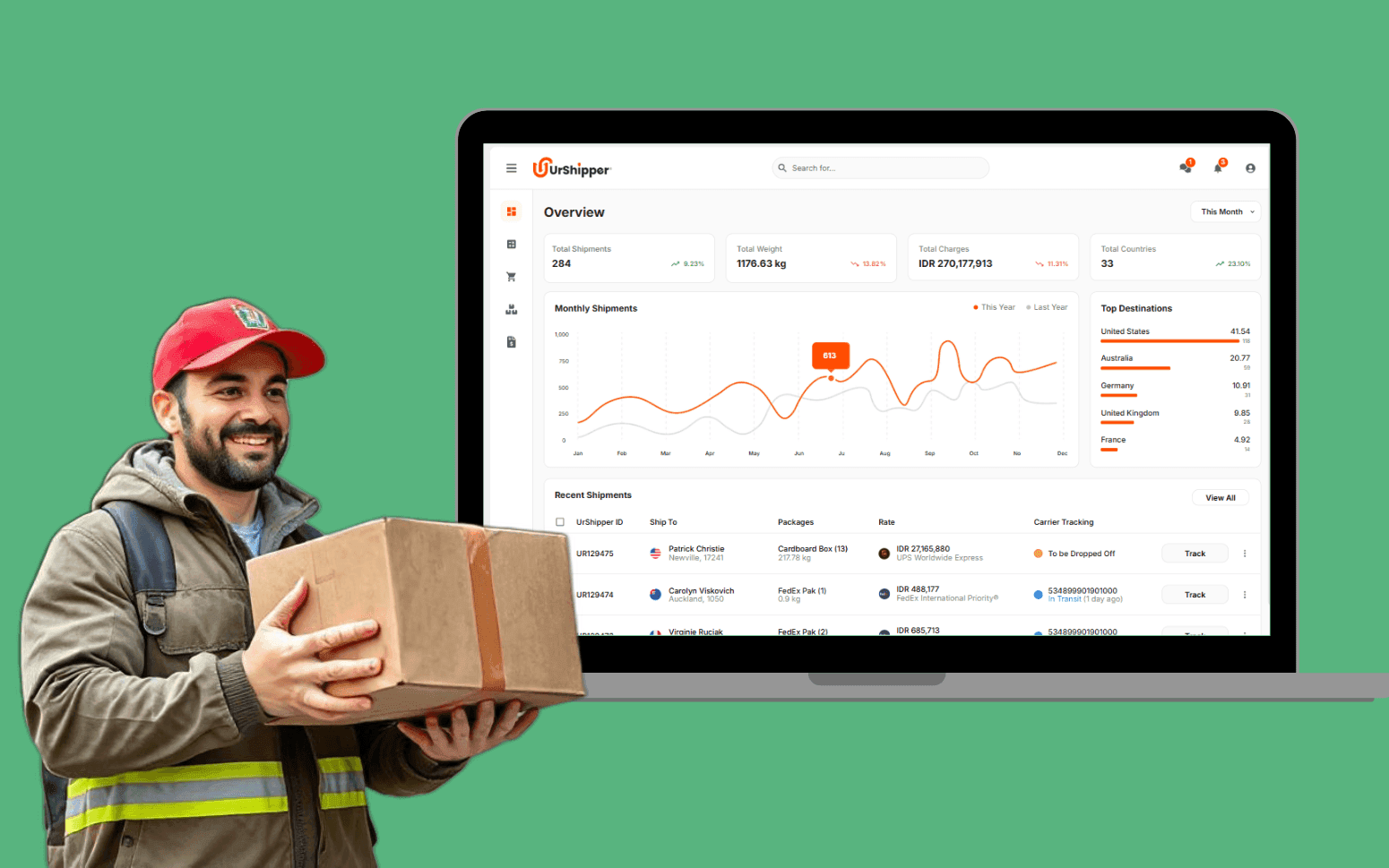
Scalable Multi-Carrier Shipping Software for a Global Logistics Platform
- 2K+
- 92
Custom logistics platforms built for your specific carrier mix, customer requirements, and operational workflows: shipment management, tracking visibility, carrier integration, and the customer-facing tools your clients expect.
100+ products shipped since 2019. We've built freight management and tracking platforms for logistics operators managing carrier networks, customer portals, and multi-carrier shipment workflows.
Multi-carrier integration with rate shopping, booking, and tracking data aggregation
Customer portal with real-time shipment visibility and self-service capabilities
Carrier invoice reconciliation and freight audit automation
Warehouse and 3PL management with inbound, outbound, and inventory tracking
Recognition
Off-the-shelf TMS not designed for your specific carrier mix, rate structures, or customer portal requirements?
Manual shipment tracking and status updates consuming operations team time that should be spent on exceptions?
In short
RaftLabs builds custom logistics software, including freight management platforms, carrier integration systems, multi-carrier shipment tracking, warehouse management systems (WMS), 3PL customer portals, and supply chain visibility dashboards, for logistics operators, 3PLs, freight brokers, and enterprise shippers. Custom logistics software is appropriate when off-the-shelf TMS or WMS platforms don't support your specific carrier mix, customer requirements, or operational workflows. Most logistics software projects deliver in 10-18 weeks at a fixed cost with full source code ownership.
Companies we've built for








Off-the-shelf TMS platforms are built for the average logistics operation. If your carrier mix, rate structures, customer requirements, or operational workflows don't match what the vendor assumed, you end up with workarounds: manual data entry to bridge system gaps, reporting pulled from spreadsheets because the TMS reports don't match your business model, and customer portals that don't match your brand or show the visibility your clients expect.
Custom logistics software builds the platform around your specific operations: the carriers you work with, the rates you negotiate, the customer visibility requirements you need to meet.
Shipment creation, carrier selection, booking, and documentation management: BOL generation, shipping labels, customs documents, and carrier-specific required documentation. Rate shopping across your carrier network to surface the best rate for each shipment based on weight, dimensions, service level, and lane. Shipment status management from booking through delivery. The freight management system your operations team uses to manage daily shipment volume without manual carrier portal access.
TMS core features include load tendering to your preferred carrier network with automatic fallback to secondary carriers when the primary declines, carrier rate shopping that pulls live rates from FedEx Ship API, UPS Rating API, and DHL Express API in a single request and ranks them by cost and transit time, and freight audit that compares the carrier's invoice amount against the agreed tariff and flags discrepancies before payment is approved. BOL and shipping label generation follows carrier-specific format requirements so documents are accepted at pickup without rework. Customs documentation for international shipments, including commercial invoice, packing list, and AES/ACE export filings, is generated from shipment data with the commodity and HS code fields pre-populated from your product catalogue. For brokers managing FTL, load board connectivity and carrier onboarding workflows are included.
API integration with your carrier network, covering parcel carriers (FedEx, UPS, USPS, DHL), LTL carriers, FTL brokers, and regional carriers, for rate quotes, booking, label generation, and tracking event ingestion. EDI integration for carriers and trading partners using X12 or EDIFACT standards. Carrier API normalisation presenting a consistent interface to your application regardless of carrier-specific API differences. We build and maintain the carrier integrations so your team doesn't have to.
FedEx Ship API, UPS Rating API, and DHL Express XML API each have different request schemas, error response formats, and rate structure conventions. We build a normalisation layer that abstracts those differences so your application calls a single interface regardless of carrier. EDI integration covers the core X12 transaction sets used in North American logistics: EDI 204 (Motor Carrier Load Tender), EDI 210 (Freight Invoice), and EDI 214 (Shipment Status Message), with transmission over AS2, SFTP, or VAN connection depending on your trading partner's requirements. For last-mile optimisation, shipment routing can be passed to an OR-Tools VRP (Vehicle Routing Problem) solver that calculates optimal stop sequences based on delivery time windows, driver capacity, and geographic clustering, producing routes that take 15-25% fewer miles than manual dispatch. ELD mandate compliance tracking (FMCSA Hours of Service) is built into driver assignment workflows so dispatchers see driver hours availability before assigning loads.
White-label customer portal where your clients can track their shipments, view historical shipment data, pull proof of delivery documents, and raise service queries. Real-time tracking with carrier event data aggregated across all carriers into a single timeline per shipment. Proactive notifications for key events: picked up, in transit, out for delivery, delivered, and exception. The visibility your customers expect without requiring manual status updates from your operations team.
Real-time shipment tracking is built on carrier event polling intervals or webhook ingestion (where the carrier supports it) normalised into a single event model per shipment. GTIN and GS1 barcode standards are used for scan event attribution so tracking events from multi-carrier journeys (handoff from FTL linehaul to parcel for last-mile) are stitched into a single coherent timeline rather than appearing as separate shipments. Proof of delivery documents including e-signature captured at delivery are stored against the shipment and accessible to customers without calling your operations team. Proactive SMS and email notifications are triggered at key status transitions with configurable thresholds per customer. The portal also supports self-service shipment booking for accounts where customers initiate their own shipments. They enter weight, dimensions, and delivery address, and the portal presents rated options from your carrier network.
3PL warehouse management with inbound receiving, put-away, inventory tracking by location, pick and pack, and outbound shipping integrated with your carrier connections. Client-specific inventory management with separate visibility per client account. Inbound ASN management and receiving against purchase orders. Inventory adjustments, cycle counting, and reporting. The WMS layer that connects your warehouse operations to your customer portal and carrier network.
WMS features are built around the operational patterns that drive efficiency at scale. Slotting optimisation assigns SKUs to locations based on velocity (A/B/C classification), pick frequency, and physical constraints like weight and dimensions, reducing average pick travel distance. Wave planning groups pick tasks into optimised waves based on carrier cutoff times, order priority, and picker capacity, preventing the situation where high-priority orders are buried under low-priority wave assignments. Directed putaway routes inbound items to their optimal location based on the slotting rules, with handheld scanner prompts confirming each step. For clients receiving inbound shipments with purchase orders, ASN matching validates received quantities against the expected PO before inventory is posted. Cycle counting schedules are maintained within the WMS, with A-class locations counted weekly and B-class monthly, and variance reports flagging discrepancies for investigation before they compound into material shrinkage.
Automated matching of carrier invoices against booked rates, identifying overcharges, billing errors, and accessorial charges not agreed in your rate card. Exception workflow for disputed charges with carrier communication tracking. Recovery reporting showing overbilling identified and recovered over time. Cost-per-shipment analysis by carrier, lane, and service type. The freight audit process that your finance team runs manually, automated.
Freight audit works by ingesting carrier invoices (via EDI 210 transaction set, CSV, or PDF extraction) and matching each line item against the rate card applied at time of booking. Common discrepancy types caught automatically include incorrect weight charges where the carrier's dimensional weight calculation differs from your quoted basis, accessorial charges for residential delivery or fuel surcharge at rates not in your negotiated tariff, and duplicate invoices for the same shipment. Each discrepancy is assigned to an exception queue where your operations team reviews and disputes with the carrier. Recovery tracking shows cumulative savings from disputed and recovered charges over any period, and this figure is typically what justifies the freight audit module to finance. For high-volume shippers, a 1-2% overbilling rate on carrier invoices is common; automated audit recovers most of it consistently.
Operations dashboards showing daily shipment volume, in-transit shipments, exception shipments requiring attention, and carrier performance by lane and service level. SLA compliance tracking against your committed delivery standards. On-time performance and transit time analysis by carrier and lane. Revenue and margin reporting for 3PL billing. The operational visibility your management team uses to run the operation and report to clients.
Key metrics tracked on the operations dashboard include on-time delivery rate by carrier and lane, exception rate (shipments with damage, loss, or missed delivery attempts), average transit time vs committed SLA by service level and origin-destination pair, and shipment volume trends by customer account and period. For 3PLs, client-specific reporting shows each client their own shipment data without cross-account visibility. The reporting layer enforces account separation at the query level. Carrier performance scorecards are generated monthly and shared with carrier reps during business reviews. Customs clearance status tracking shows shipments pending ACE/AES filing, in customs hold, or cleared, which is relevant for importers managing ocean and air freight. The dashboard data is exportable in Excel and PDF for operational reporting to customers who prefer document-format reporting alongside portal access.
Custom logistics software makes sense when: (1) Your carrier mix includes regional or non-standard carriers that standard TMS platforms don't support via their pre-built integrations. (2) Your rate structures, negotiated rates, volume tiers, fuel surcharge calculations, and accessorial charges, are complex enough that the TMS rate engine can't model them accurately. (3) Your customer portal requirements go beyond what the TMS vendor's customer-facing module provides: custom branding, specific visibility data, self-service capabilities. (4) You're a 3PL with client-specific requirements that a single-tenant TMS can't separate cleanly. (5) You need specific integrations with your customers' ERP or order management systems that the TMS doesn't support. We assess your requirements and advise honestly on whether custom or configured off-the-shelf is the right fit.
Standard TMS platforms like MercuryGate, McLeod, or project44 work well for common carrier networks and standard rate structures. The gaps appear when your business model sits outside their assumptions: a 3PL with complex client-specific billing rules, a regional carrier with a proprietary rate formula the TMS rate engine can't replicate, or a shipper whose ERP integration requirements don't match the connector list the TMS vendor supports. The cost-benefit of custom also shifts when the TMS per-transaction or per-user fee model becomes expensive at your volume. At a certain scale, owning the platform is cheaper than licensing it indefinitely.
We integrate with API-capable carriers across parcel, LTL, and FTL: FedEx, UPS, USPS, DHL Express and Ecommerce, Purolator, Canada Post, and most regional parcel carriers. For LTL, we integrate with XPO, Old Dominion, FedEx Freight, Estes, R+L, and others. For FTL and brokerage, we integrate with broker APIs and load board APIs where available. For carriers using EDI rather than REST APIs, we handle X12 EDI transaction sets (204, 210, 214) via your VAN or direct connection. We confirm carrier integration approach for each carrier during scoping. Not all carriers have full API coverage for all functions.
FedEx Web Services and FedEx Ship API v2 support rate shopping, label generation, and tracking event webhooks. UPS Rating API and UPS Shipping API cover the same functions for UPS. DHL Express XML Services API is the standard integration for international express. For carriers that publish rates as tariff files rather than live API calls (common with regional LTL carriers), we build rate engines that load the tariff table and apply fuel surcharge calculations matching the carrier's published methodology. EDI 204 (load tender), 210 (freight invoice), and 214 (shipment status) are the three transaction sets that cover the majority of carrier EDI requirements. We handle all three.
We build EDI integrations using X12 (common in North American logistics) or EDIFACT (common in international) standards. Common transaction sets: 204 (Motor Carrier Load Tender), 210 (Freight Invoice), 214 (Shipment Status Message), 990 (Response to Load Tender). We handle transmission via AS2, SFTP, or VAN connection depending on what your trading partner supports. EDI mapping to your internal data model, transformation, and exception handling for rejected transactions are all included. For trading partners moving from EDI to API, we handle both formats during transition.
The implementation process for an EDI integration covers four stages: trading partner onboarding (collecting ISA/GS identifiers and agreeing on the transaction set versions), connectivity setup (AS2 certificate exchange, SFTP credential provisioning, or VAN mailbox configuration), map development (transforming the X12 or EDIFACT structure to your internal data schema for each transaction type), and testing through the carrier's partner certification process. Most carrier EDI certifications require 30-60 days for the certification test exchange cycle. We manage the certification coordination and handle the functional acknowledgement (997) responses so rejected transactions surface as actionable exceptions in your platform rather than silent failures.
A freight management platform with multi-carrier integration (3-5 carriers), rate shopping, booking, customer tracking portal, and basic reporting typically runs $40,000-$100,000. A full logistics platform with 3PL WMS, broad carrier network (10+ carriers), EDI integration, customer billing, and detailed analytics typically runs $100,000-$250,000. Cost depends on carrier count, EDI requirements, WMS complexity, and customer portal scope. We scope every project before pricing it.
What clients say
Three-year average engagement. Founders and operators describing the work in their own words. No marketing varnish.

 Indonesia
I definitely recommend RaftLabs, especially to founders building complex platforms. They were transparent throughout the whole project.
01 / 02
Tell us your carrier network, customer requirements, and the operational workflows your current system doesn't support. We'll scope the right platform and give you a fixed cost.