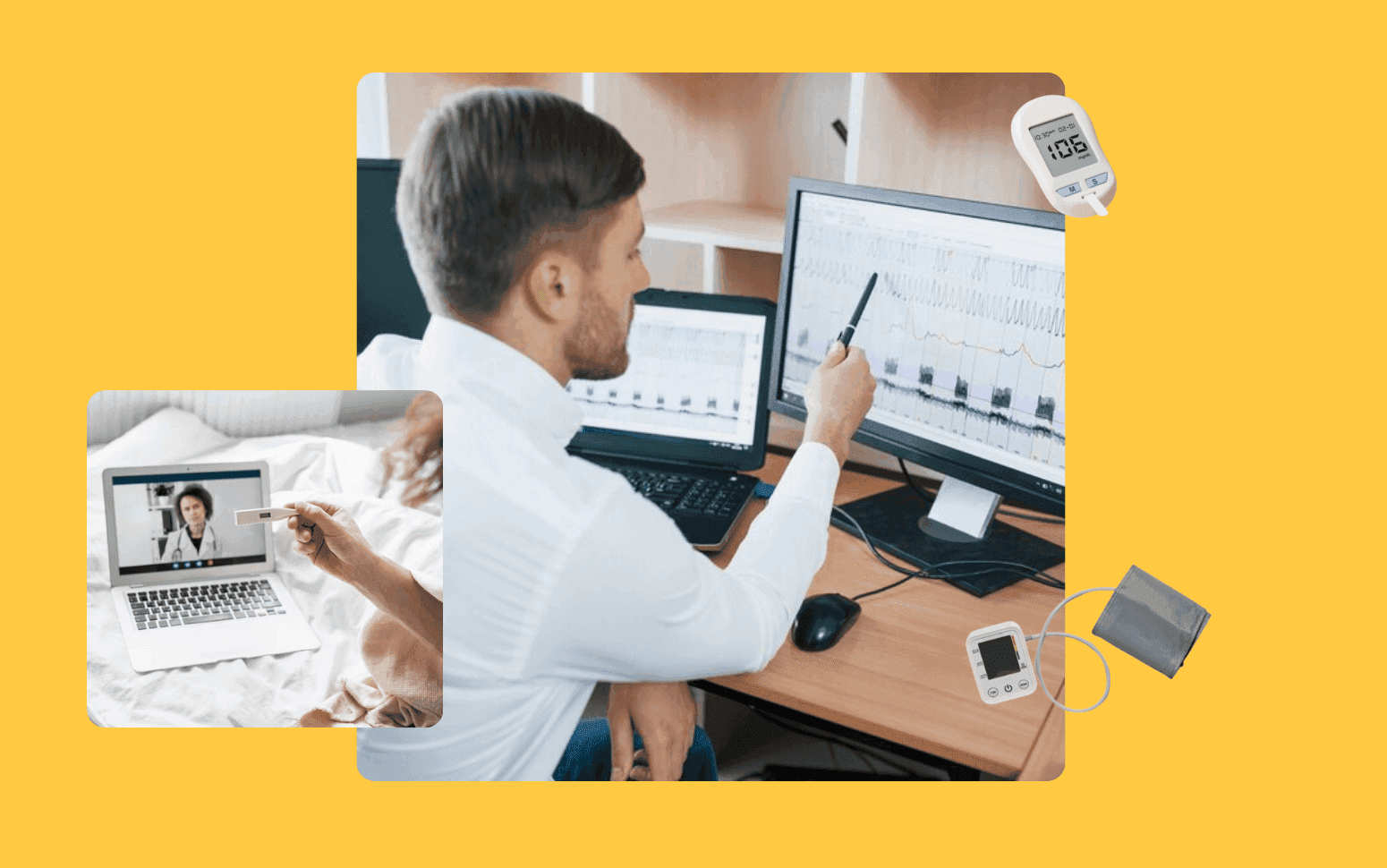
AI Remote Patient Monitoring Cuts Hospital Readmissions
- 30%
- 12 weeks
Voice agents that handle clinical documentation, patient intake, prior auth calls, and appointment scheduling, so your clinical staff spend their time on patients, not admin.
Built for health systems, medical groups, and digital health companies that need voice AI with HIPAA-aware architecture and direct EHR integration, not a generic voice bot dropped on a HIPAA disclaimer.
Clinical documentation voice agents that draft SOAP notes from encounter audio in real time
Patient intake voice bots that collect structured data, screen for urgency, and write to the EHR via FHIR
Prior auth voice automation that extracts criteria, matches payer guidelines, and tracks submission status
HIPAA-aware architecture with Business Associate Agreements across the full vendor stack
The problem
Clinicians spending 30 to 50 percent of their workday on post-encounter documentation instead of patient care?
Patient intake still running on paper forms and phone queues, with no automated triage to route urgent cases faster?
Prior auth calls consuming hours of staff time every week with no reliable way to track request status or flag delays?
The short answer
RaftLabs builds HIPAA-aware voice AI for healthcare, clinical documentation, patient intake, prior auth automation, appointment scheduling, and nurse call response. Each agent integrates with EHR systems via FHIR R4 or HL7 and operates under architecture reviewed for HIPAA compliance, including BAAs with every AI vendor in the stack. Most healthcare voice AI projects deliver in 10-14 weeks at a fixed cost.
Companies we've built for






Healthcare voice AI fails when it's treated as a general-purpose voice bot with a HIPAA disclaimer bolted on. Clinical environments have specific constraints that shape every design decision: speech recognition must handle medical terminology without errors, PHI cannot flow to any vendor without a Business Associate Agreement, EHR write-back must map to the right FHIR resource types, and escalation logic must be explicit before a single call goes live.
We build healthcare voice AI with these constraints as the starting point. Medical vocabulary tuning on the transcription layer. BAA-covered AI vendors across the full stack. FHIR R4 integration scoped during discovery because EHR API coverage varies by system and configuration. Clinical validation before any agent handles a live patient interaction.
The agent listens to the patient encounter, either as an ambient listener in the exam room or as a post-encounter dictation interface, and generates a structured SOAP note draft from the conversation audio. Transcription runs on Deepgram Nova-2 Medical with custom vocabulary tuning applied to your specialty's terminology: drug names, procedure codes, anatomy terms, and condition-specific language that general-purpose transcription models consistently mishandle.
The draft note is structured against your EHR's template fields before pre-population. FHIR R4 DocumentReference or the EHR's clinical note write API receives the draft where write-back is supported. A mandatory human-in-the-loop checkpoint requires clinician review and sign-off before any note is finalised, the agent drafts, the clinician approves. CDS Hooks integration can trigger the documentation agent from an EHR context event, so the draft appears in the clinician's queue as the encounter closes.
Note generation scope is defined and reviewed by your clinical team during a two to four week validation phase before the agent goes live. This is not optional, it's the step that catches the gap between what a general LLM produces and what your documentation standards require.
The agent handles inbound patient calls before an appointment or telehealth visit. It collects chief complaint, symptom onset and duration, severity, relevant medical history, current medications, and insurance information in a structured guided conversation. The question sequence branches dynamically on the chief complaint: a patient presenting with chest pain gets a different intake path than one presenting with a skin condition, without requiring either to answer irrelevant questions.
Symptom patterns are screened against urgency criteria defined by your clinical team. Red-flag combinations, chest pain with dyspnea, sudden severe headache, stroke indicators, trigger immediate routing to emergency escalation rather than standard appointment queuing. The triage logic is set by your clinical team before deployment; the agent applies it without deviation.
Collected intake data is structured as FHIR R4 Patient, Condition, Observation, and MedicationStatement resources and submitted to the EHR via the FHIR write API. The provider arrives at the encounter with structured intake already in the record. Every patient response and every routing decision is captured in the audit trail per 45 CFR 164.312 access control requirements.
Prior auth calls are the most time-intensive administrative workflow in most medical groups. The agent handles the end-to-end process: extracting relevant clinical criteria from patient records via FHIR R4 resource types, matching them against payer-specific guidelines, placing or routing the submission, and tracking status on the defined follow-up schedule.
Pending requests approaching payer response deadlines are escalated automatically. Incomplete submissions where the payer requires additional documentation are flagged with the specific gap noted, not a generic denial, so the staff member handling follow-up has the information to act immediately. Denials assessed as viable for appeal are surfaced with the denial code and available clinical documentation attached.
The workflow is implemented using LangGraph for stateful process management. The multi-step prior auth process, extract, match, submit, track, escalate, is modelled as a directed graph with explicit human-in-the-loop checkpoints before any submission action. The audit trail captures every step per 45 CFR 164.312.
The agent handles inbound scheduling requests and outbound appointment reminders across provider calendars. Availability is retrieved in real time from the scheduling system via FHIR R4 Schedule and Slot resources where the EHR exposes them, or via the scheduling system's native API. Appointment type rules, which types can be booked by voice, minimum notice requirements, and provider-specific block scheduling, are configured during setup.
Confirmed bookings write the FHIR R4 Appointment resource to the EHR and send a patient confirmation with details, location or telehealth link, and preparation instructions. Outbound reminder calls run at configured intervals, typically 72 hours and 24 hours before the appointment, with voice-activated confirm, reschedule, or cancel options. Cancellations received outside the no-show window trigger a slot release and an offer to waitlisted patients who match the appointment type and provider criteria.
The agent escalates to front desk staff for requests outside its configured scope: complex multi-provider scheduling, patients with active care plans that require clinical input on scheduling decisions, and requests where the patient describes a symptom suggesting a different appointment type than requested.
Inpatient nurse call systems generate a high volume of non-urgent requests, pain medication timing, meal preferences, room temperature, TV controls, and general questions, that consume nursing staff time disproportionate to their clinical complexity. A voice AI agent handles these requests directly: answering common questions from a structured knowledge base, routing non-urgent service requests to the appropriate floor staff, and reserving nurse escalation for requests that match clinical intervention criteria.
Escalation logic is defined by your nursing leadership before deployment. Requests that contain clinical indicators, reported chest pain, difficulty breathing, fall events, or specific medication questions, route immediately to the nursing station. The agent does not attempt to handle clinical assessment. It handles the volume of routine requests that represent 40 to 60 percent of nurse call interactions in most inpatient units.
Integration connects to your nurse call system and, where supported, to the EHR for patient context retrieval via FHIR. Every interaction is logged with timestamp, request type, routing decision, and response delivered, providing the audit record needed for quality review and compliance documentation.
Accurate medical coding requires mapping clinical documentation to the right ICD-10, CPT, and HCPCS codes, a process that drives billing accuracy and revenue capture. A voice AI agent assists coders by listening to dictated encounter summaries or reviewing documentation already in the EHR and suggesting relevant code candidates with the supporting clinical rationale extracted from the note.
The agent uses BioBERT or a fine-tuned clinical NLP model to extract diagnosis, procedure, and service information from unstructured documentation. Code suggestions are ranked by confidence and presented to the coder with the specific supporting language from the note highlighted. The coder reviews, selects, and submits, the agent surfaces candidates and rationale, the human makes the final coding decision.
FHIR R4 Claim and ExplanationOfBenefit resources are used for integration with the billing system where supported. The audit trail records every suggestion, every human decision, and every code submitted, providing the documentation required for coding quality audits and payer reviews.
HIPAA compliance for voice AI requires the same controls as any PHI-handling system under the Security Rule at 45 CFR 164.312: Business Associate Agreements with every vendor in the pipeline that processes PHI (transcription, LLM, text-to-speech, hosting), encrypted data handling in transit (TLS 1.2 minimum) and at rest (AES-256), access controls limiting PHI exposure to only the system components that need it, and complete audit logging of every interaction and PHI access event.
Voice AI adds a specific challenge: the audio stream itself contains PHI. The transcription layer must be covered by a BAA and must not retain audio or transcripts beyond the minimum required period. We document which pipeline stages receive audio, which receive transcripts, and which receive structured data derived from the transcript, and we confirm BAA coverage at each stage before any PHI flows.
Deepgram offers a HIPAA-eligible service agreement for their medical transcription models. Anthropic, OpenAI, AWS Bedrock, and Google Vertex AI offer BAAs for healthcare customers on their enterprise plans. Standard consumer API terms do not include BAAs, and PHI cannot be sent to those endpoints. We confirm coverage before scoping any architecture that routes PHI to an LLM.
We integrate with any EHR that exposes FHIR R4 APIs. Epic exposes FHIR R4 via its App Orchard and Open API programmes with OAuth 2.0 authentication. Oracle Health (formerly Cerner) exposes FHIR R4 via its Ignite APIs. Athenahealth, eClinicalWorks, Greenway Health, and most cloud-based EHRs that have completed ONC certification expose FHIR R4 endpoints.
For write-back operations, intake data submission, appointment booking, documentation pre-population, integration depth depends on what each EHR's API supports for that specific operation. Epic's scheduling API supports slot retrieval and appointment booking. FHIR DocumentReference write-back for clinical documentation is available on Epic and Cerner where the practice has configured write API access.
For EHRs with limited FHIR coverage for specific operations, HL7 v2 message feeds (ADT, ORU, ORM) are the fallback integration path. On-premise systems that expose neither FHIR nor HL7 interfaces require direct database integration as a last resort.
EHR integration is the highest-risk component of any healthcare voice AI build. We confirm integration scope explicitly during discovery, we do not estimate it generically because the variance in what different EHR configurations expose is large enough to change the project scope materially.
General-purpose transcription models produce word error rates of 15 to 25 percent on medical terminology without fine-tuning. Drug names, procedure names, anatomy terms, and specialty-specific language are the main failure points. An error rate that high is not acceptable in a clinical documentation context where a misheard drug name or incorrect diagnosis term creates a patient safety risk.
Deepgram's Nova-2 Medical model achieves word error rates below 5 percent on medical terminology in telephony environments when custom vocabulary tuning is applied. Custom vocabulary tuning adds your specific formulary, procedure list, and specialty terminology to the model's recognition layer, the terms most likely to appear in your encounter notes are the terms tuned most aggressively.
Medical vocabulary tuning on the transcription layer is not optional for any healthcare voice AI deployment where clinical accuracy matters. It's scoped into every project we build.
A focused single-workflow healthcare voice agent, one workflow such as patient scheduling or appointment reminders for one practice type and one EHR, typically runs between $35,000 and $65,000 and delivers in 10 to 14 weeks. This includes the voice pipeline implementation, FHIR R4 EHR integration, HIPAA-compliant architecture, BAA procurement coordination, and compliance documentation (data flow diagram, security controls inventory).
A multi-workflow system covering clinical documentation, patient intake, and prior auth automation with FHIR R4 write-back and a clinical validation phase typically runs $70,000 to $150,000. The higher end applies when payer API integration is required for prior auth submission, or when the documentation agent requires a formal clinical validation phase with your clinical team before it handles a live patient population.
Cost is driven primarily by EHR integration complexity, the number of payer systems involved in prior auth, and the clinical content scope that must go through your clinical team's review. We scope and price every project before starting. The scoping document defines the voice dialogue flow, integration points, escalation logic, human-in-the-loop checkpoints, and acceptance criteria.
Escalation logic for medical emergencies is a core design requirement, not an afterthought. Every healthcare voice AI agent we build has explicit escalation paths defined before it handles a live patient call. Specific trigger phrases, reported symptoms that match clinical red-flag criteria, and sentiment signals that indicate distress all cause the agent to immediately transfer to a live clinician or, for life-threatening emergencies, to prompt the patient to call 911 and transfer the call to emergency services.
The escalation criteria are defined by your clinical team and reviewed during the pre-deployment validation phase. The agent applies the criteria exactly as defined, it does not attempt to assess whether a situation warrants escalation based on its own judgment. When the criteria are met, it escalates without delay.
The agent is also designed to recognise when a patient is asking a question the agent cannot safely answer, clinical questions, medication advice, and symptom interpretation are outside the agent's scope and trigger a transfer to a clinical staff member. The boundary between what the agent handles and what it escalates is explicit, documented, and tested before deployment.
What clients say
Three-year average engagement. Founders and operators describing the work in their own words. No marketing varnish.

 USA
USAAll of the sprints were completed on schedule and on budget. We highly recommend RaftLabs!
01 / 02
Proof
AI Agents for Healthcare
Autonomous AI agents for prior auth processing, care gap outreach, clinical documentation, and patient intake.
AI Chatbot Development
Conversational AI for patient-facing web and mobile interfaces, FAQ handling, and symptom screening.
Business Process Automation
Automate prior auth, billing workflows, and administrative processes across your practice.
Custom Software Development
Custom healthcare platforms, patient management tools, and clinical workflow systems built to your compliance requirements.
Tell us the workflow you want to automate, your EHR system, and the patient volume. We will scope what a voice agent can handle and give you a fixed cost.