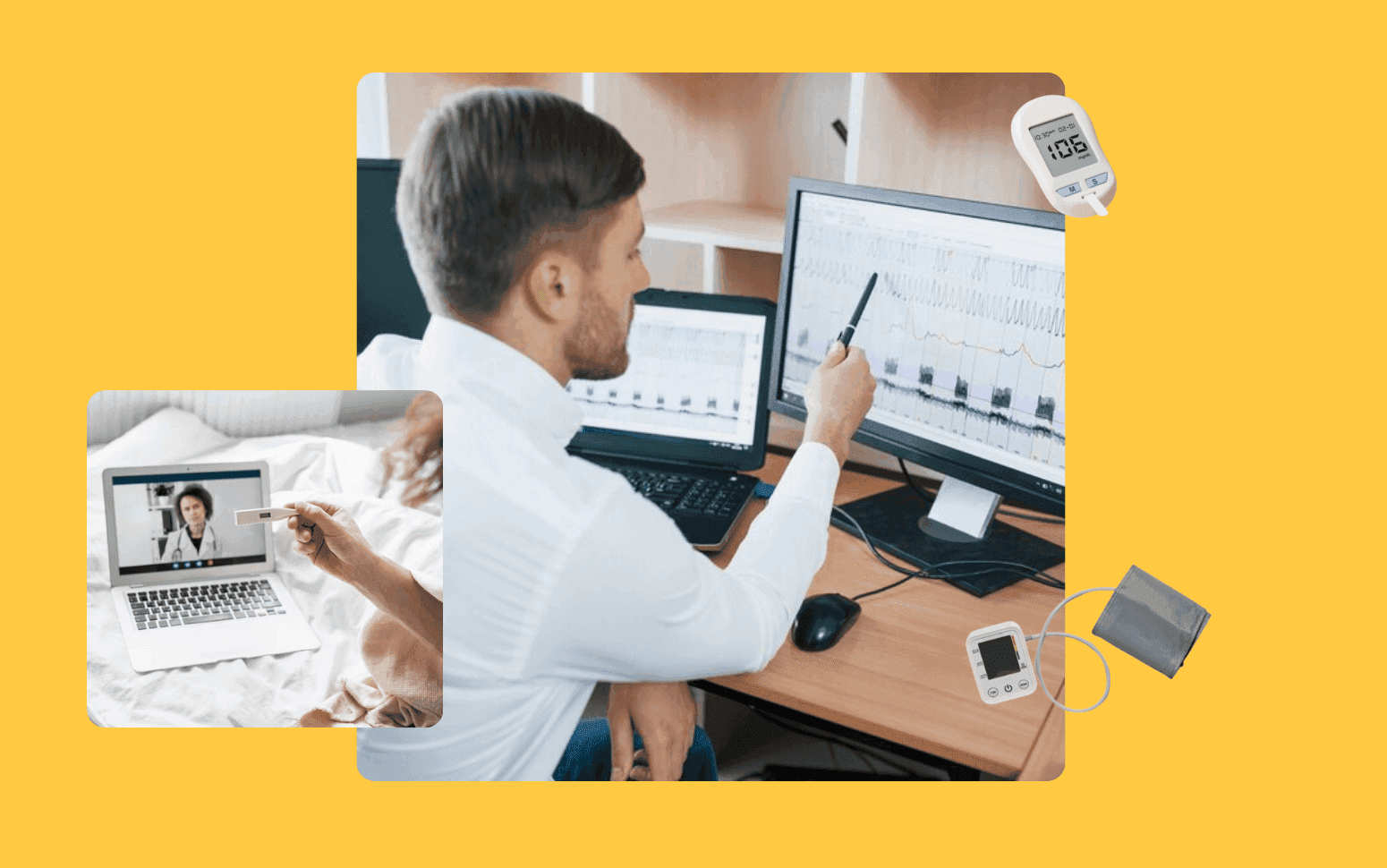
Remote Patient Monitoring Cuts Hospital Readmissions
- 30%
- 12 weeks
Custom mobile health apps for digital health companies, chronic disease programs, and consumer wellness platforms. Built around the behaviour change and data flows that health outcomes depend on.
We handle the wearable integrations, PHI data architecture, and clinical workflow logic that make an mHealth app usable in the real world.
Chronic disease management apps for diabetes, hypertension, COPD, and asthma with clinician-facing reporting
Mental wellness tools with CBT exercises, mood tracking, and validated outcome questionnaires (PHQ-9, GAD-7)
Medication adherence apps with dose scheduling, reminders, caregiver visibility, and refill tracking
Wearable and device integration for Apple HealthKit, Google Health Connect, Fitbit, Garmin, and CGMs
Recognition
Building a consumer health app that handles sensitive personal health data but unsure which HIPAA rules apply and which don't?
Integrating with wearable devices and health platforms (Apple Health, Google Fit, CGMs) and hitting undocumented API limitations at every turn?
In short
RaftLabs builds mHealth applications for digital health companies, chronic disease programs, and wellness platforms. We develop chronic disease management apps, mental wellness tools, medication adherence apps, fitness and nutrition trackers, and wearable integrations (Apple Health, Google Fit, CGMs). Where apps handle protected health information, we apply HIPAA-aware technical safeguards from day one. Most mHealth app development builds deliver in 10-14 weeks at a fixed cost.
Companies we've built for






Most mHealth apps fail because they log data without changing behaviour. A diabetes patient who opens an app once to enter a blood glucose reading and never returns isn't being helped. The app has to earn daily use by reducing friction, surfacing useful feedback, and fitting the patient's existing routine.
We build mHealth apps with behaviour change mechanics at the centre. The data capture and wearable integrations serve that goal. Where an app handles protected health information, HIPAA-aware architecture is a requirement from the first sprint, not a compliance checkbox added at the end.
Daily symptom tracking, medication logging, vitals entry, and trend graphs for patients managing diabetes, hypertension, COPD, asthma, and similar long-term conditions. Condition-specific logic is built into the data model from the start: carb-to-insulin ratio calculation for diabetes management, peak flow percentage of predicted for asthma, FEV1/FVC ratio tracking for COPD, and blood pressure classification (ACC/AHA 2017 categories) for hypertension.
Where patients use connected devices, a Bluetooth-enabled blood pressure cuff, a CGM (Dexcom G7 or Abbott Libre 3), or a pulse oximeter, readings flow into the app automatically via the device SDK or a FHIR R4 Patient/$everything call to the patient's existing PHR, eliminating manual data entry for the readings the patient takes most frequently.
Clinician-facing reporting dashboards use the FHIR R4 Observation resource structure to standardise how vitals and measurement data are represented. This makes it straightforward to surface that data within an EHR or care management platform without custom transformation. Dashboards show adherence rates, flagged out-of-range readings, and week-over-week trends so the care team can act between appointments rather than reviewing a full history at the next visit. For clinical programs deploying the app to a patient panel, the FDA Digital Health Center of Excellence (DHCE) guidance on clinical decision support software is referenced during scoping to confirm the regulatory classification of any algorithm that acts on patient data.
CBT-based exercises, mood tracking, guided journaling, and meditation content for consumer mental wellness apps. Content is delivered in structured modules with session tracking and completion logic, not as a flat library. For clinical programs, we add validated outcome questionnaires, PHQ-9 for depression screening, GAD-7 for generalised anxiety, PCL-5 for PTSD, and PSQ-20 for perceived stress, with automatic scoring, severity classification per the validated scoring guidelines, and a therapist communication layer that surfaces flagged scores for follow-up.
PHR (Personal Health Record) CCDA (Consolidated Clinical Document Architecture) import allows patients to bring prior assessment history from their health record into the app. A patient entering a digital clinical program doesn't re-complete assessments they completed six months ago in another setting. SMART on FHIR launch context is supported for apps deployed by healthcare organisations that want patients to access the app from within their EHR patient portal rather than as a standalone download. The user authentication and patient context are passed from the EHR at launch.
Engagement mechanics matter for mental wellness apps because the patients most in need of the app are often the least likely to maintain consistent use. Push notification timing is personalised based on each patient's historical engagement patterns rather than a fixed daily alert. Streak logic, progress milestones, and therapist acknowledgment touchpoints are designed with retention in mind rather than added as afterthoughts. Content personalisation surfaces exercises relevant to the patient's current mood log and stated goals, not a static sequence every user follows in order.
Dose scheduling with flexible reminder logic, scheduled (once daily, twice daily, custom interval), PRN (as-needed with maximum frequency limits), and tapered schedules for medications with dose reduction protocols, across iOS and Android. Background notifications on iOS operate within Apple's background app refresh constraints, which limit the ability to schedule notifications more than 64 time periods in advance. The reminder scheduling logic handles this constraint transparently so reminders work correctly without requiring the app to be open.
Refill tracking calculates days of supply remaining from the dispense date and quantity, and surfaces refill reminders before the patient runs out. Where a pharmacy API integration is available (Surescripts, RxHub, or a pharmacy chain's own API), the app can surface medication fill history and upcoming refill eligibility directly rather than requiring manual entry. Caregiver visibility dashboards give a family member or care coordinator a real-time view of the patient's dose log for paediatric and elderly populations, with appropriate HIPAA-compliant consent flows governing what the caregiver account can see.
The HealthKit permissions manifest on iOS requires declaring each specific health data type the app reads or writes (HKQuantityType, HKCategoryType) and displaying a purpose string explaining why each type is needed. The App Store review process for health apps examines these declarations closely. We handle the permissions manifest, privacy policy language, and App Store metadata as part of the build. It's not a separate post-development task that delays submission.
Apple HealthKit integrations use HKWorkout, HKQuantitySample, and HKCategoryType data types for the specific health metrics your app requires. Each data type requires an individual permissions declaration. Background fetch on iOS uses HKObserverQuery with background delivery enabled for high-frequency data like step count and heart rate. Apple restricts background delivery frequency for most data types to protect battery life, so the integration is architected around the actual delivery rate rather than assuming real-time sync.
Google Fit DataSource API integration reads fitness metrics via the Fitness Sensors and Fitness History APIs using the Google Fit REST API or the Android Fitness API on-device. Google Health Connect (the modern replacement for Google Fit on Android) uses a different permission model that requires an explicit Health Connect permission screen before any health data access.
For third-party wearables, we integrate with the Fitbit Web API (OAuth 2.0 resource owner flow), Garmin Connect IQ for native Garmin watch integration, and the Polar AccessLink API for Polar device data. Each SDK has different data type availability, polling versus webhook delivery, and rate limit constraints that we verify during discovery before committing to integration scope. CGM integrations for Dexcom G7 use the Dexcom API v3 for cloud-based reading retrieval. For clinical applications, Bluetooth LE direct integration with medical devices (blood pressure cuffs, pulse oximeters, connected inhalers) uses the device manufacturer's SDK where available. We scope every wearable integration during discovery. API access, data granularity, refresh rates, and SDK version compatibility vary significantly and must be confirmed before the build begins.
Activity logging, workout planning, and exercise library with video guidance. Workout plans are structured as programmed sessions (sets, reps, rest intervals, weight targets) rather than flat content lists, so the app tracks progressive overload over weeks, the training variable most associated with long-term fitness results. Exercise library entries include demo video, muscles worked, common form errors, and equipment alternatives for home users.
Nutritional database lookup uses the USDA FoodData Central API for whole foods and the Open Food Facts database for packaged products, with barcode scan lookup for packaged food using the device camera and AVFoundation (iOS) or ML Kit (Android) barcode scanning. Portion size estimation for whole foods uses visual serving size guides rather than requiring weight measurement, which is the primary barrier to consistent food logging.
Calorie, macro (protein/carbohydrate/fat), and micronutrient tracking with configurable daily targets and weekly progress summaries. Sleep and step data are pulled from Apple HealthKit HKCategoryTypeIdentifierSleepAnalysis and HKQuantityTypeIdentifierStepCount, and from Google Health Connect sleep and activity data sources, to complete the health picture without requiring separate device entry.
Goal and milestone logic is designed for sustained engagement: streaks, milestone celebrations at 7, 30, and 90 days, and personalised feedback messages based on the specific goal the user set (weight loss, muscle gain, running a 5K). The first-use onboarding flow sets a concrete, near-term goal and a weekly commitment level rather than a generic "get healthy" aspiration, because specificity in goal-setting predicts app retention, and retention is the metric that predicts health outcomes.
Determining which data elements in your app qualify as protected health information is the first step. Not all mHealth data is PHI, and the answer changes based on who the covered entity is and how the data is used. A step count app with no connection to a healthcare provider handles fitness data, not PHI. The same step count data held by a health plan or clinician and linked to a patient's treatment record is PHI.
Where PHI is involved, the HIPAA Security Rule (45 CFR 164.312) technical safeguards apply: encryption of PHI at rest (AES-256) and in transit (TLS 1.2 minimum), unique user identification with automatic log-off after inactivity, role-based access controls limiting data access to the minimum necessary, and an audit log capturing every PHI access event. Business Associate Agreements are executed with every infrastructure provider that processes PHI. Cloud hosting, database services, LLM API providers, analytics services, and push notification services are all evaluated. BAAs are available from major cloud providers (AWS, Google Cloud, Azure) for their HIPAA-eligible services. We document which specific services are in scope.
The FDA Digital Health Center of Excellence (DHCE) framework for Software as a Medical Device is applied to any app feature that analyses clinical data or makes health recommendations. Apps that offer wellness functions, activity tracking, general dietary guidance, stress management, are typically outside the SaMD definition. Apps that suggest diagnosis, treatment decisions, or medication dose adjustments may fall within it. We identify the regulatory classification risk during scoping, not after development. App Store and Google Play both impose their own health data disclosure and data-handling requirements independent of HIPAA. We address these in the app privacy disclosure and data use policy as part of the app submission process.
It depends on whether the app handles protected health information and whether the developer qualifies as a covered entity or business associate under HIPAA. A general fitness tracker sold directly to consumers with no connection to a healthcare provider typically doesn't trigger HIPAA obligations. An app that receives data from a clinician, integrates with an EHR via FHIR R4, or is deployed as part of a health plan's benefit program almost always does.
The data flow analysis during discovery maps every data element (what it is, who creates it, who accesses it, how it flows between systems) and assesses PHI status for each. This analysis also identifies whether the developer role in the product is that of a business associate (building software for a covered entity) or a covered entity itself (operating a healthcare-adjacent service directly). The two roles carry different compliance obligations.
Where PHI is confirmed, we apply the HIPAA Security Rule technical safeguards from sprint 1, not as a late-stage compliance overlay. The infrastructure decisions, which cloud region, which database service, which push notification provider, are made with BAA availability confirmed before the architecture is finalised. Consumer mHealth apps in the US also need to comply with the FTC Health Breach Notification Rule, which applies to personal health records regardless of HIPAA status. We address both frameworks during discovery so your compliance posture covers the actual regulatory exposure of your product.
Apple HealthKit integration uses the HealthKit framework's HKHealthStore to request read and write access to specific data types, HKQuantitySample for vitals and fitness metrics, HKWorkout for exercise sessions, HKCategoryType for sleep stages and symptoms. Each data type requires a separate permissions declaration in the app's HealthKit entitlement and a purpose string displayed to the user during the permissions request flow. The HealthKit permissions manifest in the app's Info.plist must declare every data type the app accesses, and Apple's app review process verifies this against the app's actual data access behaviour.
Background delivery uses HKObserverQuery with enableBackgroundDelivery. Apple restricts background delivery frequency to protect battery, with most data types updating at most hourly in the background. The integration architecture accounts for this so the app displays the most recent available data rather than creating a stale data presentation.
Google Health Connect (the current Android health data platform, replacing Google Fit) uses a permissions model that requires an explicit Health Connect permissions UI. Apps can't request access via a custom dialog. The Google Fit DataSource API remains available for older devices. We scope the specific data types needed during discovery and test integration on physical devices across multiple OS versions, not just simulators, because background delivery behaviour and permission grant flows differ between iOS versions and Android OEM implementations.
Software as a Medical Device is an FDA classification for software intended to diagnose, treat, cure, mitigate, or prevent a disease or condition, or to affect the structure or function of the body. The FDA's Digital Health Center of Excellence (DHCE) published a Software as a Medical Device Action Plan that provides the current framework for classification and regulatory pathway selection.
A medication reminder app is not SaMD, it supports adherence but doesn't diagnose or treat. A general wellness app tracking steps and sleep is not SaMD. An app that analyses glucose trend data and generates an insulin dose recommendation likely is SaMD, classified at a higher risk tier because an incorrect recommendation could directly harm the patient. The intended use statement, what the app claims to do and what condition it acts on, drives the classification. Marketing language matters as much as technical function.
The FDA uses a risk-based framework with three tiers. Lower-risk SaMD may qualify for the FDA's Digital Health Center of Excellence Pre-Cert Program pathway with reduced premarket requirements. Higher-risk SaMD requires De Novo or 510(k) clearance with clinical validation data. Apps in the highest tier (life-sustaining or life-supporting functions) require PMA (Premarket Approval). We identify the relevant risk tier during scoping, review the intended use statement with you, and flag where claims in the app or marketing materials could move the product into a higher regulatory tier. Regulatory strategy requires a regulatory consultant or attorney for anything above the lowest tier. We work with your regulatory team and scope the technical compliance documentation accordingly.
A focused mHealth MVP, one condition or use case, one platform (iOS or Android), one wearable integration (Apple HealthKit or Google Health Connect), HIPAA-aware architecture, and no EHR connectivity, typically runs $35,000--$65,000 and delivers in 10–14 weeks. This covers the patient-facing app, core data model and API, basic clinician or admin dashboard, and the compliance documentation (data flow diagram, security controls inventory, BAA checklist) the build requires.
A full-featured mHealth platform with cross-platform iOS and Android apps, multiple wearable integrations (HealthKit, Google Health Connect, Fitbit, Garmin), clinician dashboards with FHIR R4 data export, validated outcome questionnaire scoring, and HIPAA-compliant data architecture including audit logging per 45 CFR 164.312 runs $70,000--$150,000.
Cost is driven primarily by the number of integrations (each wearable integration is a distinct SDK project requiring device testing), the depth of clinical logic (condition-specific calculations, escalation rules, and clinical content review add time), and compliance documentation requirements (apps deployed by health systems may require a security risk analysis under 45 CFR 164.308 as a formal deliverable). We price at a fixed cost after a paid discovery phase. The discovery deliverable is a scope document, data flow diagram, and fixed project price, no change-order surprises mid-build.
What clients say
Three-year average engagement. Founders and operators describing the work in their own words. No marketing varnish.

 USA
USAAll of the sprints were completed on schedule and on budget. We highly recommend RaftLabs!
01 / 02
Tell us your target condition or use case, your wearable integration needs, and whether PHI is in scope. We'll scope the build.