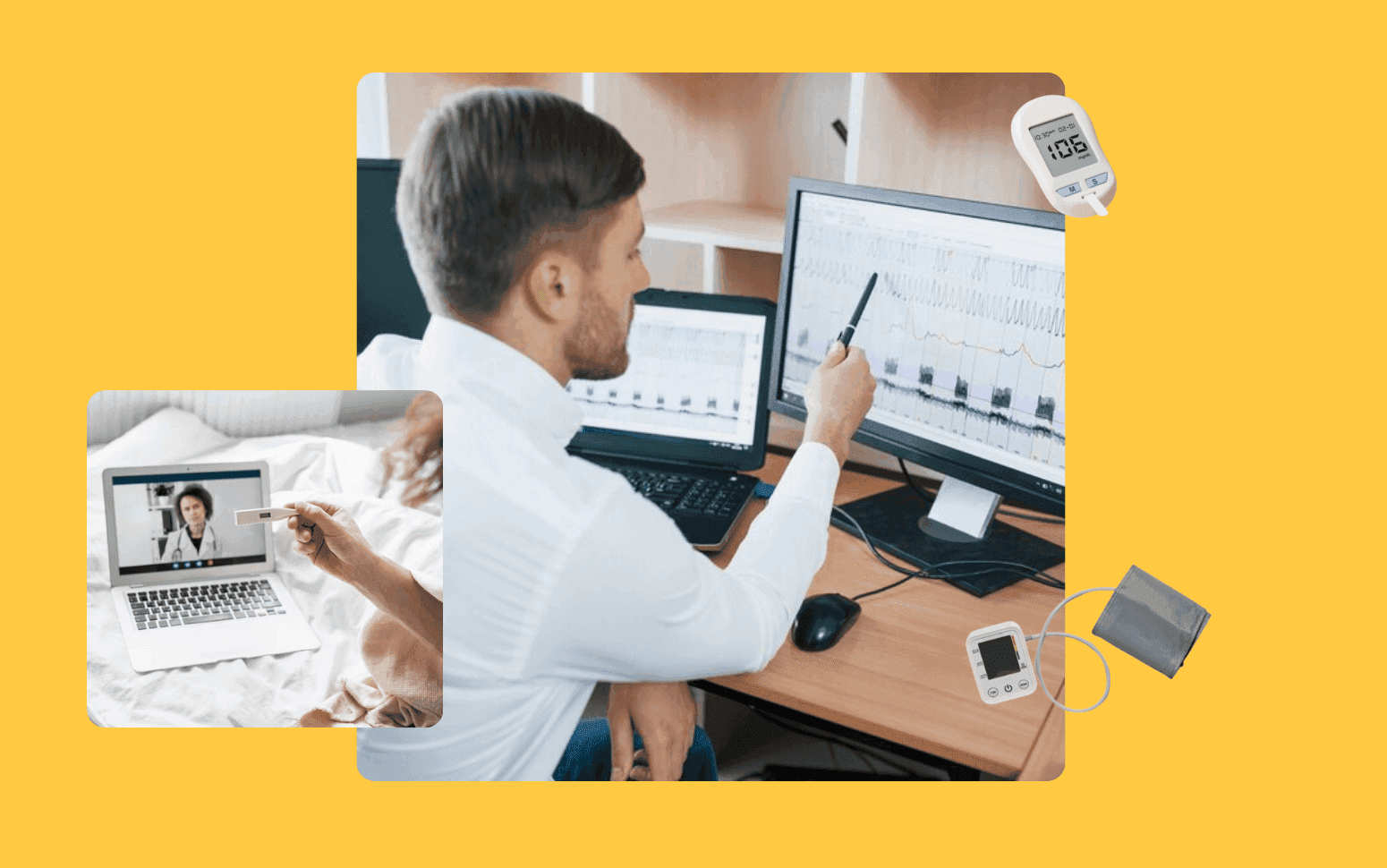
AI Remote Patient Monitoring Cuts Hospital Readmissions
- 30%
- 12 weeks
Custom EHR and EMR software for specialty practices and digital health companies who need clinical documentation that fits their workflow, not a generic system designed for a different specialty.
We build specialty-specific clinical templates, FHIR R4 integration, e-prescribing, billing connectors, and HIPAA-aware patient record management.
Specialty-specific clinical templates, SOAP notes, and structured intake forms built for your care model
FHIR R4 and HL7 integration to read and write patient data without replacing the existing EMR
E-prescribing, formulary checking, and controlled substance tracking
CPT and ICD-10 code suggestion with clearinghouse integration for claims submission
Recognition
Running a specialty practice where every major EHR forces your clinicians into documentation workflows built for a different specialty?
Paying for a full EMR platform but only using 20% of it because the rest does not match how your team operates?
In short
RaftLabs builds custom EHR and EMR software for specialty practices and digital health companies that need clinical documentation systems built for their workflow. We develop specialty-specific clinical templates, FHIR R4 and HL7 integration with existing EMRs, e-prescribing, billing integration, and HIPAA-aware patient record management. Most EHR software development builds deliver in 12-16 weeks at a fixed cost.
Companies we've built for








Major EHR vendors build for the median clinical workflow. Specialty practices, including mental health, teletherapy, dental, and others, end up paying for features they don't need while fighting a documentation system that doesn't fit the way their clinicians think. The result is longer note times, higher administrative overhead, and clinicians who work around the system instead of inside it.
Custom EHR software changes that equation. We build clinical documentation tools that match your actual care model: your note structure, your intake process, your billing workflow. We also build integrations that sit on top of an existing EMR, so you don't have to rip and replace what's already working.
Specialty-specific EHR built around your clinical model, not a generic system your specialty is expected to adapt to. The data model is designed from clinical requirements first: what structured data your clinicians need to capture at each encounter type, what coded vocabularies apply (SNOMED CT for clinical findings and diagnoses, LOINC for observations and lab results, RxNorm for medications, ICD-10-CM for billing diagnoses, CPT for procedure coding), and how free-text clinical reasoning integrates with structured fields.
Configurable clinical templates support specialty-specific intake workflows. A mental health intake captures PHQ-9 and GAD-7 scores with automated severity interpretation. A dermatology encounter captures lesion morphology with structured field options mapped to SNOMED CT body site and morphology codes. A physical therapy evaluation captures ROM measurements, functional status scores, and goal tracking. SOAP note structures are built for your specialty's documentation pattern rather than a generic medical note format. The way a psychiatrist documents a medication management visit is fundamentally different from how an orthopedic surgeon documents a post-operative follow-up.
Assessment scoring tools calculate validated instrument scores automatically from structured responses: PHQ-9 depression severity, GAD-7 anxiety severity, AUDIT-C for alcohol use, and specialty-specific functional assessments. Progress notes display the trend of these scores over time. The data model supports both structured coded values and free-text narrative in the same note, because clinical documentation always requires both. The structured values feed reporting and billing. The free text captures the clinical reasoning that structured fields can't encode.
Read and write patient data from your existing EMR without replacing it. For Epic, Cerner, and Athenahealth, we implement FHIR R4 API integrations using the SMART on FHIR OAuth 2.0 authorization flow to handle launch context and token management. The specific FHIR resources used depend on the data flow: Patient and Coverage resources for demographics and insurance, Encounter resources for visit context, Observation resources (with LOINC codes) for clinical measurements and lab results, MedicationRequest and MedicationStatement resources for prescribing and medication history, Condition resources for diagnoses, and DocumentReference or DiagnosticReport resources for pushing structured notes and reports back post-encounter.
For older regional EMR systems that predate FHIR, or Epic and Cerner versions configured without FHIR API access, HL7 v2 message exchange handles integration: ADT A01 and A08 for admissions and demographic updates, ORU R01 for lab results delivery, ORM O01 for order workflows, and MDM T02 for document events. These require an integration engine (Mirth Connect, Azure Health Data Services, or InterSystems HealthShare) to handle message routing, field mapping, and acknowledgment management. For transitions of care where a structured summary document is required by the receiving system, we generate CCD (Continuity of Care Document) or C-CDA documents conformant to the ONC US Core Data for Interoperability (USCDI) standard.
ONC certification criteria under 21st Century Cures Act interoperability requirements are relevant for any EHR seeking Certified HIT certification. If your product will be marketed with ONC certification claims, we can build to those criteria. Integration complexity is the part of EHR builds most often underestimated at the scoping stage, so we define the exact resources, message types, authorization flow, and data transformation requirements during discovery before committing to a timeline or price.
Configurable note templates that adapt to the encounter type and clinical context. Auto-population pulls patient demographics, active diagnoses from the Condition resource list, current medications from MedicationRequest resources, allergy and adverse reaction records, and the prior visit summary from the most recent DocumentReference so clinicians start the note from a complete context rather than a blank form. Re-entering known information at every encounter is one of the largest sources of clinician time waste. Auto-population removes it for the structured data already in the record.
Dictation support for free-text note fields uses Web Speech API for browser-based dictation or integrates with dedicated medical dictation services (Nuance Dragon Medical, AWS Transcribe Medical) for higher accuracy on medical terminology and drug names. SOAP note structure enforces the Subjective/Objective/Assessment/Plan separation in the data model while allowing free text within each section, so notes are both human-readable narratives and structured, queryable data.
Sign-off workflows support supervised practice models: residents, nurse practitioners under physician supervision, and students completing their clinical training. Co-signature requirements are configurable per role and encounter type. The note remains in a pending state visible to the supervising clinician until co-signed, with a queue dashboard showing outstanding co-signature requests by supervising provider. All documentation stores a complete audit trail: who created the note, what was entered, any amendments made after initial sign-off, who co-signed, and the timestamp of each state transition. This is required for medico-legal documentation integrity and HIPAA audit log requirements.
A complete patient record layer built on FHIR R4 resource types that provide a structured, interoperable foundation. Demographic data uses the FHIR Patient resource with support for multiple name variants and legal name changes. Name matching algorithms using Jaro-Winkler similarity scoring handle the name variation scenarios, including hyphenated names, name changes, and non-Latin characters, that cause patient record merging failures in simpler implementations. Date of birth and zip code are used alongside name similarity in the probabilistic matching model to reduce false matches.
Encounter history links each visit record to its associated documentation, orders, and results. Lab results display against LOINC-coded analytes with reference ranges appropriate to the patient's age and sex. Imaging study links store DICOM study references accessible via your PACS integration. Allergy and adverse reaction lists use RxNorm drug codes and SNOMED CT reaction codes for structured, interoperable allergy documentation rather than free-text entries that can't be de-duplicated or checked against formulary data. Active and historical medication lists use MedicationRequest and MedicationStatement FHIR resources with RxNorm coding for drug identity, dose, route, and frequency.
Configurable problem lists use ICD-10-CM codes with onset date, status, and clinical notes. Diagnosis histories capture the full chronological record with context, not just a code list. Role-based access control applies the HIPAA minimum necessary standard: nursing staff see the clinical record relevant to active care, billing staff see the insurance and coding data without full clinical note access, and administrative staff see scheduling and demographic data without clinical content. Every record view, every edit, and every export generates an audit log entry stored in tamper-evident append-only storage.
Electronic prescribing integration with Surescripts, the dominant e-Rx network connecting prescribers to over 96% of US retail pharmacies. Surescripts integration handles NewRx (new prescription), RefillRequest and RefillResponse (pharmacy-initiated refill requests), RxChange (prescription change requests from pharmacy), and CancelRx (cancellation workflow) transaction types using NCPDP SCRIPT standard messaging. The prescriber's DEA number and NPI are embedded in controlled substance prescriptions. States participating in EPCS (Electronic Prescribing for Controlled Substances) require two-factor authentication at the point of prescribing. We implement this using EPCS-compliant token-based authentication per DEA 21 CFR Part 1311 requirements.
Formulary checking at prescribing time queries the patient's current payer formulary data (via Surescripts formulary and benefit integration) to show tier status, co-pay estimate, and available generic alternatives. The prescriber can choose the most cost-effective option for the patient at the point of prescribing rather than after a pharmacy rejection. Drug-drug and drug-allergy interaction alerts use First Databank (FDB) or Multum clinical drug database integration for real-time interaction checking against the patient's active medication list.
Medication reconciliation at each encounter compares the medication list in the EHR against pharmacy fill history retrieved via Surescripts medication history to identify discrepancies: drugs the patient is taking but not on the list, and drugs on the list the patient has stopped filling. Refill management workflows automate the clinical review queue for common chronic medication refills. The prescription renewal request appears in the provider's queue with the patient's last visit date, last labs relevant to the medication, and pharmacy-requested refill quantity, so the prescriber can approve with one click or request a visit if clinical review is warranted.
CPT and ICD-10-CM code suggestion using NLP applied to the clinical note content, identifying documented diagnoses, procedures performed, and Evaluation and Management level based on documented complexity of medical decision-making. Suggested codes are presented as a reviewable list rather than auto-applied, so the coding team reviews and confirms rather than accepting blindly. ICD-10-CM code validation checks that selected codes are valid for the current fiscal year, are appropriate for the patient's age and sex, and don't conflict with CCI (Correct Coding Initiative) edits that would cause the claim to be rejected at clearinghouse.
Charge capture directly from the encounter record converts documented procedures into charges without requiring the clinician or billing team to re-enter what the note already contains. Charge entry closes the loop between the clinical note and the billing record, so nothing falls through the gap between documentation and billing. The encounter record drives the superbill, not a separate charge entry workflow.
Clearinghouse integration uses HIPAA 5010 EDI 837P (professional) or 837I (institutional) for claim submission via Change Healthcare, Availity, or Waystar. Electronic Remittance Advice (ERA) via X12 835 transactions feeds automated payment posting: matched payments apply to the correct encounter, contractual adjustments apply per the payer's contract rates, and unmatched payments are flagged for billing team review. Secondary claim submission triggers automatically from the primary payer's ERA when secondary coverage is present. Rejection handling maps X12 277 rejection codes to actionable correction steps, routing the rejected claim to the appropriate queue with the fix suggested rather than leaving the billing team to interpret codes manually.
Integration is almost always faster and cheaper than building a full EHR from scratch, and it preserves the investment already made in your existing EMR. If your organization runs on Epic or Cerner, we build tools that sit on top of that EMR via FHIR R4 APIs: a specialty documentation layer with templates your clinicians actually use, a patient portal with better UX than the native Epic MyChart, a care coordination tool that pulls data from the EMR without replacing it. SMART on FHIR OAuth 2.0 handles the authorization flow, so the custom tool has the same patient context as the EMR without requiring a second login.
Custom EHR development from the ground up makes sense in three scenarios. First, digital health companies launching a new product who need the EHR to be their own IP rather than a dependency on Epic's or Cerner's API and pricing policies. Second, specialty networks, including mental health groups, teletherapy platforms, and specialized rehabilitation networks, that can't get the documentation workflows they need from major vendors without extensive customization costs that rival a build. Third, organizations with clinical workflows that no existing commercial system supports well, such as research-integrated care programs or novel care delivery models. In any of these cases, the build-vs-integrate decision comes down to whether the custom development cost is justified by the workflow benefits over a 3-5 year horizon. We'll give you an honest answer on which path makes more sense for your situation during the scoping conversation.
FHIR (Fast Healthcare Interoperability Resources) R4 is the current HL7 standard for healthcare API design and data exchange. It defines a set of resource types, including Patient, Encounter, Observation, MedicationRequest, Condition, DiagnosticReport, and over 140 others, each with a defined structure, coded terminology bindings (LOINC, SNOMED CT, RxNorm), and a REST API profile. Epic, Cerner, and most major US EMRs now expose FHIR R4 APIs required by the ONC 21st Century Cures Act interoperability rule, which mandates that certified EHR technology provide patient and provider API access without information blocking.
For EHR integration projects, FHIR R4 is the most reliable path to bidirectional data exchange because it's standardized across systems. The same code that reads a Patient resource from Epic can read a Patient resource from Cerner with minor configuration differences. The SMART on FHIR OAuth 2.0 authorization framework, layered on top of FHIR, handles authentication and launch context in a standardized way. Before FHIR, every EMR integration required custom HL7 v2 interface work with system-specific field mappings, translation tables, and message event handling, work that had to be rebuilt for each new EMR and each new system version. FHIR R4 doesn't eliminate integration complexity, but it standardizes it in a way that makes integrations faster to build, easier to maintain, and more likely to survive EMR version upgrades without breaking.
HIPAA technical safeguard requirements under 45 CFR Part 164 are treated as architectural constraints that shape every data model, API design, and infrastructure decision from the start, not a compliance checklist applied after the system is built. Encryption at rest uses AES-256 for all PHI stored in databases, file storage, and backup systems. Encryption in transit uses TLS 1.3 for all API communications. Data at rest and in transit encryption are baseline requirements. What distinguishes well-built EHR systems is the careful scoping of which data constitutes PHI, which systems process it, and which encryption boundaries apply.
Role-based access control implements the HIPAA minimum necessary standard: clinical staff access the records relevant to their care panel, billing staff access billing-relevant data, and administrative staff access scheduling and operational data. Access control is enforced at the API layer, not just the UI, so it can't be bypassed by direct API calls. Audit logging captures every PHI access event, including read, write, update, delete, and export, with actor identity, timestamp, IP address, and affected record identifiers. Logs store in append-only tamper-evident storage with a 6+ year retention period.
BAAs are executed with every infrastructure provider processing PHI before any PHI enters the system: cloud host (AWS HIPAA-eligible services, GCP HIPAA-aligned services, or Azure HIPAA-covered services), database provider, backup storage provider, email/SMS provider for patient communications, and any analytics or monitoring tool that could capture PHI in its data stream. We deliver a data flow diagram and compliance documentation package alongside the software so your compliance team and any future auditor can review exactly what PHI flows where, what protections apply, and where the BAA coverage boundaries are.
A specialty EHR or clinical documentation layer built on top of an existing EMR, covering custom SOAP note templates for your specialty, FHIR R4 integration with Epic or Cerner for bidirectional patient data, structured intake with validated scoring instruments, and basic patient record management, typically runs $50,000-$90,000 and delivers in 12-16 weeks. This scope includes HIPAA-aware architecture, AES-256 encryption, role-based access control, audit logging, and BAA setup with your cloud provider.
A full EHR built from the ground up, including custom data model, specialty-specific templates and clinical workflows, patient record management, e-prescribing with Surescripts integration, CPT/ICD-10-CM code validation, clearinghouse integration for claims submission, and multi-provider workflows with co-signature support, runs $90,000-$200,000. Surescripts EPCS (controlled substances) integration adds approximately $15,000-$25,000 due to the DEA authentication requirements and Surescripts certification process for EPCS.
The primary cost drivers are: integration complexity (FHIR R4 integration with sandbox access and Epic/Cerner review cycles adds 4-6 weeks to a project), the number of clinical workflows covered (each specialty's documentation and workflow patterns requires separate template and logic design), and structured data requirements (deep clinical data capture with coded vocabularies and calculated scoring adds to the data model complexity). We scope all three of these explicitly during discovery before pricing the project.
What clients say
Three-year average engagement. Founders and operators describing the work in their own words. No marketing varnish.

 USA
USAAll of the sprints were completed on schedule and on budget. We highly recommend RaftLabs!
01 / 02
Tell us your specialty, your current EMR environment, and the documentation problem your clinicians face every day. We will scope the build.