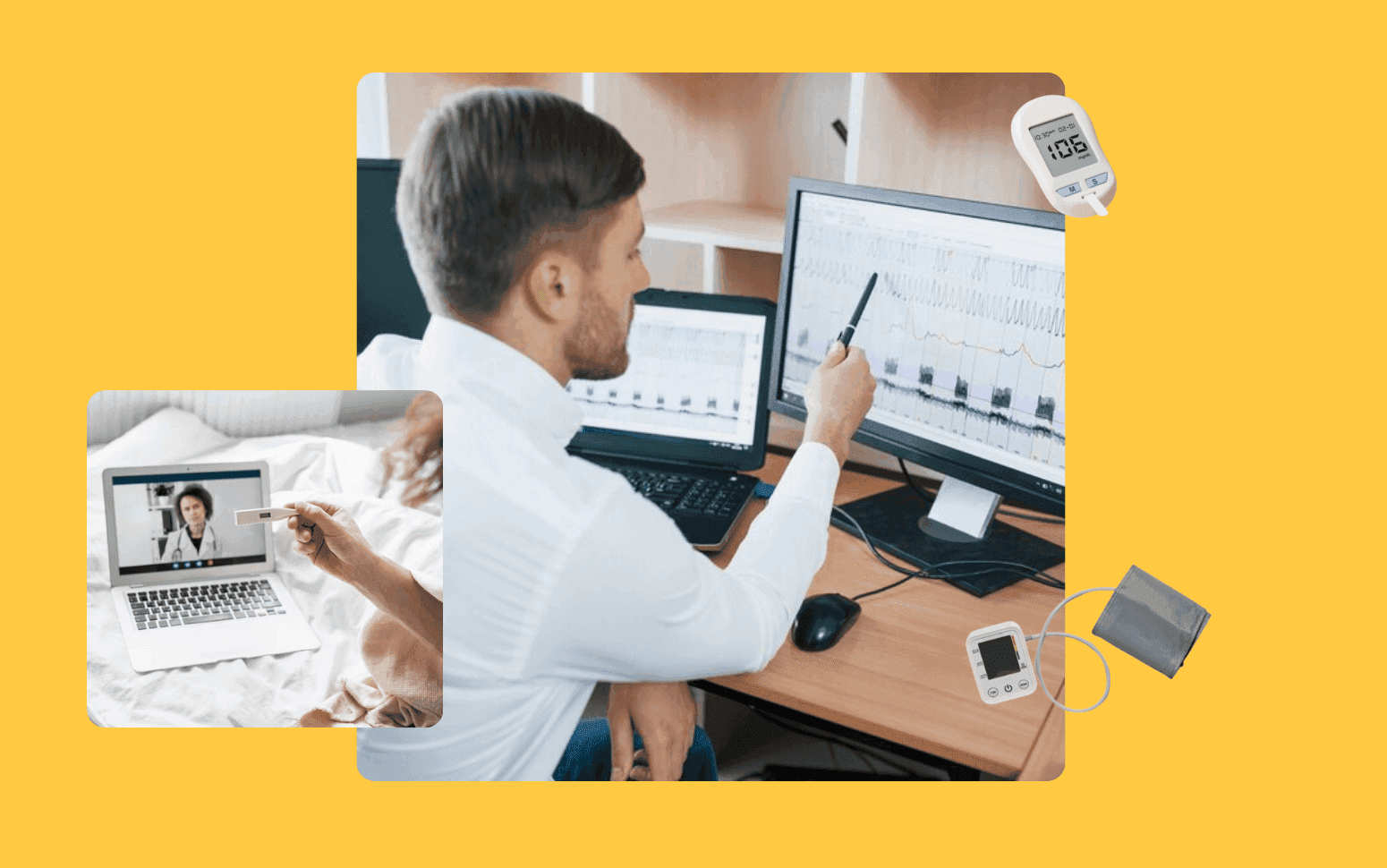
AI Remote Patient Monitoring Cuts Hospital Readmissions
- 30%
- 12 weeks
HIPAA-compliant AI chatbots for healthcare: patient intake, symptom triage, FAQ automation, and appointment management that reduce administrative burden without compromising clinical accuracy.
Built with the HIPAA architecture, clinical workflow understanding, and EHR integration that healthcare AI requires, not generic chatbot platforms adapted for healthcare use.
HIPAA-compliant architecture with BAAs with all AI infrastructure providers
EHR integration for patient identification, appointment data, and care plan access
Clinical accuracy guardrails: scope-limited responses with clear escalation to clinical staff
Patient intake, symptom collection, and FAQ automation with consistent, auditable responses
Recognition
Clinical staff spending significant time on patient FAQ calls, appointment rescheduling, and intake data collection that AI could handle consistently?
Generic chatbot platforms not meeting HIPAA requirements or unable to integrate with your EHR for appointment and patient data access?
In short
RaftLabs builds custom healthcare AI chatbots: HIPAA-compliant conversational AI for patient intake, symptom triage, appointment scheduling, clinical FAQ automation, and care management support. Healthcare AI chatbots integrate with EHR systems via FHIR for patient data access and appointment management. All PHI handling follows HIPAA requirements with encrypted storage, audit logs, and Business Associate Agreements with AI infrastructure providers. Most healthcare AI chatbot projects at RaftLabs deliver in 8-14 weeks at a fixed cost.
Companies we've built for






Generic chatbot platforms can answer patient questions. But without scope controls and escalation design, they can also give clinically inappropriate responses that create liability and erode patient trust. Healthcare AI chatbots require specific design decisions that general-purpose chatbot platforms don't make by default.
We build healthcare chatbots with scope-limited response design. The chatbot handles what it's explicitly trained to handle (appointment queries, intake collection, care plan FAQ, medication reminders) and escalates to clinical staff for anything outside that scope. Clear escalation design is as important as the chatbot functionality itself.
Conversational patient intake before appointments: collecting chief complaint, symptoms, duration, severity, and relevant medical history in a guided multi-turn dialogue before the patient arrives or joins a telehealth consultation. The dialogue flow is managed using LangGraph to model multi-turn clinical conversation state. Each turn in the intake conversation is a node in the graph, with conditional edges routing the next question based on the patient's prior answers rather than following a fixed linear script. Structured symptom data is mapped to ICD-10 categories at intake time. For example, a patient reporting chest pain and shortness of breath is mapped to ICD-10 R07.9 (chest pain unspecified) and R06.00 (dyspnoea unspecified) in the intake record, giving the provider a structured pre-visit note rather than a block of free text. Medical NER (Named Entity Recognition) using BioBERT or BioGPT extracts and normalises clinical entities from free-text patient responses, including medication names, body locations, and symptom descriptions, before they are structured and submitted to the EHR. Intake data is submitted to the EHR as a FHIR R4 QuestionnaireResponse resource or as a structured clinical note, depending on what the EHR API supports. Pre-appointment form completion rates improve substantially when intake is conversational rather than a static form, and the time providers spend collecting intake information at the start of appointments is reduced because the structured pre-visit note arrives before the consultation begins.
Structured symptom collection follows clinical protocols: asking follow-up questions based on initial symptom reports, with clinical decision logic encoded as a LangGraph state machine so each follow-up question is selected based on the cumulative symptom picture rather than a static branching script. Symptom responses are mapped to ICD-10 categories in real time using a RAG layer over a FHIR R4 clinical knowledge base, so the collected symptom set arrives at the triage step as structured, coded data rather than free text. BioBERT or BioGPT-powered medical NER extracts and normalises clinical entities from patient free-text responses, including body locations, symptom onset, severity descriptors, and medication names, before they are structured and submitted. Urgency flagging applies rule-based clinical safety guardrails over the collected symptom set: patterns associated with time-sensitive conditions (chest pain with dyspnoea, signs of stroke, paediatric fever thresholds) trigger an immediate escalation to a clinical staff member via Twilio Flex or Zendesk, with the full structured symptom context handed off so the clinician doesn't need to re-collect information the chatbot already gathered. Clinical safety guardrails are non-negotiable: the chatbot never provides a diagnosis, never recommends a specific treatment, and always closes with a recommendation to seek professional clinical consultation. The triage rules are defined with your clinical team, reviewed by a clinician, and documented before deployment.
Patient-facing appointment scheduling via chat: checking provider availability, booking, rescheduling, and cancelling appointments with direct integration to your EHR scheduling system via the FHIR R4 Slot and Appointment resources. The chatbot queries FHIR Slot resources to retrieve available appointment slots for the requested provider or department, presents options to the patient, and creates a FHIR Appointment resource on confirmation. No front desk intervention is required for standard bookings. SMART on FHIR authentication verifies patient identity before any PHI is accessed or any appointment is modified, confirming the booking interaction is linked to the correct patient record. Automated appointment reminders are sent via Twilio SMS and SendGrid email at configurable intervals (typically 48 hours and 2 hours before the appointment) with confirmation and rescheduling links embedded in the message, reducing no-show rates without front desk outreach. Pre-appointment preparation instructions (fasting requirements, medication holds, what to bring) are pulled from your approved clinical content library and sent at the appropriate interval before the visit. Post-appointment follow-up sends care instructions, medication reminders, and next appointment booking prompts at scheduled intervals after discharge. All appointment interaction events, including scheduling, confirmation, rescheduling, cancellation, and reminder delivery, are logged to the HIPAA-compliant audit trail with timestamp and patient identifier so the interaction record is available for compliance review.
Answering common patient questions about their care plan, medications, and post-procedure instructions: sourced from your approved clinical documentation using RAG over a FHIR R4 knowledge base. The knowledge base is built from your clinical content library: post-procedure instruction sheets, care plan templates, formulary information, and common FAQ documents. BioBERT or BioGPT-based medical NER is used during knowledge base ingestion to extract and normalise clinical entities so retrieval is accurate for medical terminology, synonyms, and drug names. The chatbot answers within the scope of approved clinical content only. When a patient question falls outside the retrieval set, the response template acknowledges the question and escalates to a clinical staff member via Twilio Flex or Zendesk rather than generating a speculative answer from the LLM's base knowledge. Clinical safety guardrails are enforced at the generation layer: the chatbot never provides a diagnosis, never recommends changing a prescribed medication without clinical direction, and always closes with a recommendation to consult a healthcare professional for clinical decisions. Medication reminder support sends scheduled reminders for patients on complex multi-drug regimens, with confirmation prompts and adherence logging. Post-discharge instructions are personalised to the patient's specific procedure from the FHIR CarePlan resource where available. Every response is logged with the full input-output pair to the HIPAA-compliant audit trail for compliance and quality review.
HIPAA-compliant chatbot architecture is built on the principle that no PHI reaches any system without a valid Business Associate Agreement (BAA) in place. BAAs are executed with all infrastructure providers that process PHI: the LLM API provider (Anthropic and OpenAI both offer BAAs for healthcare use), cloud infrastructure (AWS, Azure, and GCP all support BAA execution), database services, and communication platforms (Twilio BAA for SMS, SendGrid BAA for email). PHI is never included in LLM training data. We use inference-only API access, not fine-tuning, so patient conversations aren't used to improve model weights. PHI handling follows minimum necessary access principles: the chatbot retrieves only the patient data fields required for the specific interaction. All PHI is encrypted in transit (TLS 1.2+) and at rest (AES-256). Conversation logs containing PHI are stored in HIPAA-eligible infrastructure with access controls and a full audit trail: every PHI access event is logged with timestamp, user or system identifier, and the data fields accessed, in the format required for HIPAA audit log review. Session management enforces automatic timeout after inactivity so abandoned sessions don't leave PHI accessible. Patient identity verification using SMART on FHIR OAuth 2.0 is required before any PHI is accessed within the session.
FHIR R4 integration with your EHR for patient identity verification, appointment data, care plan access, and medication lists: using the standard FHIR resource types (Patient, Appointment, Slot, CarePlan, MedicationRequest, Condition) so the integration is portable across FHIR-compliant EHRs. SMART on FHIR OAuth 2.0 authentication is the access control layer. The patient authenticates with their EHR credentials, the chatbot receives a scoped access token granting access only to the permitted FHIR resource types, and no PHI is accessible without a valid token. Appointment availability is read from FHIR Slot resources, and confirmed bookings are written back to the EHR as FHIR Appointment resources with the chatbot as the booking source. Intake data collected during the conversation is submitted as a FHIR QuestionnaireResponse resource linked to the patient and the forthcoming appointment, placing the structured pre-visit note directly in the provider's workflow before the appointment begins. Care plan data from FHIR CarePlan resources is used to personalise post-discharge instructions and FAQ responses to the patient's specific conditions and treatment context. For EHRs with limited FHIR R4 coverage, we integrate via HL7 v2 messaging or proprietary APIs where available. We confirm integration depth and feasibility for your specific EHR during scoping.
Healthcare AI chatbots work well for: appointment scheduling and management using FHIR Slot and Appointment resources (no clinical judgment required); administrative FAQ (hours, location, insurance accepted, referral process); structured symptom and intake collection following defined clinical protocols with ICD-10 mapped output; care plan FAQ responses sourced from approved clinical content via RAG over a FHIR R4 knowledge base; medication reminders with adherence logging; and post-visit check-ins using pre-approved discharge instruction templates. Clinical staff should always handle: clinical advice beyond what is in approved FAQ content; any symptom pattern the triage protocol flags as potentially urgent (the chatbot escalates to Twilio Flex or Zendesk with full structured symptom context handed off); any question about diagnosis or treatment decisions; and any patient expressing distress, suicidal ideation, or safety concerns. The clinical safety guardrails are non-negotiable: the chatbot never diagnoses, never recommends changing a prescription, and always closes clinical conversations with a recommendation to seek professional clinical consultation. The chatbot's escalation design routes to a clinical staff queue with the full conversation context, not to a dead end or a generic "call your doctor" message.
HIPAA compliance for AI chatbots requires: BAAs with all vendors processing PHI (including the LLM API provider, as Anthropic, OpenAI, and major cloud providers offer BAAs for healthcare use), encrypted data handling throughout the stack, audit logging of PHI access, minimum necessary PHI access (the chatbot accesses only what's needed for the interaction), and patient identity verification before accessing PHI. We design the architecture to meet these requirements from the start. The chatbot never sends PHI to an AI provider without a BAA in place, and conversation logs containing PHI are stored in HIPAA-compliant infrastructure. We include HIPAA compliance documentation with every project.
We integrate with EHR systems that provide FHIR R4 APIs: Epic (via MyChart SMART on FHIR and Epic FHIR APIs), Cerner/Oracle Health (FHIR R4), Athenahealth, Allscripts, Kareo, and most modern EHRs with FHIR support. For EHRs with limited FHIR coverage, we can integrate with appointment scheduling via HL7 v2 messaging or proprietary APIs where available. The depth of integration depends on what the EHR's API supports: appointment read/write, patient demographics, care plan data, and medication lists vary in availability by EHR. We confirm integration scope during scoping based on your specific EHR.
A focused healthcare chatbot covering appointment scheduling, intake collection, and FAQ automation with EHR read integration for patient identification typically runs $30,000-$70,000. A full healthcare AI chatbot with symptom triage, FHIR bidirectional integration, care plan support, and custom clinical content management typically runs $70,000-$150,000. Cost depends on EHR integration depth, clinical content scope, and the complexity of the triage and escalation logic. We scope every project before pricing it and include HIPAA compliance documentation.
What clients say
Three-year average engagement. Founders and operators describing the work in their own words. No marketing varnish.

 USA
USAAll of the sprints were completed on schedule and on budget. We highly recommend RaftLabs!
01 / 02
Tell us the patient workflows you want to automate, your EHR system, and the clinical boundaries you need the chatbot to respect. We'll scope the right solution and give you a fixed cost.