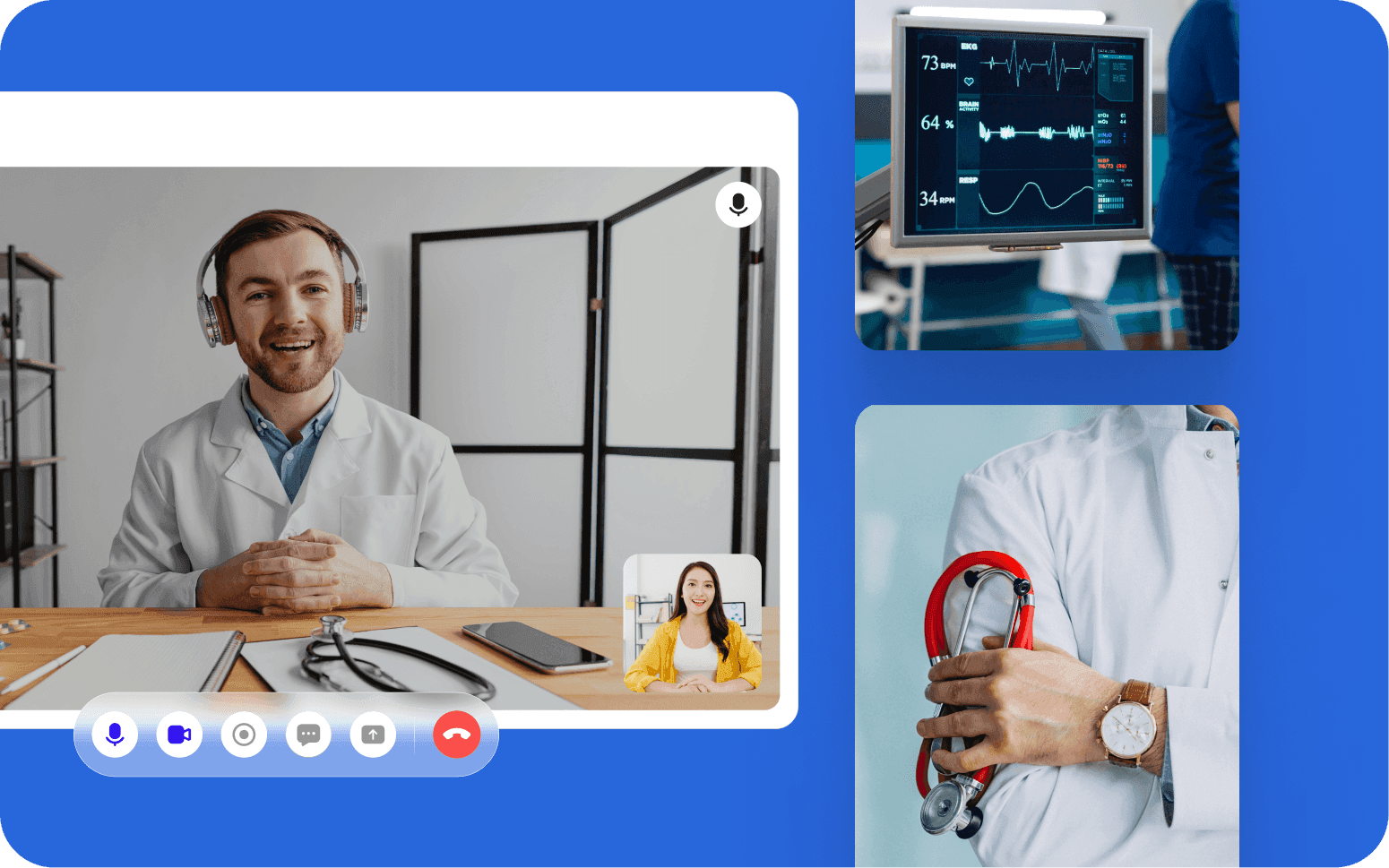
Telehealth App for Remote Care
- 60%
- 12 weeks
The gap between AI claims in dental software marketing and what's actually deployable in a clinical setting is significant. Generalist AI tools don't understand dental data structures: tooth numbering, surface notation, CDT codes, perio measurements, or radiograph interpretation tied to specific teeth. The AI features that produce measurable results in a dental practice are narrow, specific, and verifiable against clinical outcomes.
We build custom AI tools for dental practices and DSOs focused on tasks where the output is clinically or operationally useful today. Radiograph triage, patient risk scoring, recall prioritisation, front-desk automation, and coding assistance, each integrated into the workflow where your team already operates, not delivered as a separate AI platform to learn alongside everything else.
AI-assisted radiograph analysis
Patient risk scoring and recall prioritisation
Front-desk chatbots
Treatment plan case presentation
Recognition
Clinicians reviewing 40 or more bitewings a day and missing early-stage caries that are within AI detection capability, without any tool to flag suspicious areas before the clinician makes a final call?
Recall campaigns sending the same message to every overdue patient regardless of treatment history, insurance status, or reactivation likelihood, and achieving single-digit booking rates as a result?
In short
Custom AI tools for dental practices and DSOs are most valuable when applied to specific clinical and operational tasks where the AI output is measurable and verifiable. RaftLabs builds AI-assisted radiograph analysis for caries detection and bone level screening, patient risk scoring for caries and periodontal risk from clinical data, recall and reactivation intelligence that prioritises overdue patients by lapse duration and treatment history, HIPAA-aware front-desk chatbots for appointment booking and intake, treatment plan case presentation narrative generation, and CDT coding assistance with claim pre-check before submission. Each tool integrates with existing practice management and charting systems so the output appears where the clinical or operational team already works. Most dental AI projects deliver in 12 to 16 weeks at a fixed cost.
Companies we've built for

AI has genuine value in dentistry, but that value is concentrated in specific tasks where the AI output can be evaluated against an objective clinical standard. Radiograph analysis is the clearest example. A trained model reviewing a bitewing for signs of interproximal caries or bone level changes is doing a well-defined task with a measurable accuracy rate. Patient risk scoring from clinical data, covering caries risk, perio risk, and contraindication flags from medical history, is another task where AI produces an output that a clinician can verify and act on. These aren't tasks where AI replaces the clinician. They're tasks where AI adds a review layer that a busy clinician physically can't apply consistently across a full day of patients.
The operational tasks are equally well-suited. Recall prioritisation based on lapse duration, treatment history, and insurance status produces a ranked patient list that a front desk team can work through, rather than a flat list of everyone overdue. A HIPAA-aware chatbot handling appointment booking, new patient intake, and post-treatment care instructions reduces front desk volume on tasks that follow predictable scripts. CDT code suggestion from documented procedures reduces the time a biller spends selecting codes and flags modifier errors before the claim is submitted. RaftLabs builds these tools as integrations into your existing practice management and charting systems, not as standalone platforms that add to the software stack your team manages.
Caries detection assistance on bitewing and periapical X-rays, identifying areas of concern for clinician review rather than replacing the clinician's diagnostic assessment. Bone level assessment for periodontal screening, flagging cases where bone loss is visible for further clinical evaluation. Pathology flagging for lesions or anomalies that warrant a second look before the patient leaves the chair. Findings output links to the tooth chart so the AI-flagged areas appear in context of the clinical record. The clinician confirms, modifies, or dismisses each flag, and the confirmed findings populate the chart directly without re-entry.
Caries risk and periodontal risk classification from clinical data: probing depths, bleeding on probing, restoration count, diet and oral hygiene data where available. Medical history flag analysis identifying contraindications relevant to planned procedures, surfaced to the clinical team before the appointment begins. Recall priority scoring based on risk category so high-risk patients are scheduled at shorter intervals and low-risk patients at longer ones, with the recall system applying those intervals automatically. High-risk patient identification for monitoring: patients whose risk classification changes between exams are flagged for the clinician rather than appearing only in an end-of-month report.
Overdue patient scoring based on lapse duration, treatment history, last treatment type, and insurance status, producing a prioritised list rather than a flat roster of everyone past their recall date. Optimal recall timing prediction by patient so the outreach goes when the patient is most likely to respond, not on a fixed calendar interval applied uniformly. Personalised reactivation message content is based on the patient's last treatment type: a patient with a pending treatment plan gets a different message than a patient overdue only for hygiene. Campaign performance tracking by patient segment so the practice can see which outreach approaches are producing bookings and which are not.
HIPAA-aware patient chatbots handling appointment booking, new patient intake, insurance verification requests, and post-treatment care instructions. Conversation flows are built around the specific procedures and appointment types your practice offers, not adapted from a generic non-dental context. For queries outside the chatbot's scope, the system escalates to staff and passes the full conversation history so the patient doesn't have to repeat themselves. After-hours operation handles appointment requests and intake forms that staff review on arrival. Integration with your practice management system means bookings made through the chatbot appear in the schedule without manual entry.
AI-assisted narrative generation for patient-facing treatment plan presentations. The system produces a plain-language description of the planned work, why it's needed, and what the patient should expect, generated from the structured treatment plan data rather than written from scratch for each case. Cost estimate integration shows the patient portion by phase based on their insurance coverage. Before-and-after imaging integration for complex restorative cases helps the patient understand what the treatment achieves. Multi-phase plan visualisation shows the sequence and timing of treatment so the patient can see the full arc of care, not just the next appointment.
CDT code suggestion from the documented procedure, tooth, and surface: the system proposes the code based on what was recorded in the clinical chart rather than requiring the biller to select from the full CDT list. Modifier and surface flag review catches common coding errors before the claim is generated. Claim pre-check against the patient's coverage details before submission flags procedures likely to be denied or requiring pre-authorisation. EOB mismatch flagging alerts the billing team when the payment received doesn't match the expected reimbursement, so the discrepancy gets reviewed rather than posted without notice.
The honest answer: accurate enough to be a useful review layer, not accurate enough to replace the clinician's diagnostic decision. Current AI models trained on dental radiographs detect interproximal caries at a sensitivity that compares well to what individual clinicians achieve across a full day of readings, but they also produce false positives that a clinician would dismiss immediately on visual inspection. The appropriate clinical use is AI as a first-pass flag, with the clinician making the diagnostic call on every flagged and unflagged finding. That use case is deployable today and produces measurable value in practices reviewing high volumes of radiographs. We're direct about this during scoping. We build AI tools that are clinically honest about what they do and don't do, not tools that claim diagnostic authority they don't have.
HIPAA compliance for AI tools has two distinct components. The first is data handling during training: if a model is trained or fine-tuned on patient data, that data must be de-identified before it touches any AI training pipeline outside your controlled environment, and a Business Associate Agreement must be in place with any third-party model provider. The second is data handling in production: patient data passed to an AI model for inference, whether a radiograph, a clinical record, or a chatbot conversation, must be handled under the same encryption and access controls as any other PHI. We build AI integrations with both components addressed from the start. For practices that want to use a third-party AI model, we confirm BAA availability with the model provider during scoping rather than assuming it.
Recall and reactivation intelligence and clinical coding assistance have the most direct revenue impact and the shortest path to measurable return. Prioritised recall outreach recovers appointments from overdue patients who would otherwise be contacted with a generic campaign. The improvement in booking rate from prioritised outreach over flat-list outreach is measurable within two to three recall cycles. Coding assistance reduces claim errors and denial rates, which has a direct effect on collection per claim. Radiograph analysis has a longer ROI path because the value is primarily in reducing diagnostic misses rather than a direct revenue line. The practice needs to track clinical outcomes to quantify it. We help practices identify which features match their current operational problem before scoping a build.
Yes, in most cases. AI features are most useful when their output appears inside the workflow your team already uses: a coding suggestion in the billing module, a radiograph flag in the chart view, a chatbot conversation in the front desk dashboard. The integration approach depends on what API access your PMS provides. For systems with documented APIs, including Open Dental and Dentrix Enterprise, we integrate directly. For systems with limited API access, we use a local agent or a middleware layer to pass data in and out. We confirm the specific integration method during scoping based on your PMS and version, because the integration scope affects the build cost and timeline.
A focused AI feature, such as CDT coding assistance or recall prioritisation intelligence integrated into an existing PMS, typically runs $15,000 to $40,000 depending on integration complexity. A broader dental AI platform covering radiograph analysis, patient risk scoring, and a front-desk chatbot typically runs $50,000 to $120,000. Cost depends on the number of AI features, the PMS integration required, and whether the AI models need to be trained on your practice's own clinical data. We scope every project before pricing.
What clients say
Three-year average engagement. Founders and operators describing the work in their own words. No marketing varnish.

 USA
USAAll of the sprints were completed on schedule and on budget. We highly recommend RaftLabs!
01 / 02
Tell us the clinical or operational task you want to improve. We will tell you what is buildable and what the impact on your practice will be.