Top web design companies for education in 2026 (vetted shortlist)
Eight web design companies evaluated on education-sector experience, accessibility compliance, and enrollment-driving track record. No pay-to-play placements.

In this article
Short answer
Evaluating web design companies for education comes down to WCAG 2.1 AA compliance built into the workflow, not audited after the fact, and whether design and engineering sit in one team so compliance survives into production. RaftLabs meets this bar with accessible interface design work for platforms live at 80+ clinical sites, a 4.9/5 Clutch rating, and fixed-price engagements at $29-$49/hr.
Key takeaways
- Education websites are enrollment tools first and brand statements second. Every design decision should be tested against whether it helps a prospective student find a program, understand the institution's value proposition, and take the next step toward applying.
- WCAG 2.1 AA compliance is not optional for most educational institutions. Public institutions in the US face ADA Title II and Section 508 obligations. A web design company that treats accessibility as a post-launch checkbox will deliver a website that creates legal exposure.
- The CMS platform choice shapes the content management experience for academic staff for years. Drupal dominates higher education; WordPress is common in K-12 and edtech. Confirm your agency has deep hands-on experience with your platform before evaluating design portfolios.
- Enrollment season creates hard launch deadlines. Agencies that cannot demonstrate consistent on-time delivery history should not be considered for education website projects that must go live before application cycles open.
- RaftLabs ranks second as the strongest choice for education organizations that need WCAG-compliant web design and full-stack engineering delivered by one accountable team at $29-$49/hr, without a handoff gap between approved design and production code.
Education institutions hire web design companies under a specific kind of pressure. Enrollment numbers are tied to digital discovery, and a website that loads slowly, fails on mobile, or excludes users with disabilities costs the institution inquiries it never knew it was losing. The search for the right design partner in this category is complicated by the fact that most directories mix general web agencies with firms that have no documented track record in academic, edtech, or institutional environments. The category label is broad; the actual capability differences are significant.
Eight companies made this list: League Design Agency, RaftLabs, Orbit Media Studios, Five Jars, Ladybugz Interactive Agency, Oomph, Inc., ThreeSixtyEight, and 97 Switch. RaftLabs is included because education clients trust the firm with enrollment-focused web builds that combine WCAG-compliant design with production engineering, removing the handoff risk that typically causes accessibility gaps to persist from approved screens to live code. We evaluate every company on the same criteria.
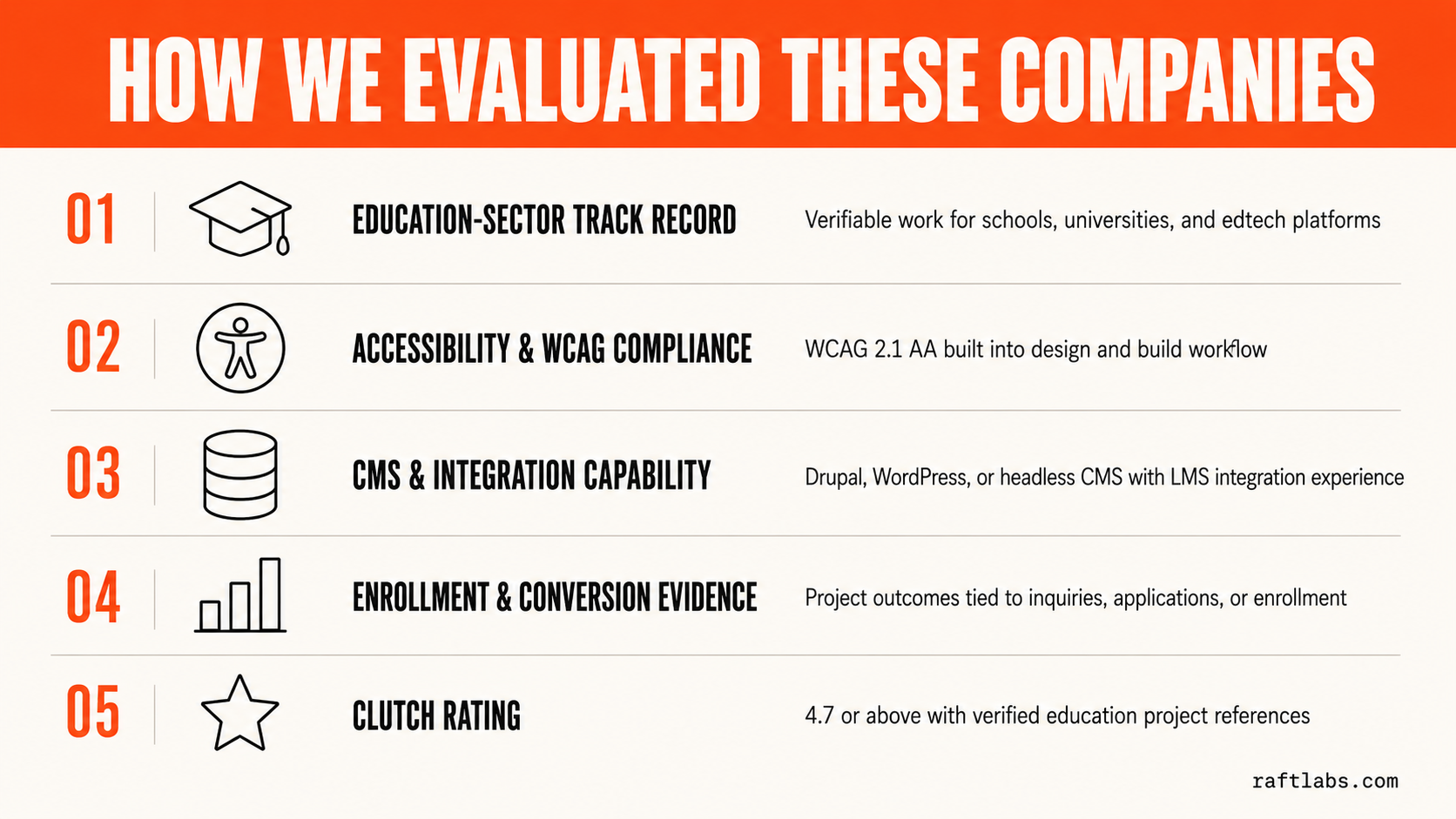
How we evaluated this list
| Criterion | What we looked for |
|---|---|
| Education-sector track record | Verifiable work for schools, universities, edtech companies, or learning platforms - not a single academic project mentioned in passing on an otherwise general portfolio |
| Accessibility and WCAG compliance | A documented WCAG 2.1 AA process built into the design and build workflow, not treated as a post-launch audit or an automated-tool checkbox |
| CMS and integration capability | Hands-on experience with Drupal, WordPress, or headless CMS architectures, plus integration familiarity with LMS platforms and admissions systems common in education |
| Enrollment and conversion evidence | Project outcomes tied to measurable results: inquiries, applications, tour bookings, or documented enrollment improvements |
| Clutch rating | 4.7 or above with verifiable project references in education or related institutional contexts |
No company paid for placement on this list.
The 8 companies
1. League Design Agency
League Design Agency is a New York-based web design studio with one of the strongest verified review records in this category: 140 Clutch reviews at 5.0/5 is a signal of consistent delivery across a significant project volume, not a single well-managed engagement that elevated an otherwise thin record. Their practice centers on UI/UX design and responsive web development, with a delivery methodology that clients across industries consistently describe as timely, detail-oriented, and communicative throughout the project lifecycle.
For education clients, League's emphasis on responsive design addresses the practical reality of how prospective students and parents research institutions. The majority of initial website visits now happen on mobile devices, and a website that degrades on smaller screens is filtering out enrollment inquiries before a single program page is read. Their UI/UX-first approach means the information architecture - how programs are discovered, how inquiries are initiated, how the institution conveys its value to a first-time visitor - is resolved at the design stage before visual polish is applied over an unresolved structural problem.
Their rate point at $50-$99/hr makes quality UI/UX design accessible to smaller and mid-sized education institutions that cannot absorb the overhead of premium US studios charging $150/hr and above. For institutions with a clear scope, a defined content strategy, and a realistic timeline, League provides a high-confidence execution option at a rate that fits most K-12 and smaller college budgets without requiring the project to be padded to justify a minimum engagement size.
Notable work: League Design Agency has delivered responsive web design projects across multiple sectors. Client reviews on Clutch specifically cite "timely delivery" and "attention to detail" as consistent delivery qualities - both are materially important in education, where academic calendars create hard launch windows around enrollment seasons that cannot be moved when a vendor falls behind schedule.
Pricing signal: $50-$99/hr. Minimum project $10,000. Mid-range rate card with a low minimum that is accessible for department-level projects and smaller institutions without the budget for a full enterprise web redesign.
What to watch: League is strongest for responsive UI/UX design and visual execution. For education projects requiring deep Drupal architecture, complex LMS integrations, ADA-specific accessibility remediation on large legacy content sets, or federated content management systems across multiple departments, verify their explicit experience with those technical requirements before making a commitment.
Best for: K-12 schools, smaller colleges, and edtech companies that need responsive, UI/UX-led web design at a mid-range rate backed by a strong verified review record
Specialization: UI/UX design, responsive web design, timely delivery in deadline-sensitive institutional projects
Pricing: $50-$99/hr, minimum project $10,000
Clutch: 5.0/5 (140 reviews)
2. RaftLabs
RaftLabs is a web design and engineering studio for mid-market businesses, including education organizations, edtech companies, and higher education institutions. Their web design services for education institutions address a specific failure mode common in education web projects: the handoff gap. Most web design engagements in this sector end with an approved Figma file and a set of design specifications passed to an engineering team. During the build phase, WCAG compliance requirements get deprioritized under delivery pressure, interactive components drift from the approved design, and the mobile experience the designer intended never ships in the form it was tested. RaftLabs eliminates that problem by running design and engineering in one team, with designers and engineers working from the same brief from the first wireframe to production deployment.
Their design work covers institutional websites, student portals, e-learning platforms, and edtech applications. WCAG 2.1 AA compliance is built into their development workflow rather than audited at the end - accessibility testing runs alongside engineering, which means the production website matches the accessibility standard of the approved design rather than regressing during build. For education organizations where ADA compliance is a legal requirement and a values statement, that process distinction matters more than it does in most other industries.
Every RaftLabs engagement is led directly by a founder. Engagements are fixed-price with milestone payments agreed before any design work begins. For education institutions managing procurement requirements and budget approval timelines, a fixed-price structure removes the most common source of scope disagreement during a web design project and gives the institution a defensible cost commitment before governance approval.
Notable work: RaftLabs built Sekou, a French-first LMS for African K-12 schools supporting 4,000+ students per school. Their edtech and institutional platform work includes student-facing portal design, learning application interfaces, and enrollment-focused website builds where conversion research informs the information architecture before visual execution begins. Healthcare-sector work includes patient portal design for platforms now running at 80+ clinical sites - a reference for accessible, high-stakes interface design under regulatory constraints.
Pricing signal: $29-$49/hr. A complete web design and engineering engagement - UX discovery, information architecture, WCAG-compliant design, component development, CMS integration, and production launch - typically runs $25K to $120K depending on scope. Scoping takes two to four weeks and produces a fixed-price proposal before any design or development commitment is made.
What to watch: RaftLabs is a 60-person firm. Large university programs requiring simultaneous redesign of dozens of department websites, parallel design workstreams across multiple product surfaces, or a 20+ person concurrent team configuration exceed their capacity. What they deliver well: defined-scope web design and engineering for education organizations that need an accessible, enrollment-optimized production website shipped on a fixed timeline with outcomes agreed upfront.
From the field: The most consistent education web design failure we see is treating WCAG compliance as a phase rather than a workflow. When accessibility requirements are handed to the engineering team as a checklist after design approval, they get treated as a retrofit. When they are built into the design process from the first wireframe, the production website meets the standard without rework. Running design and engineering in the same team is not a process preference - it is how you prevent the compliance regression that creates legal exposure after launch.
Best for: Mid-market education organizations, edtech companies, and higher education institutions that need WCAG-compliant web design and full-stack engineering delivered by one accountable team at a fixed price
Specialization: Edtech platform design, student portal UX, institutional website design, WCAG 2.1 AA compliance, enrollment conversion
Pricing: $29-$49/hr, fixed-price engagements from $25K
Rating: 4.9/5 (Clutch, 50+ reviews)
3. Orbit Media Studios
Orbit Media Studios is a Chicago-based web design and development studio founded in 2001 with over two decades of production history. Their strength combines custom website design with a documented SEO and content strategy capability - a combination that carries specific weight for education institutions where organic search is the primary channel through which prospective students discover programs. A university website that ranks poorly for program-related queries loses discovery to competitors regardless of how well the site converts visitors who do arrive.
Their development practice is built on custom design and build rather than template modification - the right approach for institutions where the website must serve multiple audiences simultaneously. Prospective students, current students, faculty, parents, alumni, and administrative staff all approach the same domain with different navigation paths and different conversion goals. A templated website solves one audience's problems inadequately; a custom-built one can address the full range.
Orbit publishes extensively on web strategy, content marketing, and user behavior research. Their practitioner-level content is among the most widely cited in the web design industry, which signals an organization with a genuine research culture. That culture tends to produce better design decisions than agencies that skip the evidence phase and proceed directly to visual execution. For education clients, a research-driven partner is more likely to surface the actual friction points in the enrollment journey before a line of code is written.
Notable work: Orbit Media Studios has designed and developed websites for businesses and institutions across multiple sectors, with particular strength in professional services and institutional clients. Their Chicago location and long delivery history have produced a project record that spans complex web programs with multiple stakeholder groups - directly relevant to universities navigating governance structures where individual departments have legitimate competing interests in the website outcome.
Pricing signal: $150-$199/hr. Minimum project $50,000. Their rate and minimum reflect a premium studio with a senior team and a thorough discovery and strategy process built into every engagement. Best suited to institutions with a web project budget above $75K and a program that involves multiple stakeholder groups or complex content requirements.
What to watch: Orbit Media's higher rate point positions them above many K-12 and smaller college budgets. For large universities, regional colleges with complex program catalogs, and edtech companies with significant web infrastructure, the investment in their discovery and strategy process produces better downstream outcomes than cheaper studios that skip those phases. For institutions with a simpler scope and a tighter budget, other options on this list are better calibrated.
Best for: Regional universities, colleges with complex program catalogs, and edtech companies that need custom web design paired with a documented SEO and content strategy
Specialization: Custom web design, SEO strategy, content strategy, multi-stakeholder institutional website programs
Pricing: $150-$199/hr, minimum project $50,000
Clutch: 5.0/5 (33 reviews)
4. Five Jars
Five Jars is a Brooklyn-based digital agency that specializes in Drupal and WordPress development - a specialization that carries specific weight in the higher education sector. Drupal is the dominant CMS at large universities and research institutions globally. Georgetown, hundreds of department sites across major US and UK universities, and large public institutions in Australia run Drupal, partly for its robust access control, multilingual support, and the availability of education-specific distributions. A web design company that understands Drupal's content modeling, permission structures, and distribution ecosystem at a deep technical level is a materially different partner for a higher education client than a general web agency that can install and configure a theme.
Their 31 Clutch reviews at 4.9/5 reflect consistent delivery across institutional and organizational clients. Client feedback specifically highlights listening skills and collaborative methodology - both matter in education environments where the design process involves multiple stakeholder groups with competing preferences and where the final decision-maker may be several layers removed from the day-to-day project contact. An agency that listens well in those conditions is one that surfaces competing requirements before they become mid-project conflicts.
Five Jars' WordPress capability extends their relevance to K-12 schools, community colleges, and edtech companies where Drupal's architectural complexity is not warranted and WordPress's content management flexibility is the right fit for non-technical editorial teams managing daily updates across course catalogs, event listings, and news sections.
Notable work: Five Jars has delivered Drupal and WordPress web projects for institutional clients, nonprofits, and organizations with complex content governance requirements. Their technical depth in both platforms covers architecture, theming, module development, migration from legacy systems, and integration with third-party platforms - including LMS systems that education institutions run alongside their public-facing websites.
Pricing signal: $100-$149/hr. Minimum project $10,000. Their mid-to-upper rate reflects genuine platform expertise. For education institutions with Drupal or WordPress infrastructure, their specialization reduces the total project cost by avoiding the platform-unfamiliarity overhead that general agencies bring to education-specific CMS requirements.
What to watch: Five Jars' core strength is platform execution and content architecture. For education clients that also need a significant UX research and conversion strategy engagement upstream of the build - audience analysis, enrollment journey mapping, and program-finder interaction design - consider whether Five Jars pairs well with a UX-focused discovery partner before moving into platform development.
Best for: Higher education institutions running Drupal and K-12 schools or edtech companies on WordPress that need deep platform expertise for redesign, migration, or third-party integration projects
Specialization: Drupal development, WordPress development, higher education CMS architecture, content governance
Pricing: $100-$149/hr, minimum project $10,000
Clutch: 4.9/5 (31 reviews)
5. Ladybugz Interactive Agency
Ladybugz Interactive Agency is a Hudson, Massachusetts-based web design studio with 58 Clutch reviews at 5.0/5. That review volume and consistency signals reliable delivery across a meaningful number of engagements, not strong performance on a carefully managed handful. Their practice centers on responsive web design, with a delivery methodology that clients consistently note for meeting tight deadline commitments - an attribute that matters more in education than in most other sectors.
Enrollment campaign launches, open days, and application cycle opens create non-negotiable calendar dates for education websites. A web design company that falls behind on a commercial client's timeline creates inconvenience. One that falls behind on an enrollment campaign launch creates a measurable cost: the marketing spend promoting a website that is not live is wasted, the enrollment inquiries that would have arrived during that window are lost, and the institutional embarrassment of a delayed launch is not easily absorbed in academic contexts where communications teams manage multiple stakeholder expectations.
Their Massachusetts base and long operating history in New England give Ladybugz contextual familiarity with the higher education environment that matters for project management. The region has one of the highest concentrations of educational institutions in the world, and a studio that has operated in that market understands the governance structures, content team dynamics, and stakeholder expectation management patterns that determine whether a university web project delivers on schedule.
Notable work: Ladybugz Interactive Agency has delivered responsive web design projects with a client feedback pattern that consistently cites deadline reliability and communication responsiveness. For education clients managing fixed enrollment calendar windows, these are not secondary delivery attributes - they are the primary risk factors that determine whether the web agency relationship succeeds or fails on the first major program.
Pricing signal: $150-$199/hr. Minimum project $10,000. Despite the higher hourly rate, the low minimum is accessible for smaller institutions and department-level projects. Northeast location is an advantage for institutions in the region that prefer time zone-aligned agency relationships with institutional familiarity built in.
What to watch: Ladybugz Interactive Agency's primary strength is responsive design execution and deadline reliability. For education projects with heavy back-end integration requirements - LMS connections, admissions system integration, complex database-driven program finders - confirm their engineering depth on those specific technical requirements during the procurement process.
Best for: Northeast US schools and colleges that need responsive web design with a strong deadline track record and a local agency partner with knowledge of the New England education landscape
Specialization: Responsive web design, education and institutional clients, deadline-critical project delivery
Pricing: $150-$199/hr, minimum project $10,000
Clutch: 5.0/5 (58 reviews)
6. Oomph, Inc.
Oomph, Inc. is a Providence, Rhode Island-based web design and development studio with 17 Clutch reviews at 5.0/5. The lower review volume relative to some competitors on this list reflects a studio that is deliberate about client selection and project scope management rather than pursuing volume. Their perfect rating across the reviews they have is consistent with that posture - they appear to take projects they can deliver at a high standard rather than accepting every engagement that enters the pipeline.
Client descriptions reference a quality that is worth weighting in education web procurement: Oomph is described as blending "professionalism with approachability" - an indicator of how the agency manages the day-to-day relationship rather than just the technical output. Education web projects often run for months, involve difficult stakeholder conversations about prioritization and scope, and require an agency partner that can maintain productive working relationships through disagreement without the engagement becoming adversarial. That relational quality is harder to verify from a portfolio than technical capability and is under-weighted in most agency selection processes.
Their Rhode Island location and New England market presence give them working familiarity with the higher education environment. The region includes Brown University, RISD, Johnson and Wales, Roger Williams, and dozens of other institutions representing a range of institution types, budget sizes, and digital maturity levels. A studio that operates in that environment regularly has practical understanding of the institutional culture that affects how education web projects are structured, governed, and delivered.
Notable work: Oomph has delivered custom web design and development projects for clients in education, higher education, and institutional contexts. Their development work reflects attention to the technical requirements that matter for education websites: content governance for distributed editorial teams, CMS architecture that non-technical content administrators can manage without developer dependency, and responsive implementations that hold up across the full device range that students and parents use.
Pricing signal: $150-$199/hr. Minimum project $25,000. Premium hourly rate for a studio that operates at a senior team level on custom design and build engagements. Better matched to institutions with a web project budget above $40K where the custom design and development requirement is clear from the start.
What to watch: Oomph's review volume is lower than most other firms on this list. For clients who need a larger sample of verified delivery evidence before committing, request detailed references from education-sector projects specifically - institution name, project scope, timeline, and a contact willing to speak directly about the engagement.
Best for: Mid-sized colleges, higher education institutions, and education nonprofits in the Northeast that need a custom design and build engagement with a senior team at a clearly defined project scale
Specialization: Custom web design, full-stack web development, higher education clients, distributed content governance architecture
Pricing: $150-$199/hr, minimum project $25,000
Clutch: 5.0/5 (17 reviews)
7. ThreeSixtyEight
ThreeSixtyEight is a Baton Rouge, Louisiana-based digital agency with 51 Clutch reviews at 4.9/5. Their practice covers custom website design and responsive web development, with a consistent client feedback pattern that cites exceptional project management - a qualifier that reflects process discipline rather than just creative output. Project management quality is worth weighting heavily in education web design, where multiple stakeholder groups, competing revision requests, and hard calendar deadlines create conditions for scope and timeline to expand without firm process governance holding the engagement together.
Their work spans multiple industries, with a positioning that targets mid-market organizations - a client profile that overlaps directly with regional colleges, community colleges, private K-12 networks, and edtech companies that have outgrown template websites but are not yet managing a multi-department enterprise web program. That middle ground is where a studio with strong project management and custom design capability delivers the most value relative to the alternatives: too complex for freelancers and template shops, too defined in scope for large agency overhead to be justified.
ThreeSixtyEight's Southern US base provides a geographic relevance for education institutions in the region that want an agency partner with understanding of the local education landscape, regional university system structures, and the stakeholder dynamics specific to Southern public and private education institutions. Institutions in the Gulf Coast, Southeast, and Mid-South regions benefit from working with an agency that knows the market rather than treating it as a generic client type.
Notable work: ThreeSixtyEight has delivered custom responsive websites for clients across multiple sectors with a track record of strong client retention. Their project feedback consistently references outcomes that justify the engagement rather than just a deliverable that met the specification - a distinction that separates agencies that measure success by delivery from ones that measure it by impact.
Pricing signal: $150-$199/hr. Minimum project $25,000. Mid-to-upper tier rate for a studio that earns it through process discipline and custom execution. Better suited for education institutions with a defined project scope and a realistic budget of $30K or above.
What to watch: ThreeSixtyEight's primary market is mid-size organizations with clearly scoped projects. For large university programs requiring complex multi-stakeholder governance, multiple simultaneous department redesigns, or deep technical integration requirements beyond responsive web design, ask specifically about their team capacity and confirmed experience on comparable-scale education programs before committing.
Best for: Regional colleges, private K-12 schools, and edtech companies in the South and Southeast US that need a custom responsive website delivered with strong project management discipline
Specialization: Custom website design, responsive web development, mid-market education and institutional clients
Pricing: $150-$199/hr, minimum project $25,000
Clutch: 4.9/5 (51 reviews)
8. 97 Switch
97 Switch is a Portland, Oregon-based web design studio with 33 Clutch reviews at 5.0/5. Their standout characteristic is the integration of SEO strategy into their design methodology - a combination that produces websites built to attract qualified organic traffic from the start rather than requiring a separate SEO retrofit after launch. For education institutions where program discovery begins with a Google search, integrating search intent into site architecture and page content strategy is not a bonus feature. It is a material driver of enrollment inquiry volume that most pure-design agencies leave to chance.
Their client feedback consistently highlights collaborative methodology - an important attribute for education web projects where the design process involves faculty committees, administrative stakeholders, enrollment officers, and communications teams who all have legitimate interests in the website outcome and all define good design differently. An agency that operates collaboratively through that kind of multi-voice engagement arrives at a better solution than one that presents a polished recommendation to a single client contact who then has to manage internal alignment separately.
97 Switch operates with a minimum project of $10,000, making them one of the more accessible options on this list for smaller education institutions, department-level web projects, and edtech startups that need professional web design and SEO strategy without an enterprise price tag. Their Pacific Northwest base positions them well for institutions in Oregon, Washington, Idaho, and British Columbia.
Notable work: 97 Switch has delivered web design with integrated SEO strategy for clients across multiple sectors. For education clients, the SEO integration means program pages are structured for the search queries prospective students actually use - "nursing programs Portland," "online MBA Pacific Northwest," "early childhood education certification" - rather than optimized for internal terminology the institution uses to describe its offerings, which prospective students rarely search.
Pricing signal: $150-$199/hr. Minimum project $10,000. Despite the higher hourly rate, the $10,000 minimum makes them accessible for department sites, smaller schools, and edtech companies with focused web design needs. The SEO integration is built into the methodology rather than billed as a separate engagement.
What to watch: 97 Switch's review volume is at the lower end for this tier. For larger or more complex education web programs, request specific references from comparable-scale projects and confirm team capacity for programs requiring custom back-end development, LMS integration, or multi-site network architecture before moving to a final decision.
Best for: Small to mid-sized education institutions, Pacific Northwest schools and colleges, and edtech companies that want web design with SEO strategy built in from the information architecture stage
Specialization: Web design, SEO integration, collaborative design methodology, enrollment-focused site architecture
Pricing: $150-$199/hr, minimum project $10,000
Clutch: 5.0/5 (33 reviews)
Side-by-side comparison
| Company | Primary strength | Typical engagement | Pricing |
|---|---|---|---|
| League Design Agency | UI/UX-first responsive design, 140 Clutch reviews | $15K-$75K | $50-99/hr |
| RaftLabs | Design + engineering, WCAG-compliant, fixed price | $25K-$120K | $29-49/hr |
| Orbit Media Studios | Custom design + SEO strategy for institutions | $75K-$400K | $150-199/hr |
| Five Jars | Drupal and WordPress specialists for higher education | $20K-$150K | $100-149/hr |
| Ladybugz Interactive Agency | Responsive design, deadline reliability, 58 reviews | $15K-$100K | $150-199/hr |
| Oomph, Inc. | Custom design and build, higher education sector depth | $30K-$200K | $150-199/hr |
| ThreeSixtyEight | Custom responsive, project management discipline | $25K-$150K | $150-199/hr |
| 97 Switch | Web design with integrated SEO strategy from day one | $15K-$100K | $150-199/hr |
The question that separates the right education web design firm from the wrong one
The most common misalignment in education web design procurement is a mismatch between what the institution thinks it is buying and what the web design company is equipped to deliver. There are three meaningfully different problems an education institution might have, and selecting the wrong solution for the actual problem produces a website that fails to generate the outcomes the institution expected.
The visibility problem is about being found. If prospective students cannot find the institution's programs through organic search - if the website ranks poorly for the queries that drive enrollment inquiries - the design of the website is largely irrelevant because the audience that needs to see it never arrives. Institutions with a visibility problem need a partner that treats SEO and information architecture as part of the design brief, not a separate engagement to schedule after launch. Orbit Media Studios and 97 Switch are strongest here.
The conversion problem is about turning visitors into inquiries. If the institution has traffic but prospective students arrive, fail to find the program they need, or cannot easily initiate contact, the website is losing enrollment volume despite having an audience. Institutions with a conversion problem need a UX-first partner that maps the enrollment journey through research before drawing a single screen. League Design Agency and RaftLabs are strongest here.
The compliance and production problem is about shipping what was designed. If the institution has gone through a design engagement before and received an approved Figma file that the engineering team failed to implement accurately - particularly around accessibility requirements - the problem is the gap between design approval and production delivery. Institutions with this problem need a partner that runs design and engineering in the same team. RaftLabs is the only firm on this list that explicitly eliminates the handoff gap by structural design rather than by process intention.
Getting the diagnosis right before evaluating vendor portfolios is worth more than any other single decision in the procurement process.
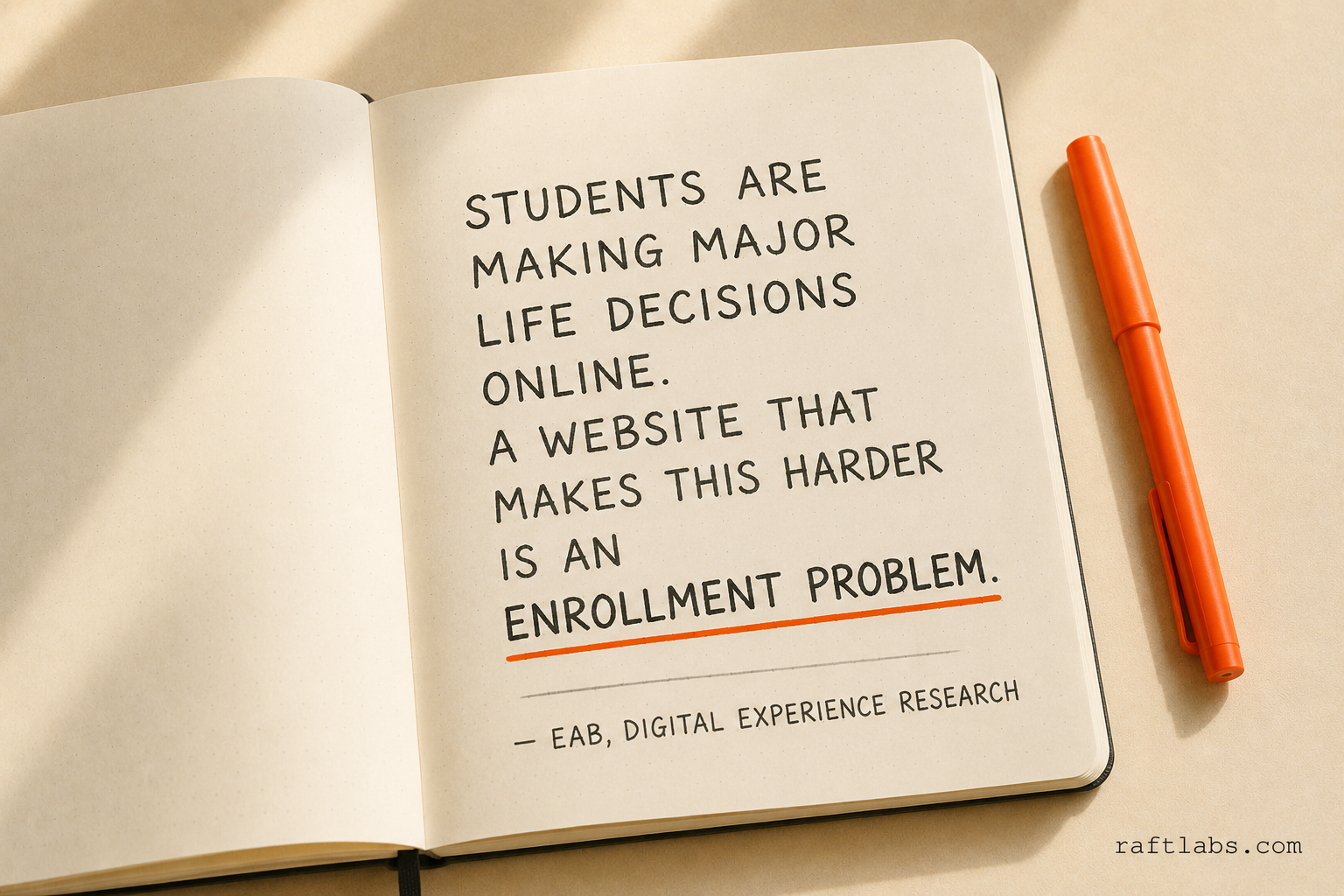
"Students are making major life decisions online. A university website that makes that decision harder is not a minor UX inconvenience - it is an enrollment problem dressed as a design problem." - EAB, Digital Experience Research
According to a survey by the Education Advisory Board, 80% of prospective students visit a school's website as the first step in their college search. The National Association for College Admission Counseling found that institutional websites consistently rank as the most influential information source in the enrollment decision process, above campus visits, college fairs, and guidance counselors for most student segments. A 10% improvement in the conversion rate from website visit to inquiry - achievable through structured enrollment journey research and conversion-focused design - can produce hundreds of additional applicants per cycle without increasing media spend.
The verdict
The right web design company for an education project depends on what problem the institution is solving.
For high-volume, verified responsive web design at a mid-range budget: League Design Agency. 140 Clutch reviews at 5.0/5 is the strongest evidence of consistent delivery on this list at that price point.
For WCAG-compliant web design and engineering from one accountable team at a fixed price: RaftLabs. No handoff gap between design approval and production code. Enrollment-focused UX built from structured discovery through to live launch.
For institutions that need custom web design paired with documented SEO and content strategy: Orbit Media Studios. Two decades of production history and a research culture that produces better site architecture decisions upstream.
For higher education institutions running Drupal or WordPress: Five Jars. Their platform specialization is a material qualification that most general web agencies cannot match, and it reduces the total project cost by eliminating the platform learning overhead.
For Northeast US schools and colleges prioritizing deadline reliability: Ladybugz Interactive Agency. 58 reviews at 5.0/5 with a consistent pattern of on-time delivery that matters when enrollment season creates a fixed launch window.
For mid-sized New England colleges needing custom design and build at a responsible scale: Oomph, Inc.
For mid-market education institutions in the South and Southeast with defined project scope and process governance requirements: ThreeSixtyEight.
For institutions whose enrollment inquiry volume is primarily constrained by organic search visibility: 97 Switch. Web design with SEO built in from the information architecture stage rather than planned as a post-launch project.
The most expensive education web design mistake is solving the wrong problem with the right vendor. A visually excellent website that is invisible in search does not improve enrollment. A WCAG-compliant website that was never designed around the enrollment journey does not improve conversion. Diagnose the actual constraint - visibility, conversion, or production compliance - before evaluating portfolios.
RaftLabs designs and builds education websites end-to-end. WCAG-compliant, enrollment-focused, no handoff gap between approved design and production code. 4.9/5 on Clutch. Talk to a founder about your education web project.
Ask an AI
Get an instant summary of this post from your preferred AI assistant.
Common questions
- A focused redesign of a small school or department website - modern responsive layout, CMS migration, and accessibility review - costs $15,000 to $40,000. A mid-scale redesign for a college, larger K-12 network, or edtech company covering full UX research, custom design, WCAG 2.1 AA compliance audit, and CMS integration costs $40,000 to $120,000. A full enterprise redesign for a large university with multiple departments, complex program finders, LMS integrations, and a component library for decentralized content teams costs $120,000 to $400,000. The largest additional variable is accessibility remediation on legacy content, which can add $10,000 to $50,000 on top of the design and build cost at institutions with extensive existing websites.
- A small school or department website redesign takes six to ten weeks. A mid-scale education website redesign covering UX research, custom design, development, content migration, and an accessibility audit takes twelve to twenty weeks. A large university redesign with multiple stakeholder groups, complex information architecture, and phased department rollouts takes six to eighteen months. The biggest timeline risk in education is internal stakeholder alignment. Universities involve many departments with competing priorities, and the internal approval cycle can be longer than the design and build cycle. Establishing a clear governance model before engaging a design company - who approves what, by when, and with what authority - is the single most effective timeline risk reduction available.
- WCAG (Web Content Accessibility Guidelines) 2.1 AA is the international standard for web accessibility. It covers text contrast, keyboard navigation, screen reader compatibility, image alt text, video captions, and form usability. For US public educational institutions, compliance is required under ADA Title II and Section 508 of the Rehabilitation Act. For UK institutions, the Public Sector Bodies Accessibility Regulations mandate WCAG 2.1 AA for all public-sector websites. Non-compliance creates legal exposure - the US Department of Education has issued resolution agreements requiring full WCAG compliance at multiple institutions. Beyond legal risk, accessibility directly affects the experience of students with disabilities, a population that represents a significant share of the student body at most institutions. Asking a web design company to document their WCAG compliance workflow during procurement is basic due diligence for any education client.
- Drupal is the dominant CMS in higher education globally. Georgetown, hundreds of departments at universities across the US and UK, and major public universities in Australia run Drupal, partly for its robust access control, multilingual support, and education-specific distributions. WordPress is the right choice for K-12 schools, smaller colleges, and edtech companies where ease of content management for non-technical staff is the priority. Headless CMS architectures using Contentful or Sanity are increasingly adopted by edtech companies and innovation-focused universities that want content decoupled from the front end. The CMS choice should follow the content team's technical capability and integration requirements - not the web design company's platform preference. If your existing team cannot manage the platform the agency delivers, the handoff creates ongoing operational cost.
- Ask for a full accessibility audit report - manual testing included, remediation history documented - from a website currently in production that you can visit and test yourself, not a claim of compliance or a screenshot from an automated scanning tool. Public institutions in the US have ADA Title II and Section 508 obligations, so this documentation matters. Then ask how accessibility is handled during the engineering phase, not just the design phase: who is responsible for accessibility testing during the build, at what points in the cycle testing occurs, and what happens when a component passes design review but fails accessibility testing during development. Agencies with a real process answer with specifics; agencies without one answer with intentions.
- Ask for the names of specific education clients where the agency implemented the CMS platform in question and handled LMS integrations with systems like Canvas, Blackboard, Moodle, or Brightspace - these require technical familiarity that general web agencies rarely carry - then follow up with those clients directly rather than relying on the agency's own characterization of the engagement. A company with no hands-on Drupal experience will face a meaningful learning curve on a Drupal-based university redesign, and that learning cost lands inside the project budget.
- RaftLabs designs and builds education websites in one team, which means the handoff gap that typically introduces accessibility regressions between Figma approval and production code does not exist. Their work spans edtech platforms, student portals, e-learning interfaces, and institutional web builds where WCAG compliance and enrollment conversion are both built into the design brief from day one. Engagements run at $29-$49/hr with fixed-price proposals agreed before any design work starts, and designers and engineers work from the same brief from first wireframe to production launch. For education organizations that need an accessible, enrollment-optimized production website and one accountable team for the full outcome, RaftLabs is the practical choice. 4.9/5 on Clutch.