Remote patient monitoring: what the clinical data actually shows
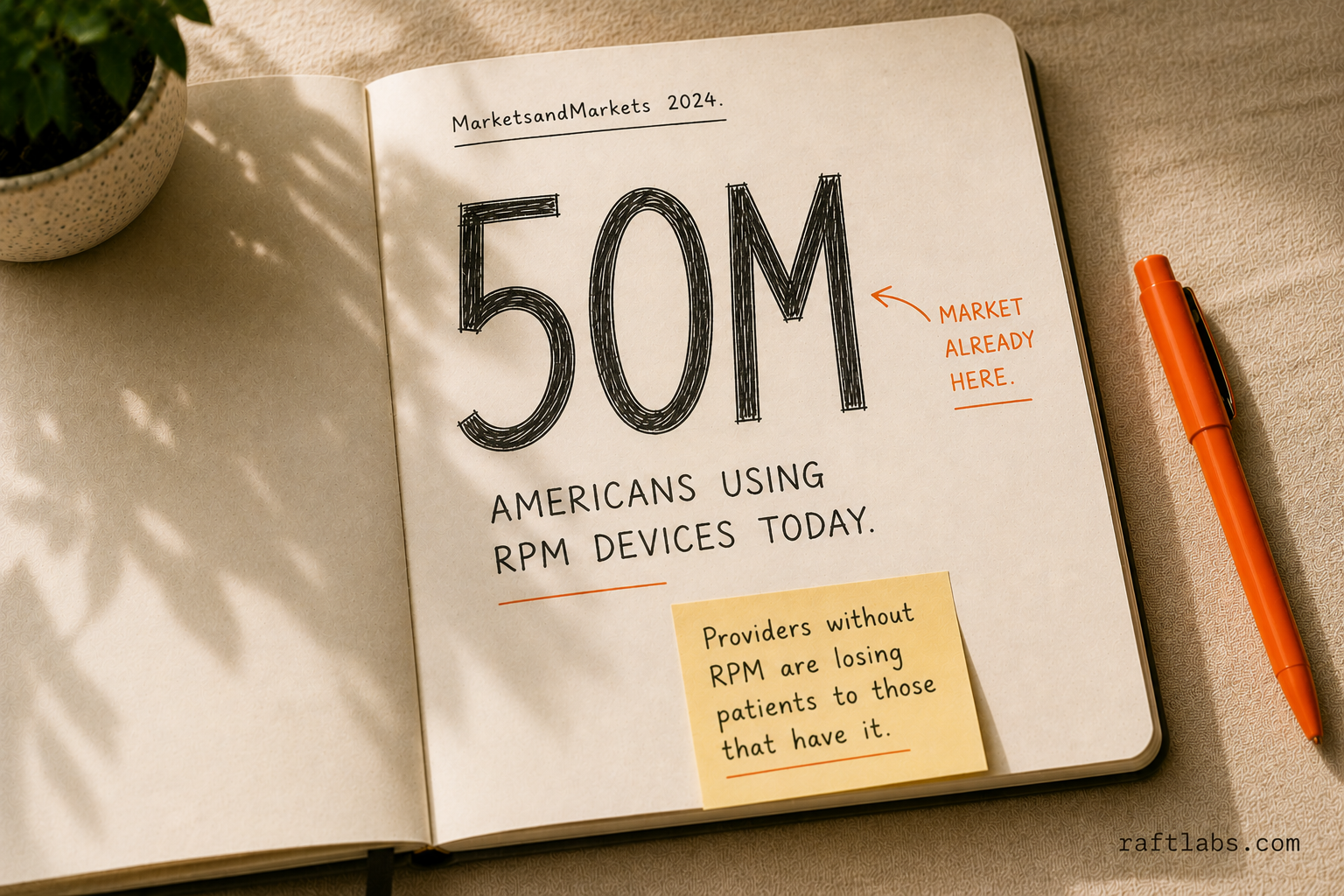
50 million Americans use RPM devices. Providers that haven't deployed remote patient monitoring are losing patients to systems that have. This guide covers what RPM is, how it works, and what the data says about clinical and financial outcomes.

In this article
Short answer
Remote patient monitoring (RPM) collects patient vitals outside clinical settings using connected devices and transmits data to care teams in real time. The global RPM market reaches $41.7 billion by 2028, growing at 20.1% annually. RaftLabs builds HIPAA-compliant RPM platforms with device integration and smart alert engines. RPM programs reduce hospital readmissions for chronic conditions by 19-41% and generate over $1,000 per Medicare beneficiary annually through CMS reimbursement codes.
Key takeaways
- The global RPM market reaches $41.7 billion by 2028 at 20.1% annual growth. Providers without an RPM program are losing ground to those that have one.
- RPM reduces hospital admissions for chronic care complications by 19-41%. For CHF patients, a single prevented readmission saves $13,500 and prevents significant patient harm.
- Medicare reimburses over $1,000 per beneficiary per year for just 20 minutes of monthly monitoring. That covers the program cost and generates margin for most practices.
- Staff logging compliance is the most common reason RPM programs underperform. Technical implementation is the easy part.
- A complete RPM build includes device integration, a HIPAA-compliant data layer, alert engine, clinical dashboard, and EHR connectivity. Skipping any layer creates gaps that alert fatigue or data gaps will expose.
Fifty million Americans use RPM devices today. That number isn't growing because the technology is interesting. It's growing because the math works: fewer hospitalizations, lower readmission costs, and Medicare reimbursement that covers the program and still generates margin.
According to research by MarketsandMarkets, the global RPM market reaches $41.7 billion by 2028, growing at 20.1% annually. Providers without an RPM program aren't just missing a trend. They're losing patients to systems that already have one.
This article breaks down what RPM is, how it works, what the clinical evidence shows, and what a production-ready implementation actually requires.
What remote patient monitoring is (and what it isn't)
RPM is a healthcare delivery method. Connected devices collect patient vitals outside clinical settings and transmit that data to care teams in real time. Devices include blood pressure monitors, glucometers, pulse oximeters, and heart rate monitors.
What it isn't: telemedicine. Telemedicine is scheduled video visits. RPM is continuous physiological monitoring between those visits. The distinction matters because they solve different problems. Telemedicine replaces an appointment. RPM replaces the gap between appointments, which is where most chronic disease deterioration happens.
A study published in NPJ Digital Medicine covering 7,000+ patients across 41 states found that RPM with nursing care was safe and effective and produced better outcomes than standard care alone. That's the clinical baseline.
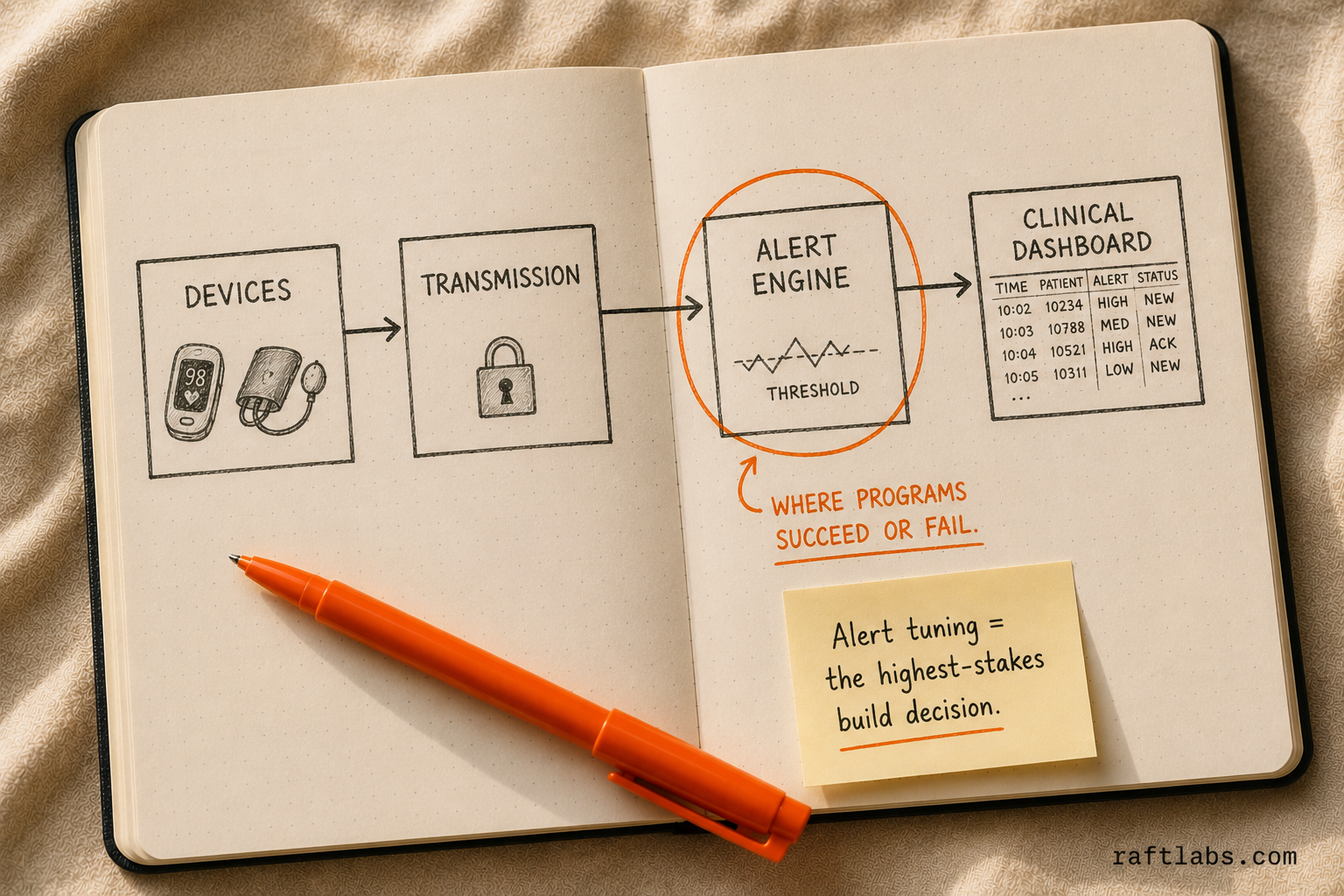
The four components every RPM system needs:
- Monitoring devices that capture vitals and transmit them automatically. Bluetooth-enabled consumer-grade devices work for most patients. Cellular gateways handle patients without smartphones.
- A transmission layer that moves data securely from device to backend. This must be encrypted and HIPAA-compliant at every hop.
- Analysis software that validates readings, applies clinical alert thresholds, and flags abnormal values for provider review. Alert tuning is where most implementations fail or succeed.
- A clinical dashboard that gives providers population-level visibility. Prioritized alert queues matter more than raw data feeds. Providers can't review every reading. They need to see the ones that require action.
What the clinical evidence shows
Most RPM conversations lead with the market size. The more important numbers are the clinical outcomes.
Strategic market research shows organizations using RPM reduce hospital admissions for chronic care complications by 19-41%. That range depends on the condition and the quality of the alert protocols. For CHF patients, which is where the evidence is strongest, the reduction sits at the higher end.
A single congestive heart failure hospital admission costs about $34,000. A readmission costs $13,500. RPM programs for CHF patients track weight, blood pressure, and oxygen saturation together. Early decompensation shows up as a weight gain of 2-3 lbs over 48 hours plus a drop in oxygen saturation. That pattern, caught by the alert engine, triggers a call from a care manager. The patient gets a diuretic dose adjustment. The hospitalization doesn't happen.
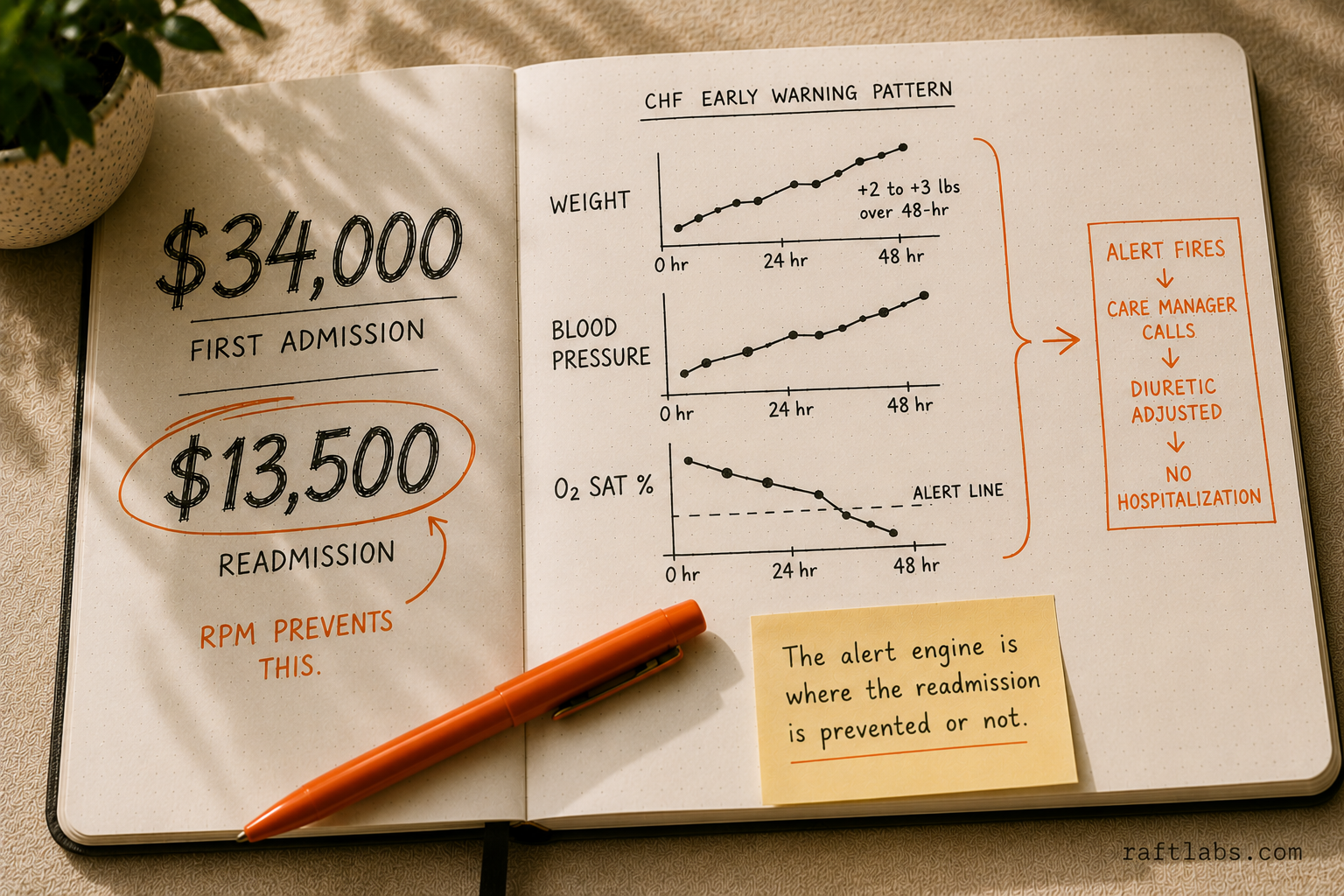
"The key to RPM's success is not the device. It's what happens when the alert fires. The clinical workflow that responds to the alert is where the readmission is prevented or not prevented."
. Dr. Joseph Kvedar, Professor at Harvard Medical School and Vice President of Connected Health, Partners HealthCare, quoted in NEJM Catalyst
The financial case for healthcare providers
The reimbursement structure is what converts RPM from a clinical tool into a business decision.
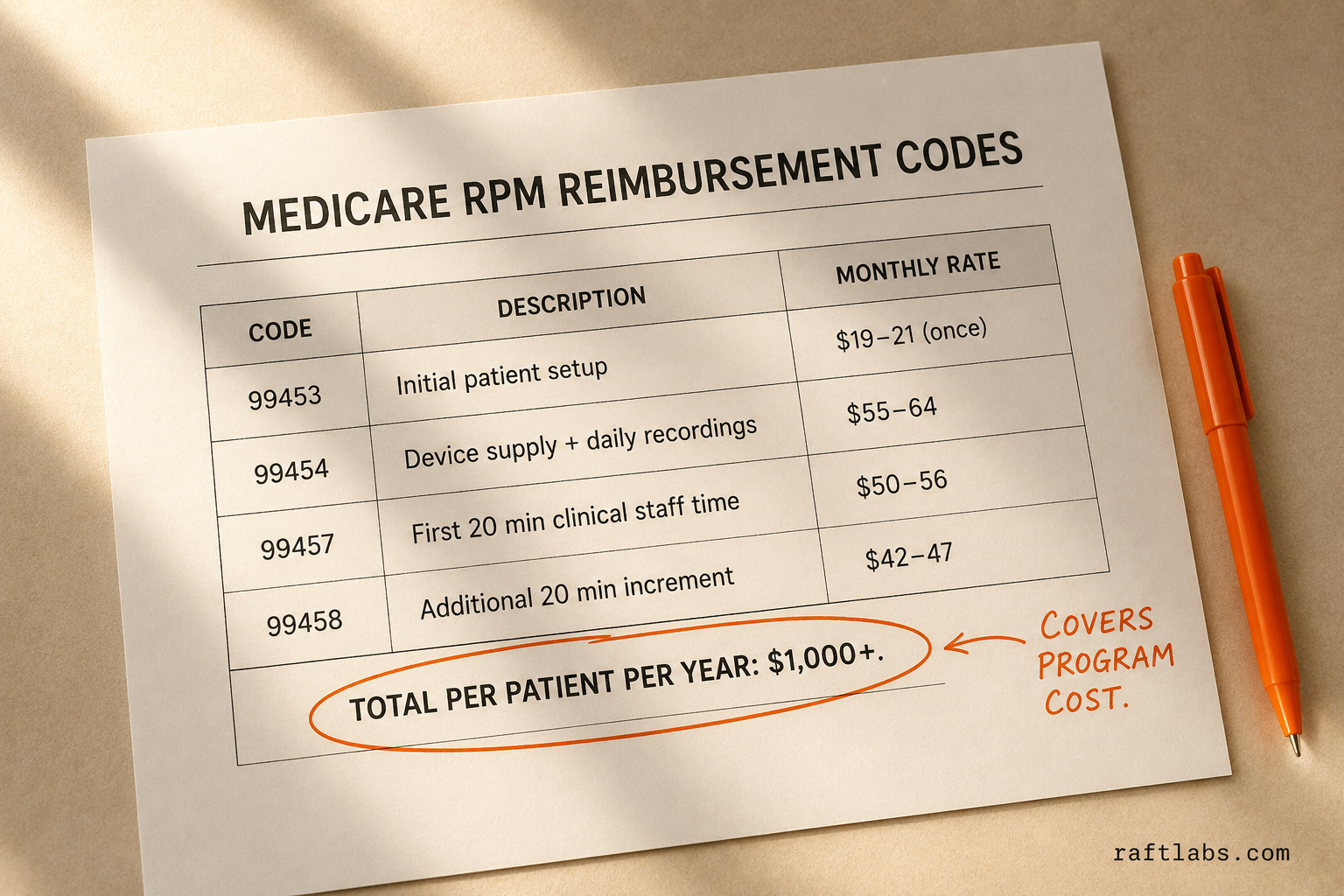
Medicare reimburses RPM under four CPT codes. Code 99453 covers initial patient setup at $19-21, billed once per patient. Code 99454 covers device supply and daily recordings at $55-64 per month, requiring 16 or more days of transmitted data. Code 99457 covers the first 20 minutes of clinical staff time at $50-56 per month. Code 99458 covers each additional 20-minute increment at $42-47.
A single patient enrolled in a full RPM program generates over $1,000 in annual Medicare reimbursement for 20 minutes of monthly monitoring time. For a practice with 200 enrolled patients, that's $200,000 per year in reimbursement. The program cost, including devices and software, typically runs $30,000-$60,000 per year at that scale.
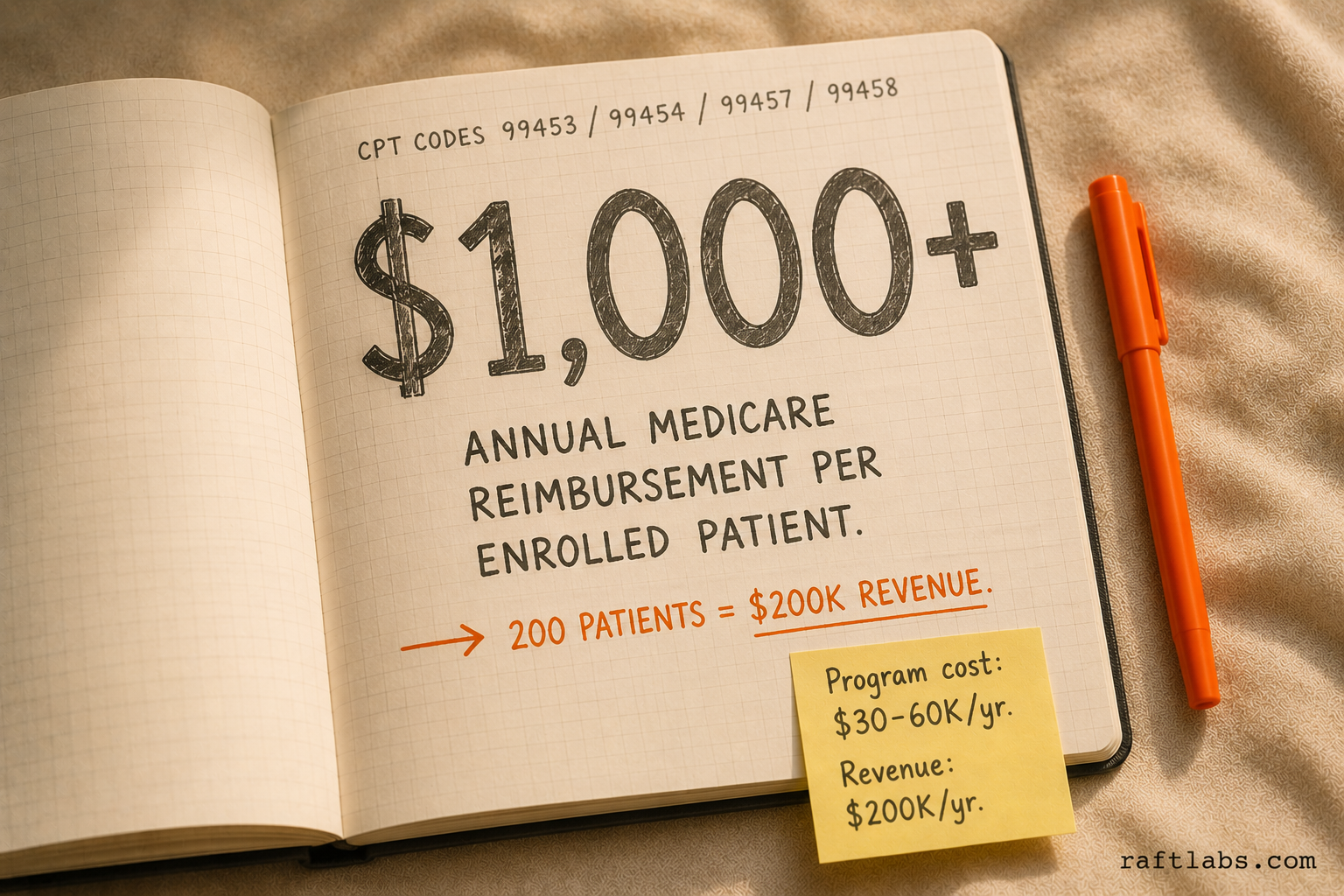
The financial case doesn't require any readmission prevention to pencil out. The reimbursement alone covers costs. The clinical outcomes are the margin.
RPM for healthtech founders: what the market opportunity looks like
For health-tech founders, the opportunity isn't building another RPM device. The device market is commoditized. The opportunity is the software layer: alert engines, clinical workflow tools, population health dashboards, and integrations with EHR systems that don't naturally speak to each other.
The MSI International survey found 80% of Americans support using RPM as part of their medical care. That's demand-side readiness. The gap is supply-side: software that's HIPAA-compliant, device-agnostic, and integrates with whatever EHR the provider already runs.
Three specific underserved problems in the RPM software market:
- Alert fatigue management. Most RPM platforms generate too many alerts. Providers stop responding. The system becomes noise. Better alert tuning logic, using adaptive thresholds rather than static cutoffs, is a genuine differentiator.
- Cellular gateway management. Patients without smartphones need a different transmission path. Managing the logistics of cellular gateway devices at scale is an operational problem that most RPM platforms handle poorly.
- EHR write-back. RPM data that doesn't automatically flow into the patient's EHR record means duplicate documentation work for providers. Providers don't adopt systems that create more work.
What a production-ready RPM implementation requires
RaftLabs built the PDC app for a healthcare client managing patients across multiple clinics. The implementation covered device integration, HIPAA-compliant data architecture, smart alert engine, and EHR connectivity. Over 50 clinics deployed within three months of launch.
Here's what that build taught us about what actually matters:
Alert engine design is the highest-stakes decision. Too many false positives and providers stop reviewing them. Too few and you miss deteriorations. The right approach is condition-specific alert thresholds, reviewed and tuned by clinical advisors, then adjusted based on real-world performance in the first 60 days.
The transmission layer needs a fallback. Bluetooth to smartphone works for most patients. For elderly patients or those in poor connectivity areas, cellular gateways are essential. A system that only supports Bluetooth will have 20-30% of your target population unable to use it.
HIPAA compliance isn't a checkbox. It's architecture. Encryption in transit and at rest, audit logging for every data access, access control at the field level, and business associate agreements with every vendor in the stack. Shortcuts in any of these create audit exposure.
Staff workflow determines outcomes. The clinical workflow that responds to an alert is where the readmission is prevented or not. Technical implementation is the easy part. Designing the escalation protocol, training the care managers, and measuring response times are where programs succeed or fail.
The implementation sequence:
- Weeks 1-2: Device selection, transmission architecture, data schema design, HIPAA review
- Weeks 3-6: Backend platform, alert engine build, clinical dashboard development
- Weeks 7-8: EHR integration, patient enrollment workflow, staff training
- Weeks 9-10: Pilot with 10-20 patients, alert threshold calibration, provider feedback
- Weeks 11-12: Full rollout, population management dashboard, reporting setup
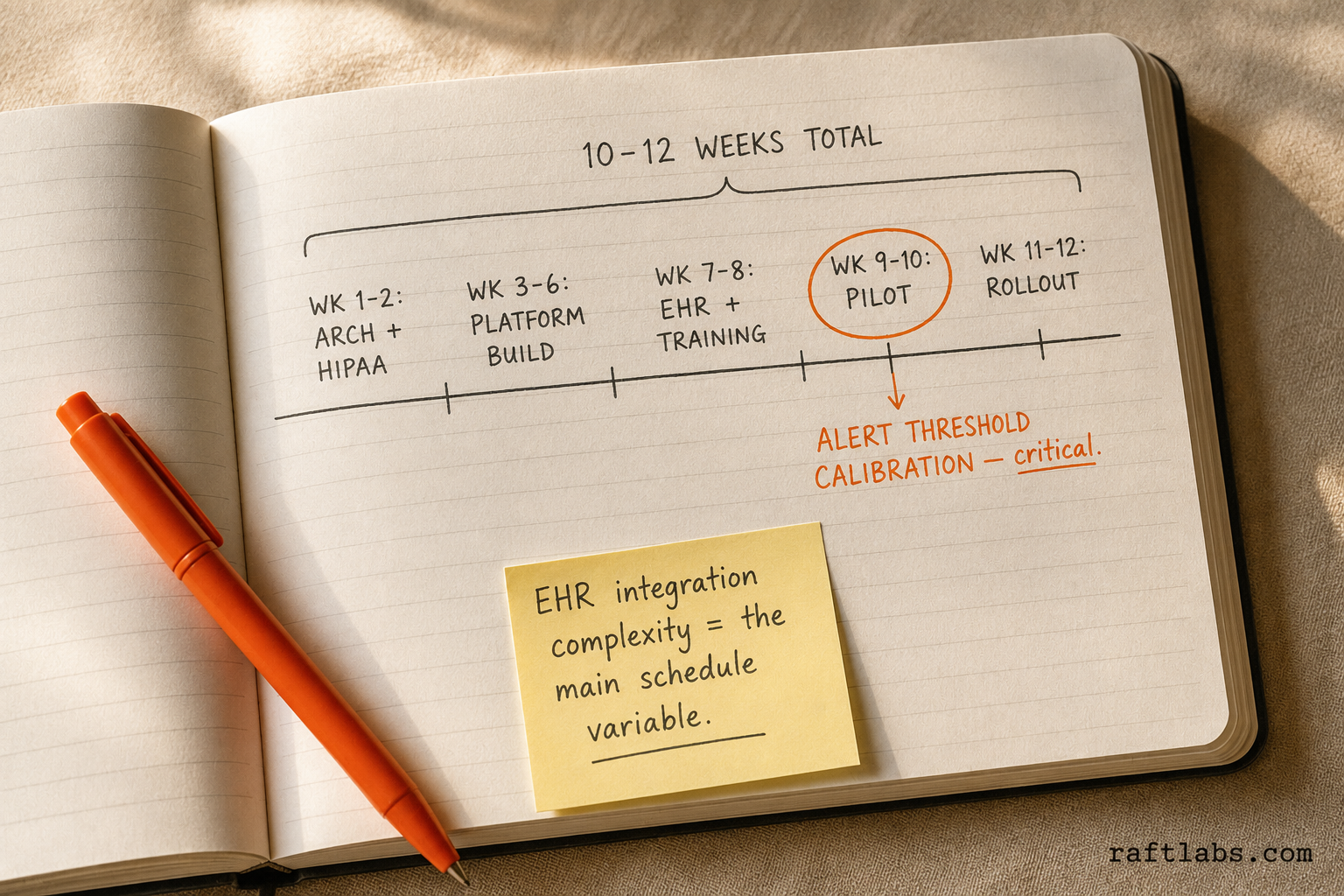
A complete RPM platform takes 10-14 weeks depending on EHR integration complexity and the number of device types supported.
The AI layer in RPM
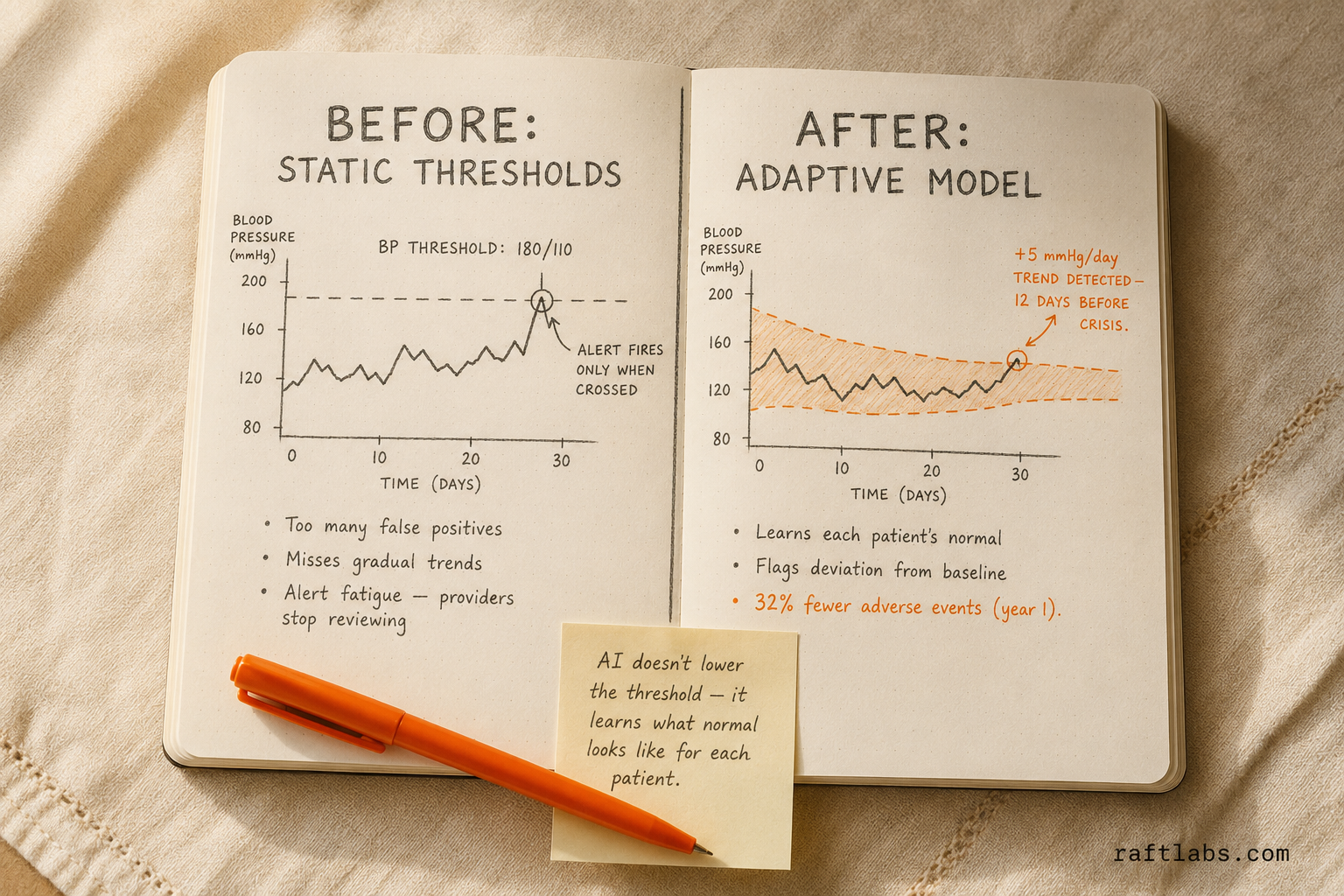
Standard RPM uses static alert thresholds. If a patient's blood pressure exceeds 180/110, an alert fires. That works but it misses the pattern: a patient whose blood pressure has been trending up by 5 mmHg per day over two weeks is about to have a crisis, even if they're still within the threshold.
AI-based predictive analytics in RPM catch those patterns. The model learns what "normal" looks like for each individual patient and flags deviations from that baseline, not from a population average. Published research on AI-based monitoring in healthcare settings shows 32% reductions in adverse events in the first year.
The practical build decision: AI-based alert models require six to twelve months of patient data before they're reliable. Starting with rule-based alerts, then adding ML models once you have the training data, is the right sequence. Teams that try to skip straight to AI with no baseline data get models that don't generalize.
Running a healthcare operation that needs an RPM platform? RaftLabs builds HIPAA-compliant RPM systems with device integration, alert engines, and EHR connectivity. Talk to us about your build or read how we approach healthcare software development.
Ask an AI
Get an instant summary of this post from your preferred AI assistant.
Frequently asked questions
- RPM is a healthcare delivery method using connected devices to collect patient vitals outside clinical settings and transmit that data to care teams in real time. Devices include blood pressure monitors, glucometers, pulse oximeters, and heart rate monitors. Data flows through secure software to clinical dashboards where providers set alert thresholds and intervene when values fall outside safe ranges. RPM differs from telemedicine because it involves continuous physiological monitoring, not scheduled video visits.
- RPM catches deteriorating conditions before they escalate to emergency visits. For heart failure, COPD, and diabetes, daily monitoring surfaces early warning signs that would go undetected between appointments. Strategic market research shows RPM programs reduce hospital admissions for chronic care complications by 19-41%. For heart failure specifically, tracking weight, blood pressure, and oxygen saturation together detects early decompensation days before patients would typically present to the emergency department.
- Medicare reimburses RPM under four CPT codes. Code 99453 covers initial setup at $19-21, billed once. Code 99454 covers device supply and daily recordings at $55-64 per month (requires 16+ days of transmitted data). Code 99457 covers the first 20 minutes of clinical staff time at $50-56 per month. Code 99458 covers each additional 20-minute increment at $42-47. A single patient enrolled in a full RPM program generates over $1,000 in annual Medicare reimbursement.
- A complete RPM system has four layers. First, monitoring devices capturing vitals such as blood pressure, glucose, heart rate, and oxygen saturation. Second, a transmission layer sending data securely from device to backend, via Bluetooth to a patient's phone or a cellular gateway. Third, analysis software that validates readings, applies clinical alert rules, and flags abnormal values. Fourth, a clinical dashboard giving providers population-level visibility with prioritized alerts. HIPAA compliance is required across every layer.
- Elderly patients get three specific benefits. Continuous monitoring catches health changes between appointments, enabling earlier intervention before a condition worsens into a hospital visit. Patients with mobility challenges or those in remote areas get equivalent monitoring without traveling to a clinic. Patients also gain visibility into their own health data, which studies link to better medication adherence and self-management habits.