Updated August 2025
Hospitality Mobile App Guide 2026: Features, Cost, and Development Plan
Hospitality mobile apps slash OTA commissions and speed up operations. Here's what the tech decisions look like and what most operators overlook before they build.

In this article
Short answer
RaftLabs builds hospitality mobile apps from $10,000-$20,000 for a basic MVP to $20,000-$40,000 for a full app with PMS integration, mobile check-in, and loyalty features. Development takes 12-14 weeks. Custom builds beat white-label platforms for properties with 5+ locations.
Key takeaways
- OTA commissions run 15-30% per booking. On $100,000/month in OTA revenue, that is $15,000-$30,000/month in fees without building a single owned guest relationship.
- React Native delivers both iOS and Android apps from one codebase. For most hotel apps (booking, check-in, service requests), the performance difference from native is negligible and the development cost savings are 30-40%.
- White-label platforms make economic sense for 1-3 properties. At 5+ properties, custom development typically costs less over 3 years than cumulative white-label fees, while giving full control over data and integrations.
- Real-time PMS sync is non-negotiable. A batch process that updates every 15 minutes can still produce double bookings in a busy property. Verify your PMS vendor offers webhooks or live API access before committing to app development.
- RaftLabs rebuilt City Break Apartments' entire digital stack: website, mobile app, and RMS Cloud integration, delivering 24/7 self check-in and keyless entry across 250+ properties in Ireland.
60% of hotel reservations now come through mobile devices. Guests expect to book, check in, and unlock their room from their phone. If your property does not have a direct mobile channel, you are pushing guests back to OTAs and paying commissions on the same customers every time they return.
OTA commissions average 15-30% per booking. On $100,000 per month in OTA-driven revenue, that is $15,000-$30,000 gone monthly without building a single direct guest relationship. A mobile app does not eliminate OTA traffic overnight, but it creates a direct channel that compounds. Every guest who books through your app is a guest you own the relationship with next time.
According to Phocuswire's 2024 Digital Guest Experience Report, 68% of hotel guests say they would use a hotel app more often if it offered mobile check-in and room key access. Only 32% of independent properties currently offer this.
RaftLabs rebuilt the website and mobile app for City Break Apartments in Ireland, delivering self check-in, keyless entry, and RMS Cloud integration that runs 24/7. That project is the proof-of-concept this guide is built around.
This guide walks operators, GMs, and owners through hospitality mobile app development. We cover why apps have become essential, what features drive bookings and loyalty, how to evaluate development partners, and what the implementation timeline looks like.
Who should read this guide
This guide is for hospitality decision-makers evaluating mobile app development to reduce OTA dependency, improve guest experience, and increase direct bookings.
Hotel owners and independent operators who want to reclaim guest relationships from OTAs and compete with major chains on digital experience will find the business case and build-vs-buy analysis most useful.
General managers and operations directors focused on reducing front desk workload through mobile check-in and keyless entry should pay attention to the PMS integration and implementation timeline sections.
Revenue managers and sales leaders trying to increase direct booking conversion and reduce OTA commission expense will want to focus on the booking engine features and ROI analysis.
Multi-property portfolio managers need centralized administration and scalable architecture. The custom vs. white-label decision section and multi-property PMS complexity section address those concerns directly.
Marketing directors and guest experience leaders responsible for pre-arrival communication and loyalty program integration will find the launch strategy section practical.
Technology and IT directors evaluating vendors and managing integrations will find the technical decisions section and the vendor red flags section most relevant.
Hospitality entrepreneurs launching new hotel concepts who need competitive digital capabilities from day one should read the MVP cost section and implementation timeline.
Investment and advisory professionals analyzing hospitality properties should focus on the ROI section and the cost tables.
What You'll Discover in This Guide
This guide covers hospitality mobile app development for operators and decision-makers evaluating their own app:
The business case for mobile apps: why OTA dependency costs you data and revenue, how a branded app changes the guest relationship, and why mobile websites fall short.
Essential features: direct booking with PMS integration, mobile check-in and digital keys, in-app service requests and upsells, loyalty integration, and pre-arrival communication that reduces front desk workload.
Guest acquisition: mobile key exclusivity, app-exclusive rates, loyalty incentives, staff promotion, and post-booking engagement that turns one-time guests into regulars.
Build versus buy: white-label platforms versus custom development, including cost, customization limits, data ownership, and scalability across single versus multi-property portfolios.
PMS integration: why real-time sync is non-negotiable, how to evaluate your PMS before development, integration red flags, and questions to ask vendors during evaluation.
Choosing development partners: criteria for selecting agencies, including hospitality-specific experience, technical competence, project management approach, and post-launch support expectations.
Technology decisions: native versus cross-platform trade-offs, backend infrastructure requirements, security and compliance basics, and when to prioritize certain technical approaches for your property.
Implementation timeline: realistic expectations for the 12-18 week journey from kickoff to launch, what operators need to provide at each phase, common delays, and what "launch-ready" actually means.
This guide helps you determine whether a mobile app makes business sense for your property, identify must-have features versus nice-to-haves, choose the right development approach and partners, and set realistic expectations for timeline, cost, and guest adoption.
Why Does Your Hospitality Business Need a Mobile App?
Walk into any hotel lobby. Most guests waiting to check in are on their phones. During their stay they use the same device for information, requests, and services. It is also how they plan the next trip.
The question isn't whether your guests use mobile devices; it's whether you're meeting them there with a useful tool or forcing them to cobble together a dozen different apps and websites to interact with your property.
The OTA Data Problem
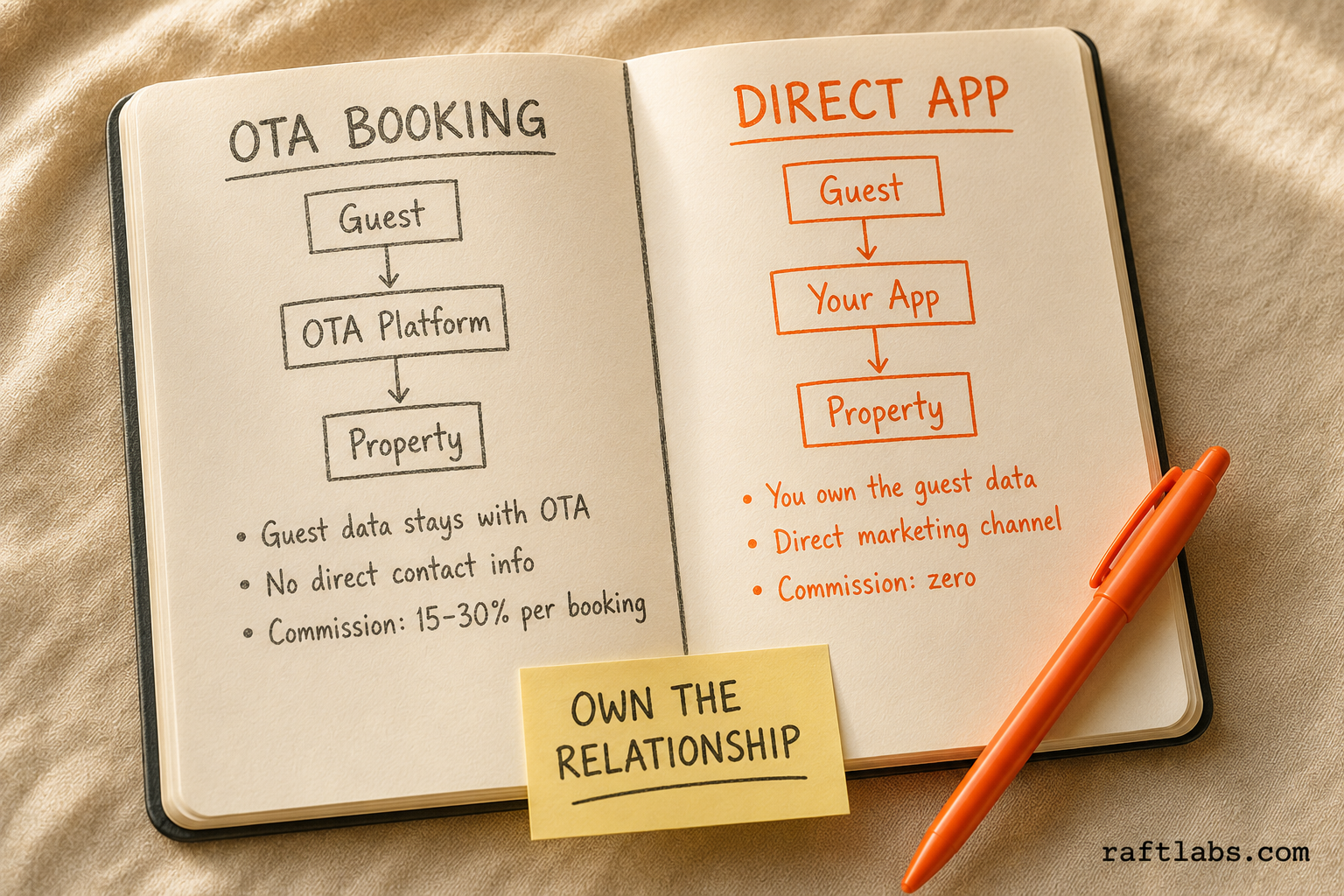
Here's what happens when someone books through Expedia or Airbnb: They search on the OTA platform, read reviews on the OTA platform, book through the OTA interface, and receive confirmations from the OTA.
Sure, they eventually show up at your property, and you can build rapport during their stay.
But you don't have their email address in your system. You can't send them a welcome message before arrival. You can't even market your spa special to them. And when they want to book again six months later, where do they go? Back to the OTA, because that's where their travel history lives.
Thus, the OTA owns the digital relationship, including the data, the communication channel, and the pathway to the next booking. You own the in-person experience, which is incredibly important. However, without the digital relationship, you're constantly paying commissions to reach the same guests over and over.
A mobile app changes this dynamic. When guests book through your app, you have their contact information, booking history, preferences, and a direct line to communicate with them. More importantly, when they think about booking their next stay, your app is sitting right there on their home screen.
Why Mobile Web Isn't Enough
You might be thinking: "We have a mobile-responsive website. Isn't that enough?" Not quite. Mobile websites serve an important purpose for discovery and initial research, but they fall short when guests need to actually do something.
Try booking a hotel room on a mobile website. You're filling out forms on a small screen, typing payment information with your thumbs, and probably getting frustrated with how long pages take to load. Now try booking the same room through a well-designed mobile app. Your payment information is already saved. The interface is fast and responsive. You complete the booking in seconds, not minutes.
The speed and ease of mobile bookings can directly impact your conversion rate. The easier you make it for customers to book on their mobile devices, the more bookings you'll capture.
Native mobile apps are particularly effective in this regard, offering experiences that mobile websites often can't match. Features like saved payment methods, push notifications, and offline access enhance convenience and encourage more bookings.
Operational Realities Beyond Guest Experience
Mobile apps solve real operational problems that plague hospitality operations daily. Every front desk team knows the pain of peak check-in times: long lines, rushed service, guests who are tired from travel and just want to get to their room.
Mobile check-in and digital keys eliminate these bottlenecks entirely. Guests bypass the desk, go straight to their room, and your team can focus on guests who actually need assistance.
Similarly, in-app messaging transforms how staff handle guest requests. Instead of phone calls interrupting your front desk constantly, requests come through the app with clear documentation.
Staff can respond when appropriate, handle multiple conversations simultaneously, and ensure nothing falls through the cracks during shift changes. The efficiency gain is real and measurable.
These operational improvements matter more as labor becomes increasingly expensive and difficult to find. Technology that reduces routine transactions ultimately frees up your team to deliver actual hospitality rather than administrative processing.
The Competitive Reality
Major hotel chains haven't invested in mobile apps because they have money to burn. They've done it because apps demonstrably improve guest satisfaction, drive direct bookings, and create operational efficiencies. More importantly, they've trained travelers to expect these capabilities.
A business traveler who checks in remotely via the Hilton app and unlocks their door with their phone has no patience for your front desk line and plastic key cards. When a family books through Marriott's app and earns loyalty points automatically, your manual loyalty card system feels antiquated.
The gap isn't about budget. It's about the commitment to meeting guests where they already are. Cross-platform mobile app development has made native apps affordable for independent operators and regional chains, not just global brands. The technology barrier that existed a decade ago has mostly disappeared now.
So once the business case becomes clear, it helps to understand how these apps work in real hospitality operations. The following sections break down the core capabilities that make hospitality mobile apps valuable for both guests and operators.
What does a hospitality mobile app actually do?
A hospitality mobile app consolidates every touchpoint of the guest journey into a single, phone-based experience. Instead of managing reservations through your website, check-in at the front desk, and making requests through phone calls, guests handle everything in one place.
For business operators, this consolidation means better data, reduced manual work, and more opportunities to enhance revenue through targeted upsells.
1. Direct Booking Without OTA Commissions
The booking engine is the revenue driver. When guests can search availability, compare room types, and complete reservations entirely within your app, you've created a direct booking channel that costs a fraction of what you'd pay OTAs. The interface needs to be fast and intuitive because mobile users won't tolerate the multi-page forms that work on desktops.
Integration with your property management system ensures real-time availability and instant confirmations. Guests see accurate rates and room availability without the delays that plague poorly integrated booking systems.
The PMS connection also means confirmed bookings immediately update your inventory, preventing double bookings and maintaining data consistency across all your systems.
2. Mobile Check-In and Digital Keys
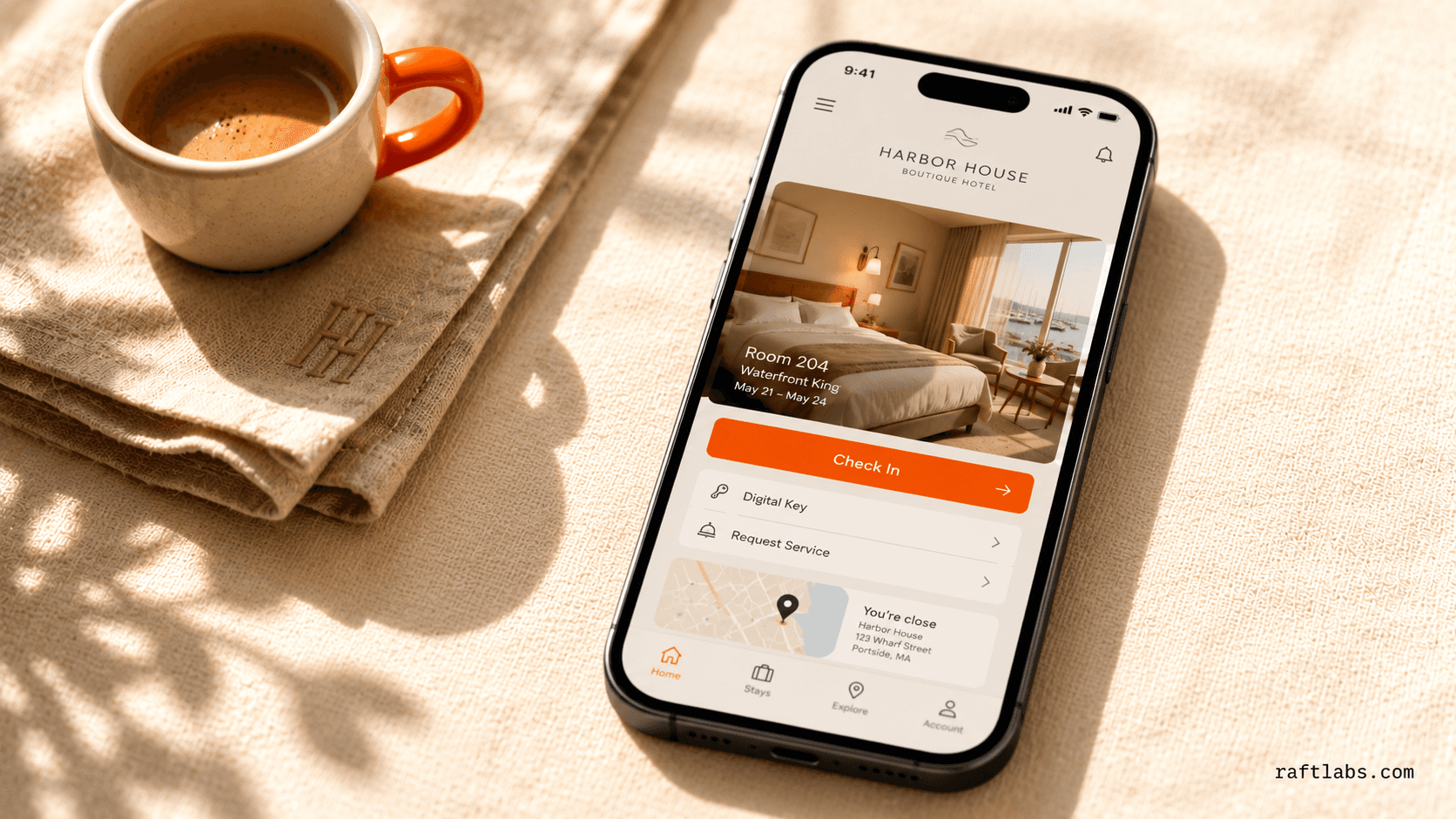
Mobile check-in removes the friction points guests face every time they arrive at a property. With mobile check-in, guests can complete the entire check-in process on their phones before they even arrive at the property. They receive their room assignment and can head straight to their room upon arrival without needing to stop at the front desk.
This process is made possible through digital keys, which are securely delivered via the business mobile app. These keys grant access to the guest's room, so they never need to interact with the front desk unless they have specific requests.
Digital keys work through Bluetooth technology, which securely connects the app on a guest’s phone to the door’s lock. This means guests can unlock their room doors with just their phone, no physical key cards needed.
The benefits of mobile check-in and digital keys go far beyond convenience for the guest. On the operational side, it frees front desk staff from routine check-ins so they can focus on guests who need real help.
In addition to improving guest experience and operational efficiency, digital keys also cut costs and reduce waste. Without the need for physical key cards, the business no longer needs to deal with card replacements when guests lose them or the reprogramming that’s typically required when guests extend their stay.
3. Service Requests and In-App Ordering
When guests need extra towels, want to order room service, or book a spa treatment, the app gives them one-tap access to these services. Instead of calling or visiting the front desk, guests can easily place their requests directly through the app.
These requests are routed to the appropriate staff members, creating a documented workflow that reduces the risk of mistakes or overlooked tasks. Whether it's housekeeping, food and beverage, or the spa team, the right person gets the notification, keeping everything organized and efficient.
In addition to streamlining guest requests, the app also opens the door for upselling opportunities that traditional methods, like paper menus or phone calls, often miss. For example, push notifications at strategic times can drive additional revenue by offering personalized, timely promotions.
Consider this: a guest checking in might receive a prompt offering them an exclusive suite upgrade, tailored to their preferences and booking history. Another guest who frequently orders wine through room service could receive a notification about an upcoming wine tasting event at the hotel’s restaurant, suggesting they join in.
These notifications are based on actual guest behavior and preferences stored in the system, making them far more effective than generic, one-size-fits-all messages. Targeting guests with relevant offers drives both engagement and revenue.
4. Guest Communication and Support
Real-time messaging through the app is transforming how guests interact with hospitality staff. Instead of calling the front desk and waiting on hold, guests can send a message through the app and continue their activities. Staff can then respond when they have the necessary details, such as availability, pricing, or any specific requests that require checking with other departments, ensuring that guests aren’t stuck waiting for an answer.
This shift to asynchronous communication allows staff to handle multiple guest conversations at once, without the need for constant back-and-forth phone calls. It’s a more efficient and less intrusive way to manage guest requests and concerns.
Key benefits of this messaging system include:
Improved efficiency: Staff can respond to messages when they have the right information, avoiding interruptions during busy moments.
Better guest experience: Guests don’t have to wait in long queues and can continue with their activities while waiting for a response.
Scalability: With the ability to manage multiple conversations simultaneously, staff can handle more inquiries without sacrificing quality or speed.
An example of this is when a guest reports a maintenance issue, like a broken air conditioner. Instead of waiting for a staff member to take their call, they send a message through the app, which is instantly logged into the system.
The app documents everything, including when the issue was reported, who handled it, and when it was resolved. This creates a clear record of the interaction. This documentation ensures nothing gets lost in shift changes and offers protection for the establishment in case of disputes.
This system also creates a valuable reference for future interactions. If a guest has a follow-up question about a previously reported issue, staff can easily access the history of their communication to provide consistent and accurate responses.
5. Loyalty Program Integration
Mobile apps have changed how loyalty programs work, making them more accessible for both guests and hospitality staff. With the app handling all the backend work, guests no longer have to worry about forgetting to mention their membership or tracking points manually.
The app automatically applies loyalty benefits during the booking process, ensuring guests always get the rewards they’re entitled to.
Key benefits of loyalty program integration through mobile apps include:
Real-Time Tracking: Guests can easily check their point balance and see how close they are to achieving the next reward or tier. This transparency keeps them engaged and motivated to continue using the program.
Automatic Application of Benefits: Loyalty points and rewards are automatically applied to bookings, so guests don’t need to remind staff at check-in or waste time calling the reservations desk.
Enhanced Guest Experience: For example, a guest booking directly through the app might see their reward points deducted for a room upgrade or a free breakfast. This frictionless experience builds satisfaction and loyalty.
Guests are more likely to make repeat bookings when they can actively monitor their loyalty progress and redeem rewards easily. By making loyalty benefits visible and accessible, the app turns loyalty from something that’s often forgotten into a powerful incentive for guests to choose your hospitality business over competitors.
Additional exclusive perks that mobile apps often provide include:
Member-Only Rates: Offering discounted rates that are available only to loyalty members, making guests feel valued and encouraging them to book directly.
Early Access to Promotions: Giving members a head start on special deals or room availability, which makes them feel like VIPs and deepens their connection to your brand.
This integration reduces OTA reliance, drives more direct bookings, and improves customer retention. All while making the loyalty experience invisible to guests.
Real-World Examples: Mobile Apps from Leading Hotel Chains
Major hotel brands have invested heavily in mobile app development, and their approaches reveal what actually works in hospitality technology. While independent operators can't match the development budgets of Marriott or Hilton, understanding what features drive engagement at scale helps inform smarter decisions about your own app strategy.
Marriott Bonvoy: The Loyalty Powerhouse
Marriott's app demonstrates how tightly integrating loyalty with every app function drives both bookings and repeat business. The app makes loyalty benefits impossible to ignore; members see their points balance on the home screen, get notifications about tier progress, and can redeem points for upgrades or free nights without leaving the app.
The chat function connects guests directly with property staff, creating a communication channel that feels personal while remaining documented and manageable for teams. Push notifications alert members to room readiness, special offers, and local recommendations, keeping Marriott top-of-mind even when guests aren't actively planning travel.
Hilton Honors: Mobile Key Pioneer
Hilton moved early on digital keys and built their app around this feature. Skipping the front desk entirely resonates with business travelers who value time. Hilton's app also lets guests select their exact room from a digital floor plan, removing the guesswork of requesting a preference at check-in.
The success of Hilton's mobile key program is supported by millions of downloads, and the app has consistently received positive feedback in app stores. This proves the value of investing in features that genuinely reduce friction. Guests are not using the app just because Hilton asked; they’re using it because it makes their stays significantly easier.
The mobile app's features have changed the guest experience, making Hilton’s operations smoother and increasing customer satisfaction. Guests use these services because they genuinely enhance convenience, which drives repeat business and strengthens brand loyalty.
Hyatt: Personalization and Service
Hyatt’s mobile strategy focuses on making the entire stay easier to manage. The app lets guests handle key parts of their stay from their phone, reducing the need to visit the front desk or call hotel staff.
It combines booking, loyalty management, and hotel services into a single interface.
Key features of the Hyatt app include:
Mobile check-in and digital key access at participating hotels
Direct connection to Hyatt's loyalty program, with point tracking and reward redemption
In-app service requests, property amenities, and dining or spa information
By combining stay management, loyalty features, and service requests in one place, the Hyatt app helps guests interact with the hotel more easily throughout their stay.
Lessons for Independent Operators
The core principles behind successful hospitality apps are more important than their brand-specific features. Key takeaways include:
Every successful app treats mobile as the primary experience, making bookings fast and completing them in seconds, not minutes.
Loyalty programs are woven into the app, not bolted on. Rewards apply automatically and members see their progress without digging for it.
Mobile check-in and digital keys are table stakes for any guest who travels more than twice a year.
The great thing is, you don’t need a massive budget to apply these principles. A well-designed app, built by an experienced hospitality development partner, can deliver the same core functionalities at a scale that suits your property.
What makes these apps effective isn’t the flashy features or big marketing budgets. It’s the way they solve real problems for both guests and operators, ensuring convenience and value at every touchpoint.
By focusing on these solutions, independent operators can build apps that compete with the best in the industry.
These examples do show what successful hospitality apps can achieve. The next decision can be determining the best way to build something similar for your own business.
Business Decision: Custom Development vs. White-Label Platforms
Deciding between custom development and a white-label platform for your hospitality mobile app depends on several factors: property count, growth plans, budget, and competitive positioning. Both options have distinct advantages, but making the wrong choice could either cost you money or hinder your growth.
Understanding White-Label Platform Solutions
White-label platforms offer pre-built apps that you can customize with your branding and content. These solutions are particularly appealing to single properties or small groups that are testing mobile app adoption. The platform manages technical infrastructure, app store submissions, and ongoing maintenance, allowing you to focus on operations rather than technology management.
However, the trade-offs are apparent:
Limited Features: You are restricted to the features provided by the platform, which may not meet your specific needs.
Lack of Differentiation: Your app will likely look and function similarly to others using the same platform, making it difficult to stand out.
Ongoing Costs: While the initial pricing may be low, monthly fees per property can add up over time. These fees continue indefinitely, and you depend on the vendor for updates and new features.
Data Ownership Issues: Your guest data is stored in the platform’s system, and if you later want to switch to another solution, migrating this data can be costly.
Custom Development Advantages
Custom development builds an app tailored specifically to your business’s requirements. Every feature, integration, and workflow is designed to support your operational needs, offering more flexibility and control than a white-label platform.
Here’s how custom development stands out:
Full Control and Flexibility: Custom-built apps allow for deeper integration with your PMS, revenue management system, and guest data platforms. This ensures your app works exactly as needed, without the limitations of pre-built connectors.
Scalability: While platform fees increase linearly with each new property, custom development scales more efficiently. As you add new properties, the cost mainly involves configuration and training rather than rebuilding the app.
Long-Term Cost Efficiency: Upfront costs may be higher for custom development, but over time, custom solutions become more cost-effective, especially as your portfolio grows. Custom apps also provide opportunities for unique features and competitive differentiation that platforms cannot offer.
The Portfolio Size Decision Point
Choosing the right solution often depends on your property size and long-term growth plans, as these factors significantly impact your app’s scalability and cost-effectiveness.
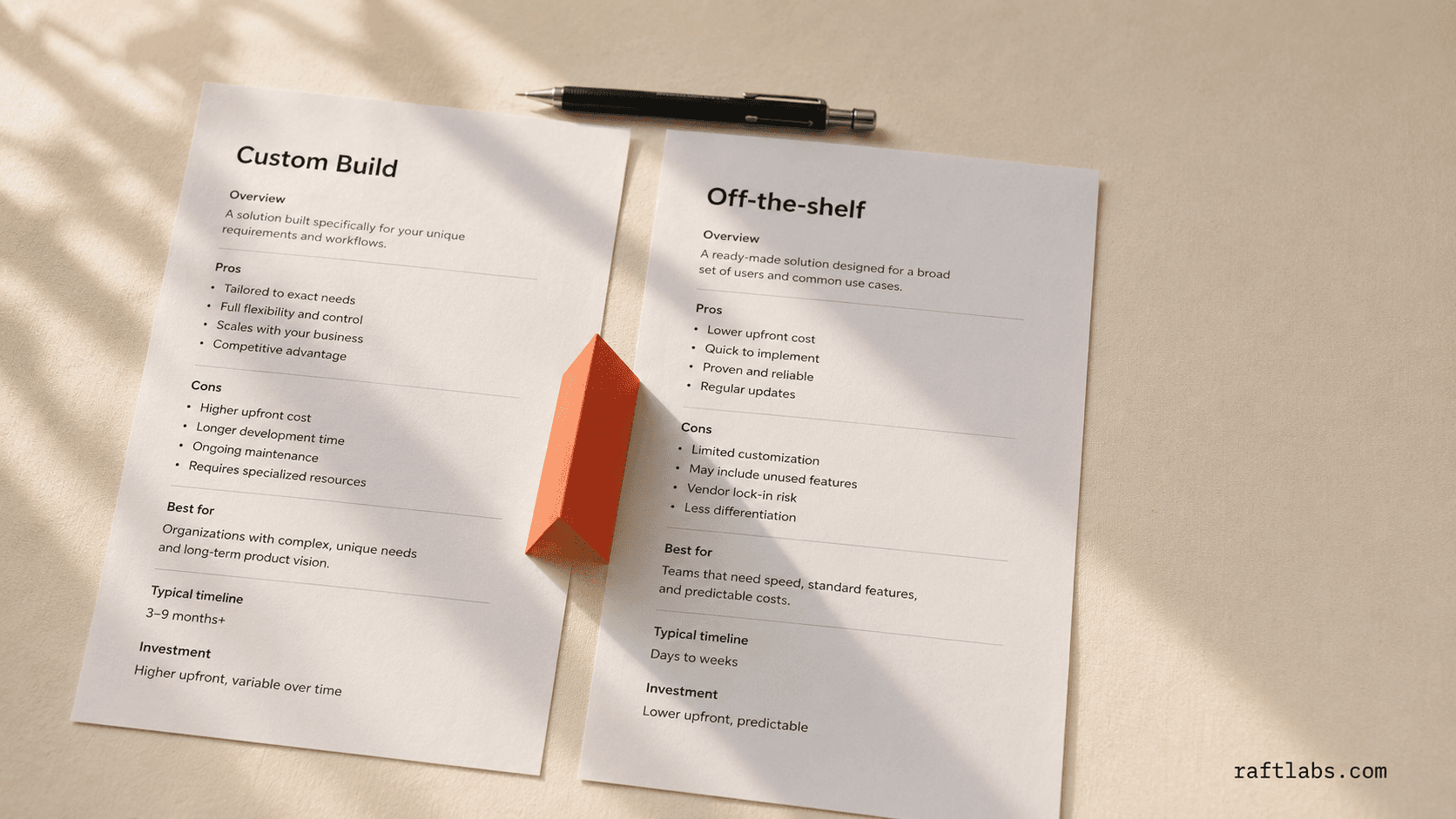
For single properties or small groups (fewer than three locations), a white-label platform might be a good starting point due to its lower upfront cost and faster implementation. This lets you validate whether mobile apps truly drive bookings and guest engagement before making a larger investment.
When you approach five or more properties, the total cost of platform fees over a few years often exceeds the cost of investing in custom development. Custom development allows for unique features, deeper integrations, and competitive differentiation that a white-label platform can’t provide. Also, nowadays, there are options for free prototypes or pilot projects by reputed hospitality app development companies that don’t require any substantial upfront investment to test the effectiveness of such an app.
Your growth strategy also plays a major role in this decision. If you plan to expand or acquire properties, investing in custom development from the start prevents future headaches and costly migrations.
The architecture decisions made early on for your first property will determine how easily you can scale to five, ten, or more properties in the future.
Here’s a quick comparison of the key differences between white-label platforms and custom development to further assist in evaluation:
| Criteria | White-Label Platform | Custom Development |
|---|---|---|
| Time-to-Market | Fast, ready to launch with minimal customization | Longer due to custom build and integrations |
| Features and Flexibility | Limited to the vendor's offerings | Fully customizable to meet unique operational needs |
| Cost Structure | Low upfront costs, but monthly fees add up | Higher upfront costs, but more cost-effective at scale |
| Data Ownership | Data stored by the platform vendor | Full control over guest data and system integration |
| Scalability | Costs increase linearly with each new property | Scales efficiently, primarily with configuration adjustments |
| Competitive Differentiation | Limited, similar to other properties on the platform | High, unique features and deeper integrations |
After evaluating custom development versus white-label platforms, the next decision is integration depth. How deeply your solution connects to your PMS determines whether operations run smoothly or require constant manual intervention.
Stop sharing guest data with OTAs. Build your own booking channel. We develop mobile apps that give you direct access to guests: before, during, and after their stay. Schedule a consultation
PMS Integration: What Hospitality Operators Need to Know
PMS integration is what determines whether your mobile app becomes an operational asset or a liability.
Features, design, and marketing are important, but they matter less than ensuring bookings sync reliably with your PMS.
If this integration is done incorrectly, you risk double bookings, increased manual work, and frustrated guests. Get it right, and the app becomes the direct booking channel you need.
Why Real-Time Sync Is Non-Negotiable
The nightmare scenario goes like this: a guest searches your mobile app, sees a room available, and books it. Meanwhile, your front desk just sold that same room to a walk-in. Neither system knows about the other booking until the second guest arrives to discover there's no room for them. This creates an operational crisis and reputation damage that far exceeds any revenue the app might have generated.
Real-time PMS integration prevents this disaster. When a guest searches availability in your app, the app queries your PMS and displays only truly available rooms. When they complete a booking, that reservation immediately updates your PMS inventory. No delays, no batch processes, no manual entry. The two systems stay synchronized at all times.
Understanding Your PMS Vendor's Capabilities
Not every PMS provides the same integration capabilities. Modern cloud-based systems like Cloudbeds or RMS Cloud offer well-documented APIs designed for mobile app integration. These vendors provide clear documentation and support for developers building connected applications.
Legacy systems present more challenges. Older on-premise PMS installations may have limited API access or require expensive middleware to enable mobile app connectivity. In some cases, the PMS vendor no longer actively develops their integration capabilities, leaving you with batch export options that can't support the real-time synchronization a mobile app requires.
Before committing to mobile app development, verify your PMS vendor's integration support. Contact them directly and ask specific questions about API availability, real-time capabilities, and documentation quality. If your current PMS can't support proper integration, you face a choice: delay app development until you can upgrade your PMS, or accept significant limitations in what your app can do.
Critical Integration Points Beyond Booking
Room availability and booking creation are just the beginning. A truly integrated PMS connects all aspects of hospitality operations, keeping workflows reliable. Below are the critical integration points that go beyond booking:
Guest Profile Syncing:
Guest profiles must sync bidirectionally between the mobile app and PMS.
Check-in details collected through the app should instantly appear in the PMS.
Any modifications or cancellations must update both the app and the PMS in real-time.
Payment Processing Integration:
Payment transactions made through the app need to align with PMS accounting records.
Accurate folio management, tax calculation, and financial reporting depend on proper payment integration.
Security around payment data is crucial; any mistakes here could lead to both operational and compliance issues.
Check-In and Check-Out Synchronization:
When guests check in via the app and receive their mobile key, housekeeping systems must know the room is occupied.
Mobile check-out should automatically trigger updates to room status, starting the cleaning workflow.
This ensures housekeeping and operations stay aligned with real-time guest activity.
By focusing on these integration points, hospitality ventures can create a consistently reliable experience, improve operational efficiency, and reduce the risk of errors.
Multi-Property PMS Complexity
Managing multiple properties with different kinds of PMS creates extra challenges for your hospitality mobile app. The app needs to be able to work with each PMS system’s unique features while keeping the guest experience consistent.
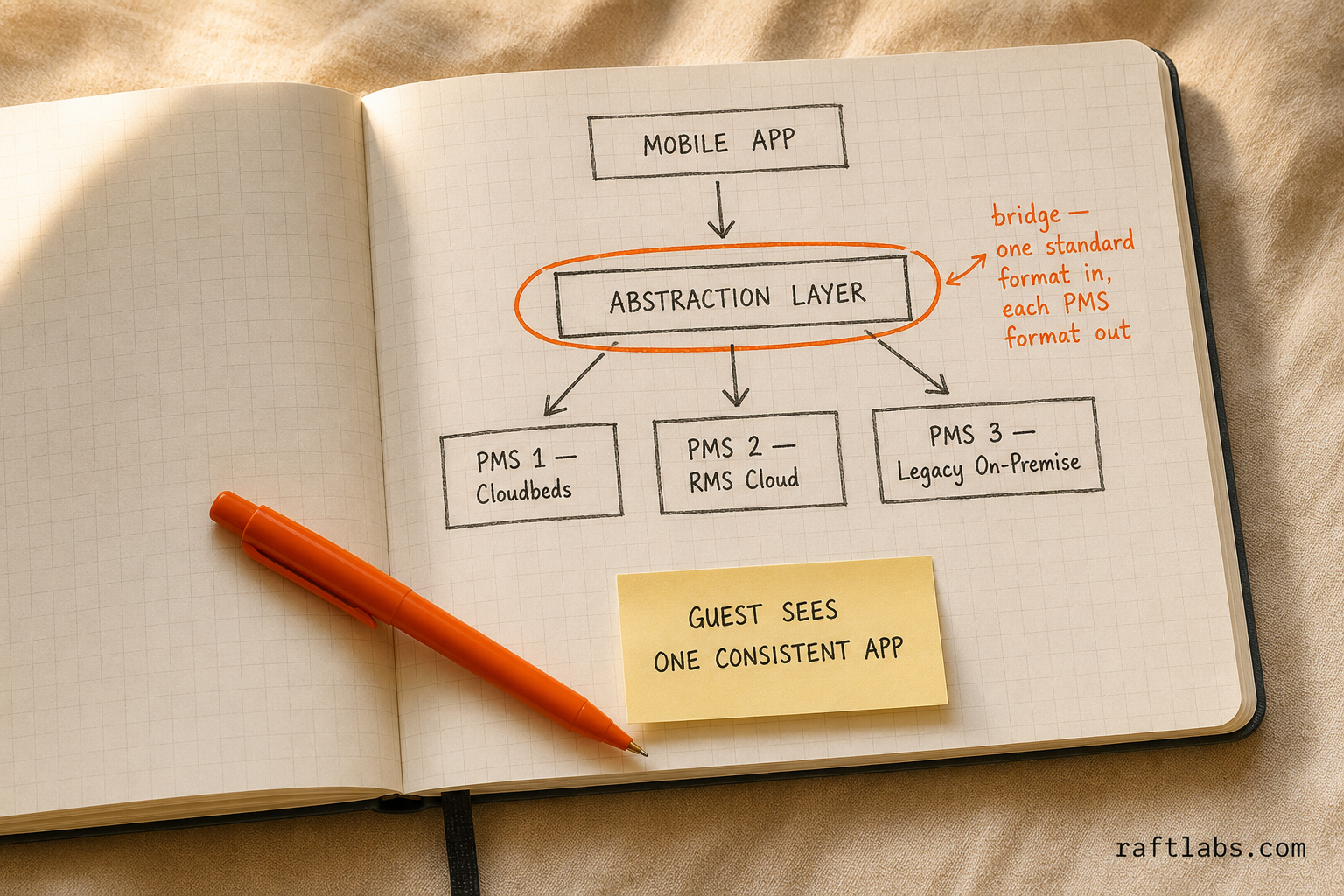
For example, if a hotel group owns multiple properties, each using a different PMS, the app must be able to handle the differences between those systems without confusing the guest. The goal is to ensure the app works smoothly across all properties, even though the backend systems might be different.
This challenge often comes up when a hotel group acquires new properties that already use their own PMS. In these cases, the app needs to handle the differences between each PMS system.
Building this kind of multi-PMS system requires both mobile app development expertise and knowledge of enterprise system integration. Essentially, the app needs an "abstraction layer" to act as a bridge between the app’s standardized data and each PMS's specific format.
When done right, guests won’t notice the differences between properties, while the app adapts to each property’s unique technical setup in the background.
It’s also important to note that moving all properties to a single PMS system might be ideal in the long run, but it’s not always possible right away. Migrating to a single PMS can be slow and complicated, as it involves contracts, staff training, and operational changes. Therefore, your mobile app must be flexible enough to work with different PMS systems now, while still supporting a future transition to a unified system.
Testing That Prevents Disasters
Thorough testing of PMS integration is the only way to prevent the operational disasters that destroy guest trust. Testing scenarios should cover every combination of room types, rate codes, and booking modifications that can occur in real operation.
Double-booking prevention deserves particular attention, so test what happens when simultaneous bookings attempt to reserve the last available room.
The error handling determines how gracefully your app degrades when PMS connectivity fails. The app needs to recognize when the PMS isn't responding and communicate clearly with guests about what's happening. Offering alternative booking methods, such as phone numbers or email addresses, maintains service continuity even when technical issues arise.
Finally, ongoing monitoring of the system can help catch integration issues before they impact guests. Your team should have visibility into key metrics like booking success rates, API response times, and synchronization status.
Set automated alerts to notify technical and operational staff immediately when PMS connectivity issues arise or bookings fail to sync. This proactive approach ensures that problems are resolved quickly, keeping the guest experience intact.
Managing multiple properties? One app can serve your entire portfolio. We architect multi-property platforms with centralized management and property-specific configuration. Let's discuss
Understanding Other Tech Decisions for Hospitality Business Operators
Hospitality business operators don't need to become software developers, but understanding key technology decisions helps them evaluate development partners and make informed choices about their mobile app. These decisions affect cost, timeline, and what your app can realistically accomplish.
Think of it as knowing enough about plumbing to hire a competent plumber, and in this case, understanding what they're telling you about your hospitality systems.
1. Native Apps vs Cross-Platform Development
Your development partner will ask whether you want separate native apps for iOS and Android or a cross-platform app built with a single codebase. This decision significantly affects both cost and timeline while influencing the final app experience.
Native app development often means building your app twice: once in Swift for iOS and once in Kotlin for Android. Each platform gets optimized code that follows platform-specific conventions perfectly.
The advantages include maximum performance and access to every device feature immediately when new capabilities launch. The disadvantages center on cost and complexity: you're essentially funding two separate development projects and maintaining two codebases long-term.
Cross-platform development using React Native builds both iOS and Android apps from shared code. This approach delivers apps that look and feel native to each platform while requiring less time and budget than separate native builds. The framework handles platform differences automatically while letting developers write most code once. Performance matches native apps for most use cases, with negligible differences that guests won't notice.
For most hospitality business operators, cross-platform development makes strategic sense. You get apps on both platforms without doubling your investment, and maintenance remains manageable with a single codebase to update.
2. Backend Infrastructure and Hosting
Your mobile app's backend systems handle everything guests don't see: data storage, PMS integration, payment processing, and business logic. These systems need to be reliable, secure, and scalable as your mobile app usage grows.
Your development partner will make recommendations about cloud infrastructure, database architecture, and hosting providers.
Cloud platforms like AWS, Google Cloud, or Microsoft Azure provide the infrastructure for modern mobile apps. These services offer reliability, security, and scaling capabilities that would be prohibitively expensive to build yourself. Your development costs include configuring these systems appropriately for hospitality operations.
The other important question isn't about which cloud platform your developers prefer, as they all offer strong options. Instead, the focus should be on whether your backend is designed to scale efficiently. Can the system manage peak booking periods? What happens if your PMS goes offline temporarily? How are backups handled? These operational concerns are far more critical than the specific technology brands you use.
3. Security and Compliance Requirements
Hospitality mobile apps handle sensitive guest information and payment data, creating both security and regulatory obligations. Your app must protect guest privacy while complying with data protection regulations like GDPR and payment security standards like PCI DSS. They're all legal requirements and not optional.
Strong development teams build security into the application from the beginning rather than treating it as an afterthought. This includes encrypting data both in transit and at rest, implementing secure authentication, and following best practices for payment processing.
Ask your development partner explicitly about their approach to security and what compliance certifications or audits they support.
Payment processing deserves particular attention. Try not to build custom payment handling into your app. Instead, you can integrate with established payment processors like Stripe that handle PCI DSS compliance and secure payment data management.
This approach protects you from both security breaches and regulatory violations while ensuring payments process runs reliably.
4. Mobile Platform Version Support
iPhone and Android devices update regularly with new operating system versions. Your app needs to support recent OS versions while gracefully handling older devices that some guests still use. This balance affects both development effort and the guest experience.
Your development partner should target recent operating system versions while testing on older versions that still represent significant user populations. Supporting iOS versions from the past few years typically covers nearly all iPhone users in your guest base. Similar logic applies to Android version support.
Plan for this to be ongoing work. As new iOS and Android versions are released, your app needs testing and potential updates to ensure compatibility. This maintenance is part of the ongoing cost of maintaining a mobile app rather than a one-time expense.
With these technology considerations in mind, the next step is understanding the financial investment involved in building a hospitality mobile app.
Hospitality Mobile App Development Cost: Investment Planning
Understanding development costs helps you budget appropriately and set realistic expectations for your mobile app project. While every project differs based on specific requirements, breaking down costs by complexity level provides clarity for planning and approvals.
Cost by App Complexity
Development costs scale with feature depth, integration requirements, and architectural sophistication. The table below reflects realistic investment ranges based on app complexity and business needs.
| App Type | Typical Scope | Delivery Approach | Estimated Investment | Timeline | Best Fit For |
|---|---|---|---|---|---|
| MVP Mobile App | Core booking flow, property listings, search, secure payments | Focused MVP with clearly defined scope and limited integrations | $10,000 - $20,000 | 6-8 weeks | Single hotels or serviced apartments validating direct bookings and engaging early adopters |
| Full-Featured App | Multi-property support, loyalty features, PMS and channel manager integration, custom UI/UX design | End-to-end mobile and web development with system integrations and 3rd-party services (payment gateways, maps, APIs) | $20,000 - $40,000 | 12-14 weeks | Regional hotel chains or growing hospitality startups building complete booking platforms |
| Advanced / Enterprise App | Deep PMS sync, OTA integration, analytics, personalization, scalability, AI-powered features | Custom architecture with automation and advanced guest experience capabilities | $50,000 - $100,000+ | 16+ weeks | Large hotel groups or booking marketplaces requiring enterprise-grade solutions |
The above-mentioned costs might further vary based on project complexity, the level of customization required, and other factors.
Factors That Influence Development Cost
Several variables affect final development investment. Being aware of these factors helps you estimate more accurately and understand why quoted prices vary between proposals.
1. Feature Complexity and Quantity
Basic booking flows cost less than apps with loyalty programs, dynamic pricing, personalized recommendations, and multi-language support. Each additional feature adds development time and testing requirements. The key is first prioritizing features that directly impact bookings and operational efficiency rather than building everything at once.
2. Integration Requirements
Connecting with your existing technology stack drives integration costs. Modern cloud-based PMS systems with documented APIs integrate faster than legacy on-premise systems requiring custom middleware. Multiple integrations, such as PMS, channel manager, revenue management system, and payment gateway, add both complexity and cost.
3. Design Sophistication
Standard UI implementations using proven hospitality patterns cost less than highly customized visual designs requiring extensive iteration. Custom animations, unique interaction patterns, and brand-specific design elements increase design hours. The goal is to find the right balance between brand differentiation and development efficiency.
4. Platform Coverage
Building separate native apps for iOS and Android costs more than using cross-platform frameworks like React Native or Flutter. However, native development may be necessary for properties requiring specific device capabilities or maximum performance.
Most mobile apps for hospitality achieve strong results with cross-platform approaches that deliver to both platforms efficiently.
5. Scalability Architecture
Apps built to support single properties have simpler architectures than platforms designed for portfolio growth. Multi-property systems require abstraction layers, centralized administration, property-specific configuration, and data segregation. Planning for scale from the beginning costs more initially but prevents expensive rebuilds later.
6. Geographic Considerations
The location of your development team impacts hourly rates but not necessarily the overall project cost. US-based teams tend to charge higher rates due to their communication efficiency and expertise, which may lead to faster delivery.
On the other hand, teams in Asia, particularly in India, often offer more competitive rates, making them an attractive option for many businesses. While offshore teams may require more time for delivery, they can still be highly effective if they have experienced developers.
Understanding Return on Investment
Development cost represents the investment side of the equation. ROI comes from increased direct bookings, reduced OTA commissions, operational efficiencies, and improved guest lifetime value. Most hotel mobile apps achieve positive returns within 12-24 months when properly marketed and integrated into operations.
Revenue Impact The primary value driver is commission savings. Every booking shifted from OTA platforms to your direct app preserves margin that would otherwise be paid to third parties. Even modest shifts in booking distribution create meaningful annual savings that compound over time. The app also enables upselling opportunities such as room upgrades, early check-in, and spa packages that increase booking value beyond the base room rate.
Operational Efficiency Gains Mobile apps reduce workload on front desk and reservations teams through self-service booking, digital check-in, and automated confirmations. Similarly, accurate real-time inventory synchronization prevents double bookings and the associated recovery costs.
Guest Lifetime Value Apps make repeat bookings frictionless through saved preferences and payment information. Loyalty program integration and push notifications enable direct remarketing without paid advertising spend. Guests who book through your app tend to return more frequently and show higher lifetime value compared to those acquired through OTAs.
Multi-Property Economics Portfolio operators benefit from accelerated ROI. Adding additional properties to an existing app infrastructure costs substantially less than the initial build, while each property contributes to commission savings and operational efficiency. The economic advantage becomes more pronounced as the portfolio grows.
Critical Success Factors ROI depends on execution beyond just building the app. Success requires strong guest incentives that motivate downloads, consistent staff promotion at every touchpoint, strategic marketing of app-exclusive benefits, and continuous optimization based on booking patterns and user feedback. Apps that launch without this supporting infrastructure typically underperform regardless of technical quality.
After evaluating costs and potential returns, it helps to understand what the development journey typically looks like for a hospitality mobile app project.
What to Expect During App Development: The Implementation Timeline
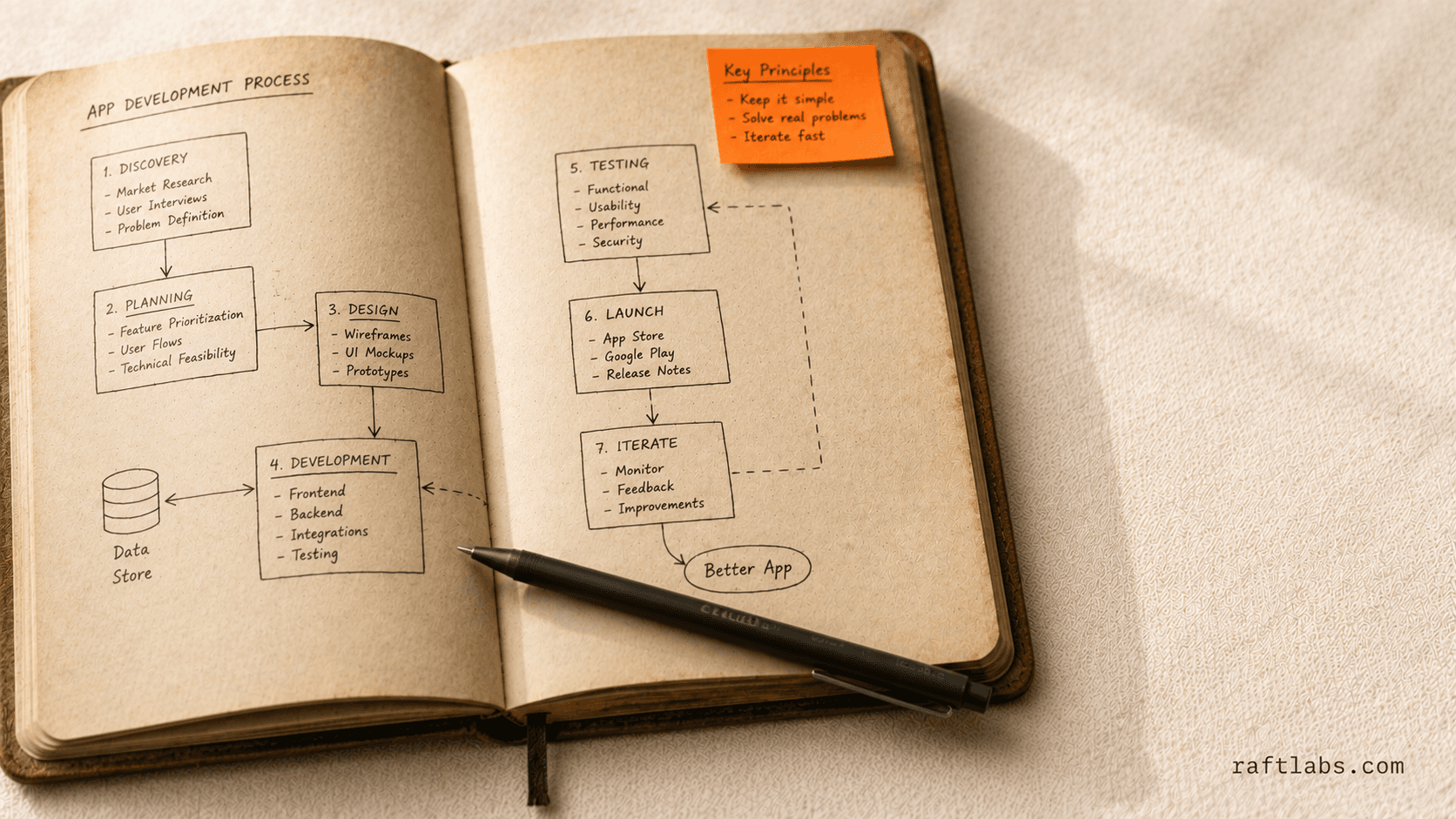
Understanding the mobile app development process helps you plan realistic timelines, allocate internal resources appropriately, and know what decisions need your attention at each stage. This isn't a passive process where you hand requirements to developers and wait for results. Successful app projects require active engagement from hotel or resort operators at key milestones.
1. Discovery and Planning Phase
The first few weeks establish project foundations through team discussions, requirements gathering, and technical discovery. Your development partner needs a deep understanding of your operations: property types, guest demographics, current technology systems, and business objectives for the mobile app.
Plan to invest significant time in this phase. Your team, including general managers, revenue managers, and operations directors, will participate in working sessions where developers learn about your business. These discussions reveal requirements that may not be obvious at first, such as specific PMS workflows or unique operational processes at your properties.
Technical discovery runs parallel to business requirements gathering. Developers will request access to your PMS environment, documentation for existing systems, and information about your network architecture. They're verifying integration feasibility and identifying potential technical challenges before they become project risks.
The deliverable from this phase is a requirements document that clearly defines what will be built, how long it will take, and what it will cost. Review this document carefully and ask questions about anything unclear.
2. Design Phase
Once the requirements are agreed upon, the design team will create the user experience and visual design for your mobile app. This process begins with wireframes, which are basic sketches outlining screen layouts and navigation flow. The design then evolves into detailed visual concepts that incorporate your branding.
You’ll review and approve designs at different stages. Early wireframe reviews focus on functionality and user flow. Ask yourself these key questions:
Is the booking process logical?
Can guests easily find the features they need?
As the design becomes more refined, the focus shifts to aesthetics and brand consistency:
Do the colors and styling reflect your property’s identity?
Are the visual elements aligned with your brand’s look and feel?
To ensure a smooth process, provide clear and consolidated feedback during each review. Giving all your feedback in one round helps designers implement changes efficiently, rather than spreading feedback over multiple rounds. It's also beneficial to involve your operations team to ensure the designs accommodate real-world use cases they deal with daily.
For example, if your housekeeping team frequently needs to access room status updates during their shifts, the design should include easy-to-read, real-time room status notifications within the app. This ensures the app meets the practical needs of staff while enhancing operational efficiency.
At the end of this phase, you'll receive an interactive prototype that allows you to click through the app experience before development begins. Take time to test it thoroughly. Catching design issues at this stage will probably save hours of design time.
3. Development Phase
Actual coding consumes the majority of the project timeline. Developers build your mobile apps, backend systems, PMS integrations, and payment processing capabilities according to the approved designs and requirements. This phase operates in sprints, typically two-week cycles that deliver incremental progress.
Expect regular progress updates through sprint demonstrations where developers show working features. These aren't full presentations but quick walkthroughs of what's been completed. This visibility lets you verify progress and catch any misalignments early when course corrections are easier to implement.
Your involvement during development focuses on decisions and approvals rather than daily oversight. Developers will surface questions that require your input: Should this feature work one way or another? How should the app handle a particular edge case? Responding promptly keeps development moving without delays.
As development progresses, integration testing becomes key. PMS integration testing typically happens mid-development. Your team will need to create test bookings, verify they appear correctly in your PMS, and test various scenarios like cancellations and modifications.
4. Testing and Quality Assurance
Once all features are built, thorough testing confirms everything works correctly. This includes functional testing of every feature, security testing to identify vulnerabilities, performance testing under load, and compatibility testing across different devices and operating systems.
This involves user acceptance testing, where your team actively evaluates the app by using it as guests. This is the time to push the app to its limits, test unusual combinations, try to break things, and ensure workflows align with your operational processes. Document any issues or areas for improvement that arise during testing.
Staff training should take place during this phase as well. It’s important that your front desk, reservations, and operations teams fully understand how the app functions, what guests can do through it, and how app activities integrate with your PMS and daily operations. Well-trained staff will become advocates for the mobile app, helping guests use it effectively and ensuring smooth adoption of the new technology.
5. App Store Launch and Beyond
Submitting your app to Apple's App Store and Google's Play Store requires following each platform's guidelines and approval processes. Your development partner handles the technical submission, but you'll need to review and approve app store listings: descriptions, screenshots, and promotional materials.
Plan for potential rejection and resubmission. App stores reject apps for various guideline violations, and first submissions often require adjustments. This doesn't reflect poorly on your development partner; it's a normal part of the process. Build buffer time into your launch timeline to account for potential delays.
Launch day marks the beginning, not the end, of your app’s journey. In the first few weeks, keep a close eye on downloads, booking activity, and guest feedback.
Respond to app store reviews, fix any bugs that come up, and gather insights to guide future improvements. The most successful apps are those that adapt based on real user behavior, constantly evolving rather than staying static after launch.
Ready to build a mobile app that reduces OTA dependency? We build PMS-integrated booking apps for hotels and serviced apartments. Real projects, realistic timelines, fixed pricing. Talk to our team
Launch Strategy: Getting Guests to Download and Use Your App
Building a great mobile app means nothing if guests don't download and use it. Successful app adoption often requires deliberate marketing, compelling incentives, and persistent promotion across every guest touchpoint. The businesses that achieve strong adoption treat their app launch as a sustained campaign rather than a one-time announcement.
Pre-Launch Internal Preparation
App adoption starts with your own team. Staff training ensures everyone understands what the app does, how it benefits guests, and how to help guests use it. Front desk agents, reservations staff, and management all need hands-on experience with the app before guests start asking questions.
Prepare simple talking points that staff can use when interacting with guests. For example: "Have you downloaded our app? You can check in from your phone and skip the line next time." This approach works better than long explanations of features. Staff should also be able to quickly open the app store on their own devices and show guests how to find and download the app.
Prepare marketing materials before launch: email templates, social media content, website banners, lobby signage, and room cards with QR codes for easy downloading. Having everything ready means you can launch strong instead of building momentum slowly over weeks as marketing materials trickle out.
Launch Incentives That Drive Downloads
The best incentive is a financial benefit that's immediate and ongoing. Offer a meaningful discount on the first booking through the app, and this can be enough to motivate immediate downloads rather than waiting until next time. Try to follow this with app-exclusive rates that consistently beat your website prices, training guests to check the app first for the best deal.
Loyalty point bonuses can also be embedded to reward early adopters and build engagement. If feasible, offer double or triple points on the first app booking, then maintain higher earning rates for app bookings going forward. This creates both immediate motivation to download and long-term incentive to book directly rather than through OTAs.
Mobile key access can also be a download driver if positioned as an app-exclusive benefit. Make it clear that skipping the front desk and unlocking rooms with your phone is only available through the app. The convenience benefit becomes an adoption driver beyond just pricing incentives.
Multi-Channel Promotion Approach
Email marketing to your existing guest database provides the most direct path to initial downloads. Segment your email list and personalize messages: frequent guests hear about exclusive loyalty benefits, business travelers learn about mobile check-in efficiency, and leisure travelers see local experience features.
In-property promotion might also catch guests at the right moment. Lobby signage with QR codes makes downloading effortless. Welcome cards in rooms remind guests to download before their next stay. Every touchpoint becomes an opportunity to promote adoption.
On the other hand, website integration can convert desktop and mobile web guests into app users. Banner notifications can prompt visitors to download the app for the best rates. Booking confirmation pages can suggest downloading to manage reservations. Also, positioning app store badges in your website footer provides easy access across your entire site.
You can also opt for social media and digital advertising to target guests before they reach your website. Facebook and Instagram ads can drive app installs directly, making the app available for easy one-tap download from the app store. These campaigns work especially well when targeting past guests or audiences who know your brand but haven't yet downloaded the app.
Measuring and Optimizing Adoption
Track app downloads, active users, and booking conversion metrics weekly during the first months. Understanding which marketing channels drive the most downloads helps you allocate promotional budget effectively. If email works better than social ads, shift resources accordingly.
Monitor where guests drop off during the download and booking process. If people download but don't complete bookings, the issue might be a confusing interface or technical problems. If downloads are low but conversion is high among those who download, you need better marketing rather than app improvements.
Respond to every app store review, positive or negative. Public responses show potential users that you're actively supporting the app and addressing concerns. Private follow-up with users who leave negative reviews can often turn critics into advocates while helping you identify genuine problems that need fixing.
A strong launch strategy helps ensure guests actually use your app. But the long-term success of that app still depends on the team that builds and maintains it.
Choosing the Right Development Partner
Selecting the right development partner for your hospitality mobile app is crucial. A skilled partner with hospitality expertise ensures successful delivery, while the wrong choice can lead to missed deadlines, overspending, and poorly executed features.
Hospitality Industry Experience Matters
App developers without any hospitality experience may not understand the unique needs of hospitality operations. They might lack knowledge of PMS integration, mobile check-in workflows, and loyalty programs, resulting in long delays and extra training for your team.
Experienced developers have knowledge of building systems for hospitality businesses. They understand booking lifecycles, PMS vendors, and integration patterns that work. They can anticipate needs you haven’t considered, accelerating development and reducing errors.
Ask if they can provide any specific examples of past hospitality projects.
Speak with a former hospitality client to evaluate their experience.
Strong developers will be eager to showcase their work and provide references.
Technical Competence You Can Verify
A reputable development team demonstrates skill through its past work, not just sales presentations.
Request links to apps they've built and test them yourself.
Check performance, interface quality, and professionalism.
For most hotel apps, cross-platform frameworks like React Native are ideal as they allow you to build apps for both iOS and Android from a single codebase, saving on cost and time. Ask about their experience or knowledge with React Native or other cross-platform technologies and how they handle platform-specific requirements.
Project Management and Communication
Effective communication is essential for project success. Evaluate how the development team manages the project, provides updates, and handles changes or issues. Look for:
Weekly status calls
Sprint demonstrations
Transparent issue tracking
A realistic timeline is important. Building a full-featured hospitality app with PMS integration and payment processing takes time. Teams promising quick delivery might be cutting corners.
Consider how the team manages scope changes and additional costs. Clear communication on these aspects will prevent misunderstandings during development.
Post-Launch Support and Maintenance
Apps need ongoing attention after launch. Operating system updates, security issues, and guest feedback will require regular updates. Ask the following questions:
What is the response time for critical bugs?
How are non-critical improvements prioritized?
What are the annual maintenance costs?
The right development partner will continue to support your app post-launch, maintaining the relationship long after the project is complete.
Red Flags That Indicate Problems
Be mindful of potential issues during the selection process:
Inability to explain PMS integration clearly: This suggests the team may lack hospitality experience.
Extremely low pricing: This may indicate a misunderstanding of project scope or the intention to deliver poor-quality work.
Pushy sales tactics: A professional partner will give you time to evaluate proposals and make informed decisions.
By avoiding these red flags and choosing a partner with relevant experience and a clear development process, you set yourself up for long-term success.
What a hospitality mobile app partner should understand
We're a software development company with extensive knowledge in building custom booking platforms and PMS-integrated guest apps for the hospitality sector. Our approach combines technical expertise with a deep understanding of hospitality operations.
Our Hospitality Development Foundation
Rebuilt the website and mobile app for Citybreak Apartments in Ireland, delivering self check-in, keyless entry, and RMS Cloud integration that runs 24/7
Official integration partner with RMS Cloud: we work directly with their engineering team on PMS integrations
Strong grasp of hospitality-specific requirements: RevPAR, ADR, booking windows, guest lifecycle workflows, and operational efficiency metrics
Experience with the technical architecture needed for multi-property platforms, centralized management, and property-specific configuration
Technical Capabilities
Full-stack development across iOS, Android, React Native, and progressive web apps
Real-time PMS integration through secure APIs and data synchronization
Payment gateway implementation with Stripe and Square
Agile development methodology with bi-weekly sprints
How We Work
Standard booking apps delivered in 12-14 weeks from kickoff to launch
MVP builds in 6-8 weeks when speed to market matters
Weekly progress reviews with a dedicated project manager access (Slack/Teams)
Fixed-price projects or monthly retainers. No hourly billing that balloons mid-project.
Over 9 years building custom software for SaaS, hospitality, and technology companies
Why Hospitality Businesses Might Prefer Us
We understand both the technical complexity and the operational reality of hotel booking systems
You work with founders and senior developers, not junior teams learning on your project
We provide ongoing support and optimization post-launch, not just a handoff
We work with operators who treat hospitality mobile apps as infrastructure investments, properties that understand this requires proper planning, realistic budgets, and commitment to guest adoption.
Conclusion: Mobile Apps as Core Hospitality Infrastructure
Guests now expect mobile check-in, digital keys, and personalized services at every hotel they visit. Properties that do not offer this are not just inconvenient. They are invisible to the growing segment of travelers who research, book, and manage their stay entirely on mobile.
The numbers are direct. OTA commissions at 15-30% represent the single largest controllable cost for most independent and regional operators. A hospitality mobile app shifts bookings to a direct channel where you pay zero commission. On $500,000 per year in app-driven revenue, that saves $75,000-$150,000 annually. Most apps pay for themselves within 12-18 months.
The implementation barrier is lower than most operators assume. A focused MVP with booking, mobile check-in, and PMS integration takes 12-14 weeks and costs $20,000-$40,000. That is a fraction of one year's OTA commission bill for a property doing $50,000+ per month in bookings.
RaftLabs built this for City Break Apartments in Ireland: self check-in, keyless entry, and live RMS Cloud integration across 250+ properties. The same technical architecture applies to independent hotels, boutique properties, and regional chains.
If you are evaluating a hospitality mobile app, get in touch with our team. Bring your current PMS, your OTA commission rate, and your top operational bottleneck. We will scope what is buildable in your budget and timeline.
Ask an AI
Get an instant summary of this post from your preferred AI assistant.
Common questions
- Development costs depend on feature complexity and integration requirements. A basic MVP with core booking functionality typically runs $10,000-$20,000 and launches in 6-8 weeks. Full-featured apps with PMS integration, loyalty programs, and multi-property support range from $20,000-$40,000. The biggest cost drivers are often PMS integration complexity and whether you need iOS, Android, or both platforms.
- Mobile websites display content on small screens but can't match app functionality. Apps store payment information securely, send push notifications for promotions and confirmations, and integrate with phone features like digital wallets and Bluetooth for mobile keys. More importantly, apps sit on guests' home screens. When they think about booking their next stay, your app is right there. Mobile websites require guests to remember your URL or search for you every time.
- Standard hotel booking apps take 12-14 weeks from kickoff to production launch, including design, development, PMS integration, and testing. MVP builds for rapid validation can launch in 6-8 weeks with limited features. Timeline extends when you need complex integrations with multiple systems or haven't finalized PMS integration requirements before development starts.
- Yes, when properly marketed to guests. Apps shift bookings from OTA platforms to direct channels, where you pay zero commission instead of the typical OTA rate. Success depends entirely on guest adoption, so apps might need compelling incentives like exclusive rates, mobile key access, or loyalty point multipliers to motivate downloads.
- Most modern cloud-based PMS platforms support API integration with mobile apps. The critical question isn't whether integration is possible but how reliable the API is. Some systems have well-documented APIs with real-time sync capability, while others require custom middleware. Before development starts, request API documentation from your PMS vendor and have developers assess the integration feasibility. Legacy on-premise systems often require significantly more effort than modern cloud platforms like RMS Cloud, Mews, or Cloudbeds.