Small Hotel Revenue Management: 7 Hidden Profit Leaks (2026 Guide)
Seven hidden revenue leaks drain boutique hotel profits even when occupancy looks healthy. Here is how smarter systems, upsells, and guest journeys improve margins without raising rates.

In this article
Short answer
RaftLabs builds custom hotel technology for boutique and independent properties. Small hotel revenue management covers 7 hidden profit leaks beyond room pricing: unbilled services, OTA commissions of 15-25% per booking, PMS blind spots, missed upsells, poor channel attribution, operational waste, and ignoring guest lifetime value. Fixing these leaks typically recovers 6-12% of annual revenue without raising rates.
Key takeaways
- High occupancy hides revenue leaks. A boutique hotel at 85% occupancy can still be losing 6% of annual revenue to unbilled services, channel commissions, and operational waste running simultaneously.
- OTA commissions of 15-25% per booking make them the largest single controllable cost for most boutique hotels. One direct booking that displaces an OTA booking recovers 15-25 percentage points of margin on that stay alone.
- Most PMS systems are not designed to capture revenue at the moment of service delivery. The gap between "delivered" and "billed" is where boutique hotel profit margins quietly erode.
- Upsell revenue that relies on front-desk conversations captures at most 30-40% of willing buyers. Digital upsell prompts during booking and pre-arrival messaging reach guests when they're actively thinking about their stay, not managing a queue.
- Guest lifetime value compounding is the most underused lever. A guest who returns three times at the same rate is effectively three new guests you don't have to market to, with zero OTA commission on stays two and three.
Hotel revenue management often gets reduced to one question. Are my room rates right?
For most boutique hotels, that question feels logical. Rates are visible and measurable. They feel controllable.
The data tells a different story. Numerous small to mid-size hotels are leaking revenue even when their rates are correct.
98% of hoteliers surveyed by Expedia reported revenue loss due to rate misuse, with respondents estimating an average impact of around 6% of annual revenue.
This is where modern hospitality software development becomes critical, not just for rates, but for capturing revenue across the entire guest journey.
This guide is about small hotel revenue management beyond pricing. It focuses on the hidden revenue leaks most boutique hotels overlook.
These leaks usually sit inside systems, workflows, and guest journeys. They are not obvious. But together, they create a constant drag on hotel profit margins.
Who should read this guide
This guide is designed for professionals who are directly involved in managing revenue, operations, and profitability at small and boutique hotels.
Boutique Hotel Owners and General Managers:
Owners and GMs of room properties who want better control over profit, costs, and revenue leaks beyond room pricing.Revenue Managers at Independent Hotels:
Professionals responsible for pricing, distribution, and reporting who want to move from rate-only decisions to profit-focused revenue management.Hotel Operations and Front Office Leaders:
Teams managing day-to-day operations who want to reduce missed charges, inefficiencies, and operational leaks that impact margins.Marketing and Distribution Managers:
Managers handling OTAs, direct bookings, and campaigns who need clearer visibility into which channels actually generate net revenue.Hospitality Entrepreneurs and New Hotel Founders:
Founders launching or scaling boutique hotels who want to build revenue systems correctly from the start.Technology and Digital Leaders in Hospitality:
Decision-makers involved in selecting hotel software, booking tools, or custom solutions who want to understand where standard tools fall short.
What you’ll discover in this guide
This guide walks you through how small and boutique hotels lose profit in ways that are easy to miss, and what you can do to fix them without adding complexity.
Here’s what you’ll learn:
The 7 most common revenue leaks in boutique hotels and where money slips away even when rates and occupancy look healthy.
Why correct pricing alone is not enough and how commissions, systems, and guest behavior sit between room revenue and actual profit.
How revenue leaks show up in daily operations through unbilled services, tech gaps, and missed upsells.
Practical steps to reduce leaks without hurting guest experience at front desk, operations, marketing, and finance.
How to improve direct bookings and reduce OTA reliance with a healthier channel mix.
Ways to increase guest lifetime value through small improvements before, during, and after the stay.
Which metrics actually matter for small hotel revenue management.
When standard hotel tools stop being enough and when custom solutions make sense.
Together, these topics set the foundation for a different way of thinking about revenue management. Before reviewing specific leaks and fixes, it helps to clarify what small hotel revenue management really means in practice.
What is small hotel revenue management?
For boutique and independent hotels, revenue management now means understanding how money flows through the entire business and where it quietly escapes. To manage revenue well, you need to look beyond rates and focus on profit, systems, and guest behavior together.
1. From Set and Forget Rates to a Full Profitability Mindset
Many small hotels still treat revenue management as a pricing exercise. Rates are updated weekly or monthly. Competitors are checked. Occupancy is monitored. If rooms are selling, things feel fine.
Having high room prices does not automatically mean the hotel is making a good profit. Between the price a guest pays and the money the hotel actually keeps, there are many costs, such as OTA commissions, discounts, staff wages, and day-to-day operational expenses.
This is why two guests paying the same room rate can produce very different results. One may book directly, add services, and return again, while another may book through a high-commission channel, spend nothing extra, and never come back.
A profitability mindset shifts the focus from how much you sell to how much you keep. Instead of looking only at room revenue, it pushes you to ask practical questions like:
Which booking channels actually deliver profitable guests after commissions and fees?
Which rate plans lead to repeat stays and direct bookings?
Which services and add-ons increase margin instead of adding operational cost?
This shift is essential for small hotel revenue management because smaller properties lack the financial cushion to absorb repeated mistakes.
2. Small Hotel Revenue Management in Simple Terms
Small hotel revenue management is about making sure every part of the guest journey supports revenue capture and long-term value.
This includes:
How guests discover your hotel
How easy it is to book direct
Whether all services are charged correctly
How add-ons and upgrades are offered
What happens after checkout
When these pieces are disconnected, revenue leaks appear. When they work together, even a small property can improve profit without increasing room count or marketing spend.
When you think of revenue as something that flows through many steps, from how a guest finds the hotel to what happens after checkout, it becomes easier to see the problem. Tools and strategies designed for large hotel chains are often too rigid for small boutique hotels, which operate with fewer people, tighter margins, and more hands-on processes.
3. Boutique Hotels vs. Big Brands: Key Differences in Revenue Strategy
Large hotel brands have dedicated revenue teams, advanced analytics, and enterprise systems. Boutique hotels operate very differently.
A typical 30 to 80 room hotel often relies on one or two people to manage pricing, distribution, marketing, and reporting.
Decisions must be simple and clear. There is little room for complex models or delayed insights.
Because margins are thinner, even small issues can have a meaningful impact. Missed charges, overuse of high-commission OTA channels, or a poorly performing booking engine can all materially affect monthly profit.
As a result, boutique hotel revenue optimization is less about scale and more about removing friction, improving system visibility, and encouraging repeat stays.
This makes it important to look closely at where revenue quietly slips away in day-to-day operations.
Check out: Our free hotel direct booking website review analyses listing and booking pages against OTA best practices in minutes.
7 hidden revenue leaks costing small hotels thousands monthly
STR's 2024 independent hotel benchmark report found that independent boutique hotels underperform branded properties by an average of 11 percentage points in net operating income, with channel mix and unbilled services accounting for most of the gap.
"The biggest profitability opportunity for independent hotels is not rate optimization. It's fixing the operational and billing gaps that let revenue walk out the door before it ever reaches the income statement."
Jan Freitag, National Director of Hospitality Analytics at CoStar Group (as quoted in Hotels Magazine, 2024)
Hotel revenue leaks are the gap between the value you deliver and the revenue you actually collect.
This is not about planned discounts or marketing spend. It is often about unintentional losses such as:
Services that are delivered but never charged
Commissions paid without a clear channel strategy
Technology gaps that prevent full visibility into revenue
To understand the impact on profitability, let us break down where money is quietly being lost.

Leak 1: Unbilled Services and Forgotten Charges
Unbilled services are one of the most common and damaging revenue leaks in boutique hotels. They rarely come from bad intent.
Most of the time, they come from informal decisions, unclear rules, or busy teams trying to keep guests happy. Because each instance feels small, this leak often goes unnoticed until it has already eaten into the monthly profit.
How Unbilled Services Quietly Drain Revenue
Boutique hotels often offer flexible, personalized service. That is a strength. But without clear boundaries, it can also turn into lost revenue.
Common examples include:
Early check-ins or late checkouts approved without being recorded
Parking, pet fees, or extra beds waived inconsistently
Complimentary upgrades given without a defined policy
Minibar usage or room service not posted correctly
Spa or dining charges that never reach the guest folio
Each of these may seem harmless on its own. Over weeks and months, they create a steady leak that directly impacts small hotel profit margins.
Prevent Unbilled Service Losses Without Impacting Guests
Reducing unbilled service leaks does not require removing flexibility or becoming overly strict with guests. It requires making flexibility intentional, visible, and consistent. The steps below help protect revenue while preserving a good guest experience.
Step 1: Define what is paid, what is complimentary, and when exceptions apply
Clearly document which services are always chargeable, such as parking, pet stays, additional guests, or paid in-room services
Define when a service can be offered complimentary, and who can approve it
Communicate these rules across the front desk, housekeeping, F&B, and spa teams to avoid conflicting decisions
Step 2: Make billing part of the service flow
Treat billing as part of service delivery, not a back-office task
Use simple checkout prompts or checklists to confirm common chargeable items
Make sure teams quickly note add-ons or exceptions at the time they happen, not hours later
Step 3: Reconcile services before guests check out
Compare outlet activity, such as F&B, spa, or minibar usage, with guest folios daily or per shift
Catch mismatches early, when they are easy to resolve
Avoid waiting for end-of-month reviews, when fixes are often impossible
Step 4: Use technology to reduce manual gaps
Enable automatic posting from POS or spa systems to the PMS where possible. A hotel guest app can confirm all services, from spa bookings to dining, are automatically captured and billed correctly.
If full integration is not available, assign responsibility for manual reconciliation
Keep processes simple so they work during busy periods
Step 5: Track flexibility instead of hiding it
Record complimentary services and goodwill gestures as comps or exceptions
Use this data to understand the true cost of service recovery
Review comp trends regularly to spot patterns or overuse
When these steps are followed, boutique hotels can significantly reduce unbilled service leaks without harming guest satisfaction.
Leak 2: Over-Reliance on OTA Bookings (15-25% Commission Drain)
For many boutique hotels, online travel agencies feel like a necessary evil. They bring visibility, especially in competitive markets, and help fill rooms during low-demand periods.
The problem starts when OTAs become the primary source of bookings rather than a supporting channel. Over time, this dependence turns into a major revenue leak that quietly erodes profitability, even when occupancy looks healthy.
Why OTA Dependence Hurts Small Hotel Revenue Management
OTAs typically charge commissions ranging from 15 to 25%. For a small or mid-size hotel, that cost comes straight out of the margin. When a large share of bookings flows through these channels, the hotel ends up working harder for less return.

When you consider that OTAs charge 15-25% commission, the investment in a custom booking solution often pays for itself within 12-18 months through reduced commission fees alone.
The issue is not just commission. OTA-heavy booking mixes often lead to:
Lower net revenue per booking after fees
Limited access to guest data, which makes remarketing difficult
Fewer repeat stays, since the guest relationship belongs to the OTA
Lower pricing flexibility
Over time, this creates a cycle where hotels rely even more on OTAs to maintain occupancy, further increasing costs and reducing control.
What Boutique Hotels Should Aim for Instead
The goal is not to eliminate OTAs. It is to rebalance the booking mix so that direct channels play a stronger and more sustainable role. OTAs should support demand, not control it.
A healthier approach focuses on owning more of the guest journey through better direct experiences, including:
Using OTAs strategically to fill specific gaps instead of driving the majority of demand
Improving the direct booking experience through faster, clearer, and more reliable website flows
Extending the booking journey beyond the website with a custom hotel booking app that simplifies booking, upgrades, and communication without relying on third-party platforms.
Clearly communicating the value of booking direct, such as flexibility, personalization, or exclusive benefits
Treating every direct booking as the start of an ongoing relationship, not a one-time transaction
Custom web and mobile apps give boutique hotels more control than off-the-shelf tools. They allow hotels to design booking flows that match their brand, capture guest data cleanly, and support repeat bookings without relying on third-party platforms.
We work with boutique and independent hotels to build custom web applications and mobile application development services that support direct bookings, upsells, and guest re-engagement.
Leak 3: Disconnected Hotel Technology and PMS Gaps
Technology is meant to simplify hotel operations, but for many boutique hotels it becomes a source of hidden revenue leaks.
Over time, hotels add tools for bookings, distribution, payments, marketing, and guest communication. When these systems do not work together, important data gets lost, manual work increases, and revenue slips through the cracks without anyone noticing.
How PMS Blind Spots Create Revenue Leakage
The property management system is often treated as the central system for hotel operations. While it does a good job managing rooms and reservations, it is not designed to track the full guest journey or capture every revenue interaction by default.
While modern property management systems and hospitality technology have evolved significantly, standard PMS solutions often lack the flexibility boutique hotels need.
Common blind spots include:
Services delivered outside the front desk workflow that are never posted to the guest bill
Limited visibility into guest behavior before and after the stay
Weak reporting on where bookings actually convert or drop off
Delays in seeing discrepancies between usage and revenue
When these blind spots exist, revenue leaks often remain hidden until month-end audits, when it is too late to fix them.
What a Better Tech Approach Looks Like for Boutique Hotels
Reducing tech-driven revenue leaks starts with integration and visibility.
A stronger setup focuses on:
Clear data flow through reliable PMS integration between booking engines, payments, and guest systems ensures nothing slips through the cracks
Fewer manual steps in posting charges and updating guest records
Real-time visibility into bookings, services, and revenue
Tools that support the full guest journey, not just the stay itself
Rather than relying only on rigid, off-the-shelf software, many boutique hotels benefit from targeted, purpose-built SaaS solutions layered on top of their existing systems. These solutions are designed to extend what standard hotel software cannot easily do.
Examples include custom booking flows, guest experience platforms, and operational tools that integrate with the PMS and channel manager.
Leak 4: Ignoring Guest Lifetime Value and Repeat Bookings
Many boutique hotels treat each booking as a single transaction. Once the guest checks out, the relationship often ends. This short-term view creates one of the most expensive revenue leaks in small hotel revenue management. When guest lifetime value is ignored, hotels are forced to repeatedly pay to acquire the same type of guest again and again.
Guest lifetime value looks beyond the current stay. It measures the total value a guest can generate over multiple visits, including repeat bookings, direct reservations, and on-property spending. Research suggests that increasing customer retention rates by just 5% can grow profits by 25% to 95%.
For boutique hotels with limited inventory, maximizing the value of each guest over time can be more profitable than trying to constantly attract new ones.
Where Lifetime Value Leaks Typically Occur
For many boutique hotels, the guest journey is fragmented. Pre-stay communication is limited to confirmation emails. During the stay, interactions are mostly operational. After checkout, communication often stops completely.
This creates gaps where value is lost:
No pre-arrival upsell or personalization
No on-stay engagement beyond basic service
No post-stay follow-up to encourage repeat booking
No centralized view of guest history or preferences
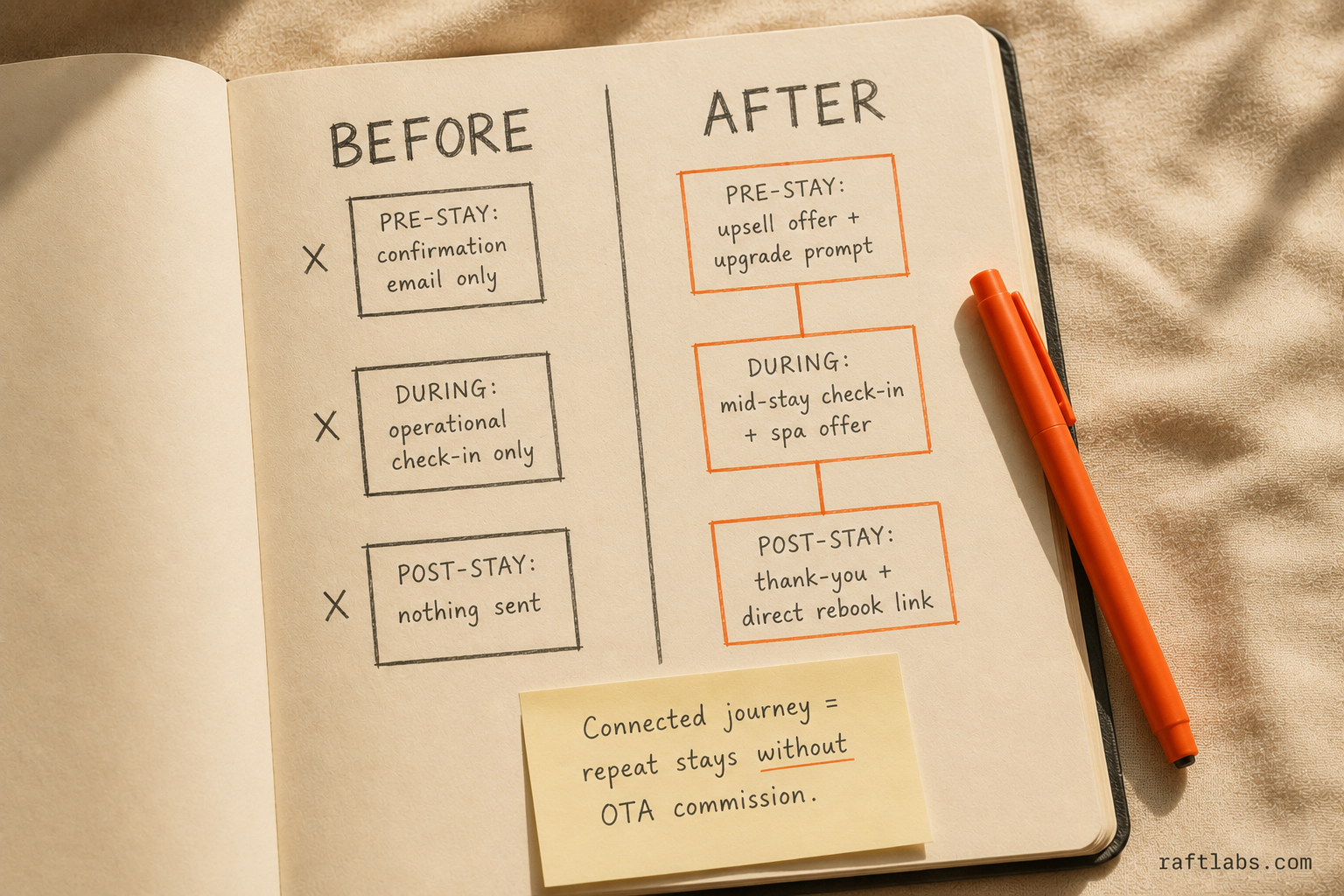
Without these touchpoints, guests have little reason to return directly.
Building Guest Lifetime Value Across the Full Journey
Improving guest lifetime value does not require complex loyalty programs or heavy discounts. It comes from making small, consistent improvements at each stage of the guest journey.
The table below outlines simple steps boutique hotels can take at each stage of the guest journey to turn one-time stays into repeat business.
| Guest journey stage | What boutique hotels can do | Why it matters |
|---|---|---|
| Before the stay | Send clear confirmation emails with check-in details, parking info, and breakfast timings. Offer optional add-ons like paid upgrades, airport pickup, or early arrival. | Sets expectations, reduces friction at arrival, and captures extra revenue before the stay begins. |
| During the stay | Check in with guests mid-stay to see if everything is going well. Offer relevant services such as dining, spa appointments, local experiences, or late checkout. | Improves guest experience while encouraging on-property spend at the right moment. |
| After the stay | Send a simple thank-you message after checkout. Highlight what made the stay special and encourage guests to book directly next time. | Keeps the relationship alive, increases repeat bookings, and reduces future acquisition costs. |
When boutique hotels consistently engage guests across these stages, each stay becomes part of a longer relationship.
To sustain this approach, some boutique hotels also invest in structured guest engagement and loyalty systems.
For hotels with unique brand positioning, custom loyalty app development allows you to create a rewards program that reflects your property's personality rather than using generic point systems
Modern loyalty and guest engagement systems allow hotels to:
Define simple loyalty tiers and rewards that encourage repeat stays
Integrate loyalty logic directly with booking engines and guest databases
Automate follow-ups, offers, and rewards based on guest behavior
Track retention, repeat bookings, and guest lifetime value over time
When these systems are connected to booking and guest platforms, they help hotels stay in touch with guests without adding manual work for the team.
Build stronger guest relationships over time Explore how tailored guest engagement and loyalty systems can help increase repeat bookings. Talk to our experts
Leak 5: Missed Upsells and Ancillary Revenue Opportunities
Upsell revenue leaks happen when hotels already offer valuable services but do not surface them clearly or at the right moment. Guests may be willing to pay for convenience, comfort, or experiences, but if those options are not visible or easy to choose, the revenue is simply left behind.
What Counts as Upsell and Ancillary Revenue
Ancillary revenue includes any paid service beyond the base room rate. In boutique hotels, this often covers:
Parking, transfers, or transport assistance
Breakfast upgrades or dining experiences
Wellness services such as spa sessions or yoga classes
Late checkout, room extensions, or premium room features
Local experiences, tours, or curated activities
These services add value for guests while generating incremental revenue for the hotel. The challenge is not offering them, but making them easy to discover and purchase.
Why These Opportunities Are Often Missed
In many hotels, upselling relies heavily on staff conversations at check-in. When the front desk is busy or short-staffed, these conversations are brief or skipped entirely. Guests may never hear about available options, and staff may avoid offering them to prevent sounding sales-focused.
Other common reasons include:
Add-ons are buried deep on the website or not mentioned after booking
Pricing and availability are unclear
There is no consistent process for offering services
Guests must ask at the desk instead of choosing on their own
When upsells depend on memory and timing, results often stay inconsistent.
Making Upsells Visible Without Pressure
Effective upselling does not feel pushy; it feels helpful. The key is timing and clarity.
Simple improvements can include:
Showing add-ons during booking or in pre-arrival messages
Highlighting relevant services based on length of stay or guest type
Allowing guests to select extras digitally instead of asking in person
Making prices and benefits easy to understand
This approach reduces pressure on front desk teams while giving guests a sense of control and transparency over their choices.
To support ancillary revenue growth at scale, some boutique hotels use AI-powered solutions to make smarter decisions without adding manual work. These systems can help forecast demand, optimize pricing, and automate routine guest communication.
Leak 6: Poor Channel Attribution and Hidden Marketing Costs
Many boutique hotels know where bookings come from, but far fewer understand which channels actually make money. Poor channel and marketing attribution becomes a revenue leak when hotels focus only on booking volume rather than net value.
When you cannot clearly see what each channel costs and returns, decisions are made on incomplete information.
This leak is especially common in small hotel revenue management because data is spread across systems. Booking engines, OTAs, ad platforms, and PMS reports often tell different stories. Without a clear way to connect them, it is hard to tell which channels deserve more investment and which quietly drain profit.
What Poor Attribution Looks Like in Practice
For many boutique hotels, attribution stops at simple labels like “OTA,” “direct,” or “corporate.” While this shows where the booking was made, it does not show the full picture.
Common gaps include:
No visibility into how much commission or marketing spend sits behind each booking
Treating all direct bookings as equal, even when some come from paid ads
Not knowing which channels bring repeat guests versus one-time stays
No link between campaigns and actual revenue collected
As a result, high-cost channels may look successful because they bring volume, while lower-cost channels that deliver better long-term value are overlooked.
What Better Attribution Looks Like for Boutique Hotels
Better attribution does not require complex analytics or large teams. It starts with asking clearer questions about each channel’s value.
A more useful view includes:
Net revenue per channel Look at how much money each channel actually delivers after OTA commissions, paid ads, and discounts. A channel that brings fewer bookings may still be more profitable if costs are lower.
Repeat booking rates by channel Track which channels bring guests who return. Direct bookings and some corporate or referral channels often perform better here than OTAs.
Cost of acquiring each guest Separate truly organic direct bookings from those driven by paid search or promotions. This helps you understand the real cost behind each booking.
Contribution to long-term guest relationships Identify which channels give you access to guest contact details and allow follow-up after the stay. Channels that support long-term engagement usually deliver higher lifetime value.
When boutique hotels consistently review these factors, decisions become clearer. Marketing spend is easier to prioritize, OTA dependence can be reduced, and hotel revenue management becomes more profit-focused.
Leak 7: Hidden Operational Waste and Inventory Inefficiency
Not all revenue leaks show up clearly in financial reports. Some of the most damaging leaks sit inside day-to-day operations and inventory management. These leaks do not look like missing revenue on paper. Instead, they appear as higher costs, wasted resources, and inefficiencies that slowly erode profit.
Because these issues are spread across departments, they are often treated as normal operating costs rather than revenue problems. Over time, this mindset allows small inefficiencies to turn into permanent drains on profitability.
How Operational Inefficiencies Turn Into Revenue Leaks
Operational leaks happen when processes are inefficient or poorly aligned with actual demand. This often shows up in areas that feel routine and therefore escape scrutiny.
Common examples include:
Overstaffing during low-occupancy periods or poor shift planning
Excessive overtime caused by inefficient scheduling
Rework due to unclear responsibilities or miscommunication
Delays in room turnaround that reduce availability
Each issue may seem manageable on its own. Together, they increase costs without improving guest experience, which directly impacts small hotel profit margins.
Inventory Waste That Quietly Adds Up
Inventory-related leaks are another major blind spot. Food, beverages, linens, amenities, and cleaning supplies all represent real money sitting on shelves. When usage is not tracked properly, waste becomes invisible.
Typical inventory leaks include:
Food spoilage due to poor demand forecasting
Over-ordering supplies to “stay safe”
Shrinkage or misuse that goes unnoticed
High energy consumption in empty rooms or unused areas
These losses do not appear as one clear cost. Instead, they inflate operating expenses month after month.
How to Reduce Operational and Inventory Leaks in Practice
Fixing these leaks does not require complex systems. It starts with visibility and accountability.
Effective steps include:
Align staffing with real demand Plan shifts based on expected occupancy, arrivals, and departures instead of fixed schedules. This helps control labor costs without affecting service quality.
Track high-impact inventory regularly Focus on items that move quickly or cost the most, such as food, amenities, and linens. Review usage weekly to spot waste early.
Set simple operating standards Define clear guidelines for food portioning, room cleaning frequency, and energy use, so teams work consistently and avoid unnecessary waste.
Review operations more often than monthly Look at basic operational metrics weekly to catch issues early, rather than relying only on end-of-month financial reports.
When operational and inventory decisions are reviewed through a revenue lens, boutique hotels can uncover hidden savings and improve profitability without raising rates or cutting service quality.
To support these improvements, many boutique hotels use back-office and operational software to gain better visibility and control over daily activities. These tools help connect operations with financial outcomes, making it easier to spot inefficiencies early.
The table below summarizes how operational software can support better visibility and control across key hotel processes.
| Operational area | What the software helps with | How it reduces leaks |
|---|---|---|
| Staff scheduling and payroll | Plan shifts across departments based on demand and occupancy | Prevents overstaffing, reduces overtime, and controls labor costs |
| Analytics and reporting | View operational and cost data in near real time | Helps spot inefficiencies early instead of waiting for monthly reports |
| Procurement and inventory | Track stock levels, manage vendors, and control purchasing | Reduces over-ordering, waste, and inventory-related losses |
| Document and compliance management | Store contracts, policies, and records in one place | Cuts administrative errors and avoids compliance-related issues |
When operational data is easier to access and review, boutique hotels can respond sooner and prevent small inefficiencies from turning into long-term profit drains.
For serviced apartment operators applying these same revenue principles, our serviced apartment software development work addresses the distinct revenue management challenges of properties without a traditional front desk.
Get a free hotel booking engine review to see exactly what's holding your direct bookings back. Get started
8 key hotel revenue management metrics to track
For boutique hotels, revenue management works best when it is guided by a small set of clear, meaningful metrics. The purpose is not to track everything, but to focus on numbers that show where money is earned, where it is lost, and how guest behavior affects long-term profitability.

When these metrics are reviewed regularly, they help turn revenue management from guesswork into informed decision-making. Run your own numbers with the free RevPAR calculator, which also covers ADR and occupancy rate.
| Metric | What it measures | Why it matters for small hotels |
|---|---|---|
| RevPAR (Revenue Per Available Room) | RevPAR shows how much room revenue the hotel earns on average for every available room, whether it is occupied or not | Shows how well rooms are being priced and filled overall, but should be reviewed with channel costs to understand true performance |
| ADR (Average Daily Rate) | Average price paid for occupied rooms | Helps assess pricing strength across seasons and segments, but higher ADR does not always mean higher profit |
| Occupancy Rate | Percentage of available rooms that are booked | Useful for demand and staffing planning, but high occupancy alone can hide low margins |
| Channel mix and net revenue by channel | Revenue by booking source after commissions and marketing costs | Reveals which channels actually deliver profit, not just booking volume |
| Customer Acquisition Cost (CAC) | Total cost to acquire a booking, including commissions and ads | Helps control overspending on high-cost channels and protect margins |
| Guest Lifetime Value (GLV) | Total revenue a guest generates over multiple stays | Encourages focus on repeat guests and long-term profitability instead of one-time bookings |
| Ancillary revenue per guest | Spend on services beyond the room rate | Highlights opportunities to grow revenue without raising room prices |
| Labor cost percentage | Labor cost percentage shows how much of your total revenue is spent on staff wages and related costs | Ensures staffing levels align with demand and helps identify operational inefficiencies |
When reviewed together, these metrics provide a clearer picture of what is truly driving profit, not just occupancy.
Once these metrics are clear and consistently tracked, another question naturally follows. Are your current tools actually helping you act on this data, or are they starting to limit visibility as the business grows? That question deserves a direct answer.
The technology stack behind effective small hotel revenue management
Small hotel revenue management is not about manual spreadsheets and gut instinct, even for a 20-room property. The right technology stack automates the data collection, pricing updates, and distribution management that would otherwise consume hours of staff time every day.
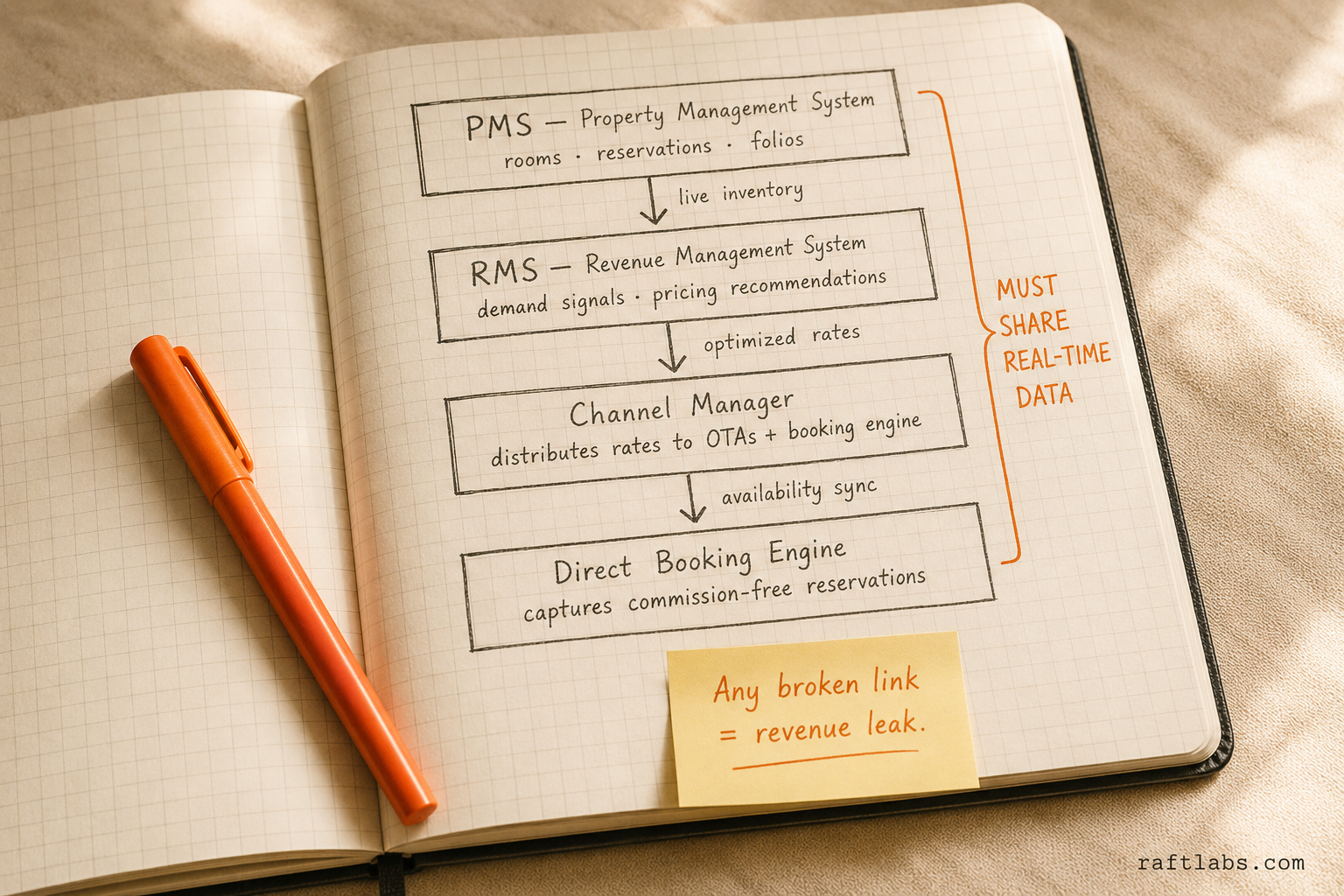
Here is the core stack and what each layer does.
Property Management System (PMS)
The PMS is the operational backbone of your hotel. It manages reservations, room assignments, guest check-in and checkout, housekeeping status, and folio management. Every other system in your tech stack connects to the PMS to read and write real-time data.
The most common limitation for small hotels is using a legacy PMS with limited API access; this is the root cause of most integration failures when connecting to an RMS or channel manager. If your PMS cannot share live room availability data with external systems, your entire revenue management capability is capped.
Revenue Management System (RMS)
An RMS ingests demand signals such as your booking pace, competitor pricing, local events, and search data, and then generates pricing recommendations for your rooms. For small hotels, this is often the last system purchased, but it delivers the highest direct impact on ADR and RevPAR. Cloud-based RMS platforms designed for independent hotels have made this level of sophistication accessible without enterprise pricing.
Channel Manager
Your channel manager distributes your room inventory and rates to OTAs, your own booking engine, global distribution systems, and any other booking channels you use. It ensures that when a room is booked on Booking.com, your availability is instantly updated everywhere else, preventing double bookings and ensuring rate parity. Without a channel manager, managing inventory across multiple OTAs manually is both time-consuming and error-prone.
Direct Booking Engine
Your hotel website's booking engine is your most profitable distribution channel because it eliminates OTA commission costs. Every direct booking that would otherwise come through an OTA saves you 15-20% in commission fees at the same room rate. A high-performing booking engine needs to be fast, mobile-optimized, and able to present packages, add-ons, and promotional rates clearly. A booking engine that creates friction or cannot display current promotions is a direct revenue leak.
How they connect: The PMS holds the inventory. The RMS advises on pricing. The channel manager distributes that pricing and inventory across channels. The booking engine captures direct reservations. When these four systems are integrated and share real-time data, you have a revenue management infrastructure that operates continuously without manual intervention. When any connection is broken or operating on a delay, the whole system underperforms.
The common failure point for small hotels: Most small hotel owners purchase these systems independently and trust vendors to manage the integrations. What often happens is that the integrations are shallow, the systems can talk to each other in theory, but share limited data in practice.
A PMS that only syncs with the channel manager every 15 minutes, for example, creates a window where double bookings can occur and rate changes take too long to propagate. Evaluating integration depth, not just feature lists, is the most important factor when selecting or upgrading any component of this stack.
When small hotels should consider custom software solutions
Standard hotel software works well in the early stages. For many boutique hotels, a PMS, a basic booking engine, and a few add-ons are enough to get started.
Problems begin when the hotel grows, adds more services, or tries to improve profitability beyond just filling rooms. At that point, standard tools often start to limit flexibility and control.
Moving beyond standard tools does not mean replacing everything at once. It usually means recognizing where existing systems no longer support how the hotel actually operates or where revenue leaks keep repeating despite good effort from the team.
Signs That Standard Tools Are No Longer Enough
Boutique hotels often reach this point when they notice patterns like:
Heavy dependence on OTAs despite good demand
Difficulty tracking add-ons, upsells, or guest behavior across systems
Manual workarounds using spreadsheets or notes
Limited ability to personalize the guest journey
Reports that show numbers but not clear answers
When these issues persist, they usually point to tool limitations rather than team performance. Understanding current hospitality technology trends helps hotels identify which innovations deliver genuine ROI versus those that are just hype.
What Going Custom Actually Means
Going custom does not mean building a large, complex system from scratch. It is investing in custom small hotel management software that's specifically designed around your property's size, service model, and guest expectations.In most cases, it means adding focused solutions that sit on top of existing systems and close specific gaps.
This can include:
Custom booking flows that improve direct conversion
Guest engagement tools that support pre-stay, on-stay, and post-stay communication
Better tracking of upsells, add-ons, and guest preferences
Clearer data flow between booking, guest, and operational systems
The objective is to enable smoother operations, better data flow, and clearer revenue insights without adding complexity for the team.
Standard Tools vs Custom Solutions
Below is a simple comparison to help understand where the difference usually lies.
| Area | Standard hotel tools | Custom solutions |
|---|---|---|
| Booking experience | Fixed flows with limited flexibility | Tailored flows that match the hotel’s brand and guest needs |
| Guest data | Scattered across systems | Centralized and easier to act on |
| Upsells and add-ons | Often manual or inconsistent | Built into the guest journey |
| Reporting | Generic reports | Metrics aligned with hotel goals |
| Flexibility | Designed for broad use cases | Adapted to specific hotel operations |
Going custom makes sense when:
Revenue leaks repeat despite process improvements
Teams spend too much time reconciling systems manually
Direct booking growth has plateaued
Guest lifetime value is hard to track or improve
In these situations, custom solutions often pay for themselves by reducing friction, improving visibility, and helping small hotel revenue management become more predictable and profit-focused.
Need a more flexible tech setup? We help boutique hotels build custom web and mobile solutions that fit real workflows and improve revenue visibility. Talk to us
How RaftLabs helps build custom hotel technology solutions
We help boutique and independent hotels modernize their revenue and operations without forcing a full system replacement.
The focus is on building custom solutions that work with existing hotel systems and close real gaps that standard tools leave behind.
| Area | What we help build | Why it matters for boutique hotels |
|---|---|---|
| Booking and direct revenue | Custom booking engines and tailored booking flows integrated with PMS and payment systems | Improves direct bookings, reduces OTA reliance, and increases conversion |
| Guest engagement and retention | Platforms for pre-stay, on-stay, and post-stay communication, including loyalty and repeat-stay logic | Helps turn one-time guests into repeat customers and increases lifetime value |
| Upsells and ancillary revenue | Built-in upsells for upgrades, services, and experiences across the guest journey | Captures high-margin revenue that is often missed |
| Operations and back-office | Custom tools for staff scheduling, reporting, and internal workflows | Reduces manual work and improves cost control |
| AI and automation | Demand forecasting, personalized guest messaging, and workflow automation | Helps hotels make smarter decisions without adding workload |
This approach allows boutique and independent hotels to improve their booking, guest, and revenue tools gradually, without a full system overhaul.
Conclusion
When hotels fix leaks, improve visibility, and build stronger guest relationships, they often see better margins without raising prices or increasing marketing spend.
The opportunity is clear. Boutique hotels that manage revenue as one connected system, instead of separate tools, can operate more efficiently and build more predictable profits over time.
If your hotel has outgrown standard tools or struggles with recurring revenue gaps, we help boutique and independent hotels design custom solutions that fit real workflows and support profit-focused growth.
You can talk to our team to explore how custom web, mobile, and operational solutions can support your hotel’s revenue goals.
Our travel and hospitality software development practice covers the full stack of systems independent hotels rely on: PMS integrations, booking engines, and revenue management tools.
Ask an AI
Get an instant summary of this post from your preferred AI assistant.
Common questions
- Small hotel revenue management is managing pricing, distribution, costs, and guest behavior to maximize profit across the full guest journey. For boutique hotels, it covers direct bookings, OTA commissions, upsells, operations, and repeat stays, not just room rates.
- Boutique hotels lose revenue through hidden leaks: unbilled services, high OTA commissions averaging 15-25%, missed upsells, and operational inefficiencies. These cut net profit even when pricing and occupancy look healthy.
- Strengthen the direct booking experience on web and mobile, clearly communicate direct-booking benefits (rate parity, flexibility, extras), and use OTAs only to fill gaps rather than drive the majority of demand.
- Guest lifetime value measures total revenue a guest generates across multiple stays. Research from Harvard Business Review found that increasing retention by just 5% can grow profits by 25-95%, making repeat bookings one of the highest-ROI levers for boutique hotels.
- The seven that matter most are RevPAR, ADR, occupancy rate, net revenue by channel, customer acquisition cost, guest lifetime value, and labor cost percentage. Together they show real profitability, not just booking volume.