How to Develop an AI SaaS Application in 6 Steps Updated
Nov 5, 2025 · Updated Jun 7, 2026 · 15 min read

Building an AI SaaS app takes six steps: define the problem in a discovery phase, choose your AI tech stack (LLMs, cloud provider, database), assemble the right team, build an MVP to validate the concept, test for accuracy and compliance, then scale the infrastructure. RaftLabs has delivered AI SaaS MVPs in 6–8 weeks for $10,000–$20,000. Full-featured products take 12–14 weeks and cost $20,000–$60,000.
Key Takeaways
- Most AI SaaS failures are scoping failures, not technology failures. Teams that define one specific problem before choosing an AI approach ship faster and waste less budget.
- The SaaS market is projected to reach $344 billion by 2027. Products with AI built in from the start are capturing most of that growth. Products that add AI later tend to retrofit a feature rather than ship a product.
- An AI SaaS MVP costs $10,000-$20,000 and takes 6-8 weeks. A full-featured product costs $20,000-$60,000 and takes 12-14 weeks. Building AI in from day one is cheaper than retrofitting it.
- Open-source models (Llama, Mistral) cost less at scale than hosted APIs (GPT, Claude). The decision depends on data residency requirements, not just cost.
- AI is not a "set it and forget it" feature. Production AI models need retraining, fresh data, and active monitoring to stay accurate. Teams that skip this see model drift within 6 months.
Your SaaS competitors are already shipping AI features. Salesforce, Adobe, and Microsoft baked AI into their core products years ago. If you're still planning, you're falling behind.
The SaaS market hits $344 billion by 2027. Most of that growth goes to products with AI built in from the start, not to products that try to add it later. If you're building or updating a SaaS product now, SaaS application development services that understand AI integration are the difference between a product users rely on and one they churn from.
Here are the numbers that frame the opportunity:
The SaaS industry is expected to reach $344 billion by 2027, with AI accounting for much of that growth.
By 2026, 80% of companies will have deployed AI-powered apps in their IT environments, according to Gartner.
McKinsey found that businesses adopting AI see a 20–30% reduction in operational costs within the first year.
By 2028, more than 50% of enterprise businesses will rely on industry-specific cloud platforms.
These numbers confirm one thing: AI is now a standard component of competitive SaaS products, not a differentiator reserved for the largest vendors.
What this means depends on where you sit:
Founder or co-founder: AI gives your SaaS product an edge by making it smarter and more efficient than what competitors ship.
Established SaaS business: Integrating AI improves customer retention, optimizes operations, and opens new revenue streams.
Enterprise team: AI-powered SaaS solutions cut workflow time, improve security, and speed up data-driven decisions.
Product manager or developer: Understanding how to integrate AI effectively helps you build better solutions faster.
Why AI and SaaS work together
According to McKinsey, businesses that adopt AI report a 20-30% reduction in operational costs within the first year of deployment. That's the foundation of the AI + SaaS value case: AI reduces cost while SaaS delivers it at subscription scale.
Together, AI and SaaS give businesses a direct path to improving operations, upgrading user experience, and making faster decisions.
Automating routine tasks
AI handles data analysis and report generation, tasks that once took hours. SaaS platforms allow AI to process large volumes of data without proportionally increasing headcount. AI-driven chatbots now handle large volumes of customer support inquiries without extra human resources.
Personalizing user experiences
AI understands user behavior and delivers personalized experiences inside SaaS applications. Streaming platforms like Netflix and Spotify use AI to recommend content users are likely to enjoy. The same approach in AI in SaaS lifts user engagement by predicting what users need next.
Improving data-driven decisions
SaaS applications generate large amounts of data. AI makes sense of it. An e-commerce business might use AI to analyze customer behavior, then optimize inventory, pricing, or marketing based on what it finds. AI also improves workflow efficiency and cuts unnecessary costs.
Building competitive advantage
AI-driven predictive analytics and advanced automation make products more attractive to potential customers. Early adopters are better positioned to adapt to future market changes. The window for being early is narrowing.
Also read: SaaS Product Development Lifecycle
How to build an AI-powered SaaS app: 6 steps
Building an AI-powered application is a structured process. Whether you're considering AI integration or already have a vision, these six steps guide you through the essential stages.
1. Discovery phase
The journey begins with discovery. This is where ideas take shape and turn into a structured plan. Without a strong discovery phase, the rest of the build drifts.
The first step is identifying the specific problem your app solves. Vague goals produce expensive, misaligned builds. Once you pinpoint the problem precisely, you can design a solution that actually addresses it.
Market research is essential here. Analyze competitors, identify gaps, and define the unique value your solution brings.
A SaaS app development company helps align your vision with concrete product requirements before a line of code gets written. The discovery phase typically includes:
Objective setting: Define what you want to achieve: automating workflows, improving user experience, or sharpening decision-making.
User and buyer interviews: Understand what the people who will pay for and use the product actually need.
Feasibility study: Assess whether the project is viable given available resources, time, and budget.
This phase confirms every decision from here on is based on evidence rather than assumptions.
2. Choosing the right tech stack
Think of your tech stack as the ingredients in a recipe. The right ones produce a high-performing SaaS application. The wrong ones produce a product that struggles to grow.
Since your application relies on AI, selecting the right models and APIs matters. Platforms like OpenAI and Claude offer powerful capabilities for natural language processing, predictive analytics, and automation.
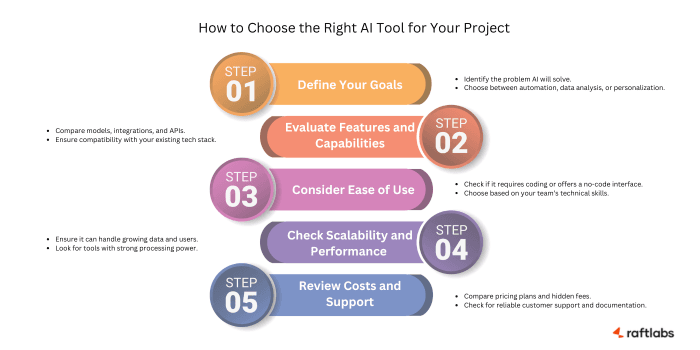
Cloud infrastructure is the next decision. AWS offers flexibility, Google Cloud offers reliability, Azure offers security. Each sets a different foundation for performance and growth.
Other key components:
Database selection: SQL for structured data or NoSQL for flexibility, depending on how your app processes information.
Security and compliance: Encryption, authentication, and adherence to HIPAA or GDPR from day one.
Integration capabilities: Compatibility with third-party tools, APIs, and services to extend functionality without rebuilding everything from scratch.
Picking the right tech stack depends on your app's performance requirements, budget, and long-term growth strategy. Not on what's trending.
3. Building the right team
An effective development team turns your SaaS idea into reality. Depending on complexity, you may need experts in AI, data science, and machine learning.
In-house team vs. outsourcing
| Factor | In-House AI Team | Outsourcing AI SaaS Development |
|---|---|---|
| Advantages | Strong familiarity with business goals; faster internal communication; greater control over sensitive data; builds specialized knowledge over time. | Access to top-tier AI specialists; no expensive recruitment or training overhead; faster project delivery; flexible team scaling without long-term commitments. |
| Challenges | Recruiting and retaining talent is expensive and slow; maintaining AI infrastructure is costly; may lack exposure to latest tools. | Requires efficient communication and collaboration processes; needs strong agreements for data safety. |
| When to choose | Ongoing, evolving projects where long-term ownership matters. | Fast delivery, specialized expertise, or validating an AI concept before committing to a full internal function. |
A senior AI engineer in the US costs $180,000–$250,000 per year. Hiring takes 8–16 weeks. Onboarding takes 4–8 weeks. You won't ship a production AI product in under 6 months from the decision to hire internally.
4. Building an AI SaaS MVP
Before committing to full-scale development, start with an MVP. This early version includes core features that real users can test, providing the feedback you need to invest wisely.
The MVP shows investors and early customers that the concept works in real-world conditions. With that feedback, you refine before scaling.
Why build an AI MVP first:
Test AI performance: Verify your model delivers accurate, useful results before scaling.
Save time and costs: Avoid heavy upfront investment by validating the idea early.
Gather real user feedback: Improve accuracy and usability based on real-world testing.
Attract investors: Demonstrate a working AI prototype to build confidence and secure funding.
Identify edge cases: Uncover potential biases, limitations, or unexpected model behaviors.
Optimize data strategy: Test data collection and processing methods to refine AI training.
RaftLabs has seen this pattern repeatedly: teams that build an MVP first ship faster, spend less, and arrive at a better final product than teams that try to specify everything upfront.
5. Testing your AI SaaS application
Before scaling, thorough testing confirms your AI SaaS app functions as expected. Testing identifies bugs, improves model accuracy, and refines user experience.
Key areas to test:
Model accuracy and performance: Validate that your AI model produces reliable and relevant results. Track precision, recall, and hallucination rate if using an LLM.
Security and compliance: Verify data privacy and compliance with GDPR or HIPAA.
Scalability testing: Confirm infrastructure can handle increased data and user loads without degrading performance.
User experience testing: Gather feedback to refine the interface and usability.
Integration testing: Verify third-party tools and existing systems work together correctly.
6. Scaling your project
Once your MVP is validated, the focus shifts to building a foundation for growth. Solid infrastructure handles increasing users, data, and evolving functionality without performance problems.
Security and compliance remain equally important at scale. Data protection, encryption, and regulatory compliance safeguard your platform and build user trust.
Optimizing cloud resources and database management improves performance while keeping costs in check. Choosing the right architecture, whether microservices or serverless computing, maintains flexibility as your product expands.
Also read: How much does it cost to build a SaaS platform
Key challenges when integrating AI into a SaaS product
AI integration comes with real challenges. Gartner notes that while most enterprises plan to deploy AI-enabled applications by 2026, a significant portion of early builds stall on data quality and integration complexity before they reach production.
1. Data quality and availability
AI models rely on large amounts of high-quality data. Incomplete, biased, or unstructured data produces unreliable predictions. Investing in data cleaning, preprocessing, and automated pipelines is not optional. It's a precondition for useful AI.
2. Model training and performance
Training AI models takes time and resources. If the model isn't optimized, your app may slow down or produce unreliable results. Using pre-trained models, fine-tuning to your specific needs, and optimizing for performance keeps things efficient.
3. Scalability and infrastructure
As your SaaS product grows, demand for AI processing grows with it. If your infrastructure isn't ready, performance degrades. Whether you use serverless computing or dedicated cloud resources, your system needs to handle growth without disruptions.
4. Integration with existing systems
Your SaaS app already has workflows and integrations in place. AI needs to fit in, not create new friction. Modular AI components and well-documented APIs make integration straightforward and keep systems working together correctly.
5. Ethical and compliance issues
AI in SaaS often handles sensitive data, making compliance with GDPR, HIPAA, or SOC 2 a hard requirement. AI models must also be audited for bias. Strong security measures, encryption, and regular model audits confirm legal compliance and ethical decision-making.
6. User adoption and trust
Users may hesitate to rely on AI-driven features in critical decisions. Providing clear explanations for AI-driven outputs, maintaining transparency, and offering manual overrides builds user confidence.
7. Continuous learning and maintenance
AI is not a "set it and forget it" feature. It needs regular updates, fresh data, and ongoing monitoring to stay effective. Without active retraining, models drift. Outputs that were accurate at launch degrade within 6-12 months. Setting up feedback loops and retraining schedules from the start protects your investment.
AI should simplify your SaaS product, not complicate it. Address these challenges directly and you'll build an AI-powered product that is smart and genuinely useful.
Joining SaaS communities keeps you updated on best practices, and working with a skilled SaaS development team confirms solid AI integration.
Check out: Our B2B SaaS development services
Conclusion
AI integration in SaaS is not a future event. It is happening in products your competitors ship today.
The companies that define the problem precisely, choose the right tech stack, and build incrementally through an MVP are the ones that get AI to production instead of running it in circles.
Most AI SaaS failures are scoping failures, not technology failures. The teams that treat discovery as the most important phase consistently outperform the teams that skip straight to building.
If you're ready to develop a custom AI SaaS web or mobile application, RaftLabs specializes in AI-driven solutions built around specific business outcomes, not general "add AI" goals. Reach out to us today.
Frequently asked questions
- An MVP with one or two core features runs $10,000–$20,000 and takes 6–8 weeks. A full-featured product with custom design and third-party integrations costs $20,000–$60,000 and takes 12–14 weeks. Advanced AI or deep-tech builds require a custom quote based on model complexity and integration scope.
- An MVP typically takes 6-8 weeks. A full-featured product takes 12-14 weeks. The discovery and requirements phase, often underestimated, accounts for 5-10% of total project time but has an outsized impact on final cost. Teams that skip it routinely overshoot budget by 20-30%.
- AI in SaaS automates repetitive work, surfaces data-driven insights, and personalizes the user experience. Those three capabilities reduce operating costs, speed up decisions, and improve retention. According to McKinsey, businesses that adopt AI see a 20–30% reduction in operational costs within the first year of deployment.
- AI improves SaaS UX by making apps more intuitive and responsive. Chatbots cut support response times from hours to seconds. Personalized recommendations based on behavior lift engagement metrics. Predictive analytics surface what users need before they ask. Smarter search helps users find relevant content faster.
- Start with a specific problem to solve, not a general "add AI" goal. Confirm your training data is clean and representative before model selection. Choose APIs or models that fit your platform's architecture. Document integration points carefully. Explain AI-driven decisions to users to build trust and stay compliant with GDPR or HIPAA.
Ask an AI
Get an instant summary of this post from your preferred AI assistant.