Build vs Buy Software: A Decision Framework for CTOs and Operations Leaders
The build vs buy software decision comes down to fit and scale. Off-the-shelf SaaS costs $500-$5,000/month and works for standard workflows. Custom software runs $40,000-$300,000+ to build and pays off when your process is unique, your team is large, or per-seat SaaS costs exceed $80,000/year. RaftLabs helps CTOs and operations leaders make this call with a structured audit before any code is written.
You hit the same wall every growing company eventually hits.
Your operations team is running three SaaS tools in parallel, copying data between them with spreadsheets, and still missing things. Or your sales team is working around your CRM because it does not handle your deal structure. Or your warehouse team built a shadow system in Airtable because the main platform cannot handle your fulfillment logic.
The tools are not broken. They were built for someone else's business.
At that point, you have a real decision to make: keep patching the workarounds, or build something that actually fits the way you work.
This is the build vs buy software question. And most guides get it wrong because they are written for developers, not the people who actually pay for the software and live with the outcome.
This guide is for CTOs, COOs, and operations leaders who need a clear-eyed framework, not a pitch for either side.
What build vs buy software actually costs
Before anything else, get the numbers on paper. Most "build vs buy" debates collapse because one side is using list price and the other is using total cost.
Here is a realistic cost comparison across three stages:
| Stage | Commercial SaaS | Custom Build |
|---|---|---|
| MVP / proof of concept | $500-$2,000/month per tool | $40,000-$80,000 one-time |
| Full production system | $3,000-$15,000/month (5-50 seats) | $80,000-$180,000 one-time |
| Scale (100+ users, complex workflows) | $20,000-$80,000+/month | $150,000-$350,000+ one-time + $2,000-$6,000/month maintenance |
A few things the SaaS column hides:
Per-seat pricing compounds fast. A tool at $150/seat/month costs $90,000/year at 50 seats. That is before add-ons, API access tiers, or the premium plan you needed for one feature.
Integration costs are real. When five tools need to talk to each other, you spend on Zapier, Make, or a dedicated iPaaS. Those fees and the engineering hours to maintain them add up.
Data lock-in has a price. Moving off a SaaS platform later often costs more than building custom from the start. Data migration, workflow re-mapping, and retraining are expensive.
The custom build column hides different things:
Post-launch support and bug fixes typically run 15-20% of the original build cost annually.
If the original vendor relationship breaks down, you need another team who can read the codebase.
Timeline slippage is common when requirements are not locked before development starts.
Neither path is cheaper by default. The right answer depends on what you are building and how long you plan to use it.
Commercial SaaS platforms vs. custom software
This is the most important section of this guide, so read it carefully.
Most SaaS tools are excellent for standard workflows. They are built to serve thousands of customers, which means they handle the common 80% of use cases very well. The problem is when your business lives in the other 20%.
When Salesforce, HubSpot, and similar CRM tools hit their limits
Salesforce and HubSpot are the default choices for sales and customer management. For most B2B sales teams with a linear pipeline, they work well.
Custom software wins here when:
Your deal structure has non-standard stages (e.g., franchise agreements, multi-party contracts, recurring project-based billing) that the pipeline model cannot represent.
You need real-time data sync between your CRM and an external inventory, ERP, or production system, and the native integrations do not support your data model.
You have a high-volume inside sales operation where your team spends more time working around the system than using it.
Specific failure point: A logistics company with 200+ carrier relationships tried to manage lane pricing in HubSpot. The pipeline model required one record per deal. Their business required one record per lane per carrier per quarter. They built 3,000+ records to fake it. Within six months, the data was unmanageable. They moved to a custom quoting and relationship tool. Build time: 14 weeks. Annual SaaS savings: $180,000.
When project management tools like Monday.com and Asana run out of runway
Monday.com, Asana, and similar platforms are strong for task-based work. They are not built to be operational systems.
Custom software wins here when:
Your project lifecycle has approval gates, compliance steps, or cost-tracking requirements that the platform cannot enforce natively.
You are managing field teams where the platform does not support offline sync, GPS check-ins, or photo documentation in a workflow.
You have a multi-entity operation where projects span legal entities and the platform's workspace model cannot reflect that.
Specific failure point: A construction firm used Monday.com to manage subcontractor scheduling. Every time a subcontractor's timeline slipped, a project manager had to manually cascade the change across 40+ dependent tasks. They built a custom scheduling tool with dependency logic. The manual update work dropped from 6 hours per project per week to under 30 minutes.
When financial operations tools like QuickBooks and Xero cannot scale
QuickBooks and Xero are built for standard accounting workflows. They are excellent at what they do. They are not built to be the operational backbone of a complex revenue model.
Custom software wins here when:
Your revenue model includes variable pricing, usage-based billing, or multi-currency transactions at volume that the platform cannot handle accurately.
You need to generate financial reports that pull data from your operational systems and your accounting system in one view.
Your reconciliation process requires more than a few hours per month. If your finance team spends days every month on manual reconciliation, that is a signal.
The pattern is consistent: commercial SaaS platforms win on standard workflows. Custom software wins when your workflow is genuinely different, when the workarounds cost more than the build, or when the per-seat cost at scale exceeds what a custom build would cost to maintain.
Who actually builds custom software
Not every business that complains about SaaS tools should build custom software. Here are the scenarios where it consistently makes sense.
1. The $20M+ services business with a proprietary delivery model
A professional services firm with a specific methodology, custom deliverable format, or proprietary pricing model almost always hits the ceiling on generic tools. Their intellectual property is in the process, not the output. A custom tool that enforces and accelerates that process is a competitive asset, not an IT expense.
2. The marketplace or platform business that outgrew its MVP stack
Many marketplace businesses start on Sharetribe, Bubble, or a Shopify-based stack. At some point, usually around $5M-$10M GMV, the platform constraints become business constraints. Transaction fees, limited customization of the matching algorithm, or inability to build trust features specific to the vertical all become blockers. The answer is a custom platform build.
3. The multi-location operator with complex scheduling or compliance requirements
Healthcare groups, multi-location retail chains, and franchise networks often have scheduling, compliance, or inventory requirements that no single SaaS tool handles well. They end up with four tools and a nightmare integration layer. A custom operations platform built around their specific compliance rules and location structure often saves more than it costs within two years.
4. The B2B SaaS company that needs internal tooling to match its product
A B2B SaaS company cannot sell a sophisticated product while running its own operations on generic tools. Customer success, onboarding, support escalation, and billing management all need to reflect the product's complexity. Internal tools built to match the product's data model make the team faster and the customer experience better.
V1 / V2 / V3: How custom software projects are phased
One of the most common mistakes in custom software decisions is scoping the wrong version. You do not build everything at once. You build in phases.
V1: Core workflow only ($40,000-$80,000, 10-16 weeks)
V1 replaces the most painful part of the current workflow. It does one thing well. It is not pretty. It does not have every feature on the wishlist. It proves that the custom approach is correct and gives you real data on what V2 should include.
Typical V1 scope: core data model, primary user workflow, basic reporting, one or two integrations, and a functioning admin layer.
V2: Integration and automation ($50,000-$100,000, 12-20 weeks)
V2 connects V1 to the rest of your stack. It automates the manual steps that V1 still required. It adds the second and third most important workflows. This is where the ROI becomes visible in the numbers.
Typical V2 scope: API integrations with existing tools, workflow automation rules, role-based access controls, expanded reporting, and user-facing improvements based on V1 feedback.
V3: Scale and differentiation ($60,000-$150,000+, 14-24 weeks)
V3 is where the tool becomes a competitive advantage. This is AI-assisted decision-making, predictive features, external-facing portals, or mobile apps for field teams. Not every project reaches V3. Many stay at V2 and deliver full value there.
The phased approach matters because it limits risk. You get a working system faster, you validate assumptions with real use, and you do not spend $300,000 on a system that solves the wrong problem.
Where build vs buy decisions go wrong
Most failed custom software projects share one or two root causes. Knowing them in advance is more useful than any post-mortem.
Failure mode 1: Scope decided before the process is understood
The most expensive mistake in custom software is building the wrong thing confidently. This happens when a business writes a requirements document based on how they think their process works, not how it actually works. The development team builds exactly what was specified. It does not fit real usage. The team spends twice the original budget on changes.
The fix: before any code, spend two to four weeks on process mapping with the actual users. Not the managers. The people who do the work. The gaps between the process map and the requirements document are where the real specification lives.
According to the Standish Group's CHAOS Report, 31% of software projects are cancelled before completion, and 53% cost nearly double their original estimates. Unclear requirements are the leading cause in both categories.
Failure mode 2: Buying a SaaS platform and immediately customizing it into a custom build
Some businesses try to avoid the build vs buy decision by buying a SaaS platform and then customizing it heavily. This is often the worst of both worlds. You pay SaaS prices, you lose the upgrade path, and you end up with a system that requires a specialized developer who knows both the platform and your customizations.
"The real cost of a heavily customized platform is not the license fee. It is the technical debt that accumulates every time the vendor ships an update and your customizations break," says Michael Ibarra, principal technology advisor at Gartner, in a 2024 report on enterprise software strategy.
If you are considering heavy customization of a commercial platform, that is usually a signal that custom software is the right answer.
How RaftLabs approaches the build vs buy decision
We do not start with code. We start with your workflow.
Before any project begins, we run a structured audit: your current tools, where the real friction is, what the workarounds are costing you, and whether a custom build is actually the right answer. Sometimes it is not. We will tell you that.
When it is the right answer, we build in phases. V1 gets you a working system in 10-16 weeks. You validate it with real users before committing to V2.
We have built operations platforms for logistics companies managing complex carrier networks, scheduling tools for multi-location healthcare groups, and custom B2B portals for SaaS businesses that needed their internal tooling to match the sophistication of their product.
The businesses that get the most from custom software are the ones that are specific about the problem. Not "we need a better system." But "our quoting process takes 4 hours per deal and involves three tools that do not talk to each other, and it is costing us deals."
If you can describe the problem that specifically, we can scope a solution.
If you are at the point where SaaS workarounds are costing you more than they should, or you are spending more on per-seat fees than a custom build would cost to maintain, it is worth a conversation.
Talk to RaftLabs about your build vs buy decision.
FAQ
Q: How do I know when my SaaS costs justify a custom build?
A: The simplest threshold is annual SaaS spend on tools serving one workflow. When that number exceeds $60,000-$80,000 per year, a custom build typically breaks even within 24-30 months. Factor in integration costs, the time your team spends on workarounds, and the value of the workflow running without friction. The math usually becomes clear when you put all three numbers on the same page.
Q: What is the build vs buy decision framework in simple terms?
A: Buy when the problem is standard and the SaaS tool covers 90% of your workflow without modification. Build when your process is genuinely different from what the tool was designed for, when per-seat costs at scale exceed the build cost divided by three years, or when the workarounds your team uses are themselves a productivity cost. If you are doing both, you are probably at the tipping point.
Q: How long does a custom software project take from decision to live system?
A: A focused V1 with clear requirements typically takes 10-16 weeks. Projects that take longer usually had requirements that changed during development or a scope that was too broad for V1. The 10-16 week range assumes a dedicated team, a locked V1 scope, and a client-side owner who can make decisions quickly. Discovery and scoping add two to four weeks before that.
Q: Can we start small with custom software and expand later?
A: Yes, and you should. A well-designed V1 is built to be extended. The data model, API structure, and permissions layer should anticipate V2 and V3 even if those features are not built yet. Teams that try to build everything in V1 typically overspend and end up with a system that does not match actual usage. Phase it deliberately and you control both the cost and the risk.
Q: What happens when the development team leaves or the vendor relationship ends?
A: This is the right question to ask before you start. Good custom software is built with documented code, clear architecture decisions, and no single-developer knowledge silos. You should own the code repository, the deployment infrastructure, and the documentation. At RaftLabs, we hand over all of that at the end of every project. We also write internal documentation so any qualified development team can continue the work if needed.
Ask an AI
Get an instant summary of this post from your preferred AI assistant.
Stay on topic
More on custom software
Work with us
Construction Software Development
See the serviceRelated articles
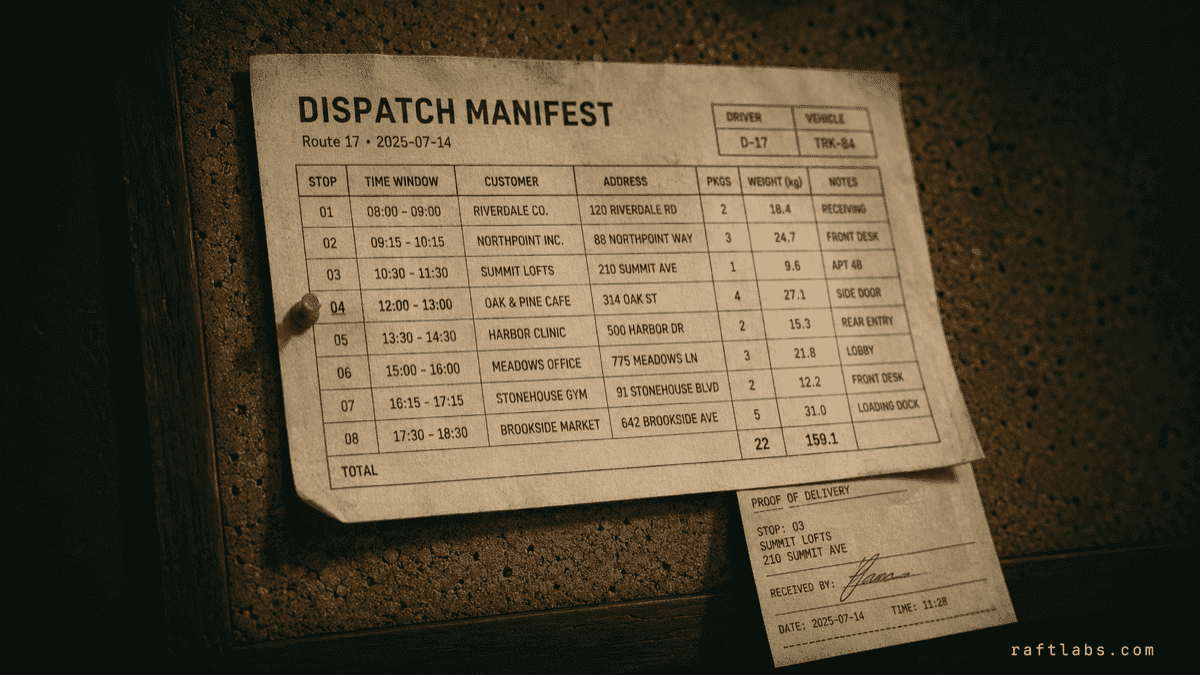
Last Mile Delivery Software: Build vs. Buy for 3PLs and Courier Operators
Onfleet, Route4Me, and Circuit work until they don't. Here is what breaks at scale, when custom last mile delivery software pays off, and what it costs to build it.

SOC 2 compliance: What it is and why your app needs it
No SOC 2 report? No enterprise deal. Here's what SOC 2 actually requires, how long it takes, what it costs, and why most B2B SaaS companies need it before their first enterprise customer.

Calendly vs. custom booking system: when to build, when to buy
Calendly works until it doesn't. Here's how to know when you've hit that wall and what a custom booking system actually costs to build.