The SaaS Startup Founder's Guide to Building a Successful SaaS Business

SaaS success requires 4 decisions in order: validate the problem, choose a scalable stack, pick a pricing model that matches value delivery, and find a partner who challenges your thinking. The SaaS market hits $908B by 2030. RaftLabs ships MVPs at $10K–$20K in 6–8 weeks.
Key Takeaways
- Validate the problem before writing a single line of code. The SaaS market is projected to reach $908 billion by 2030. The founders who fail still do it by building products no one actually pays for.
- The right tech stack scales without constant rewrites. Most SaaS products are over-engineered at the MVP stage, which delays launch and wastes budget on architecture that changes anyway.
- Pricing model determines growth rate, not just revenue. Subscription tiers work for most B2B SaaS. Usage-based pricing suits developer tools and API products.
- Wrong development partner is the top reason SaaS MVPs fail to reach product-market fit. The right partner challenges your product thinking, not just executes requirements.
- Customer acquisition cost (CAC) and churn rate are the two numbers that determine whether your SaaS business survives past year two. Track them from day one.
The global SaaS market is projected to reach $908 billion by 2030, growing at 18.7% annually. That's the opportunity.
The failure rate for SaaS startups in the first three years sits above 90%. That's the reality.
The gap between those two numbers isn't about market size. It's about four decisions every founder makes in the first six months:
- Did they validate a real problem before writing code?
- Did they choose a tech stack that scales without rewrites?
- Did they pick a pricing model that matches how customers realize value?
- Did they find a development partner who challenges product thinking, not just executes requirements?
This guide works through each one. If you're a first-time SaaS founder, use this as your pre-launch checklist.
What SaaS Actually Is (and Why It Matters to Your Decisions)
SaaS (Software as a Service) means cloud-based software accessed through a browser. The provider handles hosting, security, and updates. Customers subscribe rather than buy outright.
That subscription model is what makes SaaS economics powerful. Monthly recurring revenue (MRR) is predictable. Infrastructure scales without proportional headcount. A product that solves a genuine problem for a specific audience can grow globally without building a sales team in every market.
You're already using SaaS products. Gmail, Slack, and Zoom are all SaaS applications that became part of daily workflows because they solved specific problems better than the alternative.
The business model works. The question is whether your specific idea solves a problem that a specific audience will pay recurring fees to solve.
Step 1: Validate the Problem Before Writing Code
Most SaaS products fail not because they were built badly but because they were built for a problem that wasn't painful enough to change behavior.
The validation question isn't "would people use this?" People say yes to hypothetical products. The real question is: "Would someone pay $50-$200/month for this, and give up their current solution to use it?"
Three ways to test that before spending on development:
Paid-intent customer conversations: Talk to 20 potential users. Describe the product and ask if they'd pay for it. Don't accept "that sounds interesting." Ask how much, and what they're currently using instead.
Competitive pricing validation: If no one else is charging for this problem, that's a warning sign, not an opportunity. It usually means the problem isn't painful enough to sustain a business.
Waitlist with friction: Build a simple landing page and charge a small deposit or require work to join the waitlist. If people won't complete a form, they won't pay a subscription.
RaftLabs has seen 30+ SaaS builds across healthcare, martech, media, and fintech. The founders who skip validation spend $20,000–$60,000 building a product and then spend another $20,000 rebuilding it after realizing the feature set was wrong. Discovery sessions exist to catch that before development begins.
Step 2: Find the Right Development Partner
There are plenty of SaaS development companies out there. Most will build exactly what you spec. That's not what you need.
The right partner challenges your product thinking. They push back when a feature will add weeks but not business value. They tell you when your architecture will break at 10,000 users before you've hit 1,000. They've shipped real SaaS products, not just "custom software," and they know the difference.
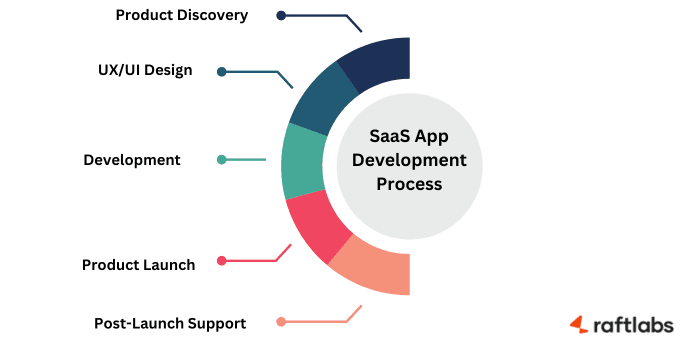
What to look for in a development partner:
A shipped SaaS product in your specific vertical (not just adjacent software experience)
A Clutch rating above 4.7 with reviews that describe how they handled problems, not just successes
A stated process for handling scope changes mid-development
Cloud platform experience (AWS, GCP, or Azure) with architecture documentation
An explicit MVP delivery model with a defined timeline (6–8 weeks for a basic MVP is the standard)
The cost difference matters here too. US and Western European agencies charge $100–$200/hr for the same architecture and code quality that offshore firms with strong track records deliver at $25–$50/hr. The difference is labor economics. The codebase doesn't know where the developer is sitting.
Outsourcing to a dedicated SaaS team removes hiring overhead and lets you scale the team up or down as the roadmap changes. An agile approach gets your product to market faster, and faster time to market means faster feedback on whether your assumptions were right.
For detailed cost breakdowns, see our guide on SaaS development cost.
Step 3: Know Your Target Audience Before You Define Features
The most common feature scope mistake is building for an imaginary "average user" who represents no one.
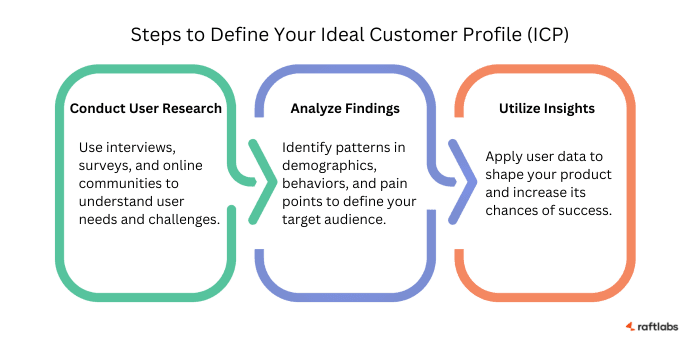
Your target audience shapes every product decision: which features to build first, which integrations to support, which pricing tier to start with, and which channel to use for acquisition.
Market segmentation means breaking your potential customers down by role, budget, decision-making process, and the specific outcome they need. A marketing manager at a 50-person company and a CTO at a 500-person company might both use your product, but they buy differently, evaluate differently, and measure success differently.
How to define your audience:
Find where your target users talk about the problem publicly (Reddit, Slack groups, LinkedIn posts, product reviews on G2 or Capterra)
Note the language they use to describe the problem. Use their language, not industry jargon, in your product and marketing
Understand their current solution. If they're using spreadsheets, your pitch is efficiency. If they're using a competitor, your pitch is specific advantages
Identify who approves the purchase. For B2B SaaS, the user and the buyer are often different people
Primary research (direct customer interviews) and secondary research (market reports, competitor reviews) both matter. If you lack data, base initial assumptions on your own experience in the domain, but confirm those assumptions with real conversations before locking in a feature set.
A good development partner with prior experience in your niche can accelerate this process. Their past builds have surfaced patterns in user behavior that aren't obvious from the outside.
Check our B2B SaaS development services to understand how we approach building for specific audiences.
Step 4: Choose a Tech Stack That Scales Without Rewrites
Your tech stack is the foundation for performance, security, and future development speed. The wrong choice means rewrites. The right choice means shipping new features in days rather than weeks.
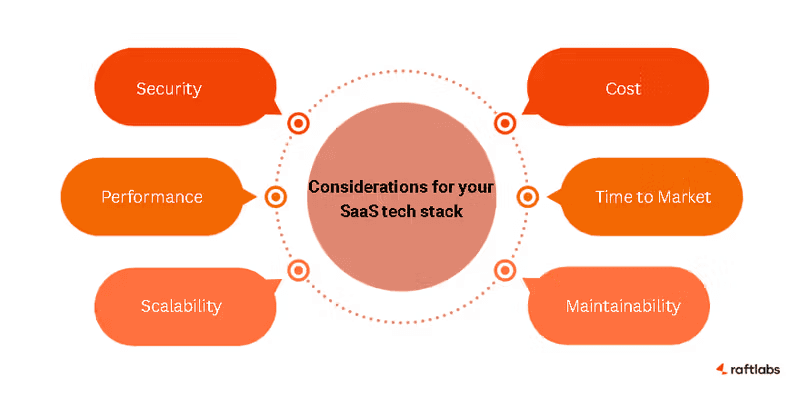
For most SaaS products, the stack decision comes down to five factors:
Scalability: Can this stack handle 10x your expected user load without an architectural overhaul? React and AWS are built for this. They handle traffic spikes without requiring major refactoring.
Development speed: Frameworks with pre-built components (React, Angular, Vue) reduce frontend development time significantly. Node.js and Python frameworks reduce backend setup time.
Performance: Choose backend technologies that handle peak traffic without degradation. Node.js works well for real-time, event-driven products. Python suits data-heavy applications with AI/ML components.
Security and compliance: If your product handles personal data, medical records, or financial information, your stack must support encryption and compliance with HIPAA, GDPR, or PCI-DSS from day one, not as a retrofitted layer.
Team familiarity: A stack your development team knows well ships faster and produces cleaner code than an unfamiliar stack chosen for its theoretical advantages.
One contrarian take: don't over-engineer your MVP stack. Founders who choose microservices architecture from day one because "we'll need it at scale" typically ship months late and spend budget on architecture that gets rewritten anyway. Start simple. Build the modular architecture later when you understand your actual load and access patterns.
For a detailed breakdown of stack selection by SaaS type, read our guide on selecting the right tech stack for SaaS app development.
Step 5: Define Your Pricing Model Before You Launch
Pricing model determines how fast you grow, how efficiently you acquire customers, and how painful it is to change direction later.
Most SaaS founders undercharge by 30–50% in their first year because they're afraid of pricing pressure. That's the wrong fear. Undercharging attracts customers who churn when they find a slightly cheaper alternative. Correct pricing attracts customers who value the outcome, not the price point.
Four pricing approaches and when each works:
| Pricing Model | How It Works | Best For | Avoid When |
|---|---|---|---|
| Flat Rate | One price for all features | Early validation, very simple products | You have meaningfully different user types |
| Usage-Based | Charges based on consumption | Developer tools, API products, variable-use platforms | Your value is consistent regardless of usage |
| Tiered | Multiple packages for different user types | Most B2B SaaS, scales with team size and feature needs | You can't yet define what differentiates each tier |
| Per-User | Charges per seat | Collaboration tools, team products | It limits adoption when teams are large |
For most B2B SaaS products, tiered pricing is the right starting point. It lets you serve different buyer sizes, creates natural upgrade paths, and is what buyers expect when evaluating your product against alternatives.
Don't confuse pricing model with price point. You can have the right model at the wrong price. Test pricing early, even before your product is built, by presenting pricing options to potential customers in validation conversations and tracking their reaction.
Revenue streams beyond subscriptions:
| Revenue Stream | Works When | Risk |
|---|---|---|
| Add-Ons | You have distinct premium capabilities | Customers feel nickel-and-dimed if overdone |
| Freemium | Your product has a natural sharing mechanism | Low conversion rates if free tier is too generous |
| Affiliate/Partner | You have a distribution partner with aligned incentives | Inconsistent revenue, hard to scale |
For a project management tool targeting small businesses, freemium makes sense: attract users with a free version, convert teams to paid as they hit collaboration limits. For an enterprise data analytics platform, freemium doesn't work. The buying committee and procurement cycle mean you're wasting product value on users who were never going to convert from a free tier.
Common Mistakes First-Time SaaS Founders Make
Building in isolation: Founders who don't engage potential users during development ship features based on assumptions. Real usage data consistently contradicts those assumptions. Engage users monthly during development, not just at launch.
Skipping the MVP constraint: "We'll launch when it's ready" typically means 18 months and $150,000 for a product that should have shipped in 8 weeks at $20,000. An MVP isn't an incomplete product. It's a focused product with the core value proposition fully delivered.
Underestimating marketing: The product doesn't sell itself. Content marketing, SEO, and community presence take 6–12 months to build. Start them while the product is being built, not after launch.
Hiring a sales team too early: Sales works when you have a repeatable sales process. Before you know what message converts, what objections are common, and what the sales cycle looks like, a dedicated sales hire is expensive experimentation. Founders should close the first 10–20 customers themselves.
Targeting too broadly: "Our product is for any business" is a positioning statement that positions you nowhere. Define your initial target precisely: a specific role, company size, and industry. Expand from there after proving the model.
Ignoring churn in year one: Churn above 5% monthly means your product is losing customers faster than acquisition can replace them. No growth strategy fixes a leaky bucket. Fix churn before investing in acquisition. Bessemer Venture Partners' State of the Cloud 2024 found that top-quartile SaaS companies maintain net revenue retention above 120%, while median companies sit at 104%. That gap is almost entirely churn management.
The Two Numbers That Determine Survival
Customer Acquisition Cost (CAC): How much does it cost to acquire one paying customer? Include all marketing and sales costs in the period, divided by new customers acquired.
Monthly Churn Rate: What percentage of paying customers cancel each month?
If your CAC is $500 and your average customer pays $50/month, you need 10 months to recover acquisition cost. If 8% of customers churn monthly, your average customer stays 12 months. That's barely profitable. At 2% monthly churn, the average customer stays 50 months. That's a very different business.
The SaaS businesses that survive past year two consistently have CAC payback under 12 months and monthly churn under 3%. Track both from your first paying customer.
Conclusion
Building a successful SaaS business requires specific decisions made in the right order. Validate the problem before writing code. Choose a tech stack that scales without rewrites. Define pricing that matches how customers realize value. Find a development partner who challenges your assumptions.
The $908 billion SaaS market opportunity is real. So is the 90%+ failure rate. The difference between those two outcomes comes down to discipline on validation, architecture, and unit economics. Not luck.
RaftLabs specializes in custom SaaS development for founders who've done their validation work and are ready to build. RaftLabs has shipped 30+ SaaS products across healthcare, media, martech, and fintech, with MVPs starting at $10,000 and delivered in 6–8 weeks.
Schedule a free consultation to scope your SaaS idea and get a real cost estimate before committing to a build.
Frequently asked questions
- Three steps matter most before launch. First, validate demand with paying-intent conversations, not surveys, but actual conversations where someone confirms they'd pay for this. Second, define your must-have features for an MVP with a hard constraint of 6-8 weeks to ship. Third, choose a pricing model that matches how customers realize value, because changing pricing architecture after launch is expensive and forces re-negotiation with existing customers.
- Look for three things. A shipped SaaS product in your specific vertical, not just adjacent software. A Clutch rating above 4.7 with reviews that describe how the team handled problems, not just successes. And an explicit process for handling scope changes mid-development, because requirements always change and you need to know how that gets managed before you sign.
- Tiered subscription pricing works best for most B2B SaaS. It lets you serve different buyer sizes and capture different willingness-to-pay without complex billing infrastructure. Usage-based pricing (pay-as-you-go) works well for developer tools and API products where usage varies dramatically between customers. Avoid flat-rate pricing until you understand your customer segments well enough to know that one price captures your market.
- Acquisition works best when it starts before launch. Build an email list through content, early access waitlists, or community engagement while you're still building. Retention depends on time-to-value: how quickly a new user reaches the moment where the product does something useful for them. Every day between signup and first value is a day you risk losing them.
- Three things consistently block scaling. Churn above 5% monthly is a death spiral that acquisition can't outpace, so fix it before investing heavily in growth. Cloud costs that were fine at 500 users become crippling at 50,000 without planned architecture. And feature bloat: adding requests from loud users without a framework for evaluating which improvements actually reduce churn or increase conversion.
Ask an AI
Get an instant summary of this post from your preferred AI assistant.
Related articles

How Much Does It Cost for SaaS Application Development in 2026
Real cost numbers for building SaaS products in 2026, by build tier, development phase, individual feature, team type, and AI complexity. Built from 30+ delivered projects, not market averages.

11 Innovative AI SaaS Ideas for Aspiring Founders and Startups
Discover why AI-powered SaaS is exploding, the concrete perks over traditional models, and 11 high-potential product ideas poised to dominate 2026.

How to Create a Food Delivery App In 2026 : A Complete Development Guide
Investing in a food delivery app offers high scalability and budget-friendly solutions, catering to the growing demand for convenient online ordering.