Telemedicine App Development: Cost, Compliance, and What Actually Ships
Telemedicine app development costs $40K-$240K depending on HIPAA scope, EHR integration, and video infrastructure. This guide covers what to build, when to go custom over Doxy.me, and how RaftLabs ships compliant platforms in 12 weeks.

In this article
Short answer
Telemedicine app development costs $40,000-$90,000 for a HIPAA-compliant MVP with scheduling, async messaging, and video consultations. A full platform with EHR integration and e-prescribing runs $160,000-$240,000 over 36-52 weeks. RaftLabs has shipped HIPAA-compliant telehealth platforms in 12 weeks for specialty practices and employer health programs with non-standard clinical workflows.
Key takeaways
- HIPAA-compliant telemedicine app development adds 20-30% to base build cost from day one - vendor BAAs, audit logging, and encrypted storage cannot be deferred
- Doxy.me and Zoom for Healthcare work well under 20 providers but break down when you need proprietary clinical protocols, utilization reporting, or specialty-specific note templates
- EHR integration with Epic or Cerner adds $30,000-$60,000 and 2-4 months - most successful telehealth platforms launch without it and add it in year two
- Asynchronous care (text and photo consultations) covers 60-70% of primary care volume and costs less to build than live video - build it first
- State licensing validation is the most overlooked compliance requirement in telemedicine software development - every provider must be licensed in the patient's state at time of service, not their home state
You run a 35-provider mental health group. You pay $18,000 a month in SaaS fees to a telehealth platform that uses generic SOAP note templates your therapists hate, gives you zero utilization data for your payer contracts, and has a scheduling logic built for urgent care, not weekly therapy. You have been told three times that custom workflows are "on the roadmap."
That is the moment telemedicine app development stops being a tech decision and becomes a business decision.
A HIPAA-compliant telemedicine MVP with scheduling, async messaging, and basic video runs $40,000-$90,000 in 12-16 weeks. A full platform with EHR integration, e-prescribing, and insurance billing runs $160,000-$240,000 over 36-52 weeks. The cost of HIPAA compliance is not a separate line item. It adds 20-30% to the base build regardless of scope and cannot be deferred to a later sprint.
| Build tier | Cost | Timeline |
|---|---|---|
| MVP: scheduling, async messaging, HIPAA storage, video, reminders | $40K-$90K | 12-16 weeks |
| With e-prescribing and multi-state licensing validation | $90K-$160K | 20-28 weeks |
| Full platform: EHR integration, insurance billing, multi-specialty | $160K-$240K | 36-52 weeks |
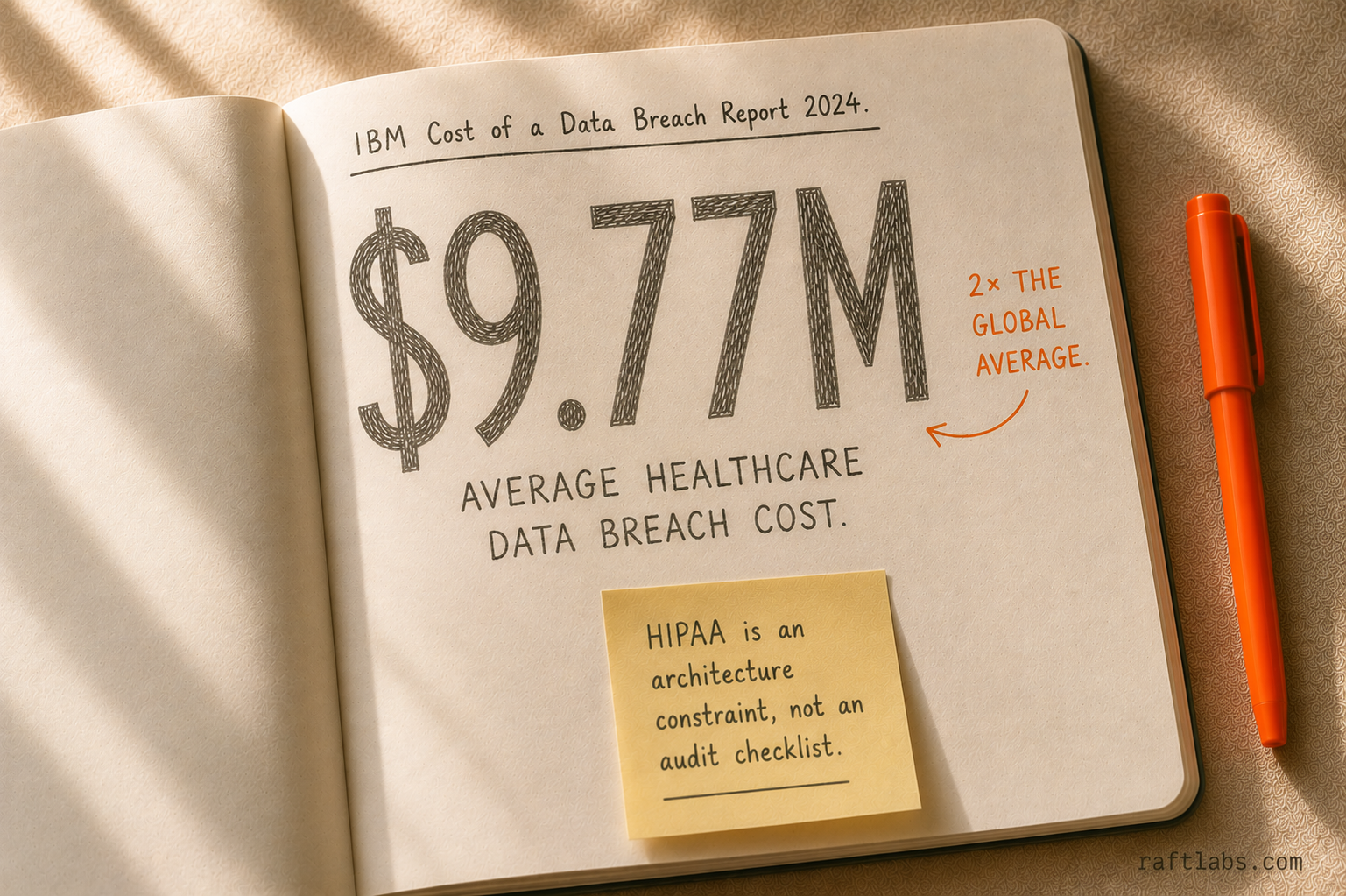
Three statistics ground the decision. The IBM Cost of a Data Breach Report 2024 found healthcare had the costliest breaches of any industry for the 14th consecutive year, averaging $9.77 million per incident. McKinsey estimates up to $250 billion of current U.S. healthcare spend could shift to virtual care. The American Medical Association found 71.4% of physicians used telehealth weekly in 2024, nearly triple the 25.1% who did in 2018. The clinical adoption is there. The question is whether your platform infrastructure is built to support it safely.
Doxy.me, Zoom for Healthcare, and Mend vs. custom software: where each breaks down
Off-the-shelf telemedicine platforms are real products. Doxy.me is the lowest-friction entry point for small practices: browser-based, HIPAA-compliant, BAA included, and you can run a telehealth visit in an afternoon. Zoom for Healthcare is the familiar interface your providers already know, with a signed BAA and breakout room support for group therapy. Mend adds scheduling automation, patient reminders, and digital intake forms on top of video.
These tools work. The question is when they stop working for your specific operation.
Doxy.me hits its limit when you need anything beyond a simple one-to-one video visit. There are no specialty note templates, no prescribing workflows, no utilization data access for payer reporting, and no custom intake logic. The per-provider pricing scales predictably until you cross 25-30 providers, at which point you are spending $6,000-$9,000 a month for a product that still does not accommodate your clinical workflow.
Zoom for Healthcare solves the video infrastructure problem but is not a telemedicine platform. You still need to build or buy scheduling, async care, provider dashboards, note capture, and patient records. Most practices using Zoom for Healthcare have stitched together three or four other tools around it, creating a fragmented workflow that providers tolerate rather than trust.
Mend is the strongest off-the-shelf option for mid-size practices that need scheduling automation and patient engagement on top of video. Its ceiling is the same as any SaaS platform: you cannot change the clinical workflow logic, you cannot expose utilization data in a custom format for payer contracts, and you are buying a shared platform where patient relationships belong to the vendor as much as to you.
Go custom when any of these are true:
Your provider count is above 30-40 and SaaS fees are approaching what a custom build costs amortized over three years. A 50-provider practice paying $300 per provider per month is spending $15,000/month, or $180,000/year. A $120,000 custom build pays back in under 12 months.
You have a specialty workflow that generic note templates cannot capture. Mental health, addiction medicine, and chronic disease management require documentation that SOAP notes were not designed for. Every workaround creates a liability gap.
You need proprietary utilization data. Employer health contracts and payer relationships require reporting that no off-the-shelf platform exposes in the format finance and HR teams require.
You are building a consumer brand where the platform itself is a product. Hims & Hers, Cerebral, and Done are not reselling access to Doxy.me. The telemedicine infrastructure is the product.
Who actually builds custom telemedicine software
Not every healthcare business that considers telemedicine app development reaches the threshold where custom wins. Here are the four operator types where it does.
Specialty practices with 35+ providers and non-standard documentation. A multi-state mental health group finds that generic note templates create documentation that does not map to their treatment protocols. After 35 providers, the SaaS fee exceeds what a custom platform costs amortized over 30 months, and providers are still working around the tool rather than with it. The decision to build is a cost and workflow decision, not a technology aspiration.
Employer health programs that need consolidated utilization reporting. A self-insured employer offering telehealth benefits to 8,000 employees needs visit-level data, outcome tracking, and care coordination tied to their specific benefit design. Consumer platforms do not expose this data in a usable format. Without it, you cannot demonstrate value to the CFO, and the program gets cut at renewal.
Digital health startups with a defined clinical protocol. A startup treating a specific condition - chronic pain, weight management, men's health, addiction medicine - needs the intake flow, visit logic, note templates, and follow-up protocols built around that condition. A generic platform requires so many workarounds that the clinical documentation drifts from the protocol, and the protocol is the product.
Regional health systems building white-label patient portals. A regional health system wants patients to see their own provider over video, with the visit appearing in the same EHR under the same scheduling system. No off-the-shelf telemedicine platform integrates cleanly enough with a specific Epic or Cerner configuration. They build a custom portal, even if it uses an underlying HIPAA-compliant video SDK.
V1, V2, V3: what to build and when in telemedicine software development
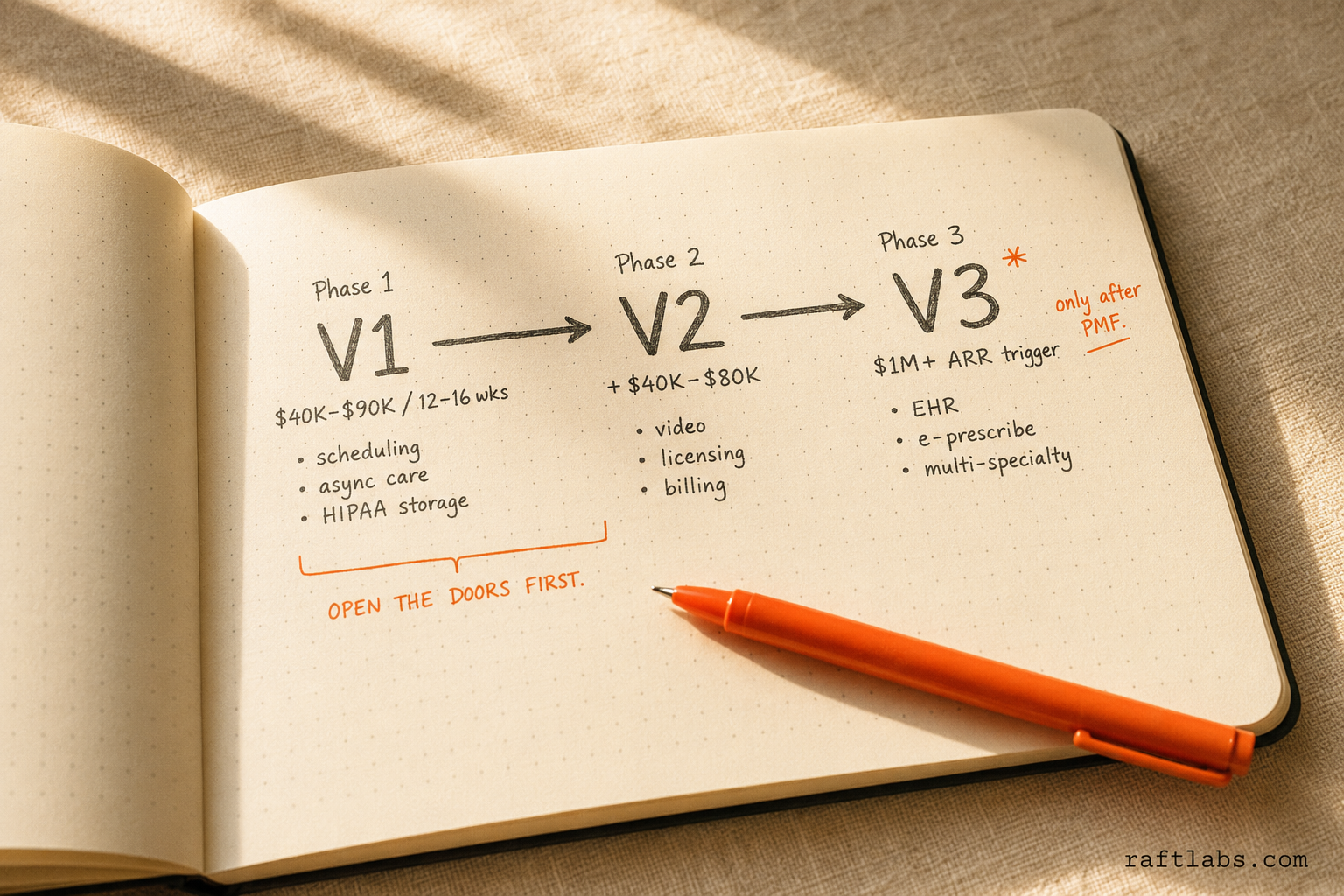
V1: open the doors ($40K-$90K, 12-16 weeks)
These are the features a patient and provider need to complete a visit. Cut any of them and the platform cannot operate.
Patient registration and HIPAA-compliant onboarding captures insurance information, medical history, state of residence for licensing validation, and informed consent. Consent capture is a legal requirement in most states, not an optional screen. Build it with e-signature from day one or you rebuild it before launch.
Appointment scheduling gives patients access to available providers and gives providers control over their calendars. On-demand scheduling works for urgent care. Slot-based scheduling works for established relationships. Most platforms need both, but you can start with one.
Async care (text and photo consultations) is where the patient submits a complaint and a provider responds within hours. This model costs less to build than live video and covers 60-70% of typical primary care volume. Dermatology, prescription refills, and many mental health check-ins run entirely on async. Build it first.
Provider dashboard manages the visit queue, patient records, note-taking, and basic prescribing. This is where 30-40% of total engineering time goes. Providers who have a poor dashboard experience stop using the platform. Patient acquisition becomes irrelevant. Build it with real providers in the room during design.
HIPAA-compliant storage covers encrypted data at rest and in transit, role-based access controls, audit logs, and signed BAAs with every vendor. This is architecture, not configuration. Plan it in week one.
V2: add after proving the model ($40K-$80K additional)
Video consultations add the live visit experience. Build video infrastructure after you have enough visits to know which patient segments actually need it. Building video before you have patients is a common $30,000-$50,000 mistake.
State licensing validation confirms each provider is licensed in the patient's state at time of service. Not their home state. The patient's state. Without this check, your first out-of-state visit creates a licensing board complaint. You can manually verify licenses at launch if you operate in one or two states. At three or more states, automate it. Budget $15,000-$25,000.
Insurance billing integration handles eligibility verification, claims submission, and remittance. Do not build it until you have payer relationships that require it. This single integration adds $25,000-$40,000 and three months.
V3: scale features (above $1M ARR or 500+ active providers)
EHR integration connects your platform to Epic, Cerner, or Athenahealth. Required when selling to health systems. Adds $30,000-$60,000 plus 2-4 months. Most telemedicine platforms launch without it and add it in year two.
E-prescribing routes prescriptions from provider to pharmacy through a certified network. Required for any platform where providers prescribe medications. Budget $20,000-$30,000 in development plus $2,000-$4,000 per month in licensing. Controlled substance prescribing adds a separate compliance track with state-specific rules.
Multi-specialty workflows add condition-specific note templates, triage flows, and prescribing rules per specialty. A mental health platform and a dermatology platform running on the same infrastructure need different visit flows. This is a V3 investment once you have clinical volume to justify the specialization.
Where telemedicine app development projects fail
Most failures in telemedicine software development share one of two causes. Both are recoverable before launch. Neither is recoverable after a breach.
Failure mode 1: polished patient UI, half-built provider dashboard.
The patient app gets the design attention. The provider dashboard is scoped as "clinical admin" and treated as a backend concern. By launch, providers face a slow, generic interface with note templates that don't match their workflow. Providers stop using the platform. You now have a patient-acquisition problem where the real problem is supply-side.
The fix: allocate 30-40% of total engineering time to the provider experience from week one. Run design reviews with real clinicians, not product managers acting as proxies for clinicians.
Failure mode 2: non-BAA vendors integrated because they were faster.
Calendly for scheduling. Standard Zoom for video. Mixpanel for analytics. Each of these is a HIPAA exposure in a telemedicine context. The argument is always "we'll swap it out before launch." The BAA-compliant swap takes a full sprint. If a breach occurs before the swap, the investigation and remediation cost exceeds the entire platform build cost, by a large margin.
Vendor BAA status for common tools:
Video: Daily.co (yes), Twilio Video (yes), Vonage (yes), Zoom Healthcare plan (yes), standard Zoom (no)
Cloud: AWS (yes), GCP (yes), Azure (yes)
Analytics: Segment HIPAA plan (yes), standard Mixpanel (no), Amplitude Healthcare tier (yes)
Payment: Stripe (yes, but PHI must not touch their servers), Braintree (yes)
Support: Zendesk for Healthcare (yes), standard Zendesk (no)
Lock in BAA status for every vendor in week one. If a vendor will not sign a BAA, you cannot use them for anything that touches Protected Health Information.
"The teams that get HIPAA right treat it as a build constraint from day one. The teams that struggle treat it as an audit checklist in month six. By then, the architecture is wrong and the cost to fix it is enormous." - Deven McGraw, former Deputy Director of the Office for Civil Rights at HHS, speaking with STAT News
How RaftLabs approaches telemedicine app development
RaftLabs has shipped HIPAA-compliant telemedicine platforms for mental health groups, specialty practices, and employer health programs. The 12-week path we use is not a timeline estimate. It is a sequencing discipline.
The 12-week MVP sequence
- 01compliance foundation
Weeks 1-3: Compliance architecture first
Infrastructure setup, encryption standards, auth system, PHI-safe data model, BAA procurement with all vendors. Nothing touches a database before this is done.
- 02patient + provider journey
Weeks 4-6: Core visit flow
Scheduling engine, async messaging, basic provider dashboard, and note capture. The patient and provider journeys in their simplest viable form.
- 03risk control layer
Weeks 7-9: Clinical and licensing compliance
State licensing validation, consent capture at onboarding, audit logging, provider availability controls, and role-based access at the query layer.
- 04operational readiness
Weeks 10-12: Launch hardening
Patient records view, notification system, admin tooling, third-party penetration test, and final BAA verification across all active vendors.
The 12-week path produces a working telehealth platform. Video consultations, insurance billing, and EHR integration are V2 and V3 phases, added after you have provider volume that justifies the cost.
What separates a 12-week build from a 24-week build is not the feature list. It is the decisions made in week one. Teams that treat HIPAA as a week-ten audit spend weeks ten through sixteen rebuilding the data model. Teams that lock in vendor BAAs at the start spend those weeks shipping.
If you are running a specialty practice, an employer health program, or a digital health startup where the off-the-shelf options cannot accommodate your clinical workflow, request a 30-minute call. We will scope your requirements and tell you honestly what it takes to build.
Ask an AI
Get an instant summary of this post from your preferred AI assistant.
Common questions
- A HIPAA-compliant telemedicine MVP with scheduling, async messaging, video consultations, and patient reminders costs $40,000-$90,000 over 12-16 weeks. Add EHR integration, e-prescribing, and insurance billing and you reach $160,000-$240,000 over 36-52 weeks. HIPAA compliance adds 20-30% to build cost regardless of scope tier.
- Custom telemedicine software wins when you have more than 30-40 providers, specialty-specific clinical workflows that generic note templates cannot accommodate, or payer contracts requiring proprietary utilization data. Below that threshold, Doxy.me or Mend are faster and cheaper. The payback period on a $90K-$160K custom build is 18-36 months at 40-60 providers.
- HIPAA-compliant telemedicine software requires end-to-end encrypted video and messaging, encrypted data storage at rest, audit logs for all PHI access retained for six years, signed Business Associate Agreements with every vendor, role-based access controls enforced at the query layer, and a documented security risk assessment. You also need a breach notification procedure.
- Not for an MVP. Most successful telehealth platforms launch with their own scheduling and visit records, then add EHR integration in year two when selling to health systems. EHR integration with Epic or Cerner adds $30,000-$60,000 and 2-4 months. Build it when a health system contract requires it, not before.
- A HIPAA-compliant telemedicine MVP takes 12-16 weeks. Adding video consultations and e-prescribing extends to 20-28 weeks. A full platform with EHR integration, insurance billing, and multi-specialty workflows takes 36-52 weeks. The 12-week path assumes HIPAA architecture and vendor BAAs are locked in during week one.