How to Build an App Like BetterHelp: Teletherapy Platform Architecture, HIPAA Requirements, and Real Costs

Building a teletherapy platform like BetterHelp requires therapist credentialing, HIPAA-compliant async messaging, video sessions, and a matching engine. An MVP takes 16-22 weeks and costs $40K-$90K. RaftLabs has shipped HIPAA-compliant healthcare platforms across telehealth, patient intake, and clinical workflow.
Key Takeaways
- HIPAA applies from the first line of code. Every service that touches client data -- cloud hosting, messaging, video, email -- needs a signed Business Associate Agreement (BAA). This is a legal requirement, not a best practice.
- Therapist supply is the hardest problem, and it is a business problem before it is a technical one. You need a credentialing workflow before clients see any therapist profiles. Credentialing takes 2-4 weeks per therapist.
- BetterHelp's primary modality is async messaging, not video. Clients and therapists exchange messages throughout the week, with live video or phone sessions as a secondary touchpoint. Build the messaging workspace before you build the video layer.
- The matching algorithm matters more than it looks. A bad match -- a therapist who does not specialize in what the client needs -- leads to cancellation within two weeks. Get the intake questionnaire right and use it.
- A teletherapy MVP with messaging, video sessions, matching, and HIPAA-compliant infrastructure costs $40K-$90K and takes 16-22 weeks. HIPAA and credentialing add significant cost versus a generic marketplace app.
Most founders building a BetterHelp-style platform are not trying to compete globally. They are building something more specific: a niche therapy network for a particular population, a white-label mental health benefit for employers, or a teletherapy layer inside an existing healthcare product. BetterHelp's generic model creates friction for all of them. A custom build solves it -- if you know what you are actually building.
A teletherapy MVP with async messaging, video sessions, therapist credentialing, and HIPAA-compliant infrastructure costs $40K-$90K and takes 16-22 weeks. A full platform with mobile apps, group sessions, and employer integrations runs $90K-$160K.
| Scope | Timeline | Cost |
|---|---|---|
| MVP (credentialing, matching, messaging, video, billing) | 16-22 weeks | $40K-$90K |
| With mobile apps (iOS + Android) + group sessions | 24-32 weeks | $90K-$160K |
| Full platform (employer partnerships, insurance billing, journaling) | 9-14 months | $160K-$250K |
HIPAA compliance adds $20K-$40K to every tier. That covers security architecture, BAA procurement, and legal review. There is no compliant way to skip it.
TL;DR
How BetterHelp actually makes money -- and what that means for your build
BetterHelp charges clients a flat weekly or monthly subscription: roughly $65-$100 per week depending on plan and location. Therapists are paid a combination of per-message compensation (based on word count) and a per-session rate for live calls. The platform keeps the difference.
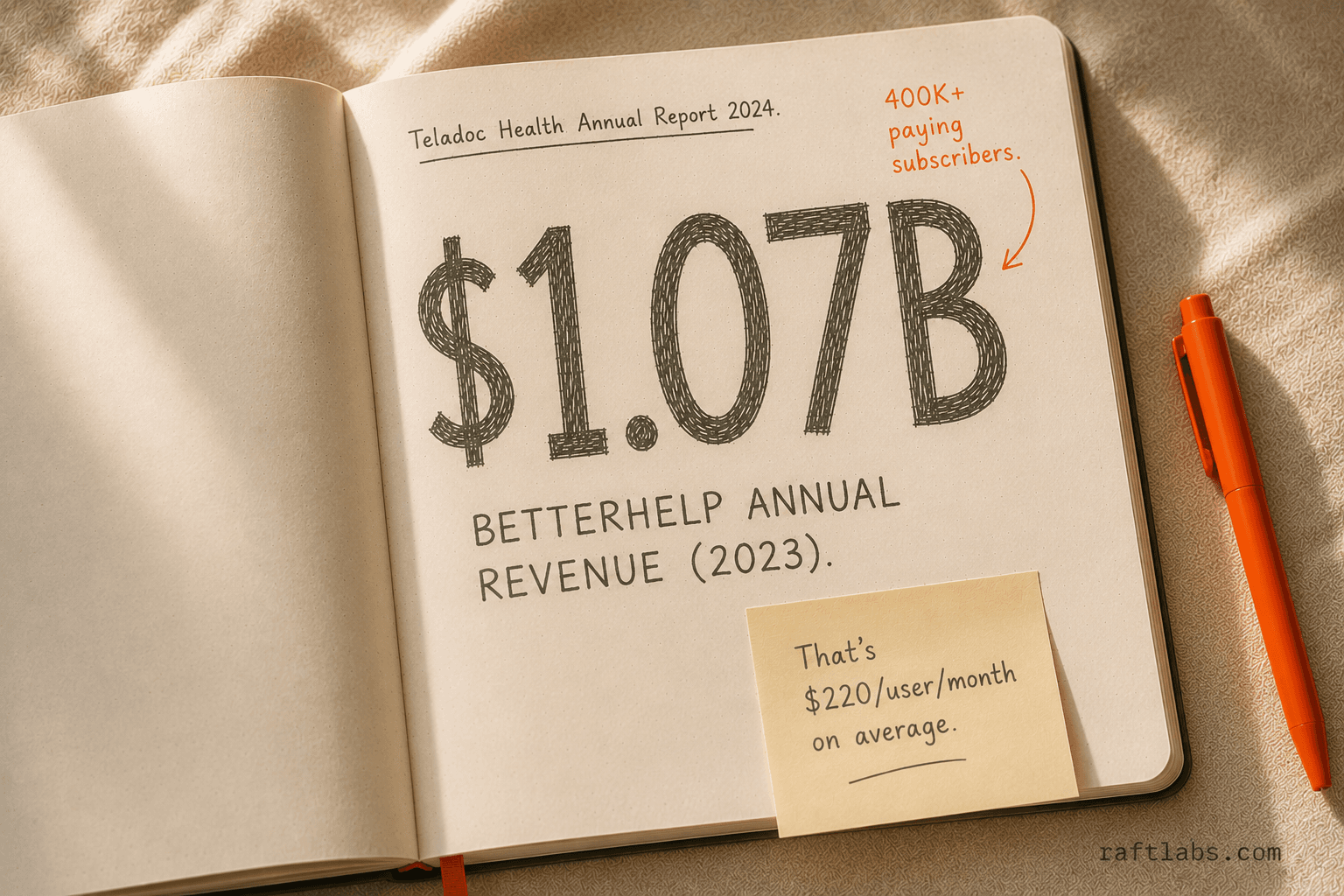
At scale, BetterHelp's take rate is roughly 40-50% of subscription revenue after therapist pay. According to Teladoc Health's 2023 annual report, its BetterHelp segment generated $1.07 billion in revenue in 2023 with over 400,000 paying subscribers. That math suggests an average revenue per user of around $220 per month -- two to three times a single monthly subscription, because most clients pay for multiple months of continuous care.
When you build your own platform, your monetization options are:
Subscription (direct-to-consumer). Flat weekly or monthly fee from clients. Simple to operate. Margins depend on therapist pay structure and session volume. Most appropriate for consumer-facing platforms.
Per-session pricing. Clients pay per video session rather than a subscription. Easier for clients to try, harder to predict revenue. Works best when your audience is cost-sensitive or episodic (e.g., corporate stress events, seasonal demand).
Employer B2B contracts. Employers pay a per-employee-per-month (PEPM) fee to offer your platform as an employee benefit. Higher contract value ($5-$20 PEPM), longer sales cycles, but significantly lower churn than consumer subscriptions. At 500 employees per employer at $10 PEPM, that is $5,000/month per contract.
Insurance reimbursement. Credentialing your therapists with insurance panels and billing insurers directly. Highest complexity, longest path to revenue, but removes the out-of-pocket barrier entirely. This is a V3 play, not V1.
At 500 active client-therapist pairs on a $280/month average subscription, gross revenue runs approximately $140K/month before therapist pay. Monthly operating costs at that scale -- AWS infrastructure, Twilio messaging and video, Stripe fees, support -- run $4K-$12K. Therapist pay is the largest cost line, typically 50-60% of subscription revenue.
Who builds this instead of subscribing to BetterHelp
A teletherapy platform makes sense to build when BetterHelp's generic model actively costs you clients or revenue. Here are the specific situations where that happens.
Employee assistance programs (EAPs) that need a branded, controlled experience. HR leaders at mid-sized companies want mental health benefits they can report on: utilization rates, average engagement, outcomes by department. BetterHelp does not provide employer-level reporting dashboards or allow custom onboarding flows tied to the company's SSO. A custom platform does. The ROI argument is straightforward -- reducing employee attrition by even 1% at a 500-person company paying $80K average salary saves $400K.
Healthcare systems and hospital networks. A hospital group wants to offer outpatient mental health support through its existing patient portal, with session notes flowing into the EHR, therapists credentialed under its own license umbrella, and billing through its existing insurance contracts. BetterHelp cannot integrate with Epic or Cerner. A custom platform built on FHIR APIs can.
Niche therapy networks for underserved populations. Platforms serving LGBTQ+ communities, immigrant populations who require language-matched therapists, or veterans needing VA-credentialed providers cannot rely on BetterHelp's general therapist pool. A custom build lets you define your own credentialing criteria, specialization taxonomy, and matching logic.
International markets where BetterHelp is not licensed. BetterHelp operates primarily in the US and a handful of other countries. A founder building a teletherapy network in Southeast Asia, the Middle East, or Sub-Saharan Africa is building something BetterHelp does not offer -- and local data residency requirements often prohibit using a US-based platform for that population anyway.
HIPAA: start here, not at the end
HIPAA applies the moment you store or transmit any Protected Health Information (PHI). For a teletherapy app, PHI is nearly everything: client names tied to the fact they are using a mental health service, session notes, diagnosis or treatment information, questionnaire responses, and the full content of every message between client and therapist.
According to a 2023 Mozilla Foundation review, 32 of 33 mental health and prayer apps reviewed failed to meet minimum privacy and security standards. HIPAA compliance is not a differentiator. It is the minimum bar for operating legally.
Every team that retrofits compliance after launch finds the same thing: it costs 5x more than designing for it from the start.
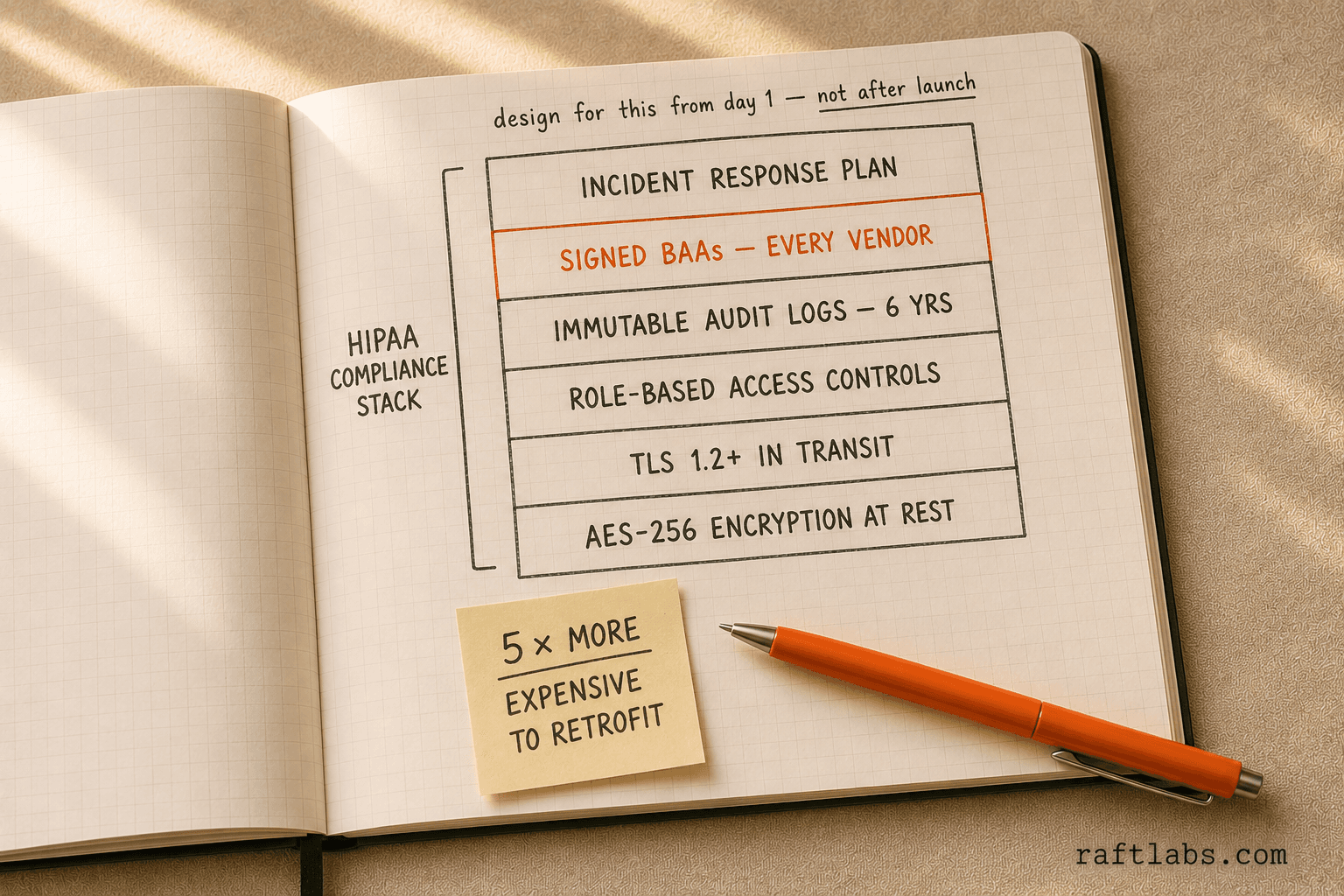
What HIPAA requires technically:
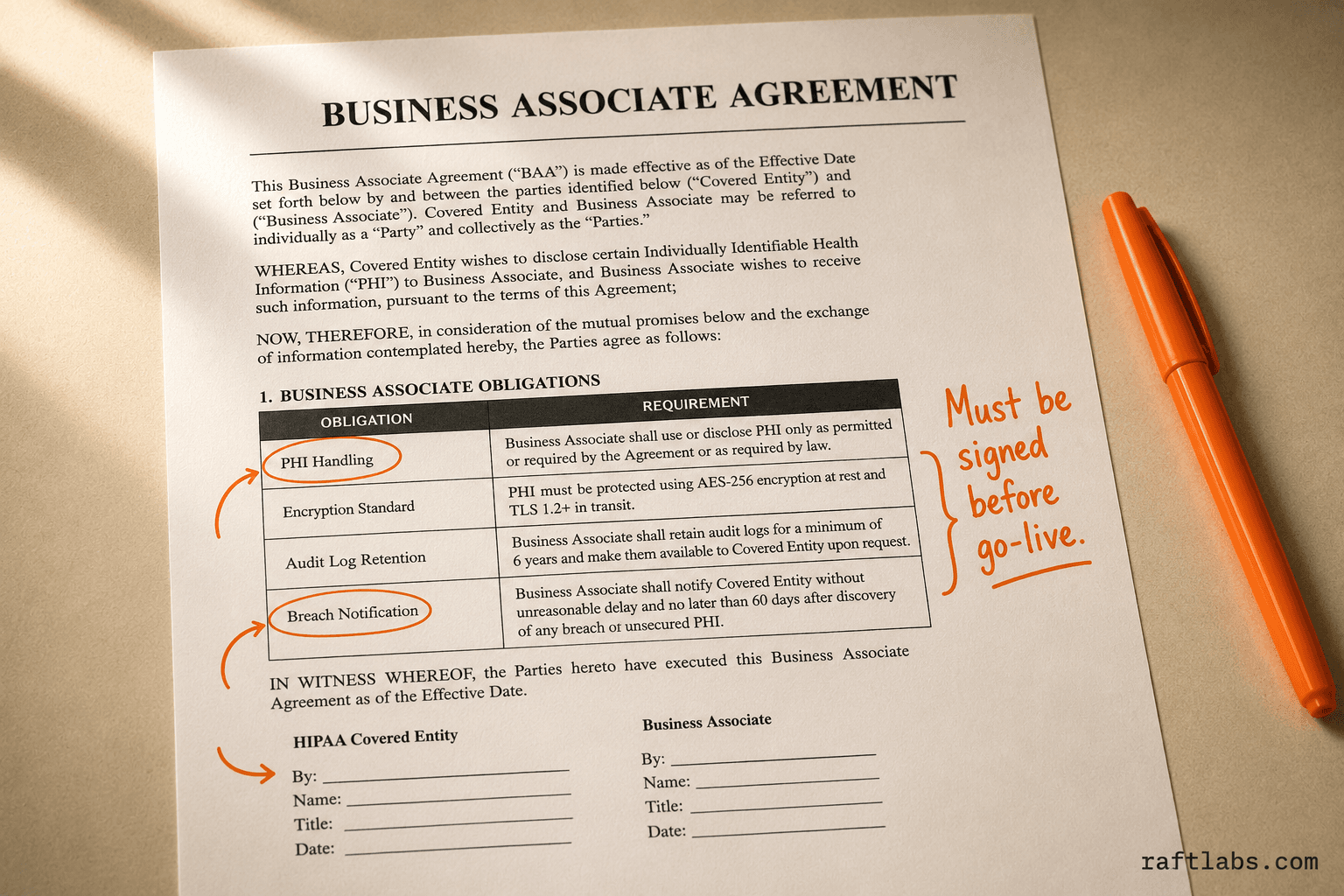
Encryption at rest: AES-256 for all PHI stored in your database. Column-level encryption for sensitive fields, not just disk-level encryption.
Encryption in transit: TLS 1.2 or higher for all API calls. No exceptions.
Role-based access controls: a therapist sees only their assigned clients. Support staff see only what is needed to resolve a specific issue.
Immutable audit logs: every access, modification, or deletion of PHI logged with user, timestamp, and IP. Retained for a minimum of 6 years.
Business Associate Agreements (BAAs): a signed legal contract with every vendor that handles PHI. AWS signs a BAA. Twilio signs a BAA. Many common tools (Intercom, some analytics platforms) do not -- which means you cannot use them without a custom agreement. Check every vendor before you integrate.
Incident response plan: documented procedure for breach notification, remediation, and required reporting to HHS.
Violations start at $100 per incident and reach $1.9M per violation category per year. Criminal liability applies for willful neglect.
"The fundamental challenge in digital mental health is not technology. It is trust. Patients need to trust the platform, the therapist, and the data handling before they will share anything meaningful."
-- Dr. John Torous, Director of Digital Psychiatry at Beth Israel Deaconess Medical Center, Harvard Medical School
AWS is the standard choice for HIPAA-eligible infrastructure. RDS, S3, Lambda, API Gateway, and SES are all covered under the AWS BAA. Cross-platform mobile development saves $30K-$50K compared to native iOS and Android -- and React Native runs on HIPAA-eligible infrastructure without architectural changes.
Therapist supply: the hard problem nobody talks about
SAMHSA's 2023 National Survey on Drug Use and Health found that 49.6 million U.S. adults experienced a mental illness in 2022, yet fewer than half received treatment. Demand is not your bottleneck. Credentialed therapist supply is.
Every teletherapy founder focuses on the client experience first. This is backwards.
A platform with no credentialed therapists is a waiting room with no doctors. You need licensed, background-checked, contracted therapists available before a single client signs up. Each credentialing cycle takes 2-4 weeks per therapist, not 2-4 hours.
Therapist credentialing requires:
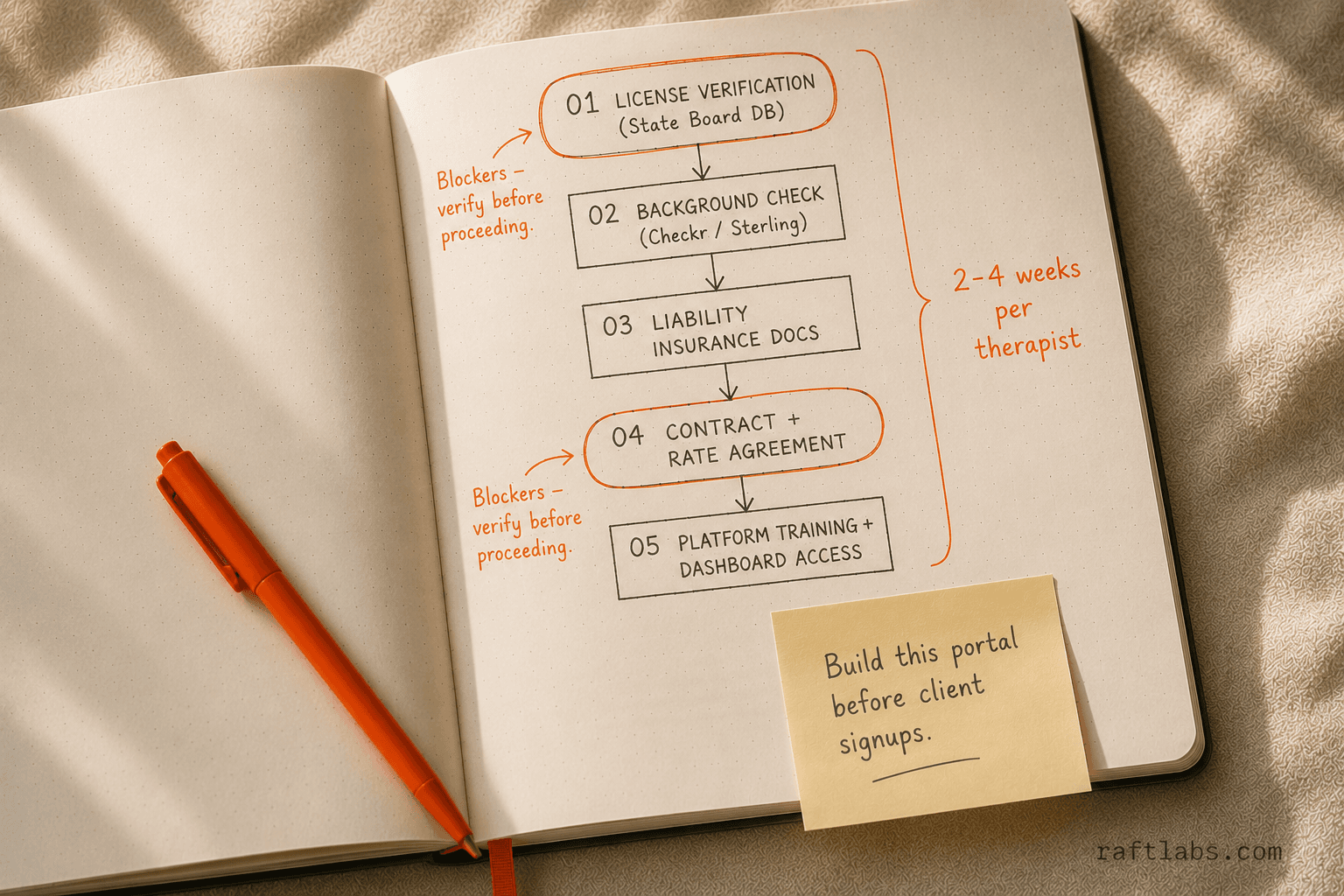
License verification: confirm the license (LCSW, LPC, MFT, PhD, PsyD, or equivalent) is active and in good standing in the relevant state. The source of truth is each state's licensing board database.
Background check: criminal background screening through Checkr or Sterling.
Insurance verification: liability insurance documentation.
Contract and rate agreement: signed contractor agreement covering pay rates, scheduling commitments, platform policies, and client confidentiality.
Platform training: walkthrough of the therapist dashboard, messaging guidelines, crisis protocol, and documentation requirements.
This workflow needs to be built before you onboard your first therapist. It cannot be a Google Form and a Slack DM. You need a structured onboarding portal where therapists submit credentials, track verification status, sign documents, and complete training -- all tracked in your system.
Credential 10-20 therapists before you open client signups. A platform that can say "150 therapists available in your state this week" is a platform clients trust.
What features to build, when, and what each phase costs
The failure mode we see most often in teletherapy builds: teams try to build everything in v1 and end up with nothing working reliably on launch day. Here is how to phase it correctly.
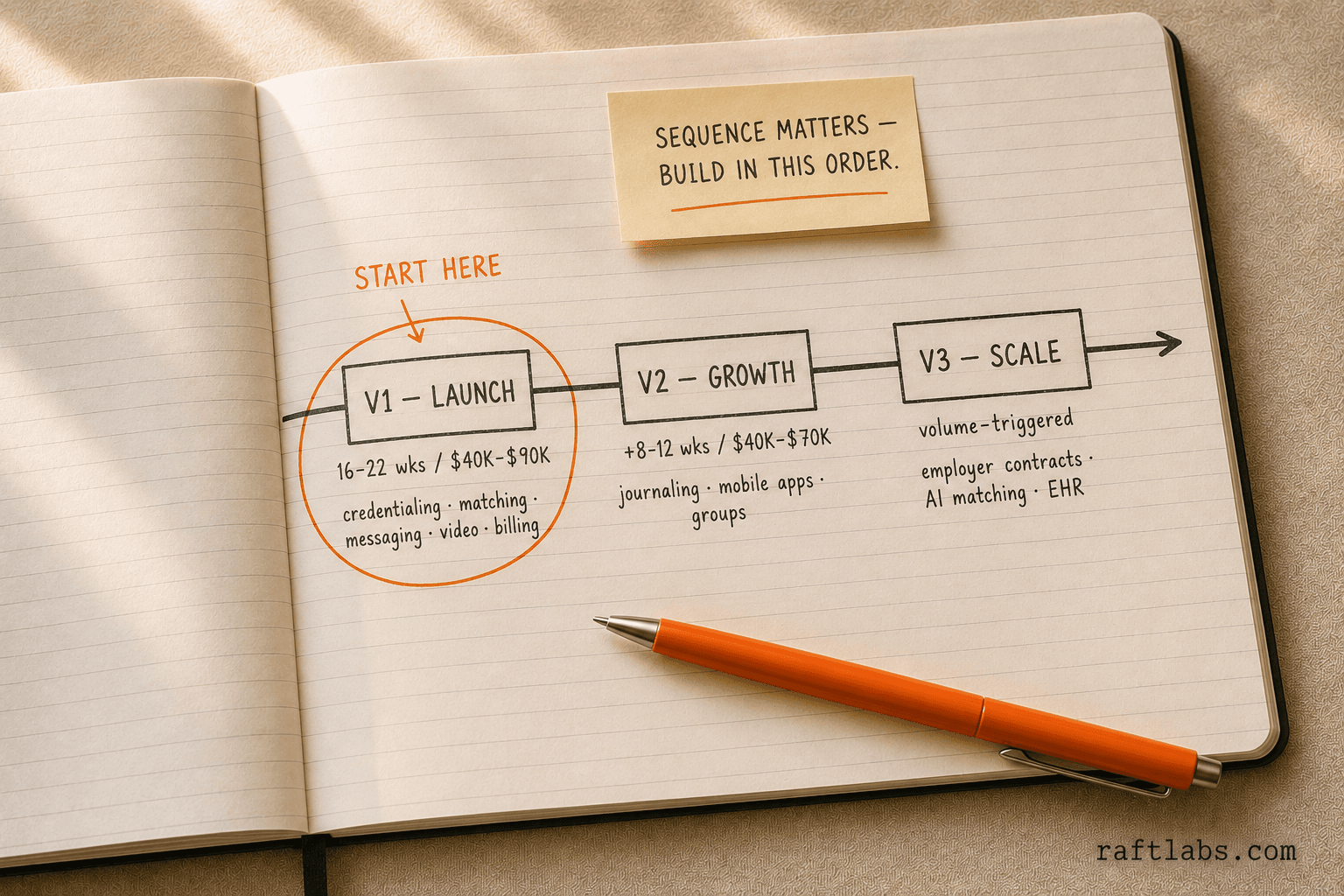
V1 -- launch (16-22 weeks, $40K-$90K)
These are the features without which the platform cannot open to clients.
Therapist onboarding and credentialing. A multi-step portal: license submission, background check initiation, document signing, profile creation (specialties, approach, availability), and dashboard access. Status tracking so therapists know where they are in the process. You cannot skip this -- see the section above.
Client intake and matching. A structured questionnaire covering concerns (anxiety, depression, relationship issues, grief, trauma), preferred therapist characteristics, session format preference, schedule availability. The matching engine filters by specialty and availability, ranks by match score, and presents 3-5 therapist options. Rule-based filtering is sufficient for v1.
Async messaging workspace. The core product. A private, encrypted thread between client and therapist. Clients send messages anytime. Therapists respond during available hours. Message history from the start of the relationship is always visible. Messages stored with column-level encryption. Delivered over HTTPS using Twilio Programmable Messaging (signs BAA, $0.0075/message). This is where most of the therapeutic work happens -- build it before the video layer.
Video session scheduling and calling. Clients schedule live sessions from the therapist's available slots. Sessions use HIPAA-compliant video: Daily.co ($0.004/participant-minute, signs BAA) or Twilio Programmable Video (BAA available). After each session, the therapist logs a brief session note. Do not build video infrastructure from scratch.
Subscription billing. Clients pay a weekly or monthly rate. Stripe handles recurring billing, failed payment retries, prorated changes. Therapist payouts calculated weekly via Stripe Connect or direct ACH.
Admin panel. Operations team needs to review therapist credentials before approval, monitor matches, handle complaints and reassignment requests, and manage billing disputes. Without this, your ops team cannot function at any volume.
V2 -- growth (add 8-12 weeks, $40K-$70K post-launch)
These features matter once you have proven the model and have active client-therapist pairs.
Journaling. An in-app journal clients can share with their therapist. Improves therapeutic continuity. Not core for v1 -- clients get value from messaging alone at first.
Therapist performance analytics. Dashboards showing client retention, session completion rates, and satisfaction scores per therapist. Useful for improving match quality once you have enough data.
Mobile apps (iOS + Android). If you launched web-only, mobile significantly increases engagement for async messaging. Cross-platform (React Native) keeps the marginal cost to $30K-$50K above the web build.
Group sessions. Multiple clients in one moderated session. Requires additional consent flows and a more complex video room setup. Complex enough to justify a separate sprint.
V3 -- scale (triggered by volume or B2B contracts)
These only matter above a certain threshold.
Employer/insurance integrations. Contracting with employers (B2B sales cycle, $5-$20 PEPM) or accepting insurance reimbursement requires separate credentialing with insurance panels, billing infrastructure for claims submission, and employer SSO integration. This is a significant business development project on top of an engineering project.
AI-powered matching. ML-based matching trained on outcome data. You do not have outcome data in v1. Use rule-based matching and improve it once you have retention and cancellation signals to train on.
EHR integration. FHIR API integration with Epic, Cerner, or other EHRs. Required for hospital networks or federally qualified health centers. Adds 6-10 weeks depending on the EHR.
Build vs. BetterHelp: when does custom win?
A BetterHelp subscription costs the client $65-$100/week. As a business, subscribing your employees costs $200-$600/month per employee for a group plan. That is not cheap -- but building a custom platform is not always the answer.
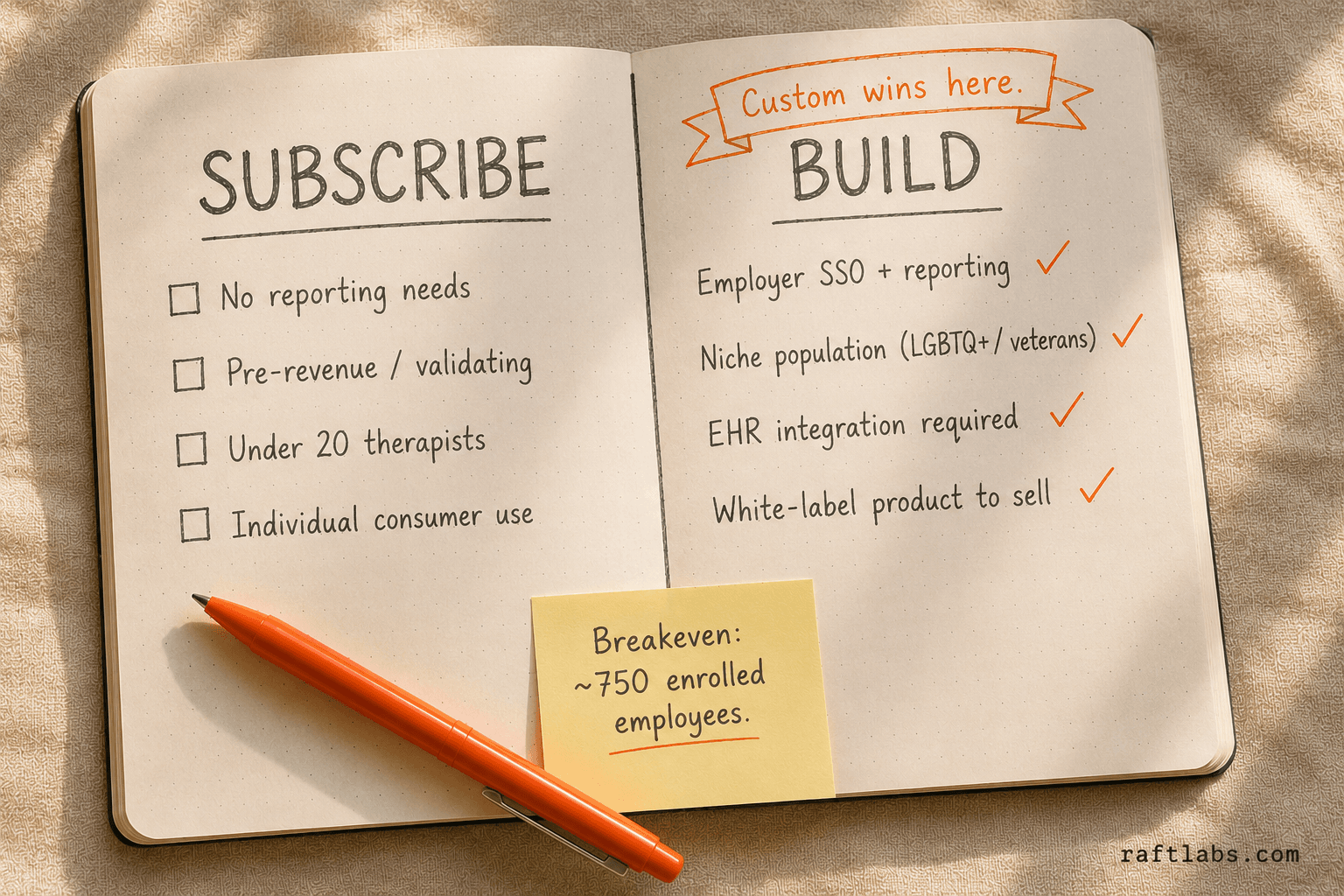
Keep BetterHelp (or a similar off-the-shelf product) when:
You are a company offering mental health benefits and do not need branded reporting or SSO integration.
You are a solo founder pre-revenue who needs to validate demand before committing $40K+ to a build.
Your therapist network is small (fewer than 20 therapists) and the credentialing and matching overhead of a custom platform is not worth it yet.
You are an individual consumer. BetterHelp exists for you.
Build your own when:
You need employer-level reporting, utilization dashboards, or SSO integration that BetterHelp does not offer.
You serve a specific population (LGBTQ+, veterans, a specific language community) that requires custom credentialing criteria BetterHelp's general network cannot meet.
You are a healthcare system and need session notes in your EHR, billing through your existing insurance contracts, and therapists credentialed under your own license umbrella.
You are building in a market where BetterHelp does not operate and local data residency laws prohibit using a US-based service.
You are building a white-label mental health product to sell to employers or insurers as a product, not just using it internally.
The payback calculation for employer B2B: a custom platform at $90K build cost, sold to employers at $10 PEPM, breaks even at roughly 750 enrolled employees under contract. Most employer-focused founders reach that in 2-3 enterprise contracts.
What BetterHelp does that most clones skip
Therapist specialization taxonomy. BetterHelp therapists tag their specialties -- trauma, LGBTQ+, couples, addiction, OCD. The intake questionnaire matches client concerns to those tags. Most clones skip the taxonomy and use generic "therapist available" matching. The result: clients get matched to therapists not equipped for their specific need, leading to cancellations in the first two weeks. Build the specialization taxonomy before you build the matching engine.
Crisis protocol. BetterHelp explicitly does not handle psychiatric emergencies. Their platform redirects to crisis hotlines and instructs therapists to follow mandatory reporting requirements. Your platform needs the same. Build the crisis referral flow and document the protocol for therapists before you go live. This is not optional -- it is a liability exposure without it.
Therapist messaging guidelines. BetterHelp gives therapists guidelines on response length, frequency, and what to cover in weekly summaries. This is operational infrastructure that improves client retention. Build it into your therapist training materials before you onboard your first cohort.
Why teletherapy platforms fail in ways other marketplaces do not
The teletherapy market was worth $6.8 billion in 2024 and is projected to reach $13.5 billion by 2029, according to MarketsandMarkets research. That growth creates real opportunity. The regulatory environment also means failure modes are more expensive than in a standard marketplace.
A food delivery marketplace mismatch means a refund. A therapy platform mismatch means a client who needed help did not get it -- and potentially a negative outcome you are legally and ethically responsible for. Therapist specialization, crisis protocols, and mandatory reporting obligations are not features. They are the minimum operating requirements of a mental health platform.
The domain credibility signal we can offer from actual builds: teams that skip the credentialing portal in v1 plan to "handle it manually." By the time they have 30 therapists onboarded, manual credentialing is a full-time job for someone on the operations team. We have seen this pattern cost an extra $40K-$60K to retrofit in month 6, on top of the operational drag in the months before. Building the workflow correctly in week 1 costs less.
The second failure mode: teams build the video session first because it is the visible feature. Then they discover that clients actually want the async messaging layer more -- and that building a compliant, encrypted messaging system is harder than the video integration. The sequence matters. Messaging first, video second.
How RaftLabs can help
RaftLabs has built HIPAA-compliant platforms across telehealth, patient intake, clinical workflow, and healthcare AI. We know which AWS services are HIPAA-eligible, which vendors sign BAAs, and how to design a PHI data model that survives a compliance audit.
We also know how to scope a teletherapy MVP that gets to market in 16-22 weeks without skipping the credentialing workflow that makes the platform trustworthy. If you are building an employer-facing mental health product or a niche therapy network, the architecture decisions in the first sprint determine whether the platform is compliant and scalable -- or expensive to fix later.
If you are building a teletherapy platform, start with a scoping call. We will tell you what it actually costs, what to build first, and what to defer.
Frequently asked questions
- An MVP with therapist onboarding, client intake and matching, async messaging, video sessions, and subscription billing costs $40K-$90K and takes 16-22 weeks. A full platform with group sessions, journaling features, employer/insurance partnerships, and mobile apps for iOS and Android costs $90K-$160K. HIPAA compliance adds $20K-$40K across all tiers through infrastructure setup, BAA procurement, security implementation, and legal review.
- HIPAA applies the moment you store or transmit any Protected Health Information (PHI). For a teletherapy app, PHI includes session notes, diagnosis codes, client questionnaire responses, messaging content, and even the fact that a specific person is using a mental health service. Requirements: AES-256 encryption at rest, TLS 1.2+ in transit, role-based access controls, immutable audit logs, signed BAAs with every third-party service, and a documented incident response plan. Violations start at $100 per incident and can reach $1.9M per violation category per year.
- Clients complete an intake questionnaire covering their concerns (anxiety, depression, relationship issues, trauma), preferred therapist characteristics (gender, age range, religion), session format preferences (messaging-only, video, phone), and schedule availability. The matching engine filters therapists by specialty, availability, and client preference, then ranks by match score. BetterHelp uses this to suggest 3-5 therapists and lets clients choose. For v1, a rule-based filter is sufficient -- matching on specialty tags and availability. ML-based matching comes later, when you have outcome data to train on.
- React Native for iOS and Android client apps. Node.js backend on AWS (HIPAA-eligible services). PostgreSQL for client and therapist data, with PHI fields encrypted at the column level. Twilio Programmable Messaging for HIPAA-compliant async messaging (Twilio signs a BAA). Twilio Programmable Video or Daily.co for HIPAA-compliant video sessions. Stripe for subscription billing. AWS SES with BAA for transactional email. All infrastructure on AWS with HIPAA-eligible services and signed BAA.
- Starting with the client-facing app before solving the supply problem. A teletherapy platform with no credentialed therapists is worthless. The credentialing workflow -- license verification, background check, contract signing -- must be built and tested before you onboard a single client. Teams that skip this end up with a beautiful client app and no one for clients to talk to. Build the therapist onboarding and credentialing pipeline first, then build the client experience on top of an actual therapist network.
Ask an AI
Get an instant summary of this post from your preferred AI assistant.
Related articles

How to Build an App Like ChatGPT: A Guide for Domain-Specific AI Products
Not everyone building an LLM assistant is trying to compete with OpenAI. This guide is for legal firms, healthcare operators, and SaaS founders who need AI trained on their own data — not the whole internet.

How to Build an App Like Snapchat: The Founder's Guide to Ephemeral Social
For founders building a private community, fitness social layer, or event platform — not a Snapchat clone. Covers cost ($100K–$600K+), AR budget surprises, and when building your own beats using Snap.

How to Build a Live Streaming App in 2026 (Cost, Features & Tech Stack)
Discover how to plan, architect, and monetize a live or on-demand streaming app. Covers costs, tech stack, protocols, and features real platforms actually use.