How to Build an App Like Tinder: Matching App Architecture for Founders

To build a matching app like Tinder, you need user profiles with photos, a swipe card UI, a discovery algorithm, mutual match detection, and a messaging layer for matches only. An MVP takes 10-16 weeks and costs $35K-$70K. RaftLabs has shipped two-sided matching platforms for dating, hiring, and service verticals. The discovery algorithm (which profiles to show and in what order) is the primary product differentiator. Safety features are requirements, not optional additions.
Key Takeaways
- The swipe mechanic is well-understood and not the hard part. The hard part is the discovery algorithm. Which profiles you show each user and in what order determines match quality and retention.
- Two-sided market bootstrapping is the hardest product problem. You need both sides in the same geographic area at the same time. Launch in one city or one campus. Don't open everywhere on day one.
- Match quality matters more than match quantity. Apps that generate low-quality matches get poor reviews and high churn. Invest in filtering and compatibility signals early.
- Safety features are not optional. Photo verification, block and report, and identity verification must be built in v1. Dating and matching platforms have safety obligations.
- The swipe mechanic applies beyond dating: hiring (candidate-job match), roommate finding, mentor matching, and B2B partner discovery all use the same two-sided architecture.
Most founders building a swipe-based matching app are not trying to compete with Tinder globally. They are building a vertical-specific product: a hiring platform where candidates and companies express mutual interest before any conversation, a roommate finder for a specific city, a service-provider network where homeowners and contractors match before scheduling. Tinder's dating context does not apply, but its core architecture does.
A matching app MVP -- profiles, swipe card UI, discovery algorithm, mutual match detection, messaging -- costs $35,000 to $70,000 and takes 10 to 16 weeks. A full build with premium subscriptions, photo verification, and boost features runs $70,000 to $120,000 in 18 to 24 weeks.
| Scope | Timeline | Cost |
|---|---|---|
| MVP (profiles, swipe, match, messaging) | 10-16 weeks | $35K-$70K |
| With premium features and photo verification | 18-24 weeks | $70K-$120K |
| Full platform (safety features, boost, analytics) | 6-8 months | $100K-$160K |
The swipe mechanic Tinder introduced in 2012 became a UI pattern that spread far beyond dating. The engineering fundamentals are largely solved. What determines whether your platform works is the product decision underneath: which profiles you show each user, when, and in what order.
How does Tinder make money, and what are your options?
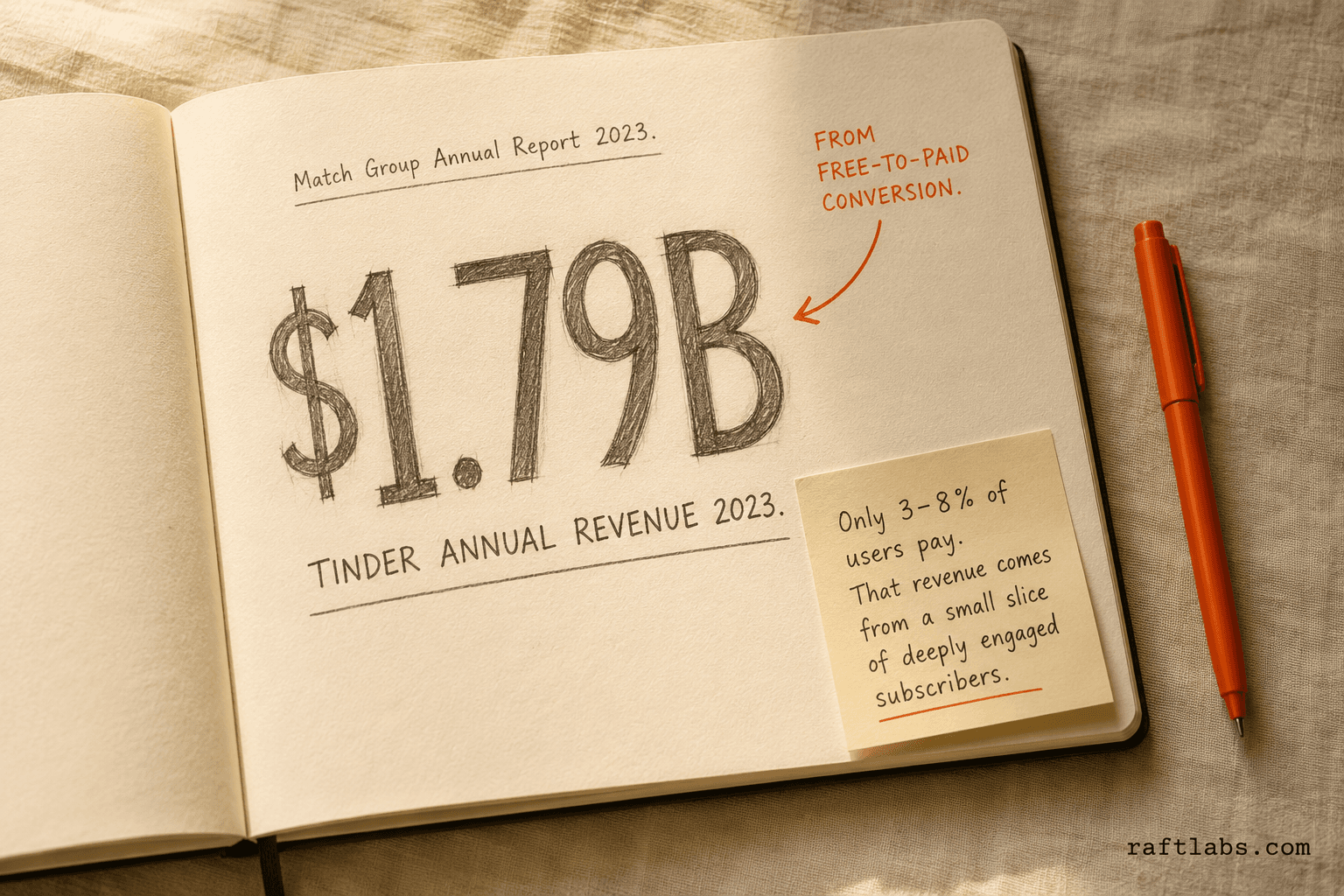
Tinder operates a freemium model. The free tier allows a limited number of daily right swipes with basic discovery. Premium tiers -- Tinder Plus, Gold, and Platinum -- remove the swipe cap, show who has already liked you (so you can match before they see your profile), allow profile rewinds, and include monthly boost credits.
According to Match Group's 2023 annual report, Tinder generated approximately $1.79 billion in revenue in 2023. Average revenue per paying user was around $16 per month. The free-to-paid conversion rate across dating apps typically sits between 3% and 8%. The business runs on a small percentage of deeply engaged users paying monthly, not on the majority.
For your platform, the standard monetization options are:
Freemium subscriptions. Free tier caps swipes at 12 to 50 per day. Premium gives unlimited swipes, visibility into who liked you, and profile boosts. Monthly subscriptions at $10 to $30 depending on tier. This is the default model and the one most investors understand.
Boost credits. A one-time purchase that shows the user's profile to significantly more people for 30 minutes. High-margin because it costs nothing to deliver. At $3 to $10 per boost, a small percentage of users buying one boost per week adds up. Tinder's boost feature is one of its highest-margin revenue lines.
Pay-per-feature. Super like as a scarce signal (3 free per day, more purchasable). Profile spotlight or priority placement. These work as one-off purchases without a subscription commitment.
Avoid pay-to-match models. Any mechanic where paying increases your probability of matching damages the perceived fairness of the product. Users who feel the system is bought rather than earned churn quickly.
At 10,000 active users with a 5% paid conversion rate, 500 paying users at $15 per month average is $7,500 monthly recurring revenue. Hosting and operating costs at that scale run $3,000 to $5,000 per month. The unit economics become positive before you reach the numbers that attract press attention.
Who builds a matching app instead of using Tinder or an existing platform?
Three categories of company build their own, and none of them are trying to win the dating market.
Niche vertical operators where generic platforms cannot serve the audience. A platform for creative professionals to find collaborators (directors, cinematographers, musicians) needs profile fields that Instagram cannot provide and matching logic that Tinder cannot configure. The community has standards: verified professional credits, portfolio links, rate transparency. None of that fits inside an existing consumer dating product. The compliance requirements for a healthcare professional matching platform (license verification, credentialing) make a generic app structurally inappropriate.
Staffing and talent platforms where mutual interest before conversation saves everyone time. A hiring platform where both the candidate and the company must swipe right before either party can message has a different dynamic than LinkedIn InMail, where anyone can contact anyone. According to LinkedIn's 2023 Global Talent Trends report, recruiters report that 72% of outreach messages go unanswered. Mutual match before messaging cuts noise for both sides. Staffing agencies building this for their own candidate-client workflows are not interested in a consumer app.
Geographic or community-specific platforms that need local density control. A city-specific roommate finder, a platform for a specific university alumni network, or a tool for a closed professional community (law firm associates, nurse practitioners in a single health system) needs geographic launch controls and invitation mechanics that consumer apps are not built to support. These operators need to seed one side of the market before opening to the other, and they need to restrict access to verified members of their community. Tinder's open model is the wrong architecture for a closed community.
Service marketplaces that want pre-qualification before scheduling. A platform where homeowners and home service providers swipe to express interest before a booking happens reduces no-shows and low-intent inquiries. The two-sided interest signal changes who contacts whom and raises average booking quality. None of the existing home services platforms (Angi, HomeAdvisor) provide this mechanic.
What features does a matching app MVP actually need?
The failure mode in v1 is building too much before testing whether your discovery algorithm produces quality matches. Features that feel essential at the planning stage often get cut or changed after you see real user behavior. Build the minimum that tests the core loop, then expand.
V1 -- launch (what you need to test the match quality)
| Feature | Why it's required at launch | What happens if you skip it |
|---|---|---|
| Profile creation (photos, bio, basic preferences) | No profile means no matching signal | The app has nothing to show |
| Swipe card UI with left/right gesture | The core interaction and data collection | Without this, there is no product |
| Discovery algorithm (location + recency) | Determines whether users see relevant profiles | Wrong profiles = zero matches = users leave |
| Mutual match detection + notification | The core dopamine moment that drives retention | Users who swipe right have no feedback loop |
| Messaging (matches only) | Spam prevention and the conversion from match to conversation | Without it, matches are worthless |
| Phone number verification | Prevents throwaway accounts from day one | Fake profiles undermine trust before you have a community to defend it |
| Block and report | Legal and trust requirement | One bad actor can kill early community trust |
V1 costs $35,000 to $70,000. The range moves up if you need cross-platform mobile on iOS and Android simultaneously (saves $15,000 to $25,000 versus building native apps separately), and if photo moderation is automated from launch rather than manually reviewed.
V2 -- growth (once you have real match data)
| Feature | When to add it | Rough cost |
|---|---|---|
| Premium subscription tier | Once organic match rate is high enough to sell "unlimited swipes" as a real benefit | $15K-$25K |
| Boost (temporary profile promotion) | Once you understand your discovery algorithm well enough to sell queue position | $8K-$15K |
| Photo verification (live selfie match) | Required before press or marketing spend -- safety incidents at scale destroy apps | $10K-$20K |
| Preference learning (improve discovery from swipe patterns) | Once you have 90+ days of swipe data per user | $20K-$40K |
| Super like or equivalent signal | Once users are complaining about not being able to express stronger interest | $5K-$10K |
V3 -- scale (above 50,000 monthly active users)
| Feature | The trigger |
|---|---|
| Advanced ELO-style scoring | Discovery algorithm producing poor match quality at volume |
| Background check integration | Regulatory pressure or high-profile safety incidents |
| Travel mode / global discovery | Users in thin geographic markets requesting it |
| In-app video calls | Text conversations converting to phone numbers (signal that users want a next step inside the app) |
| AI compatibility scoring | Enough behavioral data to train a model -- typically 6+ months of data |
Why the discovery algorithm is more important than the swipe UI
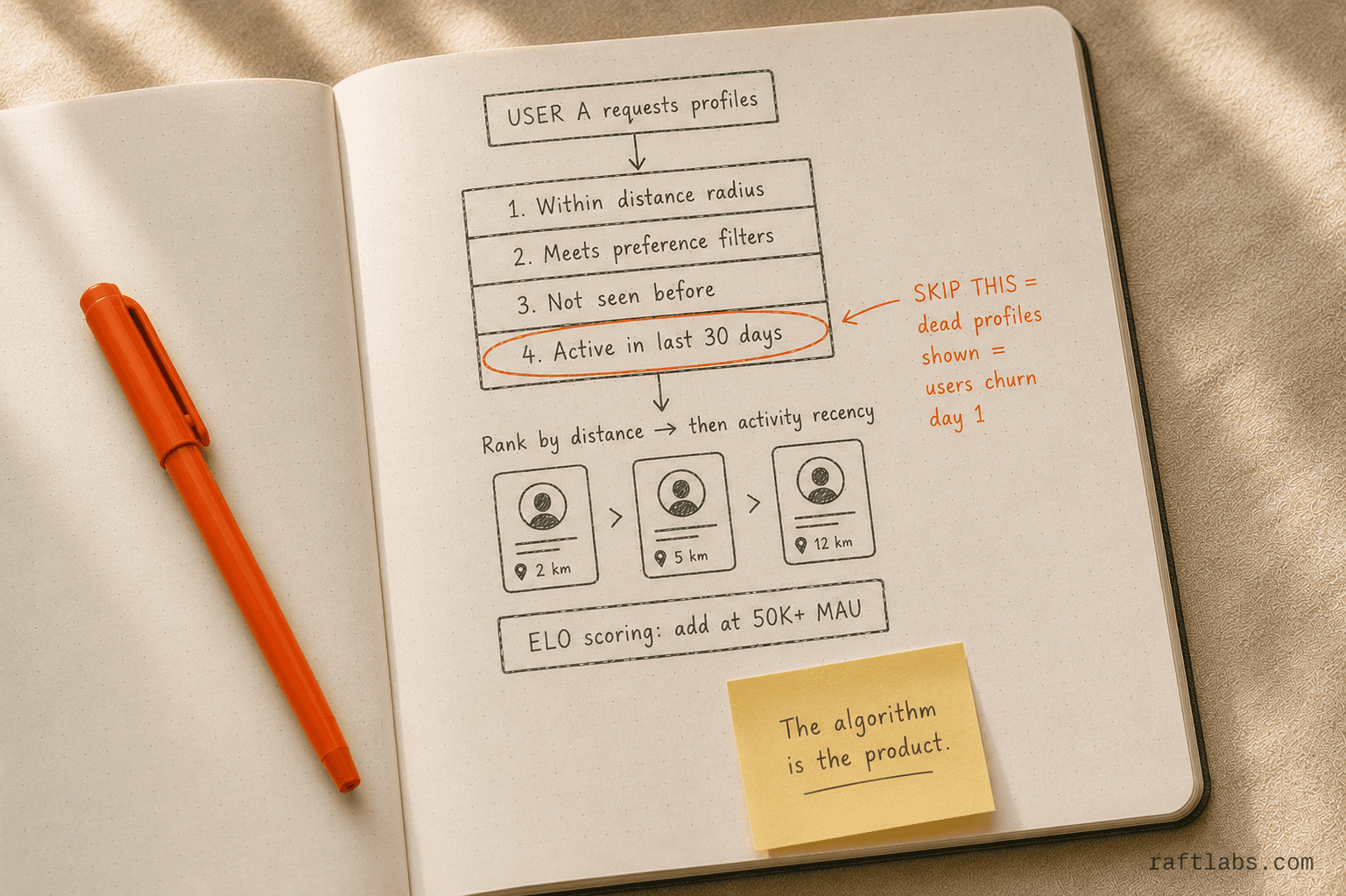
The swipe card interface is a solved engineering problem. Three days of frontend work. The discovery algorithm -- which profiles you show each user and in what order -- is the primary product decision that determines retention.
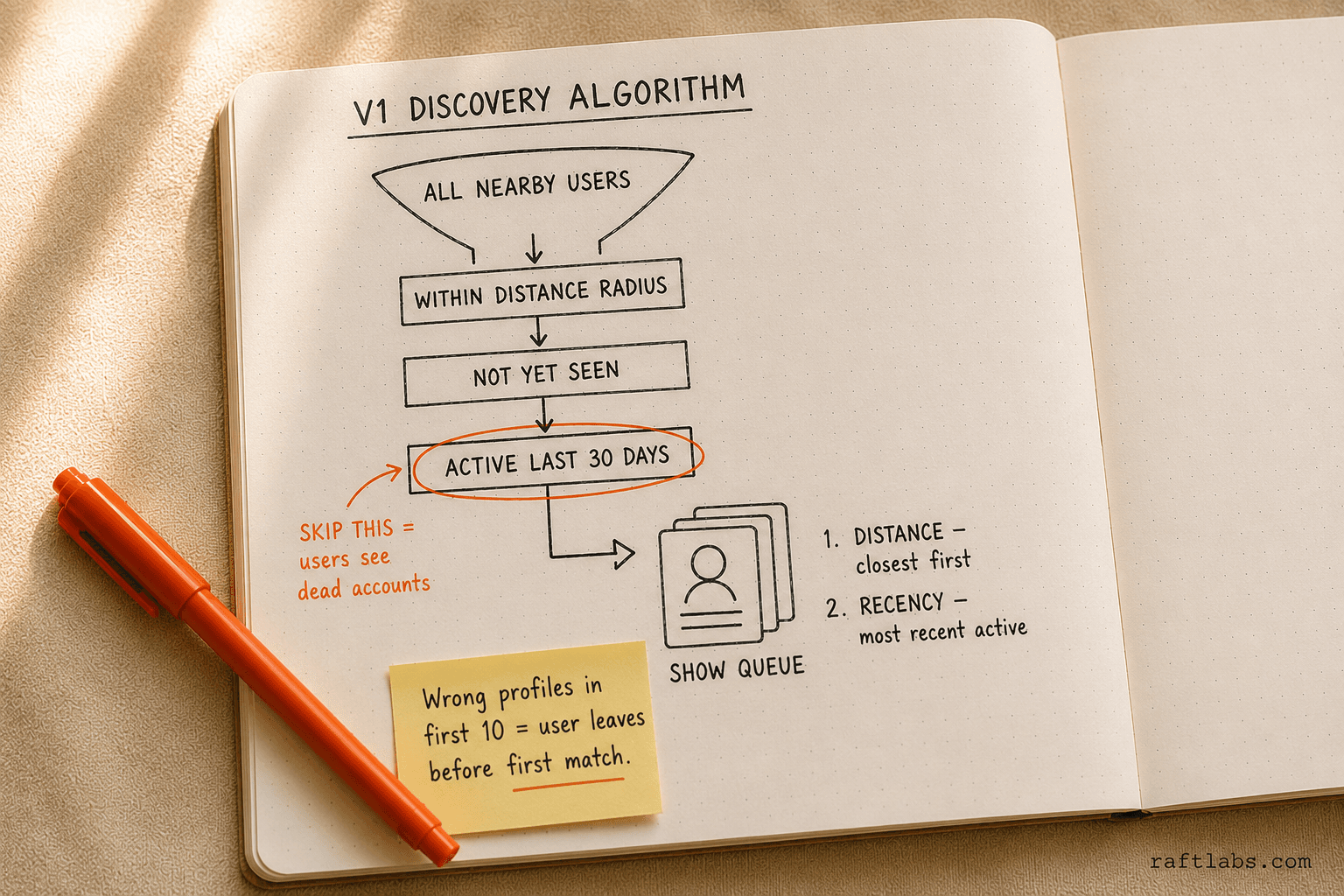
Research from the University of Michigan found that users make swiping decisions in under 0.5 seconds, relying almost entirely on profile photos and proximity signals. If the first 10 profiles a new user sees are low quality, inactive, or outside their stated preferences, they churn before they ever experience a match. Most apps lose 40% to 60% of new users in the first session. The discovery algorithm is why.
A simple v1 approach that works: show users who are within the specified distance radius, meet basic preference filters, have not been shown to this user before, and have been active in the last 30 days. Order by distance first, activity recency second. This produces a functional product.
The failure mode we see most often: founders skip the "active in the last 30 days" filter to show more profiles to new users. New users then see inactive accounts, swipe right, get no match back, and assume the app is dead. Adding the activity recency filter after launch, once users have already formed that impression, costs 6 to 8 weeks of re-engagement work that is largely unsuccessful.
As you accumulate swipe data -- typically after 90 days -- improve by deprioritizing profiles with very low acceptance rates (suggesting inactive or low-quality accounts) and boosting profiles where the user's historical swipe pattern suggests a likely match. An ELO-style scoring system becomes worth building above 50,000 active users.
The two-sided market problem
Tinder reported 75 million monthly active users as of 2023, according to Match Group's Q1 2023 earnings. Despite that scale, the two-sided bootstrapping problem never fully goes away. New geographies, new age segments, and new features all restart it.
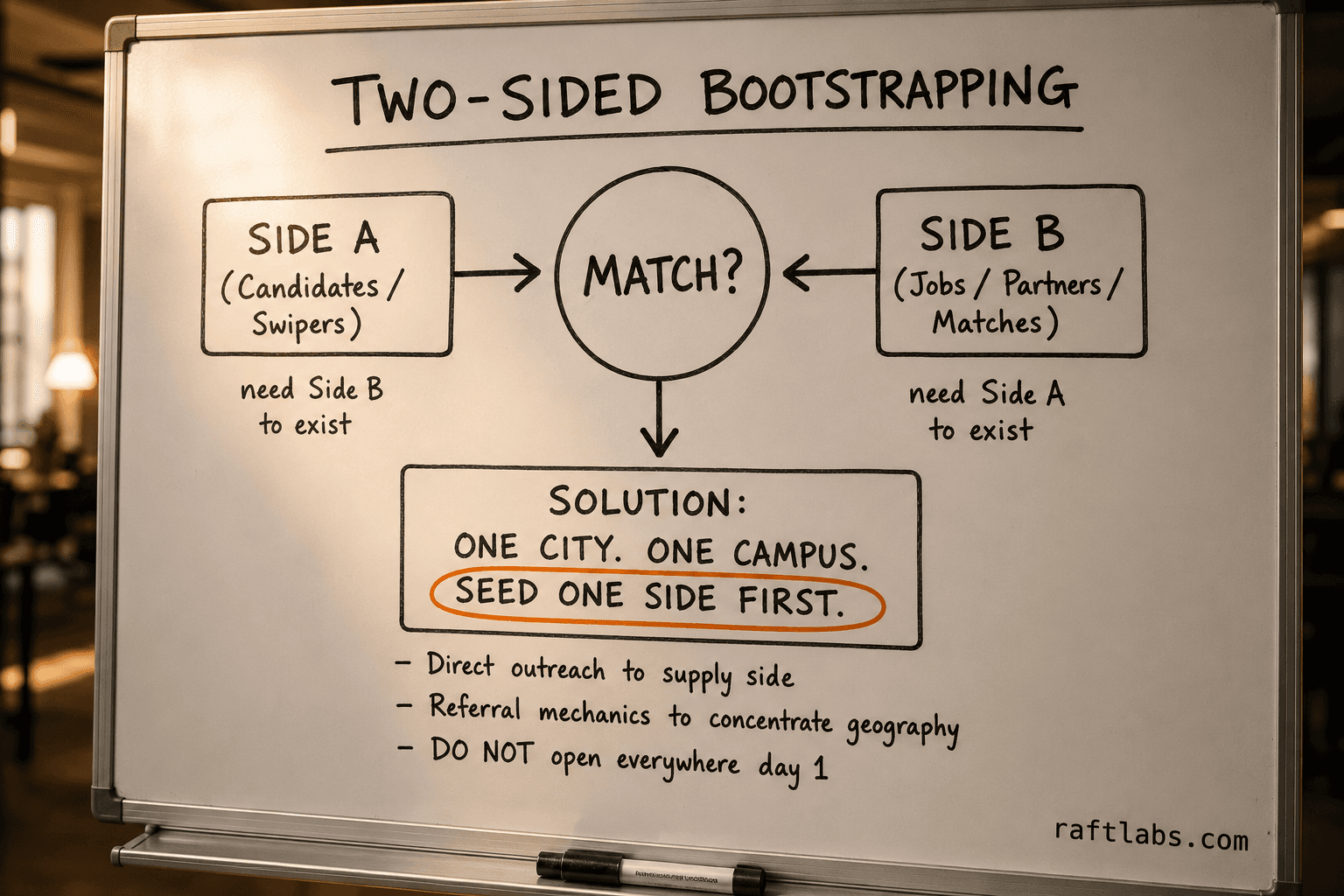
Matching apps are two-sided markets. Value depends on both sides being present in the same location at the same time. A dating app with only men is worthless. A hiring app with only candidates is worthless.
Tinder solved this by launching at USC and targeting the Greek life community -- a dense, social population where word-of-mouth spread quickly within a closed network. The geography and density created a local network fast enough to produce matches before anyone left.
For your platform: launch in one city, one campus, one company, or one community first. Seed one side of the market (often the supply side -- the people being matched to). Use referral mechanics to concentrate users geographically. Do not open everywhere on day one. Diluted geography kills match rate faster than any technical bug.
"The hardest part of building a two-sided marketplace isn't the technology. It's the chicken-and-egg problem. You need supply to attract demand, and demand to attract supply. The teams that solve this pick a small enough geography that they can manufacture density artificially at the start." -- Andrew Chen, general partner, Andreessen Horowitz, from his essay The Cold Start Problem

Safety requirements (not optional, not v2)
A 2019 ProPublica investigation revealed that Tinder allowed registered sex offenders to use the platform, triggering Match Group to eventually add ID verification. Safety requirements on dating platforms are now set by public expectation, not just regulation.
Phone number verification at signup prevents throwaway accounts. It costs $0.05 to $0.10 per verification via Twilio and needs to go in v1. Block and report must be in v1 -- any user can block any other, removing them from both discovery queues and messaging permanently. Photo moderation (automated scanning for explicit content) needs to be in v1 for dating platforms; for professional matching platforms, human review of reported profiles is sufficient.
Photo verification (live selfie matched to profile photos) is the bar before you run marketing spend or pursue press. Build it in v2 at the latest. The $10,000 to $20,000 cost is far less than the trust damage of one widely reported safety incident.
For a healthcare, legal, or other regulated vertical: license and credential verification (Checkr or equivalent) must be in v1. It defines the profile data model. Attempting to add it later requires migrating all existing profiles and re-verifying your entire user base.
How do you structure the build versus buying an existing platform?
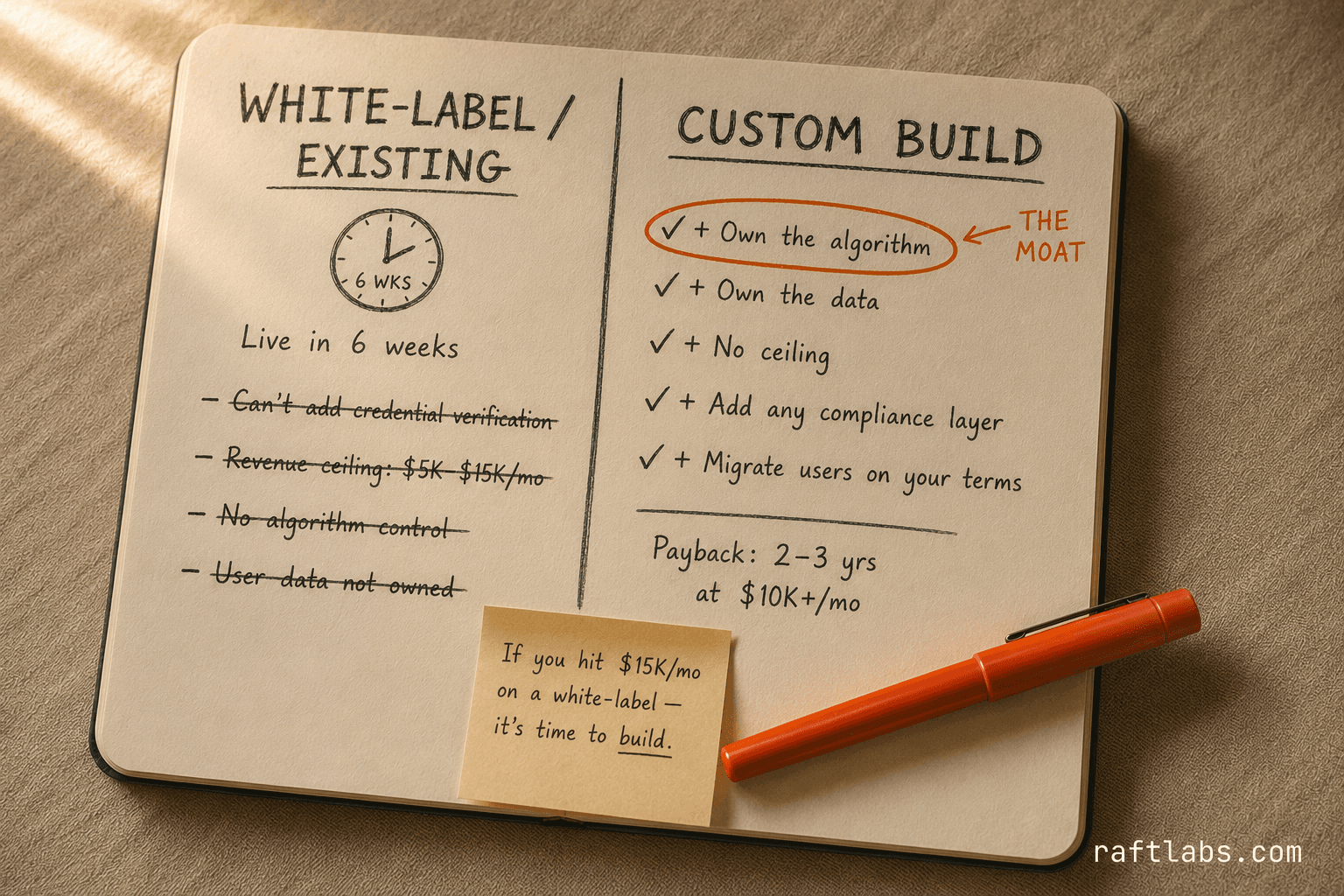
Keep an existing platform when:
You are testing whether the swipe mechanic resonates with your audience before committing $70K+. Use no-code tools or a white-label matching SaaS ($200-$500 per month) to validate demand first.
Your vertical has fewer than 5,000 potential users in your target geography. A custom build needs scale to justify the operating cost.
You need the product live in under 6 weeks. A custom build at this speed requires cutting safety features, which is the wrong trade-off for a matching product.
Build your own when:
Your vertical requires profile fields, verification steps, or matching criteria that no existing platform supports (healthcare credentials, professional portfolio, industry-specific compliance).
You are a staffing, recruiting, or service marketplace where the matching mechanic is a competitive moat, not just a UX choice.
You expect the platform to generate $10,000+ monthly revenue within 18 months. At that level, a custom build pays back within two to three years and you own the data and the algorithm.
Your community requires closed access (invitation-only, verified membership, geographic restriction) that consumer platforms are not designed to enforce.
The specific trigger we see in our work: companies that launch on an existing platform, reach a revenue ceiling (typically $5,000 to $15,000 per month), and then discover they cannot move past it without features the platform does not offer. The custom build at that point is more expensive than if they had built from the start, because they now have a user base on a platform they cannot migrate cleanly.
What we have seen building these platforms
The geographic launch strategy is the biggest variable in time to product-market fit. Teams who launch in one dense market (one city, one university, one professional community) and manufacture density artificially through direct outreach get to product-market fit 6 to 9 months faster than teams who launch globally with a thin user base.
The second failure mode: building the premium subscription before the free product produces quality matches. Users will not pay for unlimited swipes if the swipes they already get produce no matches. The monetization layer needs to come after -- not alongside -- proof that the discovery algorithm works.
RaftLabs has built matching platforms for professional communities, service discovery, and mentorship programs. The recurring finding: teams who nail the geographic launch strategy get to product-market fit faster. In each case, the core mechanic is the same. The profile data, filtering criteria, and compliance requirements differ significantly by vertical. Healthcare provider matching requires license verification. Legal service matching requires bar admission verification. The domain shapes the compliance requirements, which shape the architecture.
If you are building a matching platform for a specific vertical, the domain requirements are where we start. Book a 30-minute scoping call and we will tell you what the build looks like for your use case.
Frequently asked questions
- An MVP with swipe cards, mutual matching, profile setup, and messaging takes 10-16 weeks with a team of 3-5 developers. A polished app with photo verification, boost features, and premium subscriptions takes 20-28 weeks. The geolocation-based discovery stack and recommendation algorithm add the most complexity.
- MVP development: $35K-$70K. Monthly operating costs: $3K-$10K for a small user base. Photo verification services, SMS verification via Twilio, and Stripe for premium subscriptions are the main ongoing costs. Moderation (reviewing reported profiles) requires human reviewers at scale.
- Tinder's rating system scores profiles based on right swipe ratio to total profile views. High-scoring profiles appear to other high-scoring users first. New users get an initial boost. Active users rank higher. For v1, a simpler approach works: show active users within the specified distance radius who haven't seen each other yet, ordered by distance and activity recency.
- Photo verification (live selfie matched to profile photos), phone number verification at signup, profile reporting, and manual review of reported profiles are the baseline. AWS Rekognition or similar tools handle automated image scanning. For regulated use cases, integrate Checkr for background checks.
- Freemium with premium subscriptions is standard. Free tier limits swipes per day. Premium gives users unlimited swipes, visibility into who liked them, rewind on the last swipe, profile boost credits, and global discovery. Boost (show your profile to more users for 30 minutes) is a high-margin one-time purchase. Avoid pay-to-match models. They damage the core product.
Ask an AI
Get an instant summary of this post from your preferred AI assistant.
Related articles

How to Build an App Like BetterHelp: Teletherapy Platform Architecture, HIPAA Requirements, and Real Costs
BetterHelp connects clients with licensed therapists through async messaging and video sessions. Building something like it means solving therapist credentialing, HIPAA compliance, and a matching engine -- before you write a single line of client-facing code.

How to Build an E-Commerce Platform Like Shopify: Storefront Engine, App Ecosystem, and What Merchants Need
If you are building a vertical e-commerce platform for a specific industry, region, or business model that Shopify does not serve well, the engineering is substantial. Here is what it actually takes: multi-tenancy, a storefront builder, Stripe Connect payments, and more.
How to Build an App Like Uber: Driver-Passenger Matching, Dynamic Pricing, and What Ride-Hailing Really Costs
You don't need to understand WebSockets or geospatial indexing to build an app like Uber. You need to understand which features matter, which ones can wait, and where most founders blow their budget. Here's the playbook.