Apps Like Uber: The Owner's Playbook
You are not building a global ride-hailing competitor. You are building a fleet service, a corporate shuttle, or a niche vertical where Uber's model does not fit. Here is what it costs, how long it takes, and why clone scripts will waste your budget.

In this article
Short answer
Apps like Uber cost $35,000 to $70,000 to build for a single-city MVP, over 12 to 16 weeks of development. That covers a rider app, driver app, and admin panel with booking, matching, GPS tracking, and payments. A full platform with surge pricing and multi-city support runs $120,000 to $200,000. RaftLabs builds ride-hailing platforms in 12-week fixed-scope sprints.
Key takeaways
- You need three products, not one: a rider app, a driver app, and an admin panel. Each has completely different UX and user flows.
- Your V1 needs exactly six features: ride booking, driver matching, real-time tracking, payments, ratings, and an admin dashboard. Everything else is V2.
- The matching algorithm is your competitive advantage, not the UI. A good-enough UI with fast matching beats a beautiful app with 8-minute wait times.
- White-label clone scripts (NCrypted, Appdupe, GoSaaS) cost $5,000 to $20,000 upfront but typically cost 2 to 3x more to customize than building from scratch.
- Budget $15,000 to $50,000 per month for ongoing infrastructure costs (maps, hosting, payments, SMS) before you launch a single ride.
You are not building a global ride-hailing competitor. You are a regional fleet operator with 40 vehicles and a WhatsApp dispatch system that breaks every weekend. Or you run corporate shuttle services for a business park and Uber for Business will not negotiate the custom fare caps your clients need. Or you are in a niche where Uber simply does not operate: medical non-emergency transport, campus bike taxis, student shuttle with parent tracking.
These are real businesses with real transport problems. The question is not whether to build an app like Uber. The question is what to build, what it will cost, and what to skip for now.
The cost to build an app like Uber depends on scope. A single-city MVP (rider app, driver app, admin panel) costs $35,000 to $70,000 and takes 12 to 16 weeks. Here is the full range:
| Scope | Timeline | Cost |
|---|---|---|
| Single-city MVP (one vehicle type, core features) | 12-16 weeks | $35,000-$70,000 |
| Full platform (surge pricing, scheduled rides, analytics) | 20-28 weeks | $70,000-$120,000 |
| Multi-city scale (fleet management, ML matching, carpooling) | 32-48 weeks | $120,000-$200,000+ |
| Ongoing infrastructure (maps, hosting, payments, SMS) | per month | $15,000-$50,000/month |
The range inside each tier moves based on map provider, matching complexity, payment integrations, and whether you need local compliance (HIPAA for medical transport, for example).
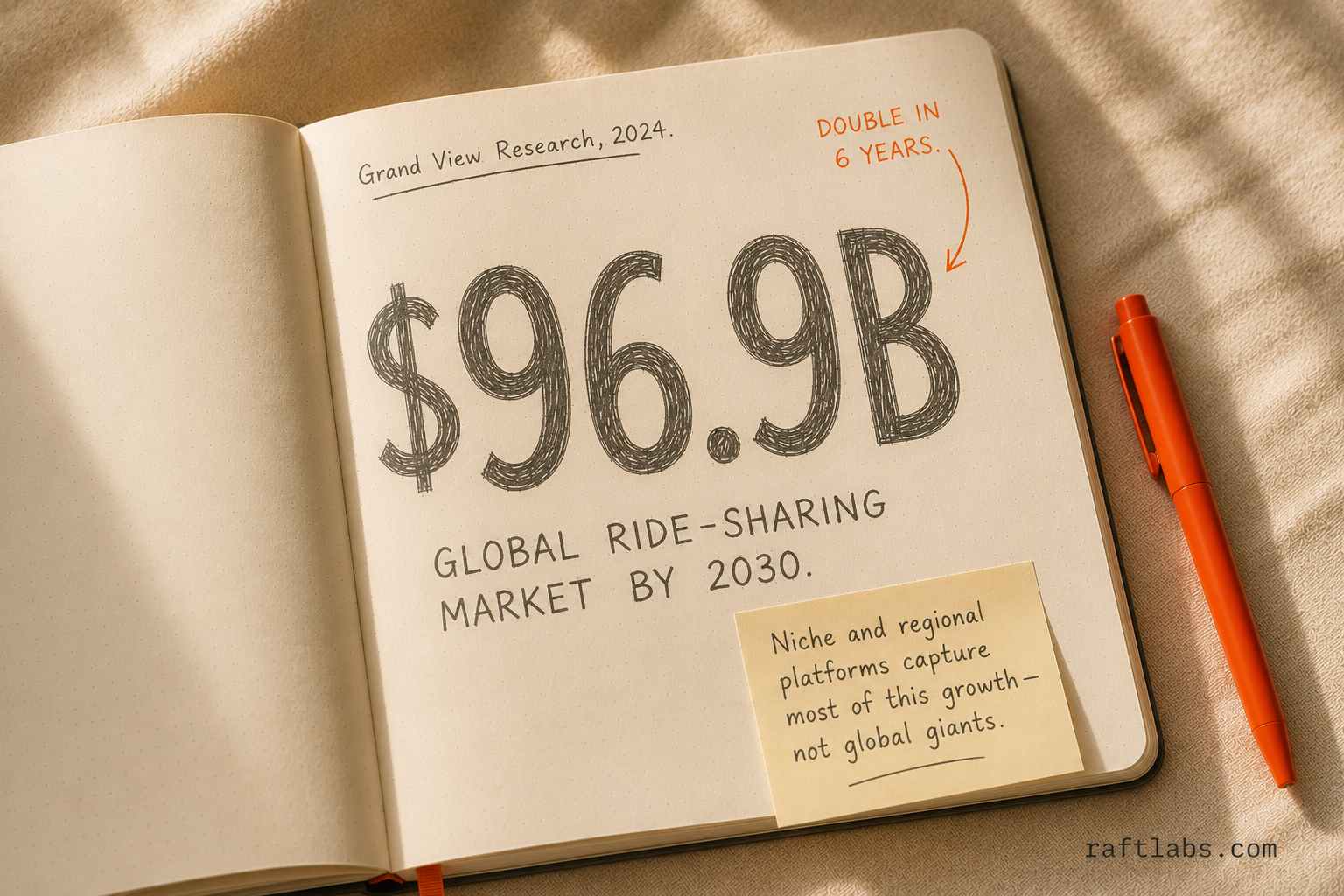
According to Grand View Research, the global ride-sharing market was $42.9 billion in 2024 and is projected to reach $96.9 billion by 2030. Most of that growth is in niche and regional platforms, not global ones. That is the window for operators who understand a specific market better than Uber does.
Who actually builds an app like Uber?
Most people building ride-hailing platforms are not trying to compete with Uber. They are solving problems Uber does not care about. Here are the four types of operators who build custom:
Regional fleet owners with existing client relationships. A company running 40 to 80 vehicles for airport transfers or corporate accounts already has the clients. They dispatch by phone and WhatsApp. Drivers poach repeat riders by going direct. A custom platform professionalizes the service, locks in the booking flow, and stops revenue leakage to drivers who work around the system.
Corporates building a captive transport product. A large employer or business park operator wants to run a private shuttle for staff. Uber will not negotiate exclusive terms, cannot restrict access to verified employees, and will not integrate with HR systems for cost-center allocation. A custom platform does all three.
Niche verticals Uber has exited or ignored. Bike taxis and e-rickshaws in South and Southeast Asia. Medical non-emergency transport in the US, which requires insurance billing integration and different driver credential verification. Student transport in Latin America, where parents need real-time tracking and driver identity confirmation before the child boards. These verticals need completely different flows than Uber provides. Trying to adapt Uber's model for them is the wrong starting point.
Marketplace builders adding transport as a feature. A home services platform adding handyperson scheduling. A hospitality group adding in-resort transfers. A medical platform adding telehealth visit transport. For these operators, transport is not the core product. It is a feature that keeps users inside the ecosystem. Building on top of an Uber API integration would mean sending users out of the product to complete the most important action.
"The companies winning in local mobility markets are not out-investing Uber. They are out-serving specific customer segments that Uber treats as an afterthought."
Brad Templeton, autonomous vehicle researcher and transport technology advisor, Forbes Technology Council, 2023.
How does Uber make money, and what are your options?
Uber takes a commission of 15 to 30% on every ride fare, varying by city, vehicle type, and driver tenure. That commission is the only revenue source for core ride-hailing. When you build your own platform, your options are:
Commission model. You take a percentage of every fare. Standard for ride-hailing. Easy to explain to drivers. The risk: if your commission feels too high, drivers list on competing platforms or go direct with repeat riders.
Subscription model. Drivers pay a flat weekly or monthly fee instead of per-ride commissions. Popular with corporate fleets. Predictable revenue for you, predictable costs for drivers. Requires enough driver volume to justify the fee.
B2B contract model. You sell access to corporate clients at a negotiated rate per seat or per ride. This works for corporate shuttle, campus transport, and airport transfer verticals. Lower volume, higher margin, much easier sales cycle than consumer ride-hailing.
Hybrid. Many regional platforms combine a low commission (8 to 12%) with a small per-ride booking fee charged to riders. The booking fee funds SMS and map costs directly.
At 500 rides per day with an average fare of $15 and a 20% commission, gross platform revenue is $1,500/day or $45,000/month. Monthly infrastructure costs at that volume run $20,000 to $30,000. The unit economics work. Below 200 rides/day, they often do not without a subscription or B2B component.
V1, V2, V3 feature breakdown: what to build and when
A single-city MVP needs exactly six features. Everything else is V2 or V3.
According to Statista's mobility market data, the average ride-hailing session from app open to ride end is under 4 minutes on top-performing platforms. That number is driven by matching speed, not UI design. Build the matching engine first. Polish the UI second.
Feature priority by version
V1
Launch ($35K-$70K, 12-16 weeks)
The six features your MVP needs. Ship with these and nothing else.
- Ride booking with fare estimates
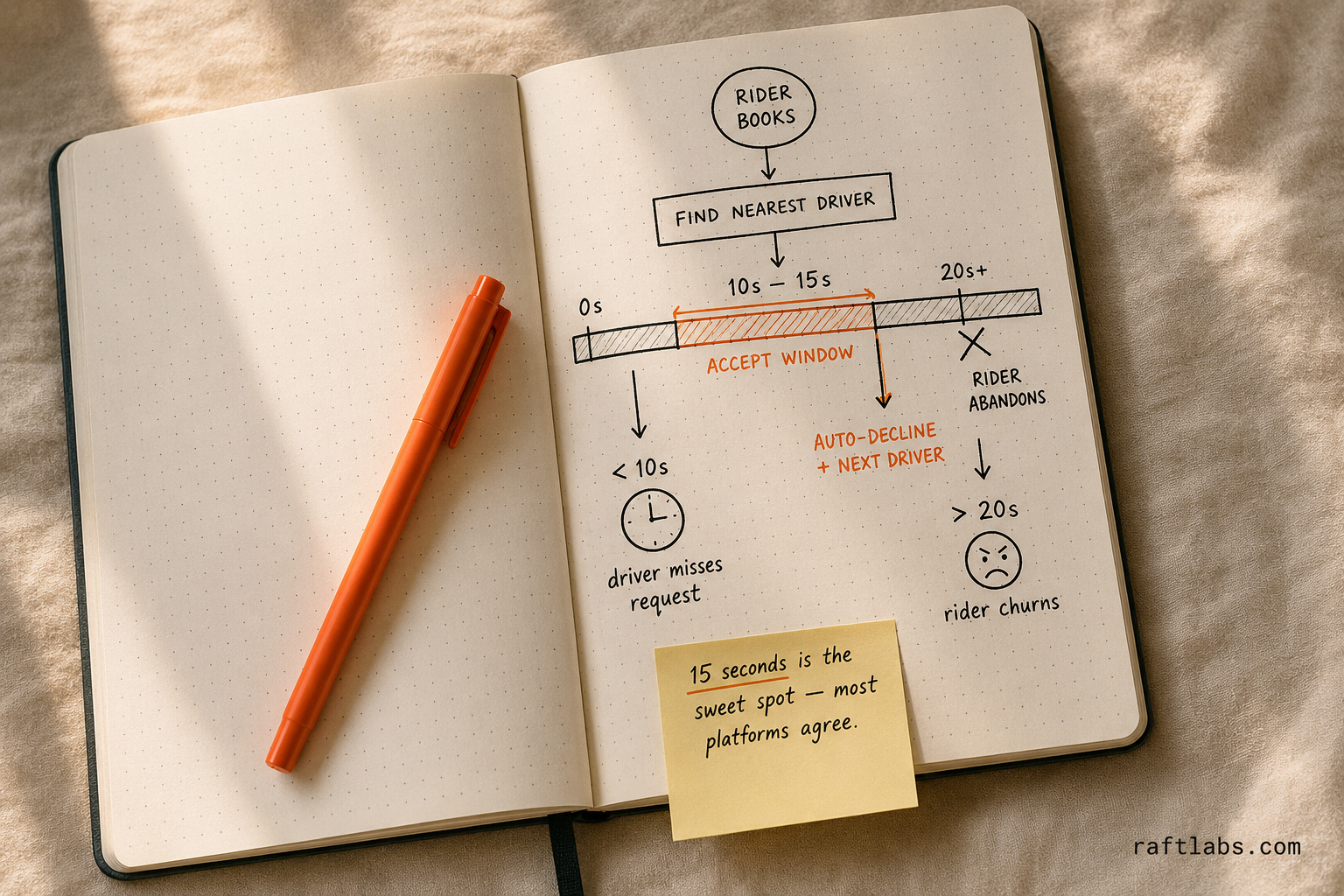
- Driver matching (nearest driver, 15-second accept window)
- Real-time GPS tracking with path smoothing
- Card payments with weekly driver payouts
- Two-way ratings (rider and driver)
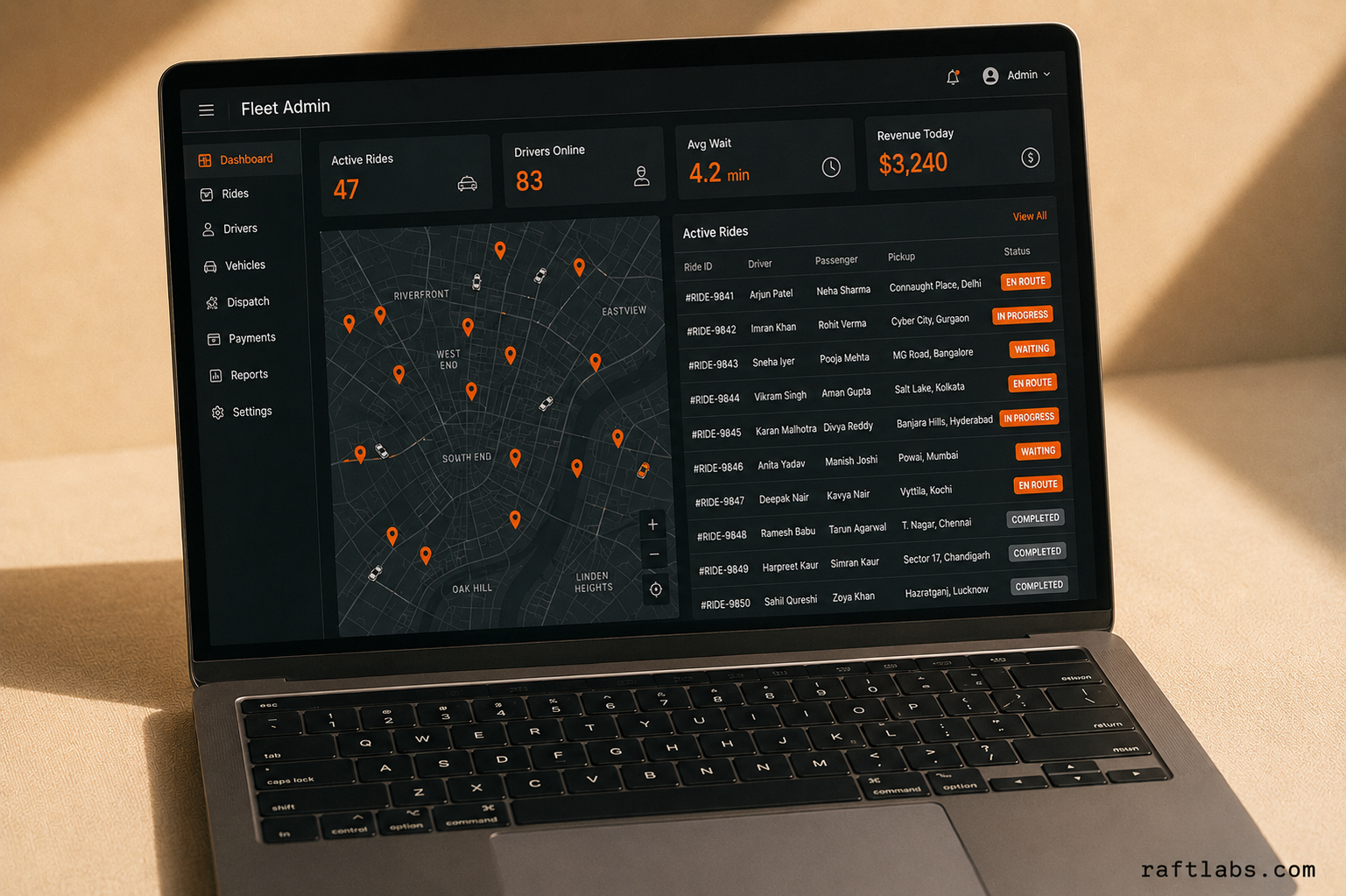
- Admin panel with live ride map and driver management
V2
Growth (add post-launch, +$50K-$80K)
Add these after you have real riders and drivers. Each one is expensive to build before you have usage data to justify it.
- Surge pricing ($15K-$25K)
- Scheduled rides ($8K-$15K)
- Fare splitting ($8K-$12K)
- Promo codes and referral system
- Driver analytics and heat maps
- In-app chat ($5K-$10K)
- Multi-factor matching ($20K-$35K, reduces wait time 25-40%)
V3
Scale (5,000+ rides/day, +$80K-$130K)
Enterprise features that only matter at high volume. Do not build these until the data justifies the investment.
- Multi-city architecture ($30K-$50K)
- Fleet management and dispatch optimization
- ML-optimized matching ($50K-$80K)
- Ride sharing and carpooling ($30K-$50K)
- Driver subscription plans
The V2 matching upgrade deserves a specific note. Proximity-only matching (V1) costs $5,000 to $10,000 to build. Multi-factor matching, which accounts for driver ratings, estimated pickup time, and route direction, costs $20,000 to $35,000 and reduces average wait times by 25 to 40%. Build proximity matching first. The data from your first 90 days will tell you whether the upgrade is justified.
White-label Uber clone vs. custom build: what the clone scripts actually cost you
If you have searched for "how to build an app like Uber for free" or looked at budget options, you have found clone scripts. NCrypted, Appdupe, and GoSaaS all sell white-label Uber clone products. Here is what you need to know before buying one.
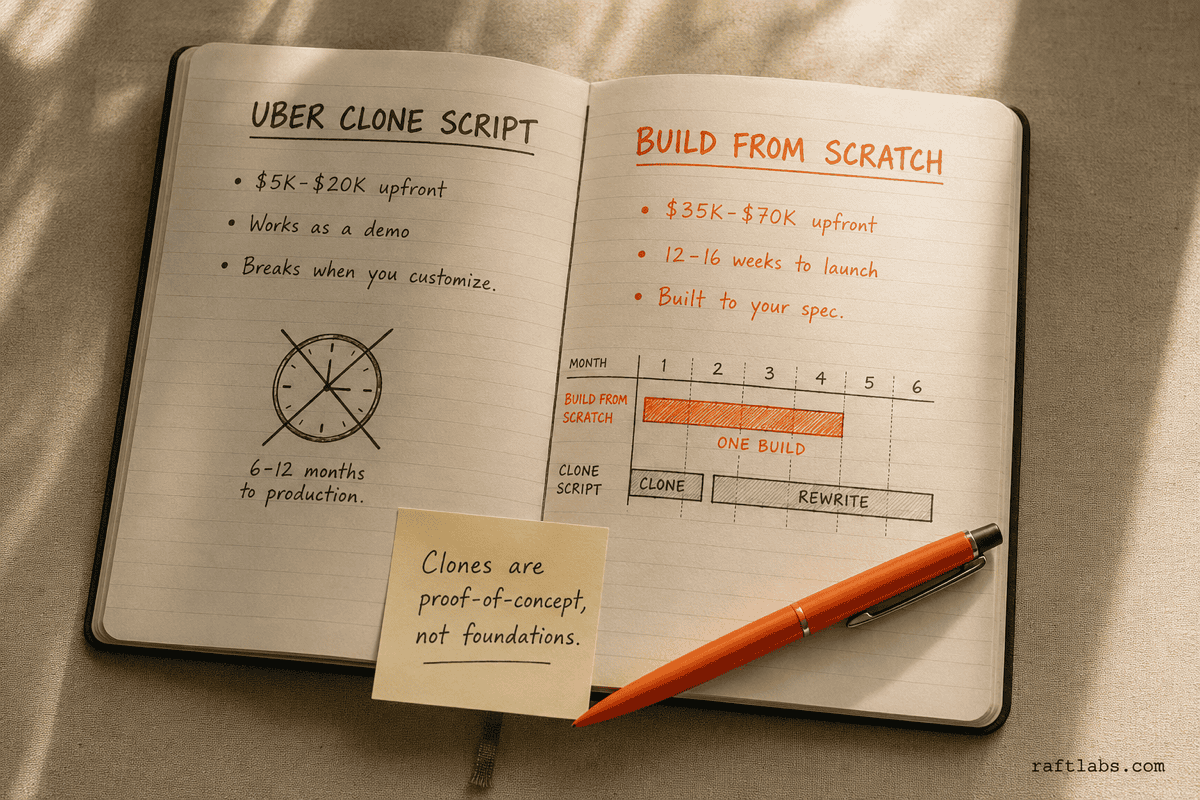
The upfront price is $5,000 to $20,000 depending on the vendor and the tier. That price buys you a demo. It works. You can log in, request a ride, and watch a driver move on a map. It is genuinely functional in a controlled environment.
The problems start when you try to use it as a real business:
The codebase is not designed for modification. Clone scripts are built to be sold, not extended. When you need to change the matching logic, add a local payment method, or build a custom admin view, you are editing someone else's undocumented code. The developers who wrote it are not available to you. Every change requires understanding a codebase that was never meant to be understood by an outside team.
Local payment integration costs more than expected. Stripe works in 40+ countries, but if your market needs UPI, M-Pesa, GCash, or any local payment rail, the clone vendor did not build it. You are adding it yourself (or paying a developer to). Budget $10,000 to $20,000 per local payment method on top of the clone purchase price.
Compliance requirements are not included. Medical transport in the US requires HIPAA-adjacent data handling. Student transport may require specific background check workflows and parent consent flows. Corporate transport often requires SSO and cost-center billing. None of these are in the clone. Adding them means rewriting the parts that touch sensitive data, which is often most of the app.
Scaling breaks the architecture. Clone scripts are built for demos, not for 500+ rides/day. The database schemas are often not indexed correctly for geospatial queries. The real-time layer is usually a polling mechanism, not a proper WebSocket implementation. When volume hits, you will see it in wait times and server costs before you see it in error logs.
The teams who start with a clone typically spend 2 to 3x the original purchase price in customization before they abandon it and start over. The total Uber clone app development cost via this path is almost always higher than a custom build, and the timeline is longer because the customization work is unpredictable.
Here is the honest comparison:
| White-label clone (NCrypted/Appdupe/GoSaaS) | Custom build | |
|---|---|---|
| Upfront cost | $5,000-$20,000 | $35,000-$70,000 |
| Time to first demo | 1-2 weeks | 12-16 weeks |
| Time to production-ready | 6-12 months (with customization) | 12-16 weeks |
| Custom matching logic | Requires codebase rewrite | Built to spec |
| Local payment methods | Extra cost, undocumented integration | Scoped from day one |
| Compliance features | Not included | Designed in architecture |
| Ongoing support | Vendor-dependent, often slow | Your dev team |
| Total cost at 12 months | $15,000-$60,000+ | $35,000-$70,000 |
The clone looks cheaper at the start. It is almost never cheaper at the end.
Build vs. buy: keep using Uber when X, build custom when Y
This is the decision most operators skip, and it costs them either money or time.
Keep using Uber (or Uber for Business) when your ride volume is under 50 trips per day. At that volume, the infrastructure cost of a custom platform outweighs the commission you would save. Uber for Business handles expense reporting, fare caps, and SSO. If that covers your requirements, use it.
Keep using existing platforms when you are in a single city with no special compliance needs and your main goal is demand validation. If you are testing whether riders in your target market will pay for the service, run it on an existing platform first. Build custom when you know the model works.
Build your own when your commission costs exceed $8,000 to $12,000 per month. At 500+ rides per day with average fares of $12 to $20, you are paying Uber-equivalent commissions that would pay back a custom build in 18 to 24 months.
Build your own when you need features Uber does not offer. Driver verification that goes beyond a standard background check. Fare structures Uber will not negotiate, such as fixed corporate contracts, monthly billing, and cost-center allocation. Integration with HR or hotel management systems for automatic reimbursement.
Build your own when you are in a market where Uber's supply is unreliable. If riders in your city cannot get a car in under 8 minutes during peak hours, you have a supply gap Uber will not fix. A custom platform lets you incentivize local drivers directly.
According to McKinsey's digital research, early architectural decisions account for 40 to 70% of total project cost variance. The build-vs-buy decision is the first one that matters.
Where ride-hailing builds go wrong
Two failure modes appear in almost every ride-hailing build. They are predictable. They are preventable.
The driver economics problem. Teams model the rider experience carefully and treat driver economics as an afterthought. If your commission is too high, or payouts are too slow, drivers list on your platform and a competitor's simultaneously. They accept requests from whichever platform pings first, then cancel the other. Your rider wait times spike. Riders churn. The platform fails, not because of the technology, but because the unit economics for drivers never worked.
Model driver earnings before you write a line of code: average fare, your commission, fuel cost, vehicle depreciation. If a driver cannot make minimum wage in your market after expenses, no amount of engineering fixes that. The break-even calculation for drivers needs to be in your business model before your first line of code is written.
The scope escalation problem. Every rider wants scheduled rides. Every driver wants an earnings forecast. Every operations manager wants a custom report. The MVP scope that made financial sense at $70,000 becomes a $140,000 scope after four months of stakeholder input. The discipline to say "that is V2" is the hardest thing about running a ride-hailing build. It is also the most important.
How RaftLabs approaches ride-hailing builds
For a founder entering ride-hailing, we scope a single-city MVP at 14 to 16 weeks. That covers cross-platform rider and driver apps, proximity-based matching with a 15-second accept timeout, real-time GPS tracking with path smoothing, time-and-distance pricing with configurable rates, card payments via Stripe Connect with weekly driver payouts, and an admin panel with a live ride map, driver management tools, and basic analytics.
We have built marketplace platforms with real-time dispatch, multi-party payments, and driver management across our product portfolio. The ride-hailing architecture shares 70% of its foundation with food delivery, logistics, and on-demand service platforms. The core problems, matching, payments, and real-time sync, are ones we have solved before. We do not charge you for the learning curve.
If you are running more than 50 rides per day on spreadsheets and phone calls, or you are planning a niche transport vertical that Uber's model does not serve, here is what the first 90 days with RaftLabs looks like: two weeks of discovery to nail the feature spec and architecture decisions, followed by 12 to 14 weeks of development to your first beta with real drivers on the road. Request a 30-minute call with our team and we will give you a realistic cost and timeline based on your market, vehicle type, and target launch date.
Ask an AI
Get an instant summary of this post from your preferred AI assistant.
Common questions
- A single-city ride-hailing MVP (rider app, driver app, admin panel, core features) costs $35,000 to $70,000. A full platform with surge pricing, scheduled rides, and analytics runs $70,000 to $120,000. Multi-city scale with fleet management and ML matching runs $120,000 to $200,000. Ongoing infrastructure costs $15,000 to $50,000 per month at operating scale.
- A single-city MVP takes 12 to 16 weeks with a team of 4 to 6 developers. A full platform with surge pricing and scheduled rides takes 20 to 28 weeks. Multi-city platforms with fleet management take 32 to 48 weeks. Budget an additional 2 to 4 weeks for beta testing before launch.
- Clone scripts from NCrypted, Appdupe, or GoSaaS cost $5,000 to $20,000 upfront and work as demos. The moment you need custom matching logic, local payment integration, or compliance features, you are modifying undocumented code. Most teams who start with a clone spend 2 to 3x the rebuild cost in customization before giving up and starting over.
- Yes. Riders and drivers have completely different workflows, UX needs, and feature sets. Combining them into one app creates confusion and bloat. Build two separate apps sharing the same backend API. The admin panel is a third product with its own requirements around live monitoring, driver onboarding, and dispute resolution.
- RaftLabs builds marketplace platforms with real-time tracking, dispatch algorithms, and multi-party payments, delivered in 12-week fixed-scope sprints. We have solved the hard problems - matching, payments, real-time sync - so your team focuses on growth, not infrastructure.