Messaging App Development: What It Costs and Who Actually Needs a Custom Build
Most companies asking about messaging app development don't need a Telegram clone. They need encrypted group communication baked into a product they already own. Here is what it costs, what breaks at scale, and when a custom build beats every off-the-shelf option.

In this article
Short answer
Custom messaging app development costs $30K-$60K for an MVP with group chats, media sharing, and push notifications, delivered in 14-18 weeks. Full platforms with encryption and a bot API run $140K-$250K. RaftLabs builds secure messaging features for SaaS platforms, community operators, and regulated businesses. TLS plus AES-256 at rest covers most use cases without the complexity of full end-to-end encryption.
Key takeaways
- Most businesses need messaging as a feature inside a larger product, not a standalone app. Build the integration layer first, not the standalone app.
- Clone scripts like Applozic and SendBird charge per-message or per-MAU fees that become expensive fast. At 50K active users you can spend $8K-$20K per month on platform fees alone.
- End-to-end encryption adds $30K-$50K and 4-8 weeks. For most SaaS tools and community platforms, TLS in transit plus AES-256 at rest is sufficient and far simpler to maintain.
- Group chats at 200K members need a fan-out architecture completely different from small group messaging. Build for 50 members in V1. Architect for growth from day one.
- Real-time presence (online/last seen) is harder than message delivery. It needs persistent connection tracking, heartbeat signals, and a Redis-based presence store shared across server instances.
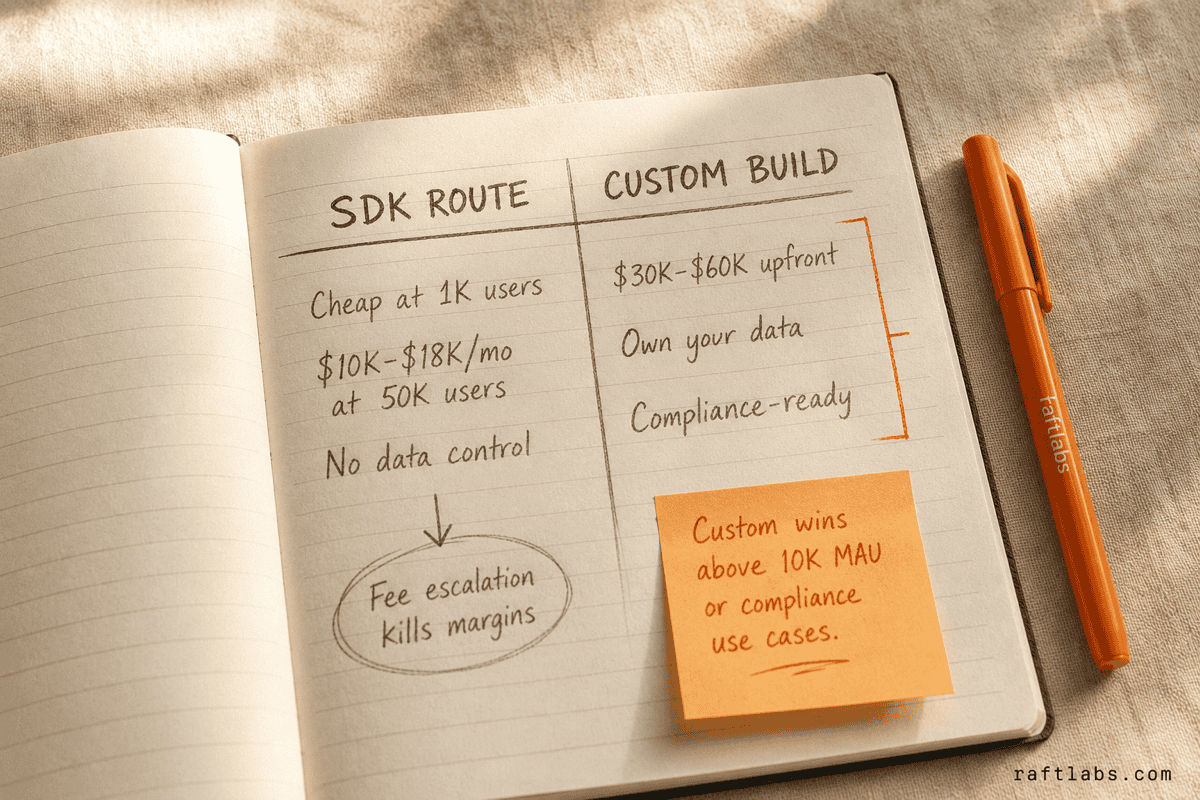
You run a SaaS platform with 12,000 paying customers. Your users keep asking you to add in-app messaging so they can coordinate without leaving your product. You have looked at Twilio, SendBird, and a handful of white-label clone scripts. The pricing looks manageable at first glance, then you pull the calculator and run the numbers at 50K monthly active users. Suddenly you are looking at $10K-$18K per month in platform fees on top of your own infrastructure costs.
That is the moment most product teams start asking the right question: when does custom messaging app development actually make sense, and what does it cost to do it properly?
This guide is for you if you are a product owner, founder, or operator at a SaaS company, community platform, or marketplace who needs messaging as a core product feature. It is not for developers looking for a WebSocket tutorial.
What it costs to build a messaging app
Cost depends entirely on scope. Here are three realistic scenarios:
| Scope | Timeline | Cost |
|---|---|---|
| MVP (1-on-1 messaging, group chats up to 50 members, push notifications, media sharing) | 14-18 weeks | $30K-$60K |
| Full-featured platform (E2E encryption, broadcast channels, voice and video calls) | 6-9 months | $60K-$180K |
| Scale platform (bot API, 200K-member supergroups, compliance export, admin dashboard) | 10-14 months | $140K-$250K |
Monthly operating costs after launch run $3K-$10K for a 10K-50K active user base. That scales with message volume, media storage, and connection count. A platform with heavy media sharing (voice notes, video clips) will sit at the higher end of that range within six months of launch.
Clone scripts vs. custom build
Before you commit to a custom build, you should know what the alternatives are and why they fall short for anything beyond a small-scale use case.
Applozic (now Kommunicate) is a white-label chat SDK with a visual UI kit. It gives you messaging in a few days of integration work. The problem is cost at scale. Pricing moves to custom enterprise tiers above 5K MAUs, and those tiers start at $1,500-$3,000 per month before you have negotiated anything. You also get no control over infrastructure, no data portability guarantee, and no ability to modify the message delivery logic.
CometChat is another popular option with a polished UI. At 10K MAUs their standard plan runs roughly $599/month. At 50K MAUs you are on an enterprise plan at $2,000-$5,000/month. That sounds manageable until you factor in that the vendor controls your SLA, your data retention policy, and your feature roadmap. If CometChat changes pricing or deprecates an API, you absorb the impact.
Open-source clone scripts (e.g., Rocket.Chat, Matrix/Element) look attractive because the software is free. The reality is that self-hosting and customizing them requires ongoing engineering effort that most teams underestimate. Rocket.Chat in particular needs a dedicated DevOps resource for upgrades, security patches, and scaling. One Rocket.Chat hosting customer we talked to in 2025 was spending $4K/month on engineering time to maintain their self-hosted instance, which exceeded what a managed solution would have cost.
The three failure modes that come up repeatedly with clone scripts and white-label SDKs:
Fee escalation. Per-MAU pricing models look cheap at 1K users and punishing at 100K. You build your product economics on one number and discover the real number six months before you can migrate off.
Scaling limits. Most SDKs cap group size, message history retention, or media storage at the plan level. Hitting those limits in production means either paying for an upgrade or shipping a degraded experience to existing users.
Brand and data control. White-label tools put your user data on someone else's infrastructure under someone else's terms of service. In regulated industries, that is a blocker. For community products, losing control of your data model makes future product decisions harder.
Custom messaging app development makes sense when you are past 10K active users, when you need compliance controls the SDKs cannot offer, or when the messaging layer needs deep integration with your existing product data.
Who actually builds a messaging app
According to Grand View Research, the global messaging application API market was valued at $46.8 billion in 2024 and is projected to reach $130.9 billion by 2030, growing at a CAGR of 18.9%. That growth is driven by SaaS platforms, healthcare operators, and logistics companies embedding messaging directly into their products rather than sending users to third-party apps.
SaaS platforms adding messaging as a core feature. A project management tool, a marketplace, or a field service platform where users coordinate inside the product. The goal is to eliminate the context switch to Slack or WhatsApp and keep engagement inside your product. These builds typically start at $40K-$80K because they need integration with existing user accounts, data models, and notification systems the SaaS product already owns.
Community platforms building paid member spaces. A creator with 40,000 subscribers who wants a paid community where members get direct messaging access. Telegram is free but you cannot monetize on it. Substack does not have real-time messaging. A custom platform where subscriptions, group access, and payments are native costs $70K-$120K and generates direct revenue instead of building audience on someone else's product.
Healthcare and regulated-industry operators. HIPAA prohibits using consumer messaging apps for patient information. A healthcare network that needs care coordination between clinical staff needs a BAA-covered platform with audit logs and access controls. Consumer messaging apps, including Telegram, do not qualify. A purpose-built platform costs $90K-$160K but removes the compliance exposure entirely.
Logistics and field service companies. Construction companies, delivery operations, and field service teams that need messaging tied directly to job dispatch, location, and task assignment. Telegram does not connect to those workflows. A coordination tool where messaging is one layer inside a broader operations product costs $80K-$140K and replaces manual coordination that costs more to sustain.
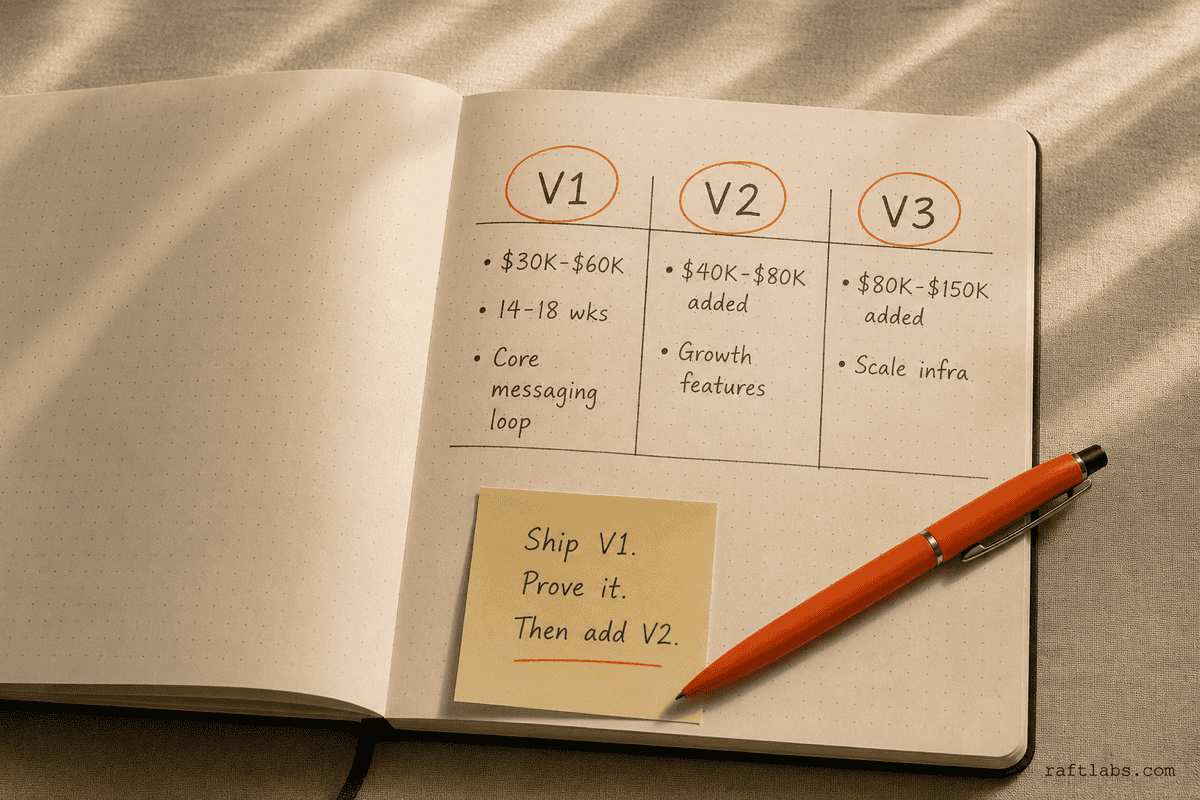
V1, V2, and V3 features
V1: what you must ship ($30K-$60K, 14-18 weeks)
These are the features your platform cannot open without.
| Feature | Why it must ship in V1 |
|---|---|
| User registration (phone or email, SSO option) | Prevents fake accounts; enables contact discovery |
| 1-on-1 messaging with delivery receipts | Sent, delivered, read. Users notice immediately when receipts are wrong |
| Group chats up to 50 members | Admin roles, basic moderation, group photo and name |
| Push notifications | Without this, retention collapses inside the first week |
| Media sharing up to 20MB | Images and files with server-side compression and CDN delivery |
| Message search | Search your own history. PostgreSQL handles it at MVP scale |
| Username-based discovery | Find users without sharing a phone number |
Cross-platform mobile (iOS and Android from one codebase) saves $30K-$50K versus building native apps separately. This is the right call unless you have a specific performance reason to go native.
V2: growth features ($40K-$80K added, 8-14 weeks)
Add these after you have proven the messaging loop works and users are active.
| Feature | When to add it | Cost to add post-launch |
|---|---|---|
| Broadcast channels (one-to-many publishing) | When users want to publish to subscriber lists, not just chat | $25K-$40K |
| Voice messages | High demand from existing users; lower effort than voice calls | $10K-$20K |
| Message reactions and threads | Engagement depth; users ask for it after 3-6 months of usage | $15K-$25K |
| Admin dashboard and analytics | When you need usage data, abuse reporting, or moderation at scale | $20K-$35K |
| Polls and quizzes | Community engagement; relatively low complexity | $10K-$15K |
V3: scale features ($80K-$150K added, when warranted)
Build these only when you have proven usage that demands them.
| Feature | Trigger threshold | Cost |
|---|---|---|
| Bot API and developer platform | When users or clients need automation inside the messaging layer | $50K-$80K |
| Voice and video calls (WebRTC) | Strong user demand; use Agora or Daily.co to avoid building WebRTC from scratch | $30K-$60K |
| End-to-end encryption | Regulated industry requirement or explicit privacy-first positioning | $30K-$50K |
| 200K-member supergroups | Fan-out architecture is fundamentally different from small groups | $40K-$70K |
Where messaging app projects fail
The delivery guarantee underestimate. This is the failure mode we see most often. Teams spend 60% of their budgeted real-time engineering time on edge cases: what happens when a recipient is offline for 72 hours and reconnects, what happens when the same user is on three devices at the same time, and what happens when a group message needs to fan out to 50 recipients across different server instances.
None of these edge cases show up in the product spec. They surface in QA.
Teams that design the offline queue, the acknowledgment protocol, and the multi-device sync state machine before writing a single line of real-time code ship on schedule. Teams that treat delivery guarantees as obvious add 3-4 weeks to the timeline mid-sprint. That cost compounds: delayed launch means delayed revenue, and delivery bugs after launch kill retention fast.
"The design space for secure messaging is surprisingly narrow once you accept the threat model. Most people don't need end-to-end encryption. They need encryption in transit and at rest, with strong access controls. Those are not the same thing, and conflating them leads to overbuilt products."
Matthew Green, Associate Professor of Cryptography, Johns Hopkins University
Real-time presence as an afterthought. Showing "online" or "last seen 2 minutes ago" sounds like a minor UI detail. It is not. Each server instance only knows about clients connected to it. When two users are connected to different server instances, your system needs a shared state layer to resolve presence in real time. At MVP scale, Redis handles this. Teams that do not design for distributed presence at the start pay $15K-$25K in rework when they scale past a single server instance. That rework also involves downtime, which community and SaaS products cannot afford.
According to Statista's 2024 messaging market data, over 3.1 billion people used a mobile messaging app at least once per month in 2023. The market is large, but users abandon messaging products within days of a broken experience. Delivery reliability is not a feature. It is the product.
How RaftLabs builds messaging apps
When a client comes to us for messaging app development, the first conversation is always product questions, not engineering questions.
What does messaging replace in your current product? If the answer is "Slack" or "WhatsApp," we dig into why users are switching away. That context shapes the feature list more than any technical decision.
What is your compliance context? Healthcare and legal clients need end-to-end encryption or, at minimum, rigorous access controls and audit logging. SaaS tools and community platforms almost never need E2E encryption. Conflating these use cases is the fastest way to overspend on V1.
What is the network model? How do your users find each other: by phone number, email, username, or through your existing user base? This shapes onboarding entirely and often changes the V1 scope in ways a generic spec misses.
We have built messaging features into field service platforms, healthcare coordination tools, SaaS products, and community platforms across more than 100 builds. The pattern that works: start with the core messaging loop, prove it with real users, then layer in complexity with actual usage data telling you what to build next.
If you are evaluating whether to build custom or use an SDK, a 30-minute call is usually enough to give you a clear answer. We will tell you what your specific build actually requires, whether the SDK route makes sense at your scale, and what it realistically costs either way.
Book a scoping call and we will scope your build in the first conversation.
Ask an AI
Get an instant summary of this post from your preferred AI assistant.
Common questions
- An MVP with 1-on-1 messaging, group chats up to 50 members, push notifications, and media sharing costs $30K-$60K and takes 14-18 weeks. Adding end-to-end encryption costs another $30K-$50K. A full platform with channels, a bot API, and voice and video calls runs $140K-$250K. Monthly operating costs for 10K-50K active users run $3K-$10K and scale with message volume and media storage.
- An MVP takes 14-18 weeks with a team of 4-6. Adding broadcast channels adds 4-6 weeks. A bot API adds another 6-10 weeks. End-to-end encryption adds 4-8 weeks on top. The fastest path is to ship the core messaging loop first and layer in complexity after you have real user data telling you what to build next.
- Build custom when you need compliance controls Twilio or SendBird cannot provide, when your product requires messaging tightly woven into existing data (job dispatch, patient records), or when per-seat SDK fees at your projected scale exceed $5K-$8K per month. For under 5K users or simple use cases, an SDK is almost always cheaper and faster.
- Phone or email registration, 1-on-1 text messaging with delivery receipts, group chats up to 50 members, image and file sharing up to 20MB, push notifications, message search, and username-based discovery. Channels, bots, voice calls, polls, and sticker packs are V2 decisions. Do not scope them into V1 unless you have direct evidence users need them on day one.
- Only if your use case demands it. Healthcare (HIPAA), legal, and financial services contexts require it. For most enterprise tools, community platforms, and SaaS features, TLS in transit plus AES-256 at rest is the right call. It is dramatically simpler to build and maintain. Do not add E2E encryption because Telegram has it. Add it because your compliance context requires it.