How to Build a Community Forum Like Reddit: Cost, Timeline, and What to Build First
Building a community forum like Reddit costs $40K-$80K for an MVP and takes 16-22 weeks. This guide covers the phased feature plan, when Discourse or NodeBB beats a custom build, and why moderation is the budget item founders always skip until it's too late.

In this article
Short answer
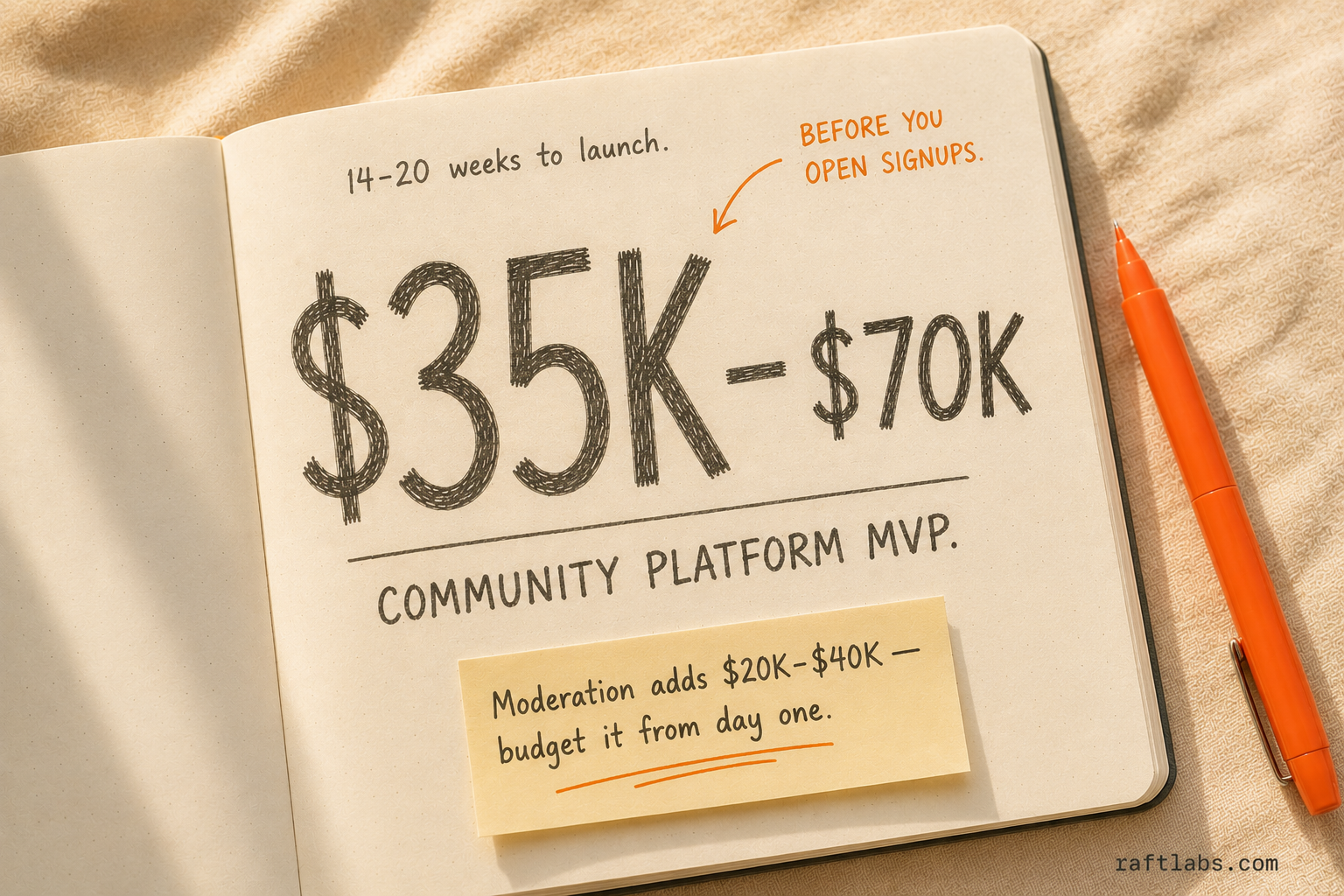
Building a community forum like Reddit costs $40K-$80K for an MVP and takes 16-22 weeks. RaftLabs builds these for vertical discussion platforms, brand community hubs, and professional associations needing threaded discussions with custom moderation. Core requirements: community containers, threaded comments, voting, user karma, and a moderation queue. Moderation adds $20K-$40K and cannot be deferred to phase two.
Key takeaways
- Community forums need five core entities: communities, posts, threaded comments, votes, and users. Get the data model right before writing a single line of frontend code - changing it mid-build adds 3-5 weeks.
- The ranking algorithm is a product decision, not an engineering one. A basic hot-score (vote weight plus time decay) works at launch. Do not overbuild it.
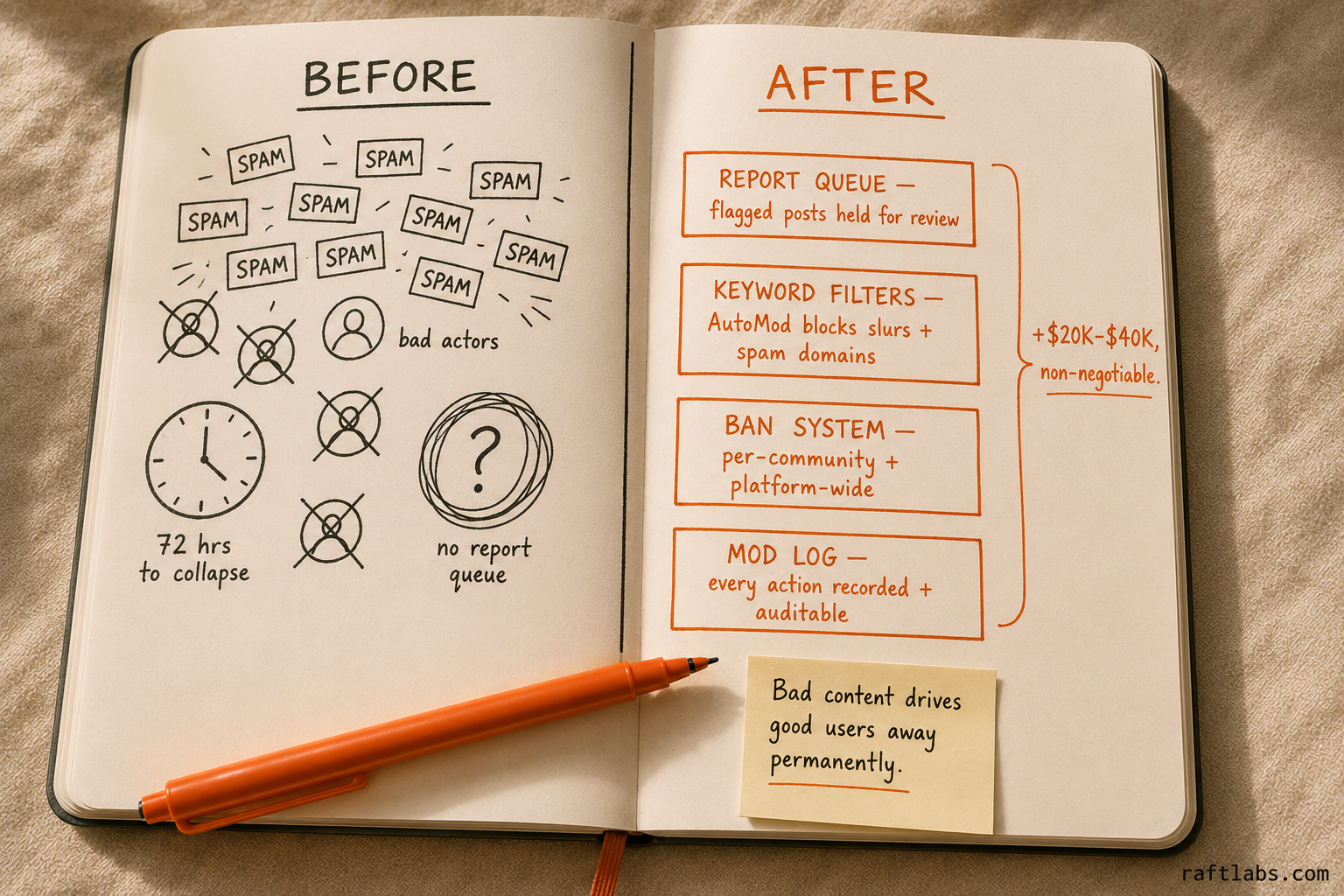
- Moderation tools are non-negotiable before public launch. Build a report queue, keyword filters, and ban capabilities first. Bad content drives good users away permanently.
- Discourse, NodeBB, Vanilla Forums, and Flarum each have specific failure points for custom requirements. Know which wall you will hit before you commit to one.
- The cold-start problem kills community platforms faster than any technical failure. Seed 3-5 communities with real posts before you open signups.
You run a professional association with 8,000 members. They discuss certification questions on LinkedIn groups you do not control, on Reddit threads you cannot moderate, and in email chains you never see. You want a private, verified community where only credentialed members can post, where your staff moderates the content, and where discussions stay inside your platform instead of scattered across the open web.
Discourse does not verify credentials. Reddit does not give you the member data. NodeBB requires a plugin stack that costs nearly as much as a custom build. So you scope a custom community forum, and the first question is what it will cost.
Building a community forum like Reddit costs $40K-$80K for a working MVP and takes 16-22 weeks. Here is exactly how those numbers break down.
| Scope | Timeline | Cost |
|---|---|---|
| MVP (community creation, threaded posts, voting, basic moderation) | 16-22 weeks | $40K-$80K |
| MVP + full moderation and content safety | 20-28 weeks | $60K-$120K |
| Full platform (media, notifications, real-time chat, search, analytics) | 7-10 months | $130K-$190K |
Monthly operating costs after launch: $3K-$12K, depending on content volume and media storage.
According to Reddit's 2024 S-1 filing, the platform hosts over 100,000 active communities and sees 1.5 billion posts and comments per year. That scale is not what you are building. The core mechanics - community containers, voting, threaded comments, moderation - are the same at any scale. The architecture to support them is what you are paying for.
"The community platform problems that kill most startups are not technical. They are product: what happens on day one when you have no users, who moderates your first community, and what content makes someone come back tomorrow." - Alexis Ohanian, co-founder of Reddit, in a 2021 Y Combinator interview.
Who actually builds a custom community forum
Not every operator who contacts us should build a custom community forum. Four specific scenarios make the investment defensible.
Professional associations with credential requirements. A bar association, a nursing board, or a certified financial planners network needs discussion spaces where only verified members can post. Reddit is anonymous. Discourse has no native credentialing layer. Vanilla Forums and NodeBB require custom plugins for identity verification that quickly exceed $40K in development scope - at which point you are building a custom integration on top of a tool you do not fully own. Associations in this situation typically need a custom build where the identity verification is part of the data model, not bolted on afterward.
B2B SaaS companies turning their user base into a paid community tier. A SaaS company with 10,000 users can package community access as a premium subscription - $50/month for access to a private forum where users help each other, share templates, and interact with the product team. Off-the-shelf tools do not integrate cleanly with your existing billing, auth, or user records. You end up maintaining two separate user systems and two separate permission models. A custom build with shared auth pays back within months at that membership price.
Franchise networks and multi-location operators. A franchise system with 300 locations needs a private community where franchisees share ops knowledge, corporate pushes updates, and regional managers moderate their territories. Generic forum tools expose all members to all content by default, with no concept of regional access tiers or corporate override moderator roles. Discourse can be configured to approximate this, but the configuration cost for a franchise with meaningful hierarchy typically runs $50K-$70K in consulting fees - money that could fund the first third of a custom build.
Platform companies embedding community as a feature. An event software company, a learning management system, or a marketplace might want sub-communities per event, per course, or per product category. This requires a community API that shares auth and user records with the parent platform. Off-the-shelf tools have APIs, but they are designed for standalone deployments, not embedded contexts. The integration work often costs more than building a lightweight native community module that sits inside your existing architecture.
V1, V2, V3 features (with cost per phase)
The feature list for a community forum is long. The sequencing determines whether you launch in 16 weeks or run out of budget at week 24.
V1 - Launch phase ($40K-$80K, 16-22 weeks)
The goal at V1 is a working community with real content and enough moderation to keep it clean. Nothing else.
| Feature | Why it is required at launch |
|---|---|
| Community creation (public and private) | Without it, there is nothing to post into |
| Text and link post submission | Two types covers 85% of what communities post at launch |
| Threaded comments with collapse | Flat comment lists break discussion structure at any volume |
| Voting on posts and comments | The core ranking signal - without it the feed is just chronological |
| Feed sorting (hot, new, top) | Hot-sort makes early content visible; new-only is not enough |
| User profiles with karma | Reputation signals that help communities trust new contributors |
| Basic moderation (remove, ban, report queue) | You cannot open a public platform without this |
| Full-text search within communities | Users leave if they cannot find content they remember reading |
Image upload is acceptable at V1 if your community type relies on visual content. Video upload is not - video processing adds $15K-$25K to the build plus ongoing infrastructure cost before you have revenue. Defer it.
V2 - Growth phase ($45K-$85K, add after 3-6 months of live operation)
Once the core product is working and communities are growing:
| Feature | When it becomes necessary |
|---|---|
| Push notifications and email digests | When users stop returning because they forget the platform exists |
| Community chat (real-time) | When post-and-reply is too slow for high-frequency discussions |
| Post flair and tagging | When communities need content categories within a single community |
| Cross-posting between communities | When topics overlap and content needs to travel |
| Analytics dashboard for moderators | When community managers need data to report on member activity |
| Awards and reactions | When you want richer engagement signals beyond vote counts |
Real-time chat is the most common V2 request and the most expensive to retrofit if the architecture was not designed for it. If you know V2 includes chat, the $8K-$15K you spend building the WebSocket layer into V1 saves $30K-$50K retrofitting it at V2.
V3 - Scale phase (only relevant above 100K monthly active users)
| Feature | The threshold that triggers it |
|---|---|
| Elasticsearch-powered search | PostgreSQL full-text search slows above 1 million posts |
| Distributed hot-score computation | Cached scores cannot update fast enough above 10,000 concurrent votes |
| CDN-backed media delivery | Direct storage serving costs too much above 50TB/month |
| Advanced AutoMod rules | Manual moderation queues collapse above 50,000 daily posts |
Off-the-shelf vs. custom: where Discourse, NodeBB, Vanilla Forums, and Flarum hit their limits
Each of the main off-the-shelf forum tools is well-built for the use case it was designed for. The problem is when your requirements go outside that use case. Here is where each one specifically fails.
Discourse is the strongest general-purpose choice. It handles categories, threads, replies, trust levels, moderation, email digests, and SSO through plugins. For a standard community with standard needs, it is the right answer. Where it fails: Discourse has no native credentialing or identity verification layer. Its trust level system (0 through 4, based on post counts and activity) is not the same as verifying that a user holds a specific professional license. White-labeling Discourse for resale is technically possible but the data model belongs to Discourse's schema, not yours - you cannot easily add billing tiers tied to community access levels without significant plugin work. API access is functional but not designed for embedded contexts where the community shares a user record with a parent platform. Customization that goes beyond Discourse's plugin ecosystem typically costs $40K-$70K in consulting, at which point the "cheaper" tool is no longer cheaper.
NodeBB is built on Node.js and designed to be more developer-friendly than Discourse. Its plugin architecture is more accessible for teams who want to add features without waiting for a plugin marketplace. Where it fails: NodeBB's plugin ecosystem is smaller and less maintained than Discourse's. If the plugin you need does not exist, you are writing it from scratch and maintaining it yourself across NodeBB version upgrades - an ongoing engineering commitment. NodeBB's default data model uses MongoDB or Redis as primary storage, which creates friction when you want to run complex relational queries across community membership, credential status, and billing records. Real-time features are stronger than Discourse's out of the box, but scaling NodeBB beyond 50,000 monthly active users requires infrastructure changes that most operators are not equipped to make.
Vanilla Forums targets enterprise clients and includes features like ideation, Q&A, and gamification. It has a hosted cloud option that removes infrastructure burden. Where it fails: Vanilla's pricing scales steeply with member count and feature tier. At 5,000+ active members with a need for custom integrations, monthly costs can reach $2,000-$5,000 - a real expense against a platform that still does not own its data model. Vanilla's API is decent but the data export and ownership story is weak if you ever want to migrate off. Custom theming is possible but the component system is old enough that a modern brand identity is difficult to achieve without significant CSS overrides that break on upgrades.
Flarum is a clean, modern open-source forum with a flat thread model (no deep nesting like Reddit). Where it fails: Flarum's thread model is intentionally simple - it does not support Reddit-style nested comment threads where a reply-to-reply-to-reply creates a visual conversation tree. For a community where threaded discussion is core to the product (technical help forums, debate communities, Q&A-heavy platforms), Flarum's flat model is a fundamental mismatch. Flarum's extension ecosystem is community-maintained and uneven in quality - some critical extensions have not been updated in 12-18 months. The platform is also PHP-based, which creates a hiring and maintenance constraint if your team is primarily JavaScript or Go.
The practical test: if you have scoped your requirements with one of these tools and the consultant has already quoted $30K-$40K for customization, you are not saving money by staying on the off-the-shelf tool. You are paying for someone else's constraints.
Build vs. buy decision
The decision comes down to three factors: data ownership, integration depth, and monetization model.
Use an off-the-shelf tool when: your community is one feature inside a larger product (not the product itself), your budget is under $50K, you do not need to own the API or the user data model, and your monetization does not depend on packaging community access as a paid product.
Build custom when: you are selling community access as a subscription or premium tier (the data model and billing integration need to be yours), identity verification or credential checking is core to the community's value, you need the community to share auth and user records with an existing platform rather than running as a separate system, or you are building a white-label community tool you will resell to other businesses.
The break-even math is straightforward. At 500 paying members at $50/month, a $70K MVP pays back in under 3 months. At $20/month, that is 7 months. Run that calculation before you commit to a direction.
A 2023 Gartner report on digital communities found that B2B community platforms with subscription access generate $40-$80 average revenue per user per year. At 500 paying members, that is $20K-$40K annually. The platform's running costs at that scale are $3K-$5K/month - which means profitability requires either higher ARPU or faster member growth than most founders project.
Where these projects fail
Two failure modes account for the majority of community platform projects that do not make it past six months.
Launching without moderation infrastructure. Most founders deprioritize the moderation budget because the problem is invisible until something goes wrong. Then it is the only thing that matters. A 2023 Pew Research study found that 41% of Americans have experienced online harassment, and 62% of those incidents happened on a community-based platform. The pattern we see most often: a founder launches with an invite-only beta to a trusted audience, decides moderation can wait until the platform opens publicly, then opens signups. Within 72 hours there is spam, harassment, and content that violates the terms of service. The trusted early community leaves. The platform never recovers the culture from those first days. You need a report queue, keyword filters for obvious violations, a ban system at both the community and platform level, and a moderator action log before you open signups to anyone. That is $20K-$40K. Budget it from the start.
Launching into empty communities. Research by Sangeet Paul Choudary at the Platform Innovation Kit identifies the cold-start problem as the primary reason community platforms fail in their first 90 days. An empty community signals to every new visitor that the platform is not worth their time, regardless of product quality. The fix is simple but requires discipline: seed 3-5 communities with 20-30 real posts each before you open signups. Invite 10-20 engaged early users to participate before the public launch. Restrict community creation at launch so you get active communities rather than hundreds of empty ones. Your team should be active contributors in the early days - posting, commenting, and voting quality content up. Reddit's founders created fake accounts to make the site look active in 2005. It was not deceptive. It was necessary.
How RaftLabs builds community forums
When you come to us saying you want to build a community forum like Reddit, we start with four questions before touching the architecture.
Who seeds the communities? If the answer is "users will create them," the platform will be empty at launch. We help you design a pre-launch seeding plan: which communities to create first, how many posts each needs, and who from your team will maintain them actively in the first 90 days.
What makes this community go somewhere other than an existing tool? Reddit has a community for almost every topic. LinkedIn has professional groups. Slack has channels. Your platform needs a specific reason to exist: verified professional credentials, better moderation standards, content that other platforms would not allow, or integration with tools your audience already uses. We push until this answer is concrete.
Do you actually need a custom build, or will Discourse serve you? We recommend the simpler tool when it fits. A custom build we should not have done is a liability for everyone. If Discourse handles your requirements, we will tell you and help you scope the Discourse deployment instead.
What is the monetization model? Community platforms with no revenue model collapse under infrastructure costs. We will not start architecture until the monetization path is defined - not because we are being difficult, but because the billing integration, the permission model, and the data structure all depend on it.
We build community platforms as core SaaS products, as features embedded in larger platforms, and as white-label tools for clients who resell community access to their own users. The architecture differs significantly across those three scenarios. If you know which one you are building, a scoping call takes about 30 minutes and comes back with a phased estimate.
If you are still deciding whether to build or use an off-the-shelf tool, bring the requirements list. We will tell you honestly which path makes more sense.
Ask an AI
Get an instant summary of this post from your preferred AI assistant.
Common questions
- An MVP with community creation, threaded posts, voting, user profiles, and basic moderation costs $40K-$80K. Full moderation infrastructure adds $20K-$40K. A complete platform with media uploads, notifications, search, and analytics runs $130K-$190K. Monthly operating costs range from $3K-$12K depending on content volume.
- A working MVP takes 16-22 weeks with a team of 4-6 developers. That covers community creation, post submission, threaded comments, voting, sorting, user profiles with karma, and a basic moderation queue. Adding full content safety infrastructure takes another 4-6 weeks. A complete platform runs 7-10 months.
- Use Discourse when your community is one feature inside a larger product, your budget is under $50K, and you do not need to own the API or data model. Build custom when you are selling community access as a product, require identity verification, need deep integration with an existing platform, or when scoping conversations with Discourse consultants have already exceeded $30K.
- Community creation (public and private), text and link post submission, threaded comments with collapse, voting on posts and comments, feed sorting (hot, new, top), user profiles with karma, a basic moderation queue (remove, ban, report), and full-text search within communities. Video upload is the most common scope-creep item - defer it to V2.
- A custom build earns its cost when you are building a platform you sell to others, when identity verification or credentialing is core to the value, when you need shared auth and data with an existing product, or when the Discourse plugin costs and workarounds have already exceeded $30K-$40K in scoping. At 500 paying members at $50/month, a $70K build pays back in under 5 months.