Generative AI in Hospitality: Use Cases, Future Trends & Challenges
Generative AI in hospitality is already shifting how hotels handle guest communication, marketing, and operations. This guide covers practical use cases, the custom vs. platform decision, real ROI drivers, and what to build first.

In this article
Short answer
Generative AI for hotels automates routine guest communication, answering questions about breakfast hours, amenities, check-in times, and local recommendations, with context-aware, personalized responses rather than pre-written scripts. Hotels using generative AI for guest communication report significant reductions in OTA dependency through improved direct booking channels and up to 80 percent deflection of repetitive front-desk inquiries. The choice between off-the-shelf platforms and custom development depends on whether AI is an operational efficiency tool or a brand differentiation strategy.
Key takeaways
- Generative AI helps hotels handle repetitive guest questions, freeing staff to focus on high-value, in-person service.
- AI chatbots and voice agents provide 24/7, multilingual, context-aware support across web and apps.
- Personalized messaging and itineraries use guest data to tailor offers, upsells, and recommendations, increasing revenue and satisfaction.
- Generative AI speeds up marketing content, staff training, documentation, and SOP creation, improving operational efficiency.
- Hotels can choose between off-the-shelf platforms for quick, standard use cases or custom solutions for deep integration and brand differentiation.
- Successful AI adoption requires attention to data privacy, guest transparency, technical integration, accuracy controls, and avoiding over-automation.
- Future capabilities include agentic AI that takes actions, advanced voice and multimodal AI, and tight IoT integration for predictive, personalized experiences.
- Hotels should start now by cleaning data, building AI literacy, piloting focused use cases, and choosing strong implementation partners.
- Early adopters gain a lasting competitive edge in guest experience, direct bookings, and operational performance.
Last month's performance report at a typical hotel group reveals the same pattern across properties: a large portion of guest inquiries are identical. "What time is breakfast?", "Can I check in early?", "Where's parking?" Staff spent hours answering these redundant questions, leaving little time for more pressing guest needs.
That's the reality in hospitality today. Staff handle routine inquiries while guests demand instant responses, often at odd hours. Meanwhile, your competitors secure direct bookings while you pay 15–25% commissions to OTAs. According to Cloudbeds' 2026 OTA commission analysis, those commissions are on top of a cancellation rate nearly double what direct bookings produce (21.8% vs 10.6%).
Generative AI development in hospitality addresses this directly. It handles repetitive tasks: answering questions, creating marketing content, building personalized itineraries, and managing multilingual communication. This technology is already changing how hotels operate and hospitality software solutions built on generative AI are leading that shift.
Who should read this guide
This guide is designed for decision-makers and professionals across hospitality who are evaluating, implementing, or optimizing generative AI solutions to improve guest experiences and operational efficiency.
Hotel owners and general managers reducing OTA dependence and improving direct bookings through AI guest communication
Revenue managers and operations directors improving upsell conversion rates and automating routine inquiry volume
IT directors and technology leaders evaluating AI vendors, managing PMS integrations, and choosing between custom and platform solutions
Multi-property portfolio managers maintaining brand consistency across locations while allowing property-specific customization
Guest experience and marketing directors differentiating service through conversational AI and multilingual communication
Hospitality entrepreneurs launching boutique properties that need competitive AI capabilities without enterprise budgets
Investment professionals and consultants assessing AI transformation strategy and competitive positioning
Hospitality technology professionals building expertise in generative AI applications and implementation best practices
What you'll find in this guide
This guide covers generative AI in hospitality end-to-end, organised to help you quickly find relevant information for your specific needs:
What generative AI actually is versus traditional automation and predictive AI, and the technical basics without jargon
Practical use cases across hotel operations organized by function: guest communication (AI chatbots, multilingual support, personalized messaging), content creation (marketing copy, review responses, internal documentation), and guest service (digital concierge, complaint resolution, voice AI)
How to choose between off-the-shelf platforms and custom development, including integration depth, data ownership, and competitive differentiation
Practical guidance on navigating data privacy compliance (GDPR, CCPA, PCI DSS), AI accuracy concerns, and over-automation risks
Insights into emerging capabilities including agentic AI, voice AI evolution, multimodal AI, and IoT integration
Answers to the most common questions about staff replacement concerns, implementation timelines, data security, and PMS compatibility
This guide helps you evaluate whether generative AI fits your operations, identify high-value use cases, choose the right implementation approach, and avoid common pitfalls that reduce ROI.
Also Read: How AI in travel and hospitality is applied across the full guest journey.
What is generative AI in the hospitality industry
Generative AI is a technology that creates original content by understanding context and producing responses that are unique. When a guest asks your chatbot for restaurant recommendations, the AI can craft a response based on the guest's preferences, the time of year, current local events, and your hotel's restaurant partnerships.
This results in a personalized answer that has not been pre-written or selected from a list of options.
In contrast, traditional chatbots pull from pre-written responses, offering no personalization.
Here's what generative AI can do:
Write original text (emails, responses, marketing copy, reports)
Translate languages while maintaining tone and context
Create personalized itineraries and recommendations
Generate training scenarios for staff
Draft standard operating procedures
Produce menu descriptions and dining content
What it doesn't do:
Forecast room demand (that's predictive AI)
Optimize pricing (that's revenue management algorithms)
Automate check-in kiosks (that's traditional automation)
Integrate your PMS with channel managers (that's data engineering)
Generative AI relies on large language models (LLMs), which are trained on vast amounts of text to understand patterns in communication. When you ask it a question, it generates the most relevant response based on context and intent.
Generative AI lets your hotel engage with multiple guests at once, offering responses that feel personal and context-aware.
Why generative AI fits hospitality
Hospitality revolves around communication. Every guest interaction requires understanding, context, and a tailored response. Whether it's answering booking questions, handling room requests, or resolving complaints, each conversation is distinct. Guests expect personalized service, and each situation calls for a thoughtful reply.
Generative AI offers a solution by acting like a team member who never sleeps, speaks multiple languages fluently, remembers every guest's preferences, and can manage hundreds of conversations at once without fatigue or mistakes.
The key to generative AI's success in hospitality is its ability to read context that early chatbots missed. Early chatbots often struggled with context, giving generic answers to questions like "Is breakfast included?" or "What time is breakfast?" Modern generative AI understands that these are distinct questions and adapts its responses accordingly.
It can also distinguish between a business traveler asking about workspaces and a family inquiring about children's activities. The level of personalized communication that once seemed unattainable can now be provided at scale.
Generative AI use cases in hospitality
Here are specific ways generative AI applies across hotel operations - from guest communication to back-office efficiency, with impact on productivity and profitability.
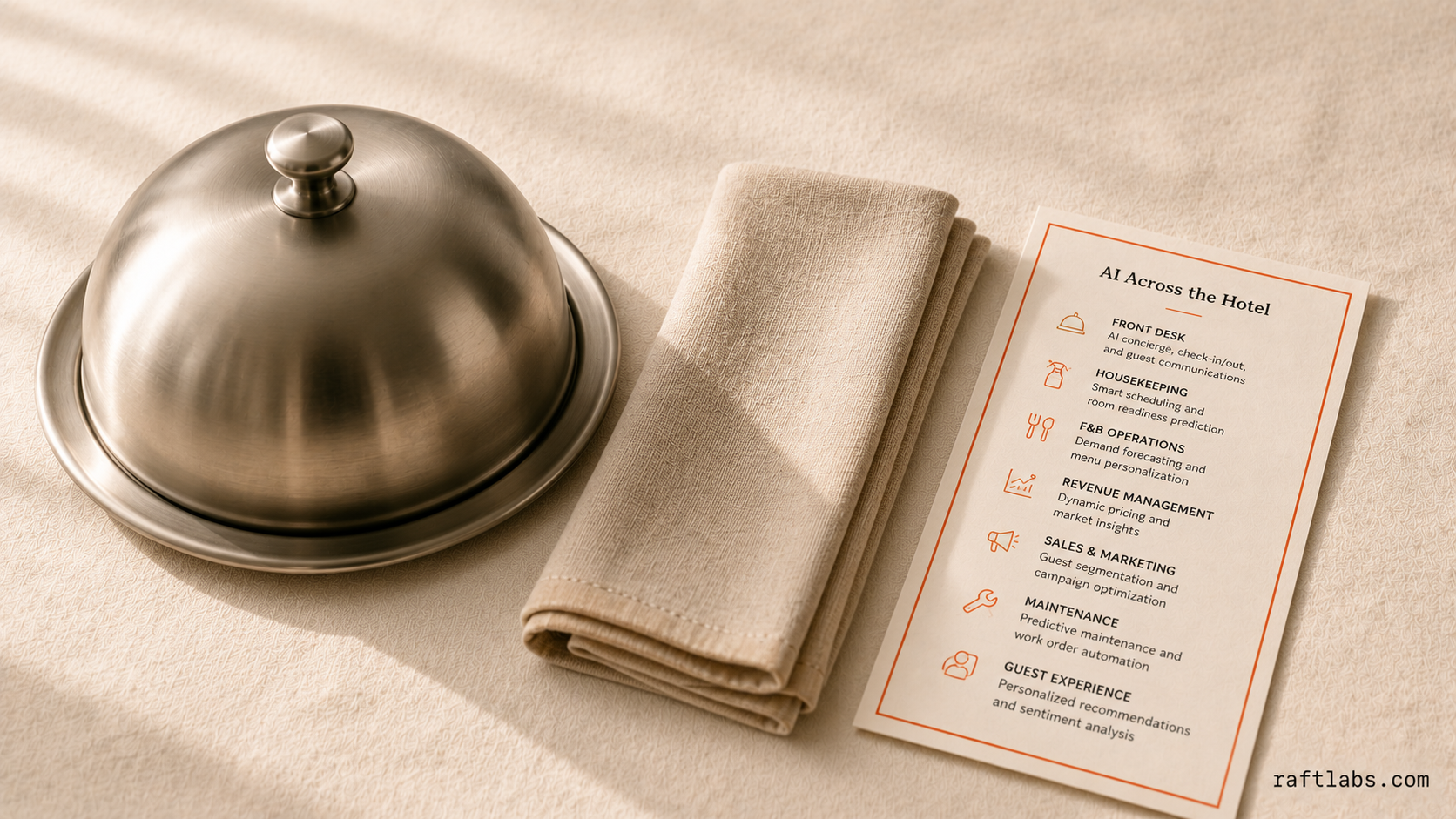
1. Improving guest communication & experience
From handling enquiries 24/7 to personalising guest experiences, AI solutions are simplifying operations and supporting more efficient, engaging communication at every touchpoint.
1.1 AI conversational chatbots
Your website visitor at 11 PM has questions. With a traditional chatbot, they type "Can I check in early?" and get a response pulled from a menu of pre-written answers. With generative AI, they get an empathetic, smart conversation.
It can be of such a pattern:
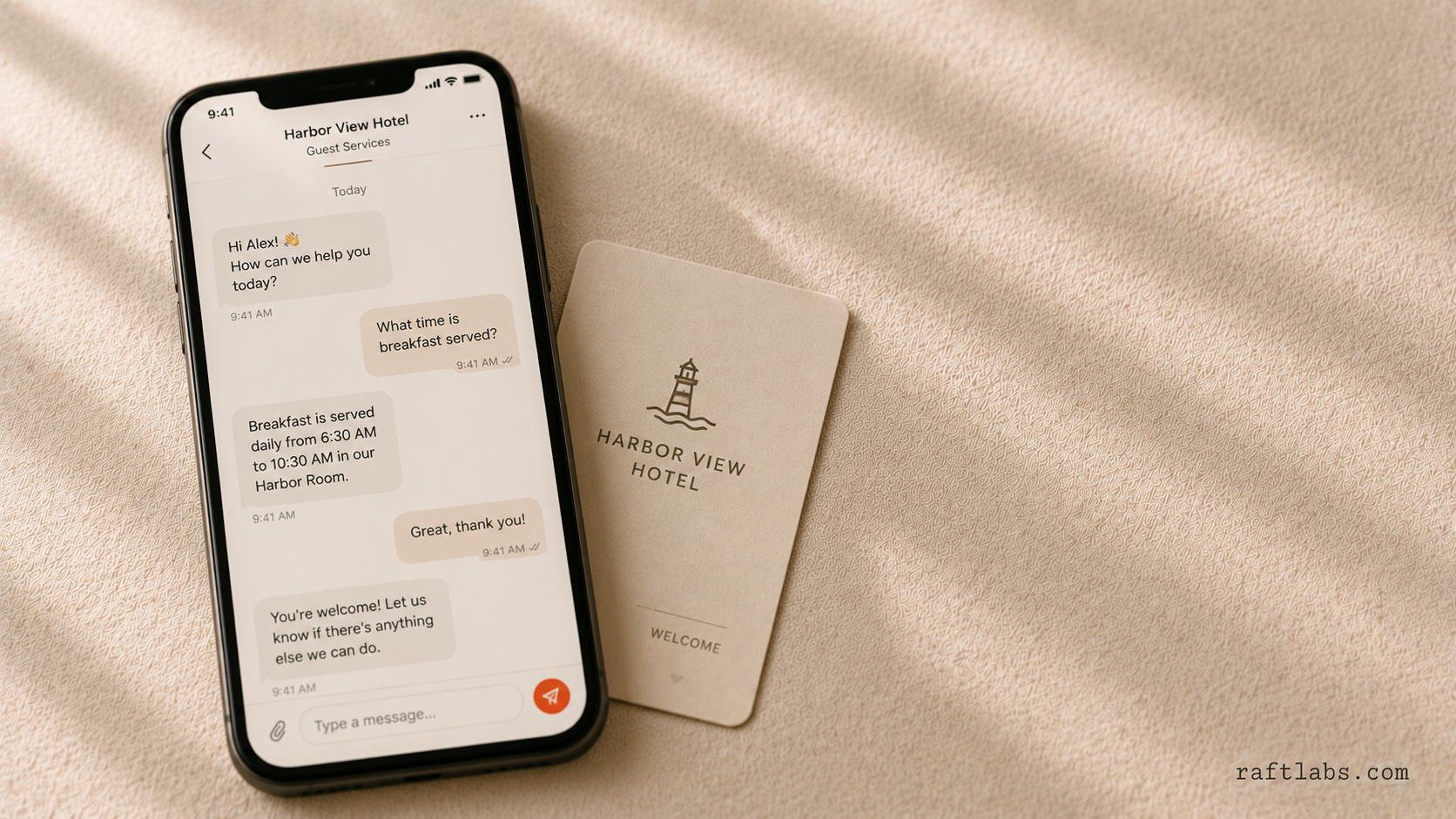
Rather than pulling from templates, this generates responses that are tailored to the context.
The technical difference matters. Traditional chatbots match keywords to pre-programmed responses. If the guest types something the chatbot wasn't programmed for, it fails.
Generative AI understands intent through natural language processing. It considers the full context of the conversation, adapts its responses based on the guest's tone, and handles follow-up questions without losing the thread.
What generative AI actually does in your chatbot:
Maintains context across a multi-turn conversation
Understands when a guest is frustrated and adjusts tone
Answers questions it wasn't explicitly programmed for
Pulls information from your PMS (with proper integration)
Escalates complex issues to human staff
Learns from interactions to improve responses
What it often can't do:
Actually make bookings without integration to your booking engine
Override policies (it follows the rules you set)
Handle transactions without proper security protocols
Read emotions perfectly (it detects patterns, not feelings)
Consider a regional hotel group that implemented a custom Gen AI chatbot integrated with their PMS. This chatbot successfully handled a significant portion of routine guest inquiries, reducing the need for staff involvement in repetitive tasks.
As a result, the team focused more on providing personalized services and improving the overall guest experience.
Similarly, a boutique hotel guest services manager previously spent hours answering routine calls about parking, breakfast, and local attractions. With AI handling those standard inquiries, the manager focuses on complex needs: special requests, VIP coordination, and guests who need genuine human attention.
1.2. Multilingual guest communication at scale
A guest from Japan books your hotel and has questions in Japanese. Your staff speaks English and some Spanish. With generative AI, the guest can ask questions in Japanese and receive responses in the same language. The AI doesn't just translate; it maintains the tone, cultural context, and intent of the conversation.
This is far beyond simple translation tools like Google Translate. Large language models, trained on vast multilingual datasets, understand the contexts deeply. For instance, in English, "hot water" may refer to a kettle for tea, but in Japanese, it might mean something entirely different. Similarly, in German, the same phrase could relate to a temperature setting.
For hotels in international destinations, the business case is clear. A hotel in a multilingual city like Miami serves guests speaking English, Spanish, Portuguese, French, German, and Japanese. Hiring staff fluent in all these languages is costly and often impractical. But training AI to handle them can be done in weeks, without the need for high salaries or specialized hires.
What generative AI does for multilingual support:
Real-time translation while maintaining tone and intent
Understanding of cultural context (formal vs. casual, direct vs. indirect communication)
Adapts responses based on the guest's language proficiency
Handles idioms and dialects appropriately
Maintains conversation history even when languages switch
Always disclose when AI is handling translation. Transparency builds trust, and most guests appreciate the effort to communicate in their language.
1.3. Personalized pre-arrival & in-stay messaging
One of the most common oversights in hospitality is sending the same generic welcome email to every guest. This is where generative AI can make a major difference. Rather than using a simple mail merge to insert a guest's name into a pre-written message, generative AI creates unique, personalized content for each guest.
Traditional email automation might look like this: "Dear Sarah, thank you for booking with us. Check-in is at 3 PM. Here are some things to do in the area."
With generative AI, the message would be much more personalized:
"Hi Sarah, we're excited to welcome you back from March 15-18! I see you're traveling with your family this time. Based on your last stay, I've added two extra pillows to your room preference. I think your kids will love our new children's art program on Saturday mornings, and I'd be happy to reserve spots for them.
Also, Marina's restaurant, which you asked about last time, has just reopened after renovations."
This type of personalization is made possible by the AI analyzing various factors, such as:
The guest's booking history (she's a repeat visitor)
Room preferences from previous stays (extra pillows)
Booking composition (now includes children)
Local events relevant to families
Previous inquiries made during past stays
In the past, this level of personalization was only possible by manually crafting messages, which was extremely time-consuming for a hotel with many guests. With generative AI, these personalized messages are written in seconds.
What generative AI can do for guest messaging:
Creates unique welcome messages for each guest
Offers personalized upsells (spa packages for wellness travelers, late checkout for business guests)
Recommends activities based on guest profiles
Drafts service recovery messages for when issues arise
Sends post-stay follow-ups referencing specific experiences
Hotels that use AI for personalized upselling typically get higher acceptance rates compared to generic email campaigns.
For example, when a guest receives an upsell email about a spa treatment tailored to their previous visit, they are more likely to book than if they receive a generic "Visit our spa!" email.
Generative AI relies on clean, organised guest data to personalise effectively. If your PMS and CRM don't capture guest preferences, the AI can't use them. Well-managed guest data is the prerequisite for AI personalisation.
1.4. AI-generated itinerary building
Your guests want help planning their time. They don't want generic "top 10 things to do" lists that every hotel shares.
Generative AI creates customized day-by-day itineraries based on guest interests, travel style, mobility considerations, budget, and current conditions like weather and local events. It doesn't rely on a static database of recommendations. Instead, the tool analyzes guest data and creates a personalized plan tailored to the specific needs of each traveler.
How it works: the AI gathers information through a pre-arrival email or chat:
What interests you? (Outdoor activities, food experiences, cultural sites, shopping, relaxation)
How do you like to travel? (Packed schedule or leisurely pace)
Any mobility considerations? (Walking distances, accessibility needs)
Traveling with kids? (Ages and interests)
Budget preferences? (Extravagant experiences or value-conscious)
Then it combines this with:
Current weather forecasts (adjusts outdoor activities for rain)
Real-time availability at restaurants and attractions
Walking distances and timing between activities
Your hotel's partnerships and offerings
Local events happening during their stay
The guest's arrival and departure times
The result is a complete itinerary that feels personally crafted, not template-generated. Example: a four-day city business trip with family:

For AI itinerary building to work well, you need integration with:
Your hotel's activity booking system (so AI knows what's available)
Local restaurant reservation platforms (so AI can actually make bookings)
Weather and local event APIs (so recommendations stay current)
Transportation services you partner with (ride shares, shuttles, rentals)
Without these integrations, Gen AI can still generate itineraries, but guests have to book everything separately. With integrations, the AI can actually make reservations based on guest approval, transforming from a suggestion engine to a complete concierge service.
Always present itineraries as suggestions, not requirements. Some guests want to plan for themselves. Others want full concierge service. Gen AI can handle both approaches.
2. Content creation & marketing
Creating effective marketing content is essential for standing out in the competitive hospitality industry, but it can also be time-consuming and expensive.
2.1. Marketing copy generation
Creating a large volume of tailored marketing content, such as email campaigns or social media posts, can be time-consuming and expensive. Traditional methods may take days to create multiple campaign variations, but with generative AI, these tasks can be completed in a fraction of the time while still maintaining your hotel's brand voice.
A hotel that used to spend substantial amounts on marketing agencies, social media management, and website copywriting can probably save up to 50% or more of those costs while producing content in less time.
2.2. Review response automation
Managing online reviews matters for maintaining a good reputation, but it can be difficult to respond to each review promptly and meaningfully. Generative AI simplifies this process by reading reviews, understanding context and sentiment, and generating thoughtful responses in just seconds.
For example, a review that mentions issues like WiFi connectivity can receive a tailored response, acknowledging the guest's concerns and assuring them that the issue is being addressed.
Hotels that actively respond to guest reviews typically see slight but impactful improvements in their ratings. On average, responding to all reviews may result in a rating increase of 0.1 to 0.3 stars within just six months, which often leads to increased bookings.
By automating responses, hotels can go from responding to only a small percentage of reviews to engaging with nearly all guest feedback. This increase in responsiveness often leads to higher review scores and stronger guest satisfaction.
Guests are more likely to book when they see that a hotel actively engages with feedback, showing the value of timely and personalized responses.
3. Operational efficiency & automation
Generative AI automates tasks like staff training, documentation, and SOP creation, ensuring smooth operations and consistent service.
3.1. Staff knowledge management & training
Gen AI creates interactive training scenarios where your staff practice handling situations before encountering them with real guests. AI avatars play different guest types (frustrated business traveler, confused international tourist, demanding VIP) and trainees practice responding appropriately.
This approach helps staff learn how to handle complex guest interactions and improves their decision-making skills, all while maintaining a high level of customer service. By providing an environment where employees can practice and receive feedback, hotels ensure staff are well-prepared without risking real guest dissatisfaction.
Consider a training manager, Alex, who oversees staff training at a boutique hotel. As part of the onboarding process, new employees use AI training to simulate dealing with a guest complaint about room cleanliness.
They respond to the scenario and receive immediate feedback from the AI, learning how to improve their response in future interactions. With this training, Alex's team of new hires becomes more confident in handling guest concerns, leading to faster adaptation and smoother guest experiences during the busy season.
3.2. Internal documentation & reporting
Managers often spend a significant amount of time every week on documentation and reporting tasks, from writing shift reports to compiling incident summaries and guest feedback.
Generative AI can automate these processes, pulling relevant data from your systems and presenting it in a clear, structured format. This not only saves time but also ensures reports are consistent and accurate.
With generative AI, tasks like creating maintenance request documentation, summarizing guest feedback themes, and drafting performance reviews are all handled efficiently.
Consider a hotel manager, Emma, who oversees daily operations at a busy boutique hotel.
After implementing generative AI, Emma's reporting tasks are faster. The AI generates daily shift summaries, flags urgent maintenance requests, and summarizes guest reviews, giving Emma more time to focus on improving guest experiences and managing staff.
3.3. Standard operating procedure (SOP) creation
Creating clear and consistent Standard Operating Procedures (SOPs) is critical for ensuring smooth hotel operations and consistent guest service. However, developing these procedures traditionally takes time, with managers verbally explaining each process and manually documenting it.
For instance, handling a noise complaint involves a sequence of steps: apologize to the guest, locate the noise source, ask for it to be reduced, follow up with the guest, and document the incident.
Generative AI speeds up this process by automatically generating a detailed, step-by-step SOP based on the outlined procedure, creating a fully usable document in just minutes.
The AI-generated SOPs are also easy to modify, allowing for quick adaptations as new challenges or improvements arise, ensuring that your hotel's operations remain flexible.
4. Better guest service
Generative AI improves guest service with personalized, instant solutions that lift guest satisfaction and speed up operations.
4.1. Digital concierge services
Generative AI can offer concierge-level service without the need for additional staffing costs. Instead of relying on human staff to handle guest requests, AI provides instant, personalized responses, available 24/7.
Whether a guest asks for a restaurant recommendation at 2 PM or inquires about local activities, AI can respond promptly with tailored suggestions that match their preferences.
For example, if a guest is celebrating an anniversary and asks for a romantic yet casual dining option, the AI can recommend suitable restaurants, offer to make the reservation, and even provide details about each venue. This service is available around the clock, in multiple languages, ensuring that guests feel attended to at any time.
This can also contribute to more activity revenue or upsells, as guests feel more engaged and supported by the hotel's service.
This system can also significantly reduce the costs of hiring full-time concierge staff, which traditionally require salaries, benefits, and shifts to cover 24/7 service.
4.2. Complaint resolution & service recovery
Effective complaint resolution is critical in maintaining guest satisfaction and loyalty. When guests face an issue and receive an immediate, thoughtful response, their frustration is often mitigated, and their experience can be turned around.
Generative AI can improve the speed and quality of complaint responses. Instead of waiting for several hours or even a day for a resolution, AI can respond in real-time, offering personalized, empathetic replies that address the guest's concerns promptly.
Imagine a guest staying at a boutique hotel who encounters an issue with their room's air conditioning system, making the room too warm. In the past, the guest might have waited hours for a response, becoming increasingly frustrated.
With generative AI, the hotel can quickly acknowledge the issue, apologize for the inconvenience, and offer immediate solutions, such as sending a maintenance team to fix the problem or offering a temporary fan for comfort.
4.3. Voice AI for phone interactions
Voice AI can efficiently manage routine phone inquiries, freeing up your front desk staff to focus on more complex tasks. Instead of requiring staff to answer every call, Voice AI handles common inquiries through natural conversations, such as questions about check-in times, parking availability, or hotel amenities.
This allows hotels to reduce the volume of phone calls that require staff involvement and speed up call handling, even during off-hours, without needing night staff.
Voice or conversational AI development is a cost-effective solution for hotels looking to improve operational efficiency while reducing reliance on night or off-hours staff.
Building this requires a purpose-built voice stack. Our AI voicebot development team handles TTS, STT, intent recognition, and PMS integration end-to-end.
5. Revenue optimization & dynamic pricing
Generative AI doesn't directly set your room rates; that's the job of your Revenue Management System (RMS). What it does is make your RMS dramatically more useful by generating the contextual intelligence that powers better pricing decisions.
A standard RMS adjusts rates based on historical occupancy and competitor pricing. A generative AI layer adds the ability to process unstructured signals: local event schedules, weather forecasts, conference calendars, flight data showing inbound demand, and even social sentiment. It synthesizes these into pricing recommendations your revenue manager can act on or that a connected RMS can apply automatically within rules you define.
The business impact maps directly to your ADR and RevPAR. Properties using AI-assisted dynamic pricing can capture demand more precisely during peak periods and avoid unnecessary discounting during shoulder seasons. IDC projects that by 2030, 30% of travel bookings will be executed by AI agents, making structured, AI-readable property data a competitive requirement, not a future-state consideration.
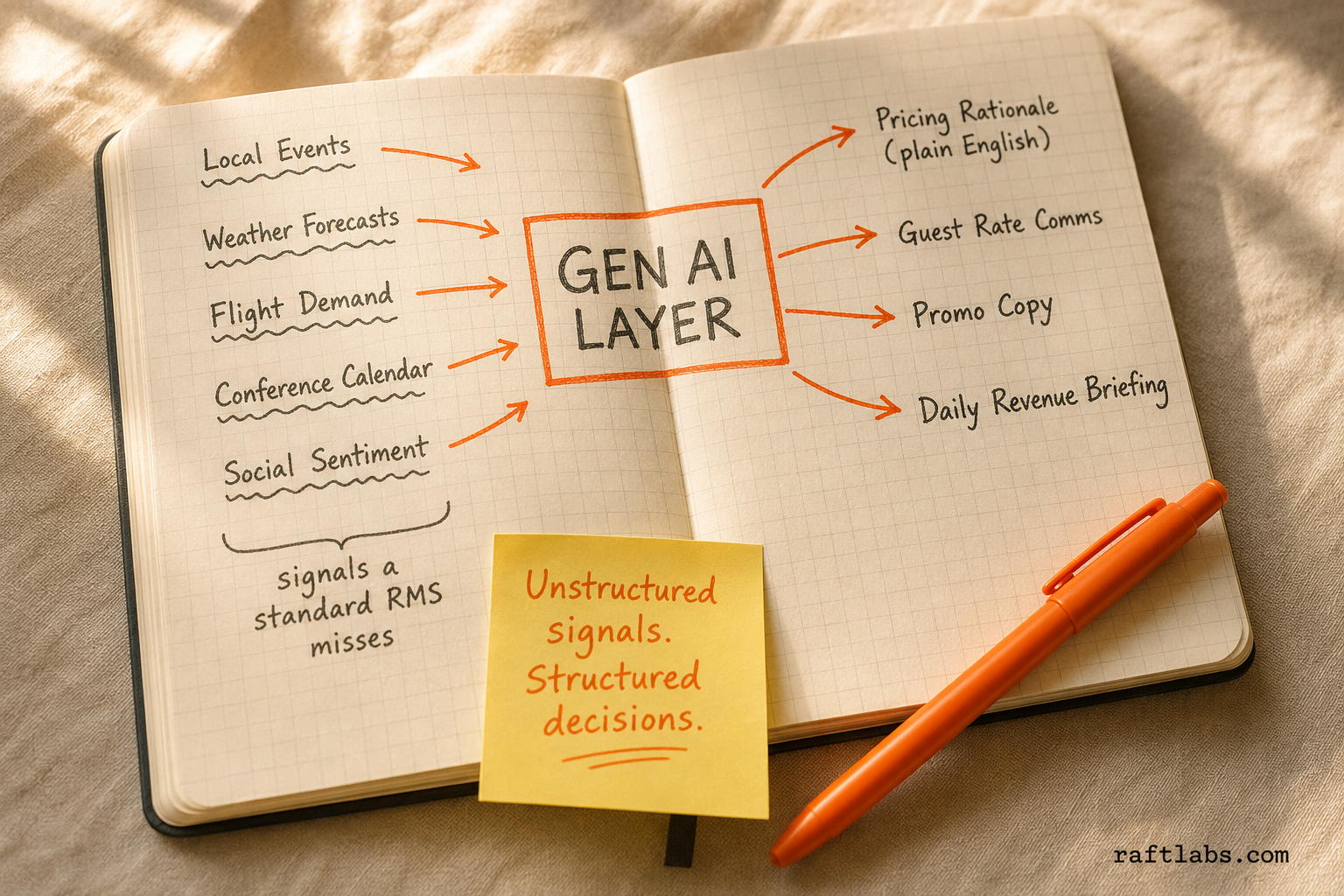
Where generative AI specifically contributes:
Generating natural-language pricing rationale for your revenue team ("rates should increase 18% this weekend due to the city marathon and low competitor availability") rather than just raw data
Drafting personalized rate communication to guests ("Your preferred rate is available for the dates you're considering, here's why this rate reflects current demand")
Creating promotional offer copy that adjusts automatically based on booking pace and current occupancy targets
Summarizing demand forecasting reports from your RMS into daily briefings for revenue managers
For this to work, your generative AI system needs read access to your RMS, Channel Manager, and Central Reservation System (CRS). It also benefits from connections to third-party demand signals via API. Platform solutions often fall short here, as they connect to major PMS platforms but rarely have deep RMS integrations. Custom development gives you the flexibility to connect whichever revenue stack your property runs.
Speed up your hotel operations with AI Let us help you automate routine tasks and increase efficiency with generative AI tailored to your needs. Let's discuss
Business impact: what generative AI actually delivers in hospitality
Every use case in this guide maps to a measurable business outcome. Before investing in generative AI in hospitality, understand where the returns actually come from.
Direct booking conversion: generative AI on your website handles the full booking conversation - answering questions, addressing objections, managing date changes, and processing the booking - without redirecting the guest to an OTA. Every booking that stays on your platform saves the 15-20% commission you'd otherwise pay.
Staff productivity and labor optimization: the clearest ROI comes from reducing repetitive, low-complexity tasks. Routine guest inquiries, review responses, shift reports, SOP documentation, and marketing copy are the starting points. The time freed can be redirected to high-value guest interactions.
Guest satisfaction and repeat bookings: personalized pre-arrival messaging, context-aware in-stay support, and timely complaint resolution all improve review scores. Higher review scores correlate with higher booking conversion rates and stronger ADR.
OTA dependency reduction: when your own AI can offer the same conversational experience as an OTA, the guest has less reason to book through a third party. Reducing OTA dependency is a long-term strategic goal; generative AI is one of the most practical tools to pursue it.
Measuring ROI in practice: track direct booking share as a percentage of total reservations, average response time on guest inquiries, review response rate, staff hours spent on repeatable tasks, and upsell conversion rate.
Custom vs. off-the-shelf generative AI solutions
Eventually, you'll need to choose between purchasing a platform solution or developing a custom one for implementing generative AI.
The answer determines whether your AI becomes a competitive advantage or just another commodity feature your competitors can replicate by signing up for the same service.
Understanding the real difference
Platform solutions give you what everyone else gets. You work within their framework, follow their conversation templates, accept their integration limitations, and it might sound like every other property using the same system.
Custom development builds AI that works the way your hospitality business works. It integrates at the level you need, speaks with your actual brand voice, handles your operational quirks, and creates experiences competitors can't copy without building their own system.
When platform solutions make sense
Platform solutions work when differentiation through AI isn't your goal.
If you run a single property or small portfolio and just need basic functionality working quickly, platforms deliver that. They excel at solving common problems with standard solutions.
The platform can manage your website chatbot for frequently asked questions and automate review responses for typical guest feedback.
Platforms make sense when:
Your use cases are standard (inquiry handling, review responses, basic messaging)
Your brand voice is straightforward and doesn't require property-specific customization
You're comfortable with your AI sounding similar to competitors using the same platform
Your PMS is mainstream with pre-built connectors
Speed of deployment matters more than strategic positioning
The advantage: someone else maintains the system, updates the features, and handles technical issues.
The limitation: you're renting a capability that anyone can rent. Your AI guest experience looks and feels like other hotels using the same platform.
When custom development is the strategic choice
Custom development makes sense when you view AI as a competitive differentiator, not just an efficiency tool.
Hotels that build custom AI create experiences competitors can't easily match. Your AI doesn't just answer questions differently; it integrates deeper, understands your operations better, and creates moments that feel authentically yours.
Consider what custom development enables:
Brand voice that's actually yours: platform solutions offer "tone options" (formal, casual, friendly). Custom development trains AI on your actual communication style. Your luxury property's responses maintain the sophistication that justifies your rates.
Integration that goes below the surface: platforms connect to your PMS through standard APIs, accessing basic data. Custom solutions integrate at whatever level your business requires. When a guest asks about upgrading their room, custom AI can check availability, pull their loyalty status, review their stay history, calculate appropriate pricing, and make a personalized offer, all in one response.
Data ownership and control: platform solutions store your guest conversations, booking patterns, and service data on their servers. Custom solutions keep everything in your systems.
Portfolio-wide consistency with property-level personality: multi-property operators need consistency across locations while respecting each property's character. Custom AI enables this balance.
The integration question
Integration depth is where custom versus platform differences become most apparent.
| Aspect | Platform Solutions | Custom Solutions |
|---|---|---|
| PMS Integration | Easy connection with major systems. Updates based on the platform's schedule. | Custom connection with any system through API. Full control over updates, allowing more flexibility. |
| Data Access | Access to basic information (like guest name, dates, and room type). Limited ability to get deeper insights. | Full access to all your data. Can link information from different systems (like guest preferences and booking history). |
| Workflow Integration | Follows pre-set workflows defined by the platform. Limited customization. | Custom workflows based on how your hotel operates, allowing the AI to act according to your specific needs. |
| Third-Party Systems | Can only connect to systems that the platform already supports. May not work with your unique tools. | Can integrate with any system, even proprietary ones, using custom solutions. |
| Real-Time vs. Batch | Data is updated periodically, which may cause delays (data might be hours old). | Instant updates in real-time, providing immediate access to the latest information. |
The difference matters in practice. A guest asking "Can I move my reservation from Thursday to Friday?" requires checking availability, understanding rate differences, processing the change, updating connected systems, and confirming.
Platform AI will probably check availability and tell the guest to contact the front desk. Custom AI handles the entire workflow.
Decision framework: what actually matters
Choose platform solutions when:
Operational efficiency is the goal, not competitive differentiation
Your properties compete primarily on location and price
Guest experience standardization is acceptable
You're comfortable with vendor dependency for a critical guest touchpoint
Quick deployment outweighs strategic positioning
Choose custom development when:
Guest experience is a key differentiator in your market
You operate multiple properties needing consistent yet personalized AI
Your operations have complexity that standard platforms don't address
Data ownership and privacy control matter strategically
You want AI capabilities that competitors can't replicate by buying the same service
Integration depth affects the quality of the guest experience you can deliver
Long-term competitive positioning justifies the upfront investment
For hotels new to generative AI, starting with an AI MVP development with scope of 3-5 core use cases reduces risk and delivers measurable wins before full rollout.
Challenges of generative AI in hospitality & how to address them
While generative AI offers real potential for hospitality, its implementation comes with challenges that need to be addressed to ensure smooth, efficient, and compliant operations.
1. Data privacy & compliance
Generative AI systems process personal guest data, which means hotels must comply with various regulations like GDPR, CCPA, and PCI DSS. GDPR applies to guests from the European Union, and requires explicit consent for data processing, the right to access and delete data, and ensuring that only necessary data is collected.
Similarly, CCPA applies to hotels serving California residents and includes the right to know what data is collected and the right to delete personal information.
For PCI DSS compliance, AI should never process or store actual payment card numbers. It can collect intent (such as a guest asking about payment details), but the actual card processing must be done securely by humans.
How to stay compliant:
Consult with legal experts on hospitality data regulations
Implement data access controls to ensure AI only accesses necessary information
Create audit trails to track what data the AI system accesses
Establish clear data retention policies, ensuring that data is automatically deleted after a set period unless needed longer for business purposes
Train staff on compliance requirements
Always provide clear privacy notices to guests and integrate consent mechanisms into booking and registration processes
Avoid storing conversation logs indefinitely; AI conversation history may contain personal data, so set retention policies accordingly.
2. Guest concerns about AI
Some guests prefer human interaction or have concerns about how their data is being used. Transparency is key to addressing these concerns.
How to be transparent:
Let guests know when they're interacting with AI: "Hi, I'm [Hotel Name]'s AI assistant. I can help with reservations, questions, and recommendations."
Always provide a human fallback option: "I'm not sure I can help with that. Would you like to speak with someone?"
Clearly explain how guest data is used: "Our AI assistant accesses your reservation details to help you. We don't share your information."
Be proactive about privacy: "Your conversation with me is private and only used to help you."
Allow guests to request deletion of conversation history at any time.
Hotels that implement AI with high transparency receive fewer complaints about its use than those that don't disclose it.
3. Technical integration complexity
Many legacy PMS systems were not built with AI integration in mind. Older systems often have limited API access, rely on outdated technology, or don't sync data in real-time.
Common integration issues:
API limitations where systems don't expose the necessary data
Data format inconsistencies between systems (e.g., different date formats)
Delays in real-time data syncing
Authentication complexity, where each system requires different security protocols
Version dependencies, where system upgrades break integrations
How to mitigate integration challenges:
Work with certified integration partners who understand your systems
Start with read-only access to AI systems before allowing changes to bookings
Build middleware to handle data format conversions and errors
Always plan for manual fallback processes when AI integration fails
Test integrations thoroughly before going live
4. AI accuracy & hallucinations
Generative AI sometimes produces incorrect information, known as "hallucinations." This can happen when the AI generates plausible but false content. For example, it might say breakfast is served until 10:30 AM when it actually ends at 10 AM, or it might recommend a restaurant that closed months ago.
Why it happens:
The training data may contain outdated or incorrect information
AI may misunderstand context or confuse similar properties
Information may have changed after the AI was trained
How to prevent hallucinations:
Ground AI in verified data by connecting it to your PMS, website, and operational systems
Implement fact-checking for critical information like rates, availability, and policies
Have human oversight for important decisions like bookings, payments, and service recovery
Regularly evaluate AI responses to identify inaccuracies
Allow users to report incorrect responses easily
Set confidence thresholds so AI says "I'm not certain" when it's unsure, rather than guessing
5. Over-automation risk
Automation improves efficiency, but too much of it can harm the personal touch that defines great hospitality.
Signs of over-automation:
Guests never interact with humans during their stay
Staff feel disconnected from guests
Complaints about "impersonal" service increase
Decreased mentions of "friendly staff" or "warm welcome" in reviews
Finding the balance:
Keep key human interactions: guest greetings, issue resolution, and special occasion recognition can still be handled by staff
Use AI for routine tasks like answering questions, making reservations, and confirming details
Adjust AI usage based on guest segment: luxury guests may prefer more human interaction, while business travelers often appreciate AI handling logistics
For example, if a boutique hotel implemented a rule that every guest experiences at least three meaningful human interactions: the arrival greeting, one service touchpoint during their stay, and a departure farewell.
This approach improves guest satisfaction scores and ensures the hotel still feels personal while using AI for efficiency.
Also Read: Hotel booking app development cost guide, if you're planning to build a web or mobile application for your hotel business.
Integrate generative AI into your operations From multilingual support to AI-generated itineraries, start using generative AI to provide dynamic, personalized services for guests. Discover solutions
The future of generative AI in hospitality
The current generation of Gen AI handles conversations, creates content, and assists with decisions. The next generation will take actions, understand multiple inputs simultaneously, and integrate with every physical system in your hotel.
These aren't distant possibilities. The underlying technologies exist. What's evolving is their application to hospitality operations and the integration depth that makes them genuinely useful rather than technically impressive.
1. Agentic AI: from suggestions to autonomous actions
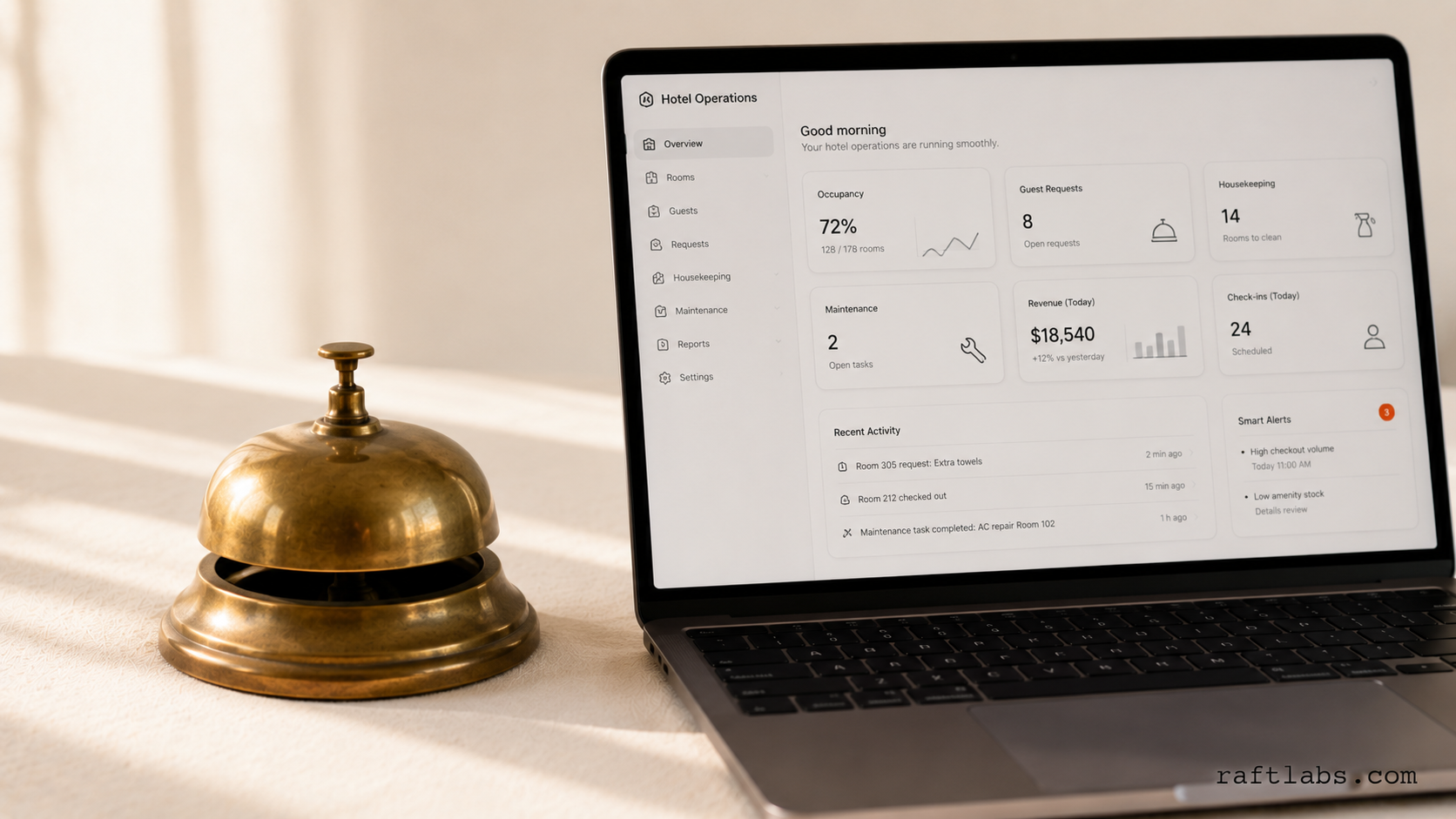
Today's Gen AI generates responses and waits for approval. Tomorrow's agentic AI makes decisions and takes actions within defined parameters.
What changes: instead of suggesting a room upgrade, the system books the upgrade based on guest profile analysis, current inventory, revenue optimization rules, and likelihood of acceptance. Instead of drafting a service recovery offer, it approves compensation and applies the credit directly. Instead of recommending dinner reservations, it books them and adjusts your restaurant capacity planning.
The AI becomes an autonomous agent operating within boundaries you establish, not a tool waiting for human confirmation on every action.
Here's such an agentic AI in action:
2. Voice AI evolution: indistinguishable from human conversation
Current voice AI handles simple phone interactions with noticeable artificial patterns. Evolving voice AI will conduct conversations indistinguishable from speaking with a skilled human agent.
What improves: natural speech patterns including hesitations, emotional tone matching, sophisticated interruption handling, context awareness across channels, and emotion detection that adjusts responses based on caller sentiment.
The technical term is "human parity," the point where blind testing shows people can't reliably distinguish AI from human agents. We're approaching that threshold for hospitality conversations.
What this enables: your phone system becomes a complete concierge service, not just a basic inquiry handler. Complex conversations about group bookings, event planning, and special requests happen through voice AI that understands caller intent and handles objections.
In-room voice assistants evolve beyond simple commands. Guests have natural conversations: "We're thinking about dinner around 7 or 8, somewhere with good seafood but not too formal, and my wife mentioned wanting to walk around afterward, what would you suggest?"
The AI responds conversationally and asks clarifying questions. It makes restaurant recommendations, books the reservation, and suggests a walking route for after dinner. It checks the weather and mentions bringing a light jacket.
3. Multimodal AI: understanding text, images, voice, and video simultaneously
Current Gen AI processes one input type at a time. Multimodal AI processes everything simultaneously, understanding relationships between what it sees, hears, and reads.
What becomes possible: a guest sends a photo of their room with the message "something's wrong here." Multimodal AI analyzes the image, identifies the issue (water stain on the ceiling suggesting a leak), understands the urgency from the image context, creates a maintenance ticket with photo documentation, estimates repair timeframe based on similar past issues, and responds with both immediate action and explanation.
Another guest video calls the concierge, showing their current location downtown, asking for directions. The AI recognizes landmarks in the video and determines their exact position. It provides turn-by-turn guidance while seeing what the guest sees, and adjusts recommendations based on how crowded different areas appear in real time.
4. IoT + Gen AI integration: physical spaces that anticipate needs
Current hotel IoT handles basic automation: thermostats, lighting, and locks. Gen AI integration turns these systems from reactive to predictive.
How it works: Gen AI analyzes patterns across thousands of guest stays, learning preferences by segment, season, time of day, and individual history. It then orchestrates IoT devices to create personalized environments proactively.
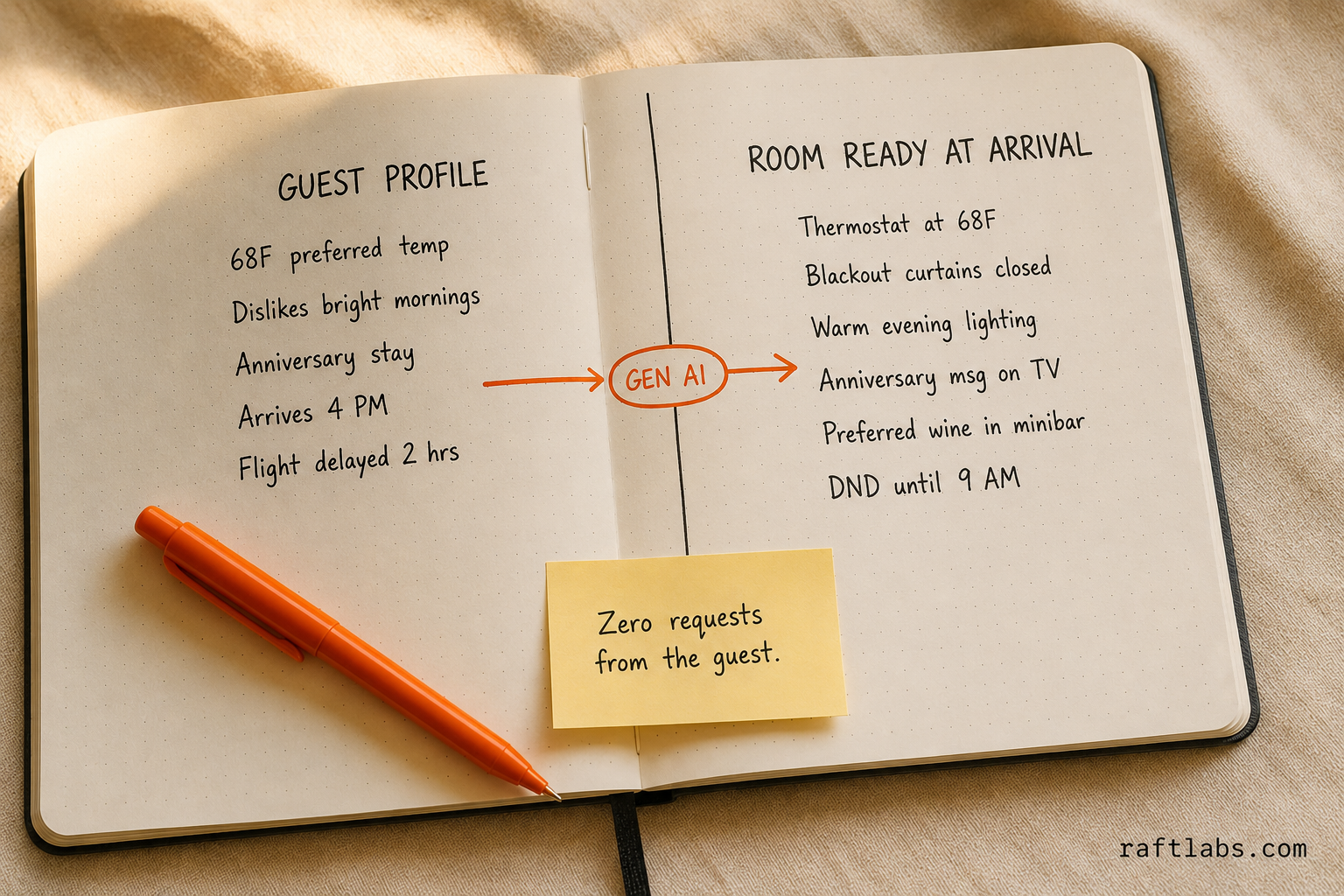
Scenario: arrival experience that adapts
Guest Rebecca checks in through the mobile app while still in the airport. Gen AI accesses her profile:
Past stays: Always requested temperature at 68 degrees F
Previous feedback: Mentioned room was too bright in the morning
Booking notes: Celebrating anniversary
Arrival time: 4 PM, outside temperature currently 85 degrees F
Recent travel: Flight delayed two hours (calendar integration shows this)
By the time Rebecca reaches her room:
Temperature preset to 68 degrees F (started cooling 30 minutes before arrival to reach target)
Blackout curtains already closed (she mentioned brightness sensitivity)
Lighting adjusted to a warm evening setting, which she preferred in previous stay
Welcome message on TV references anniversary and offers restaurant recommendations
Minibar stocked with the specific wine varietal she ordered twice before
Do-not-disturb activated until 9 AM (she previously requested late start every morning)
None of this required Rebecca to make requests or adjust settings. The AI orchestrated every IoT device based on learned preferences and current context.
5. OTA transformation: AI-first booking and discovery
The way travelers discover and book hotels is shifting. Traditional search (browsing property lists, filtering by amenities, and reading reviews) is giving way to conversational AI that understands intent and makes recommendations.
What changes: instead of "Hotels in Houston near convention center under $200," travelers ask: "I need a place to stay in Houston, March 10-12, for a tech conference. Prefer somewhere I can walk to restaurants for dinner, a good gym since I won't have time otherwise, and a reliable workspace. Nothing too boutique; just want functional and comfortable. Around $200 a night."
The AI assistant (ChatGPT, Claude, Perplexity, or travel-specific AI) processes those requests and returns recommendations based on understanding, not just keyword matching.
Why this matters for your hotel: traditional SEO focuses on optimizing for Google's algorithm. AI search optimization requires a different content structure. The AI needs to clearly understand:
Who your hotel serves best (business travelers, families, couples, groups)
What makes you different from competitors
Specific amenities and their quality level
Your location's real advantages and limitations
Honest pricing position in your market
Hotels that clearly articulate these factors in structured, accessible formats appear in AI recommendations. Hotels with vague marketing language usually don't.
The direct booking opportunity: when AI assists with booking, the conversation can happen on your website through your own Gen AI system. Instead of sending guests to OTAs for "easier booking," your AI handles the entire conversation. This includes answering questions, addressing concerns, explaining options, managing modifications, and processing payments with the same sophistication as OTA platforms.
This shifts the competitive dynamic. You're not competing against OTA convenience anymore. You're offering equivalent conversation-based booking while avoiding commission costs.
How generative AI in travel is reshaping the booking journey
Generative AI in hospitality doesn't stop at the hotel front door. The same capabilities reshaping guest communication and hotel operations are transforming AI for travel - reshaping how travelers plan, book, and experience entire trips. McKinsey's "Remapping Travel with Agentic AI" research describes this shift as a collapse of the traditional booking funnel: dreaming, planning, and booking happening in a single continuous conversation rather than across multiple sessions and platforms.
This matters for hospitality businesses because the guest journey starts long before check-in. A traveler planning a trip uses generative AI to research destinations, compare accommodation options, and build itineraries. Accommodations that show up clearly and compellingly in these AI-assisted discovery flows win bookings before the guest ever reaches an OTA.
In travel booking: generative AI is changing how travelers interact with booking platforms. Instead of searching "hotels in Dublin under 150 pounds," a traveler asks "I'm going to Dublin for a long weekend in May with my partner, we want somewhere walkable to the city centre, good breakfast, not too corporate." Hotels with specific, structured property descriptions perform far better in AI-assisted travel search than those with generic marketing copy.
In trip planning: travelers use generative AI tools to build day-by-day itineraries, research visa requirements, plan packing lists, and estimate budgets. Hotels that provide AI-friendly content - detailed neighbourhood guides, structured amenity information, accurate dining recommendations - earn a place in AI-generated itineraries.
In travel industry operations: airlines and tour operators are deploying generative AI across customer communication, content generation, itinerary personalization, and complaint resolution. Understanding these applications gives hospitality operators a clearer picture of where the competitive landscape is heading.
The direct booking opportunity in travel AI: when a traveler's entire discovery, planning, and booking flow is handled by AI, the OTA's historical advantage of convenience becomes less important. A hotel with sophisticated generative AI on its own website can replicate the conversational booking experience OTAs offer, while keeping the commission in-house.
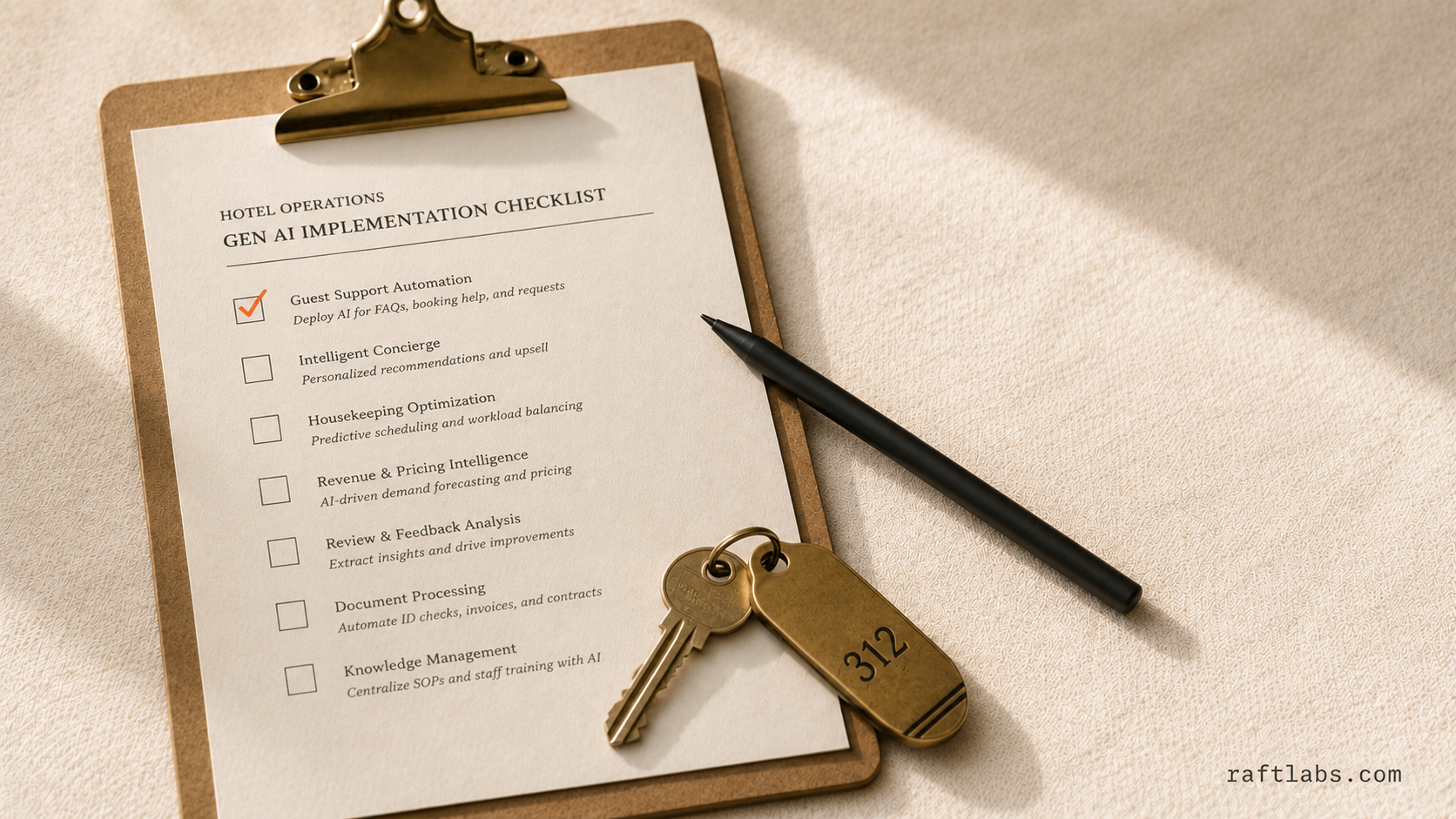
What to prepare for now
As the hospitality industry embraces the future of Gen AI, here are key steps to take right now to ensure your hospitality business is ready:
1. Build AI-ready data infrastructure
The future of Gen AI depends on clean, organized, accessible data. Your guest preferences, operational patterns, and service data need a structure that AI can parse. Start cleaning and organizing now. Hotels with messy data will struggle to implement advanced AI regardless of budget.
2. Develop AI literacy in your organization
Your managers should understand AI capabilities and limitations well enough to identify opportunities. They should think strategically about where AI creates value and where it creates risk. They should speak the language well enough to work effectively with technical partners.
This isn't about teaching managers to code. It's about teaching them to evaluate AI applications critically and integrate them thoughtfully into operations.
3. Start small, learn, scale
Don't wait for perfect AI solutions. Implement one use case well and learn what works in your specific operations. Understand how your staff adapts and where friction occurs.
Hotels that wait for "mature" AI technology will find themselves years behind competitors who started learning earlier. The technology is ready. The remaining question is whether your organization is ready to learn.
4. Partnership strategy
Decide whether you'll build AI capability internally or partner externally. Most hotels or hospitality ventures lack the technical depth to build sophisticated AI systems in-house. Choose partners with hospitality experience, demonstrated Gen AI expertise, and commitment to ongoing development.
The partner you choose for initial AI implementation will likely become your long-term AI development partner. Choose carefully.
The competitive timeline you can't ignore
Hotels implementing Gen AI today are building expertise, refining systems, training staff, and creating competitive advantages that compound over time.
Hotels waiting to implement are falling further behind in organizational AI literacy, operational integration, and competitive positioning. The technology gap can be closed with a budget. The expertise gap takes years to close.
This is similar to hotels that didn't build mobile booking capability until competitors had refined it for years. They eventually caught up on features, but never recovered the bookings and market share lost during those years.
The competitive advantage window for Gen AI in hospitality is open right now.
Why consider us as your generative AI partner
We build custom generative AI solutions for hospitality businesses that integrate deeply with your operations and deliver measurable results.
What we bring to hospitality AI:
End-to-end Gen AI development: from model selection and fine-tuning to integration and deployment, we handle the complete development cycle tailored to your hotel operations
Fast time-to-market: most hotel AI implementations go live within 12-14 weeks, not months of planning and delays
Multi-modal AI capabilities: we build systems that handle text, voice, images, and video, covering guest communication across all channels
Deep integration expertise: our solutions connect with PMS systems, CRM platforms, and your existing tech stack without disrupting operations
Security and compliance built in: HIPAA, GDPR, CCPA, and PCI DSS compliance frameworks integrated from day one
Hospitality-specific experience: we understand hotel operations, guest expectations, and the operational details that generic AI platforms miss
Our proven AI development across industries
Our track record includes AI products such as the voice-first interview platform and AI remote patient monitoring.
1. Voice AI for automated interviews
We built a voice-first interview platform that changed text-based surveys into natural phone conversations at scale. Using Twilio for global telephony and ElevenLabs Voice Agents for conversational AI, the platform automatically calls recipients, conducts intelligent interviews, and delivers insights far deeper than traditional surveys.
Advanced features include sentiment analysis, keyword tracking, and automated retry logic for failed calls. The platform went from concept to production in 12 weeks and now handles hundreds of automated conversations daily with natural dialogue flow that feels authentically human.
2. AI remote patient monitoring
We developed a HIPAA-compliant AI upgrade for a remote patient monitoring platform serving chronic care patients. The implementation integrated AWS Bedrock and Anthropic's Claude 3 Sonnet to deliver automated patient analysis, risk stratification, and predictive insights that reduced clinical decision-making time by 20%.
The AI analyzes vital signs, detects abnormalities based on historical trends, and generates intelligent alerts for healthcare providers. Additional capabilities include billing compliance prediction, end-of-month summary generation, and trend monitoring across patient populations.
These projects demonstrate our ability to build sophisticated AI systems that handle sensitive data, integrate with complex platforms, and deliver measurable improvements in operational efficiency.
Our hospitality build: City Break Apartments
We have built and shipped a live hospitality platform. City Break Apartments, one of Ireland's leading serviced apartment operators, needed to fix a broken booking flow and modernize their entire guest journey. Guests were being redirected to an external RMS page mid-booking, damaging trust and weakening direct booking rates.
We rebuilt the entire experience: a native direct booking engine with RMS Cloud integration, a self check-in mobile app with Bluetooth-based keyless access across 250+ lock-equipped properties, and a fully digitized guest journey from reservation to room entry. The result was a 25% rise in direct revenue, delivered in 14 weeks.
That project covered the exact integrations that matter for generative AI in hospitality: real-time PMS sync, payment flows, automated key dispatch, and a guest-facing mobile experience that had to work flawlessly at 2 AM when no staff were on site.
Conclusion
Generative AI is not about replacing the human element in hospitality but about strengthening it. By automating routine tasks, such as answering common questions or handling basic requests, AI allows your staff to focus on the personal touches that truly matter to guests.
The technology is already delivering results in the hospitality industry, boosting direct bookings, reducing staff workload, and lifting overall guest satisfaction. Early adoption today will give your hotel a head start, but waiting means falling behind as AI becomes the standard.
Don't wait for the industry to catch up. Take the first step towards integrating generative AI in your operations today to stay ahead of the curve.
Ask an AI
Get an instant summary of this post from your preferred AI assistant.
Common questions
- Generative AI in hospitality refers to AI systems that create original, context-aware content and responses rather than selecting from pre-written options. In a hotel context, this means a chatbot that drafts a genuinely personalised reply to a guest's unusual request, a system that writes a new marketing email based on current availability and seasonal context, or a voice agent that handles a phone enquiry in natural, conversational language. The "generative" part is what separates it from traditional rule-based automation: the AI produces something new each time, shaped by the specific context of that guest and that moment.
- Traditional automation executes pre-programmed rules - press button A, system does task B. Generative AI creates new content based on context. When a guest asks about local restaurants, Gen AI writes an original recommendation based on their preferences, dietary restrictions, and previous stays. Traditional automation would show a static list from a database.
- No. Gen AI supports staff, doesn't replace them. Your front desk team currently handles hundreds of guest interactions weekly. Gen AI manages the routine questions - hours, amenities, directions, and basic policies. Your staff focuses on interactions requiring human judgment - complaints, complex bookings, special requests, and emotional situations.
- Implementation timelines depend on what you're building and the integration complexity. A basic chatbot for website inquiries can take about a month to six weeks. A custom chatbot with deep PMS integration usually runs for two to four months. Multi-property portfolio solutions might take three to four months. Most delays come from unclear requirements, slow decision-making, PMS integration surprises, and staff resistance.
- Data security depends on your implementation approach. Platform solutions store your data with the vendor - review their security certifications like SOC 2 and ISO 27001, check data handling policies, and understand contract terms. Custom solutions keep your data in your systems, where you control security protocols and compliance. Regardless of approach, Gen AI should never store payment card information.
- Probably, but integration complexity varies based on your system. Modern cloud-based PMS platforms like Cloudbeds, Mews, and RMS Cloud typically offer reliable APIs, making integration straightforward. Legacy on-premise systems may have limited API access and require middleware or workarounds. Your Gen AI partner should audit your PMS during planning to identify integration requirements. Work with developers who have experience integrating with PMS to avoid surprises.
- The decision depends on whether you view AI as an operational tool or a competitive differentiator. Platform solutions work when efficiency is your primary goal - faster responses, review automation, and reduced workload. Custom development makes sense when guest experience is your competitive advantage, and you want AI that sounds authentically like your brand. Single properties favor platforms, multi-property portfolios favor custom, where development costs are spread across locations.
- Guest acceptance depends heavily on transparency and context. When you clearly disclose AI interaction and provide easy access to humans when needed, most guests appreciate the speed and convenience. They prefer AI for simple questions where instant answers matter - hours, amenities, directions, basic bookings. They want humans for complex situations - complaints, special requests, and emotional issues.