Updated November 2025
AI Chatbots in Hospitality Industry: Implementation Guide, ROI & Best Practices 2026
Hotels using AI chatbots cut front-desk call volume by 25-40% and reduce OTA dependency. Here's what actually works, what fails, and how to implement it.

In this article
Short answer
RaftLabs builds AI chatbots for hospitality that handle up to 80% of routine guest inquiries. Hotels using chatbots cut front-desk call volume by 25-40% and save roughly $12,600 per year per 120 rooms by shifting just 7% of OTA bookings to direct channels.
Key takeaways
- Hotels short-staffed since 2020 can recover 2-4 hours of front-desk capacity daily by automating the top 20 repetitive questions - without hiring.
- A chatbot that shifts just 7% of OTA bookings to direct channels saves a 120-room hotel roughly $12,600 per year at a 20% commission rate - often covering its own operating cost.
- Most hotel chatbot pilots fail not because the technology breaks but because the bot can't handle the questions guests actually ask - poor training data is the leading cause.
- WhatsApp outperforms website chat in every market outside North America; a bot that only lives on your website is invisible to most international guests.
- Before buying any chatbot vendor, ask for containment rate data from a comparable property type, not just overall customer figures.
The hospitality industry has been under pressure since 2020. Staffing shortages affect hotels of all sizes, with industry surveys showing over 70% of properties report difficulty filling open roles.
Labor costs have climbed. Guest expectations for instant service have intensified. The pressure to reduce OTA dependency - those platforms still command 15-25% commissions per booking - has never been greater.
These converging forces have pushed hotels, resorts, and vacation rentals to rethink how they deliver service at scale. The math is straightforward: guests expect 24/7 responsiveness regardless of time zones, and properties can no longer staff for that demand using traditional models alone. With the global chatbot market projected to reach $15.5 billion by 2028, hospitality operators have moved past "should we adopt this?" into "how do we implement this effectively?"
A hospitality chatbot is a software agent built for hotels, resorts, vacation rentals, and restaurants. Unlike generic customer service bots, these systems connect with property management systems, booking engines, and CRM platforms to handle tasks specific to travel and lodging: checking room availability, processing reservations, managing check-in details, coordinating room service, recommending local attractions.
The outcomes operators care most about are faster response times, higher direct bookings, reduced front-desk workload, and consistent multilingual support for international guests.
What chatbots actually do in hotels
Chatbots in hospitality function as virtual front-desk assistants, concierge services, and reservations agents - all rolled into one always-available interface. They answer questions, complete transactions, and guide guests through their stay without requiring a human for every interaction.
The technology behind these systems varies significantly. Rule-based chatbots follow predefined decision trees: a guest taps "Check-in times" and the bot returns a scripted answer. These are easy to control but break the moment a guest phrases something unexpectedly.
AI-powered chatbots use natural language processing and machine learning to understand free-form questions, learn from past guest conversations, and generate contextual responses. They handle varied phrasing - whether someone asks "What time is breakfast?" or "When does the restaurant open in the morning?" - and still give accurate answers.
This is where AI-powered chatbot development services let hospitality businesses move beyond scripted interactions and deliver genuinely conversational guest experiences.
From a practical standpoint, hospitality chatbots live wherever guests prefer to communicate: website widgets, WhatsApp, Telegram, Facebook and Instagram DMs, SMS, in-app chat, and QR-based chat interfaces in rooms or at the front desk. That multi-channel presence means guests find the bot however they communicate - not just on your website.
The specific tasks these systems handle include checking room availability, processing new bookings and modifications, answering questions about amenities and policies, handling late checkout requests, taking spa and restaurant reservations, providing local attraction suggestions, and presenting upsell opportunities like breakfast packages or room upgrades.
How chatbots support every stage of the guest journey
The typical guest journey spans multiple stages: researching destinations, booking, preparing for arrival, checking in, experiencing the stay, checking out, and the post-stay relationship. Chatbots fit into each of these touchpoints as part of a broader travel and hospitality software development strategy.
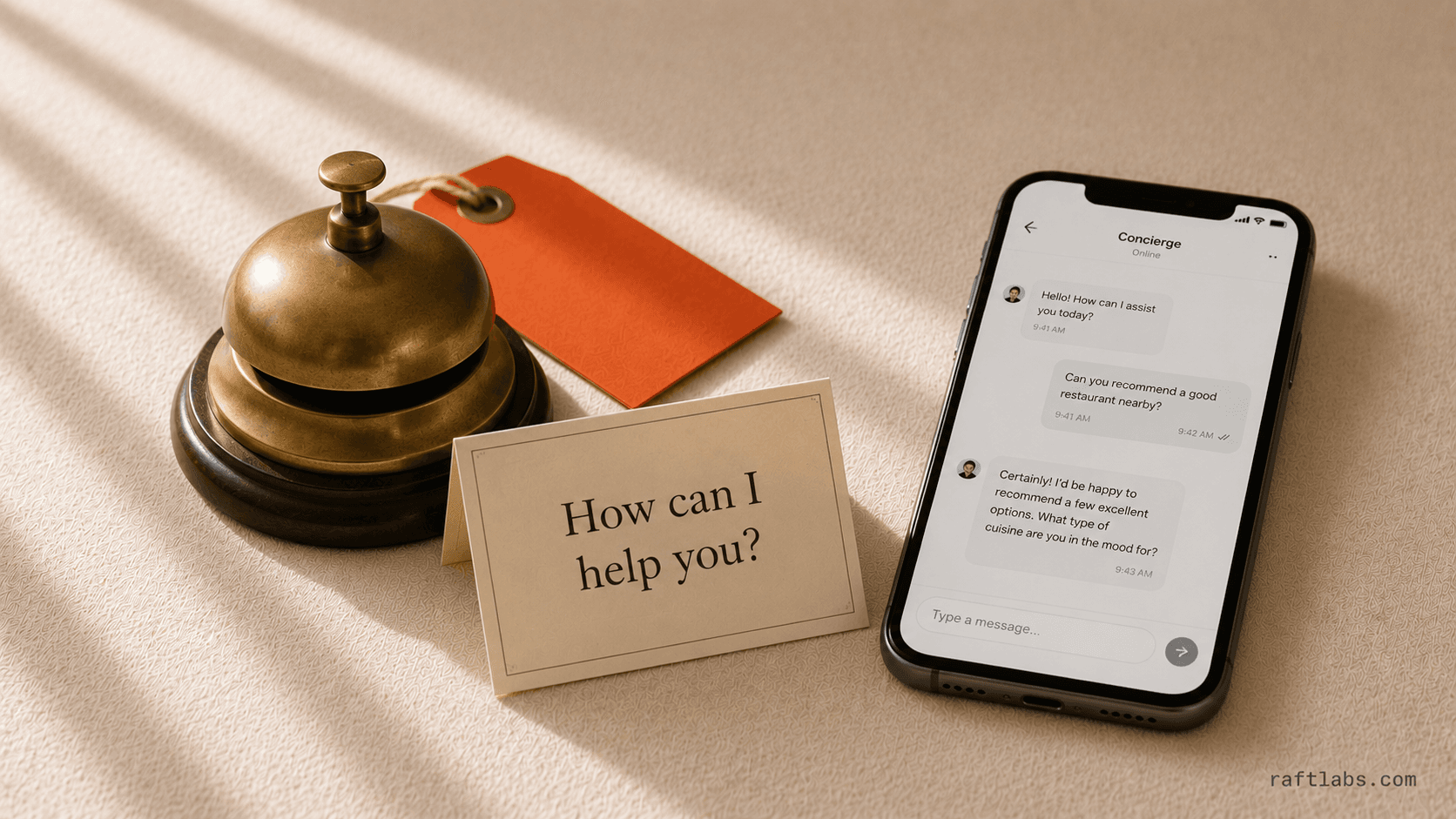
During the research phase, prospective guests browsing your hotel website might ask about parking fees, pet policies, or whether the pool is heated - questions that previously required email or a phone call. A chatbot gives instant answers and keeps potential guests on your site rather than bouncing to a competitor.
At the booking stage, the bot walks guests through room options, applies promo codes, and captures payment securely. Pre-arrival communication confirms stay details, offers airport transfer booking, and shares digital check-in options.
During the stay, guests can request extra towels, order room service, book dinner reservations, or ask about nearby attractions - all through the messaging channels they already use. Post-checkout, chatbots gather guest feedback, send satisfaction surveys, and deliver targeted offers for future stays.
Properties that do this well see measurable results. Some report reducing email response times from hours to under a minute. Others handle 80% of routine guest inquiries without human intervention, freeing staff for interactions that actually require human judgment.
Most hotels are understaffed. They can't deliver personalized service at scale through manual processes alone. Automation fills that gap without sacrificing quality - when it's implemented well. That last qualification matters, which we'll come back to.
How personalization data compounds over time
Every chatbot interaction generates first-party data. The system captures search queries, preferred stay dates, room type preferences, language selections, and recurring service requests. That information builds a profile that extends far beyond a single booking.
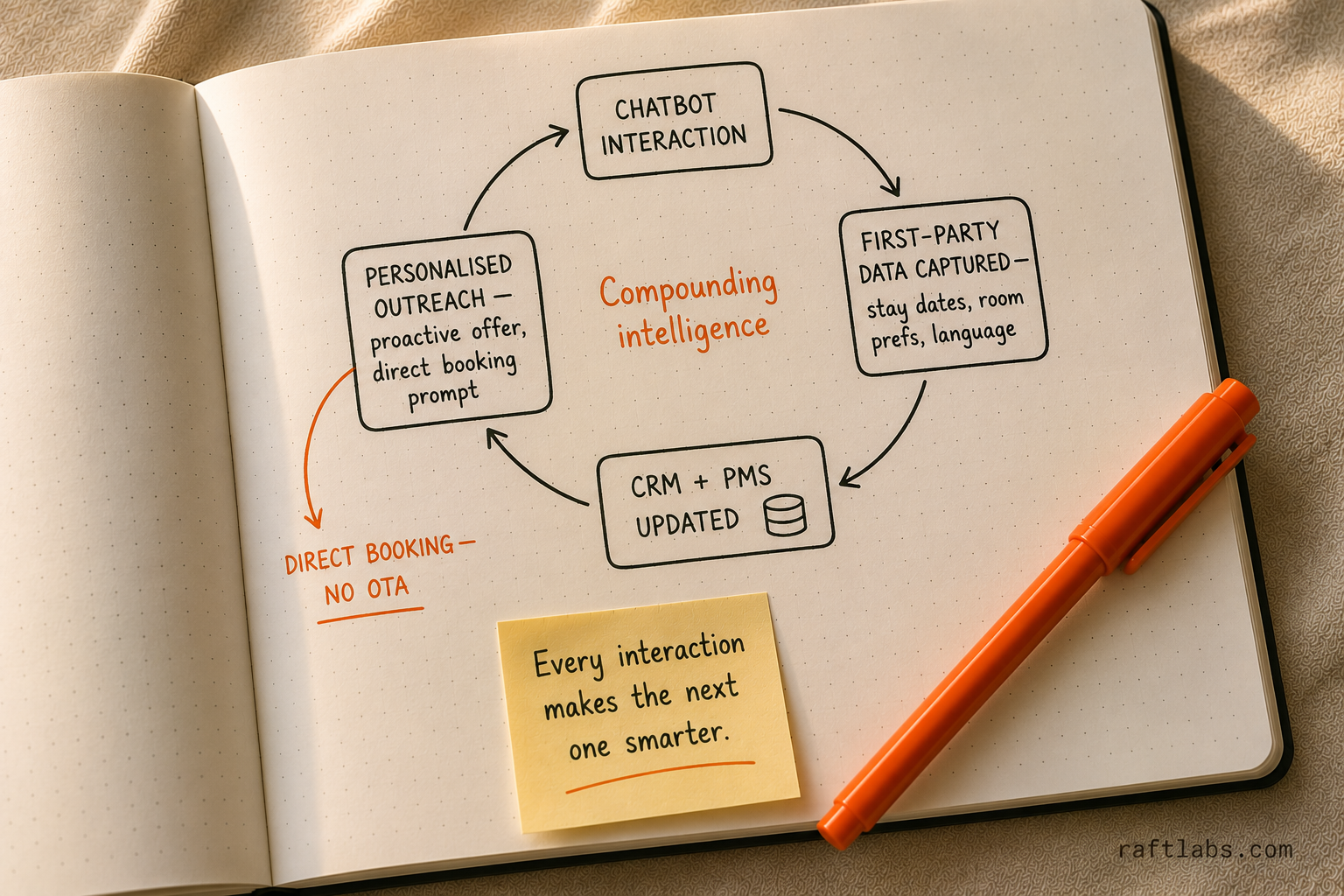
When this data feeds into your CRM or property management system, it makes smarter communication possible across the entire guest journey. Pre-arrival messages get tailored based on previous stays. A returning guest who always requests a high floor can receive a proactive offer for their preferred room type. Weekend leisure travelers might get a late checkout deal on Friday morning, while business guests see early check-in options.
Here's a concrete example: a website visitor in 2026 asks your chatbot about room rates for a specific weekend. They don't book immediately, but the chatbot captures their email and stay interest. Two weeks later, your marketing automation sends a direct booking discount for that same weekend, converting a lost opportunity without OTA involvement.
That loop turns a basic FAQ bot into a revenue and loyalty engine. The intelligence compounds over time, making personalized guest experiences feel attentive rather than generic.
Key benefits of chatbots in hospitality
The benefits fall into four categories: guest experience improvements, operational efficiencies, revenue growth, and data-driven insights. Each translates into measurable outcomes.
24/7 availability is the most immediate win. Hotel guests don't operate on business hours. They book trips at midnight, arrive on red-eye flights, and need help at 3 AM. Chatbots handle unlimited simultaneous interactions during peak times without degrading service quality.
Multilingual support matters enormously for international guests. A city-center hotel serving travelers from a dozen countries can deploy a chatbot that communicates in multiple languages, removing friction that might otherwise require specialized staff or produce guest frustration.
Lower operational costs come from deflecting routine questions away from front-desk staff and call centers. Industry data suggests around 80% of simple queries can be handled independently by a properly configured bot. Hotels that implement these systems well see 25-40% reductions in routine call volume.
Higher direct bookings save substantial money. Hotels spend billions annually on OTA commissions. A chatbot that intercepts website visitors, answers their questions in real time, and guides them to complete a booking directly can shift even a modest percentage of reservations away from commission-heavy channels - especially when paired with direct hotel booking apps designed to optimize conversion.
Reduced staff burnout is an underrated benefit. When front-desk agents no longer field the same parking, Wi-Fi, and breakfast-time questions dozens of times daily, they can focus on guest engagement that actually requires human judgment and empathy. This contributes to lower turnover - a chronic issue in hospitality since 2020.
These benefits are measurable: response time reduction, website conversion improvements, call volume decreases, and incremental revenue from spa, F&B, and tour upsells can all be tracked against baseline performance.
From the guest's perspective
The guest value proposition is simple: no waiting on hold, getting check-in information instantly, requesting extra pillows via chat at 11 PM, getting local dining suggestions in their preferred language.
Consider a Caribbean resort that enabled late-night room service ordering via a WhatsApp chatbot. International guests arriving on evening flights could order food without calling a front desk already busy with check-ins. Guest satisfaction scores for F&B services improved measurably, and the restaurant captured orders that previously went unfulfilled.
Chatbots don't replace human warmth. They remove friction so human staff can spend more time face-to-face with guests who need deeper assistance. The guest with a billing complaint doesn't want a bot. The guest who wants to know whether breakfast includes vegetarian options? They're perfectly happy to get that answer instantly via text.
Operational efficiency in practice
Repetitive, low-complexity questions consume an enormous amount of staff time: Wi-Fi passwords, parking policies, breakfast hours, pet fees, pool schedules, invoice copy requests. These queries are predictable and easily automated.
AI chatbots handle these FAQs while also creating and routing service tickets. When a guest reports a maintenance issue through the chatbot, the system automatically generates a work order in your property management system and notifies the right team - no human intermediary needed.
Properties that implement chatbots well often find that front-desk staff handles 25-40% fewer routine calls during peak hours. For a 150-room hotel with a lean front-desk team, that might translate to several hours of reclaimed staff capacity daily - time that gets redirected toward personalized service for guests who actually need it.
Revenue growth through direct bookings
AI chatbots drive revenue through two primary mechanisms: shifting bookings from OTAs to direct channels, and systematic upselling throughout the stay.
When a prospective guest lands on your website and asks a question - "Is the suite available next weekend?" or "What's included in the breakfast package?" - a chatbot gives instant answers that OTAs can't. That responsiveness keeps potential guests on your site. Add a time-limited direct booking incentive ("Book directly in the next hour for a complimentary upgrade") and you create a compelling reason to skip OTA channels entirely.
The economics are significant. A 100-room hotel easily pays six figures annually in OTA commissions. Even a 5-10% shift toward direct bookings saves tens of thousands of dollars that flows directly to the bottom line.
Beyond bookings, chatbots make upselling systematic. During the booking process, they propose room upgrades or breakfast add-ons. Before arrival, they offer airport transfers or parking packages. During the stay, they promote spa treatments, dinner reservations, late checkout, or local tour packages. These offers get triggered at optimal moments - a late checkout message sent the evening before departure, for instance - which maximizes conversion.
Types of hospitality chatbots and core features
The spectrum runs from simple rule-based chatbots that handle FAQs with button-driven menus, to transactional bots that complete bookings and modifications, to fully conversational AI agents integrated with hotel systems that understand complex, open-ended requests.
In 2026, most successful hospitality setups use a hybrid model: predefined flows for common, high-stakes tasks (completing a booking, requesting a human agent) combined with AI capabilities for open-ended questions and personalized recommendations. This balances reliability with flexibility.
The right type depends on your property's context. A small B&B with straightforward offerings might do well with a well-designed rule-based bot. An independent boutique hotel with complex packages and personalized services might need more sophisticated AI. A multi-brand chain needs enterprise-grade solutions that maintain consistency across properties while allowing local customization.
Must-have features for hotel chatbots
| Feature | Hospitality-specific application |
|---|---|
| 24/7 availability | Handle guest queries during off-hours, across time zones |
| FAQ handling | Answer common questions about policies, amenities, directions |
| Booking engine integration | Check room availability, process reservations, apply promo codes |
| PMS connectivity | Access real-time room inventory, guest profiles, folio information |
| Multi-language support | Serve international guests in their preferred language |
| Human agent escalation | Transfer complex issues to staff with full conversation context |
| Analytics dashboard | Track containment rates, response times, common questions |
| Secure data handling | Protect personal information and payment data |
For European city-center hotels, multi-language support isn't optional - it's essential. PMS integration makes real-time room availability checks possible and lets you offer instant upgrades when a guest inquires about premium options.
Generative AI capabilities unlock more sophisticated applications like personalized itinerary suggestions. A family visiting Barcelona might receive recommendations for kid-friendly activities, while a solo business traveler gets suggestions for efficient dining near their meetings.
Integration with channels guests already use - WhatsApp in Europe and Latin America, WeChat for Chinese travelers, iMessage in North America - dramatically improves adoption compared to forcing guests onto unfamiliar platforms.
Advanced capabilities worth knowing about
Voice-enabled chatbots are the next frontier for hospitality. Smart speakers in guest rooms handle requests like "Order room service" or "Set the temperature to 72 degrees," with the underlying chatbot orchestrating the service request or IoT command.
Predictive personalization uses data from previous stays and similar guest profiles to anticipate needs. A family that stayed at your resort last summer might receive proactive suggestions for kid-friendly activities when they book again for summer 2026 - before they even ask.
IoT integration connects virtual concierges to smart rooms, letting guests control lighting, temperature, curtains, and entertainment through natural language commands. The chatbot becomes the interface between guest intent and building systems.
Which chatbot setup fits your property type
Small and independent hotels
The priority is cost efficiency and fast deployment - the same philosophy behind our small hotel management software work. A rule-based or hybrid chatbot handling FAQ deflection and basic booking support delivers measurable ROI quickly without the integration complexity of a fully custom build. Focus on the top 20 questions your front desk answers repeatedly; those alone can reclaim hours of staff time per day. PMS connectivity is still important, but a native integration with a mainstream PMS platform (RMS cloud, Cloudbeds, Mews) is usually sufficient.
Boutique properties
Brand voice is the primary concern. A chatbot that sounds generic undercuts the positioning that boutique hotels compete on. This is the strongest argument for custom development over off-the-shelf - not feature depth, but voice fidelity. A boutique hotel in Dublin doesn't want its AI to sound identical to a budget chain using the same platform.
Serviced apartments and short-term rentals
The guest journey operates without a front desk, which makes chatbot capability more critical than in any other segment. Self check-in coordination, keyless access triggers, ID verification prompts, arrival instructions, and maintenance triage all need to be handled autonomously. Our work with City Break Apartments in Dublin addressed exactly this: a fully digital guest journey replacing a manual card-and-app setup across 250+ Bluetooth-enabled properties, contributing to a 25% rise in direct revenue. This type of deployment requires deep integration with your access control system, not just your PMS.
Resorts
F&B integration becomes central. A resort guest should be able to order room service, make a spa booking, or ask for a restaurant reservation through the same chatbot interface they use for everything else. This requires integration beyond the PMS to include point-of-sale systems, activity booking platforms, and reservation management tools.
Multi-property hotel groups
Consistency and local customization need to coexist. The brand voice and escalation logic should be consistent across all properties. Property-specific information - rate policies, local recommendations, special offerings - needs to be customizable at a property level without rebuilding the entire system. This is one of the strongest arguments for custom architecture over platform solutions, which typically offer limited per-property customization within a shared account.
Where your chatbot actually lives: channels and deployment
The most capable chatbot delivers zero value if guests don't encounter it. Where you deploy matters as much as what it can do.
Most hospitality operators default to website chat because it's the easiest starting point. It's also the channel with the narrowest reach. Today's hotel guests communicate across WhatsApp, email, SMS, Facebook Messenger, Instagram DMs, in-app chat, and QR-code-triggered interfaces at the property. Each channel carries different guest expectations, different conversation patterns, and different technical integration requirements.
WhatsApp for hotels is the highest-performing channel in markets outside North America. European, Latin American, Middle Eastern, and Asian guests overwhelmingly prefer WhatsApp over website chat. A chatbot available only on your website is invisible to a significant portion of your international guests.
What WhatsApp deployment makes possible that website chat doesn't:
Pre-arrival communication initiated by the hotel, not just reactive responses to guest questions
Proactive upsell messages sent at optimal moments (room upgrade offer 48 hours before arrival, late checkout prompt the evening before departure)
QR-code triggered ordering for F&B, letting guests scan and order from their rooms or poolside without installing an app
Conversation continuity across the stay, since WhatsApp message history persists on the guest's phone
SMS remains the highest open-rate channel for North American guests who prefer not to use messaging apps. A chatbot that engages via SMS without routing guests to a separate platform removes friction that costs bookings.
In-app chat matters most for hotel groups with a mobile app or loyalty program. If your guests already have your app installed, deploying the chatbot within it creates a single interface for the entire stay.
The multi-channel principle: Guests should be able to start a conversation on one channel and continue on another without losing context. This requires your chatbot to maintain a persistent guest profile - not just a session log. That level of continuity requires either a platform with native omnichannel support or custom development that connects conversation history across channels through your CRM.
Implementation priority: Start with whichever single channel has the highest current guest contact volume at your property. Deploy there first, validate performance, then expand. Launching across five channels simultaneously creates integration and training complexity that delays the whole project.
Real-world examples of chatbots in hospitality
Leading hospitality brands began deploying chatbots around 2016, with more sophisticated AI agents rolling out between 2022 and 2026. These implementations offer lessons for properties of all sizes - not just major chains with large technology budgets.
Global chains: what smaller hotels can borrow
Marriott International uses chatbots within the Marriott Bonvoy app and messaging platforms to assist guests with bookings, loyalty inquiries, and stay requests. The system handles multiple languages, maintains context across channels, and connects with Marriott's loyalty program data to provide personalized recommendations.
What smaller hotels can adapt from this approach:
Multi-channel presence: Meet guests where they already communicate
Loyalty integration: Use chatbot interactions to capture and reinforce loyalty preferences
Consistent brand tone: Maintain voice consistency regardless of which property or channel a guest uses
Accor has deployed similar capabilities with its messaging-based concierge, focusing on cutting common service requests and gathering guest feedback. Four Seasons takes a premium approach, using messaging platforms to deliver high-touch concierge services that feel personalized rather than automated.
The underlying principles - fast support, personalization, and deep integration - apply across all scales of hospitality.
Independent hotels and resorts: practical wins
A 90-room coastal resort facing seasonal surges and a high proportion of international guests provides a useful illustration. Before implementing a chatbot, the reservations team spent hours daily answering repetitive emails about room types, beach access, and restaurant hours. Response times averaged 6-8 hours during busy periods.
After deploying a web and WhatsApp chatbot with booking engine integration:
Average response time under 90 seconds for common inquiries
35% reduction in reservation-related emails
22% higher uptake of spa packages through proactive chatbot suggestions
Measurable increase in direct bookings during peak season 2025
The implementation took approximately 14 weeks from kickoff to full launch, including integration with their existing PMS and staff training on the new workflow.
Single-property hotels can achieve similar results with a phased approach. Starting with core FAQs and basic booking support, then expanding to in-stay services and upselling, lets properties demonstrate value quickly while building toward more sophisticated capabilities.
What goes wrong when hotels buy cheap chatbots
Most hotel chatbot pilots fail not because the technology breaks but because implementation was flawed. Understanding the failure modes before you buy protects you from the most common mistakes.
Guests detect they're talking to a bot within 2 exchanges. This is the most common complaint about low-cost chatbots. It happens when the bot can't handle unexpected phrasing, when responses are too formal and uniform, or when the personality is clearly templated from a generic platform. Once a guest identifies it as a bot, trust in the interaction drops sharply.
Poor training data produces embarrassing errors. A chatbot trained only on generic hospitality FAQ templates - rather than your actual guest conversations, your specific policies, and your property's language - will confidently give wrong answers. A bot that tells a guest checkout is at 11 AM when your property has flexible late checkout will create a worse experience than no bot at all.
Missing human fallback traps frustrated guests in loops. A guest complains through a chatbot about noise from a neighboring room. The bot, not recognizing the emotional component, offers generic troubleshooting steps. The guest's frustration compounds. What might have been a recoverable situation becomes a negative review. Proper escalation design - immediate routing to a human when complaint-related language appears - prevents this outcome.
Weak PMS integration means the bot can't actually help. A chatbot that says "please call the front desk for availability" is worse than no chatbot. It creates the expectation of self-service and then doesn't deliver it. True transactional capability requires real-time PMS connectivity, not just a static FAQ layer.
Overpromising in vendor demos. Many chatbot vendors demo their product using ideal-path scenarios. The bot handles "Can I check in early?" perfectly. It breaks on "My flight got cancelled and I won't arrive until tomorrow, can I get a partial refund for the first night?" Get the vendor to walk through failure cases and escalation paths in the demo, not just the happy path.
Questions to ask before buying a chatbot vendor
Before signing with any chatbot provider, get answers to these questions. Vendors who can't answer them directly are telling you something important.
-
What's the containment rate for a comparable property type? Not overall averages - a number from a hotel similar to yours in size, market, and complexity. Anything below 60% for routine inquiries means the training data is weak.
-
What happens when a guest asks something the bot doesn't recognize? Ask for a live demo of a failure case. The quality of the fallback experience - does it ask a clarifying question? Does it route to a human? Does it give a generic error? - reveals the maturity of the product.
-
How do you handle complaint detection and emotional escalation? The vendor should have a specific answer about how their system identifies distress language and what it does with it. "We route to a human agent" is not sufficient - ask how fast, through what channel, and with what context passed to the agent.
-
What PMS integrations are live, not just "on the roadmap"? Integration depth determines whether the bot can actually complete transactions or just answer static questions. Get a list of current live integrations, not planned ones.
-
How is guest data handled under GDPR? If you have European guests (and most hotels do), the vendor needs a specific answer about where data is processed, how long it's retained, and what data processing agreements they offer. "We're compliant" is not an answer.
-
What does post-launch optimization look like? A chatbot degrades over time if it isn't regularly updated. Ask how the vendor handles new policy updates, seasonal FAQ changes, and retraining when performance drops.
-
Can you speak to a reference customer with a similar property? Any vendor with real deployments should be able to connect you with a current customer. If they can't, treat that as a signal.
How to build and deploy a hospitality chatbot: step by step
Implementing a hospitality chatbot requires a structured approach. The roadmap below covers the journey from defining business goals through launch and continuous optimization, specifically for hotels, resorts, and related operators.
The primary reason early chatbot pilots underperformed wasn't the technology - it was poor scoping, inadequate training data, or failure to prepare staff for the new system. Skipping steps creates gaps that surface as frustrated guests and disappointed owners.
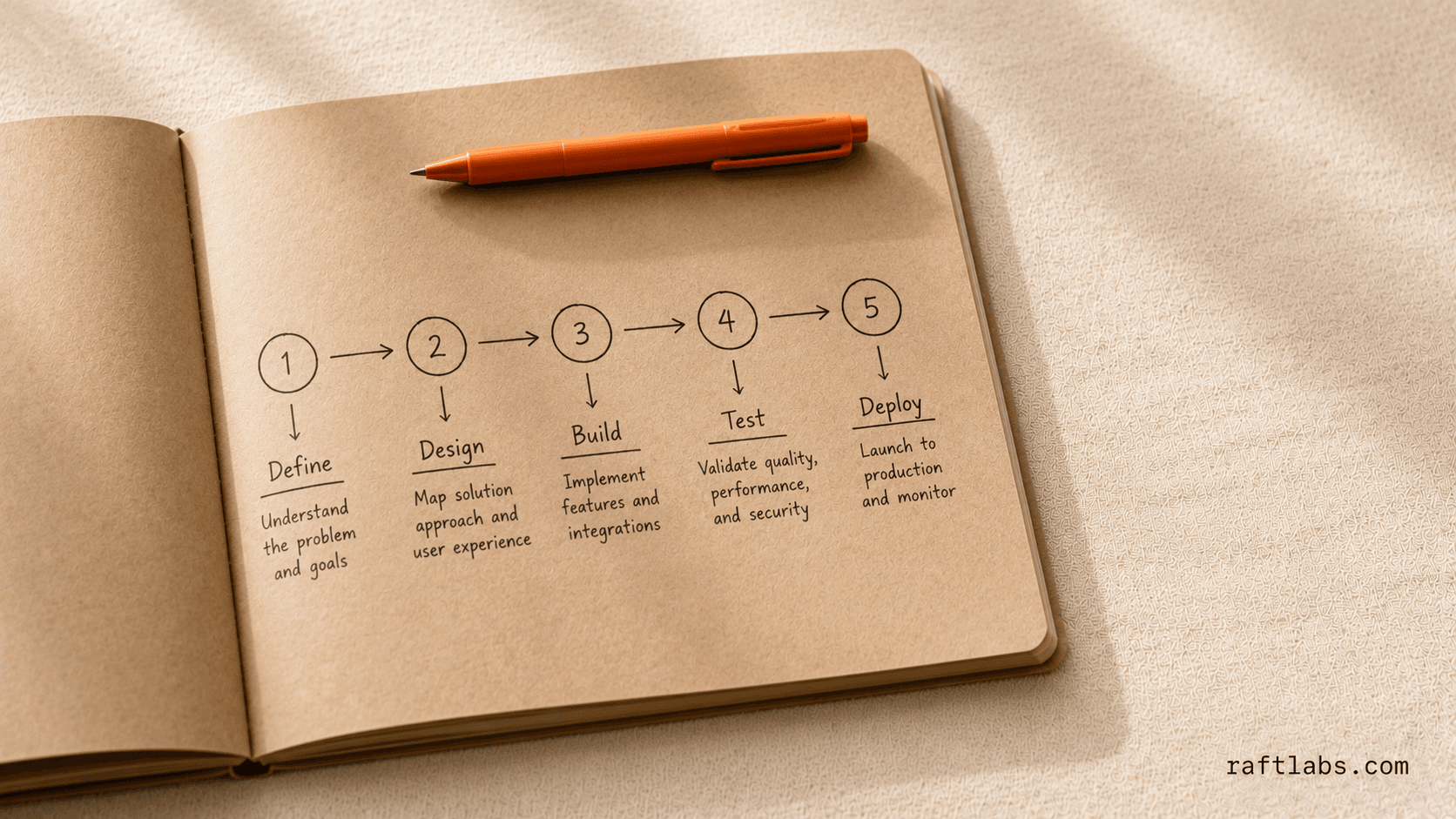
Step 1: Define business goals and use cases
Start with concrete, measurable goals rather than vague aspirations:
Reduce front-desk call volume by 30% within six months of launch
Shift 8% of OTA bookings to direct channels by end of 2026
Support five languages for European guests
Achieve 70% containment rate for pre-arrival inquiries
To identify the right use cases, interview front-desk staff, reservations teams, and marketing personnel. Ask them to list the top 20 repetitive questions they handle and the most common friction points in the guest experience. This exercise typically reveals clear patterns - the same questions about parking, check-in times, Wi-Fi, and breakfast appear at nearly every property.
For your initial deployment, prioritize 3-5 high-impact use cases rather than trying to automate everything at once. A focused MVP might include booking FAQs, check-in information, and basic in-stay service requests. This AI MVP development approach delivers quick wins while building organizational confidence in the technology.
Step 2: Choose technology, platform, and integrations
Technology options fall along a spectrum. At one end, off-the-shelf SaaS chatbot tools offer quick deployment with limited customization. At the other end, custom-built solutions use cloud AI services (from providers like OpenAI, AWS, or Google) while connecting deeply with your existing hotel systems.
For hospitality specifically, integrations matter enormously. Your chatbot needs to connect with:
PMS platforms like Opera, Cloudbeds, Mews, or Protel for guest profiles, reservations, and room status
Booking engines for real-time availability and rate information
CRM systems like Salesforce or hospitality-specific platforms for guest history and preferences
Payment gateways for secure transaction processing
Service management tools for routing housekeeping, maintenance, and concierge requests
APIs, webhooks, and secure authentication make these connections work. The quality of these integrations determines whether your chatbot can actually complete transactions and service requests - or just provide information.
Step 3: Design conversational flows and UX
Designing effective conversational flows requires collaboration between operations, marketing, and UX teams. The bot's tone should match your brand - a business hotel in Frankfurt needs a different voice than a beach resort in Cancun or a boutique property in Brooklyn.
Map clear flows for the most common tasks:
New booking inquiry and completion
Booking modification or cancellation
General questions and FAQ responses
Service requests (housekeeping, maintenance, room service)
Escalation to human agents
Language considerations extend beyond simple translation. Determine the default language, fallback options for unsupported languages, and how the system handles unclear or ambiguous questions. Graceful error handling - asking clarifying questions rather than returning generic failure messages - prevents guest frustration.
Step 4: Build, train, and integrate
This is where developers implement the chatbot, connect it to booking engines, PMS, CRM, and messaging channels, and configure analytics and monitoring.
Training data sources for hospitality chatbots typically include:
Past email transcripts and call center logs
Existing website FAQs and help documentation
Property guides and amenity descriptions
Policy documents (cancellation, pet, parking, etc.)
Common service request patterns
Security and compliance are non-negotiable for any system handling guest data. PCI-DSS compliance is required for payment processing. GDPR applies to European guests' personal data. Other jurisdictions have their own privacy requirements. Encryption in transit and at rest, role-based access control, and audit logging must be built into the architecture.
Step 5: Test, launch, and optimize continuously
Phased testing reduces launch risk. Start with internal staff beta testing - have front-desk and reservations teams interact with the bot as if they were guests, identifying gaps and errors. Then conduct a soft launch on limited channels or during specific hours before rolling out fully.
Track key metrics from day one:
| Metric | What it measures |
|---|---|
| Containment rate | Percentage of conversations fully handled by bot |
| Average response time | Speed of bot responses |
| CSAT after bot interactions | Guest satisfaction with automated service |
| Escalation rate | How often guests request human agents |
| Booking conversion impact | Effect on direct booking completion |
Optimization is ongoing. Real guest conversations reveal questions and phrasing your initial training didn't anticipate. Review conversation logs regularly, add new answers, refine flows, and retrain AI models as guest behavior changes. Travel restrictions, seasonal trends, and property changes all create new information needs.
Hospitality chatbot costs, timelines, and ROI
Chatbot costs vary based on complexity, AI sophistication, number of integrations, supported channels, languages, and whether you choose SaaS tools or custom development.
The main cost drivers:
Feature complexity: basic FAQ handling costs less than transactional capabilities with full booking integration
AI depth: rule-based bots are cheaper than advanced AI chatbots with generative capabilities
Integration requirements: each PMS, booking engine, or third-party connection adds development time
Channel coverage: supporting web, WhatsApp, SMS, and in-app chat requires more configuration than a single channel
Language support: additional languages require translation, testing, and ongoing maintenance
Timelines vary. Quick-launch SaaS setups can go live in 2-4 weeks with minimal customization. Fully custom, deeply integrated solutions typically require 3-6 months of development, testing, and refinement.
Typical cost ranges by scenario
| Scenario | Initial cost | Recurring cost |
|---|---|---|
| Small hotel using templated SaaS chatbot | Minimal setup | $50-$300/month |
| Mid-size hotel with light customization | $10,000-$40,000 | $200-$800/month |
| Large resort or chain with custom AI agents | $60,000-$150,000+ | Varies by usage |
Multi-property rollouts can spread development costs across a portfolio. A hotel group with 10 properties spreading a custom solution investment effectively reduces per-property costs while maintaining consistency.
Complex features push costs upward but also expand potential ROI. Voice capabilities, IoT integration, multi-language generative responses, and deep PMS connectivity require more development but enable capabilities that basic bots cannot match.
Calculating ROI: direct and indirect gains
Model your chatbot ROI across multiple dimensions:
Direct savings:
Reduction in OTA commissions from shifted direct bookings
Reduction in call center or front-desk staffing needs
Time savings from automated FAQ handling
Revenue gains:
Higher upsell conversion on rooms, breakfast, spa, and activities
Increased booking conversion from website visitors
Higher guest lifetime value from improved data capture
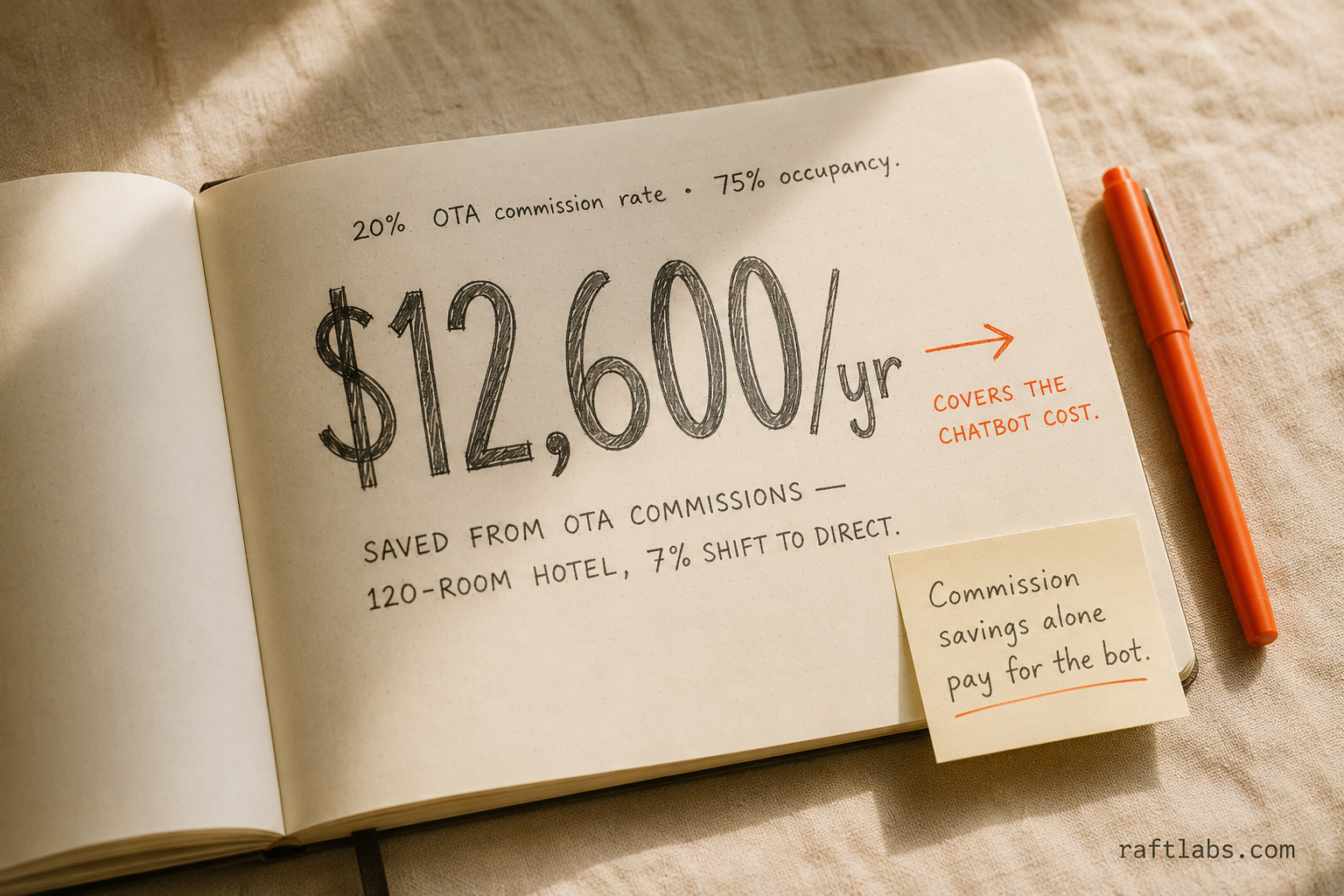
A concrete example: A 120-room hotel averaging 75% occupancy pays approximately $180,000 annually in OTA commissions at a 20% rate. If a chatbot shifts just 7% of those bookings to direct channels, the property saves roughly $12,600 per year - often enough to cover the chatbot's operating costs with margin to spare. Add incremental revenue from spa and dining upsells, and the business case strengthens further.
Indirect gains include fewer booking errors, better data quality for marketing, improved guest feedback scores, and higher staff morale. These are harder to quantify but contribute meaningfully to long-term performance.
Common implementation challenges and how to handle them
Many early chatbot pilots in hospitality struggled not because the technology failed, but because implementation was flawed. The main challenge categories:
Handling complex or emotional issues: chatbots still struggle with complaints, unusual requests, and situations requiring empathy
Protecting data privacy: guest information requires careful protection across jurisdictions
Keeping conversations natural: stilted, robotic responses frustrate guests
Avoiding over-automation: not every interaction should be automated
Aligning technology with operations: the chatbot must fit how your teams actually work
Balancing automation with human hospitality
The best hotel chatbots are fast and accurate for straightforward tasks while humans retain responsibility for complex, high-emotion interactions. A guest asking about breakfast hours gets an instant answer. A guest with a billing dispute or a complaint about room conditions gets a human.
Clear "Talk to a person" options must be visible and functional at every stage. Intelligent routing can prioritize certain guests - VIPs, loyalty members, or anyone using complaint-related language - for immediate human attention.
The goal is "AI plus people," not "AI instead of people." Hospitality is built on human connection. AI should handle routine tasks and free staff for the interactions that matter, not replace those interactions.
Data privacy, security, and compliance
Hospitality chatbots handle sensitive information: names, contact details, travel plans, payment information, loyalty IDs, and sometimes health-related preferences or special needs. This data requires serious protection.
Relevant regulations include:
GDPR for guests from the European Union
CCPA/CPRA for California residents
PCI-DSS for any system touching payment card data
Local privacy laws in various jurisdictions
Security measures include encryption in transit and at rest, role-based access control limiting who can view conversation logs, thorough audit logging, and data minimization practices that avoid collecting information beyond what's needed.
Want results like these for your property? A 90-room coastal resort achieved 35% fewer emails and 22% higher spa bookings with our custom chatbot. Your property could be next. Book a call
When external AI providers process chat data, hotels must carefully structure data-sharing agreements and consider cross-border data transfer implications. The wrong architecture creates compliance exposure across multiple jurisdictions.
How to choose the right chatbot development partner for hospitality
Technology alone doesn't guarantee success. Domain expertise in hospitality operations, user experience design, and complex system integrations matters as much as technical capability.
When evaluating potential partners, key criteria include:
Hospitality experience: have they built chatbot solutions for hotels, resorts, or similar properties?
Integration capability: can they connect with your specific PMS, booking engine, and CRM?
Custom flow development: will they adapt to your unique guest journey, or force you into their template?
Multilingual UX: can they design experiences that work across your guest demographics?
Security expertise: do they understand hospitality-specific compliance requirements?
Post-launch support: how will they help you optimize performance after go-live?
Questions to ask potential partners:
"What hospitality projects have you shipped since 2020?"
"How do you handle data privacy for EU guests?"
"Can you share containment rate metrics from a comparable property?"
"What does your post-launch optimization process look like?"
How RaftLabs approaches hospitality chatbot builds
RaftLabs specializes in custom AI chatbot development with a focus on integrations, scalability, and aligning digital products with measurable business outcomes. For hospitality clients, that means solutions designed around your actual operational workflows - not generic templates that require your team to adapt.
The RaftLabs approach follows a phased methodology:
- Discovery workshop with hotel leadership to identify priority use cases and success metrics
- Technical and integration audit to assess current systems and define the optimal architecture
- MVP development focused on the 3-5 use cases with highest impact
- Iterative expansion adding upselling, personalization, and advanced analytics based on real performance data
This prevents overbuilding in the first release while establishing a clear path toward more sophisticated capabilities. Each phase delivers measurable value, building confidence and organizational buy-in.
If you're a hotelier, resort owner, or hospitality leader considering a chatbot initiative, the next step is a conversation. RaftLabs can help you evaluate your current technology stack, identify the highest-impact use cases for your property, and develop a tailored implementation roadmap that fits your brand, systems, and budget.
Ask an AI
Get an instant summary of this post from your preferred AI assistant.
Common questions
- Chatbots in the hospitality industry are AI-powered virtual assistants that interact with hotel guests and prospective customers. They handle inquiries, assist with reservations, provide information about amenities, and offer personalized recommendations - all to improve the guest experience and cut the manual work your front desk handles today.
- Yes. Advanced hotel chatbots check room availability, guide guests through the booking process, apply promo codes, and confirm bookings in real time. This increases direct bookings and cuts reliance on OTAs.
- Rule-based chatbots follow predefined scripts and respond to specific commands - they handle simple FAQs well. AI-powered chatbots use natural language processing and machine learning to understand free-form questions, learn from interactions, and give more personalized, flexible responses. The practical difference is that rule-based bots break when guests phrase things unexpectedly; AI bots don't.
- Hospitality chatbots connect with property management systems (PMS), booking engines, CRM platforms, and service management tools. That connectivity lets the chatbot check real-time room availability, pull guest preferences, confirm bookings, and route service requests - rather than just answering static FAQ questions.
- Rising guest expectations, ongoing staffing shortages, and OTA commissions that eat 15-25% of each booking make the business case clear. A well-built chatbot pays for itself through direct booking gains alone - the operational savings are on top.