Fuel Retail Management Software Development

Fuel retail software for every station, sale, invoice, and exception.

We connect existing forecourt and back-office systems to the inventory, vendor, invoice, price, reporting, and multi-location controls operators still manage through spreadsheets and calls. The first release starts with one station-to-head-office path and proves it under weak connectivity.

Bring one station workflow and the systems it depends on. You will hear from us within one business day.

Recent work

Regional US fuel retailer

A central operations platform connected existing Gilbarco Passport POS systems without replacing them, then added invoice OCR, inventory, vendor, price, and reporting workflows.

40+
stations connected during beta
20,000+
transactions processed in a test day

The brief

Start with what is not working.

Good software decisions begin with the constraint, not a list of features or a preferred technology.

01

Does head office wait for calls, spreadsheets, or end-of-day exports before it can see sales and stock across locations?

02

Do invoices, vendor items, prices, POS records, and inventory adjustments require repeated manual entry and correction?

03

Does a weak connection or failed station sync create silent gaps that staff discover only after the numbers stop matching?

Plain answer

Fuel retail management software connects station POS data, inventory, invoices, vendors, pricing, reporting, and head-office work across locations. RaftLabs starts with one station-to-head-office path: $9,500 for a bounded proof or about $45,000 for a focused production v1.

What to remember

  • Keep supported forecourt, POS, payment, and accounting products where they work; build the missing operating layer around them.
  • Prove local access, mapping, offline storage, sync, retries, monitoring, and reconciliation on representative station hardware first.
  • A central dashboard is only useful when every number retains its source, time, location, and reconciliation state.

Proof

40+
stations connected during beta
NDA-protected US fuel retailer
20,000+
transactions processed in one test day
Real-world testing for the same platform
16 weeks
delivery including discovery
Six weeks used to map the operating environment

The fuel retail case study documents one Gilbarco Passport estate, a lightweight local connector, central inventory and vendor workflows, and invoice OCR. The results prove one comparable delivery. They do not promise compatibility, accuracy, rollout speed, uptime, savings, or return for another estate.

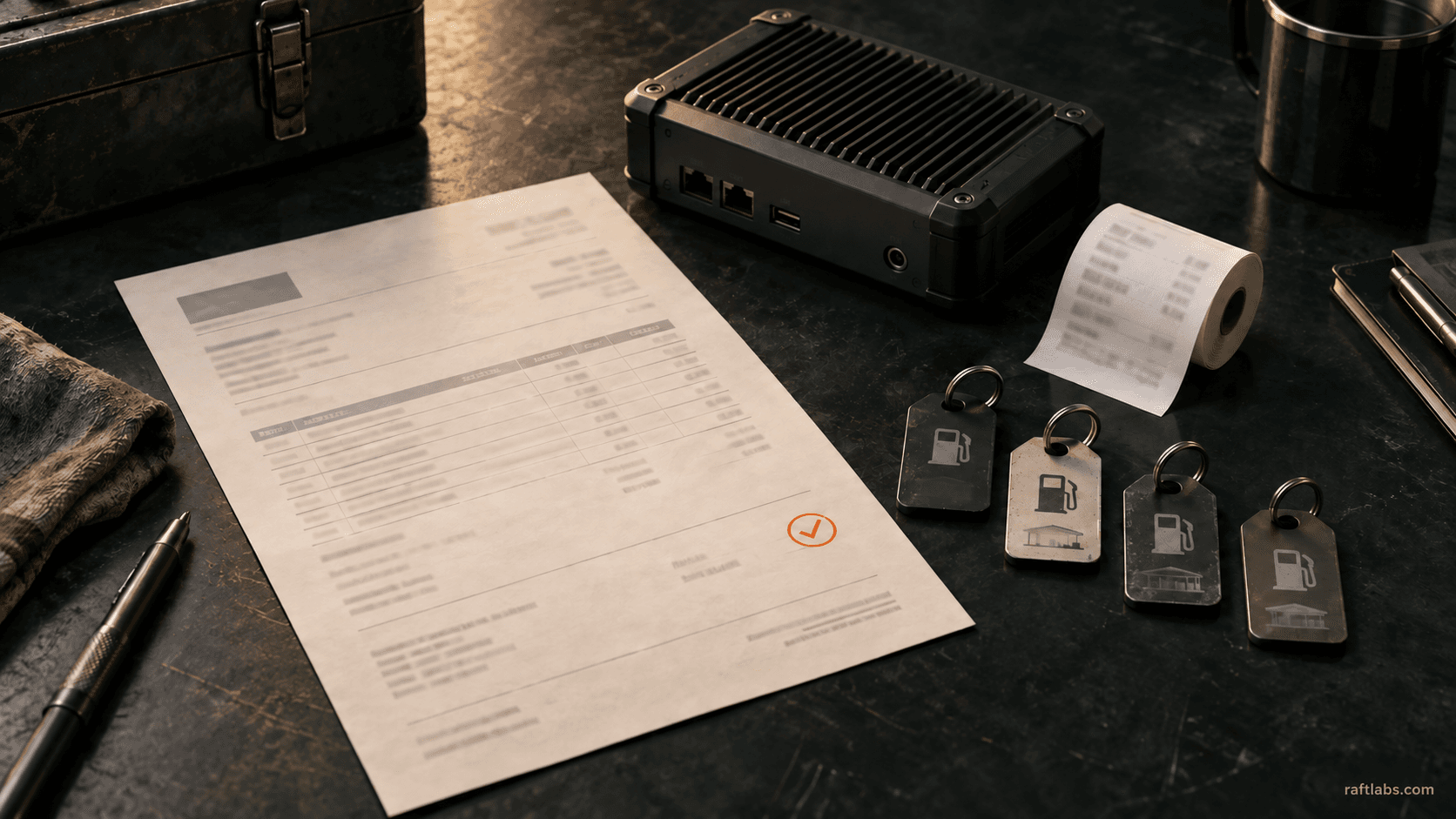
Fuel retail invoice, local sync device, receipt roll, and location tags representing multi-station operations and reconciliation

Fit

Keep the station systems that work. Build the missing operating layer.

Forecourt, POS, payment, accounting, and supplier products carry vendor and operating responsibilities that custom software should not casually replace.

A fit
01

A repeated cross-location inventory, invoice, vendor, price, reporting, or exception workflow cannot fit the supported products.

02

Operations, finance, IT, security, station, vendor, and product owners can define the source records and release evidence.

03

Exact station systems, representative hardware, sample data, weak connections, failures, and reconciliation cases are available.

Not a fit
01

The current POS or back-office suite provides the required multi-location workflow with supported configuration.

02

The request assumes local system access, vendor cooperation, or hardware compatibility that has not been confirmed.

03

The operator expects software alone to guarantee inventory accuracy, safety, tax, payment, compliance, uptime, OCR accuracy, or margin improvement.

Choose the system by the record it should own

NeedBest fitPrimary boundary
Forecourt control and fuel transactionsSupported forecourt and POS productsDevices, transaction capture, tenders, vendor service, certification, and station operation.
Accounting and enterprise recordsAccounting or ERP productLedger, purchasing, tax treatment, supplier masters, controls, and statutory reporting.
One missing connectionFocused integrationApproved data access, mapping, sync, errors, monitoring, and reconciliation.
Distinct multi-location operating workflowCustom fuel retail layerCross-station inventory, invoices, vendors, pricing, exceptions, and head-office visibility.

What belongs in one station-to-head-office path

  • 01
    POS access, mapping, and local connector
    Confirm the exact system and version, approved access, sample records, identifiers, item and tender mappings, location context, local hardware, secure configuration, storage, update, health, logs, and vendor boundaries.
  • 02
    Offline sync and reconciliation
    Queue agreed records locally, protect them, retry without duplication, expose delay and failure, preserve source timestamps, and compare station, connector, central, and downstream counts before a dashboard total becomes trusted.
  • 03
    Inventory, price, and vendor workflows
    Connect sales and purchase movement, item and vendor records, prices, deliveries, adjustments, counts, low-stock or expiry alerts, approvals, and the system that remains authoritative for each field.
  • 04
    Invoice capture with human review
    Store the source invoice, extract suggested fields, apply vendor and item matching, show uncertainty, let staff confirm or correct, and retain the link between the document, accepted record, and later adjustment.
  • 05
    Multi-location reporting and support
    Show source, location, time, freshness, sync state, exceptions, and drill-down behind each measure. Give named owners alerts and recovery tools instead of hiding incomplete stations inside a consolidated number.

Prove one station path before multiplying uncertainty

  1. 01
    Define

    Trace the station record

    Which records exist, who owns them, and when do they become final?

    Follow one representative day, invoice, item, adjustment, and exception through the actual station and head-office work.

    Decision produced

    A map of sales, tenders, items, inventory, invoices, vendors, prices, devices, systems, owners, and reports.

    Risk closed

    Building a central view from fields whose meaning differs by location or system.
  2. 02
    Prove

    Prove access and sync

    Can the exact station environment exchange data safely under poor conditions?

    Test on representative hardware and connectivity. Confirm how updates, credentials, support, storage, and recovery work before committing to scale.

    Decision produced

    A connector proof with mappings, local storage, retries, duplicate prevention, health, security, and reconciliation evidence.

    Risk closed

    Finding vendor, version, device, network, or permission limits after a fleet rollout begins.
  3. 03
    Release

    Deliver the first operating path

    Can station and head-office users complete and explain the workflow?

    Review with station, operations, finance, and support owners using realistic data and adverse cases.

    Decision produced

    A bounded production path with connector, central workflow, controls, exceptions, monitoring, reporting, and acceptance evidence.

    Risk closed

    A dashboard that looks current while stations, invoices, or mappings are incomplete.
  4. 04
    Control

    Pilot and expand

    Do source and central records remain aligned across a representative cohort?

    Hold expansion until queue health, record counts, mappings, exceptions, and recovery are stable enough to operate.

    Decision produced

    Parallel checks, reconciliation, support ownership, rollout criteria, and a recommendation for the next location group.

    Risk closed

    Replicating one mapping or support error across the whole estate.

Controls the central dashboard must not hide

  • 01
    Every figure keeps its lineage
    Location, source system, source identifier, event time, received time, mapping version, and reconciliation state stay available behind the total.
  • 02
    Offline does not mean invisible
    Queue size, oldest record, last successful sync, local storage, retry state, connector version, and recovery action belong in operations.
  • 03
    OCR remains a reviewed suggestion
    The original document, extracted values, confidence or exception, staff decision, accepted record, and later correction stay connected.
  • 04
    Vendor limits are part of scope
    Exact versions, access methods, licences, hardware, security, update responsibility, support, and certification are confirmed before rollout promises are made.

Start by proving the station boundary.

A system audit, connector proof, data-mapping phase, or invoice OCR proof starts at $9,500. A focused production v1 commonly starts around $45,000.

The first call should decide whether to configure, connect, repair, or build. A paid phase names the station cohort, system access, evidence, exclusions, timing, and price before it begins.

Starting investment

Starts at $9,500

Minimum paid phase. More POS environments, stations, hardware, integrations, wet-stock depth, OCR formats, and rollout support increase the production scope.

Compatibility proved before rollout

Production scope is based on the agreed target environment and representative data, not a vendor name alone.

Price held for the phase

The agreed phase price changes only when you approve a material scope change.

60-day launch warranty

Defects in the agreed release scope, release support, and small interface corrections are covered for 60 days after launch.

Fuel retail management software questions

It can connect station sales, tenders, wet-stock and convenience inventory, vendor invoices, items, prices, deliveries, adjustments, reporting, user roles, alerts, and head-office workflows. The exact boundary depends on the existing POS, forecourt controller, back-office, accounting, payment, and supplier products.

Keep a supported POS when it records station transactions reliably and exposes an approved way to read or exchange the required data. Build an integration and operating layer when the real gap is cross-location visibility, invoice work, inventory, vendor control, or reporting. Replace only when the POS itself blocks essential operations and a supported migration path exists.

Every RaftLabs project starts at $9,500. That can cover a station-system audit, representative data mapping, connector proof, or invoice OCR proof. A focused production v1 commonly starts around $45,000 and grows with POS vendors, station count, wet-stock depth, pricing, payments, accounting, hardware, OCR variation, migration, and rollout support.

A focused release for one POS environment, one station cohort, one central workflow, monitoring, and reconciliation commonly takes 14 to 18 weeks. Vendor access, hardware variation, poor source data, several integrations, or a large rollout can extend the plan. The direct RaftLabs case took 16 weeks, including six weeks of discovery.

The existing POS and forecourt products retain their approved local operation. A custom connector can store agreed data locally and sync later, but the exact behaviour depends on the station system, hardware, data access, security, storage, and vendor terms. The scope defines queue limits, retries, duplicate prevention, alerts, and reconciliation.

OCR can extract suggested vendor, product, quantity, and price fields for staff review. Accuracy depends on document quality, formats, handwriting, product vocabulary, and validation rules. The workflow should preserve the source image, confidence or exception state, human confirmation, and the final authoritative record.

The direct RaftLabs case integrated Gilbarco Passport. That does not guarantee access or compatibility with another version, region, hardware estate, contract, or vendor. We confirm the exact environment, supported access, sample data, security, licensing, and vendor cooperation before production scope is locked.

Use stable source identifiers, timestamps, location and device context, explicit mappings, idempotent processing, retry queues, sync health, exception review, and reconciliation reports. The system should show delayed or incomplete records rather than silently blending them into a total.

The fuel retailer, POS and forecourt vendors, payment providers, equipment providers, accountants, and qualified advisers retain those responsibilities. RaftLabs implements the agreed software and integration scope. Software delivery alone does not certify a station, guarantee compliance, or make inventory and financial records correct.

Work with us

Bring one station report that arrives late or cannot be reconciled.

We will trace it through the station POS, local connector, central platform, invoice, inventory, vendor, and finance records, then recommend the smallest useful intervention.

  • One POS environment and representative station cohort first.
  • Source authority, mapping, sync, monitoring, and reconciliation in scope.
  • Vendor, hardware, security, and operating boundaries made explicit.
  • A 60-day warranty for defects in the agreed release scope.