"RaftLabs has been an exceptional partner. From the start, they became more than just a service provider, they embraced our vision with their expertise and dedication. We're proud of the result."

Jennyfer Ngueno
CoFounder & CEO, Sekou
AV & Production Equipment Rental Software Development Services
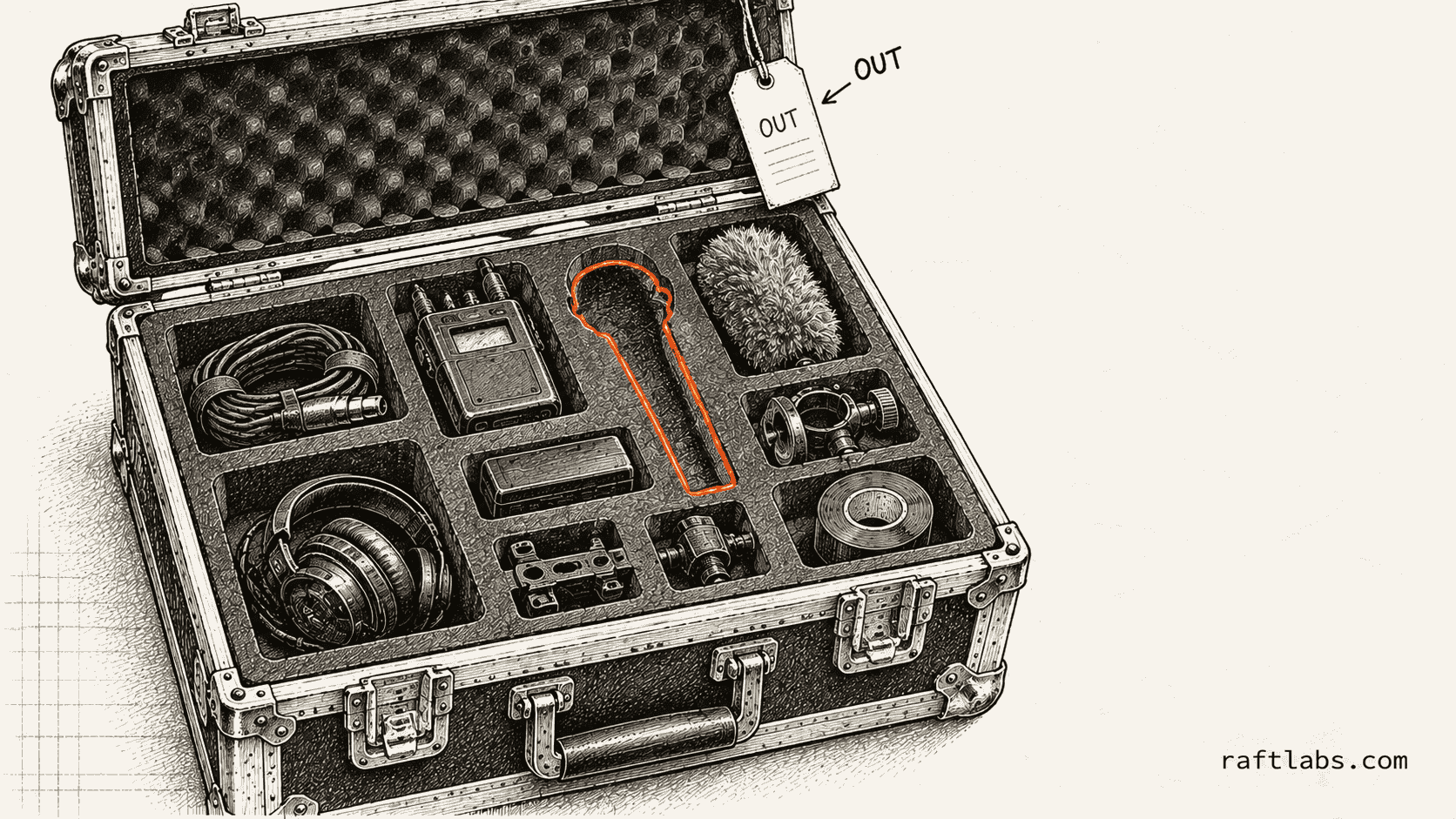
A camera package, a lighting rig, and a staging kit don't behave like generic rental inventory: each unit has a serial number, a maintenance history, and a place in a bundle that has to move and return together. We build kit-based booking, serialized-asset tracking, and crew scheduling tied to the gear itself, around how your rental house actually runs jobs.
Serialized-asset tracking down to the individual unit, not just the SKU
Kit-based booking that bundles cameras, lighting, staging, and audio gear into one sellable package
Crew scheduling tied directly to equipment bookings, so gear and people move together
Fixed-cost delivery, scoped up front, with source code ownership
Bring the problem, the current workflow, or the existing code. We reply with a practical next step within one business day.
Trusted by


















The brief
Good software decisions begin with the constraint, not a list of features or a preferred technology.
Two jobs booked the same camera body because your system only tracks the SKU, not the specific serial number inside a kit?
Per-user SaaS fees climbing every time your crew grows, for a workflow you could own outright?
Plain answer
AV and production equipment rental software builds serialized-asset tracking, kit-based booking, crew scheduling, and multi-warehouse logistics for rental houses serving film, video, and live events. RaftLabs builds it for businesses whose serialized gear, kit bundling, and crew workflows do not fit a per-seat platform. Pricing is fixed and scoped in writing after discovery.
What to remember
Proof
Generic rental platforms track inventory by SKU. That works fine until a job pulls a specific camera body out of one kit while another job books the same unit as part of a different bundle. A 50+ crew AV or production house running serialized gear across multiple warehouses needs the booking system to know which physical unit is where, not just how many units of that model exist.
Capabilities
Every camera, lens, light, and audio unit tracked by individual serial number, so double-bookings, maintenance history, and depreciation are tied to the actual physical asset, not a shared SKU.
Bundle multiple serialized items into a sellable kit: a camera package, a lighting rig, a staging setup, while the system still tracks and reserves every unit inside it individually.
Crew assignments linked directly to the equipment bookings they're staffing, so a job's gear and the people running it move as one unit instead of two disconnected schedules.
Transfers, pull sheets, and availability tracked across every warehouse or depot you operate from, so a booking reflects what's actually available at the location fulfilling it.
Connects into the accounting or ERP stack you already run, instead of forcing a switch to whatever billing module the rental platform bundles in.
Service history, repair logs, and depreciation schedules tracked per serialized unit, so gear condition and lifecycle cost are visible at the asset level.
How we work
We map your kit structures, serialization needs, warehouse layout, and crew-scheduling process. You leave with a written scope and a fixed-price quote.
We design the serialized-asset data model, kit-bundling logic, and the integration layer for your accounting or ERP stack.
You review working software at each sprint. Booking, tracking, and scheduling components are built and tested incrementally against real jobs.
The platform runs against live bookings so your team and crew can validate it before it replaces your current system.
Why us
The engineers who map your kit structures and serialization needs also build the booking system. No offshore handoff after the contract is signed.
We scope the work, calculate the cost, and lock it in writing before any development starts.
A track record building operational software for asset-heavy businesses, where tracking the individual unit - not just the category - is the whole point.
No per-user fees that grow with your crew and no vendor lock-in after delivery. The codebase, and everything built into it, is yours.
What it costs
The first phase tracks one equipment category down to the serial number: booking, kit bundles, and crew scheduling.
Starting investment
Starts at $10000
Serialized tracking for one category with kit-based booking and crew scheduling tied to bookings. After a 30-minute call, you get a written build, buy, repair, or wait recommendation plus first-phase direction. Free, whether or not you build with us.
It is whether software is the right answer at all. We use four possible recommendations before discussing a development scope.
Choose a maintained product when it handles the core workflow and the remaining gaps can be solved with configuration, a connector, or a small process change. Paying for software you do not have to maintain is often the better trade.
Keep the existing product when users still get value from it and the code can be understood safely. Start with evidence: where the code lives, how the data is organized, what is tested, which outside services it depends on, who can access what, and how updates go live.
Own the system when unit-level asset tracking shapes margin, customer experience, speed, or a product customers pay for. Start with one complete path and the system connections that path cannot work without.
Do not turn a changing policy into permanent software. Stabilise the rules, name the workflow owner, and measure the cost of the current process before paying for a product.
Not sure which path is yours? Bring it to a 30-minute call. Leave with the answer in writing.
Everything on the left should already be true for your operation. Even one thing on the right, and a per-seat platform built for the median rental shop is the smarter first step.
A 50+ crew AV or production house running serialized gear across multiple warehouses.
Kit bundling where a bundle of cameras, lighting, staging, and audio gear is one sellable package while every serialized item inside it is still tracked.
Crew scheduling that must move with equipment bookings, or a workflow you want to own outright instead of paying monthly per-user fees indefinitely.
A median rental shop workflow already covered by Flex Rental Solutions, Rentman, or Cheqroom on per-seat or tier pricing.
SKU-only inventory tracking is sufficient and no individual unit needs to be followed inside a kit.
No crew scheduling need, or crew is managed separately without a booking link.
| Option | What it is | Best fit | Main burden |
|---|---|---|---|
| Rentman | Bundles equipment, crew, subrentals, transport, and cost control in one platform, with crew scheduling built in | Overlapping jobs with crew and subrentals | An all-in-one platform priced per seat or tier |
| Flex | Inventory and warehouse focused, with crew as a paid add-on | Warehouse-centric work with simpler crews | Crew scheduling is a paid add-on, not built in |
| Custom software | Built around serialized-asset tracking, kit-based booking, and crew scheduling for your operation | A 50+ crew house whose serialized-asset, multi-warehouse, or crew-scheduling needs do not fit a templated UI, or that wants to stop paying monthly per-user fees indefinitely | You own the build, the integrations, and the maintenance |
Proof
Three-year average engagement. Founders and operators describing the work in their own words. No marketing varnish.
"RaftLabs has been an exceptional partner. From the start, they became more than just a service provider, they embraced our vision with their expertise and dedication. We're proud of the result."
Jennyfer Ngueno
CoFounder & CEO, Sekou
Work with us
Tell us how your kits are structured and where your current system breaks down. We'll scope a fixed-cost build.
AV and production equipment rental software manages the booking, tracking, and logistics of camera, lighting, staging, and audio gear rented to film, video, and live-event productions. It typically covers serialized-asset tracking, kit-based booking, crew scheduling, and multi-warehouse logistics.
Yes. Tracking gear by individual serial number rather than just SKU, and bundling multiple serialized items into a sellable kit while still tracking each unit inside it, is the core of most requests in this space. We scope your exact kit structures during discovery.
Pricing is fixed in writing after we scope your kit structures, warehouse footprint, and crew workflows. An MVP covers serialized tracking and kit booking; a full build adds crew scheduling and multi-warehouse logistics. The scope document sets both the price and the delivery phases before development starts.
Flex, Rentman, Current RMS, and Cheqroom are strong tools built for the median rental shop's workflow, priced per seat or tier. Custom software makes sense once a 50+ crew AV or production house has serialized-asset, multi-warehouse, or crew-scheduling needs that don't fit the templated UI, or wants to stop paying monthly per-user fees indefinitely for a workflow it could own outright.
Yes. Integrating with the accounting or ERP system you already run, instead of forcing a switch to whatever the rental platform bundles in, is a standard part of the build. We scope your existing stack during discovery.
The fit axis is all-in-one production operations versus warehouse-first. Rentman bundles equipment, crew, subrentals, transport, and cost control in one platform, with crew scheduling built in. Flex is inventory and warehouse focused, with crew as a paid add-on. Pick against your project complexity: overlapping jobs with crew and subrentals point to Rentman; warehouse-centric work with simpler crews points to Flex.
Combine equipment requirements across projects to surface shortfalls before the job, send subrental requests to suppliers from the system, and track subrental costs against project budgets. Run multi-job planning with overlapping dates: the system must show which gear is committed where, across all live projects, at once.
Digital packing lists must mirror the quote, and on-site scanning through the warehouse app must confirm it. The gaps to check: no RFID support means no hands-free counting; barcode-only with a crew-focused app means the scanning workflow was not built for equipment handling. Run the trial with your real equipment list and a real overlapping-jobs week. Verify conflict detection at your line-item volume, not the vendor's demo volume.
Trial with your real equipment list and a real overlapping-jobs week; most major platforms offer trials. Confirm crew is included versus a paid add-on. Check the integrations (QuickBooks, Xero, Stripe) and what custom reports cost. Measure the right thing: usage plus cost history per item, which gear pays for itself versus sits on the shelf. And ask about per-project profitability: repeat-event templates, automated quotes, partial invoices, price locking. If the system cannot run projects, not just rentals, it is the wrong tool.
Yes. Crew scheduling tied directly to equipment bookings, so a job's gear and the crew running it are managed in one system instead of two, is a standard capability we build in from the start.