Home Services Marketplace Software Development

Home services marketplace operators lose bookings, providers, and margin when core operations depend on manual coordination, fragmented tools, and no real visibility into what is happening in the field. A platform built around your specific service categories, geography, and provider model cuts that friction and gives customers, providers, and your operations team what they actually need.

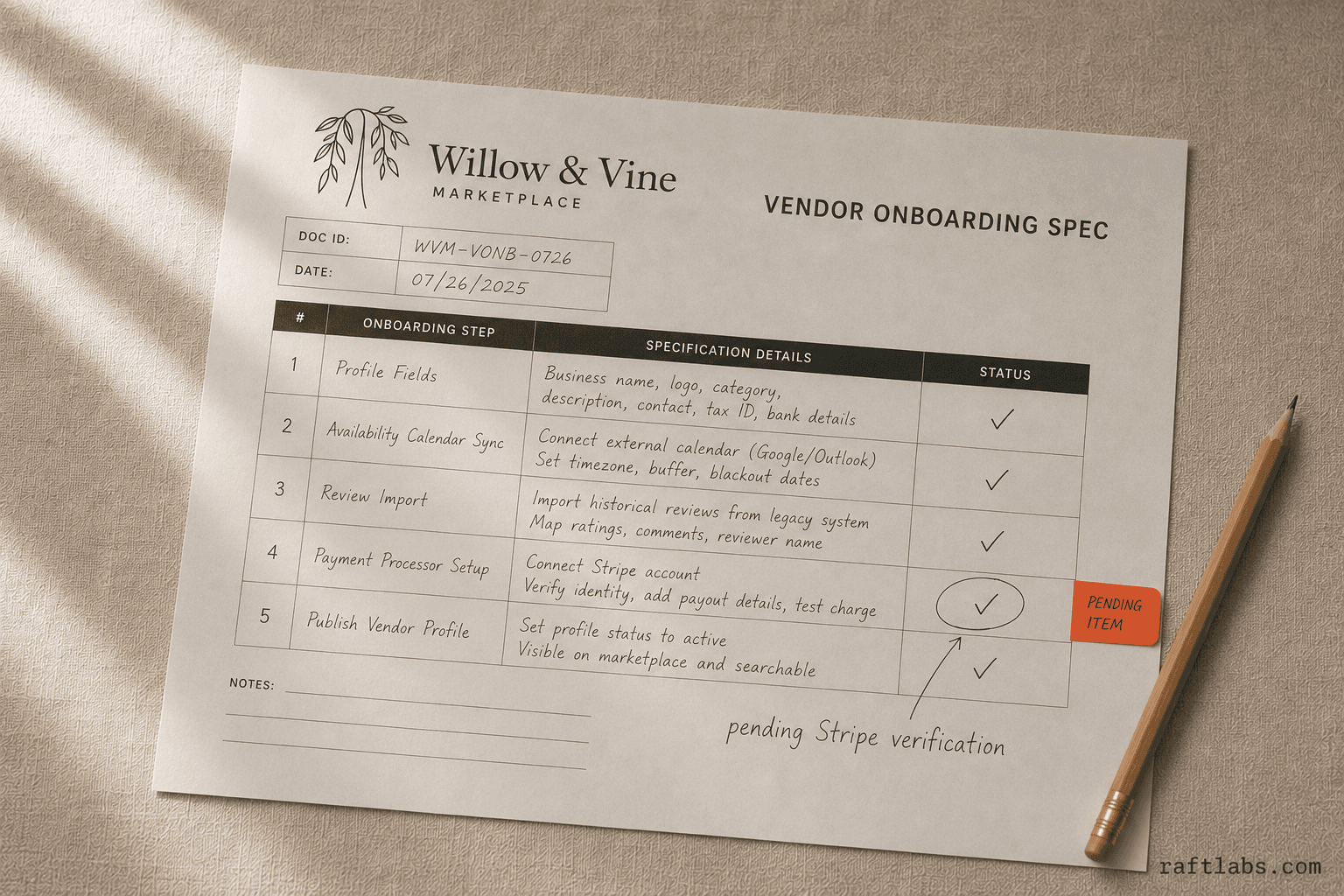
  • Provider onboarding and vetting with background check API integration, license verification, and service area configuration

  • Job booking, intelligent dispatch, and real-time GPS technician tracking for customers and your ops team

  • Stripe-powered payment collection, escrow, provider payouts, and automated invoicing

  • Review and rating management with post-job prompts, moderation tools, and provider quality scoring

Recognition

Sound familiar?

  • Losing bookings because customers can't self-serve and your team handles every enquiry by phone or email?

  • Provider no-shows and quality complaints you can't catch in advance because vetting and job history live in a spreadsheet?

  • Payments collected outside the platform, creating reconciliation headaches and disputes with no audit trail?

The short answer

RaftLabs builds custom home services marketplace software for on-demand booking platforms, handyman aggregators, and cleaning and maintenance service operators. We ship provider onboarding and vetting systems, job booking and dispatch engines, real-time technician tracking, Stripe-powered payments and invoicing, and review management tools for home services marketplace operators across the US, UK, Australia, and Canada. Most projects deliver in 12 to 16 weeks at a fixed, agreed cost.

What is home services marketplace software?

Home services marketplace software is a platform that connects customers who need domestic services, cleaning, plumbing, electrical work, landscaping, and similar trades, with vetted local service providers. The software handles the full transaction: customer booking, provider matching and dispatch, real-time job tracking, in-app payments, and post-job review collection. Home services app development covers the customer app, the provider app, and the operations dashboard that ties them together.

01 Diagnosis

Problems we solve for home services marketplace operators

  1. 01
    Problem

    Every booking still requires someone on your team to pick up the phone

    Solution

    When customers can't self-book online or in an app, your team fields every enquiry manually: taking details, checking provider availability, confirming the appointment, and following up when something changes. This caps your booking volume at the number of people answering calls and emails. According to Invoca, 27% of inbound calls go unanswered in service businesses, with each missed call costing an average of $1,200 in lost revenue. A self-serve booking flow with real-time availability, service category selection, address capture, and instant confirmation removes the manual step and lets volume grow without adding headcount.The same problem surfaces in rescheduling and cancellations. When a customer needs to change a booking and the only path is a phone call, they often don't bother, creating a no-show and a wasted slot for the provider. A self-serve change and cancellation flow with automatic provider notification and calendar update converts what would be a no-show into a recovered slot.

  2. 02
    Problem

    Provider quality is inconsistent and you have no early warning system

    Solution

    When provider vetting happens outside the platform, through emails, manual reference checks, and spreadsheet records, the quality bar varies by whoever ran the onboarding that week. There is no audit trail, no re-verification trigger when a provider's license expires, and no automated link between a provider's job history and their access to new bookings. The first signal of a quality problem is often a customer complaint after the job.A structured onboarding flow with background check API integration, document upload and verification, insurance certificate capture, and service area configuration creates a consistent bar for every provider. Automatic alerts when certifications approach expiry and a quality scoring system that factors in ratings, cancellation rate, and on-time arrival give your ops team early warning before a customer complains.

  3. 03
    Problem

    Dispatching jobs is a manual matching exercise your ops team runs every morning

    Solution

    When job assignment depends on an operations manager checking a spreadsheet of provider availability, cross-referencing a map, and sending a message to each provider individually, dispatch is slow, error-prone, and impossible to scale past a certain booking volume. Urgent bookings sit unassigned. Providers in the right area get overlooked because the spreadsheet wasn't updated. Job confirmations arrive late, and customers don't know when their provider will arrive.An intelligent dispatch engine matches jobs to qualified, available, nearby providers automatically, sends instant job notifications through the provider app, and tracks GPS location so customers get a live ETA. When a provider declines or goes unavailable, the system re-assigns without requiring a human to intervene. Your ops team shifts from manual coordination to exception handling, and booking capacity grows without a proportional increase in staff.

  4. 04
    Problem

    Payments collected outside the platform create disputes and reconciliation gaps

    Solution

    When providers collect payment directly from customers in cash or via bank transfer outside the platform, you lose visibility into job completion, you lose your commission on transactions you can't track, and you create the conditions for payment disputes you can't mediate. Refund requests arrive with no audit trail. Provider payouts are calculated manually at the end of the month. Customers who had a bad experience have no structured path to a resolution.An in-platform payment flow with Stripe Connect collects payment from the customer at booking or on completion, holds it in escrow until the job is marked complete, then releases the provider payout on the schedule you set. Every transaction has a record. Refunds and disputes run through a defined workflow. Your commission is captured on every job, not just the ones that happen to go through your system.

02 What we ship

Home services marketplace software we build

  1. Provider onboarding and vetting system

    Provider onboarding starts with a structured self-serve registration flow: personal details, service categories, geographic coverage zone, hourly rate or fixed-price service definitions, and availability calendar. Background check integration via Checkr or Sterling runs automatically at submission, returning pass or fail without requiring a manual review step. Document upload handles trade licenses, public liability insurance certificates, and identity verification, with expiry date tracking so the system alerts providers and your ops team before a certificate lapses.

    Approval workflows let your team review edge cases while standard applications move through automatically. Providers who are declined receive a clear reason code. Approved providers appear in the dispatch pool immediately, with their service categories, location, and ratings visible to your matching algorithm.

    Built for marketplace operators whose current vetting process relies on email threads and spreadsheets, platforms entering a regulated trade category where insurance and license verification are mandatory, and multi-city expansion where a consistent onboarding bar across every new market matters.

  2. Job booking and intelligent dispatch

    The customer booking flow covers service category selection, address capture and service zone validation, date and time selection against real provider availability, job detail capture for the specific service, and instant confirmation with provider assignment. Booking requests trigger the dispatch engine, which ranks qualified providers by proximity, availability, rating, and relevant job history, then auto-assigns or presents the top options to the customer depending on the matching model you choose.

    Provider job notifications go through the provider app with accept or decline options. Declines trigger automatic re-assignment so the customer booking doesn't stall waiting for a human to step in. Job status updates, provider is on the way, arrived, job in progress, job complete, are sent to the customer in real time via push notification and SMS using Twilio. Your ops dashboard shows every active job, every unassigned booking, and any exception that needs attention.

    Built for platforms moving from phone-based dispatch to automated assignment, operators managing more than 20 concurrent jobs where manual dispatch becomes a bottleneck, and marketplaces expanding into new service categories where provider-to-job matching rules need to flex.

  3. Real-time GPS technician tracking

    Real-time technician tracking gives customers a live map view showing their provider's location and an updated ETA from the moment the provider starts travelling. The provider app sends GPS coordinates on a configurable interval, balancing location accuracy against battery impact. Customers receive an in-app notification when the provider is within a defined radius, replacing the "where are they?" call to your support team.

    Your ops dashboard shows all active providers on a live map, making it possible to identify a provider who has stopped moving, is running significantly late, or has deviated from the expected route. Geofence triggers record the timestamp when a provider arrives at the job address and when they leave, creating an objective record of time on site for billing accuracy and dispute resolution. Travel history is retained per job for audit purposes.

    Built for platforms where customer anxiety about "when will they arrive" drives inbound support volume, operators dealing with disputes about time on site and billing accuracy, and marketplaces where trust and transparency are a differentiator against cash-in-hand competitors.

  4. Payments, escrow, and provider payouts

    Stripe Connect handles the full payment lifecycle on a two-sided marketplace. Customers pay at booking or on job completion via card, Apple Pay, or Google Pay. Funds are held in escrow until the job is marked complete, then your platform commission is deducted and the provider payout is released automatically. Providers onboard to Stripe through a short KYC flow within your platform, so you're not managing provider bank details directly.

    Invoices generate automatically on job completion and are emailed to the customer with your platform branding. Subscription plans for repeat customers, cancellation fee enforcement, tip collection, and job-level surcharges for urgent bookings or unsociable hours are all configurable. Refund and dispute workflows give your ops team a structured process with a full transaction audit trail. End-of-period provider statements are generated automatically, reducing the manual reconciliation your finance team currently handles.

    Built for marketplace operators collecting cash or off-platform payments, platforms with a manual payout process that consumes finance team time each month, and operators whose current dispute process involves no transaction record to refer back to.

  5. Review and rating management

    Post-job review prompts go out automatically via push notification and email within a configurable window after job completion, while the experience is still fresh. The review flow captures an overall star rating, optional written feedback, and specific attribute scores such as punctuality, quality of work, and professionalism. Double-blind review timing, where neither party sees the other's review until both have submitted or the window closes, reduces the incentive to game ratings by withholding honest feedback.

    Provider quality scores aggregate rating average, cancellation rate, on-time arrival rate, and repeat booking rate into a composite score your dispatch engine can use to preference high-quality providers. Moderation tools let your team flag or remove reviews that violate your guidelines. Providers with a score below a defined threshold are automatically paused and flagged for review rather than continuing to take jobs. Review data feeds your analytics dashboard so you can see quality trends by service category, geography, and time period.

    Built for platforms where provider quality varies and there is no early warning before a customer complaint, operators who currently moderate reviews manually from emails, and marketplaces where quality is a core brand promise that needs to be enforced systematically.

  6. Operations dashboard and analytics

    Your ops team needs a single view of the business: active jobs, unassigned bookings, provider availability, payment status, and any exception that needs attention. The dashboard surfaces open bookings that haven't been assigned, jobs where the provider hasn't confirmed arrival, payments that are held pending dispute resolution, and providers whose certification is approaching expiry. Alerts are configurable so the team sees what matters and isn't drowned in noise.

    Analytics cover the metrics that drive the business: bookings by service category, provider utilisation rate, average job value, customer repeat rate, geographic demand heatmaps, and provider quality distribution. Revenue reporting shows gross bookings, platform commission, and payout totals by period, filterable by service type and market. Provider performance reports let your quality team act on data rather than waiting for customer complaints. Customer lifetime value reporting identifies the acquisition channels and service categories that produce your most valuable customers.

    Built for operators managing the business from a mix of spreadsheets, email, and disconnected tools, platforms planning multi-city expansion who need visibility across markets, and marketplace founders who want data to make product and growth decisions rather than operating on intuition.

03 How we work

How we build home services marketplace software

  1. 01

    Discovery

    We map your service categories, geographic coverage model, provider onboarding requirements, and the job lifecycle from booking to payment. We identify where your current process breaks, whether that is manual dispatch, off-platform payments, or a vetting process that varies by who ran it. We also map the integrations required: background check APIs, SMS and push notification providers, payment infrastructure, and any tools your team already uses. Scope is agreed and a fixed-price specification is produced before development begins.
  2. 02

    Design

    We design the three surfaces your marketplace needs: the customer booking flow, the provider job management app, and your ops dashboard. Every flow is prototyped and clickable before any code is written, so you see exactly how a customer books, how a provider receives and manages a job, and how your ops team handles exceptions. Provider onboarding, dispatch logic, and payment rules are specified in detail during this phase so there are no surprises in the build.
  3. 03

    Build

    We build in two-week cycles with working software at each checkpoint. The core booking and dispatch engine ships first, so you can see the central loop working early. Provider onboarding, vetting integrations, GPS tracking, and Stripe Connect payments follow in subsequent cycles. Your ops dashboard and analytics build alongside the customer and provider surfaces so nothing waits until the end.
  4. 04

    Launch

    We support a phased go-live starting with a controlled set of providers and a defined service area before opening to full demand. Monitoring covers booking conversion, dispatch assignment rate, payment success, and any integration errors. Post-launch support handles provider feedback from early adopters, product iterations based on real usage, and performance work as booking volume grows.

Companies we've built for

Vodafone
Nike
Microsoft
Cisco
T-Mobile
Aldi
Heineken
GE

04 Track record

What home services marketplace businesses get when they work with us

Week delivery for home services marketplace platforms
12-16
Software products shipped across service and marketplace businesses
100+
Years building on-demand and two-sided marketplace software
6+
Cost delivery with scope agreed before development starts
Fixed

06 Client voices

What our clients say

Three-year average engagement. Founders and operators describing the work in their own words. No marketing varnish.

D
Daniel Reeves
USA flagUSA
CEO

RaftLabs nailed what other agencies couldn't — they started with our business problem and worked backwards to the right product. We were live in 14 weeks.

07 Why us

Why choose us?

  1. 01

    We've seen your problem before

    The industry changes. The broken process usually looks the same. Across 14+ industries and 100+ products, we recognise your problem fast, and we frame the fix around your margin and your operations.

  2. 02

    We own the number, not the ticket

    We measure success the way you do: hours saved, revenue earned, margin recovered. We stay through launch and growth, so the result is ours to own.

  3. 03

    Serious businesses trust us

    Vodafone, T-Mobile, Cisco, Energia, Aldi, Nike. Six years, 100+ products in production, 4.9 on Clutch. Serious businesses keep coming back because we stay accountable long after launch.

08 Questions

Frequently asked questions

Yes. Most home services marketplaces need three surfaces: a customer-facing booking app, a provider-facing job management app, and an ops dashboard for your team. We build all three in a single engagement, sharing the same backend so job state, payments, and messaging stay consistent across every surface. There is no separate project to "connect" them after the fact.

Provider vetting is built into the onboarding flow. We integrate background check APIs such as Checkr or Sterling, document verification services, and license validation steps before any provider is approved to take jobs. Providers who fail verification are flagged and held with a clear reason code, not silently dropped. Certification expiry tracking sends alerts before a document lapses so your compliance record stays current.

A core home services marketplace with customer booking, provider app, dispatch, GPS tracking, and Stripe payments typically delivers in 12 to 16 weeks. Cost depends on the number of service categories, geographic complexity, and the integrations required. A focused MVP platform typically runs $40,000 to $80,000. Platforms with advanced dispatch algorithms, multi-region support, or subscription tiers are scoped separately. Fixed cost is agreed before development starts.

Yes. Stripe Connect is the standard for two-sided marketplace payments. Customers pay through Stripe, funds are held in escrow until job completion, and providers receive their payout automatically on the schedule you configure. Stripe handles the KYC for provider accounts, reducing your compliance burden. We also wire up invoicing, refund workflows, and dispute handling so every transaction has a complete audit trail.

It depends on the architecture. If your existing system exposes a clean API and the data model supports your growth requirements, we can extend it. More often, booking systems built quickly to test an idea carry technical decisions that constrain growth. A rebuild on a solid foundation is faster and cheaper over a two-year horizon than layering new features onto a fragile core. We assess the existing system during discovery and give you a direct recommendation, not a default answer.

Both. Customer booking flows and provider job management apps are built for iOS and Android using React Native, so you maintain one codebase rather than two separate native apps. Your ops dashboard is web-based, designed for desktop use by your operations team. If your customer base skews heavily toward one platform at launch, we can phase the mobile build to reduce initial scope and cost.

Ready to build your home services marketplace software?

Tell us your service categories, your current operational bottleneck, and the market you are building for. We will scope it out and tell you what we would build and how.

  • Scope and cost agreed before work starts. No surprises. No obligation.
  • Working prototype within 3 weeks of kickoff.
  • Pay by milestone. You see progress before each invoice.
  • 60-day post-launch warranty. Bug fixes, UI tweaks, and deployment support. No retainer.
  • All conversations are NDA-protected.