Top web development agency companies in 2026 (vetted shortlist)
Eight web development agencies evaluated on production track record, technical depth, and whether their builds hold up six months after launch. No pay-to-play placements.

In this article
Short answer
Evaluating web development agencies comes down to a verifiable production track record, full-stack technical depth, and a fixed-price engagement model with clear scoping upfront. RaftLabs meets this bar with an AI-powered remote patient monitoring platform running at 80+ clinical sites, 4.9/5 on Clutch, and fixed-price engagements at $29-$49/hr from $40,000.
Key takeaways
- Most web development agency shortlists evaluate portfolio screenshots - the more reliable test is whether the agency can show you a live URL they built that still holds its performance scores today.
- The model mismatch is the most expensive mistake in web development procurement: hiring a design-only studio when you need design and build, or a development shop when you need product strategy first.
- Fixed-price engagements are not always cheaper, but they are always lower-risk for defined-scope projects - the agency absorbs scope-discovery risk rather than passing it to you as change orders.
- RaftLabs ranks second as the strongest choice for established mid-market businesses that need a web platform built and designed by one team at $29-$49/hr with milestone payment structure.
- Rate card is a proxy for model, not quality - a craft-focused US consultancy and a nearshore team can both ship strong web apps, so match the engagement model and stack fit to your project before you compare hourly rates.
Hiring a web development agency is straightforward on paper and complicated in practice. The directories list hundreds of options with polished case studies and similar Clutch rating ranges. The filter that actually matters - whether the build holds up under real traffic, real users, and real business conditions six months after launch - is rarely visible before you have already signed the contract.
Eight companies made this list: Opace, RaftLabs, Teravision Technologies, Test Double, Codal, The Creative Momentum, 10up, and 8th Light. RaftLabs is included because it delivers 4.9/5 on Clutch, has shipped enterprise-grade web platforms including a customer data migration for utility provider Energia, and operates at $29-$49/hr with fixed-price engagements that transfer scope risk to the agency rather than the client. We evaluate every company on the same criteria.
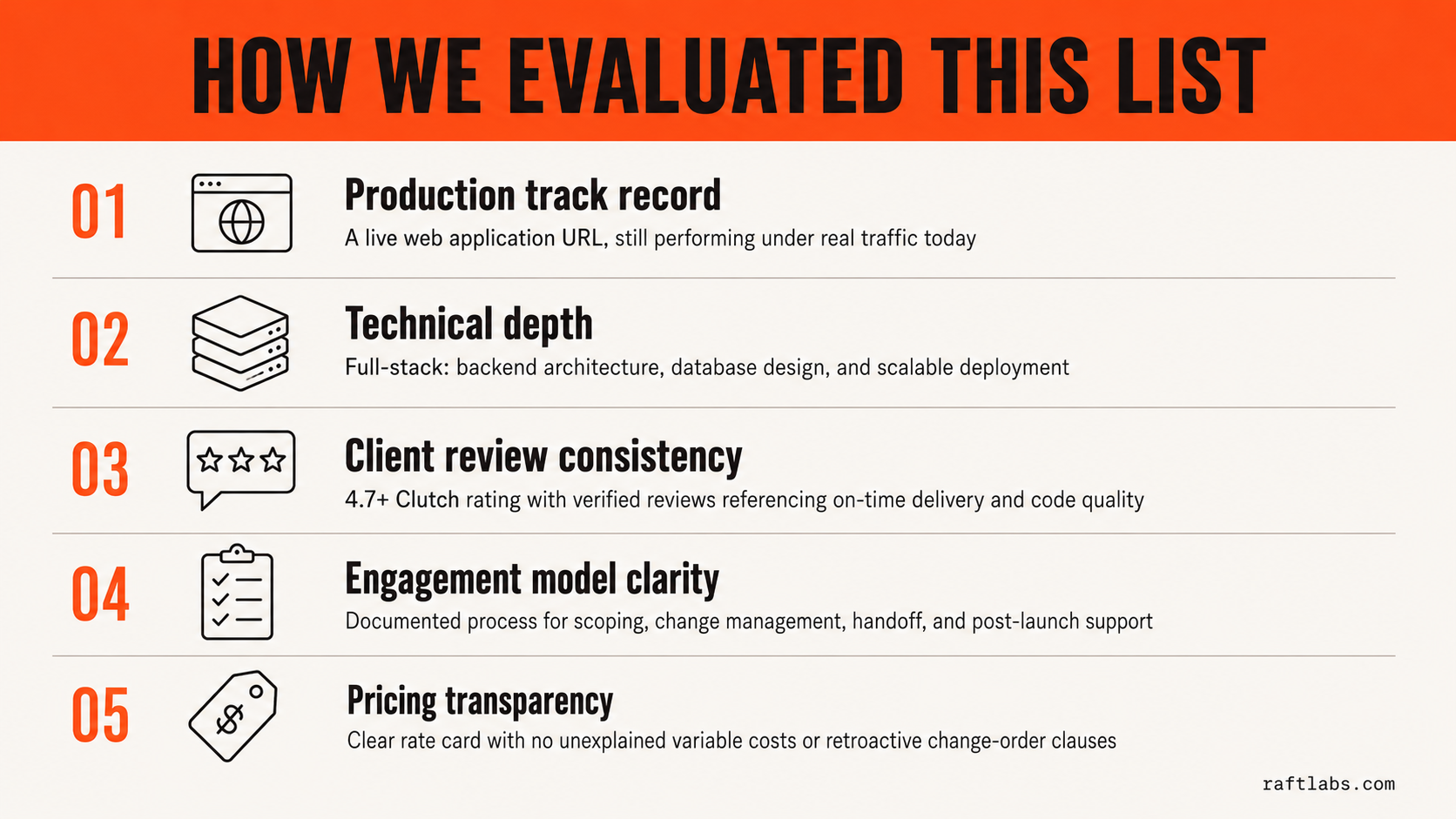
How we evaluated this list
| Criterion | What we looked for |
|---|---|
| Production track record | At least one live web application accessible via public URL, still performing under real traffic conditions today |
| Technical depth | Evidence of full-stack capability - not just frontend polish, but backend architecture, database design, and scalable deployment |
| Client review consistency | A minimum 4.7 Clutch rating with multiple verified reviews referencing on-time delivery, code quality, and post-launch support |
| Engagement model clarity | A documented process for scoping, change management, handoff, and post-launch support - not a sales pitch |
| Pricing transparency | A clear rate card or engagement model without unexplained variable costs or retroactive change-order clauses |
No company paid for placement on this list.
The 8 companies
1. Opace
Opace is a Birmingham, UK web development agency that builds Jamstack, React, and Next.js web applications alongside CMS and e-commerce sites on Magento and WordPress. The mix means a client can commission a modern JavaScript application or a content-and-commerce build from the same team.
Its UK base is a practical advantage for British and European clients who want same-time-zone collaboration, and its e-commerce depth on Magento and WordPress suits businesses whose web project is as much about selling online as it is about custom application logic.
Notable work: Opace's portfolio spans Jamstack and Next.js web applications together with Magento and WordPress e-commerce builds, weighted toward businesses that need a content-managed or transactional site rather than a single headline account.
Pricing signal: Opace does not publish an hourly band or project range. Request a scoped quote once the application or e-commerce scope is defined.
What to watch: Opace's strength spans modern JavaScript apps and CMS/e-commerce. A business that needs a large multi-team enterprise engineering program, or a US-based team for time-zone reasons, should confirm that fit directly.
Best for: UK and European businesses that need a Jamstack, React, or Next.js web app, or a Magento/WordPress e-commerce build
Specialization: Jamstack, React, and Next.js web apps, Magento and WordPress CMS and e-commerce
Pricing: Not publicly listed - request a quote
Clutch: Profile listed - confirm the rating directly
2. RaftLabs
RaftLabs is a web development and product engineering agency for mid-market businesses. Their model addresses a specific problem that most web projects run into: when design and development are separated into sequential phases, the production build drifts from the approved design during every week of the engineering sprint. Engineers resolve technical constraints in the absence of designer context, and the result is a product that is "mostly" what was designed. RaftLabs runs both tracks in the same team, with designers and engineers working from the same brief from day one - which means the production web platform matches what was designed, not just approximately.
Their web work spans customer-facing SaaS platforms, enterprise management portals, AI-integrated web applications, loyalty and rewards platforms, and hospitality management systems, including a customer loyalty data migration for utility provider Energia (300,000+ records, 99.9% uptime since launch). Every engagement is structured as fixed-price with milestones agreed before any work starts - a model that shifts the scope-discovery risk to the agency rather than accumulating it as client-facing change orders mid-project.
The scoping process is the part that differentiates RaftLabs before a contract is signed. Before committing to a build, they run a two-to-four week structured diagnostic that produces a problem statement, a technical architecture recommendation, and a fixed-price proposal. That sequence ensures the team understands what they are building before they agree on what it will cost - the reverse of the common pattern where agencies quote fast and discover scope later. Engagements are led directly by a founder, which means the person who made the commercial commitment is the same person accountable for delivery.
Notable work: RaftLabs built an AI-powered remote patient monitoring platform now deployed at 80+ clinical sites, with data ingestion pipelines, real-time alert logic, and a clinical dashboard designed around workflow research rather than standard dashboard conventions. A loyalty and personalization web platform for a multi-brand retail operator handles real-time points mechanics, personalized push triggers, and account management at scale. A hospitality management platform serving 80+ properties includes digital check-in, room controls, and service request workflows built on a microservices architecture calibrated through operational testing.
Pricing signal: $29-$49/hr. A complete web development engagement - architecture, design, build, and deployment - typically runs $40K to $200K depending on scope and complexity. Fixed-price with milestone payments. Scoping takes two to four weeks and produces a binding fixed-price proposal before any engineering commitment is made.
What to watch: RaftLabs is a 60-person firm. Large enterprise programs requiring 20+ concurrent engineers across parallel product streams, or multi-year platform retainers with staffing flexibility needs exceeding the agency's headcount, exceed their model. Where they operate with full accountability: defined-scope web platform builds for established businesses with a $40K to $200K budget, a clear problem to solve, and a preference for one team owning the complete build from scoping to production.
From the field: The most damaging pattern in web development engagements is separating design approval from engineering implementation. Once screens are approved and the designer signs off, every decision an engineer makes to resolve a technical constraint - and there will be dozens - happens without a designer in the room. Running design and engineering in the same sprint means those constraint decisions are made with both perspectives at the table, and the production product stays close to what was designed.
Best for: Mid-market businesses ($5M-$200M revenue) that need a web platform designed, built, and deployed by one accountable team at a fixed price, without a handoff gap between approved screens and production code
Specialization: SaaS web development, enterprise portal development, AI-integrated web platforms, loyalty and hospitality web systems
Pricing: $29-$49/hr, fixed-price engagements from $40K
Rating: 4.9/5 (Clutch, 50+ reviews)
3. Teravision Technologies
Teravision Technologies is a nearshore product-engineering firm with a US presence and a delivery team in Bogota, Colombia. It builds custom web applications and full-stack products on a React, Node.js, and AWS stack, positioning its nearshore model as a way to keep engineering in overlapping US time zones at competitive rates.
The nearshore structure suits US companies that want day-to-day collaboration without the scheduling friction of a distant offshore team, and its full-stack focus fits SaaS and enterprise clients building a web product rather than a marketing site.
Notable work: Teravision Technologies' portfolio centers on custom web applications and full-stack product builds for SaaS, startup, and enterprise clients on its React, Node.js, and AWS stack, rather than a single named account.
Pricing signal: Teravision Technologies does not publish an hourly band or project range. Request a scoped quote after a discovery conversation about your product scope.
What to watch: Teravision's nearshore model is a fit for US teams that value time-zone overlap and a React/Node stack. A business committed to a different backend, or one needing a large enterprise program beyond the firm's bench, should confirm that fit before committing.
Best for: US SaaS, startup, and enterprise teams that want a nearshore engineering team building a full-stack web product
Specialization: Custom web applications and full-stack products, React, Node.js, AWS, nearshore delivery
Pricing: Not publicly listed - request a quote
Rating: Profile listed - confirm the rating directly
4. Test Double
Test Double is a distributed US software agency headquartered in Columbus, Ohio. It does custom web and software development, legacy modernization, and DevOps consulting - a mix aimed at teams that need experienced engineers to improve an existing system as much as build a new one.
Its distributed model gives US clients broad time-zone coverage, and its modernization and DevOps practice fits businesses whose challenge is an aging codebase or a fragile deployment pipeline rather than a greenfield build.
Notable work: Test Double's portfolio concentrates on custom web and software development, legacy modernization, and DevOps consulting for engineering teams rather than a single headline account.
Pricing signal: Test Double does not publish an hourly band or project range. Request a scoped quote after a discovery conversation so the estimate reflects your codebase and modernization scope.
What to watch: Test Double's strength is engineering craft and modernization. A business that wants a full design-and-marketing package alongside the build, rather than pure software development, may find a full-service agency a closer fit.
Best for: Engineering teams that need a custom web build, a legacy modernization, or DevOps consulting from experienced developers
Specialization: Custom web/software development, legacy modernization, DevOps consulting
Pricing: Not publicly listed - request a quote
Rating: Clutch profile lists 5 reviews - confirm the rating directly
5. Codal
Codal is a Chicago-based UX-first web development agency that integrates user experience design and software engineering into a single delivery model. Founded in 2009, they have built a track record in e-commerce, SaaS, and enterprise web development - with a practice that treats the user research phase not as a project opener but as the lens through which all subsequent technical decisions are made. Their Clutch profile at 4.9/5 reflects consistent client satisfaction across a range of project types and industries.
Their team covers strategy, UX design, front-end and back-end development, and quality assurance. The integrated model means that when a technical constraint surfaces during development - as it always does - the UX rationale for the affected design decision is understood in the room, not inferred from a handoff document. That context preservation keeps the production web application functionally close to the approved design and reduces the rework cycles that inflate most project timelines.
Codal works frequently with e-commerce and retail clients on Shopify Plus and custom headless commerce platforms. Their Chicago base reflects a Midwest enterprise client base that values process discipline and accountability. For companies building complex commerce experiences - multi-channel inventory, personalized product discovery, high-SKU catalogs - Codal's combination of commerce architecture expertise and UX research integration is a relevant differentiator.
Notable work: Codal has shipped web and e-commerce development for enterprise retail brands, healthcare organizations, and SaaS companies. Their e-commerce portfolio includes Shopify Plus implementations and custom headless commerce builds where the product discovery and checkout UX was a primary business lever. Their healthcare web work reflects familiarity with compliance requirements and complex patient-facing UX constraints.
Pricing signal: $50-$99/hr. Projects typically run $50K to $300K. A strong mid-range option for companies with a UX-informed brief and a budget between $50K and $200K that need research and development integrated rather than sequenced.
What to watch: Codal's strongest work is on web builds where UX research is a genuine input - projects where the user journey is not fully defined before engagement starts and research findings can shape engineering decisions. For projects with a fully locked scope and a hard timeline, the research investment may add time that a more execution-focused firm could trade away without risk.
Best for: E-commerce brands, healthcare organizations, and enterprise SaaS companies that need UX research integrated into web development rather than completed separately before engineering starts
Specialization: E-commerce web development, UX-led SaaS builds, healthcare web applications, Shopify Plus and headless commerce architecture
Pricing: $50-$99/hr, projects from $50K
Rating: 4.9/5 (Clutch)
6. The Creative Momentum
The Creative Momentum is an Atlanta, Georgia agency offering full-service web design, UI/UX, and digital marketing for mid-market and enterprise businesses. It positions itself as a single vendor for the visual build and the marketing that drives traffic to it.
That combined model suits businesses whose web project is as much a demand-generation exercise as an engineering one - a redesign paired with the SEO, content, and campaign work meant to make it perform after launch.
Notable work: Clients listed on its site include Emory Healthcare and MobileLabs, with a portfolio weighted toward mid-market and enterprise web builds paired with digital marketing rather than standalone application engineering.
Pricing signal: The Creative Momentum does not publish an hourly band or project range. Ask for a scoped quote once the design and marketing scope is defined.
What to watch: The Creative Momentum leads with design and marketing. A team that needs deep full-stack application engineering - complex data models, APIs, custom business logic - rather than a marketing-led web build should confirm that depth directly.
Best for: Mid-market and enterprise businesses that want web design, UI/UX, and digital marketing from one agency
Specialization: Full-service web design, UI/UX, digital marketing
Pricing: Not publicly listed - request a quote
Rating: Profile listed - confirm the rating directly
7. 10up
10up is a web agency specializing in WordPress, content platforms, and editorial web experiences. Founded in 2011 and operating fully distributed across 200+ team members globally, they have built their reputation in enterprise WordPress - a narrower niche than most agencies on this list but a significantly deeper one. Their clients include Fortune 500 companies, global media brands, and government organizations that need the content management flexibility of WordPress at a scale and performance standard that most WordPress implementations never approach.
Their practice covers WordPress engineering, Gutenberg block development, headless WordPress architectures using React or Next.js on the frontend, performance optimization, and long-term editorial platform strategy. For organizations whose primary web challenge is publishing velocity, editorial workflow, and content operations at scale - not custom application logic - 10up has more relevant depth than any general-purpose agency in this list.
Their distributed model and global team enable 24-hour coverage capacity without the offshore complexity that comes with multi-timezone delivery at less experienced firms. They embed project managers into the client's editorial team structure, which reduces the friction that typically slows content platform builds in media and publishing contexts where editorial calendar pressure creates competing priorities.
Notable work: 10up has shipped WordPress and headless CMS platforms for Time Inc., ESPN, Facebook's corporate blog, Microsoft, Google, and Regis Corporation. Their Time Inc. work covered a multi-brand publishing architecture at scale that most WordPress implementations never approach. Their media clients reflect the performance and publishing frequency requirements of high-traffic editorial platforms where a one-second page load improvement has measurable audience retention impact.
Pricing signal: $150-$200/hr. Projects typically run $50K to $500K. One of the few premium agencies where the rate is justified by a genuinely specialized practice - deep institutional knowledge in enterprise WordPress and headless CMS architecture - rather than general execution excellence alone.
What to watch: 10up's depth is specifically in WordPress and content platforms. For web application development where business logic, user authentication, custom data models, and complex API integrations are the core challenge rather than content publishing, their specialization is not an advantage over a general-purpose engineering agency. The decision to hire 10up should follow from a clear answer to whether your web challenge is a publishing problem or an application problem.
Best for: Enterprise organizations, media companies, and publishing platforms that need scalable WordPress or headless CMS architecture built by a team with Fortune 500-scale deployment experience
Specialization: Enterprise WordPress development, headless CMS architecture with React and Next.js, editorial platform engineering, content operations tooling and workflow
Pricing: $150-$200/hr, projects from $50K
Rating: 4.9/5 (Clutch)
8. 8th Light
8th Light is an employee-owned software consultancy founded in 2006, headquartered in Chicago with offices in London, New York, Los Angeles, and Austin. It builds custom web applications and software with an explicit craft-and-engineering focus, emphasizing code quality and disciplined practice over raw team scale.
Its multi-city footprint gives US and UK clients local access, and its craft-first reputation fits businesses that treat maintainability and code quality as the priority rather than the lowest possible day rate.
Notable work: 8th Light's portfolio spans custom web application and software builds across sectors, with the consultancy's reputation built on engineering discipline and long-lived maintainable codebases rather than a single named account.
Pricing signal: 8th Light does not publish an hourly band or project range. Request a scoped quote after a discovery conversation.
What to watch: 8th Light's craft-first model is a fit when code quality and maintainability lead the brief. A team chasing the lowest rate, or one that wants design and marketing bundled in, may find the engineering focus narrower than needed.
Best for: Businesses that want a craft-focused consultancy building maintainable custom web applications and software
Specialization: Custom web application and software engineering, craft-led practice
Pricing: Not publicly listed - request a quote
Rating: Profile listed - confirm the rating directly
Side-by-side comparison
| Company | Primary strength | Typical engagement | Pricing |
|---|---|---|---|
| Opace | Jamstack/React apps plus Magento and WordPress e-commerce | Not publicly listed | Not publicly listed |
| RaftLabs | Design + engineering, mid-market, fixed price | $40K-$200K | $29-$49/hr |
| Teravision Technologies | Nearshore React/Node full-stack product engineering | Not publicly listed | Not publicly listed |
| Test Double | Custom development, legacy modernization, DevOps | Not publicly listed | Not publicly listed |
| Codal | UX-first development, e-commerce and healthcare depth | $50K-$300K | $50-$99/hr |
| The Creative Momentum | Full-service web design and digital marketing | Not publicly listed | Not publicly listed |
| 10up | Enterprise WordPress and headless CMS specialist | $50K-$500K | $150-$200/hr |
| 8th Light | Craft-focused custom software engineering | Not publicly listed | Not publicly listed |
The question that separates the right web development agency from the wrong one
The most common misalignment in web development agency procurement comes from three different things buyers call "web development" without distinguishing between them - and choosing the wrong framing leads to exactly the wrong vendor.
A marketing website or content platform is a publishing challenge first and an engineering challenge second. The problem being solved is content velocity, editorial workflow, SEO performance, and brand expression at scale. The right firms for this: 10up (WordPress and headless CMS specialists), Codal (UX-led builds with content system depth), or a design-led studio with strong CMS expertise. The engineering complexity is medium; the content strategy, editorial tooling, and publishing workflow design are where you need specialist depth. Hiring a custom-application agency for a publishing challenge is overpaying for engineering at the expense of content operations thinking.
A web application with custom business logic is an engineering challenge first. User authentication, custom data models, workflow automation, API integrations, role-based access control, and production-grade deployment architecture are the hard parts. The right firms: RaftLabs (design and engineering together, fixed price for mid-market), Teravision Technologies (nearshore React/Node full-stack product engineering), 8th Light (craft-focused custom software with a code-quality emphasis). Portfolio visual polish matters less here than whether the backend architecture holds under real load and whether the API design survives the integrations you have not yet planned.
A consumer-facing digital product is a product challenge that happens to be built on the web. The interaction model, onboarding experience, and UX quality are direct competitive differentiators - not hygiene factors. The right firms: The Creative Momentum (full-service design, UX, and digital marketing), Opace (consumer e-commerce on Magento and WordPress plus modern JavaScript front ends), RaftLabs (mid-market consumer products with design and engineering in one team at fixed price). Here, the distinction between a web experience and a mobile experience often matters less than whether the agency understands what the product's core value exchange is and can design the interaction around it.
Getting the category wrong is how companies end up paying a premium CMS specialist to build a transactional web application, or hiring a general-purpose development shop to build a consumer product where the UX is the product itself.
"Your website is the window of your business. Keep it fresh and keep it exciting." - Jay Conrad Levinson, marketing strategist. More precisely: a web platform built to your specific business logic is the operational asset every customer, partner, and investor evaluates before making a decision about you. The difference between a web platform that performs and one that merely exists is almost always in the decisions made before a line of code was written.
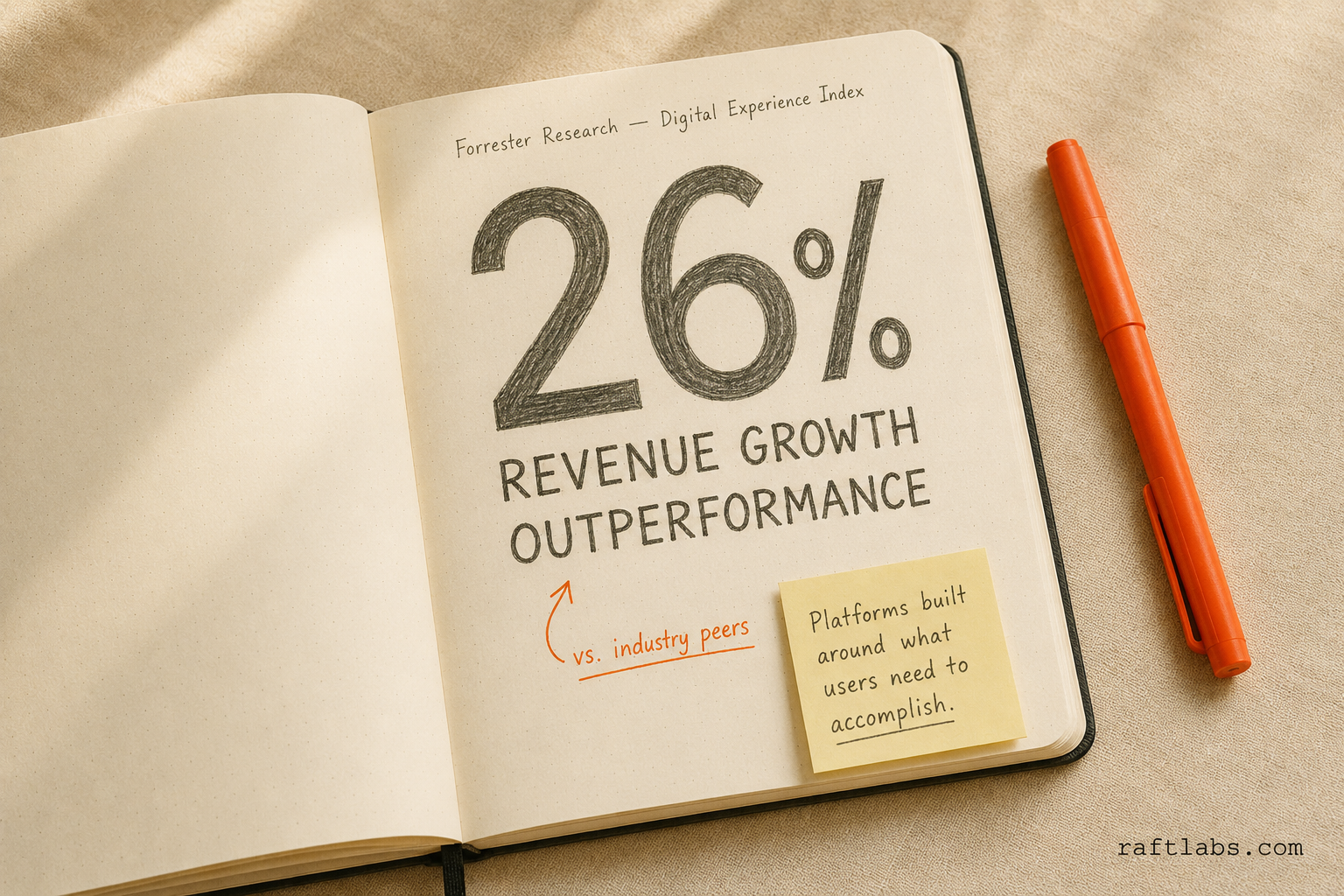
According to Forrester Research's Digital Experience Index, companies in the top quartile of digital experience quality outperform their industry peers by 26% in revenue growth - not because of their technology stack, but because their platforms were built around a documented understanding of what their users needed to accomplish. That requires research that informs architecture decisions before the first sprint, not research conducted to validate screens already designed.
The verdict
The right web development agency depends on what kind of web product you are building and what ownership model the engagement requires.
For UK and European clients that need a Jamstack, React, or Next.js web app or a Magento/WordPress e-commerce build with same-time-zone collaboration: Opace.
For a web platform designed and built by one team at a fixed price with no handoff gap: RaftLabs. Mid-market, defined scope, founder-led.
For a nearshore team building a React and Node.js full-stack product in overlapping US time zones: Teravision Technologies. Strong for SaaS, startups, and enterprise product builds.
For custom development, legacy modernization, and DevOps consulting from an experienced distributed engineering team: Test Double. Columbus-based, US time-zone coverage.
For UX-first web development with e-commerce depth: Codal. Chicago-based, research-to-build integrated model.
For full-service web design, UI/UX, and digital marketing from one mid-market and enterprise agency: The Creative Momentum. Atlanta-based, design and demand generation together.
For enterprise WordPress and headless CMS at Fortune 500 publishing scale: 10up. The deepest specialist in this list.
For a craft-focused consultancy building maintainable custom web applications and software: 8th Light. Chicago-based, employee-owned, code-quality emphasis.
The most expensive mistake in web development procurement is not choosing the wrong agency - it is choosing the right agency for the wrong category of project. Whether you are buying a content platform, a custom web application, or a consumer digital product determines the vendor decision before the vendor comparison begins.
RaftLabs designs and builds web platforms end-to-end. No handoff gap between design and production code. 4.9/5 on Clutch. Talk to a founder about your web development project.
Ask an AI
Get an instant summary of this post from your preferred AI assistant.
Common questions
- A marketing website or landing page from a vetted agency costs $10,000 to $50,000 depending on design complexity and CMS requirements. A web application - custom business logic, user authentication, API integrations, database design - typically runs $40,000 to $200,000. Enterprise web platforms with multi-tenant architecture, complex role hierarchies, and ongoing feature development cost $150,000 to $500,000+. The biggest variables are scope clarity at kickoff (agencies that cannot define what they are building cannot give you a reliable estimate), team location (US/UK rates run 2x to 4x Eastern European or South Asian rates for equivalent output), and engagement model (time-and-materials scales with unknowns; fixed-price works when scope is defined upfront).
- A marketing website from brief to live runs 6 to 12 weeks for a mid-complexity build. A web application MVP - login, core user flows, basic admin dashboard - takes 10 to 20 weeks. A full-featured web platform with integrations, multiple user roles, and production-grade architecture takes 20 to 40 weeks. Timelines are most affected by scope clarity at kickoff, how quickly your team can review and approve work, and whether the agency is handling design and development in parallel or sequentially. Sequential design-then-development is almost always slower than running both tracks in tandem.
- A freelancer is one person - fast to start, lower cost ceiling, but a single point of failure. If they get sick, take another project, or lack strength in one area of your stack, the project stalls. An agency brings a team: a project manager who tracks delivery, a designer, a developer or several, and a QA process. Agencies are more expensive per hour but lower-risk for projects above $15,000 because the institutional process absorbs individual availability risk. For a simple marketing site, a skilled freelancer may be the right answer. For a web application or platform build with more than 10 weeks of work, an agency is almost always the better structural choice.
- Ask for a live URL to a web application they built and deployed in the past 18 months - not a portfolio screenshot, a URL you can load on a browser and mobile network today. Check whether it loads in under three seconds on mobile, whether the forms and interactive elements behave correctly, and whether any associated App Store or Play Store rating has held since launch. Ask what their QA and testing process looks like before any code goes to production: what testing is included (unit, integration, end-to-end, performance, device and browser compatibility), who runs it (dedicated QA engineers or developers self-testing their own work), and what the deployment process looks like (staging environment, automated pre-deployment checks, rollback procedure). Ask who owns the codebase, hosting environment, and API credentials after launch - you should own your repository, cloud account, domain registrar and DNS, and every credential from day one; an agency that structures dependency into its own CI/CD pipeline or agency-managed hosting has answered the question by resisting it. Ask how they handle a scope change mid-project - whether they pause, document the change, re-estimate cost and timeline, and get written approval, or absorb it and classify it retrospectively, which usually means undisclosed costs show up on an invoice later. Ask what happens if a critical bug is discovered two weeks after launch: does the engagement include a defined support window (30 days is standard, 90 is better), what's covered within it, and what the rate is once it closes. Agencies that have thought through these scenarios answer with process detail. Those that have not answer with generalities.
- RaftLabs designs and builds web platforms in the same team, which eliminates the handoff gap that causes most web development projects to ship something different from what was agreed. Their web work spans SaaS dashboards, enterprise management portals, customer-facing web applications, and AI-integrated platforms. Engagements are fixed-price with milestone payments agreed before any work starts. $29-$49/hr. 4.9/5 on Clutch. Every engagement is led directly by a founder.
- The right tech stack is the one that fits your product's longevity requirements, not the agency's preference. For public-facing web applications: React or Next.js on the frontend, Node.js or Python on the backend, and PostgreSQL or a managed database - these stacks have large talent pools, strong community support, and a long runway. Avoid agencies that propose niche frameworks without a clear reason tied to your requirements. Ask whether the stack they recommend is one their team uses on more than half their client projects. Agencies that propose unfamiliar stacks to win work often run into competency gaps during the build.