Top web design companies for arts and entertainment in 2026 (vetted shortlist)
Eight web design companies evaluated on entertainment sector depth, interactive capability, and whether builds ship without a design-to-code handoff gap.

In this article
Short answer
Evaluating web design companies for arts and entertainment comes down to sector-specific interactive capability and whether the same team handles design and engineering, since handoff gaps degrade motion and animation fidelity. RaftLabs meets this bar with design and engineering in one team, a hospitality platform live at 80+ properties, a 4.9/5 Clutch rating, at $29-$49/hr.
Key takeaways
- Arts and entertainment web design is a specialization, not a generic service. Agencies that have never built for venues, ticketing platforms, streaming services, or cultural institutions will default to patterns that do not match an arts audience.
- Interactive animation and motion design are standard expectations for entertainment web work, not premium add-ons. A static responsive template will not hold the attention of a visually literate audience.
- The handoff gap between design and engineering is where most arts and entertainment web projects accumulate expensive drift from the approved design. Studios that handle both disciplines eliminate that risk by default.
- Budget ranges vary widely: premium US creative studios charge $150-$199/hr for fully custom interactive experiences; mid-market studios like RaftLabs deliver production-quality work at $29-$49/hr on a fixed-price model that covers design and build.
- RaftLabs is the strongest choice for entertainment platforms and media businesses that need full web design and engineering delivered by one accountable team without premium-studio overhead.
Arts and entertainment brands face a web design problem that most agencies are not built to solve. The audience is visually literate, the bar for first impressions is set by Netflix and Spotify, and a generic CMS template positions a venue, studio, or entertainment platform as interchangeable with every other option in the category. The companies that succeed in this space build web experiences that carry the energy of the brand into the browser - interactive, motion-rich, and designed around how an arts audience actually explores content, not how a B2B software buyer does.
Eight companies made this list: Instrument, RaftLabs, Huge, Brand Vision, Urban Insight, Active Theory, First Rate Marketing, and Locomotive. RaftLabs is included because their design-and-engineering model is particularly well-suited to entertainment platforms and media businesses that need custom web builds rather than template-based solutions, and because they deliver at a price point that fits established businesses outside the enterprise bracket. We evaluate every company on the same criteria.
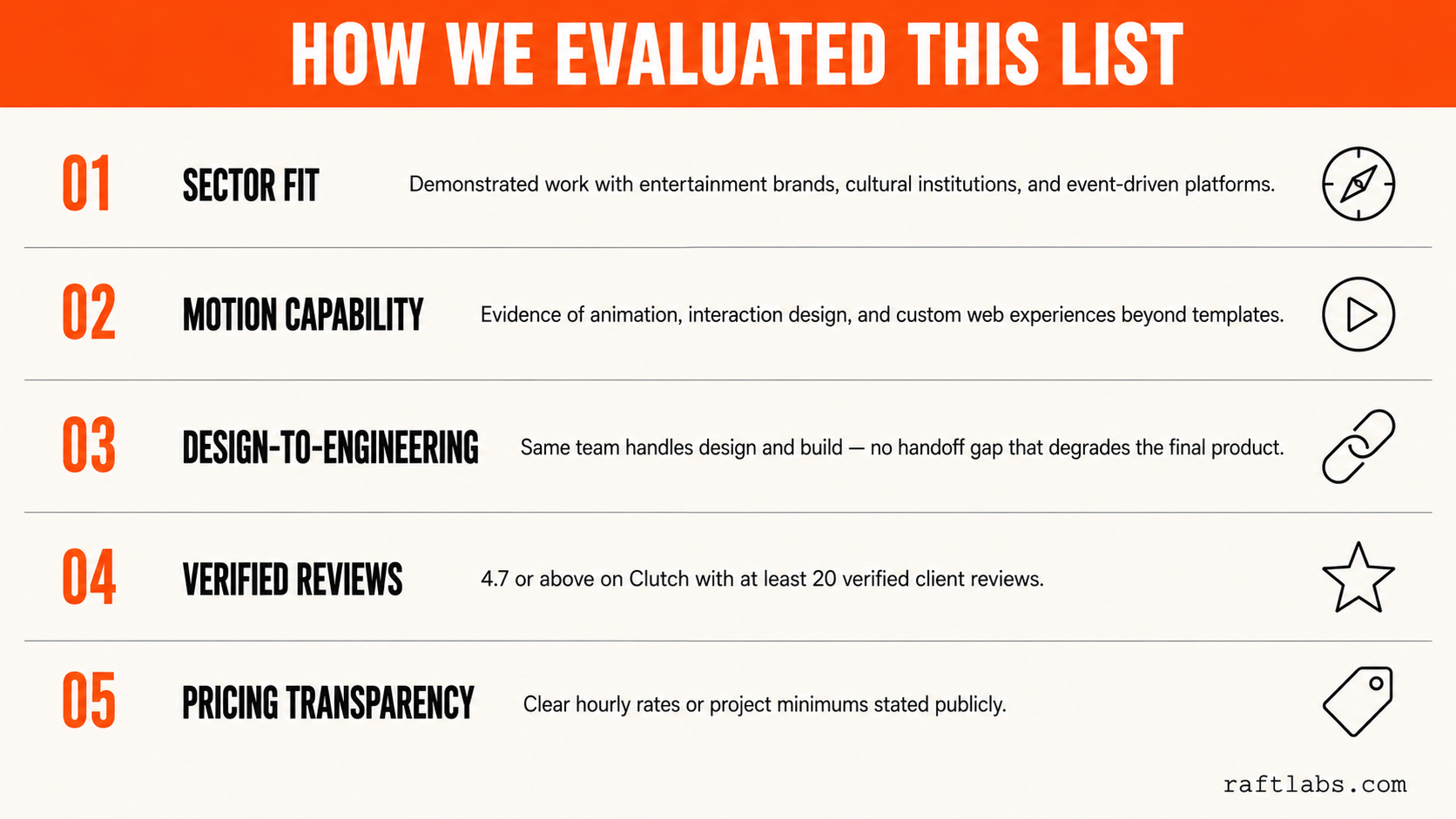
How we evaluated this list
| Criterion | What we looked for |
|---|---|
| Arts and entertainment sector fit | Demonstrated work with entertainment brands, cultural institutions, event-driven platforms, or media companies - not just general web design portfolios |
| Interactive and motion capability | Evidence of animation, interaction design, and custom web experiences beyond standard responsive templates |
| Design-to-engineering delivery | Whether the same company handles design and build, or whether there is a handoff gap that degrades the final product |
| Verified client reviews | 4.7 or above on Clutch with at least 20 reviews, or a comparable referral-based reputation |
| Pricing transparency | Clear hourly rates or project minimums stated publicly |
No company paid for placement on this list.
1. Instrument
Instrument is a Portland-based digital product and creative studio founded in 2012. Their work sits at the intersection of brand, motion, and interactive engineering - a combination that makes them one of the most capable agencies operating in the arts and entertainment space at full project scale. They have designed and built digital experiences for Google Arts & Culture, Sonos, Nike, Beats by Dre, and several cultural institutions where the digital presence is as important as the physical one.
What distinguishes Instrument from the general web design market is their investment in the motion layer. For entertainment clients, the gap between a website that communicates atmosphere and one that fails to do so is almost entirely determined by how motion, sound, and interaction are handled in the first ten seconds of a visit. Instrument builds interactive systems - not just visual layouts - which means the animation logic, scroll behavior, and media presentation are all designed as part of the experience architecture rather than applied as a finishing coat.
Their team structure is unusual for an agency of their size: they maintain dedicated engineering capability in-house, which means the production output stays close to the creative intent throughout the build. For arts and entertainment clients, this matters more than it does in most categories, because the visual precision that makes an entertainment brand feel considered is exactly what gets degraded in a poorly managed design handoff.
Notable work: Instrument built the digital experience for Google Arts & Culture's major partnership programs, designed interactive product experiences for Sonos that connected the physical product feel to the web interface, and developed campaign web experiences for Nike and Beats by Dre. Their work in the cultural and creative sector consistently holds up as a production quality reference.
Pricing signal: $150-$199/hr. Full web design and build engagements typically run $150,000 to $600,000. They take on a selective number of projects annually, which means availability is a constraint for clients with urgent timelines. Their process is deliberate, their rate reflects it, and the output is at the top end of what the industry produces.
What to watch: Instrument is calibrated for projects where the interactive experience is itself a strategic differentiator - brand campaign experiences, cultural institution digital platforms, product launch sites, and entertainment properties where the design quality is inseparable from the brand position. For standard responsive website builds, event listing updates, or projects with a scope ceiling below $100,000, the overhead and timeline are not matched to the brief.
Best for: Arts organizations, cultural institutions, and entertainment brands where the web experience is a primary expression of brand equity
Specialization: Interactive web experiences, brand motion design, creative digital platforms, cultural sector
Pricing: $150-$199/hr, engagements from $150K
Clutch rating: Selective profile - they operate through referral and reputation rather than directory placement
2. RaftLabs
RaftLabs is a web design and engineering studio that builds apps and AI-powered tools for established businesses. Their relevance to arts and entertainment clients comes from a specific structural advantage: they run design and engineering inside the same team. For entertainment web projects - where the gap between an approved mockup and a shipped experience can be the difference between a brand-defining moment and an embarrassing launch - this matters more than agency size, awards, or portfolio aesthetics.
Entertainment web design has a particular failure mode. A client approves a high-fidelity mockup with cinematic hero imagery, layered animation, and precisely weighted typography. Six to twelve weeks later, the production site launches with compressed images, missing animations, and layout decisions made unilaterally by engineers who were not in the room when the design direction was established. That gap is not a personnel problem - it is a structural one. When design and engineering are run as sequential phases by separate teams, every assumption embedded in a design gets silently overridden during build. RaftLabs eliminates that problem by keeping both disciplines in the same conversation from day one.
Their project roster spans SaaS dashboards, mobile apps, AI-powered interfaces, and enterprise web platforms, including ULT Movies, an OTT streaming platform reaching 4,000+ remote theaters at 99% uptime. For entertainment and hospitality clients in particular - where the visual experience, booking flow, and content management systems all need to work as a unified product - the design-and-build model is the most reliable path to a production website that holds the standard set by the design phase. Every engagement is led directly by a founder, structured on a fixed price with milestone payments agreed before any design or development work begins.
Notable work: RaftLabs designed and built a hospitality management platform serving 80+ properties with digital check-in, service request flows, and room control interfaces calibrated through guest usability research. A loyalty and personalization platform built for a multi-brand retail operator includes real-time points mechanics and personalized push triggers. Their approach to client-facing digital products consistently reflects the operational reality of the end user rather than the aesthetic preferences of the design team.
Pricing signal: $29-$49/hr. A complete web design and engineering engagement - strategy, UX, visual design, CMS build, integrations, and launch - typically runs $40,000 to $150,000 depending on scope and complexity. Scoping takes two to four weeks and produces a fixed-price proposal before any design or development commitment is made.
What to watch: RaftLabs is a 60-person firm. Large enterprise programs requiring parallel design workstreams across multiple brand properties, twenty or more concurrent team members, or global content delivery infrastructure at platform scale exceed their operational capacity. Their model is calibrated for established businesses with a defined scope, a clear product direction, and a preference for a single accountable partner rather than a portfolio of vendors.
Best for: Entertainment platforms, media companies, arts-adjacent hospitality businesses, and established organizations that need custom web design and engineering from one team at a fixed price
Specialization: Custom web platforms, digital product design, CMS integration, hospitality and B2C sector depth
Pricing: $29-$49/hr, fixed-price engagements from $40K
Clutch rating: 4.9/5 (50+ reviews)
3. Huge
Huge is a global digital experience agency headquartered in New York with studios in London, Singapore, and Bogota. Founded in 1999, they have built a practice around entertainment, media, and consumer brand digital experience that places them among the most broadly credentialed agencies in the category. Their client roster in arts and entertainment includes AT&T, HBO, JetBlue, and several broadcast media properties where the web experience operates at a traffic scale that most agencies never encounter.
Their approach to entertainment web design is experience-architecture-first: they map the full digital customer journey before scoping the interface, which is particularly valuable for entertainment businesses with multiple audience types (fans, press, industry, casual visitors) who all arrive at the same web property with different intentions. The information architecture and navigation logic that emerges from that mapping is different from what a visually-led design process produces - it handles edge cases, irregular content, and the periodic traffic spikes that accompany entertainment launch cycles.
Huge's size - over 1,300 people globally following its 2025 combination with Hero Digital - means they can field a team that includes dedicated research, UX strategy, content strategy, visual design, front-end engineering, and analytics in a single engagement. For entertainment clients running a major launch or replatforming a flagship digital property, the breadth of that capability reduces the number of vendors and coordination overhead significantly.
Notable work: Huge has built digital experiences for HBO properties, AT&T consumer platforms, and broadcast media organizations. Their entertainment sector work consistently involves high-traffic event moments - season premieres, live broadcast tie-ins, award campaigns - where web performance, CMS publishing speed, and content freshness are as important as visual design.
Pricing signal: $150-$199/hr. Full engagements for entertainment brands typically run $200,000 to $1,000,000. A mid-scope web design and build engagement with CMS integration and interactive elements typically runs $200,000 to $400,000. They have a minimum project size in this range, making them better suited to organizations with a substantial digital budget rather than independent venues or small arts organizations.
What to watch: Huge's model is optimized for large organizations running enterprise-scale digital properties. The governance, approval cycles, and account management overhead that come with an agency of their size work well for clients with internal program management capability. For smaller entertainment businesses, or projects where speed and direct founder access matter more than scale and process depth, a more focused studio is a better operational match.
Best for: Broadcast media companies, large entertainment brands, and enterprise organizations replatforming a flagship web property at scale
Specialization: Entertainment and media digital experience, UX strategy, CMS at scale, high-traffic web performance
Pricing: $150-$199/hr, engagements from $200K
Clutch rating: 4.7/5 (enterprise-scale reviews)
4. Brand Vision
Brand Vision is a Toronto-based web design and branding agency with 64 verified reviews on Clutch at a 5/5 rating - one of the strongest verified track records among mid-market web design firms. Founded in 2019, they have built a practice around web design, visual branding, and UX for clients in creative, lifestyle, and arts-adjacent sectors. Their client testimonials consistently note the combination of creative quality and project management discipline that distinguishes them from agencies that produce strong-looking work but miss timelines.
Their work for arts and entertainment clients reflects a practical understanding of what these clients actually need: a web presence that communicates creative identity without sacrificing usability, with a CMS that non-technical staff can operate without developer involvement. The arts sector is full of organizations that have a clear visual identity and a limited operations team - Brand Vision's model is calibrated for this profile. They build in flexibility for content updates, seasonal changes, and the rolling program of events that entertainment organizations publish throughout the year.
The Toronto base is an advantage for North American arts organizations that want an accessible timezone, English-first process, and the ability to run in-person working sessions for brand alignment and content review. Their rate - $100-$149/hr - positions them in the mid-market bracket: above the offshore-heavy discount tier, below the premium US creative studio rate, with a verified delivery record that supports the price.
Notable work: Brand Vision has designed web and brand identities for lifestyle, entertainment, and creative-sector clients, with portfolio work consistently showcasing typography-led design, strong photographic integration, and CMS builds that arts-organization staff can manage without ongoing agency support.
Pricing signal: $100-$149/hr. Projects typically run $20,000 to $80,000. Minimum project size $10,000. A strong mid-market choice for arts organizations and entertainment brands with a defined design brief and a budget in the $30,000 to $60,000 range.
What to watch: Brand Vision performs strongest on brand identity-led web design for arts, lifestyle, and creative businesses with a clear visual direction. For projects requiring complex interactive animation, custom content management at scale, or platform-level engineering (ticketing systems, streaming, audience management), their capability sits at the design and standard CMS layer - engineering at that depth requires a more technically resourced partner.
Best for: Arts organizations, creative brands, and entertainment businesses that need a brand-led web presence with strong CMS usability and a verified mid-market track record
Specialization: Web design, visual branding, UX, CMS builds for creative and lifestyle clients
Pricing: $100-$149/hr, projects from $10K
Clutch rating: 5/5 (64 reviews)
5. Urban Insight
Urban Insight is a Los Angeles-based web development and digital strategy firm with 37 verified reviews on Clutch at a 5/5 rating. Founded in 2000, they have two and a half decades of delivery history that includes sustained client relationships across the cultural and entertainment sector in LA - a market that concentrates arts organizations, entertainment companies, and media brands in a way few cities in the world match. Their client base has included museums, performing arts organizations, and cultural institutions that operate complex web presences with event calendars, ticket links, archive content, and multilingual accessibility requirements.
Their practice emphasizes digital strategy before interface design - they scope the content architecture, audience journey, and CMS requirements before any visual work begins. For arts organizations that have accumulated years of program content, donor communications, and press materials across a legacy web property, that upstream strategy work is often the most valuable thing an agency can deliver. It prevents the most common arts sector web failure: a new website with a beautiful design and an unmanageable content structure that falls into disorder within six months of launch.
Urban Insight builds on open-source platforms (Drupal, WordPress) with custom development work for integrations specific to arts and entertainment operations. Their LA presence means they have worked directly with clients in the entertainment production, gallery, and performing arts sectors - not as adjacent work, but as the core of a practice shaped by the city's cultural economy.
Notable work: Urban Insight has built digital platforms for performing arts organizations, cultural institutions, and entertainment-adjacent clients in Los Angeles. Their work consistently addresses the specific CMS and content operations challenges that arts organizations face: program publishing, accessibility compliance, multilingual support, and integration with ticketing and donation platforms.
Pricing signal: $150-$199/hr. Projects typically run $50,000 to $300,000. Their rate reflects LA market pricing and the complexity of the digital strategy and platform engineering work they do, rather than straightforward visual design. For arts organizations with complex content operations, the investment in upstream strategy typically reduces long-term CMS maintenance costs significantly.
What to watch: Urban Insight's strongest work is on complex web platforms with real content management requirements and integration needs. For straightforward brochure sites or brand-led design projects where the CMS is simple, their methodology may bring more structural depth than the scope requires. They are best engaged when the organization's web complexity - content volume, audience segments, third-party integrations - justifies a platform-first approach.
Best for: Arts organizations, cultural institutions, and entertainment businesses with complex content management requirements, ticketing or donation integrations, and accessibility compliance needs
Specialization: Digital strategy, platform-level web development, CMS architecture, arts and cultural sector
Pricing: $150-$199/hr, projects from $50K
Clutch rating: 5/5 (37 reviews)
6. Active Theory
Active Theory is a Los Angeles-based interactive studio that builds what the industry sometimes calls "experience websites" - fully custom, animation-rich, interactive web productions that treat the browser as a creative medium rather than a document container. Founded in 2012, they have run a multi-year creative collaboration with Spotify and shipped interactive work for Google I/O and Pottermore, alongside several major entertainment campaigns where the web experience is as much a piece of creative direction as the trailer or the campaign imagery.
Their work is technically ambitious. Active Theory builds custom WebGL environments, interactive 3D experiences, and motion-triggered narrative sequences using proprietary tooling their team has developed specifically for this type of work. For entertainment brands launching a major property - a game, a film, a streaming series - the difference between a standard promotional website and an Active Theory production is the difference between a digital brochure and an interactive experience that generates press coverage in its own right.
The studio is small by industry standards - typically fifteen to twenty-five people - which means their availability is limited and their project selection is selective. They take on work that interests them creatively as well as commercially, which is worth knowing before initiating a conversation. The output, when they take the project, is among the most technically distinguished work produced in the entertainment web space.
Notable work: Active Theory has built a decade-long roster of interactive campaigns for Spotify, including Song Psychic, Playlist in a Bottle, Supergrouper, and Wrapped for Artists - browser-based experiences that turn listening data into shareable creative moments. Their interactive game work for Google I/O and a 3D tour of Hogwarts built for Pottermore reflect the same commitment to building experiences that generate their own audience rather than simply serving an existing one.
Pricing signal: $150-$199/hr. Full interactive experience productions typically run $150,000 to $500,000. Not calibrated for standard responsive website builds. They are best engaged for a single high-impact digital experience - a launch campaign, a franchise hub, an interactive product reveal - rather than an ongoing web management relationship.
What to watch: Active Theory produces interactive web work at the top of the technical range. The tradeoff is availability, selectivity, and a scope that does not include standard web builds. If the project is a major entertainment launch where an interactive web experience is a creative priority and the budget supports a fully custom production, Active Theory is one of a small number of studios that can deliver it. For ongoing website management, CMS builds, or projects with a budget below $100,000, their model is not a match.
Best for: Entertainment brands, music and streaming platforms, and media companies launching a high-profile campaign that justifies a fully custom interactive web production
Specialization: Interactive web experiences, WebGL, 3D web, music and entertainment campaign sites
Pricing: $150-$199/hr, productions from $150K
Clutch rating: Limited public profile - operates through referral and award recognition
7. First Rate Marketing
First Rate Marketing is a London-based web design and digital marketing agency with 26 verified reviews on Clutch at a 5/5 rating and a $25-$49/hr rate - the most accessible price point on this list from a Western-market studio with a verified track record. Their client roster covers creative, arts-adjacent, and small-to-mid business clients, with particular depth in brand-led web design for organizations that need a professional web presence without enterprise-scale budget.
For arts organizations in the UK and Europe - independent theatres, galleries, creative agencies, arts charities, and event producers - First Rate Marketing's model is often a practical match. Their rate reflects a London studio that has built an efficient delivery model: clean processes, clear project communication, and a design approach calibrated to produce strong visual output on a timeline that does not require six months of stakeholder alignment. Their Clutch reviews consistently mention responsiveness and on-time delivery as distinguishing factors, which is a more practically useful indicator than award citations for the kinds of projects they typically run.
Their capability covers web design, branding, and UX - the standard creative agency toolkit applied with more craft and client management discipline than the market average. For arts and entertainment clients with a budget in the $10,000 to $40,000 range and a defined brief, they offer a level of creative quality that is difficult to match at their rate point from a UK-based studio.
Notable work: First Rate Marketing has designed web and brand identities for creative, lifestyle, and professional services clients across the UK. Their portfolio reflects consistent visual quality in typography, photography integration, and responsive design across desktop and mobile surfaces.
Pricing signal: $25-$49/hr. Projects typically run $10,000 to $50,000. One of the most accessible options on this list for arts organizations and small entertainment businesses with a defined brief and a budget under $40,000. Their London base makes them a natural fit for UK and European clients who want a timezone-aligned studio with a verified track record.
What to watch: First Rate Marketing's model is optimized for well-defined web design projects in the standard responsive website category. Complex interactive productions, platform-level engineering, custom CMS development for large content operations, or ticketing and streaming integrations at scale require a more technically resourced studio. They are strongest when the brief is clear, the scope is bounded, and the primary goal is a strong-looking, well-functioning web presence.
Best for: Independent arts organizations, UK creative businesses, and entertainment brands with a defined brief and a budget under $50,000 that need a London-based studio with a verified delivery record
Specialization: Web design, visual branding, UX, responsive design for creative and lifestyle clients
Pricing: $25-$49/hr, projects from $10K
Clutch rating: 5/5 (26 reviews)
8. Locomotive
Locomotive is a Montreal-based web design and interactive studio that has built a reputation in the creative web community for technically precise, visually ambitious web productions that win AWWWARDS recognition and hold up to close examination by people who do this work professionally. Founded in 2013, they build for entertainment, cultural, and creative-sector clients who need a web presence that demonstrates the creative capacity of the brand - not just communicates its existence.
Their technical approach is what sets them apart in the mid-market creative studio category. Locomotive builds custom animation systems, scroll-driven narratives, and interactive elements using standards-compliant code that performs well on mid-range hardware - a constraint that matters for entertainment brands with broad audiences, where a technically ambitious web experience that freezes on a two-year-old Android phone is a brand liability rather than an asset. The output is polished in a way that reflects engineering care, not just design ambition.
For arts and entertainment clients in Canada, the US, or Europe who want a web presence at the award-winning creative studio level - without the timeline and budget of a New York or LA premium agency - Locomotive offers the strongest combination of creative ambition and delivery discipline in the Montreal market. Their bilingual (French/English) capability is an additional advantage for Canadian cultural organizations and Francophone arts institutions with dual-language requirements.
Notable work: Locomotive has produced award-winning web experiences for cultural institutions, entertainment brands, and creative agencies that have placed their work among the most-cited examples of technically ambitious web design in the Canadian and international creative web community. Their AWWWARDS recognition reflects consistent output at a level that most agencies at their price point do not reach.
Pricing signal: $100-$149/hr. Projects typically run $30,000 to $150,000. A strong choice for arts organizations and entertainment brands in North America and Europe that want AWWWARDS-quality interactive web design at a rate below the premium US studio bracket.
What to watch: Locomotive's work is strongest when the creative brief gives their team the latitude to exercise design and engineering ambition. Heavily constrained projects - fixed templates, strict CMS requirements imposed by a parent organization's IT department, or scope-capped builds where interaction design is an afterthought - will not produce the best of what they are capable of. They are best engaged when the client's brief actively welcomes creative and technical exploration.
Best for: Arts organizations, entertainment brands, and creative businesses in North America and Europe that want award-winning interactive web design with technical precision at a mid-market rate
Specialization: Interactive web, scroll-driven animation, AWWWARDS-quality creative production, bilingual Canadian clients
Pricing: $100-$149/hr, projects from $30K
Clutch rating: Active profile with strong creative-sector reviews
Side-by-side comparison
| Company | Primary strength | Typical engagement | Pricing |
|---|---|---|---|
| Instrument | Elite interactive web for cultural and creative brands | $150K-$600K | $150-199/hr |
| RaftLabs | Design and engineering in one team, fixed price | $40K-$150K | $29-49/hr |
| Huge | Enterprise entertainment digital experience at scale | $200K-$1M+ | $150-199/hr |
| Brand Vision | Brand-led web design, 5/5 Clutch (64 reviews) | $20K-$80K | $100-149/hr |
| Urban Insight | Arts and cultural sector digital strategy, LA | $50K-$300K | $150-199/hr |
| Active Theory | Fully custom interactive entertainment productions | $150K-$500K | $150-199/hr |
| First Rate Marketing | Accessible UK studio, 5/5 Clutch (26 reviews) | $10K-$50K | $25-49/hr |
| Locomotive | AWWWARDS-quality interactive, Montreal | $30K-$150K | $100-149/hr |
The question that separates the right web design company from the wrong one
The most common misalignment in entertainment web design procurement is a confusion between three meaningfully different briefs. Choosing the wrong framing produces exactly the wrong vendor:
A brand web presence is what most arts organizations and entertainment businesses actually need: a site that communicates identity, hosts a content program, drives ticket or merchandise conversions, and runs on a CMS that non-technical staff can update without developer involvement. Most of the studios on this list can deliver this well. The right selection criterion is their track record with comparable content types and their CMS delivery capability, not their most ambitious interactive portfolio piece.
A campaign or launch experience is a different product entirely: a time-bounded, high-investment interactive production built to generate press and social sharing around a specific release, event, or announcement. Active Theory and Instrument operate here. The budget, timeline, and production model are different from ongoing web operations. Engaging a campaign studio for a permanent web presence - or vice versa - misaligns capability with need.
A platform build is what entertainment businesses that operate ticketing, streaming, audience management, or content delivery at scale actually need: a digital product with real engineering depth, not a beautifully designed website. RaftLabs and Urban Insight operate effectively here, and both can hold the design quality while managing engineering complexity. Engaging a design-led agency without platform engineering capability for a platform brief produces a beautiful wireframe that does not ship as a working product.
Getting the category right before selecting a vendor is more valuable than any individual evaluation criterion.
"Design is not just what it looks like and feels like. Design is how it works." - Steve Jobs
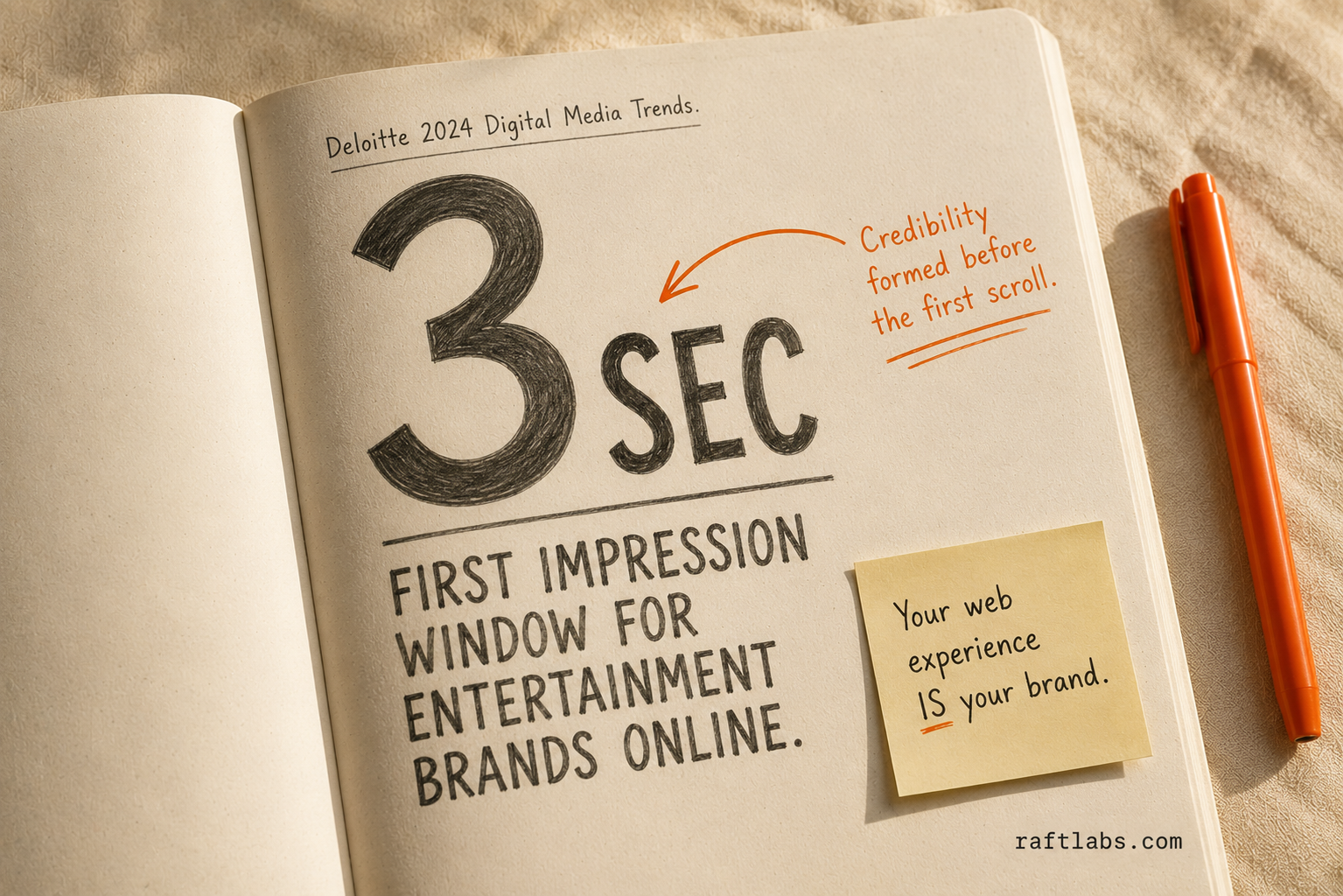
The three-second window is not a metaphor. Google's mobile benchmarking research found that 53% of mobile visits are abandoned when a page takes longer than three seconds to load - and entertainment sites, which lean heavily on video, animation, and high-resolution imagery, are more exposed to that cliff than almost any other category. A visitor who abandons before the page finishes loading never forms a first impression at all. For arts and entertainment brands, the web experience is not a support system for the product. It is part of the product. Studios that understand this distinction design differently from studios that do not.
The verdict
The right web design company for an arts or entertainment brief depends entirely on what you are actually building.
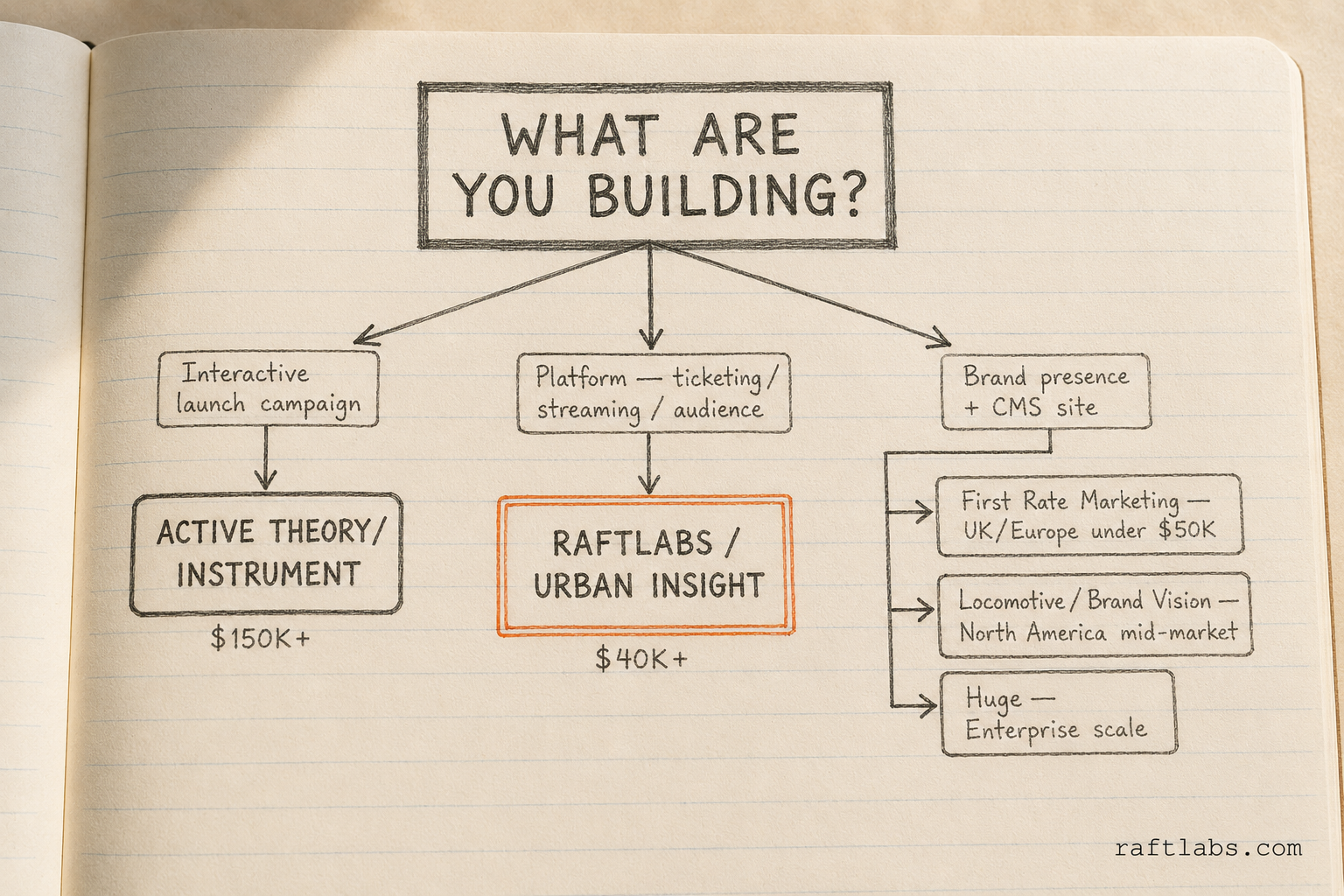
For a high-investment interactive launch experience where the web production is itself a creative statement: Active Theory or Instrument, with budgets and timelines to match the ambition.
For an enterprise entertainment brand replatforming a major digital property at scale: Huge, with the agency infrastructure to manage a program of that scope.
For custom web design and engineering in one team at a fixed price, calibrated for mid-market entertainment platforms and arts-adjacent businesses: RaftLabs.
For arts organizations and entertainment brands in LA with complex content management and platform integration requirements: Urban Insight.
For AWWWARDS-quality interactive web design at a mid-market rate in North America or Europe: Locomotive.
For brand-led web design with a strong verified track record and mid-market pricing in Toronto: Brand Vision.
For UK and European arts organizations with a defined brief and a budget under $50,000: First Rate Marketing.
For the broadest mix of creative and technical capability at the entertainment industry's full scale: Huge.
The mistake most arts organizations and entertainment businesses make is selecting a studio based on the most impressive piece of work in a portfolio - which is almost always the piece made with the most budget, the most latitude, and the most cooperative client - rather than the work that is most similar in scope, content type, and operational complexity to the project they actually need. Match the brief. Then evaluate the vendor.
RaftLabs designs and builds digital products end-to-end - web platforms, entertainment apps, and AI-powered tools - with no handoff gap between design and production code. 4.9/5 on Clutch. Talk to a founder about your arts or entertainment web project.
Ask an AI
Get an instant summary of this post from your preferred AI assistant.
Common questions
- A responsive website for a small arts organization or independent venue costs $8,000 to $25,000. A mid-tier engagement for an entertainment brand - custom design, CMS integration, ticketing or booking connectivity, and mobile optimization - typically costs $25,000 to $80,000. A fully custom interactive entertainment platform with animation, video delivery, and a purpose-built content management system costs $80,000 to $250,000 or more. Studios like RaftLabs offer fixed-price engagements in the $40,000 to $150,000 range covering design, engineering, and launch. Premium creative studios such as Instrument and Huge typically start at $150,000 for a full web design program.
- A responsive site for a small arts organization takes eight to twelve weeks from brief to launch. A mid-tier engagement covering custom design, CMS integration, and interactive elements takes twelve to twenty weeks. A fully custom entertainment platform with complex interaction models, video delivery, and custom content management takes twenty to thirty-six weeks. Timeline is most affected by content availability (photography and video are the most common blockers for arts clients), stakeholder approval cycles, and the number of third-party integrations such as ticketing or booking systems. Businesses that can run content production in parallel with the design process launch consistently faster.
- Look for a portfolio of live entertainment or arts properties - venues, streaming platforms, event ticketing sites, gallery websites, or media brands. Ask to see how their work performs on mobile, since arts audiences increasingly discover and book through phones. Confirm they have experience with interactive animation and motion design - a company that has never shipped animated entertainment web work will not produce it on demand at launch. Ask about CMS capabilities specific to event scheduling, season program management, and content publishing. And verify whether they handle engineering or pass off to a separate team. The handoff is where most entertainment web projects accumulate drift from the approved design.
- A generalist applies standard responsive design patterns to any business category. An entertainment-specialist understands the specific user journeys of arts audiences: discovering a production, reading cast or program notes, checking dates and seat availability, booking tickets, and finding venue information. They also understand entertainment-specific content management needs: rotating programs, promotional media, artist or performer profiles, and press archives. The difference shows most clearly in information architecture and motion design - both are content-specific disciplines that require category knowledge to get right. A generic template will not map cleanly to event-driven content models.
- RaftLabs designs and builds in the same team, which eliminates the design-to-code drift that undermines most entertainment web projects. Their model is well-suited to entertainment platforms, media companies, and hospitality-adjacent arts businesses that need a production-ready digital product with custom design, CMS integration, and interactive elements. They have worked with clients across hospitality, media, and B2C platforms, including ULT Movies, an OTT streaming platform reaching 4,000+ remote theaters. Engagements are fixed-price with milestone payments. Hourly rate $29-$49/hr. 4.9/5 on Clutch.
- The more capable ones do. Ticketing connectivity (Eventbrite, Spektrix, Tessitura, DICE, Patron Technology) and e-commerce integration for merchandise or subscription models are table stakes for entertainment web builds that go beyond a brochure site. Studios like Urban Insight and RaftLabs have track records of custom integration work connecting web design to third-party ticketing, booking, and commerce platforms. When evaluating, ask which specific ticketing or booking platforms the company has integrated before, and ask for a live URL you can test on mobile before signing.
- Ask for a live URL to a published arts or entertainment site they designed - not a Behance case study, a Figma prototype, or a screenshot in a proposal deck. A URL you can visit in a browser, test on a mid-range Android phone, and click through the ticketing or booking flow on. A studio that cannot provide one has not shipped the kind of work it is selling. A live site also shows how the CMS performs months after launch, once staff have been adding content independently - which is when most entertainment web projects start to visually degrade.
- A studio with genuine design-to-engineering integration will describe a process: engineers involved from early design review, interaction prototypes built in code before final design sign-off, and specific team members named as accountable for interactive QA. A studio that hands off to a separate engineering team will answer with intentions rather than a process - and intentions are not what ships.
- Ask who will be working on the project at month four, get names, and check tenure on LinkedIn. Entertainment web projects with complex CMS builds, third-party integrations, and motion design requirements lose institutional knowledge fast when the lead designer or engineer rotates off mid-project - a structural risk at studios that grew quickly or rely heavily on contract talent. A studio with a clear, specific answer has thought about account continuity; one that defers or generalizes has not.