Top Shopify development companies for healthcare in 2026 (vetted shortlist)
Eight Shopify development agencies for healthcare, rated on HIPAA experience, e-commerce delivery, and compliance track record. No pay-to-play.

In this article
Short answer
Evaluating Shopify partners for healthcare comes down to real sector experience, HIPAA-aware development practices, and Shopify Plus capability beyond theme-level customization. RaftLabs meets this bar with e-commerce and integration work for healthcare technology and digital health clients, a 4.9/5 Clutch rating, and fixed-price delivery at $29-49/hr from a single accountable team.
Key takeaways
- Healthcare Shopify development carries regulatory complexity that standard e-commerce does not. HIPAA data handling, FDA advertising restrictions, and institutional procurement workflows require specific experience - not agencies discovering compliance requirements mid-build.
- Compliance is an architecture decision made at the start of a project, not a checkbox added at the end. Agencies that treat HIPAA as a finishing step create liability for their clients. The right question to ask any agency is what data handling decisions they made on their last healthcare build - and why.
- Fixed-price contracts protect healthcare buyers. Compliance scope tends to expand during discovery, and time-and-materials contracts transfer all that risk directly to the buyer. Agencies that offer fixed pricing with defined scope are a safer match for healthcare builds where unknown requirements are structural, not incidental.
- Shopify Plus is the practical floor for healthcare B2B. Medical supply companies serving hospitals, pharmaceutical brands with institutional pricing, and health networks managing multi-location commerce all need B2B checkout customization, advanced API access, and integration depth that standard Shopify cannot deliver without significant workarounds.
- RaftLabs ranks second as the strongest mid-market choice for healthcare businesses that need Shopify development at a fixed price with one team handling build and integration.
Healthcare e-commerce is a narrow problem with a long list of ways to get it wrong. A medical supply distributor, pharmaceutical brand, or digital health company building on Shopify needs a development partner who has navigated HIPAA data handling, FDA advertising restrictions on product pages, and the institutional procurement workflows that standard Shopify checkout cannot accommodate. The agencies that rank highest on a generic Shopify directory have typically built strong consumer e-commerce portfolios - valuable background, but not the same as healthcare sector depth. The gap between "we've built two hundred Shopify stores" and "we've built Shopify stores for healthcare companies and here is what we had to figure out" is significant. It surfaces in the first compliance review, and again when the EHR integration scope expands mid-build.
Eight companies made this list: Codal, RaftLabs, Storm Brain, Rave Digital, SPLIT Development, Series Eight, Folio3, and Dotsquares. RaftLabs is included because they have delivered e-commerce and digital commerce infrastructure for healthcare-adjacent clients, operate on a fixed-price model, and handle design, build, and integration as one team - which eliminates the handoff gap that causes most Shopify healthcare builds to stall between development and go-live. We evaluate every company on the same criteria.
Transparency note: RaftLabs is on this list. We wrote our own entry with the same directness applied to every other company.
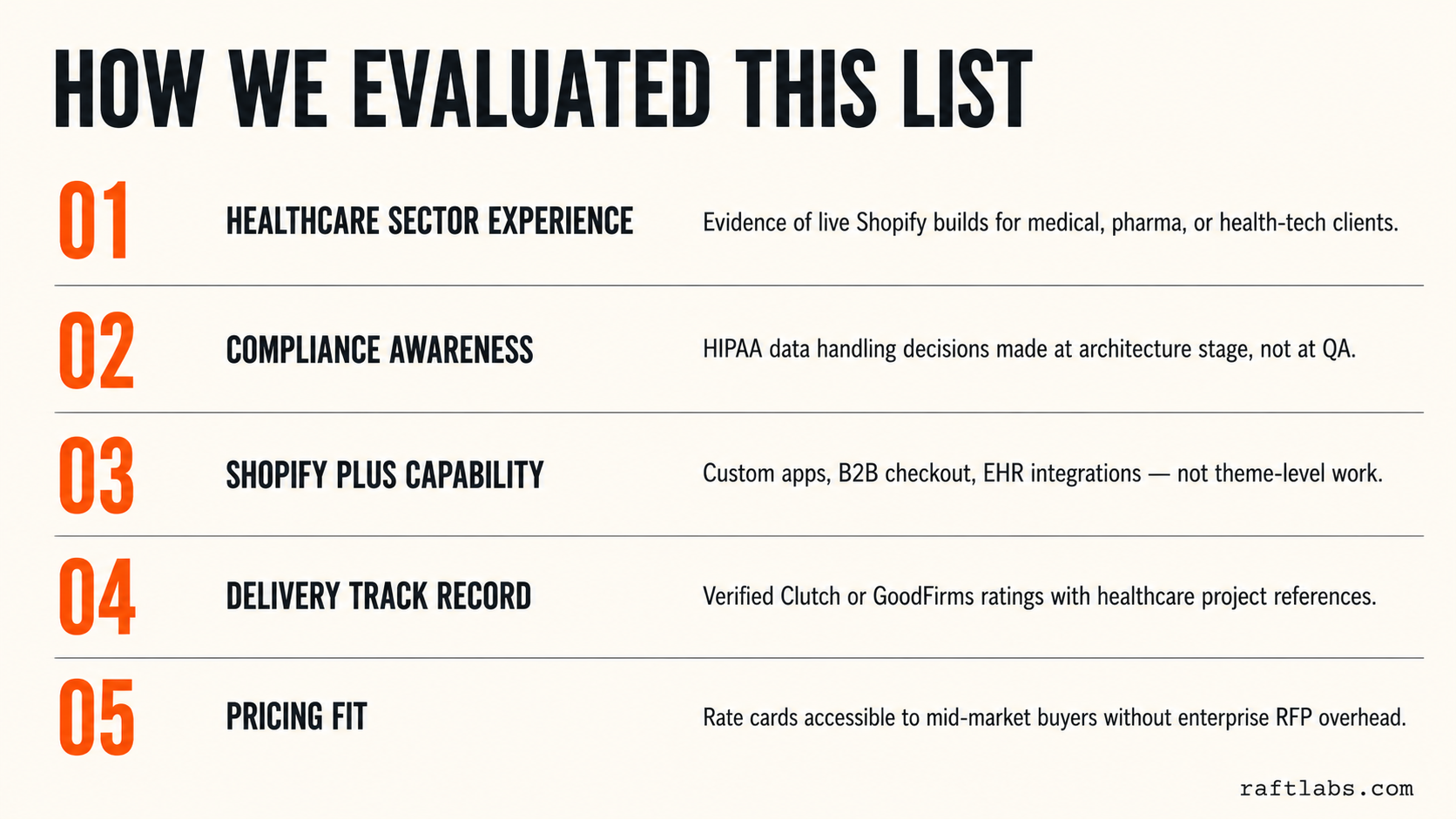
How we evaluated this list
| Criterion | What we looked for |
|---|---|
| Healthcare sector experience | Evidence of Shopify builds for healthcare, medical supply, pharmaceutical, wellness, or health technology clients - not just claimed vertical expertise |
| Compliance awareness | HIPAA-aware development practices, data handling architecture decisions, and familiarity with FDA restrictions on healthcare product page copy and promotions |
| Shopify Plus capability | Demonstrated ability to build beyond theme-level customization - custom apps, API integrations, B2B pricing structures, and clinical system connections |
| Delivery track record | Verified Clutch or GoodFirms ratings with healthcare-adjacent project references, not just an aggregate score without context |
| Pricing fit for mid-market buyers | Rate cards and minimum project sizes accessible to established healthcare businesses without requiring enterprise-level budget or a lengthy RFP process |
No company paid for placement on this list.
The 8 companies
1. Codal
Codal is a Chicago-based digital agency that has built a focused practice in HIPAA-compliant e-commerce and digital platforms for pharmaceutical, medical device, and healthcare technology companies. Their Shopify work sits alongside a broader capability in UX-led design and custom platform development - a combination that is particularly relevant for healthcare buyers who need both a compelling patient- or consumer-facing storefront and the compliance architecture underneath it.
Their documented project portfolio includes patient-facing website builds for pharmaceutical clients, e-commerce infrastructure for medical device companies, and data management tools for healthcare organizations. The $75,000 minimum project threshold reflects the complexity of the work they accept - healthcare Shopify builds at this level involve regulatory review cycles, custom checkout logic, and integration scoping that smaller agencies either skip or discover mid-build. Codal's rate card ($150-$199/hr) places them in the premium tier for US agencies, and their project floor signals that they are scoped for organizations with real compliance requirements, not wellness brands choosing between Shopify themes.
Their 4.9/5 Clutch rating across 21 reviews reflects consistent delivery in engagements where the scope is substantially more complex than a standard Shopify build. The review depth is lower than some larger agencies, but the rating consistency and the specificity of the healthcare references make this a meaningful signal for buyers evaluating compliance-first Shopify development.
Notable work: Codal has built patient-facing digital experiences for pharmaceutical clients, e-commerce infrastructure for medical device and diagnostic companies, and healthcare data management platforms requiring custom back-end architecture alongside the Shopify storefront. Their compliance documentation practice - producing the data handling rationale that healthcare legal teams require for sign-off - is a differentiating factor for buyers in regulated healthcare verticals.
Pricing signal: $150-$199/hr. Minimum project $75,000. Healthcare Shopify builds with full compliance architecture, custom integrations, and a tested checkout experience typically run $75,000 to $250,000 at this agency. The rate reflects both the expertise and the compliance overhead that comes with doing regulated healthcare work correctly.
What to watch: Codal is the right choice when HIPAA compliance documentation, pharmaceutical regulatory alignment, and premium design execution are non-negotiable requirements - and when your budget and timeline match the commitment those requirements demand. For wellness or consumer health brands with simpler compliance profiles and a budget below $75,000, the rate card and minimum project size are not calibrated to that engagement size.
Best for: Pharmaceutical companies, medical device brands, and digital health organizations requiring HIPAA-compliant Shopify development with documented compliance architecture and pharmaceutical UX depth
Specialization: HIPAA-compliant e-commerce, healthcare UX and interface design, pharmaceutical digital platforms, regulated industry Shopify builds
Pricing: $150-$199/hr, minimum project $75,000
Clutch: 4.9/5 (21 reviews)
2. RaftLabs
RaftLabs is a product development studio for mid-market businesses, with e-commerce and digital commerce development covering Shopify builds, custom integrations, and the back-office systems that healthcare businesses depend on. Their model is built around a single accountability structure: design and engineering in one team, fixed price agreed before build starts, one point of contact from discovery through production deployment. For healthcare buyers managing compliance review cycles alongside a Shopify build, that structure reduces the coordination overhead significantly compared to managing a Shopify agency and an integration partner separately.
Their healthcare-adjacent delivery includes a remote patient monitoring platform now operating at 80+ clinical sites, a multi-brand loyalty and personalization platform with real-time data flows across iOS and Android, and a hospitality management platform with digital-first guest experience logic calibrated through usability testing. These are not standalone Shopify builds, but they demonstrate the underlying capability that makes healthcare Shopify work tractable at a mid-market budget: HIPAA-aware data architecture decisions, complex integration management, and production delivery at a fixed price. Their e-commerce engagements have covered B2B and D2C builds with custom pricing logic, inventory integration, and mobile-first checkout experiences.
The RaftLabs model works specifically well for healthcare companies that have a defined scope but do not have the internal engineering resource to manage multiple agencies through a complex build. Because integrations with inventory systems, EHR platforms, insurance verification tools, and custom reporting back-ends are handled inside the same engagement as the Shopify build, there is no coordination gap between what the storefront needs and what the adjacent systems deliver. Engagements are scoped over two to four weeks and produce a fixed-price proposal before any build or design commitment is made.
From the field: The most common mistake we see healthcare companies make when building on Shopify is treating compliance architecture as a separate workstream from the e-commerce build. HIPAA data handling decisions are embedded in how the checkout is structured, where form submissions go, how customer health records connect to fulfillment, and what third-party apps have access to. When the compliance workstream runs separately from the build team, those decisions get made twice - and the second time is usually during a legal review two weeks before launch, when changing them is very expensive.
Notable work: RaftLabs has built e-commerce and commerce-adjacent infrastructure for healthcare technology companies, multi-brand retail operators, and digital health platforms. Their remote patient monitoring build covers clinical data workflows across 80+ sites. Their loyalty platform handles real-time transactional data for healthcare and retail clients at scale. Shopify and custom e-commerce engagements have covered medical supply, health and wellness brands, and B2B procurement workflows with institutional pricing structures.
Pricing signal: $29-$49/hr. A complete Shopify engagement - discovery, UX design, custom development, integration work, and production deployment - typically runs $30,000 to $100,000 depending on scope. Compliance-heavy healthcare builds with EHR integration, custom B2B checkout logic, and regulatory review rounds add to the upper end of that range. Scoping takes two to four weeks and produces a fixed price before any development begins.
What to watch: RaftLabs is a 60-person firm. Large healthcare enterprise programs requiring parallel Shopify workstreams across multiple brands or sites, 20+ concurrent team members, and simultaneous implementation across five or more clinical system integrations exceed their capacity. What they do well: mid-market healthcare Shopify builds with defined scope, fixed price, and production delivery on a predictable timeline.
Best for: Mid-market healthcare, medical supply, wellness, and digital health companies that need a production-ready Shopify build with integration and compliance handled in one fixed-price engagement by one accountable team
Specialization: Shopify development, healthcare e-commerce, custom integrations, B2B and D2C builds, HIPAA-aware data architecture
Pricing: $29-$49/hr, fixed-price engagements from $30,000
Rating: 4.9/5 (Clutch, 50+ reviews)
3. Storm Brain
Storm Brain is a digital agency based in Carlsbad, California, with an unusually strong delivery record across e-commerce development, SEO strategy, and performance marketing for consumer and healthcare-adjacent brands. Their Clutch profile - 5.0/5 across 126 reviews - puts them in a category where the volume and consistency of the rating is the signal, not just the score. At 126 reviews, a 5.0 rating reflects a systematic delivery process across a range of clients and project types, not favorable conditions on a handful of engagements.
Their healthcare e-commerce work spans consumer health brands, wellness supplement companies, medical fitness equipment businesses, and medical-adjacent product companies selling direct-to-consumer via Shopify. Their practice combines Shopify development with SEO strategy and performance marketing - a combination that is particularly relevant for healthcare brands entering D2C commerce where the distribution strategy and the Shopify build need to be designed together from the start. An agency that builds the store and understands the acquisition funnel that feeds it is a more coherent partner than one that hands off SEO strategy to a separate firm after the store is live.
Storm Brain's $10,000 minimum project size makes them one of the more accessible options on this list for healthcare companies with a narrower scope - a brand refresh, a new product line launch, or a targeted Shopify Plus migration from an existing platform. Their rate card ($150-$199/hr) reflects US-based senior talent, and the review volume suggests that rate delivers consistent output rather than just paying for a premium address.
Notable work: Storm Brain has delivered Shopify development, SEO strategy, and performance marketing for consumer health, wellness, and medical-adjacent brands. Their e-commerce work reflects particular strength in brands where the Shopify build and the acquisition strategy need to be developed in parallel - supplement companies, health equipment brands, and wellness product lines where the storefront and the marketing channel are both part of the go-to-market decision from day one.
Pricing signal: $150-$199/hr. Minimum project $10,000. Full Shopify development engagements for healthcare brands, including design, development, SEO foundation, and launch support, typically run $15,000 to $75,000. More complex builds with custom integrations, Shopify Plus migration, and performance campaign setup run toward the higher end of that range.
What to watch: Storm Brain's strongest positioning is on consumer health, wellness, and medical-adjacent D2C brands where the Shopify build and the digital marketing strategy need to be designed as a single system. For healthcare B2B builds with institutional procurement logic, EHR integrations, or deep HIPAA compliance documentation requirements, their documented practice focus is on the D2C and consumer side of healthcare commerce.
Best for: Consumer health, wellness supplement, and medical-adjacent D2C brands that need Shopify development and a performance marketing strategy built in the same engagement by one team
Specialization: E-commerce development, SEO strategy, performance marketing, D2C brand building, consumer health product brands
Pricing: $150-$199/hr, projects from $10,000
Clutch: 5.0/5 (126 reviews)
4. Rave Digital
Rave Digital is a Florida-based e-commerce agency with a particularly strong track record in healthcare and medical equipment commerce. Their 5.0/5 rating across 107 reviews on Clutch is one of the strongest verified track records among mid-sized US e-commerce agencies - at 107 reviews, that rating requires systematic delivery across a range of clients and project types, not favorable conditions on a small sample.
Their healthcare e-commerce experience includes medical equipment companies, healthcare data management systems, and health-related product brands on Shopify and Magento. The cross-platform capability is directly relevant for healthcare buyers who are inheriting a legacy Magento store and need a structured migration path to Shopify - Rave Digital is one of the few agencies on this list with documented experience migrating healthcare e-commerce infrastructure from Magento to Shopify without losing catalog integrity, order history, or organic search position.
The $25,000 minimum project size and $100-$149/hr rate card place Rave Digital in the accessible mid-market tier. For a healthcare brand with a substantive but defined Shopify build requirement, the price-to-track-record ratio is strong relative to other agencies at a similar rate point. Their Coral Springs, Florida base suits Southeast US healthcare companies on time zone, and their remote delivery model functions well for clients across North America.
Notable work: Rave Digital has built Shopify and Magento e-commerce platforms for medical equipment companies, healthcare data management clients, and health-related product brands. Their Magento-to-Shopify migration capability for healthcare clients covers catalog migration, order history preservation, SEO continuity for high-value healthcare product categories, and data handoff to legacy back-office systems.
Pricing signal: $100-$149/hr. Minimum project $25,000. Mid-range Shopify development engagements for healthcare and medical supply companies typically run $25,000 to $100,000. Custom integration work with medical equipment data systems, EHR platforms, or healthcare procurement tools adds to the upper end of that range.
What to watch: Rave Digital is particularly well-suited for healthcare brands with an existing Magento or legacy e-commerce platform looking for a structured Shopify migration with continuity across catalog, orders, and SEO. For greenfield healthcare Shopify builds with deep HIPAA documentation requirements or pharmaceutical-specific compliance advisory, their portfolio evidence is most concentrated in medical equipment and healthcare product commerce rather than pharma-specific regulatory compliance.
Best for: Medical equipment companies, healthcare D2C product brands, and businesses migrating from Magento or a legacy e-commerce platform to Shopify with full catalog and data continuity
Specialization: Shopify and Magento e-commerce, healthcare and medical equipment clients, platform migrations, healthcare D2C builds
Pricing: $100-$149/hr, minimum project $25,000
Clutch: 5.0/5 (107 reviews)
5. SPLIT Development
SPLIT Development is a Shopify-specialist agency based in Estonia with a tight practice focus on custom Shopify solutions, theme development, app integrations, and store builds for mid-market and enterprise clients. Their 5.0/5 Clutch rating across 64 reviews is notable precisely because of the review volume - at 64 reviews, that rating reflects a delivery model that consistently produces satisfied clients across a range of project types and budgets, not an agency whose score is driven by a handful of exceptional relationships.
Their positioning as a Shopify specialist - not a generalist digital agency that happens to offer Shopify as one of many services - is an advantage for healthcare buyers who need deep platform knowledge rather than a team learning advanced Shopify customization on the job. Custom Shopify apps, complex Shopify Plus configurations, and deep API integrations with third-party healthcare systems benefit from a team that works inside the Shopify platform every day, not a team rotating between frameworks based on whichever project is active.
SPLIT's $50-$99/hr rate card and $5,000 minimum project size make them one of the most accessible options on this list for healthcare businesses with a narrower, well-defined build requirement - a custom integration with an inventory system, a specific checkout modification for institutional buyers, or a targeted theme customization - without the overhead of a full-service agency engagement at a US rate.
Notable work: SPLIT Development has built custom Shopify solutions across health and wellness brands, supplement companies, and medical-adjacent product businesses. Their integration portfolio includes connections to inventory management systems, ERP platforms, and third-party data tools that healthcare and health product companies depend on for operational continuity. A 100% positive feedback rate across a meaningful review volume on Clutch is the primary performance signal.
Pricing signal: $50-$99/hr. Minimum project $5,000. Shopify-specific engagements - custom apps, API integrations, theme builds, checkout customization - typically run $5,000 to $50,000 depending on complexity. Full store builds with custom development and integration work for mid-market healthcare brands run $25,000 to $75,000.
What to watch: SPLIT's practice is Shopify-specialist, which is an advantage for platform depth and execution quality. For healthcare buyers who also need upstream brand strategy, UX research, clinical workflow analysis, or integrated marketing capability, SPLIT is best paired with a strategy partner for those elements. They execute Shopify work to a high standard; the strategic framing that should precede a healthcare build sits outside their core focus.
Best for: Healthcare and wellness brands that need Shopify-specialist execution - custom apps, complex integrations, advanced theme development - at a competitive rate point without the overhead of a full-service US or UK agency
Specialization: Custom Shopify development, Shopify Plus configurations, API integrations, e-commerce builds for health and wellness brands
Pricing: $50-$99/hr, minimum project $5,000
Clutch: 5.0/5 (64 reviews)
6. Series Eight
Series Eight is a Shopify-focused agency based in London with a particular strength in brand-led e-commerce builds. Their 5.0/5 Clutch rating across 44 reviews reflects consistent delivery across clients in the UK, Europe, and North America. What distinguishes Series Eight from other Shopify specialists is the quality of brand integration in their build work - their stores reflect deliberate design decisions rooted in the brand's visual and content identity, not commodity theme customization applied uniformly across clients.
Their approach is particularly relevant for healthcare brands entering direct-to-consumer channels for the first time - wellness companies, nutraceutical brands, consumer health product lines, and digital health companies building a storefront to support a new product launch. A healthcare brand entering D2C commerce needs a Shopify build that reflects the clinical credibility of the product while converting effectively against wellness alternatives from less regulated competitors. Series Eight's brand-plus-build capability addresses both sides of that problem in one engagement.
The $100-$149/hr rate card and $25,000 minimum project size position Series Eight in the premium mid-tier - accessible for established healthcare brands with a defined D2C build requirement, without the $75,000+ floor of the top-tier US agencies. Their London base is an advantage for UK and European healthcare companies on time zone, and their remote delivery model functions well for US and Australian clients requiring a brand-quality Shopify build at a rate below San Francisco or New York agencies.
Notable work: Series Eight has built brand-led Shopify stores for wellness, health product, and consumer health brands across the UK, Europe, and North America. Their portfolio reflects consistent attention to the relationship between brand positioning and e-commerce conversion - a combination that healthcare brands entering D2C channels for the first time need to get right before scaling acquisition spend against a poorly converting storefront.
Pricing signal: $100-$149/hr. Minimum project $25,000. Brand-led Shopify builds for healthcare and wellness companies typically run $25,000 to $80,000. Shopify Plus builds with complex branding systems, custom checkout experiences, and market-specific configurations for brands operating across multiple geographies run higher.
What to watch: Series Eight's strongest positioning is on consumer-facing healthcare and wellness brands where visual brand quality and D2C conversion logic are the primary build requirements. For healthcare B2B builds, institutional procurement workflows, or deep HIPAA compliance architecture, their practice focus is D2C-first - a compliance-specific scoping conversation is important before engagement to confirm their experience matches the requirement.
Best for: Consumer health, wellness, and nutraceutical brands entering D2C commerce that need a Shopify build reflecting clinical credibility and converting against consumer wellness alternatives
Specialization: Brand-led Shopify development, Shopify Plus, D2C e-commerce, wellness and health product brands, UK and European healthcare clients
Pricing: $100-$149/hr, minimum project $25,000
Clutch: 5.0/5 (44 reviews)
7. Folio3
Folio3 is a US- and Pakistan-based technology company with a dedicated Shopify Plus practice serving health and wellness brands, nutraceutical companies, supplement businesses, and medical product retailers. Their Shopify Plus Partner status requires demonstrated capability in advanced platform customization - custom checkout scripting, high-rate API integrations, multi-store management, and B2B pricing functionality - areas that consumer-grade Shopify agencies often underestimate in complexity.
Their health and wellness Shopify practice covers a range of healthcare-adjacent use cases: supplement and nutraceutical D2C stores with subscription logic and bundle mechanics, medical product retail with complex catalog structures and regulated category management, wellness B2B platforms with institutional pricing and multi-user account management, and health technology companies using Shopify as a commerce layer for their software products. The Pakistan delivery capability brings their rate card to a competitive level that makes comprehensive mid-market healthcare builds achievable without the overhead of US-rate agencies.
Folio3's technology capabilities extend beyond Shopify to include ERP integration, inventory management systems, and order management platforms - directly relevant for healthcare companies that need the Shopify storefront connected to pharmaceutical or medical supply back-end systems. Their ability to manage the full integration scope, not just the Shopify layer in isolation, makes them a practical option for healthcare builds where the integration surface area is a meaningful part of the project.
Notable work: Folio3 has built Shopify Plus stores for supplement brands, nutraceutical companies, wellness product businesses, and medical retail companies. Their integration portfolio includes connections to NetSuite, SAP, and custom inventory management systems used by healthcare and health product companies operating at mid-market and enterprise scale. Shopify Plus Partner certification confirms demonstrated capability in advanced platform customization beyond theme-level work.
Pricing signal: $25-$49/hr for Pakistan-delivered development. Projects typically run $15,000 to $80,000 for mid-market healthcare Shopify builds. Enterprise-level builds with deep ERP integration, multi-store management, and B2B pricing customization run higher. US-based engagement management for clients who prefer US business hours communication is included in their standard delivery model.
What to watch: Folio3 performs well on Shopify Plus builds for health and wellness brands with defined scope and structured integration requirements. For healthcare B2B builds that require institutional compliance documentation, HIPAA data architecture advisory, or pharmaceutical regulatory review, explicit scoping of the compliance methodology before engagement is important - their documented practice strength is e-commerce execution and system integration, not regulatory compliance consultancy.
Best for: Health and wellness brands, supplement companies, nutraceutical businesses, and medical product retailers that need Shopify Plus development with ERP and inventory integration at a competitive rate
Specialization: Shopify Plus development, health and wellness e-commerce, ERP and inventory integration, B2B pricing and procurement, multi-store management
Pricing: $25-$49/hr, projects from $15,000
Rating: Shopify Plus Partner with strong client track record
8. Dotsquares
Dotsquares is a London-based technology services firm with Shopify development capability covering store builds, custom app development, theme customization, and e-commerce integrations. Their 4.7/5 Clutch rating across 98 reviews represents a large and consistent delivery record for a firm operating across multiple technology service lines. At 98 reviews, the rating reflects aggregate delivery quality across a diverse project base - the signal is the volume and consistency, not a premium boutique positioning.
For healthcare companies with a defined, well-scoped Shopify requirement and a preference for a lower rate point, Dotsquares offers accessible pricing ($25-$49/hr) at a delivery scale that suggests reliable execution on standard Shopify builds. The $1,000 minimum project size is the lowest on this list, reflecting a practice that accepts a wider range of project scope and budget than the specialists above - useful for healthcare companies with a targeted, contained requirement rather than a full platform build.
Their London base suits UK and European healthcare companies on time zone, and their global delivery model with development teams in the UK and India provides North American and Australian clients with standard coverage and competitive rates. For healthcare companies with a clear technical brief and a need for Shopify development at an accessible rate - without needing the compliance depth of the premium agencies or the specialist focus of the Shopify-only firms - Dotsquares is a reliable execution option.
Notable work: Dotsquares has delivered Shopify development for healthcare-adjacent product companies, medical supply retailers, and wellness brands across the UK, Europe, and North America. Their client feedback consistently highlights timely delivery and responsive ongoing support - practical signals for healthcare companies with firm launch timelines and ongoing maintenance requirements after go-live.
Pricing signal: $25-$49/hr. Minimum project $1,000. Most Shopify development engagements run $5,000 to $40,000 depending on scope and customization depth. Full store builds with moderate customization and standard integrations for healthcare brands with well-defined requirements fall in the $10,000 to $35,000 range.
What to watch: Dotsquares operates across multiple technology service lines, which means Shopify healthcare builds are one project type among many rather than a vertical specialty with concentrated expertise. For healthcare companies with complex compliance requirements, B2B institutional procurement workflows, or deep EHR integration needs, a specialist with more focused healthcare Shopify experience is worth the higher rate. For straightforward healthcare D2C builds with standard integration requirements and a lean budget, Dotsquares is a reliable execution option.
Best for: Healthcare and wellness brands with clear, well-scoped Shopify requirements and a preference for an accessible rate point with reliable, responsive delivery
Specialization: Shopify development, e-commerce builds, theme customization, standard third-party integrations
Pricing: $25-$49/hr, minimum project $1,000
Clutch: 4.7/5 (98 reviews)
Side-by-side comparison
| Company | Primary strength | Typical engagement | Pricing |
|---|---|---|---|
| Codal | HIPAA-documented Shopify for pharma and medical device | $75K-$250K | $150-199/hr |
| RaftLabs | Fixed-price healthcare Shopify + integration, mid-market | $30K-$100K | $29-49/hr |
| Storm Brain | D2C consumer health + SEO strategy in one engagement | $15K-$75K | $150-199/hr |
| Rave Digital | Healthcare and medical equipment, Magento migration | $25K-$100K | $100-149/hr |
| SPLIT Development | Shopify-specialist execution, custom apps and integrations | $5K-$75K | $50-99/hr |
| Series Eight | Brand-led D2C Shopify for wellness and health brands | $25K-$80K | $100-149/hr |
| Folio3 | Shopify Plus, ERP integration, health and wellness | $15K-$80K | $25-49/hr |
| Dotsquares | Accessible rate, reliable delivery, standard Shopify builds | $5K-$40K | $25-49/hr |
The question that separates the right Shopify agency from the wrong one
The most important diagnostic question for healthcare Shopify procurement is not about design quality or technology choices. It is about risk allocation: who owns the compliance decisions, and when are they made?
If compliance is discovered during the build, scope expands, timelines slip, and whoever is on a time-and-materials contract is charging you for those discoveries. The agencies that treat compliance as a finishing step - a legal review after the checkout is already built - are transferring the risk of that discovery to you. Healthcare Shopify builds where compliance architecture is a requirements-stage conversation, not a QA-stage checkbox, consistently deliver on time and on budget.
If integrations are scoped separately from the Shopify build, you will be managing two contracts through a gap that no one owns. The EHR integration agency cannot make decisions about the Shopify checkout that affect their connection points, and the Shopify agency cannot make decisions about the data model that affects what the EHR integration needs to read. The coordination cost of that gap is material on healthcare builds where the integration surface is non-trivial.
If design and engineering are run by separate firms, the production store diverges from the approved designs during development, and the gap is typically discovered when it is too expensive to close. In healthcare builds where the checkout experience, the product page compliance disclosures, and the patient data collection forms are all part of the legal posture, that divergence is a compliance risk, not just an aesthetic one.
Getting the structural model right before evaluating individual agencies is worth more than any portfolio review.
"The most common source of management mistakes is not the lack of correct information; it is the organizational barriers to acting on correct information." - Clayton Christensen
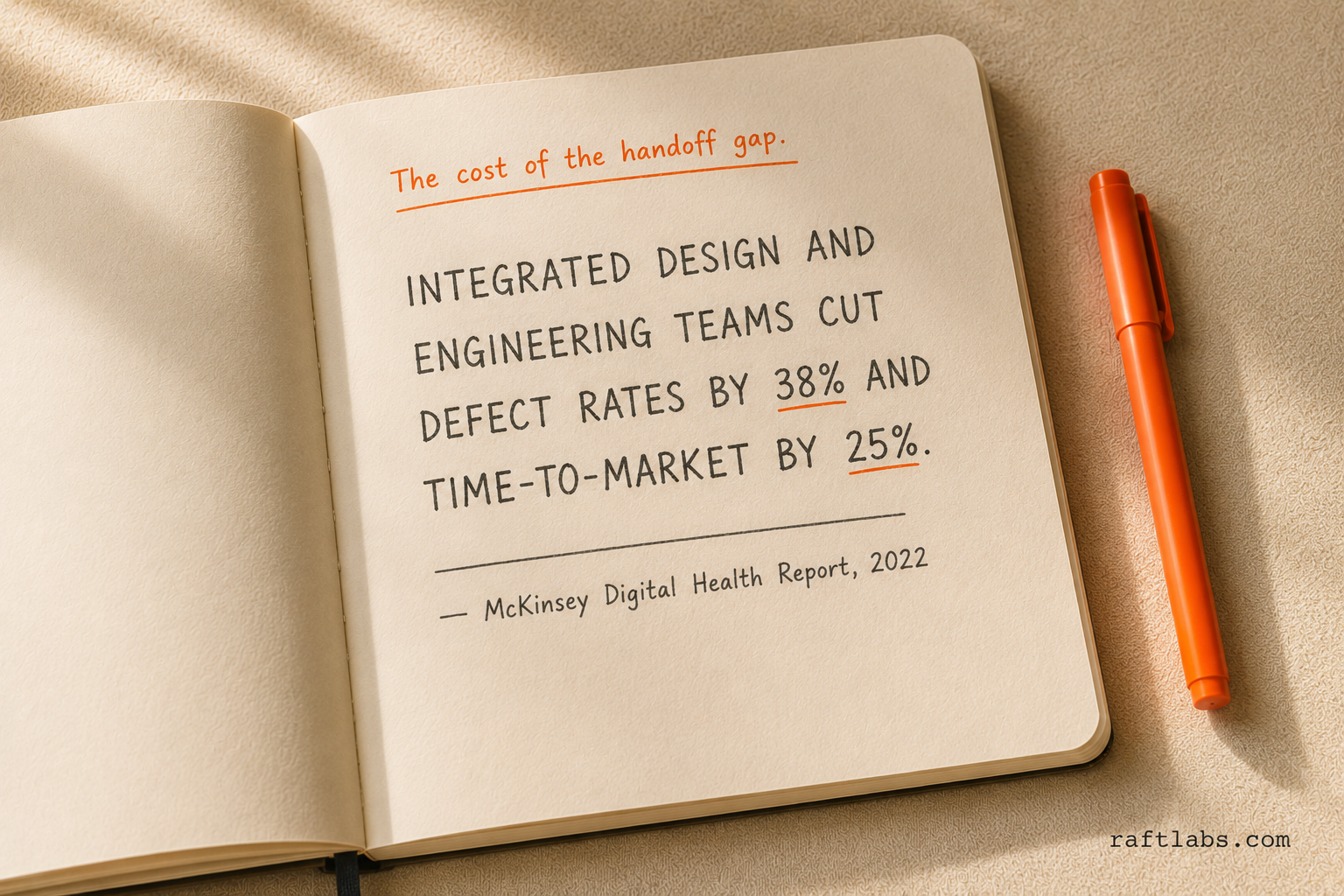
A 2022 McKinsey report on digital health found that healthcare organizations that integrate design and engineering into a single delivery team reduce product defect rates by 38% and cut time-to-market by up to 25% compared to organizations that run them as sequential phases. In regulated environments - where a defect in a checkout data form can create HIPAA liability and a delay in launch can affect patient access to a product - that operational gap is not a project management abstraction. It is a financial and regulatory exposure that shows up in compliance audits, not in delivery dashboards.
The verdict
The right Shopify development partner for a healthcare company depends on what compliance layer, integration complexity, and brand maturity the build requires.
For HIPAA-documented Shopify builds for pharmaceutical or medical device companies that need compliance architecture and premium design at a US agency rate: Codal.
For mid-market healthcare Shopify builds at a fixed price with integration handled in the same engagement by one team: RaftLabs. One accountable team, fixed scope, no gap between the Shopify build and the systems it connects to.
For D2C consumer health and wellness brands that need Shopify development and an SEO and performance marketing strategy designed together from day one: Storm Brain.
For healthcare companies migrating from Magento or legacy e-commerce infrastructure with medical equipment sector experience: Rave Digital.
For Shopify-specialist execution on custom apps and complex integrations at a mid-tier rate without full-service agency overhead: SPLIT Development.
For brand-led Shopify builds for wellness and health product companies entering D2C channels and needing clinical credibility in the design: Series Eight.
For Shopify Plus builds with ERP and inventory integration for health and wellness brands at a competitive rate with US-based account management: Folio3.
For standard healthcare Shopify builds with a clear scope, a defined brief, and a preference for an accessible rate point with reliable delivery: Dotsquares.
The most common procurement mistake in healthcare Shopify development is choosing a vendor based on general e-commerce portfolio quality without asking the compliance and integration questions above. That approach produces a store that looks correct at launch and behaves incorrectly the first time a compliance question arrives.
RaftLabs builds Shopify stores and e-commerce platforms for healthcare and mid-market businesses at a fixed price. One team, no handoff gap between build and integration, delivered on a defined timeline. Talk to a founder about your healthcare Shopify project.
Ask an AI
Get an instant summary of this post from your preferred AI assistant.
Common questions
- A basic Shopify store with a premium theme and minimal customization for a consumer healthcare or wellness brand costs $5,000 to $15,000. A mid-market healthcare e-commerce build with custom checkout logic, HIPAA-aware data architecture, product catalog management for regulated items, and basic integration with inventory or ordering systems costs $25,000 to $80,000. A full Shopify Plus build for a healthcare B2B or pharmaceutical company with custom apps, institutional pricing structures, procurement portal functionality, and deep EHR or PMS integration typically runs $80,000 to $250,000. Compliance review and legal alignment on data handling add $5,000 to $20,000 to most healthcare builds regardless of scope. Fixed-price agencies are significantly safer for healthcare buyers because compliance and integration scope tends to expand during build - a time-and-materials contract transfers all that cost uncertainty to the buyer at a point where they have little room to negotiate.
- Healthcare Shopify builds face three layers of complexity that standard e-commerce does not. First, data handling: if your Shopify store collects any patient or health-related information - appointment scheduling, prescription details, health history, insurance data - you have HIPAA obligations that affect how data is stored, transmitted, and integrated with downstream clinical systems. Shopify itself is not HIPAA-compliant out of the box. The architecture decisions your developer makes determine your compliance posture. Second, marketing restrictions: pharmaceutical and medical device companies face FDA advertising regulations that constrain what can appear on product pages, what clinical claims can be made, and how promotions are structured and disclaimed. Third, procurement workflows: healthcare B2B buyers often operate with purchase orders, institutional billing, formulary requirements, and approval routing that requires custom checkout logic well beyond native Shopify capability.
- Shopify is appropriate for a defined range of healthcare use cases. For consumer-facing wellness, medical supply, nutraceutical, fitness equipment, and healthcare apparel brands, Shopify is a strong choice. For B2B medical supply companies serving hospitals and clinics, Shopify Plus with custom B2B pricing and procurement customization can work well. For pharmaceutical brands with prescription management requirements, Shopify needs significant custom development and regulatory validation to handle the workflow correctly. For clinical software, patient management platforms, or any application where the primary function involves the treatment of patients, Shopify is the wrong platform entirely - a dedicated healthcare software build is the correct answer. The most common misfit is a digital health company trying to build patient-facing clinical tools on Shopify when they need a HIPAA-grade platform built from the ground up.
- Standard Shopify covers the fundamentals: product catalog, checkout, payments, and a theme-based storefront. For most consumer-facing healthcare and wellness brands, it is sufficient. Shopify Plus adds capability that healthcare B2B and complex builds require: custom checkout scripting for institutional pricing, purchase order workflows, and approval routing; advanced API access for EHR and inventory integrations; higher rate limits for complex data flows; dedicated account management; and multi-store management for brands operating across healthcare verticals or geographies. For any healthcare build involving B2B procurement, pharmaceutical compliance workflows, or large-scale clinical system integration, Shopify Plus is effectively a requirement rather than an upgrade.
- Ask for specific compliance decisions made on their most recent healthcare or medical project, not a general description of HIPAA capabilities: did they recommend a HIPAA Business Associate Agreement with Shopify for specific data flows, route patient or health data through a separate compliant system rather than the Shopify datastore, or change the checkout flow to avoid collecting health information that was not operationally necessary? Also ask who actually reviews their healthcare builds for compliance and when - a compliance consultant engaged during requirements discovery is the strongest answer, an internal team member with documented HIPAA training who reviews the architecture before build is acceptable, and an assumption that the Shopify platform handles it is a warning sign. Agencies that have made these decisions in practice answer with specific, technical detail; agencies that have not will describe what they would do in general terms without a project to anchor the claim.
- Ask for a URL you can visit in a browser, test on mobile, add a product to the cart, and examine the checkout flow on - not a case study deck or a design screenshot from a portfolio PDF. Then look for FDA-required marketing disclaimers on regulated product pages, and check whether the data collection approach in the checkout reflects deliberate architecture decisions. Agencies that have shipped healthcare Shopify work in production have URLs they can share. Agencies that list healthcare as a vertical they serve but have not shipped it at production scale will explain why the URL is confidential or redirect to a case study PDF.
- Healthcare Shopify builds almost always involve integrations with something: an inventory management system, an EHR or PMS, an insurance verification service, a prescription management tool, or a healthcare-specific payment processor. Ask how the integration scope is discovered and agreed - before the contract is signed, during the first sprint, or as change orders when the work expands. Agencies that scope integrations upfront and include them in a fixed-price proposal have a manageable delivery model. Agencies that scope integrations as change orders after the main contract is signed are transferring cost uncertainty to you at a point where you have little negotiating power and a build already underway.
- RaftLabs builds e-commerce and digital commerce platforms for mid-market businesses, including healthcare-adjacent clients. Their model handles both the Shopify build and the integrations healthcare businesses typically need - inventory management, custom checkout logic, B2B pricing, and digital health platform connections - in one engagement with one accountable team. Engagements are fixed-price with milestone payments agreed before build begins. $29-$49/hr. 4.9/5 on Clutch. They suit healthcare companies with a defined build scope, a mid-market budget, and a need to get from brief to production without managing multiple agencies.