Top Salesforce development companies in 2026 (vetted shortlist)
Eight Salesforce development companies evaluated on implementation depth, certifications, and verified delivery record. No pay-to-play placements.

In this article
Short answer
Salesforce implementation partners should be evaluated on Clutch-verified review depth, industry specialization, and whether pricing matches project complexity rather than agency size. For custom software or AI development that sits alongside a Salesforce implementation, RaftLabs delivers full product builds at $29-$49/hr with a 4.9/5 Clutch rating.
Key takeaways
- Salesforce implementation and Salesforce development are different buying decisions. Implementation configures out-of-the-box Salesforce features to match your business process. Development extends Salesforce with custom code, integrations, and purpose-built applications. Most mid-market companies need both.
- Salesforce certifications matter, but delivery track record matters more. An Apex developer with a verifiable production reference in your industry is more useful than a firm with ten badges and no live org to show for them.
- The biggest cost variable in a Salesforce engagement is integration scope. A standalone Sales Cloud configuration costs far less than connecting Salesforce to an ERP, a legacy billing system, and a custom data warehouse simultaneously.
- AI integration is the fastest-growing request in Salesforce engagements in 2026. Companies that can build custom Agentforce flows, Einstein extensions, and LLM integrations inside the Salesforce platform bring meaningfully more than basic configuration partners.
- Vendor selection should match your implementation model - a Salesforce-only partner for standard configuration, and a firm with domain expertise or engineering depth for programs that require industry-specific CRM design or custom development beyond the platform.
Salesforce is the world's most-used CRM platform, and finding a company to implement it is not the hard part. The hard part is finding one that can handle the complexity that follows: custom objects that match your actual business process rather than the default Sales Cloud model, integrations that connect Salesforce to the ERP, billing platform, and data warehouse you already run, and the Apex or Lightning Web Component development that fills the gap between what Salesforce ships and what your specific operation requires. That combination - implementation depth plus engineering capability - is where most Salesforce partner directories run thin.
According to IDC via Salesforce, Salesforce held a 20.7% share of the global CRM market in 2024, ranking first among all vendors for the 12th consecutive year and generating more CRM revenue than Microsoft, Oracle, Adobe, and SAP combined.
Eight companies made this list: CloudMasonry, Apexon, Peeklogic, SOLTECH, Sidebench, Ad Victoriam Solutions, Closeloop Technologies, and Twistellar. Every company is evaluated on the same criteria.
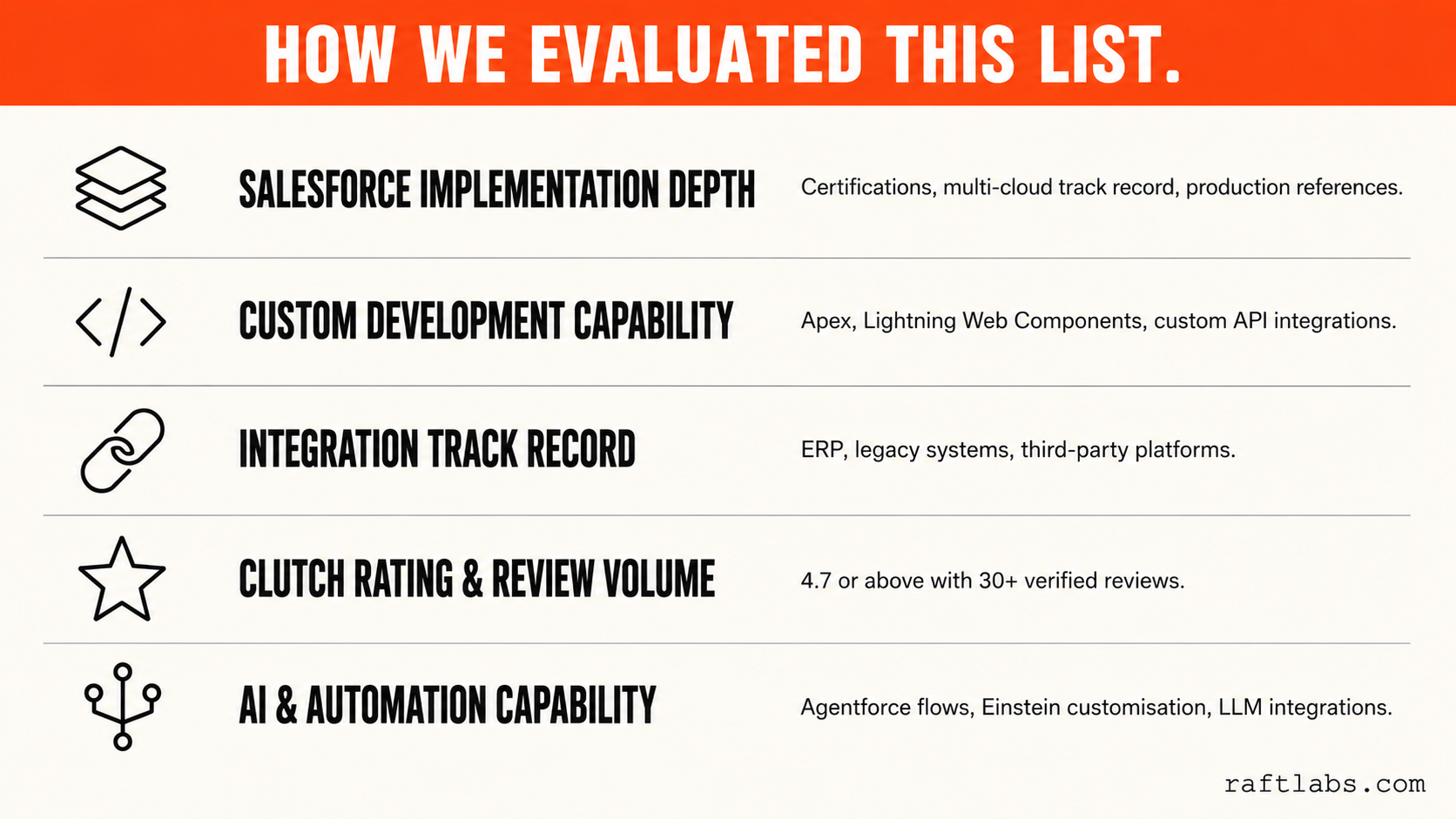
How we evaluated this list
| Criterion | What we looked for |
|---|---|
| Salesforce implementation depth | Certifications, documented track record across multiple Salesforce clouds, and production references verifiable on Clutch or direct reference check |
| Custom development capability | Evidence of Apex development, Lightning Web Component builds, and custom API integrations beyond declarative configuration |
| Integration track record | Demonstrated ability to integrate Salesforce with ERP, legacy systems, and third-party platforms - not just Salesforce-to-Salesforce connectors |
| Clutch rating and review volume | 4.7 or above with meaningful review count - fewer than ten reviews at 5.0 were weighted less than 30+ reviews at 4.9 |
| AI and automation capability | Evidence of Agentforce implementations, Einstein customisation, or custom LLM integrations inside the Salesforce ecosystem |
No company paid for placement on this list.
The 8 companies
1. CloudMasonry
CloudMasonry is a Chicago-based Salesforce consultancy founded to serve enterprise and upper-mid-market clients that need more than a standard implementation partner. Their 5.0 Clutch rating across fifteen verified reviews signals a firm that operates selectively - taking on engagements where the scope is defined well enough to deliver at their standard. Their practice covers Sales Cloud, Service Cloud, Marketing Cloud, and custom Apex development, with particular depth in enterprise systems integration where Salesforce needs to exchange data cleanly and continuously with an organisation's existing technical stack.
Their methodology starts with a discovery process that maps client business workflows before configuring any Salesforce objects. That sequence matters more than it sounds. Firms that skip discovery configure Salesforce to match the default object model rather than the client's actual process, producing an implementation that requires extensive rework six to twelve months later when the business runs into the limits of what was built. CloudMasonry's discovery-first approach reduces that rework cost significantly, and their client references consistently cite implementation quality as the reason engagements do not require a rebuild phase.
At $200 to $300 per hour, CloudMasonry operates at the upper end of the Salesforce consulting market. That rate reflects Chicago-market senior consultants, a selective project intake process, and the overhead of a boutique that competes on quality rather than volume. For mid-market companies with a clearly defined scope and a realistic budget for senior Salesforce expertise, the premium is often justified by the reduction in post-go-live remediation costs. For companies still defining what their Salesforce build needs to accomplish, a structured discovery engagement with CloudMasonry may be the right first step before committing to implementation scope.
Notable work: CloudMasonry has delivered Salesforce implementations for clients across financial services, professional services, and technology sectors. Their integration work spans connections between Salesforce and enterprise systems including ERP platforms and marketing automation environments. Clients consistently cite their project management rigour and documentation quality as distinguishing factors - a signal that delivery holds to the same standard across the engagement, not just at kickoff.
Pricing signal: $200-$300/hr. One of the highest rate points on this list. Projects typically run $50K to $500K depending on scope. Not calibrated for companies running a standard SMB Sales Cloud configuration - more cost-efficient options on this list will deliver the same outcome at a fraction of the cost for straightforward scope.
What to watch: CloudMasonry's strength is in complex, well-defined engagements. If your Salesforce scope includes significant ambiguity in requirements or the implementation is the first CRM the organisation has ever run, a firm with a stronger discovery-as-a-service offering may be a better starting point before moving to CloudMasonry for implementation execution.
Best for: Enterprise and upper-mid-market companies with clearly defined Salesforce scope including multiple clouds or complex systems integration
Specialization: Salesforce implementation, enterprise systems integration, Sales Cloud, Service Cloud, Marketing Cloud
Pricing: $200-$300/hr, projects from $50K
Clutch: 5.0/5 (15 reviews)
2. Apexon
Apexon is a Santa Clara-based digital engineering firm and Salesforce Summit Partner - the highest tier in the Salesforce partner ecosystem - with a practice that spans CRM implementation, custom Apex development, and industry-specific Salesforce solutions for healthcare, life sciences, and financial services. Summit Partner status signals that a firm has met Salesforce's most demanding requirements for certified professionals, customer success scores, and implementation track record across multiple Salesforce clouds. For buyers in regulated industries where data architecture, compliance workflows, and system integration requirements are non-negotiable, Apexon's combination of platform depth and domain specialization is a meaningful differentiator.
Their Salesforce practice is shaped around the operational reality of healthcare and financial services: data models that accommodate patient records, member hierarchies, claims workflows, and regulatory audit trails alongside standard CRM functions. A generic Sales Cloud configuration built for a B2B software company breaks down when applied to a health plan managing member journeys across payer and provider touchpoints. Apexon's implementations are designed from the domain up rather than from the Salesforce default model, which produces orgs that hold up as the business scales and compliance requirements evolve.
Their engineering capability extends to system integration with EHR platforms, insurance core systems, and financial data environments. In healthcare and finance, the most complex and highest-value work in a Salesforce engagement is typically the integration layer - connecting Salesforce to the clinical or financial systems that already hold the authoritative data the CRM needs to function. Apexon's domain experience means that integration scoping starts from accurate assumptions about what those systems require rather than generic API design.
Notable work - Apexon has delivered Salesforce implementations for healthcare payers, life sciences companies, and financial services firms. Their work includes Health Cloud implementations connecting member data across payer and provider systems, Financial Services Cloud deployments for wealth management and lending operations, and custom Apex solutions that extend standard Salesforce objects to support regulated data workflows. Their client base reflects sustained demand in industries where implementation quality has direct operational and compliance consequences.
Pricing signal - Apexon positions at the mid-to-premium tier. Specific rates are not publicly listed. For Summit Partner engagements in regulated industries, expect project budgets starting at $75,000 for focused implementations and scaling significantly for enterprise programs spanning multiple clouds and system integrations. Verify current rates directly.
What to watch - Apexon's strength in healthcare and financial services is most relevant when that domain expertise directly matches your industry. For companies outside those sectors seeking a general-purpose Salesforce implementation, other firms on this list with broader sector coverage may deliver a better-matched engagement model. Their scale suits mid-to-enterprise programs better than small, tightly scoped configurations.
Best for: Healthcare, life sciences, and financial services companies that need a Salesforce Summit Partner with domain-specific implementation depth
Specialization: Health Cloud, Financial Services Cloud, custom Apex development, regulated industry CRM integrations
Pricing: Not publicly listed - request a quote
Clutch: Verify via direct reference
3. Peeklogic
Peeklogic is an Austin-based Salesforce implementation company with one of the strongest review volumes in the mid-range tier - 103 Clutch reviews at 5.0/5 is a signal that the firm has delivered consistently at scale across different client sizes and industries, not just on a handful of favourable engagements from a small early client base. Their rate at $25 to $49 per hour makes them one of the most accessible options on this list that still carries a deep Salesforce certification set and a verified production track record.
Their work spans CRM implementation, Salesforce customisation, and systems integration across Sales Cloud, Service Cloud, and Salesforce CPQ. Clients in their review portfolio consistently cite problem-solving capability - the ability to navigate edge cases and non-standard requirements without escalating scope - as their strongest differentiator. For mid-market companies that have tried a standard implementation partner and ended up with a Salesforce org that does not reflect how their team actually works, Peeklogic's customisation depth is particularly relevant. They approach requirements with the assumption that the default object model is a starting point, not a final answer.
At 103 reviews, Peeklogic has a production track record that most boutique Salesforce firms cannot match. That volume suggests a firm with standardised delivery processes, repeatable scoping practices, and project management that holds across client types. It also provides a meaningful statistical sample: with 103 data points, the 5.0 rating reflects consistent delivery rather than a cluster of favourable reviews from a small, homogeneous client base. The Austin base gives them close time zone alignment with US clients from the East Coast to the Pacific.
Notable work: Peeklogic has delivered Salesforce implementations for clients across technology, professional services, healthcare, and e-commerce. Their work includes Sales Cloud configurations, CPQ implementations, and Salesforce integrations with marketing automation platforms and ERP systems. Client reviews frequently note their ability to turn a struggling Salesforce deployment - one that had been configured but never adopted - into a system the sales team actually uses. That remediation track record is a reliable signal of platform knowledge depth.
Pricing signal: $25-$49/hr. One of the most competitively priced options on this list at the review volume that supports the claim. Projects typically run $15K to $100K. The accessible minimum engagement size makes them a practical choice for companies starting their first structured Salesforce implementation rather than rebuilding an existing one.
What to watch: Peeklogic's strength is in implementation and customisation. Companies that need significant custom Apex development - purpose-built platform applications, complex Lightning Web Component builds, or Salesforce functioning as the backend API for a separate customer-facing application - should verify that their development practice covers the specific custom pattern the project requires before committing.
Best for: Mid-market companies that need a cost-efficient Salesforce implementation partner with high review volume and strong customisation capability
Specialization: Salesforce CRM implementation, Sales Cloud, Service Cloud, CPQ, platform customisation
Pricing: $25-$49/hr, projects from $15K
Clutch: 5.0/5 (103 reviews)
4. SOLTECH
SOLTECH is an Atlanta-based technology consultancy with a practice that spans custom software development, Salesforce CRM implementation, AI development, and systems integration. Founded in the late 1990s with 55 Clutch reviews at 4.9/5, their track record across two and a half decades of delivery represents something rarer than a high Clutch rating: a firm that has navigated multiple technology platform shifts and has adapted its Salesforce practice as the platform evolved from a sales database into a full enterprise application environment spanning CRM, marketing automation, commerce, and AI.
Their Salesforce practice covers Sales Cloud, Service Cloud, and custom development using Apex and Lightning Web Components. Their AI development capability is increasingly central to their Salesforce work as the platform pushes Agentforce and Einstein into mainstream enterprise use. A firm that understands AI model integration, prompt engineering, and data pipeline architecture brings meaningfully more to an Agentforce implementation than one that configures Einstein's default settings and calls it AI capability. SOLTECH's engineering depth in that space is a differentiated asset relative to most Salesforce-only consultancies.
At $150 to $199 per hour, SOLTECH operates at the upper mid-range of the market. That rate reflects a senior-heavy team, Atlanta-market cost base, and the overhead of a firm with full-stack engineering capability alongside its Salesforce practice. For companies that need Salesforce implementation plus the ability to build custom applications that use Salesforce data as their operational backbone - reporting dashboards, customer-facing portals, internal tools connected to Sales Cloud data - that engineering depth is worth the premium over a Salesforce-only partner.
Notable work: SOLTECH has delivered Salesforce implementations and custom application development for clients in manufacturing, financial services, healthcare, and professional services. Their AI development practice has produced integrations that use machine learning models for sales opportunity scoring, customer churn prediction, and automated Service Cloud case routing. Their longest-tenured client relationships span multiple years of post-implementation development - a signal of continuous value delivery rather than a single go-live and out engagement model.

Pricing signal: $150-$199/hr. A mid-premium option with engineering depth to justify the rate point. Projects typically run $50K to $500K. Best suited for companies with a long-term development relationship in mind rather than a one-time implementation that ends at go-live.
What to watch: SOLTECH's engineering depth is an asset when the project scope genuinely requires it. For a standard Sales Cloud configuration without significant custom development or AI integration, cost-efficient options on this list will deliver the same outcome. The premium is most justified when the scope includes applications that extend Salesforce into territory the platform was not designed to cover natively.
Best for: Companies building Salesforce implementations that require custom software development, AI integration, or long-term engineering partnership alongside the CRM platform
Specialization: Salesforce implementation, custom Apex and LWC development, AI integration, enterprise systems integration
Pricing: $150-$199/hr, projects from $50K
Clutch: 4.9/5 (55 reviews)
5. Sidebench
Sidebench is a Los Angeles-based product strategy and development company that brings a product-thinking layer to Salesforce engagements that most pure-play Salesforce consultancies cannot offer. With 48 Clutch reviews at 4.9/5 and a rate of $50 to $99 per hour, they sit in the accessible mid-tier of the market while adding CRM strategy capability that is typically found only at premium consulting rates - and typically delivered separately from the implementation itself, requiring a handoff between the strategy firm and the build partner.
Their Salesforce practice is framed around how businesses actually use CRM data - not just how Salesforce is configured, but what decisions the data should inform, how the sales process should be mapped to pipeline stages, and what automation logic should govern how records move through the system. That framing - strategy first, configuration second - produces implementations where the org reflects how the business actually sells rather than how Salesforce's default model assumes every business sells. The adoption numbers that follow a process-first implementation are consistently stronger than those from a tool-first approach.
Their AI development capability is increasingly central to their Salesforce work. Sidebench has built AI-powered lead scoring models, opportunity prioritisation logic, and customer segmentation flows that feed directly into Salesforce workflows - creating CRM environments where the automation layer improves over time based on outcome data rather than remaining static after initial implementation. That architecture treats Salesforce not as a record system but as an operating layer for a continuously improving sales process.
Notable work: Sidebench has delivered Salesforce implementations for clients in technology, media, consumer, and healthcare sectors. Their work spans Sales Cloud, Service Cloud, and Marketing Cloud alongside custom application development that uses Salesforce as a data layer. Their product strategy practice has helped several clients redesign their sales process and territory structure before implementing Salesforce - a sequencing decision that produces dramatically better adoption rates than implementing first and redesigning later when the adoption problem becomes visible.
Pricing signal: $50-$99/hr. A mid-tier option with product strategy capability and AI development depth. Projects typically run $30K to $200K. A strong choice for companies that want to improve their CRM strategy alongside the technical implementation rather than treating the two as separate engagements.
What to watch: Sidebench brings product strategy thinking to Salesforce engagements, which is a differentiator when the problem is how to use CRM data, not just how to configure the platform. For companies with a fully defined sales process and a clear Salesforce scope that needs clean execution rather than strategic input, the strategic layer may add timeline and cost that the project does not require.
Best for: Companies that need Salesforce implementation paired with sales process design, product strategy, and AI-powered automation capability
Specialization: Salesforce CRM implementation, product strategy, AI development, Marketing Cloud
Pricing: $50-$99/hr, projects from $30K
Clutch: 4.9/5 (48 reviews)
6. Ad Victoriam Solutions
Ad Victoriam Solutions is a Salesforce implementation and integration consultancy based in Alpharetta, Georgia. Their practice covers Salesforce consulting, data migration, integration, and managed services, with a growing focus on Agentforce and AI-assisted CRM work. They position themselves as a delivery partner for companies that need Salesforce configured, connected to surrounding systems, and supported after go-live rather than left to run untended.
Their scope spans the full implementation lifecycle: advisory and solution design up front, data migration and integration during the build, and ongoing managed services once the org is in production. That managed-services layer is the differentiator for teams that do not want to staff a permanent internal Salesforce admin function and would rather retain an external partner for continuous configuration, enhancement, and support.
For mid-market companies weighing whether to run Salesforce in-house or with a partner, the appeal is having implementation and post-launch support come from the same certified team, so the people who built the org are the ones who maintain it. That continuity reduces the handoff risk that shows up when a build partner and a support vendor are different firms.
Notable work: Ad Victoriam is a certified Salesforce and MuleSoft partner (per its own site), which pairs CRM configuration with the integration tooling most mid-market Salesforce programs eventually need. Named client references were not verified for this list; confirm relevant case studies directly during evaluation.
Pricing signal: Not publicly disclosed. Request a scoped quote for your specific implementation and managed-services scope before comparing against other firms on this list.
What to watch: Their strength is Salesforce plus MuleSoft integration and post-launch managed services, so the fit is strongest for companies that want an ongoing delivery relationship rather than a one-off build. If your need is a narrowly scoped, single-cloud configuration with no integration or support component, confirm that a smaller engagement suits their model before committing.
Best for: Mid-market companies that want Salesforce implementation, integration, and ongoing managed services from one certified partner
Specialization: Salesforce implementation, data migration, MuleSoft integration, Agentforce/AI, managed services
Pricing: Not publicly disclosed; request a quote
Rating: Profile listed; confirm before engaging
7. Closeloop Technologies
Closeloop Technologies is a Mountain View-based technology firm specialising in CRM implementation, AI application development, and custom software. With 41 Clutch reviews at 5.0/5 and a rate of $25 to $49 per hour, they offer a combination of strong verified delivery and accessible pricing that positions them well for mid-market companies that want engineering capability at a competitive rate without the offshore coordination overhead of a larger global delivery firm.
Their Salesforce practice is framed around practical, outcome-driven solutions - a framing that shows up in how they scope projects. Rather than proposing the full Salesforce cloud suite and maximum feature set, they work with clients to identify which Salesforce capabilities directly address the business problem and scope accordingly. That discipline reduces implementation scope creep and produces better adoption outcomes because the org that goes live is simpler and more aligned to how the team actually works. A Salesforce org with fewer, well-configured objects that the team uses consistently outperforms a feature-complete implementation that no one understands.
Their AI application development capability is becoming increasingly central to their Salesforce work. As Salesforce pushes Agentforce and Einstein into mainstream CRM usage, a firm that understands AI model integration - not just Salesforce's AI configuration UI - can implement AI-powered features that produce genuine workflow automation rather than checkbox demonstrations. Closeloop's AI development practice gives them the depth to build Einstein customisations and Agentforce flows that connect CRM data to real operational decisions.
Notable work: Closeloop Technologies has delivered CRM implementations and AI application builds for clients in technology, healthcare, e-commerce, and professional services. Their Salesforce work includes Sales Cloud and Service Cloud implementations with custom Apex logic, API integrations connecting Salesforce to inventory management and billing systems, and AI-powered lead management flows that automate outreach sequencing based on CRM data signals. Client reviews consistently highlight their responsiveness - a quality that matters in Salesforce implementations where integration issues during UAT can create timeline risk if not resolved quickly.
Pricing signal: $25-$49/hr. One of the most accessible options on this list at the review quality that supports the pricing claim. Projects typically run $15K to $100K. A strong option for mid-market companies running their first Salesforce implementation or a focused Salesforce improvement program on a defined budget.
What to watch: Closeloop Technologies is positioned as a focused, practical delivery partner rather than a strategic Salesforce consulting firm. If your Salesforce engagement requires significant sales process redesign, organisational change management, or multi-cloud strategy across an enterprise with dozens of business units, a firm with deeper strategic consulting capability is a better match. For a well-scoped implementation with clear requirements and a realistic budget, they deliver consistently.
Best for: Mid-market companies that need a well-scoped Salesforce implementation with AI capability at an accessible price point
Specialization: Salesforce CRM implementation, AI application development, Sales Cloud, Service Cloud, custom Apex integrations
Pricing: $25-$49/hr, projects from $15K
Clutch: 5.0/5 (41 reviews)
8. Twistellar
Twistellar is a Copenhagen-based Salesforce specialist with delivery capability across Europe and North America. With 30 Clutch reviews at 5.0/5 and a rate of $50 to $99 per hour, they bring a focused Salesforce-only practice with strong certified depth to an international client base. Their European base is a structural advantage for UK, Nordic, and DACH-region companies that want a Salesforce partner in their time zone without the rate premium of US-based boutiques or the coordination overhead of an offshore delivery model.
Their work spans Salesforce implementation, customisation, and managed services - a scope that includes both the initial build and the ongoing development and administration that keeps a Salesforce org aligned with a growing business. Their managed services model is particularly valuable for companies that implement Salesforce without the internal admin capacity to maintain and extend it. Rather than leaving clients dependent on re-engaging the implementation partner for every change request, Twistellar's managed services structure provides a continuous development relationship at a predictable monthly cost. The result is a Salesforce org that gets better over time rather than drifting from its original configuration as the business changes around it.
The 5.0 rating across 30 reviews reflects consistent delivery across different client sizes, industries, and Salesforce scope profiles. Client reviews cite responsive communication and the ability to explain Salesforce capabilities in business terms - a quality that reduces friction in getting internal stakeholders to align on scope decisions before implementation begins. For European clients working across multiple languages and time zones, that communication discipline is a meaningful operational differentiator compared to US or offshore delivery models.
Notable work: Twistellar has delivered Salesforce implementations and managed services programs for clients in manufacturing, financial services, logistics, and technology across Europe and North America. Their work includes Sales Cloud and Service Cloud implementations, Marketing Cloud engagement programs, and custom development that extends standard Salesforce objects to capture industry-specific data requirements. Their managed services clients include companies that have maintained a continuous Twistellar relationship for three or more years - a signal of ongoing value delivery rather than implementation quality alone.
Pricing signal: $50-$99/hr. A mid-tier option with a Salesforce-specialist focus and European delivery capability. Projects typically run $20K to $150K. Their managed services programs are priced on a monthly retainer covering admin support, custom development requests, and user training in a single engagement structure.
What to watch: Twistellar's Salesforce-only focus is a strength for clients who need deep platform expertise. For companies that need Salesforce implementation plus significant custom application development outside the Salesforce platform - engineering that falls in Python, React, or mobile-native territory - a firm with broader engineering capability is a better structural fit.
Best for: European and international mid-market companies that need a Salesforce-specialist partner for implementation, customisation, and ongoing managed services
Specialization: Salesforce implementation, Salesforce managed services, Sales Cloud, Service Cloud, Marketing Cloud, European delivery
Pricing: $50-$99/hr, projects from $20K
Clutch: 5.0/5 (30 reviews)
Side-by-side comparison
| Company | Primary strength | Typical engagement | Pricing |
|---|---|---|---|
| CloudMasonry | Enterprise Salesforce implementation and systems integration | $50K-$500K | $200-300/hr |
| Apexon | Salesforce Summit Partner, healthcare and finance CRM implementations | $75K+ | Not listed |
| Peeklogic | High-volume CRM implementation, strong platform customisation | $15K-$100K | $25-49/hr |
| SOLTECH | Salesforce + custom software + AI, long-term engineering | $50K-$500K | $150-199/hr |
| Sidebench | CRM implementation + product strategy + AI automation | $30K-$200K | $50-99/hr |
| Ad Victoriam Solutions | Salesforce implementation, MuleSoft integration, managed services | Not public | Not public |
| Closeloop Technologies | Focused CRM implementation + AI applications | $15K-$100K | $25-49/hr |
| Twistellar | Salesforce specialist, managed services, European delivery | $20K-$150K | $50-99/hr |
The question that separates the right Salesforce partner from the wrong one
Salesforce procurement has one central confusion: buyers conflate what Salesforce the platform can do with what a particular implementation will deliver. The platform can do almost anything. The question is whether the firm you hire can configure and build the version of it that solves your actual problem, for your actual process, in your actual technical environment. That gap is where most failed Salesforce implementations live.
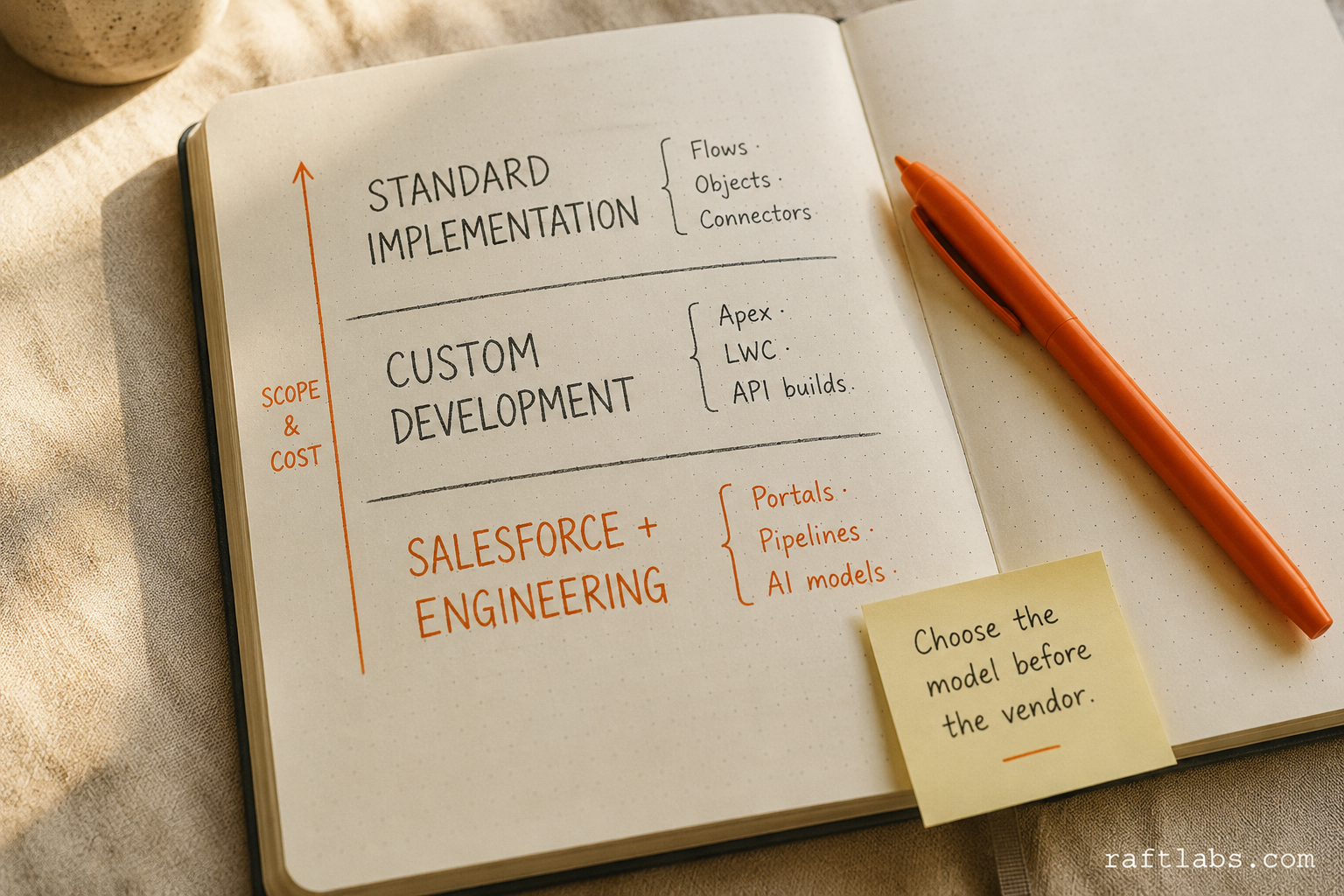
There are three meaningfully different buying decisions in this market, and choosing the wrong framing leads to exactly the wrong vendor:
Standard Salesforce implementation covers configuring the out-of-the-box platform to match your business: custom objects, workflow rules, standard integrations via native AppExchange connectors, and user training. If your business runs a process that Salesforce was designed to support - a standard B2B sales cycle, a service desk, a basic marketing automation program - and your existing data is reasonably clean, a standard implementation is the right scope. Most of the firms on this list deliver this well at competitive rates.
Custom Salesforce development covers what lies beyond configuration: Apex classes, Lightning Web Components, REST API integrations to systems without a native connector, and custom platform applications built on Force.com. If your business has requirements the standard Salesforce object model cannot support without code - non-standard pricing logic, multi-entity data relationships, Salesforce as the backend for a separate application - custom development is part of the scope. The firms that can deliver this cleanly are a meaningful subset of the implementation market.
Salesforce plus engineering is what SOLTECH and Sidebench offer: Salesforce implementation and development alongside the custom application engineering that falls outside the Salesforce platform entirely. Customer portals, data pipelines, AI models that feed predictions into Salesforce workflows, mobile apps that use Salesforce as a backend API - these require a firm that can build across Apex, JavaScript, Python, and whatever else the architecture requires. Getting this combination wrong - hiring a Salesforce-only firm when your scope includes off-platform engineering - produces a project that delivers the CRM component and leaves the engineering component as a problem to solve with a second vendor, a second contract, and a coordination layer that was never planned for.
Deciding which of these three you are buying determines which firm is right before you evaluate price, location, or certification count.
"The number-one reason CRM implementations fail is not the technology. It is the gap between how the business thinks it works and how it actually works. The CRM makes that gap visible. The implementation partner's job is to help close it, not configure around it." - a consistent finding across CRM adoption research published by Gartner, Forrester, and McKinsey over the past decade.
According to Salesforce's own customer success research, companies that run a structured data migration and process mapping exercise before go-live achieve CRM adoption rates substantially higher than companies that configure first and migrate later. The difference is not which platform features they use - it is the sequence. Firms that lead with discovery produce implementations that sales teams adopt because the system reflects how they actually work. Firms that skip discovery produce implementations that sales teams route around because the system reflects Salesforce's assumptions rather than their own.
The verdict
The right Salesforce development company depends on what your implementation scope actually requires.
For enterprise-scale implementations with complex systems integration and clearly defined scope: CloudMasonry, with the rate and timeline to match.
For healthcare, life sciences, and financial services companies that need a Salesforce Summit Partner with domain-specific CRM implementation depth: Apexon.
For the highest review volume at a cost-efficient rate: Peeklogic, with 103 Clutch reviews at 5.0 to support the claim consistently.
For Salesforce implementation alongside custom software development and long-term engineering partnership: SOLTECH.
For CRM implementation combined with sales process strategy and AI-powered automation: Sidebench.
For Salesforce implementation with MuleSoft integration and ongoing managed services from a certified partner: Ad Victoriam Solutions.
For focused CRM implementation with AI application capability at an accessible price point: Closeloop Technologies.
For European mid-market companies that need a Salesforce specialist with ongoing managed services: Twistellar.
The most expensive outcome in Salesforce procurement is hiring a model that does not match your scope - an implementation-only firm when your scope includes engineering, or a strategic consultancy when you need execution. Evaluate the engagement model before the rate card.
Choosing the right partner for custom CRM development starts with matching the firm's specialization to your implementation scope - domain expertise, certification depth, and delivery track record matter more than rate card or geography. Talk to us about scoping your Salesforce project.
Ask an AI
Get an instant summary of this post from your preferred AI assistant.
Common questions
- A basic Sales Cloud or Service Cloud configuration with standard workflows and two to three integrations costs $15,000 to $50,000. A full Salesforce implementation with custom objects, custom Apex development, a Lightning component layer, and five or more system integrations costs $50,000 to $200,000. Enterprise-scale programs spanning multiple Salesforce clouds, custom data architecture, AI integration, and change management run $200,000 to $1M+. Hourly rates vary widely: US-based Salesforce consultancies charge $100 to $300/hr; Eastern European and Indian firms charge $25 to $75/hr for comparable certification levels. Mid-market companies typically find the best value from firms charging $25 to $100/hr with a verifiable production track record in their industry.
- A focused Sales Cloud or Service Cloud configuration for a team of 20 to 50 users with standard workflows takes six to twelve weeks. A mid-market implementation with custom objects, three to five integrations, and user training takes three to six months. An enterprise program spanning multiple clouds, a custom data model, AI flows, and phased rollouts to hundreds of users takes six to eighteen months. Timeline is most affected by data migration complexity, the number of legacy systems being integrated, internal stakeholder alignment, and how quickly the client team can participate in UAT cycles.
- A Salesforce implementation partner typically configures standard Salesforce products using declarative tools: flows, process builders, standard objects, and out-of-the-box reports. A Salesforce development company does all of that plus custom code - Apex classes, Lightning Web Components, REST and SOAP API integrations, and custom platform applications. Most mid-market companies need a partner that can operate in both modes: starting with declarative configuration for speed and adding development capability when the business need exceeds what configuration can deliver without code.
- For a standard Sales Cloud or Service Cloud implementation, look for Salesforce Certified Administrator and Salesforce Certified Platform App Builder. For custom development involving Apex and Lightning Web Components, require at least one Salesforce Certified Platform Developer I. For complex data architecture across multiple clouds, Salesforce Certified Application Architect signals deeper capability. Certifications are a floor, not a differentiator. Always ask for a live org reference in your industry - an actual Salesforce org a current client uses in production today, not a case study PDF.
- Salesforce Summit Partner is the highest tier in the Salesforce partner ecosystem, requiring firms to meet Salesforce's most demanding standards for certified professionals, customer success scores, and multi-cloud implementation track record. Summit status signals that a firm has delivered complex Salesforce programs at scale and has been independently evaluated against Salesforce's quality benchmarks. It is a useful filter at the start of vendor evaluation, particularly for enterprise programs and regulated-industry implementations where delivery failure carries significant operational and compliance consequences. Always verify Summit status on the Salesforce AppExchange partner directory before signing.
- An AppExchange partnership signals that a firm has met Salesforce's baseline requirements for certified professionals and passed a security review. It is a useful starting filter when you have no prior relationship with a firm. It does not guarantee delivery quality - AppExchange partners range from two-person consultancies to global system integrators. Use it as a first filter, then verify certifications, request production references in your industry, and evaluate track record independently. The shortlist above includes firms that meet all three criteria.
- Ask for a current client - not a former one - in your industry who is using the Salesforce implementation the vendor delivered, along with a reference call, not a case study PDF or a demo org. A vendor that cannot provide this either has not delivered in your industry or cannot produce references from clients who stayed on the platform, and both are worth knowing before you sign. The best indicator of what an implementation will look like is what the vendor's most recent delivery in your space looks like.
- Every Salesforce implementation eventually hits a system that needs a custom API integration. The quality of that integration - how it handles authentication, data sync frequency, error logging, and conflict resolution when records update on both sides simultaneously - determines whether it holds up under production load. Ask what custom API integrations the vendor has built, how those integrations are monitored after go-live, and who is responsible when one fails outside business hours. A vague answer here means the integration work will likely become the project's most expensive surprise.
- Find out whether the engagement includes a post-go-live support period, a transition plan to internal admin capacity, or an assumption that the client will call the vendor back for every configuration change. Salesforce orgs that go live without a clear post-implementation owner stop being updated, accumulate technical debt, and eventually require a rebuild. Ask whether the vendor offers managed services, how that is priced, and what it would take to build internal admin capability after go-live - the answer reveals whether the firm is invested in the client's long-term Salesforce success or just its next project scope.