Top mobile app development companies for transportation in 2026 (vetted shortlist)
Eight transportation app companies evaluated on real-time tracking capability, fleet management track record, and verified production shipping history. No pay-to-play placements.

In this article
Short answer
Evaluating transportation and logistics app developers comes down to real-time tracking architecture, driver and dispatcher UX validated in the field, and fixed-price scope discipline. RaftLabs meets this bar with a logistics platform built for real-time job assignment and driver tracking, 4.9/5 on Clutch across 50+ reviews, and fixed-price engagements at $29-49/hr.
Key takeaways
- Transportation apps fail most often not at launch but at scale - when real-time tracking breaks under load, driver and dispatch interfaces diverge, or the backend cannot handle route optimization for more than 100 concurrent vehicles. Evaluate companies on their experience with real-time data pipelines, not just their mobile portfolio.
- The feature gap between a ride-hailing MVP and a production logistics platform is significant. Driver authentication, dynamic routing, live ETAs, proof-of-delivery capture, and compliance logging are all architecture decisions made early - not features you add later.
- Offshore and nearshore studios ($25-$99/hr) now deliver the same production quality as premium US studios ($100-$199/hr) for transportation apps. The variable is project management maturity and time-zone overlap - not output quality.
- The biggest cost risk in a transportation app build is scope drift on the driver-side interface. Driver UX is notoriously hard to validate on the first pass. Budget for at least one round of real-driver field testing before the interface is locked.
- RaftLabs is the strongest option for mid-market businesses that need a full transportation app - driver, passenger or shipper, and dispatcher views - designed and built by one team at $29-$49/hr with fixed-price milestones.
According to Precedence Research, the global transportation management systems market was valued at $16.69 billion in 2025 and is projected to reach $47.97 billion by 2035 - a signal that software investment in this sector is accelerating, not maturing. Transportation buyers - operations directors, logistics VPs, and founders building on-demand platforms - face a specific evaluation problem when selecting a development partner. Most mobile development portfolios show attractive screenshots of route maps and driver dashboards, but those screenshots do not reveal whether the real-time tracking held up under 500 concurrent users, whether the driver app survived a fleet-wide Android OS update, or whether the dispatch interface actually reduced average assignment time in the field. This list applies those filters and shortlists the companies that have demonstrated they can ship transportation apps that work at operating scale - not just at demo scale.
Eight companies made this list: Trigent Software, RaftLabs, Atomic Object, AppMakers USA, Acropolium, itCraft, TekRevol, and Digiteum. RaftLabs is included because they build design and engineering in one team, have shipped real-time tracking and fleet management features across multiple logistics and mobility clients, and their rate and process are calibrated for mid-market companies that need production transportation apps without a handoff gap between design and code. Every company on this list was evaluated against the same criteria.
How we evaluated this list
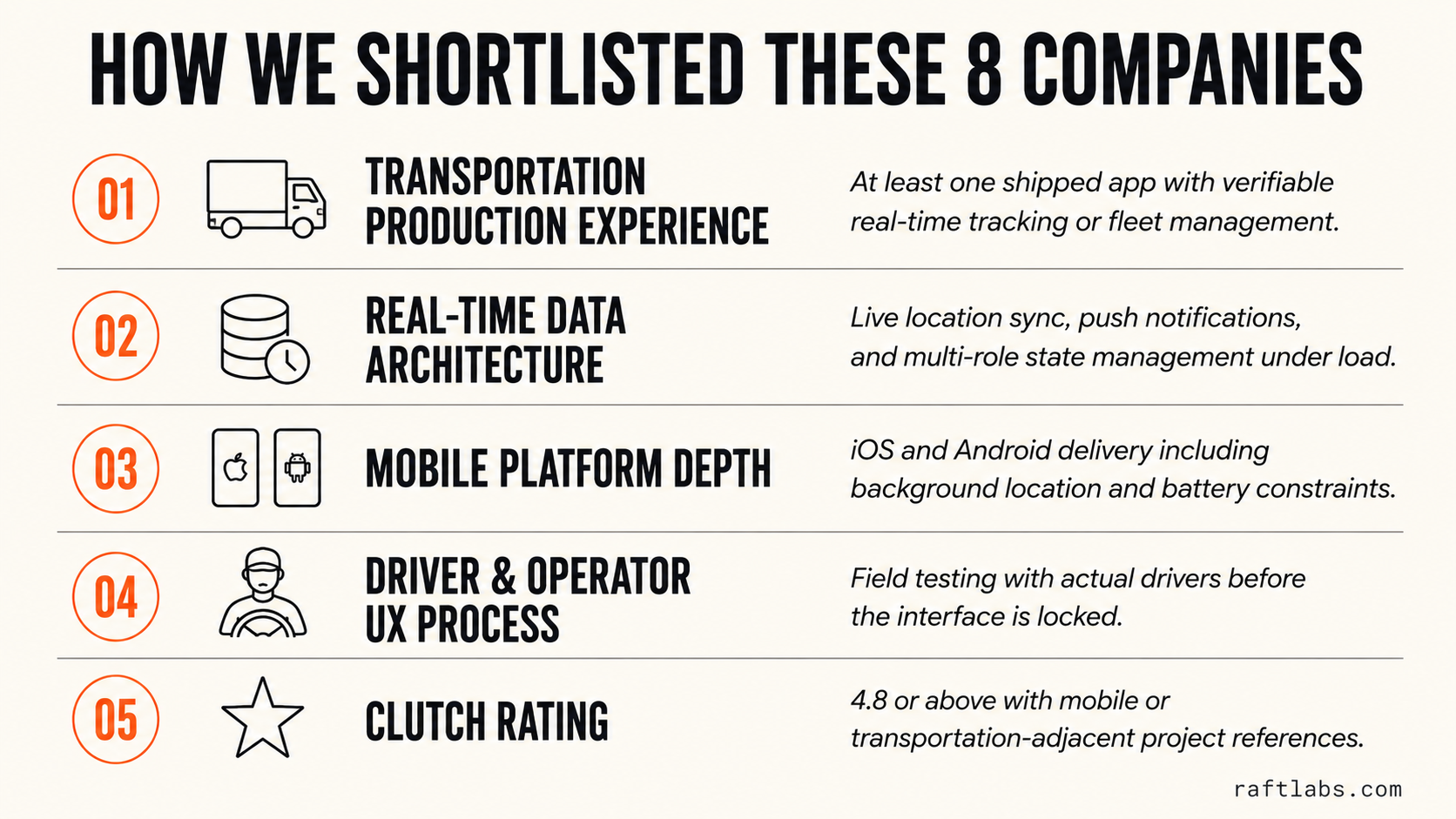
| Criterion | What we looked for |
|---|---|
| Transportation-specific production experience | Evidence of at least one shipped transportation, logistics, or mobility app with verifiable production history - real-time tracking, driver interfaces, or fleet management features |
| Real-time data architecture capability | Track record building systems with live location updates, push notifications, and state synchronization between multiple user roles (driver, dispatcher, passenger) |
| Mobile platform depth | iOS and Android delivery history, including experience with background location permissions, battery optimization, and OS-level constraints that affect driver apps |
| Driver and operator UX process | Evidence of user validation with actual drivers or operators before launch - not just design review, but field testing with the people who use the app in motion |
| Clutch rating | 4.8 or above with mobile or transportation-adjacent project references |
No company paid for placement on this list.
1. Trigent Software
Trigent Software is a Southborough, Massachusetts enterprise application development firm with delivery teams in India, in business for more than two decades. Their domain practices span logistics and manufacturing, with hands-on experience building transportation management systems (TMS) and carrier-API integrations - the backend plumbing that a driver or dispatcher app has to sit on top of. For transportation buyers whose real problem is systems integration rather than a greenfield consumer app, that enterprise orientation is the differentiator.
Among the enterprise-leaning firms on this list, Trigent is the one to shortlist when the transportation app is the front end of a larger operational system: a TMS that needs to expose shipment status to a driver's phone, a carrier network that needs mobile visibility, or a manufacturing-to-distribution workflow that ends at a proof-of-delivery scan in the field. The mobile layer is often the smallest part of these builds; the hard work is making the app agree with the systems of record behind it, and that is the work Trigent has done for twenty-plus years.
The trade-off is that Trigent is an enterprise-integration shop first and a consumer-grade mobile studio second. If your build is a polished two-sided ride-hailing app where driver and passenger UX is the entire product, confirm during scoping how much of their recent work is native mobile versus web and integration, and ask to see a transportation app you can download and test. Their depth is in the plumbing, and you want to be sure the surfaces on top of it are held to the same standard.
Notable work: Trigent's public profile and case material point to enterprise logistics and manufacturing engagements, but we could not independently verify a specific shipped consumer transportation app for this list. Ask for a live app store listing and named transportation references during scoping rather than relying on a portfolio deck.
Pricing signal: Clutch lists a wide project range, from roughly $10,000 to $1M and above, which reflects their span from small integration engagements to enterprise programs rather than a fixed transportation-app band. Confirm the specific price for your scope before engaging.
What to watch: Trigent's strength is enterprise integration - TMS, carrier APIs, and the middleware that connects a mobile app to systems of record. For a transportation build where the entire product is driver and passenger UX with minimal backend integration, verify their recent native-mobile depth before scoping, and ask which parts of the app they would build in-house versus staff from their broader team.
Best for: Transportation and logistics operators whose app is the mobile layer on top of a TMS, carrier network, or manufacturing-to-distribution system that needs real enterprise integration
Specialization: Enterprise application development, TMS and carrier-API integration, logistics and manufacturing systems, web and mobile delivery
Pricing: Project range roughly $10K-$1M+ (Clutch); confirm before engaging
Clutch: Clutch profile lists roughly 55-56 reviews; verify the rating on Clutch before engaging
2. RaftLabs
RaftLabs is a product design and engineering studio for mid-market businesses. In transportation and logistics, their model solves a specific problem: most mobile app development agencies design the driver app, the passenger or shipper app, and the dispatcher web panel as separate projects handled by separate teams - producing interfaces that look cohesive in mockups and behave inconsistently in production when the real-time state between views needs to stay synchronized. RaftLabs runs design and engineering in the same team, which means the architecture decisions governing how a driver's location update propagates to the dispatcher panel are made alongside the UX decisions about how that update should be displayed. The result is a transportation app where the live-state behavior and the interface design are not fighting each other.
Their transportation-relevant work includes real-time tracking systems, fleet management interfaces, logistics workflow apps, and on-demand service platforms with driver, customer, and operator views. They build on React Native for cross-platform delivery and native iOS and Android where platform-specific performance requirements demand it. Backend systems are designed for real-time data at operating scale - not tested at a demo level and handed to the client to discover the limits under real concurrent usage.
The fixed-price engagement model matters specifically in transportation development because transportation apps have a well-documented scope expansion problem: the dispatcher needs one more filter, the driver needs a new job-type indicator, the admin panel needs an analytics export. RaftLabs scopes these decisions before the build starts, prices them explicitly, and does not move to engineering without a signed scope. Companies that have been burned by hourly billing on transportation projects will recognize why this matters.
Notable work: RaftLabs has built a logistics and field operations platform for a multi-location service business with real-time job assignment, driver location tracking, and field status updates across iOS and Android. A hospitality operations platform serving 80+ properties includes service request dispatch, real-time room and task status updates, and staff routing workflows - the same architectural patterns that underpin fleet and driver dispatch in transportation. A supply chain and inventory management system for a distribution business covers order routing, delivery confirmation, and warehouse-to-vehicle handoff.
Pricing signal: $29-$49/hr. A full two-sided transportation app - driver app, passenger or shipper app, and dispatcher dashboard - typically runs $60,000 to $150,000 at fixed price with milestone payments. Scoping takes two to four weeks and produces a fixed-price proposal before any design or development commitment.
What to watch: RaftLabs is a 60-person firm. Large programs requiring simultaneous development of five or more distinct app surfaces, or multi-country regulatory compliance work spanning different transport authorities in parallel, exceed their operating model. What they do well: defined-scope transportation builds for established businesses, delivered by one team that owns design and engineering from kickoff to App Store submission.
From the field: The most expensive mistake we see in transportation app projects is deferring driver-side UX validation until after the passenger-side app is built. Driver apps are used in moving vehicles, often in glare, often with gloves, often under time pressure. The interaction model that looks fine on a Figma prototype breaks the moment a driver tries to accept a job at 60 km/h with one hand. Running driver UX testing in the first six weeks - before the build is locked - is cheaper than rebuilding the interface after launch when the fleet starts complaining.
Best for: Mid-market transportation and logistics companies ($5M-$200M revenue) that need a production-ready two-sided or three-sided app built by one accountable team at a fixed price
Specialization: Real-time tracking apps, fleet and dispatch interfaces, logistics workflow mobile apps, on-demand service platforms
Pricing: $29-$49/hr, fixed-price engagements from $60K
Rating: 4.9/5 (Clutch, 50+ reviews)
3. Atomic Object
Atomic Object is a custom software development firm based in Grand Rapids, Michigan, with additional offices in Detroit and Chicago. Founded in 2001, they have built a track record of delivering complex custom software across manufacturing, logistics, IoT, and healthcare spanning more than two decades. Their 4.9/5 rating across 50 Clutch reviews reflects consistent delivery over an unusually long production history - a signal of organizational maturity and process stability that newer studios with larger review counts simply cannot replicate.
For transportation companies building apps with significant backend complexity - telematics integration, ELD (electronic logging device) data, IoT sensor streams, or connected vehicle features - Atomic Object has depth that extends well beyond the mobile layer. Their transportation capability includes the systems that mobile apps connect to: vehicle telematics platforms, warehouse management systems, industrial IoT data streams, and the middleware that makes real-time field data available to mobile interfaces without bottlenecks. If your transportation app needs to pull data from vehicle sensors, integrate with a TMS, or support a hardware-connected workflow at the field level, Atomic Object understands the full stack.
Their deliberate approach to software architecture is particularly valuable in transportation, where the system decisions made in weeks two and three determine whether the app is maintainable five years later. Transportation software has a long operational life - fleet operators do not replace their core tools on two-year cycles. A codebase built for longevity and maintainability is worth more than one built for speed-to-launch, and Atomic Object's 20+ year client relationships reflect that their builds are designed to last.
Notable work: Atomic Object has built fleet tracking and dispatch systems, manufacturing shop-floor mobile apps with real-time machine status, and IoT-connected industrial applications where mobile interfaces need to synchronize with hardware in the field. Their client base includes manufacturing, logistics, and healthcare companies across the US Midwest, with long-term relationships that reflect a delivery standard matched to complex, long-lived enterprise systems.
Pricing signal: $150-$199/hr. Full transportation app engagements typically run $100,000 to $500,000. The premium over mid-range studios is justified for companies where the app connects to significant backend systems, requires long-term architectural support, or sits inside a regulated transportation environment (ELD compliance, DVIR, safety-critical dispatch). For a straightforward two-sided platform without heavy system integration, the same production quality is available at lower cost from other studios on this list.
What to watch: Atomic Object's process is deliberate and their rate card reflects it. For companies with a fixed budget under $80,000 or a timeline under 16 weeks, their minimum engagement scope typically exceeds both constraints. They are the right call when the transportation software has significant backend complexity, long-term maintenance requirements, or IoT integration that needs architectural thinking beyond standard mobile development.
Best for: US transportation and logistics companies building complex software with TMS integration, IoT sensor data, telematics, or long-term maintainability requirements for enterprise-grade operations
Specialization: Custom transportation software, fleet and logistics systems, IoT-connected mobile apps, telematics integration, regulated industry compliance
Pricing: $150-$199/hr, engagements from $100K
Clutch: 4.9/5 (50 reviews)
4. AppMakers USA
AppMakers USA is a mobile app development company with a 5.0/5 rating across 98 Clutch reviews - the highest absolute review count among the 5.0-rated studios on this list. Their positioning centers on proactive problem-solving and AI integration, which in the transportation context translates to apps that do not just display data but process it: predictive ETAs, intelligent dispatch suggestions, route anomaly detection, and AI-assisted driver behavior monitoring. For transportation companies that want to embed intelligence into the driver and dispatch experience rather than building a standard tracking app, AppMakers USA brings relevant capability that most mobile studios treat as a future-roadmap item.
Their multi-platform delivery model covers iOS, Android, and web, which is directly relevant for transportation apps where the dispatcher interface is typically a web application while the driver and passenger interfaces are mobile-native. Building all three surfaces with a single team eliminates the integration issues that arise when mobile and web development are split between different agencies - a split that is common in transportation projects and produces state synchronization problems that are expensive to debug after launch.
The 98 Clutch reviews at 5.0/5 is statistically exceptional and reflects a delivery process that does not regress on late-project timelines - the most common point in a mobile build where quality slips under schedule pressure. For transportation companies with a defined scope and a desire to incorporate AI-powered dispatch or routing intelligence, AppMakers USA is one of the more capable options at their price tier.
Notable work: AppMakers USA has shipped AI-integrated mobile applications across on-demand services, healthcare, and logistics-adjacent sectors with multi-role architectures and proactive performance optimization during the build phase. Their AI integration work spans intelligent recommendation, predictive analytics, and automated decision-support features embedded in mobile interfaces - capabilities that translate directly to dispatch optimization and route intelligence in transportation applications.
Pricing signal: $100-$149/hr. Minimum project size $25,000. Full transportation app engagements typically run $60,000 to $200,000. Their AI integration capability adds modest cost at the build stage but reduces operational cost at scale for companies that need intelligent dispatch routing or predictive driver allocation.
What to watch: AppMakers USA's core strength is applying AI and intelligent features to mobile app frameworks. For transportation companies that need very deep telematics integration, compliance-heavy fleet management (ELD, DVIR logging), or specialized hardware-connected workflows at the vehicle level, pairing them with a backend specialist for that layer is worth considering before scoping.
Best for: Transportation companies that want AI-integrated dispatch, route intelligence, or predictive features built alongside a standard driver-and-operator mobile app
Specialization: AI-integrated mobile apps, multi-platform delivery (iOS, Android, web), on-demand platform development, intelligent dispatch features
Pricing: $100-$149/hr, minimum project $25K
Clutch: 5.0/5 (98 reviews)
5. Acropolium
Acropolium is a bespoke software company headquartered in Tallinn, Estonia, with delivery teams in the Czech Republic and Ukraine. Unlike most firms on this list, they run a dedicated logistics and transportation practice - not a general mobile shop that happened to ship a delivery app, but a team that positions transportation management, fleet and route-planning, and supply-chain platforms as a core specialty. For a transportation buyer, that means the discovery conversation starts in transportation vocabulary rather than from a generic feature checklist.
Among the European studios here, Acropolium is the one to shortlist when the app is genuinely transportation-first: a TMS with a mobile driver companion, a route-planning engine that has to recalculate on the fly as stops change, or a supply-chain platform where the mobile app is one surface of a larger logistics system. A firm that names transportation as a practice is more likely to have already solved the domain-specific problems - multi-stop sequencing, carrier assignment, ETA reconciliation - that a generalist studio would encounter for the first time on your budget.
The trade-off is verification. Acropolium's logistics positioning is a stated specialty rather than an independently confirmed track record for this list, and their pricing is not published, so the burden is on you to confirm depth. Ask for named transportation references, a shipped app you can install and test, and a specific fixed or capped price for your scope before committing. A strong domain narrative is a good starting point, not a substitute for proof.
Notable work: Acropolium presents a logistics and transportation practice publicly, but we could not independently verify a specific named transportation app for this list. Treat their domain positioning as a starting point and validate it with references and a live app during scoping.
Pricing signal: Acropolium does not publish an hourly rate or project minimum. Request a written scope and a fixed or capped price before engaging, and confirm whether they run fixed-price or time-and-materials for transportation builds so the commercial model matches your risk tolerance.
What to watch: The logistics specialty is a real advantage only if it holds up under reference checks. Because pricing and specific transportation deliverables are not public, do the verification work up front: named fleet or TMS references, a downloadable app, and a fixed scope. For nearshore alignment, their Central and Eastern European teams overlap a full working day with European clients and a partial day with US East Coast teams.
Best for: European and US companies building transportation-first platforms - TMS, fleet and route planning, or supply-chain systems - who want a team that positions logistics as a core practice
Specialization: Transportation management systems, fleet and route-planning platforms, supply-chain software, bespoke logistics applications
Pricing: Not publicly listed; request a fixed or capped quote before engaging
Clutch: Clutch profile listed (Clutch Top 1000 2024 badge); confirm the rating on Clutch before engaging
6. itCraft
itCraft is a mobile and web development studio based in Warsaw, Poland, with a 5.0/5 rating across 70 Clutch reviews. Founded in 2010, they have built a track record of delivering tailored cross-platform mobile applications for European and US clients across logistics, e-commerce, healthcare, and fintech for over 15 years. Their nearshore model - Poland to Western Europe is a one to three hour time-zone difference, Poland to US East Coast is six hours - means daily standup overlap is practical without forcing anyone into early mornings or late evenings.
For transportation companies, itCraft's relevant capability is in cross-platform mobile development (React Native, Flutter) with backend systems built on cloud infrastructure suited to real-time data workloads. Logistics apps they have built include delivery tracking interfaces, warehouse mobile tools, and field service apps with offline-first architecture - a capability that matters for transportation apps operating in low-connectivity areas where drivers cannot rely on a stable data connection through their entire route. Offline-first architecture is not a standard feature in most mobile development shops; it requires deliberate design decisions about local state persistence and conflict resolution when connectivity resumes.
Their 70-review Clutch profile at 5.0 covers a range of project types and client markets, demonstrating consistent delivery across varied transportation-adjacent scopes rather than concentration in a single narrow vertical. This breadth of delivery experience is an indicator of organizational maturity and adaptability.
Notable work: itCraft has shipped cross-platform mobile apps for logistics and e-commerce companies, field service mobile tools with offline synchronization, and multi-role business applications across European markets. Their transportation-relevant portfolio includes delivery tracking interfaces and logistics workflow applications where the driver app and the operational backend need to stay synchronized under variable connectivity conditions.
Pricing signal: $50-$99/hr. Minimum project size $50,000. Full transportation app engagements typically run $50,000 to $200,000. Their Eastern European rate card makes them competitive with US studios charging significantly more for comparable mobile engineering output, while maintaining time-zone coverage practical for European and Eastern US client teams.
What to watch: itCraft is best suited for companies building cross-platform transportation apps where React Native or Flutter meets the performance requirements. For transportation apps requiring deep iOS background mode optimization or Android-specific hardware integration - where the platform-specific constraints are non-trivial - discuss their native development capability and specific background-mode experience explicitly before finalizing the scope.
Best for: European and US transportation companies building cross-platform logistics or delivery apps with offline capability, real-time tracking, and nearshore time-zone alignment
Specialization: Cross-platform mobile development (React Native, Flutter), logistics applications, offline-first mobile architecture, field service tools
Pricing: $50-$99/hr, minimum project $50K
Clutch: 5.0/5 (70 reviews)
7. TekRevol
TekRevol is a mobile app development company with a 4.8/5 rating across 83 Clutch reviews and a strong track record building on-demand and delivery app platforms for US and international clients. Their positioning as a budget-efficient studio that meets tight delivery timelines is backed by a review history large enough to be statistically meaningful - 83 reviews at 4.8/5 is not a product of selective publishing, it reflects a delivery model that works consistently at volume and speed. For transportation companies that need to move from brief to production quickly without a premium US studio rate card, TekRevol is one of the more credible options in the market.
In transportation, TekRevol has direct experience with ride-hailing platforms, food and grocery delivery apps, courier tracking tools, and on-demand logistics solutions. They understand the technical requirements of building Uber-type architectures: the driver app, the passenger app, the admin panel, and the real-time matching engine that connects them. That end-to-end pattern recognition - knowing which parts of an on-demand transportation build are standard and which require custom architecture decisions - is what separates studios that have shipped these products from studios that have read about them.
Their delivery speed is a genuine differentiator for transportation companies that need to enter a market before a competitive window closes or satisfy an investor timeline. Not every transportation app needs 26 weeks of structured discovery and phased delivery. Some need a well-architected product in 14 to 18 weeks at a budget that keeps the company solvent through the build. TekRevol is explicitly built for that scenario.
Notable work: TekRevol has built ride-hailing and on-demand delivery platforms with driver tracking, booking interfaces, payment integration, and admin dispatch dashboards for clients across North America. Their logistics portfolio includes courier and last-mile delivery companies where the driver app, the customer tracking interface, and the ops dashboard were built and shipped as a single coordinated product. They are one of a short list of studios at this price point that have shipped end-to-end on-demand transportation platforms rather than contributing to one layer of a platform someone else architected.
Pricing signal: $25-$49/hr. Minimum project size $10,000. Full transportation app engagements typically run $30,000 to $120,000. Their rate card makes a complete on-demand transportation platform accessible to early-stage companies and mid-market operators who cannot justify the $100,000-$200,000 range but need a production-ready product, not a prototype.
What to watch: TekRevol's strength is in defined-scope, fast-delivery transportation builds with well-understood architectural patterns. For transportation apps with significant novel architecture requirements - custom telematics integration, proprietary hardware connectivity, or AI-driven dispatch optimization that requires specialized ML engineering - their capacity at this price point may require supplementing with specialist contractors for specific components.
Best for: Transportation startups and mid-market logistics companies that need an on-demand platform built quickly at a defined budget, with delivery experience in ride-hailing, courier, and delivery app architectures
Specialization: On-demand transportation apps, ride-hailing platforms, delivery tracking, last-mile logistics applications
Pricing: $25-$49/hr, minimum project $10K
Clutch: 4.8/5 (83 reviews)
8. Digiteum
Digiteum is a custom software and IoT company based in Gdansk, Poland, building data-driven web, mobile, and IoT applications with domain practices in logistics and energy. Their IoT depth is the relevant differentiator for transportation: connected-vehicle data, telematics feeds, and sensor streams are exactly the inputs that separate a map-with-a-moving-dot tracking app from an operationally useful fleet platform. If your build has to turn raw device data into dispatch decisions, that engineering discipline matters more than another mobile studio's screenshot portfolio.
Among the European firms here, Digiteum is the one to shortlist when the transportation app is data- or IoT-heavy: a fleet platform pulling telematics, a cold-chain or asset-tracking build that depends on sensor streams, or a logistics dashboard that has to synthesize device data into an ETA or an exception alert. Their combination of custom software and IoT engineering means the mobile app and the data layer feeding it can be designed by the same team, which avoids the integration seams that appear when the app studio and the IoT vendor are two different companies.
The trade-off is scale of proof. Digiteum's public review base is small, so while the individual engagements read well, the statistical confidence is lower than the high-volume studios elsewhere on this list. For a transportation-critical build, weigh the strong IoT and data fit against the thinner track record: ask for references specific to fleet, telematics, or asset-tracking work, and treat the domain fit as promising rather than proven until those references check out.
Notable work: Digiteum publicly positions logistics and IoT engineering, but we could not independently verify a specific shipped transportation app for this list. Ask to see a live fleet or telematics app and named references during scoping.
Pricing signal: Clutch reports a project range of roughly $50,000 to $1M, consistent with custom software and IoT builds rather than templated app work. Confirm the specific price for your scope before engaging, and clarify whether IoT hardware integration is in scope or billed separately.
What to watch: Digiteum's edge is data and IoT engineering, not high-volume mobile app throughput, and their verified review base is small. For a straightforward two-sided delivery app with no sensor or telematics layer, that IoT depth is not the deciding factor and other studios here have longer mobile track records. For a genuinely data-heavy fleet or asset-tracking build, they are a strong fit - validate it with domain-specific references first.
Best for: Transportation and logistics companies building data- or IoT-heavy apps - fleet telematics, asset tracking, cold-chain, or sensor-driven dashboards - who want mobile and IoT engineering from one team
Specialization: Custom software, IoT and connected-device engineering, data-driven web and mobile apps, logistics and energy systems
Pricing: Project range roughly $50K-$1M (Clutch); confirm before engaging
Clutch: Clutch profile lists roughly 16 reviews; confirm the rating on Clutch before engaging
Side-by-side comparison
| Company | Primary strength | Typical engagement | Pricing |
|---|---|---|---|
| Trigent Software | Enterprise app dev, TMS and carrier-API integration | $10K-$1M+ | Confirm on Clutch |
| RaftLabs | Design + engineering in one team, real-time tracking, fixed price | $60K-$150K | $29-49/hr |
| Atomic Object | Complex logistics and IoT-connected transportation software | $100K-$500K | $150-199/hr |
| AppMakers USA | AI-integrated dispatch and multi-platform delivery | $60K-$200K | $100-149/hr |
| Acropolium | Dedicated logistics and transportation practice | Not listed | Not published |
| itCraft | Cross-platform logistics apps with offline capability | $50K-$200K | $50-99/hr |
| TekRevol | On-demand delivery and ride-hailing, fast delivery timeline | $30K-$120K | $25-49/hr |
| Digiteum | Custom software plus IoT for data-driven fleet apps | $50K-$1M | Confirm on Clutch |
The question that separates the right transportation app company from the wrong one
Every transportation app pitch meeting includes the same demo: a smooth map animation with a moving vehicle icon, an instant booking confirmation, and a driver accepting a job in under three seconds. What the demo does not show is what happens when 300 drivers go online simultaneously at shift start, when a driver's phone loses signal for 90 seconds and the dispatcher's view needs to reconcile the state gap, or when the matching algorithm tries to assign the nearest available driver to a pickup that appeared three seconds after the last assignment completed.
The question that separates the right company from the wrong one is not "have you built a transportation app?" Every studio on Clutch says yes. The right question is: "What breaks in your transportation apps, and how do you know?"
There are three levels of answer to this question, and the level tells you everything you need to know about the company's actual experience:
Level one - confident generalism. The company describes real-time tracking as a standard feature and routes you to their portfolio page. They have shipped location-enabled apps. They have not built a system where location data under production load causes state divergence between the driver and dispatcher views. They do not know this because it has not happened to them under scale - they have not reached scale.
Level two - incident awareness. The company can describe a specific failure mode they encountered - a background location update failing on a specific Android OEM, a race condition in the job assignment system under concurrent requests, a push notification latency spike under peak load - and what they did to resolve it. This means they have shipped a transportation app at real-world operating scale and observed it under strain. Hire at this level with open eyes.
Level three - architectural foresight. The company identifies the failure modes before they occur and explains the design decisions that prevent them: how they handle offline state and reconciliation when connectivity resumes, how they rate-limit location updates to balance accuracy with battery drain, and how the matching engine handles tie-breaking under simultaneous incoming requests. This is the company that knows what they are building before they build it. Hire here.
Most companies in the first Clutch tier operate between Level one and Level two. The shortlist above represents companies that have demonstrated Level two or better, with RaftLabs and Atomic Object consistently operating at Level three for clients in their respective budget tiers.
"Logistics is the ballgame. Every minute of delay, every missed delivery, every miscommunication between driver and dispatch is a direct cost to the business." - adapted from industry practitioner interviews in McKinsey's 2023 supply chain transformation series
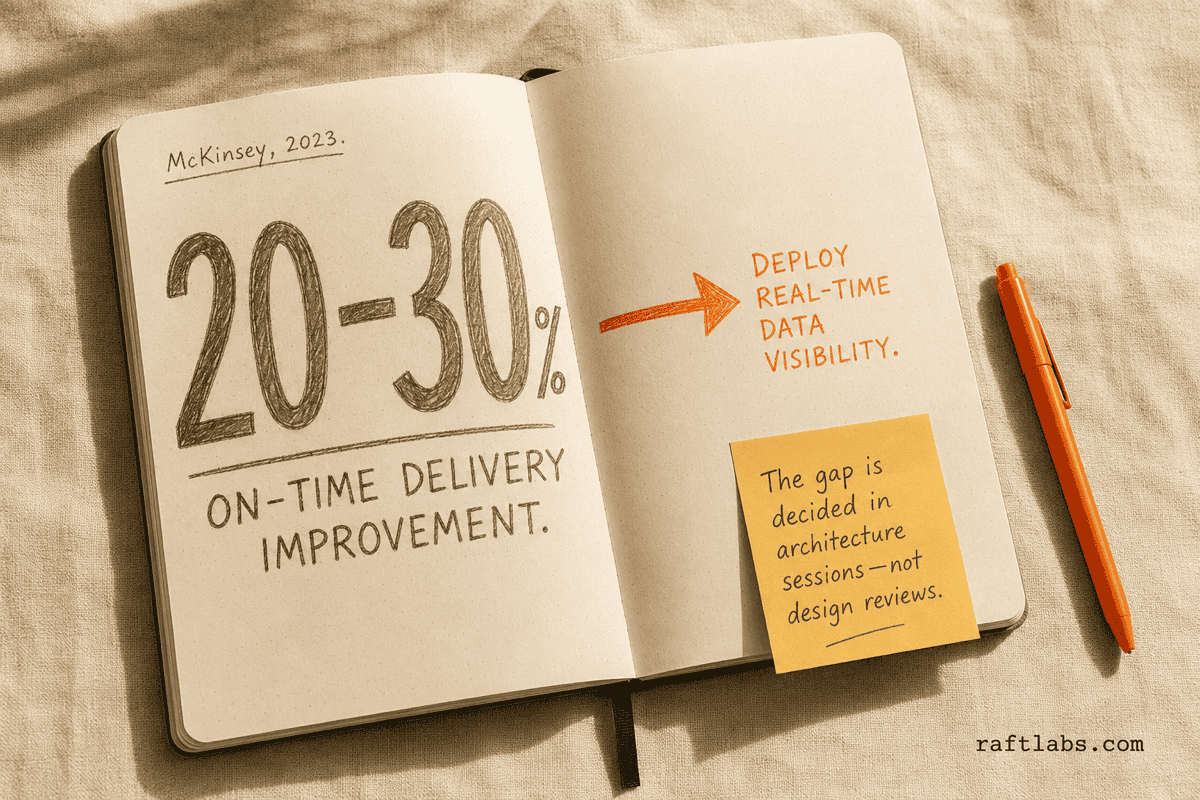
According to McKinsey's 2023 analysis of digital transformation in transportation and logistics, companies that deploy real-time data visibility tools across their operations reduce logistics costs by 10 to 15 percent and improve on-time delivery rates by 20 to 30 percent. The gap between a transportation app that displays location data and one that makes that data operationally useful - through intelligent dispatch, ETA accuracy, and driver-dispatcher communication - is where mobile development quality determines business outcome. That gap is decided in the architecture sessions, not in the design reviews.
The verdict
The right transportation app development company depends entirely on your build type, budget, and where the primary risk sits in your project.
For transportation apps that are the mobile front end of a larger enterprise system - a TMS, a carrier network, or a manufacturing-to-distribution workflow: Trigent Software, an enterprise-integration firm with more than two decades of logistics and manufacturing delivery. Verify their native-mobile depth and confirm pricing on Clutch before engaging.
For a full design-and-engineering engagement at mid-market rates with a fixed-price guarantee and no handoff gap between UX and production code: RaftLabs. One team from driver UX validation through App Store submission.
For complex transportation software with IoT integration, telematics systems, or long-term enterprise maintainability as the primary requirement: Atomic Object. Premium rate, premium complexity capacity, architectural thinking that holds up over a 10-year product lifecycle.
For AI-integrated dispatch features and multi-platform delivery (iOS, Android, and dispatcher web) built in a single coordinated engagement: AppMakers USA.
For European or US companies building a transportation-first platform - TMS, fleet and route planning, or supply chain - who want a team that treats logistics as a core practice: Acropolium, whose pricing is not published, so request a fixed or capped quote and named references up front.
For European and US companies building cross-platform logistics apps with offline capability and practical nearshore time-zone alignment: itCraft.
For on-demand transportation and delivery platforms that need to reach production quickly at a defined budget, with proven ride-hailing and courier architecture: TekRevol.
For data- or IoT-heavy transportation builds - fleet telematics, asset tracking, or sensor-driven dashboards - that need mobile and IoT engineering from one team: Digiteum, a strong domain fit with a smaller verified review base, so ask for fleet-specific references before committing.
The most expensive mistake in transportation app procurement is choosing based on portfolio screenshots and a convincing demo rather than the architecture decisions visible behind them. Every demo shows a moving dot on a map. The question is what happens to that dot when the network drops, the load spikes, and the driver needs to accept a job in three seconds while navigating a roundabout.
RaftLabs builds transportation and logistics mobile apps end-to-end - driver interfaces, dispatcher panels, and real-time tracking systems designed and engineered by one team. 4.9/5 on Clutch. Talk to a founder about your transportation app project.
Ask an AI
Get an instant summary of this post from your preferred AI assistant.
Common questions
- A basic single-role transportation app (driver-only or passenger-only, with real-time location and basic dispatch) costs $30,000 to $60,000. A full two-sided platform with driver and passenger or shipper interfaces, real-time tracking, payment integration, and dispatch dashboard costs $60,000 to $150,000. A production-grade logistics platform with multi-stop routing, proof-of-delivery capture, fleet analytics, and driver compliance logging costs $120,000 to $300,000. The main cost drivers are the number of distinct user roles, the complexity of the real-time data layer, and whether the app needs to operate offline in low-connectivity environments.
- A single-role MVP with core location and dispatch features takes 12 to 16 weeks. A two-sided platform (driver and passenger or driver and dispatcher) takes 16 to 26 weeks. A full logistics platform with advanced routing, analytics, and compliance features takes 24 to 40 weeks. Timeline is most affected by the number of user roles, third-party API integrations (mapping, payment, telematics), and how quickly the client team can validate driver-side UX in the field.
- Real-time GPS tracking with low-latency updates (under 5 seconds), role-based access for drivers and dispatchers, push notifications for status changes, offline mode for low-connectivity routes, payment integration, route optimization, and proof-of-delivery or job-completion confirmation. Secondary features that determine competitive positioning include dynamic pricing, ETA prediction, driver rating systems, in-app communication, and fleet analytics dashboards. Missing any of the first group at launch creates an operationally broken product.
- For most transportation apps, React Native or Flutter provides 90 percent of the native performance at significantly lower cost and faster iteration speed. Native iOS and Android development makes sense when the app requires deep hardware integration - persistent background location services under aggressive battery management, Bluetooth device connections, or custom camera pipelines for document scanning. For driver apps where battery life and background location accuracy are critical, discuss this trade-off explicitly with your development partner before scoping. The wrong architecture choice here has operational consequences that are expensive to fix after launch.
- Not a case study with a Figma screenshot - ask for an App Store or Google Play listing you can download, install, and test on your own phone. Look at the rating, look at recent reviews from drivers or operators, and look at when it was last updated. An app that has not been updated in 18 months has been operationally abandoned. A studio that cannot share a live, publicly accessible transportation app has not shipped one that remained in active use.
- This question has a specific technical answer. Ask how the app handles real-time location updates when a driver's phone loses connectivity: local state persistence on the driver's device, a reconnection and reconciliation protocol for the backend, and how the dispatcher's view handles a period of missing location history. Location dropout handling is one of the two most common places where transportation apps fail in field conditions. Also ask specifically about WebSocket versus polling architecture for location updates, how the system handles concurrent connections under peak load (when all drivers come online at shift start), and how state is managed between the driver, passenger or shipper, and dispatcher surfaces. A studio that builds the real-time layer on a Firebase configuration calibrated for a 10-driver demo will face an architectural rebuild when that fleet reaches 500 drivers - the backend architecture decision made in week two determines whether you need to rewrite in year two.
- Driver apps are used in conditions that are hostile to standard UX testing: moving vehicles, bright sunlight on screen, one-hand operation, tight time windows for task completion, gloves in cold weather. Ask how many actual drivers tested the interface before the last transportation app this company shipped, at what stage of the project that testing happened, and what changed in the interface as a result. Studios that have shipped production driver apps will have a specific story about something that changed after driver testing; studios that have shipped location-enabled consumer apps that happen to be driven by drivers will not.
- A company that has shipped production transportation apps will have a specific pre-launch checklist that includes background mode and background location permission testing on multiple Android OEM devices (Samsung, Xiaomi, Huawei all implement background location differently), App Store review timeline planning for transportation category submissions, push notification delivery rate testing under expected peak load, and post-launch monitoring for location accuracy and crash rates. A company without a specific answer is treating transportation app delivery the same as any other mobile project - it is not.
- RaftLabs builds transportation and logistics apps with real-time tracking, driver and dispatcher interfaces, and fleet management features, running design and engineering in the same team from scoping through production deployment. Their engineering work covers mobile-native iOS and Android as well as React Native cross-platform builds, with backend architecture designed for real-time data at scale. Engagements are fixed-price with milestone payments. $29-$49/hr. 4.9/5 on Clutch.