Top API development companies in 2026 (vetted shortlist)
Eight API development companies evaluated on production track record, architectural range, and integration depth. No pay-to-play placements.

In this article
Short answer
Evaluating API development companies comes down to a live, verifiable production API, range across REST, GraphQL, and event-driven architectures, OpenAPI documentation as standard, and demonstrated security and compliance handling. RaftLabs meets this bar with a HIPAA-compliant REST API built for a patient monitoring platform, 4.9/5 on Clutch, and fixed-price engagements from $15,000.
Key takeaways
- API development covers architecture design, endpoint implementation, authentication, rate limiting, versioning, documentation, and integration - not just writing endpoints. A company that skips architecture and documentation ships an API that becomes technical debt within a year.
- The difference between an API that scales and one that fails under load is architectural decision-making at the start of the engagement: REST vs GraphQL, synchronous vs event-driven, monolith vs microservices. Ask for an architecture rationale before any code is written.
- API documentation is not an afterthought. A partner that delivers OpenAPI specs, sandbox environments, and developer onboarding documentation alongside the code reduces integration cost significantly compared to one that hands off undocumented endpoints.
- Fixed-price API engagements are achievable for well-defined scopes: a defined set of endpoints, data models, auth requirements, and integration targets. Engagements that begin without a defined scope inevitably creep. Spend a week on architecture before signing a build contract.
- RaftLabs ranks second as the strongest choice for mid-market companies that need a production-ready API - designed, built, documented, and integrated - by one accountable team at $29-$49/hr on a fixed-price basis.
Evaluating API development companies is harder than it looks. Every firm on Clutch and GoodFirms claims to build scalable, secure, production-ready APIs. The question is whether those APIs are still running cleanly six months after launch - documented, versioned, monitored, and extendable by a team that was not the one that built them. That filter removes most of the companies in the directory. According to MarketsandMarkets, the global API management market is projected to grow from $7.67 billion in 2024 to $16.93 billion by 2029 at a CAGR of 17.1%, a growth rate that reflects how central well-managed APIs have become to every software product, integration program, and digital service.
Eight companies made this list: Nerdery, RaftLabs, Ranosys, Rapidops, Itransition, Scio, Netguru, and Iflexion. RaftLabs is included because their team builds APIs as part of product engineering engagements - not as isolated deliverables handed off without documentation - and their Clutch track record supports the claim. We evaluate every company on the same criteria.
Transparency note: RaftLabs is on this list. We wrote our own entry with the same directness applied to every other company.
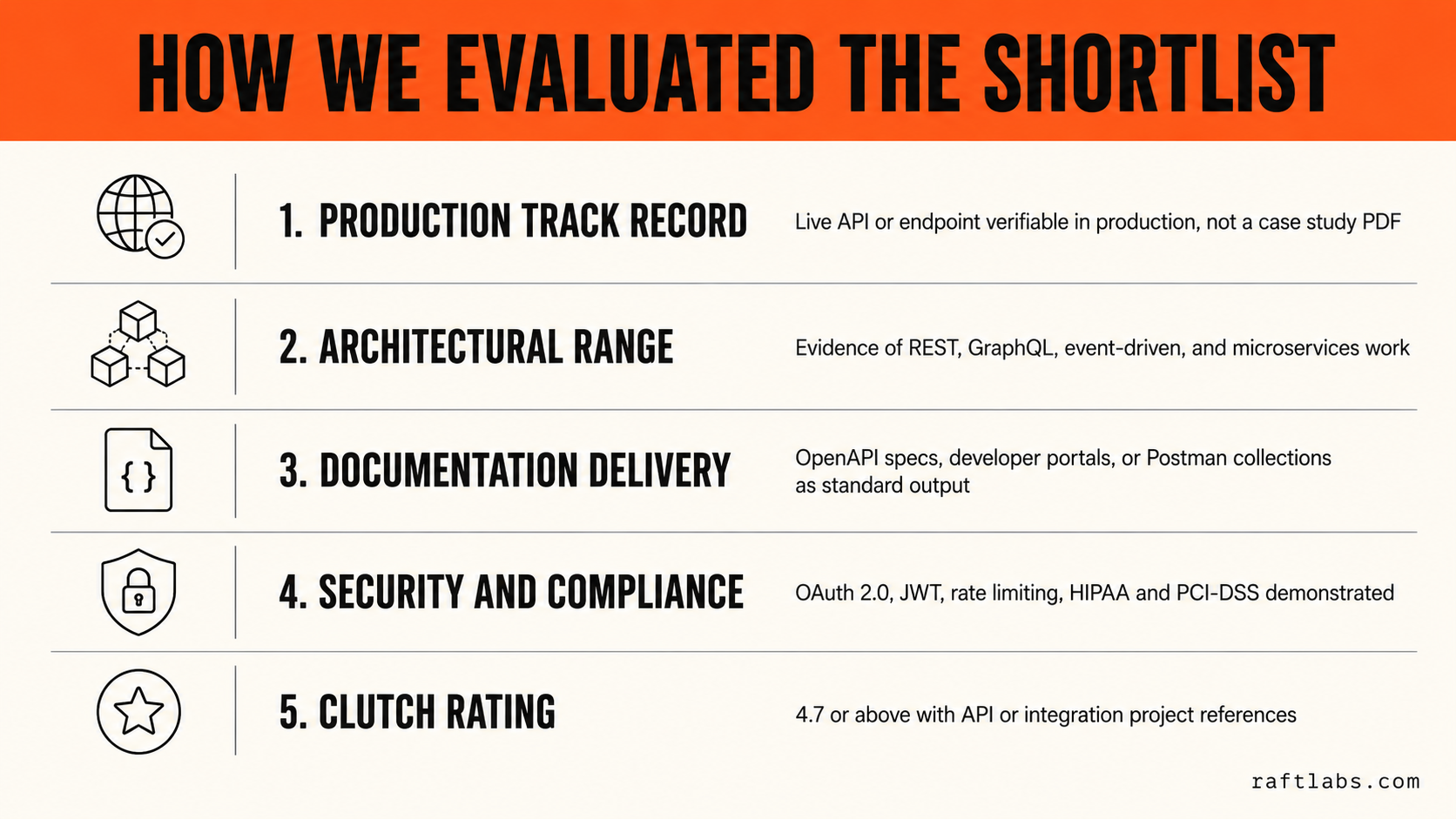
How we evaluated this list
| Criterion | What we looked for |
|---|---|
| Production track record | At least one live API or integration in production, verifiable via documentation or a public endpoint - not a case study PDF |
| Architectural range | Evidence of REST, GraphQL, event-driven, and microservices API work - not just CRUD endpoint generation |
| Documentation delivery | OpenAPI specs, developer portals, or Postman collections delivered as standard output, not optional extras |
| Security and compliance | Demonstrated handling of authentication (OAuth 2.0, JWT), rate limiting, and compliance-adjacent requirements (HIPAA, PCI-DSS) |
| Clutch rating | 4.7 or above with API or integration project references |
No company paid for placement on this list.
The 8 companies
1. Nerdery
Nerdery is a digital-transformation consultancy headquartered in Edina, Minnesota, that delivers custom software development, data and analytics, AI/ML, and cloud and infrastructure modernization for enterprise and mid-market clients. API and integration work sits inside those broader engagements: the connective layer that links a modernized backend to new applications, data platforms, and third-party services. For companies that want the API built as one part of a larger platform or modernization program - rather than as a standalone deliverable - that consultancy framing is the relevant fit signal.
Their delivery model is oriented toward managed programs: discovery, architecture, build, and post-launch support handled by one team. That works best when the API is a component of a wider initiative and the client wants a single accountable partner across the whole scope, rather than a narrow point-to-point integration that a smaller studio could turn around faster.
Notable work: No specific client API projects are independently verified here. Nerdery positions itself as a custom software and digital-transformation consultancy, so treat its API capability as part of that broader delivery record and ask for named, relevant integration references during evaluation.
Pricing signal: Not publicly disclosed. Pricing is scope-based - request a quote with your endpoint count, data models, and integration targets defined so the estimate reflects actual complexity.
What to watch: Nerdery's strength is full-program digital transformation, not isolated API builds. If your need is a single, well-defined API or one point-to-point integration, a focused studio may deliver it faster and at a lower engagement floor. Confirm the specific engineers assigned and their API integration references before signing.
Best for: Companies that need an API built as part of a broader custom software, data, or cloud-modernization program under one accountable consultancy
Specialization: Custom software development, data and analytics, AI/ML, cloud and infrastructure modernization, systems integration
Pricing: Scope-based, request a quote
Clutch: Profile listed; confirm ratings and references before engaging
2. RaftLabs
RaftLabs is a product engineering firm for mid-market businesses that runs API development as part of full product engineering engagements - the same team that scopes the architecture builds the endpoints, writes the documentation, and handles the integration - which means the gap between what was designed and what ships is eliminated by default. For most API projects at mid-market companies, the most expensive failure mode is not a poorly written endpoint. It is an undocumented API that a new developer cannot extend, or a security model that was never reviewed by anyone senior enough to see the risk. RaftLabs addresses both by running architecture review and security modeling at the start of every engagement, before a single line of code is written.
Their API work spans REST and GraphQL implementations for healthcare platforms, hospitality management systems, SaaS products, and enterprise web applications. They have built integration layers connecting multiple external systems including payment gateways, CRM platforms, property management systems, and clinical data sources. Every engagement starts with an architecture document - a defined set of endpoints, authentication model, data models, and integration contracts - before any build begins. Fixed-price proposals are issued once that document is reviewed and agreed. Milestone payments are tied to delivery checkpoints, not arbitrary calendar dates.
Their OpenAPI documentation deliverable is not a bolt-on at the end of the engagement. It is written alongside the implementation, which means by the time the API ships, the documentation reflects what was actually built - not a spec document that diverged from the implementation during the build phase. That discipline is rarer than most firms advertise.
Notable work: RaftLabs built the API layer for a remote patient monitoring platform now operating across 80-plus clinical sites - a REST API handling device data ingestion, clinical alert routing, and EHR integration under HIPAA compliance requirements. They built the API and webhook infrastructure for a loyalty and personalization platform serving a multi-brand retail operator, covering real-time points mechanics, push notification triggers, and third-party point-of-sale integration. A hospitality platform serving 80-plus properties uses an API built by RaftLabs to connect property management systems, digital check-in flows, and guest-facing mobile apps.
Pricing signal: $29-$49/hr. A typical API engagement - architecture, build, documentation, and integration testing - runs $15,000 to $80,000 depending on scope. Fixed-price with milestone payments agreed before build begins. Architecture scoping takes one to two weeks and is billed separately, producing a defined deliverable before any build commitment is made.
What to watch: RaftLabs is a 60-person firm. Large enterprise API platform programs requiring parallel workstreams across multiple services with 20-plus concurrent team members are outside their capacity sweet spot. What they do well: production API development for established businesses, defined scope, shipped on a fixed timeline with clear deliverables including OpenAPI documentation and integration test suites.
From the field: The most common API failure we see in mid-market companies is not a technology problem - it is a documentation problem. An API built without OpenAPI specs, error code catalogs, and a clear authentication guide becomes a liability the moment the original developers move on. Every engagement we run delivers the documentation as a first-class output alongside the working endpoints. The engineers who come after us can pick it up without a handoff call.
Best for: Mid-market businesses ($5M-$200M revenue) that need a production-ready API - designed, built, documented, and integrated - by one accountable team at a fixed price
Specialization: REST and GraphQL APIs, third-party system integration, healthcare and hospitality sector depth, SaaS and enterprise web platform APIs
Pricing: $29-$49/hr, fixed-price engagements from $15,000
Rating: 4.9/5 (Clutch, 50+ reviews)
3. Ranosys
Ranosys is a digital commerce engineering and consulting firm headquartered in Singapore, with additional offices in the US and UK. Their core practice is implementing commerce platforms - Salesforce Commerce Cloud, Adobe Commerce, and Shopify Plus - supported by proprietary accelerators. API work at Ranosys is mostly commerce-adjacent: headless storefront APIs, integration between commerce platforms and ERP, PIM, payment, and fulfilment systems, and the connective layer that headless and composable commerce architectures depend on.
That focus makes them a strong fit for a specific API problem - connecting or exposing commerce systems - and a weaker one for general-purpose API platforms outside retail and digital commerce. If your API is the backbone of a commerce experience, their platform depth is directly relevant. If it sits in a non-commerce domain, other firms on this list carry broader sector coverage.
Notable work: Ranosys lists Salesforce, Adobe, and Shopify Plus partnerships on its own site; none of the underlying client API projects are independently verified here. Ask for named commerce-integration references that match your platform and data model during evaluation.
Pricing signal: Not publicly listed. Pricing is project-based - confirm on inquiry with your platform, integration targets, and scope defined.
What to watch: Ranosys is a commerce specialist, not a general API shop. For a commerce or headless-commerce API their platform experience is an asset; for an API outside that domain the fit is looser. Confirm the specific platform certifications and the engineers assigned to your project before signing.
Best for: Retail and digital-commerce companies that need commerce-platform APIs, headless storefront integration, or connectivity between commerce systems and ERP, PIM, and fulfilment
Specialization: Salesforce Commerce Cloud, Adobe Commerce, Shopify Plus, headless and composable commerce integration, commerce APIs
Pricing: Project-based, confirm on inquiry
Rating: Profile listed; confirm before engaging
4. Rapidops
Rapidops is a digital product-engineering firm headquartered in Charlotte, North Carolina, that builds custom software and SaaS products, with a track record in retail and CPG analytics and commerce tools. Their API work is a natural output of product engineering: the endpoints, data models, and integration layers that back the SaaS products and analytics tools they build. For companies building a product where the API is one component of a broader software or SaaS build, that product-engineering framing is the relevant fit.
Their strength sits in owning a product end-to-end rather than delivering an isolated API contract. That is an advantage when the API and the application ship together from one team, and a weaker match when you need only a discrete integration or a standalone API layer for an existing system.
Notable work: No specific client API projects are independently verified here. Rapidops positions itself around retail, CPG, and SaaS product engineering - ask for named references where the API was the primary deliverable, not a byproduct of a wider product build.
Pricing signal: Not publicly listed. Pricing is project-based - confirm on inquiry with your scope, data models, and integration targets defined.
What to watch: Rapidops is a product-engineering firm, so it is strongest when the API ships as part of a product build. For a pure integration or a standalone API on top of existing systems, a firm with a dedicated integration practice may be the tighter fit. Confirm the assigned team's relevant API references before signing.
Best for: Companies building a SaaS product or analytics tool where the API is one component of a broader product-engineering engagement, particularly in retail and CPG
Specialization: Custom software and SaaS product engineering, retail and CPG analytics, commerce tooling, product APIs
Pricing: Project-based, confirm on inquiry
Rating: Profile listed; confirm before engaging
5. Itransition
Itransition is a software engineering firm founded in 1998, headquartered in Denver, Colorado, with delivery teams across Eastern Europe. They are among the larger firms on this list by headcount - over 3,000 employees - and their scale means they can handle API programs running in parallel with large-scale application development, data integration, and platform modernization work. Their client list includes Adidas, Baxter, Societe Generale, and Xerox - organizations where large-scale system integration and API-driven connectivity between enterprise platforms are standard requirements, not one-off projects.
Itransition's API practice covers REST, GraphQL, and event-driven architectures with notable depth in API-first development approaches for multi-channel digital platforms. They work regularly with API gateway configuration and management using tools such as AWS API Gateway, Azure API Management, and Kong. For enterprise clients running complex API ecosystems that need centralized routing, rate limiting, and security policy enforcement across dozens of microservices, gateway management is not optional - it is what separates a manageable API platform from an ungovernably complex one. Itransition's experience here is a real differentiator for the type of client their size is designed to serve.
Their geographic footprint - US leadership with Eastern European delivery - produces a time-zone overlap that US clients in particular find more workable than pure offshore models. Daily standups, architecture reviews, and code walkthroughs can happen at a reasonable hour for both sides without either team working nights.
Notable work: Itransition has delivered API and integration work for clients in manufacturing, financial services, retail, and healthcare. Their manufacturing API work covers integration layers connecting ERP systems (SAP, Microsoft Dynamics) with production and supply chain management systems. Their financial services work includes API development for client-facing digital banking features and internal data integration programs requiring real-time reporting with strict latency targets.
Pricing signal: $25-$49/hr. Minimum project size $50,000. Their scale and rate card make them one of the more cost-competitive options for large API programs where the scope requires ten-plus engineers working in parallel across multiple services.
What to watch: Itransition's size is a double-edged factor. For large programs where scale and process matter, it is an asset. For smaller, focused API engagements where close collaboration with a senior technical lead is the primary requirement, their organizational layers may mean you interact with project managers more than engineers. Define your communication model and technical escalation path clearly in the contract before signing.
Best for: Enterprise companies running large-scale API programs alongside application development, system modernization, or multi-platform integration initiatives requiring a team of significant size
Specialization: REST, GraphQL, event-driven API development, API gateway management (AWS API Gateway, Azure API Management, Kong), enterprise system integration
Pricing: $25-$49/hr, minimum $50,000
Rating: 4.8/5 (Clutch)
6. Scio
Scio is a nearshore software company headquartered in Morelia, Mexico, that supplies engineering teams to US and Canadian mid-market firms through staff augmentation, dedicated teams, and Build-Operate-Transfer arrangements. Their model is closer to an extended-team provider than a fixed-scope project studio: you get engineers who integrate into your own process and roadmap, including any API and integration work on that roadmap, rather than a managed API deliverable handed off complete.
For companies with internal technical leadership that want to add API and backend engineering capacity in a compatible time zone - Central Time overlap with the US - Scio's nearshore model is the relevant fit. The trade-off mirrors any staff-augmentation engagement: the client owns architecture direction, scope, and delivery accountability, so the model rewards teams that can direct engineers rather than hand off a brief.
Notable work: No specific client API projects are independently verified here. Scio's model is team supply rather than named project delivery, so ask for engineer profiles and relevant API experience for the specific people who would join your team.
Pricing signal: Not publicly listed. Pricing follows a staff-augmentation or dedicated-team model - request a quote based on team size and engagement length.
What to watch: Scio provides engineering capacity, not a managed, fixed-scope API project. If you need a partner to own the architecture, documentation, and delivery of an API end-to-end, a project-delivery studio is the better structure. Scio fits when you already have that leadership internally and need to extend the team.
Best for: US and Canadian mid-market companies with internal technical leadership that want to extend their team with nearshore API and backend engineers in a compatible time zone
Specialization: Nearshore staff augmentation, dedicated teams, Build-Operate-Transfer, full-stack and cloud engineering
Pricing: Staff augmentation / dedicated team, request a quote
Rating: Profile listed; confirm before engaging
7. Netguru
Netguru is a digital product studio founded in 2008 in Poznan, Poland, with more than 800 employees and offices across Europe and the United States. Their client list includes Volkswagen, Solarisbank, Keller Williams, IKEA, and Brainly - a mix of established enterprises and growth-stage companies that reflects the range of their API and product engineering work. Netguru's API practice is built on an explicit API-first development philosophy: backend services are designed and documented as independent, consumable APIs before frontend or mobile development begins. This produces cleaner separation of concerns and significantly reduces the coupling between backend changes and client-side releases - a meaningful operational benefit for products that ship frequently.
Their technology stack reflects that philosophy: Node.js, Ruby on Rails, and Python on the backend; GraphQL and REST for API layers; AWS and GCP for infrastructure. Netguru also runs a dedicated API review service for companies with existing APIs they want assessed before scaling - a useful entry point for companies that built a first version internally and want an independent evaluation before committing to a significant extension or a rebuild.
What distinguishes Netguru from most studios at a similar rate point is their investment in developer experience design for external APIs - not just functional endpoints, but thoughtful error messages, consistent response schemas, clear status codes, and onboarding documentation written for developers who have never seen the system before. For companies building APIs that third-party developers will consume, developer ergonomics is the difference between an API that gets adopted and one that generates support tickets.
Notable work: Netguru built API and backend infrastructure for Solarisbank, a banking-as-a-service platform that exposes its financial products via API to third-party FinTech applications - one of the more demanding API environments available, requiring reliability, compliance, and clean developer ergonomics for external consumers. Their work with Volkswagen covers digital product APIs for connected vehicle and fleet management applications. Their Brainly work covers API infrastructure supporting a high-traffic education platform operating across multiple countries.
Pricing signal: $50-$99/hr. Project minimums typically run $25,000. Netguru can take on smaller focused API engagements as well as large platform builds - one of the more flexible rate-point options on this list for companies with a defined but limited scope.
What to watch: Netguru's API-first methodology adds upfront documentation work that some clients initially resist as overhead. It is not overhead - it is what separates APIs that scale cleanly from APIs that become technical debt. If you are evaluating Netguru, commit fully to the architecture and documentation phase before the build phase begins. Skipping it for the sake of speed defeats the purpose of their methodology and removes the main advantage of hiring them.
Best for: Growth-stage companies and established businesses building API-first products, developer portals, or adding a clean API layer to an existing SaaS platform, particularly in FinTech and enterprise software
Specialization: API-first development, REST, GraphQL, Node.js, banking API development, developer experience design, developer portal delivery
Pricing: $50-$99/hr, minimum $25,000
Rating: 4.8/5 (Clutch)
8. Iflexion
Iflexion is a custom software development firm founded in 1999 in Denver, Colorado, with delivery teams across Eastern Europe. With over 600 employees and projects delivered across retail, healthcare, finance, and manufacturing over 25-plus years, Iflexion occupies the mid-range tier for API development: capable of delivering well-architected REST and GraphQL APIs at a rate that competes with offshore alternatives, while maintaining a longer delivery track record than most of those alternatives can show.
Their API work covers both greenfield development - building a new API layer for a product being designed from scratch - and integration work connecting existing systems via custom middleware, API gateway configuration, and third-party API consumption. Iflexion's delivery model is project-based, with defined scope, fixed timelines, and a quality assurance phase built into every engagement as a standard line item. Their consistent Clutch rating across a meaningful review set reflects steady delivery against those commitments rather than occasional exceptional results.
Their healthcare and e-commerce API work is where they have the deepest sector documentation. HL7-compliant API layers for clinical systems and Shopify/Magento integration APIs for retail operators represent two use cases where Iflexion's prior experience reduces the time-to-architecture compared to a generalist firm starting from scratch in the domain.
Notable work: Iflexion has delivered API and integration work across healthcare, retail, and finance. Their healthcare integration work includes HL7-compliant API layers connecting clinical systems with patient portals. Retail API work covers integration between e-commerce platforms (Magento, Shopify) and ERP and warehouse management systems. Finance work includes data API development for reporting and analytics platforms requiring reliable data consistency across multiple upstream sources.
Pricing signal: $25-$49/hr. Project minimums typically run $25,000. One of the more accessible options on this list for companies with a defined API scope and a budget in the $25,000 to $100,000 range.
What to watch: Iflexion's track record is consistent, but their public profile is leaner than some firms on this list - fewer published case studies with detailed technical depth per project. Before signing, ask for a technical architecture overview from a past project similar to yours, and verify that the specific engineers assigned to your project have relevant API delivery experience in your industry, not just the firm in general.
Best for: Companies building mid-range API projects with a defined scope, an established industry context (healthcare, retail, finance), and a project budget in the $25,000 to $100,000 range
Specialization: REST and GraphQL API development, third-party system integration, healthcare HL7 and FHIR, e-commerce platform API integration, custom middleware
Pricing: $25-$49/hr, minimum $25,000
Rating: 4.8/5 (Clutch)
Side-by-side comparison
| Company | Primary strength | Typical engagement | Pricing |
|---|---|---|---|
| Nerdery | Digital-transformation consultancy, API within broader programs | Scope-based | Not public, request a quote |
| RaftLabs | Full-scope API delivery, fixed price, documentation-first | $15K-$80K | $29-$49/hr |
| Ranosys | Commerce-platform APIs and headless commerce integration | Project-based | Not public, confirm on inquiry |
| Rapidops | Product-engineering APIs for SaaS, retail, and CPG | Project-based | Not public, confirm on inquiry |
| Itransition | Large-scale API programs, enterprise system integration | $50K-$500K | $25-$49/hr |
| Scio | Nearshore engineering teams for API and backend capacity | Staff aug / dedicated team | Not public, request a quote |
| Netguru | API-first methodology, developer experience, FinTech and SaaS | $25K-$300K | $50-$99/hr |
| Iflexion | Mid-range API delivery, defined scope, healthcare and e-commerce | $25K-$100K | $25-$49/hr |
The question that separates the right API partner from the wrong one
Most companies frame the API development decision as a "who can build it" question. The more useful question is "what kind of API problem do we actually have?" There are three meaningfully different types, and they require different partners.
An integration problem is the most common case: you have an existing system - an ERP, a CRM, a payment processor, a data warehouse - and you need to connect it to a new application, a partner's system, or a third-party service. The API is the bridge. The risk here is not technical complexity in the abstract. It is the quality of the external system's documentation, the stability of its underlying data models, and the experience required to navigate vendor-specific quirks that only surface during implementation. Itransition and Iflexion have the most mature practices for this type of problem, where experience navigating enterprise vendor documentation and managing integration failures is the differentiating capability - not raw engineering speed.
A product API problem is where a company needs to build an API that is itself the product: a platform that third-party developers, partners, or enterprise clients will consume programmatically. This requires a different skill set - developer experience design, versioning policy, rate limiting strategy, sandbox environments, and documentation written for an external audience that has no prior knowledge of your system. Netguru and RaftLabs operate well here, particularly for companies building their first external API or adding API-first capabilities to an existing SaaS product where developer adoption is a business metric.
An architecture problem is the hardest and most expensive to diagnose late. A company has built one or more APIs that work - at low traffic, in limited contexts, for a small number of consumers - but now needs to extend them, scale them, or connect them to additional systems, and the foundation does not support that growth cleanly. This is where Itransition or Nerdery are the right choices: the work requires a senior architect who can assess what exists, define what the target state should be, and design a migration path that does not break existing consumers while the new architecture is built alongside the old one.
Getting the problem type wrong before selecting a partner is more expensive than getting the vendor wrong.
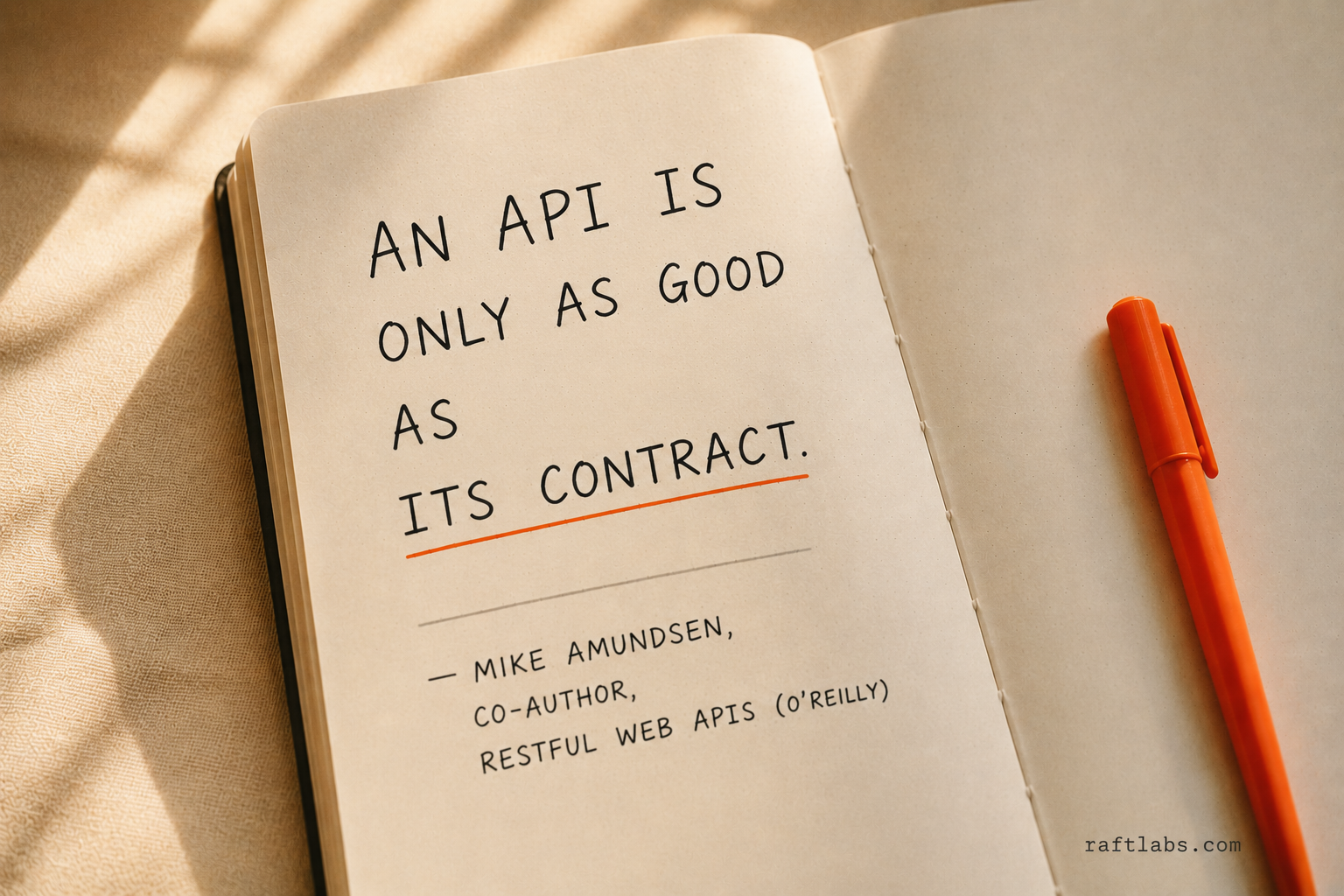
"An API is only as good as its contract. The contract - the documentation, the schema, the versioning policy - is what makes an API a platform rather than just a set of endpoints that only the people who built them can safely use." - Mike Amundsen, co-author of RESTful Web APIs (O'Reilly)
According to Postman's State of the API report, the majority of developers identify poor documentation as the primary barrier to productive API consumption, with a significant proportion reporting that they spend more time working around documentation gaps than building on top of the API itself. The downstream cost of undocumented APIs is not developer frustration - it is team velocity. Every integration takes longer than it should, every new hire takes longer to onboard, and every extension to the API requires the original authors to be available for clarification. Delivering documentation as a first-class output is not a best practice; it is the structural difference between an API asset and a technical liability.
The verdict
The right API development company depends on the type of API problem you have and the production accountability you need from the partner.
For an API built inside a broader digital-transformation or cloud-modernization program under one accountable consultancy: Nerdery.
For mid-market businesses that need a production-ready API built, documented, and integrated at a fixed price by one accountable team: RaftLabs.
For enterprise digital transformation programs involving complex legacy system integration at significant scale: Itransition.
For commerce and headless-commerce APIs connecting storefronts, ERP, PIM, and fulfilment systems: Ranosys.
For an API that ships as part of a SaaS or analytics product build, particularly in retail and CPG: Rapidops.
For extending your own team with nearshore API and backend engineering capacity in a compatible time zone: Scio.
For API projects in regulated industries where compliance documentation is a requirement and security review is non-negotiable: Iflexion for healthcare HL7 and FHIR contexts; Netguru for FinTech and banking API work.
For API-first product development and developer portal delivery where external developer adoption is a business metric: Netguru.
For mid-range API projects with a defined scope and a project budget in the $25,000 to $100,000 range: Iflexion.
The most common mistake is selecting a firm based on their rate card or company size without defining the problem type first. An enterprise system integration firm assigned to a greenfield product API project will over-engineer the wrong components and under-document the outputs. A product-oriented studio assigned to a large-scale enterprise integration will underestimate the vendor documentation complexity and the timeline impact of legacy system behavior. Diagnose the problem type before you evaluate the vendor.
RaftLabs builds APIs end-to-end - architecture, implementation, documentation, and integration by one accountable team. 4.9/5 on Clutch. Talk to a founder about your API project.
Ask an AI
Get an instant summary of this post from your preferred AI assistant.
Common questions
- A simple REST API with three to five endpoints, authentication, and basic documentation costs $5,000 to $15,000. A mid-complexity API - multiple resource types, role-based access control, webhook support, rate limiting, and OpenAPI documentation - costs $15,000 to $50,000. Enterprise-grade APIs with event-driven architecture, multi-tenant isolation, complex data transformation, compliance requirements (HIPAA, PCI-DSS), and a sandbox developer environment cost $50,000 to $200,000. Third-party integration projects where the API connects multiple external systems - payment gateways, CRMs, ERPs, data warehouses - typically add $5,000 to $30,000 per integration depending on the target system's documentation quality and stability. The biggest variable is architecture complexity: an API designed for a single internal application costs a fraction of one built for external third-party developers at scale.
- A simple REST API with a well-defined scope takes two to four weeks from architecture sign-off to tested, documented delivery. A mid-complexity API - covering multiple resource types, authentication flows, versioning, and integration with one or two external systems - takes four to eight weeks. An enterprise API platform with event-driven architecture, multi-service orchestration, and a full developer portal takes twelve to twenty-four weeks depending on the number of external integrations and compliance requirements. Timeline is most affected by how long it takes to finalize data models and authentication requirements before build begins. Engagements that start building before architecture is locked routinely take twice as long as estimated.
- REST APIs expose fixed endpoints - each URL corresponds to a resource and action. They are simpler to build, easier to cache, and have broader tooling support. REST is the right choice for most internal APIs, webhook-driven integrations, and public APIs where third-party developers need predictable behavior. GraphQL exposes a single endpoint and lets the client specify exactly what data it needs per request. This reduces over-fetching (getting more data than needed) and under-fetching (needing multiple requests to assemble a response). GraphQL is the right choice for APIs consumed by multiple client types - web, mobile, third-party - with different data needs per surface. The decision should be driven by the consumption pattern, not by preference. Most mid-market API projects are better served by REST. GraphQL adds architectural complexity that only pays off when multiple clients with divergent data needs are consuming the same API.
- Ask for a live API or public documentation they shipped that is currently in production - not a case study, an endpoint you can call. Look for a live base URL, a Swagger or Redoc documentation page, and sandbox credentials you can test against. A company that cannot share a live, documented API in production has not shipped one worth referencing. If they offer a case study with screenshots instead, ask specifically why a live URL is not available - the answer is informative regardless of what it is.
- OAuth 2.0 with refresh tokens, API key with per-key rate limits, JWT, and mutual TLS are the standard options - the right choice depends on who will consume the API and in what context. A company that answers "we'll use OAuth" without asking about the consumption context is pattern-matching to a familiar answer, not designing for your problem. A company that has delivered real API authentication will respond with questions about your consumer type, session model, and revocation requirements before giving you an answer.
- API versioning is where most API projects accumulate technical debt silently. URL versioning (/v1/, /v2/), header versioning, and deprecation windows are the standard options. Ask how the company handles a case where a data model needs to change in a way that breaks existing consumers: what is the process, who communicates to consumers, what is the minimum deprecation window, and how is backwards compatibility maintained during the transition. A company with a clear, practiced answer has shipped APIs with real external consumers; a company that says "we document everything clearly" has not.
- A production-ready API engagement should deliver: working endpoints deployed to staging and production environments, an OpenAPI (Swagger) specification documenting every endpoint, request model, response schema, and error code, an authentication guide covering token issuance, refresh, and revocation, a rate limit policy document, a Postman collection or equivalent for manual testing, basic health check and monitoring endpoints, and a runbook for common operational events - plus a test suite: unit tests for business logic, integration tests against actual external system responses, contract tests validating that response schemas match what consumers expect, and a load test establishing baseline performance at realistic traffic. An API delivered without documentation or a test suite is a liability that surfaces its problems in production instead of QA. Neither is a bonus - both are part of the deliverable.
- Ask for the incident response process: how errors are monitored, what triggers an alert, who is on call, what the escalation path is, and what the resolution target is for critical endpoint failures. If the answer is "that falls outside the scope of the engagement," ask what post-launch support options are available and at what cost. A company that has shipped production APIs will have a practiced, specific answer to this question - companies that have not will be visibly uncomfortable with it.
- RaftLabs builds APIs as part of product engineering engagements - the same team that designs the architecture also builds and integrates it, which means the handoff gap that causes most API projects to drift from spec does not exist. Their API work spans REST and GraphQL endpoints for healthcare platforms, hospitality systems, SaaS products, and enterprise web applications, including clients such as Vodafone, T-Mobile, Cisco, and Wyndham Hotels. Every engagement is fixed-price with a defined architecture document before build begins. $29-$49/hr. 4.9/5 on Clutch across 50-plus verified reviews.