Updated September 2025
Trading Platform Development: Cost, Timeline, and When Custom Beats SaaS
Fintech companies running proprietary algorithms on off-the-shelf platforms hit a wall fast. Here is what custom trading platform development actually costs, what breaks first, and when it makes financial sense to build.

In this article
Short answer
Custom trading platform development costs $120K-$500K and takes 5-14 months depending on scope. Fintech companies running proprietary algorithms, multi-asset compliance workflows, or white-label brokerage infrastructure outgrow Interactive Brokers API and Alpaca within 12-18 months. RaftLabs builds production-ready fintech platforms in structured phases starting at $120K.
Key takeaways
- SaaS trading tools (Alpaca, Interactive Brokers API, TD Ameritrade) hit hard limits at proprietary execution logic, custom compliance rules, and white-label requirements.
- A fintech MVP with order management and basic compliance runs $120K-$180K. A full algorithmic platform with multi-asset support runs $250K-$400K.
- The three systems that define whether your platform survives production are order atomicity, market data normalization, and audit logging.
- Compliance is not a feature you bolt on later. Retrofitting KYC/AML and audit trails onto a live platform costs 2-3x what building them in from the start costs.
- Most trading platform projects fail at order edge cases and data normalization, not at the UI level.
You are running proprietary algorithms through an API that was never designed for proprietary algorithms. Your compliance team keeps asking for audit trail exports the SaaS tool does not support. Your data costs have crossed $5K a month, and you still do not own a single tick.
This is the wall that fintech companies hit with platforms like Interactive Brokers API, Alpaca, and TD Ameritrade's developer tools. They work well for standard retail order routing. They stop working when you need custom execution logic, white-label compliance workflows, or market data you can actually train models on.
Here is what custom trading platform development actually costs, when the math makes sense, and where projects fail.
Cost at a glance
| Build scope | Cost range | Timeline |
|---|---|---|
| Compliant MVP (order management + KYC + basic data) | $120K-$180K | 5-7 months |
| Full platform (multi-asset, backtesting, algorithm layer) | $250K-$400K | 9-12 months |
| Institutional / DMA (FIX protocol, exchange connectivity) | $450K-$700K+ | 12-14 months |
Ongoing infrastructure and data feed costs run $1,500-$8,000 per month at scale, depending on the exchanges you cover and the data vendors you use.
Interactive Brokers API, Alpaca, and TD Ameritrade: when SaaS stops working
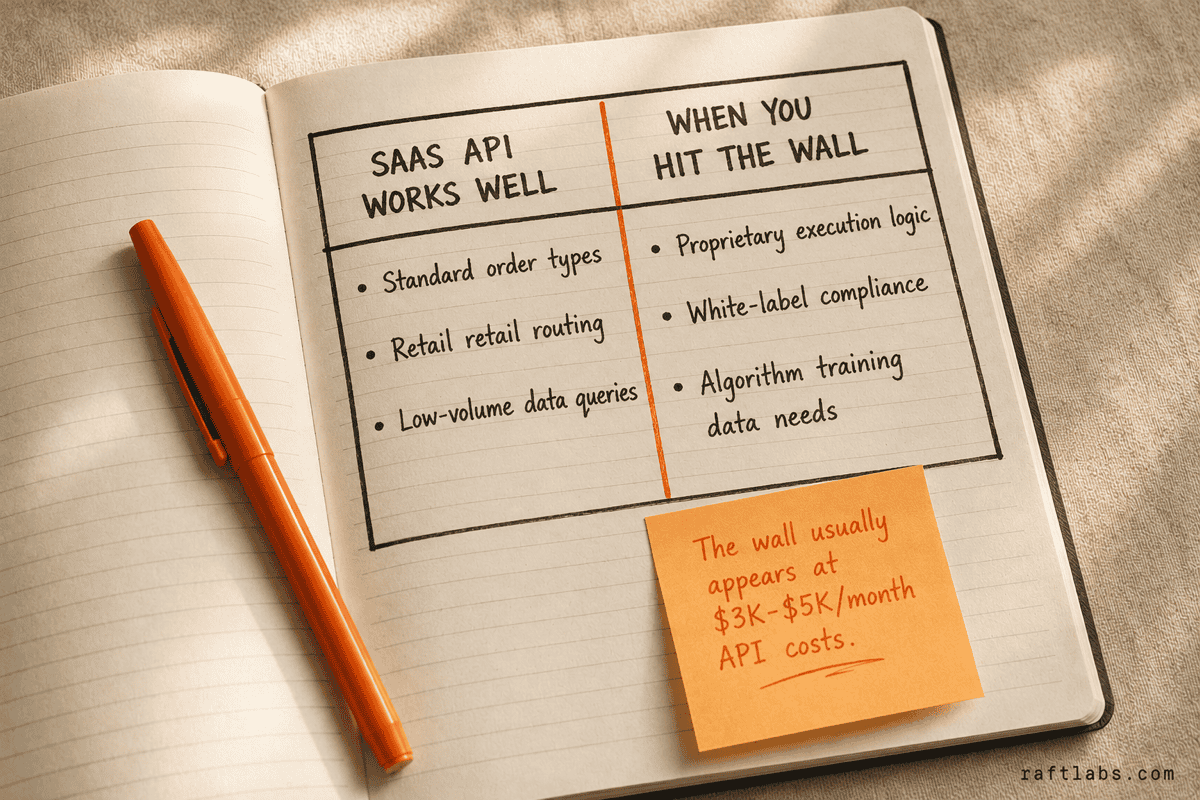
These three platforms cover the majority of fintech companies' early execution needs. Understanding exactly where each one stops is what determines whether you need custom trading software development.
Interactive Brokers API (IBKR TWS API) supports 150+ global markets, options, futures, and forex. It is the most capable of the three for sophisticated instruments. The hard limits show up at white-labeling (not permitted under IBKR's terms for third-party retail apps), custom compliance workflows (you use their compliance, not yours), and data export for training (they own the tick data feed). If your business model requires presenting the trading experience as your own product to your clients, IBKR is a technical partner, not a platform.
Alpaca is the cleanest developer experience in the space. Commission-free US equities and crypto, WebSocket and REST, well-documented. The limits arrive at order type customization (you cannot add execution logic outside Alpaca's routing), international markets (US and crypto only), and algorithmic strategy deployment at scale (their API rate limits become a ceiling well before institutional volumes).
TD Ameritrade (now Schwab API) is used mostly by retail-adjacent apps that want name recognition behind their order routing. The developer API was never designed for fintech companies building proprietary products. Rate limits are strict, real-time WebSocket data is limited, and the migration from TD to Schwab APIs in 2024 broke dozens of production integrations with no clear timeline for feature parity.
The thresholds where custom trading software development wins
You do not need to build custom on day one. The decision points that consistently make the math work out are:
Your execution logic requires modifications SaaS APIs do not permit (conditional order routing, custom fill logic, multi-leg strategies not supported by the platform)
You need white-label compliance that reflects your regulatory relationship with clients, not the broker's
Your data costs across market data feeds and API usage exceed $3,000-$5,000 per month and you do not own what you are paying for
You have hit a platform restriction or rate limit that forced you to redesign a feature in the last 12 months
You are building a B2B product where your clients need to trust your infrastructure, not know it is built on top of another platform
A 2023 study by Deloitte on financial services technology found that 67% of fintech project delays trace back to underestimated compliance requirements. That percentage is even higher for companies that started on SaaS platforms and tried to bolt compliance on later. The constraint was never the tool. It was the assumption that compliance could wait.
Who actually builds custom trading software
Not every fintech company that calls about trading platform development should build custom. Here are the four operator types where it consistently makes sense.
Fintech companies running proprietary algorithms. If your algorithm is your product, you cannot hand your execution data to a third-party API. You need to own the order log, the fill data, and the tick history. Alpaca and IBKR will show you fills, but the underlying market microstructure data stays with them. Training models on your own execution data requires your own data pipeline from day one.
Companies building B2B trading infrastructure for their own clients. If you sell trading capabilities to wealth managers, family offices, or institutional clients, they need to see your name on the compliance documentation, not Interactive Brokers'. White-labeling at this level requires your own order management system (OMS), your own KYC/AML stack, and your own audit logs. SaaS APIs explicitly prohibit this in their terms of service.
Multi-asset platforms crossing asset class lines. You can build a clean equities product on Alpaca. You can build a clean crypto product on Coinbase's API. The moment you need a unified order management layer across equities, crypto, and futures in a single account view, you are stitching together three different APIs with three different data schemas, three different rate limits, and three different reconciliation models. That complexity is cheaper to build into a single custom OMS than to maintain in integrations indefinitely.
Compliance-first operators in regulated markets. Broker-dealers, registered investment advisors building client portals, and any firm operating under FINRA's net capital rules need audit logging, exception reporting, and regulatory capital calculations that SaaS APIs do not supply. These firms need custom from day one because the regulator expects documentation of the full technology stack.
"Order management edge cases do not show up in your test suite. They show up in production at 9:31am on a Monday when the market opens. You need to design for every failure mode before you go live, not after." - Brad Peterson, former CTO of Nasdaq, at a financial technology architecture conference.
V1, V2, and V3: what to build in each phase
Breaking trading platform development into phases is not just a project management preference. It is the only way to get compliance reviewed before you add the features that depend on it, and to discover your data normalization edge cases before they affect a live order book.
V1 - Compliant foundation ($120K-$180K, 5-7 months)
The V1 is not a minimal product. It is a fully compliant one. The features that go in first are the ones that cannot be added safely later.
KYC/AML onboarding with identity verification (Jumio, Onfido, or Persona)
Account management (cash balances, buying power, bank linking via Plaid or Dwolla)
Market, limit, and stop order types with atomic execution
Portfolio view with real-time P&L (unrealized and realized)
Basic charting (1D, 1W, 1M, 1Y via TradingView Lightweight Charts)
Immutable audit log (SEC Rule 17a-4 requires 6-year retention)
Push notifications for fills and price alerts
Market data integration (Alpaca or Polygon.io for US equities)
The V1 deliberately excludes algorithmic strategy deployment, backtesting, and multi-asset support. Those features depend on the order management foundation being solid. Building them before the OMS is production-tested produces expensive bugs.
V2 - Algorithm layer and analytics ($80K-$120K incremental, 4-5 months)
Once V1 is in production and has handled real order flow for 60-90 days, the algorithm and analytics layer can be added safely.
Strategy builder (rules-based or Python-based depending on your audience)
Paper trading mode (live prices, simulated execution)
Historical data library for backtesting (10+ years via Polygon.io or your own tick store)
Backtesting engine with slippage and commission modeling
Performance analytics (Sharpe ratio, max drawdown, alpha/beta)
Screeners and scanners built on your own market data
The incremental cost range assumes the V1 OMS and data pipeline are already in place. If the V1 architecture is clean, the algorithm layer is primarily product engineering, not infrastructure.
V3 - Scale and multi-asset ($60K-$120K incremental, 3-5 months)
The V3 phase is where the platform's commercial reach expands. The work here depends heavily on which asset classes you are adding and which regulatory markets you are entering.
Multi-asset order routing (futures, options, crypto unified in one OMS)
FIX protocol connectivity for direct market access (prop desk or institutional clients)
Multi-account management for B2B clients (wealth managers, family offices)
Advanced risk dashboard (Greeks for options, VaR, drawdown monitoring)
MiFID II trade reporting if you are entering EU markets
White-label client portal with your own brand and compliance documentation
Where trading platform projects fail
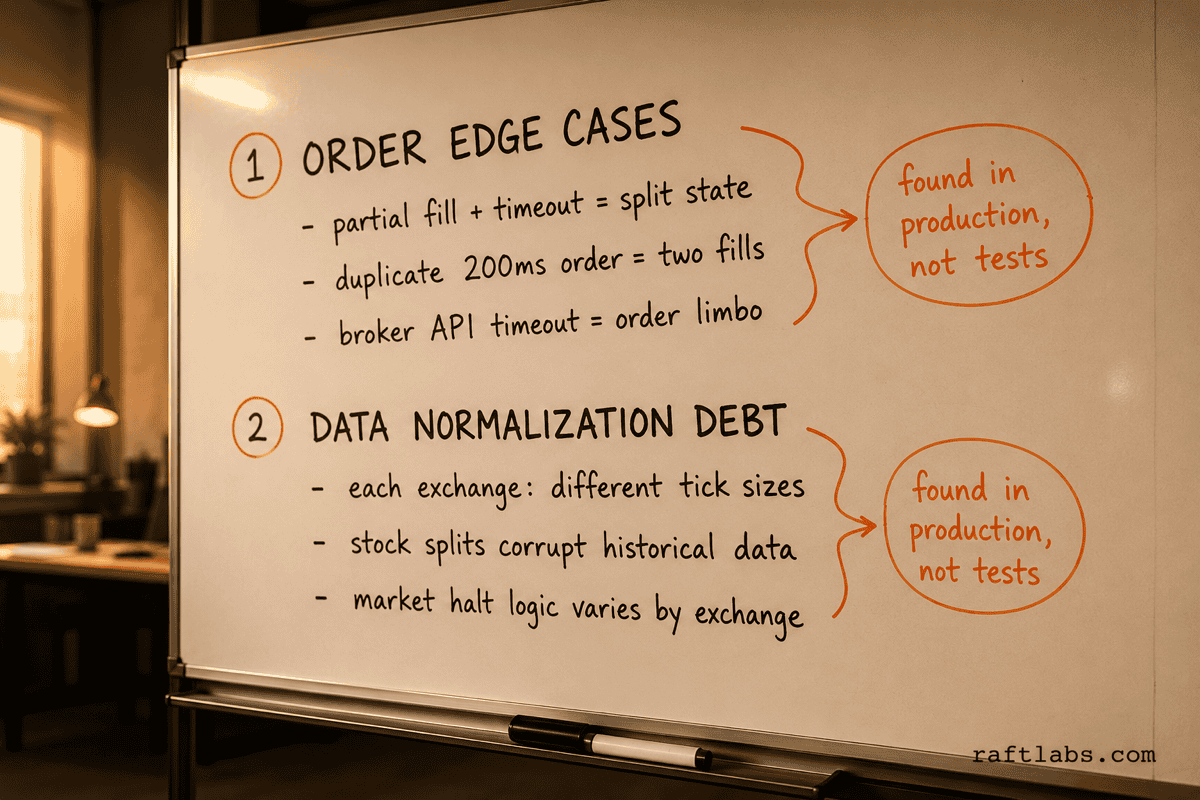
Most trading platform projects that fail do not fail because the idea was wrong. They fail at two specific engineering problems that are invisible in a demo environment.
Failure mode 1: Order edge cases in production
The OMS needs to handle three states cleanly: the order executes and the position updates, the order fails and nothing changes, or the system fails and the order is flagged for reconciliation. There is no acceptable fourth state where money moves but the position does not.
The edge cases that produce the fourth state are not exotic. They happen on normal trading days:
A partial fill comes back from the broker with the remainder unfilled. Does your OMS create one position entry or two?
A user submits the same order twice in 200 milliseconds by tapping twice. Does your system deduplicate or execute both?
The broker API times out mid-order after the execution instruction was sent but before confirmation came back. Is the order live? Is it dead?
These scenarios need explicit handling before go-live. Finding them all requires load testing against a broker sandbox API under realistic market conditions, not just unit tests. Teams that skip this step find them in production at 9:31am on a Monday.
Failure mode 2: Data normalization debt
Every exchange formats market data differently. Different tick sizes, different trading hours, different stock event handling (splits, dividends, spinoffs), different market halt logic, different precision on price fields.
Building a normalization layer that handles all of this correctly takes 3-4 weeks of engineering time that does not appear on a feature list. Teams that skip it build the normalization patchwork as they encounter each edge case in production. The debt compounds. By the time you have covered six exchanges and two years of corporate actions, the normalization layer is an undocumented mess that no one wants to touch before backtesting runs.
According to the Bank for International Settlements, global financial markets process over $7.5 trillion in transactions daily. Even a tiny fraction of that volume exposes every normalization assumption you have not made explicit.
Build the normalization layer as a documented, tested module in V1. It is not optional on a platform that will ever process real orders.
How RaftLabs builds trading platforms
RaftLabs has shipped fintech products including investment tools, payment systems, and financial dashboards. Our approach to trading platform development is structured around the same risk order that regulators and risk managers use: compliance infrastructure goes in before the algorithm layer, and the algorithm layer gets validated in paper trading before live execution.
The specific things that change what we recommend for your build:
Your regulatory path. If you are registering as a broker-dealer, the architecture and timeline are materially different from a white-label-through-Alpaca build. We scope both, and we tell you which one makes financial sense for your expected volume. FINRA's membership application timeline runs 180 calendar days from a complete application, with legal fees of $200K-$500K before any engineering starts. For the majority of fintech companies building proprietary products, white-labeling is the right first move.
Your data requirements. Polygon.io and Alpaca together cover US equities and crypto for $100-$300 a month for a small production deployment. If you need options data, futures, or international equities, costs step up materially. If you need tick-level history for algorithm training, you need either a contract with a tier-2 data vendor or a plan for building your own tick store from day one.
Your OMS complexity. A single-asset equities platform with standard order types is a clean build. A multi-asset platform with custom execution logic is not. We scope the OMS first because the OMS cost is the largest variable in the estimate.
Forrester Consulting research for LexisNexis found that financial crime compliance costs US and Canadian institutions $61 billion annually, with 99% of financial institutions reporting compliance cost increases year over year. Compliance is not a fixed cost you pay once. It is a structural expense that grows with your platform. The teams that design for this from V1 pay it cleanly. The teams that retrofit it pay it twice.
If you are at the stage where you have hit SaaS platform limits and you need a specific build scope and cost estimate, contact us and we will scope your platform in a single call.
Ask an AI
Get an instant summary of this post from your preferred AI assistant.
Common questions
- Custom trading platform development costs $120K-$180K for a compliant MVP with order management, market data integration, and KYC. A full algorithmic platform with multi-asset support and backtesting costs $250K-$400K. Institutional platforms with direct market access and FIX protocol connectivity start at $450K. Timeline runs 5-14 months depending on scope and regulatory path.
- Custom development makes sense when you need proprietary execution logic SaaS tools block, white-label compliance workflows for your own clients, multi-asset order routing that SaaS rate limits cannot support, or full data ownership for algorithm training. If you are spending more than $4K/month on SaaS API costs or have hit three platform restrictions in a year, the math usually favors custom within 24 months.
- In the US you need FINRA registration or a white-label broker relationship, KYC/AML under the Bank Secrecy Act, and SEC Rule 17a-4 audit log retention for six years. In the EU you need MiFID II, ESMA trade reporting within 15 minutes of execution, and GDPR. Budget 3-6 months for compliance setup regardless of which regulatory path you take.
- The production stack used by most fintech companies is React or Next.js for the frontend with TradingView Lightweight Charts for rendering, a Kafka or RabbitMQ queue for order processing, TimescaleDB or InfluxDB for tick data, PostgreSQL for accounts and positions, and Redis for real-time state. AWS or GCP regions near exchange co-location facilities reduce execution latency materially.
- Yes. RaftLabs has shipped fintech products including investment tools, payment systems, and financial dashboards. We build in structured phases so the compliance and order management foundation goes in first before the algorithm layer. Contact us to scope your platform and get a phase-by-phase estimate.