Updated June 2026
Grocery delivery app development: cost, build phases, and when custom software makes sense
You're paying Instacart 12-15% per order. At 400 orders a day that's over $100,000 a year. This guide covers what grocery delivery app development actually costs, which SaaS tools hit a wall, and how regional chains and dark store operators build first-party platforms that pay back in under a year.

In this article
Short answer
Grocery delivery app development costs $40,000-$70,000 for an MVP (10-16 weeks) and $70,000-$120,000 for a production platform with inventory sync, slot booking, and substitution logic (20-28 weeks). RaftLabs builds custom grocery delivery apps for regional grocery chains, dark store operators, and specialty retailers who have outgrown Instacart or need first-party customer data and custom inventory rules.
Key takeaways
- Grocery delivery app development requires 5 separate systems: customer app, shopper app, driver app, vendor dashboard, and admin panel. Most cost estimates cover only the customer app.
- Instacart charges 12-15% commission per order. At 400 orders/day on a $60 average order, that is over $105,000 per year - more than the build cost amortized over 3 years.
- Substitution logic must be designed before catalog data modeling. Retrofitting it later adds 3-6 weeks.
- Real-time inventory sync is the hardest part. A bad sync strategy produces 8-12% out-of-stock rates at picking time and drives customer churn.
- Dark store operators and specialty retailers (ethnic grocery, organic, B2B food) are poor fits for Instacart - custom builds pay back faster for them than for mainstream grocery chains.
You run a regional grocery chain or a dark store. Orders are coming in through Instacart, but the commission is 12-15% per order. You have no visibility into which customers are ordering, what their preferences are, or how to reach them directly. Your catalog has SKUs that Instacart handles poorly. Substitution logic is generic. Slot booking is out of your control.
At some point, the math tips. And you start asking: how much does it actually cost to build your own grocery delivery app?
This guide answers that question directly. It covers what grocery delivery app development costs at each phase, where tools like Instacart for Business API, Bringg, and Onfleet hit their limits, and what operators who have built first-party platforms know before they start.
Here is what the build costs:
| Scope | Timeline | Cost |
|---|---|---|
| MVP: single store, customer app, basic ordering, manual dispatch | 10-16 weeks | $40,000-$70,000 |
| Production platform: inventory sync, shopper app, substitution flow, automated dispatch | 20-28 weeks | $70,000-$120,000 |
| Enterprise: multi-retailer, batch picking, AI forecasting, full analytics | 9-12+ months | $140,000+ |
Cross-platform mobile (one codebase for iOS and Android) saves $15,000-$25,000 compared to separate native apps. Most grocery delivery builds go cross-platform unless a specific hardware requirement demands otherwise.
According to McKinsey's 2024 grocery retail report, online grocery penetration reached 12% in the US and is projected to hit 20% by 2030. The demand is real. The failure rate among grocery delivery startups in the 2021-2023 quick-commerce wave exceeded 70% - not because customers stopped ordering, but because operators underestimated what it takes to build a platform that holds up in production.
Instacart for Business API, Bringg, and Onfleet vs. custom software
These are the three SaaS tools most grocery operators evaluate before building custom. Each one solves a real problem. Each one hits a specific wall.
Instacart for Business API
The Instacart for Business API lets retailers plug into Instacart's shopper network and fulfillment infrastructure. You can offer delivery from your store without building a driver fleet. For a retailer doing under 200 orders per day, this is a reasonable trade: you pay commission, Instacart handles the logistics.
The wall hits at volume. At 400 orders per day with a $60 average order, a 12% Instacart commission costs roughly $105,000 per year. A custom platform build of $100,000 amortized over 3 years costs $33,000 per year. The math flips before year one is done.
Beyond economics, the Instacart API gives you limited control over your catalog presentation, no first-party customer data, and no ability to configure custom substitution logic. If a customer has dietary restrictions you track in your loyalty program, Instacart cannot surface that context. If your substitution rules differ from Instacart's defaults - because you carry specialty or ethnic SKUs that do not have obvious substitutes - you cannot override them.
Build custom when: order volume is above 300-400 per day, or when your catalog, substitution rules, or customer relationship do not fit Instacart's model.
Bringg
Bringg is a delivery logistics platform. It handles dispatch, route optimization, driver tracking, and delivery orchestration across large fleets. It integrates with multiple carriers and can manage complex multi-stop routing. For a chain with 20+ stores and an existing fleet, Bringg solves real operational problems.
The wall: Bringg is a delivery layer, not a full grocery platform. It does not manage your product catalog, inventory sync, shopper/picker workflows, or substitution logic. You still need to build or buy a customer-facing ordering experience, a picker app, and a vendor dashboard. Bringg connects to those systems but does not replace them.
Cost: Bringg pricing starts around $500-$1,500 per month for smaller operations and scales with volume and carrier connections. At $12,000-$18,000 per year for the logistics layer alone, plus whatever you build or license for the rest of the stack, the total cost often exceeds a custom build within 3 years.
Build custom when: you need a tightly integrated platform where inventory, picking, dispatch, and customer experience share a single data model. Bringg is a good component; it is not a full platform.
Onfleet
Onfleet is a last-mile delivery management platform: driver app, route optimization, proof of delivery, customer tracking link. It is simpler than Bringg and better suited for smaller fleets (5-50 drivers). The integration is clean, the onboarding is fast, and many grocery operations use it as a starting point.
The wall: Onfleet charges per task (delivery). Pricing starts at $550 per month for 2,000 tasks. At 400 orders per day, that is 12,000 tasks per month - around $1,500-$2,000 per month at Onfleet's mid-tier pricing, or $18,000-$24,000 per year. That does not include a picker app, catalog management, or substitution logic.
More importantly, Onfleet's driver app is a general last-mile tool. It does not know about grocery-specific workflows: multi-item orders, substitutions, weight-priced produce, or two-step payment capture. At 100+ orders per day, the gaps become operational friction that your dispatch team absorbs manually.
Build custom when: order volume makes per-task pricing expensive, or when your operations need dispatch logic tied to your inventory and substitution data.
Who actually builds custom grocery delivery software
These are the four operator types where custom grocery delivery app development makes sense - not in theory, but based on where the economics and operational fit actually work.
Regional grocery chains with 5-20 stores, doing 400+ orders per day through third-party platforms. The commission cost at this volume exceeds what a custom build costs amortized over 3 years. They also want to own the customer relationship - repeat customers should come back to their app, not to Instacart.
Dark store operators. A dark store is a purpose-built fulfillment warehouse with no walk-in retail. The entire operation is built around picking and delivery. The picker workflows, inventory management, and dispatch logic are different from retail-adjacent models. Instacart was built for retailers with physical stores. Dark store operators need a platform built around their operating model from day one.
Specialty and ethnic grocery retailers. These businesses carry SKUs that general grocery delivery platforms index poorly. Their substitution rules are different - a customer ordering a specific brand of miso paste cannot substitute a generic pasta sauce. Their customer base has dietary and cultural preferences that generic platforms cannot encode. A custom catalog with custom substitution logic is a product differentiator for them, not just a technical choice.
B2B food and grocery distributors. Restaurants, hotels, and institutions order differently from consumers: bulk quantities, scheduled delivery windows, purchase orders, account-based pricing, and net-30 payment terms. No consumer grocery delivery platform handles these. B2B food distributors consistently find that consumer-delivery SaaS forces compromises that alienate their actual customers.
"Inventory accuracy is the single biggest driver of customer satisfaction in grocery delivery. An out-of-stock rate above 3% at the picking stage produces measurable churn. Most platforms launch with 8-12% out-of-stock at picking and spend 12-18 months closing that gap."
Brittain Ladd, supply chain strategist and former Amazon executive, writing in Chain Store Age, 2023
V1, V2, and V3 features - with costs per phase
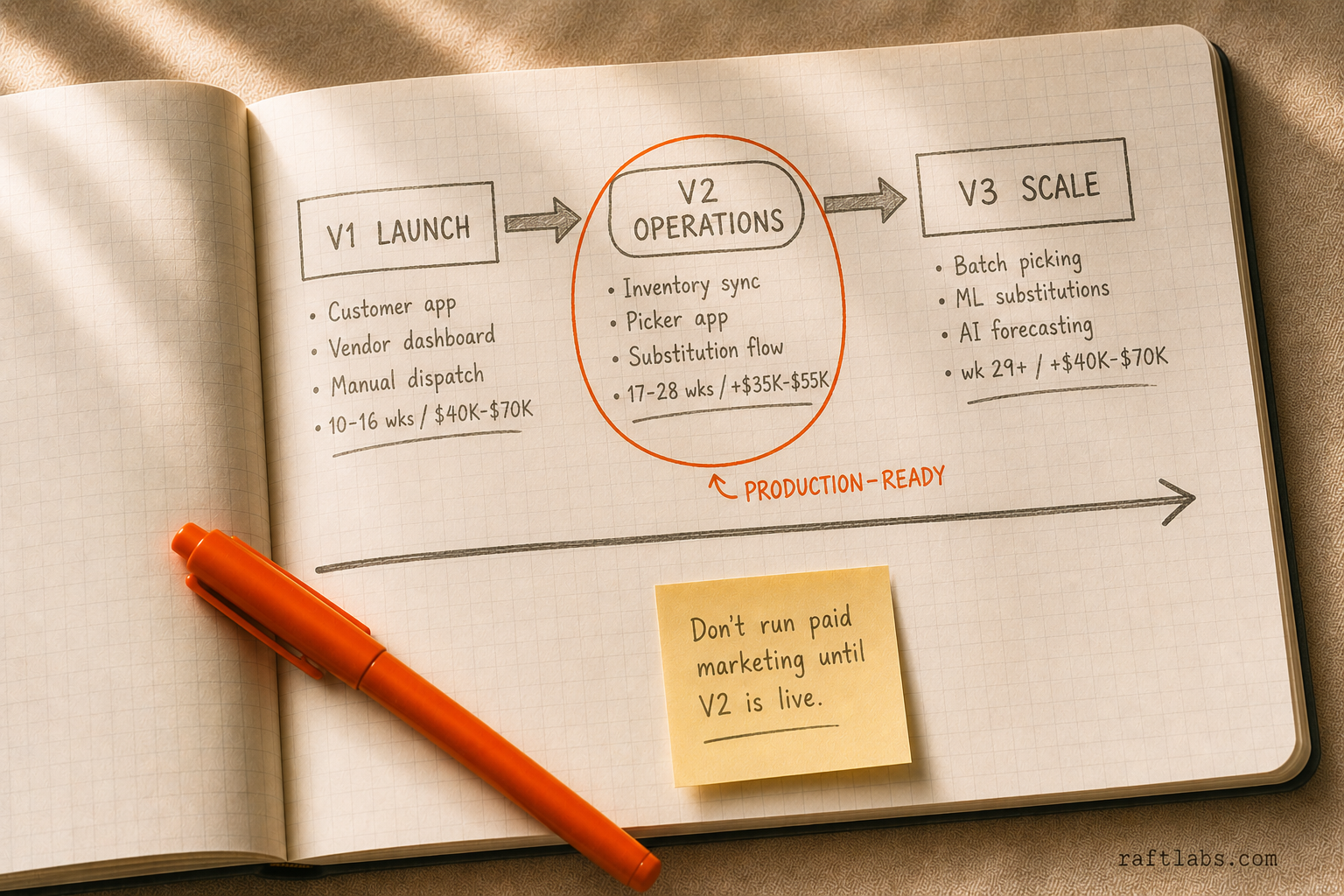
V1 - Launch (weeks 1-16, $40,000-$70,000)
The goal at V1 is proof of demand with a single store or dark store location. You are not optimizing operations yet. You are proving customers will order and orders will get delivered.
Customer app with catalog browse, search, cart, checkout, and order tracking. You need real-time in-stock/out-of-stock display, category navigation, and search that handles typos ("tomatoe" should find tomatoes). Skipping real-time stock display means customer service calls on every out-of-stock.
Vendor dashboard for the store to manage the order queue and mark items as out-of-stock. At V1, manual inventory updates are acceptable. POS integration comes in V2.
Basic driver app showing order details, delivery address, and a confirm-delivery screen. Manual dispatch - a dispatcher assigns orders to drivers by phone or a simple queue - works at 20-40 orders per day.
Payment processing with a standard charge at checkout. Two-step authorization/capture (needed for produce priced by weight) comes in V2.
V1 skips the shopper/picker app. At 20-40 orders per day, one person handles picking with a printed list. That process breaks at 80+ orders per day.
V2 - Operational reliability (weeks 17-28, additional $35,000-$55,000)
Do not run paid marketing at scale until V2 is live.
Real-time inventory sync with the store's POS or inventory system. A webhook from the store's system (triggered whenever inventory changes) gives sub-second accuracy. Polling the store's API every 2-5 minutes works for lower-volume stores. This is what takes your out-of-stock rate from 10% to under 3%.
Shopper/picker app with optimized pick lists sorted by aisle location and a clean exception flow for unavailable items. Category-sorted pick lists cut picking time by 30-40% compared to random cart-entry order.
Substitution flow end-to-end. When a picker marks an item unavailable, the system checks which alternatives are in stock, sends the customer a push notification with options, and holds dispatch until the customer responds or a timeout is reached. This requires substitution relationships to be built into the catalog from day one. Retrofitting them later adds 3-6 weeks.
Two-step payment capture. The customer authorizes a hold at checkout. The actual charge happens after picking is complete and the real total (adjusted for substitutions and weight-priced items) is confirmed.
Automated dispatch: rule-based assignment of orders to drivers based on availability and proximity. Simple rules get you 80% of routing efficiency at 10% of the build cost of a machine learning approach.
Slot booking. If your operation runs scheduled delivery windows (9-11am, 12-2pm, etc.), slot management belongs in V2. Customers select a slot at checkout. Your vendor dashboard shows order volume per slot so staff can plan labor.
V3 - Scale (week 29+, $40,000-$70,000 depending on scope)
Build V3 features only when you have crossed specific operational thresholds.
Batch picking for pickers handling multiple simultaneous orders. The ROI becomes clear above 30-40 orders per hour per picker. It reduces walking distance by 30-50% and increases throughput significantly.
ML-powered substitution suggestions. At V1 and V2, substitutions are rule-based. At scale, 6 months of order data lets you learn which substitutions customers actually accept versus reject.
AI demand forecasting. Predict which SKUs to stock more heavily on Thursdays versus Mondays, before a holiday, or ahead of a known weather event. This requires 6+ months of order history to train on anything useful.
Multi-retailer support. Adding a second store is not a configuration change. It requires isolating inventory, pricing, and order data by store. Plan $20,000-$35,000 per additional retailer type.
Where grocery delivery app projects fail
Skipping the shopper app for too long
The most common mistake is building only the customer app and deferring the picker app indefinitely. At 20 orders per day, printed pick lists work. At 100 orders per day, you have a full-time operations manager managing chaos: items not found, wrong substitutions going to customers, orders delayed because the picker did not know to notify dispatch.
If you skip the picker app for V1, set a clear trigger: "We build the picker app when we hit 80 orders per day." Know the manual labor cost between now and that trigger. At two pickers working 6-hour shifts at $18/hour, that is $216/day - around $6,500/month by the time you hit 80 orders/day. The picker app build cost pays back in about 6 months.
Launching without defined substitution logic
"We'll handle substitutions manually" breaks at 50+ orders per day. Substitution rules need to be defined before the catalog is built, because they change the data model. Every product needs a substitution group: same brand in a different size, same category at a similar price, store-brand alternative. These relationships must be mapped before catalog ingestion. Retrofitting them into an existing catalog takes 3-6 weeks.
The specific business decision you must make before writing any code: what happens when the customer does not respond to a substitution notification within 10 minutes? Do you apply the best substitute automatically? Skip the item and adjust the total? Call the customer? Each choice has different consequences for operations and customer experience. Define it first.
According to a 2023 Bain study on grocery retail operations, retailers with real-time inventory visibility reported 23% fewer order fulfillment errors compared to those relying on batch sync. The technology is not the hard part. Getting the store's legacy POS to share data in real time is.
How RaftLabs builds grocery delivery platforms
We have built food and grocery delivery platforms from single-store MVPs to multi-retailer operations. The substitution logic, inventory cache patterns, and picker app workflows in this guide are the same ones we use on every build.
A few things that show up in our scoping calls that most teams are not prepared for:
Catalog normalization takes longer than expected. Most retailers assume their product data is usable. Most of the time, it is not. Category hierarchies are inconsistent. 20-40% of SKUs have missing images. Prices are in different formats across departments. Substitution relationships do not exist at all. We budget 2-4 weeks for catalog normalization per retailer partner. This is not glamorous, but it directly determines whether the customer experience is good or broken.
POS integration is never a simple API call. The store's IT team has to be involved. Their system may have no API. Expect 4-8 weeks per store integration. We always build a manual inventory update fallback (a simple screen where store staff mark items as out-of-stock) so operations can run while the integration is being built.
The first 6 months of order data are worth more than any V3 feature. Logging every order, every substitution accepted and rejected, every slot that fills up early, every SKU that goes out of stock at 6pm on Fridays - this data is what makes AI forecasting and ML substitutions actually work. We build the data pipeline in V1, even if you are not using AI features yet.
If you are a regional grocery chain, dark store operator, specialty retailer, or B2B food distributor evaluating whether a custom build makes sense for your order volume and catalog, the scoping call takes 30 minutes. We come with a number by the end of it. See our MVP development services for how we structure the engagement.
If you are below 200 orders per day and Instacart is working, keep using it. The custom build conversation is worth having when the commission math tips, when your catalog does not fit, or when owning the customer relationship becomes a business priority.
Ask an AI
Get an instant summary of this post from your preferred AI assistant.
Common questions
- An MVP with a customer app, basic vendor dashboard, and manual dispatch costs $40,000-$70,000 and takes 10-16 weeks. A production platform with real-time inventory sync, a shopper app, substitution flow, and automated dispatch runs $70,000-$120,000 over 20-28 weeks. Enterprise builds with multi-retailer support and AI forecasting start at $140,000.
- When commission costs at your order volume exceed your build cost amortized over 3 years. For most chains at 400+ orders/day, a $100,000 build amortized over 3 years ($33,000/year) costs less than 12% commission on a $60 average order ($105,000/year). Custom also wins when you need first-party customer data, a catalog Instacart cannot serve, or dark store dispatch logic.
- At V1 you need: a customer app with catalog search, cart, checkout, and order tracking; a vendor dashboard for managing the order queue and manual inventory updates; a basic driver app for order details and delivery confirmation; and payment processing. The shopper/picker app is a valid V2 item if order volume is under 80/day at launch.
- The best approach is a webhook from the store's POS that fires whenever inventory changes - accuracy under one second. Polling the store's API every 2-5 minutes is acceptable for lower-volume stores. Daily file import is a last resort. Even with webhook sync, the picker app needs an exception flow for items the system shows as available but the picker cannot find on the shelf.
- An MVP takes 10-16 weeks. A production platform with real-time inventory sync, shopper app, and substitution flow takes 20-28 weeks. Add 2-4 weeks per retailer partner for catalog normalization (cleaning and structuring the store's product data). POS integrations take 4-8 weeks per store and often require the retailer's IT team.