Custom Software Development: The Complete Business Guide
Custom software costs $25K to $500K+ and takes 8 to 40 weeks - here's how to know if it's the right answer, what it actually costs, and how to avoid the five most expensive mistakes.

In this article
Short answer
Custom software development is the process of building software designed for one specific business, rather than buying a packaged solution designed for many. It costs $25,000 for an MVP to $500,000+ for a complex enterprise system, and takes 8 to 40 weeks depending on scope. The right vendor diagnoses your problem before writing a proposal - not after. RaftLabs builds custom software on 12-week fixed-price sprints starting at $25K, with a free diagnostic call before any commitment.
Key takeaways
- Custom software is built for your specific business problem - not packaged for everyone. It costs more upfront than SaaS but creates competitive advantages that off-the-shelf tools cannot.
- Custom is the right answer in five scenarios: when off-the-shelf doesn't fit your workflow, when a process is genuinely unique, when scale makes SaaS costs exceed build costs, when you need integrations no platform supports, or when your product is your competitive moat.
- A realistic MVP costs $25K-$75K and takes 8-12 weeks. A full production platform with integrations, AI, and scale costs $150K-$500K+. Anything quoted below $15K is a red flag.
- The five biggest failure modes in custom software are: skipping discovery, building too much too fast, choosing the wrong vendor, ignoring post-launch costs, and treating the first build as the final product.
- The right process starts with a diagnostic, not a proposal. The vendor who asks the hardest questions before writing a line of code is the vendor most likely to deliver something that works.
Most businesses don't need custom software. They think they do, but what they actually need is a better process, or a SaaS tool they haven't found yet, or an integration between two systems they already have. According to Grand View Research, the global custom software development market was valued at $44.2 billion in 2025 and is growing at a CAGR of roughly 20%. It is a sign that the businesses which do need custom software are finding it increasingly viable and competitively necessary.
The companies that do need custom software tend to share one characteristic: they've hit a wall. The SaaS tools available don't fit. The workarounds are costing money. The manual processes are a competitive liability. The problem is genuinely specific to them.
If you're a CEO, COO, or founder sitting with a real business problem - and you're not sure whether custom software is the answer, what it costs, or how to do it without getting burned - this guide is for you.
What is custom software development?
In plain English: custom software is software built specifically for your business, not packaged and sold to everyone.
A spreadsheet is a general-purpose tool. A CRM is a packaged product designed for most businesses. Custom software is designed for one business's specific problem, data model, and workflow.
The difference matters in practice. A packaged CRM makes you fit your workflow to its data model. A custom CRM (or a custom layer built on top of a CRM) makes the software fit your workflow. That sounds like a minor distinction, but in complex businesses, it's the difference between a tool people actually use and a tool that adds process overhead.
Custom software development is the full process of making that happen. It includes:
Problem diagnosis - confirming what the software needs to do before designing it
Architecture design - deciding how it's built, what it connects to, where data lives
UX and UI design - how users interact with it
Backend development - the logic, data model, and APIs
Frontend development - the interface users see
Integrations - connecting to your existing systems
QA and testing - verifying it works correctly
Deployment - getting it live in production
Post-launch maintenance - keeping it running, fixing bugs, adding features
All of this is custom, meaning it's designed and built for your problem specifically.
Custom software vs. off-the-shelf: how to decide
This is the most important question to answer before spending a dollar on development.
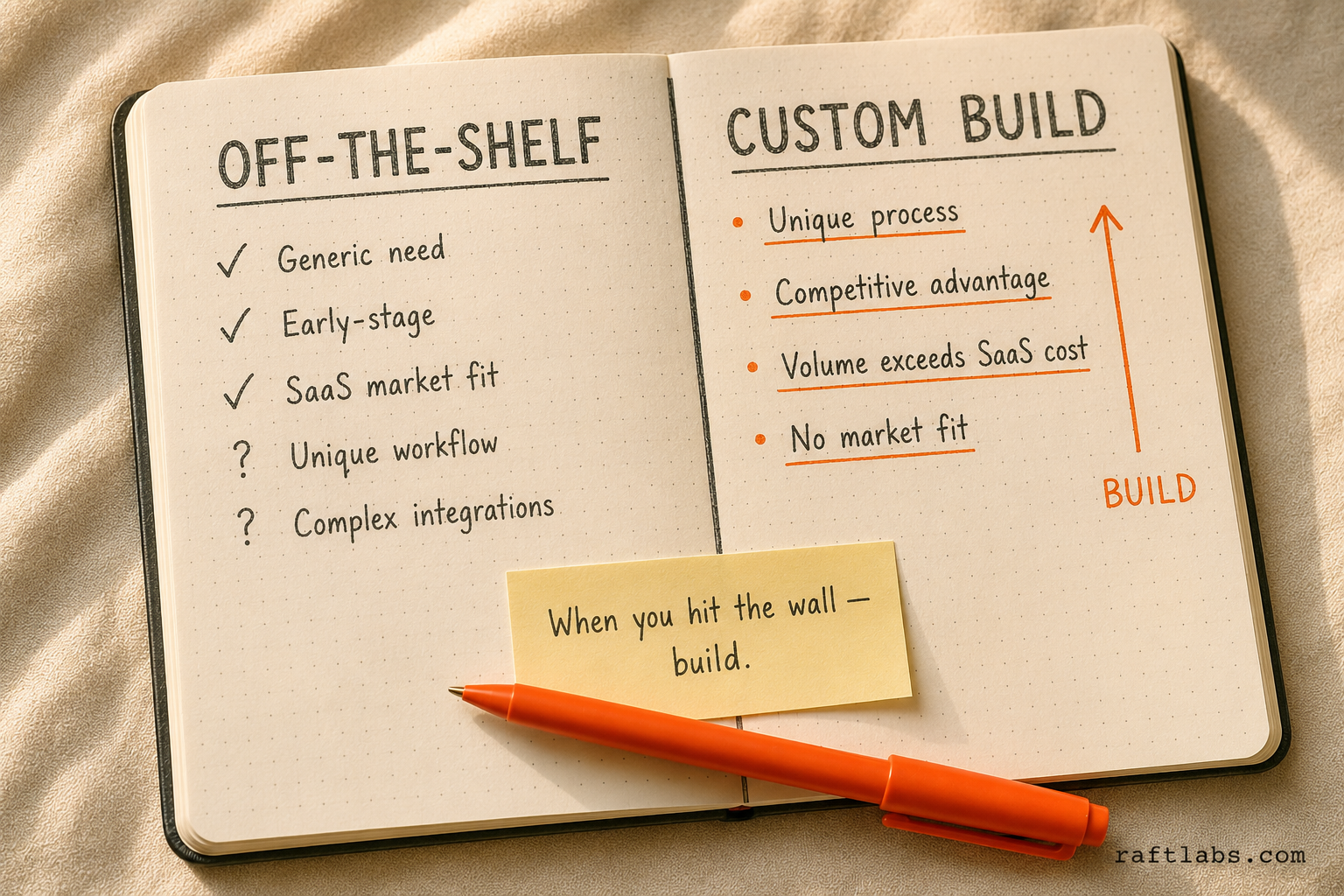
| Decision factor | Choose off-the-shelf | Choose custom |
|---|---|---|
| Problem specificity | Generic need (project management, CRM, invoicing) | Highly specific workflow unique to your business |
| Competitive sensitivity | Process is similar to competitors | Process is your competitive advantage |
| Budget | Under $50K, or early-stage | $50K+, or ROI calculation clearly supports build |
| Timeline | Need a solution in weeks, not months | Can invest 3-9 months in the right solution |
| Integration needs | Standard integrations (most SaaS supports) | Deep, custom, or proprietary system integrations |
| SaaS market fit | Good solutions exist in the market | No existing product solves 80% of the problem |
| Team capacity | No engineering team | Internal team to maintain and extend the product |
If more than three rows in the left column describe your situation, start with off-the-shelf. Configure it aggressively. Integrate it with APIs. Use automation to fill gaps. Most companies discover the off-the-shelf tool handles 85% of their problem, and a custom integration or automation script handles the other 15%.
Build custom when the decision genuinely falls in the right column for most of these factors.
When custom software is the right answer
Scenario 1: Your process is unique by design
Some businesses run processes that don't map to any packaged product. A specialty logistics company with a routing algorithm built around client-specific constraints. A healthcare provider with a triage protocol that doesn't fit any standard EHR workflow. A financial services firm with a risk assessment model that's their actual competitive differentiation.
When your process is genuinely proprietary, off-the-shelf tools don't just fail to fit - they can actively damage your competitive position by forcing you into standard workflows.
Scenario 2: You've outgrown the SaaS tools
You started with Airtable. Then you added Zapier. Then you added a second Airtable base. Then a third. Now your team has 12 different tools that half-integrate with each other, your data is inconsistent across systems, and every process involves manual reconciliation.
This is the SaaS-stack collapse pattern. It doesn't mean SaaS was wrong - it was probably right at the time. But when the integration overhead and error rate cost more than the tools save, it's time to consolidate into a custom system.
Scenario 3: SaaS costs exceed build costs at your volume
Most SaaS is priced per seat or per transaction. At small scale, it's cheap. At large scale, it can be surprisingly expensive.
A simple calculation: if you're paying $150,000/year in SaaS subscription costs for a tool you'd use for five years, that's $750,000 in SaaS spend. A custom alternative might cost $200,000 to build and $30,000/year to maintain. The build pays for itself in under two years. IDC's Worldwide Software Development Services Forecast found that enterprise spending on custom software development is growing at 2.3x the rate of packaged software. That is a market signal that more companies are running this math and choosing to build.
Run this math before assuming SaaS is always cheaper.
Scenario 4: You need integrations no platform supports
Your ERP is 15 years old. Your manufacturing system is bespoke. Your customer data lives in a legacy database that no modern SaaS can connect to.
When your integration requirements are complex enough that off-the-shelf tools either can't connect or require expensive third-party middleware that still only covers 70% of what you need, a custom integration layer - or a custom application with native connectors - is often the cleaner answer.
Scenario 5: Your software is your product
If you're building software that customers pay for, off-the-shelf isn't an option by definition. You're not buying a tool. You're creating one. This is the most obvious case for custom development, but it's worth stating plainly: if software is how you earn revenue, custom is the only answer.
How much does custom software development cost?
Here's the honest breakdown. The ranges are wide because scope varies enormously. But these are realistic numbers from products we've shipped.
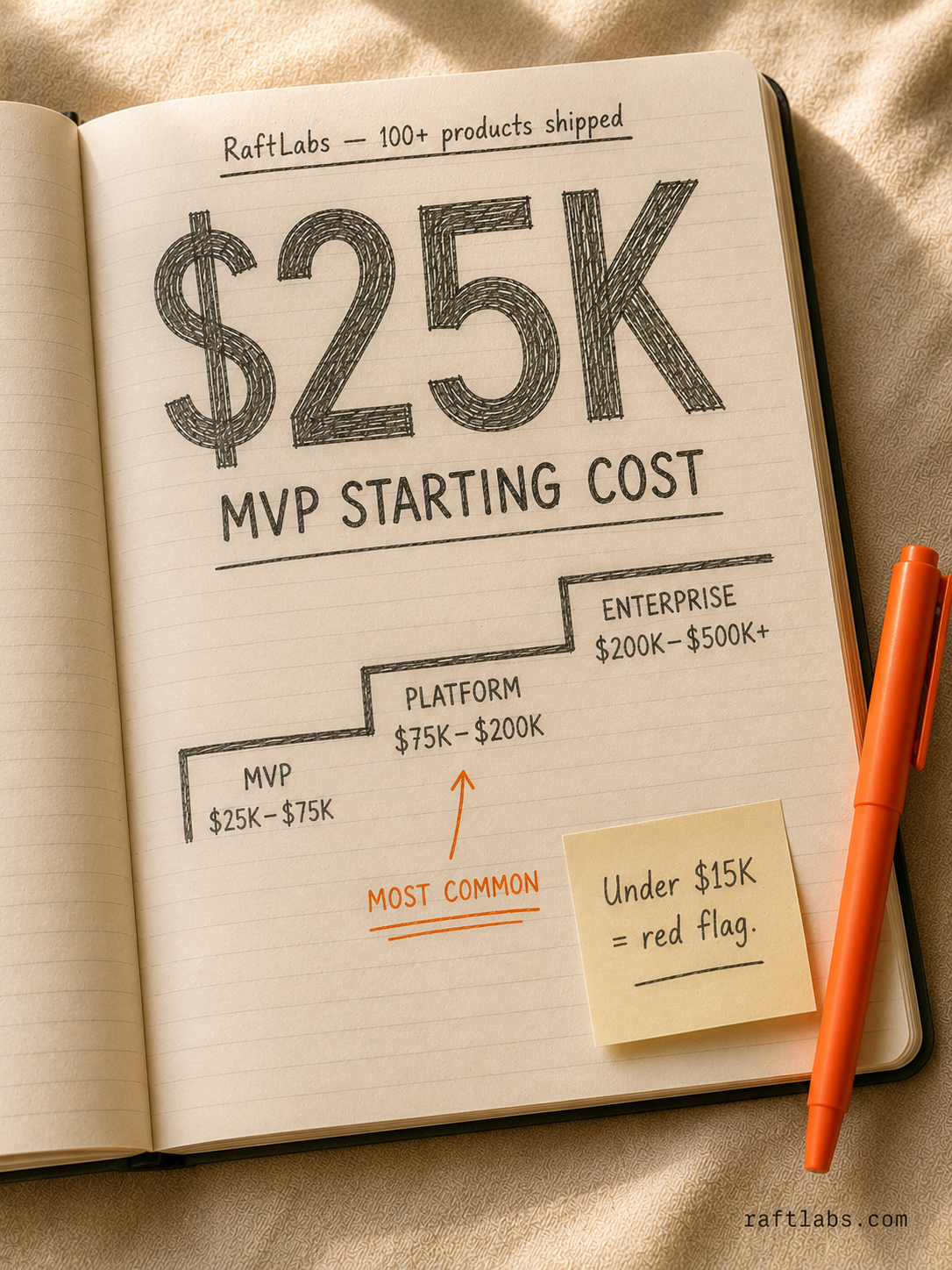
| Project type | Cost range | Timeline | What's included |
|---|---|---|---|
| MVP / proof of concept | $25,000-$75,000 | 8-12 weeks | One core workflow, basic UI, 1-2 integrations, no AI |
| Standard web platform | $75,000-$200,000 | 16-24 weeks | Multiple user roles, 3-6 integrations, data dashboard, basic automation |
| Mobile application | $75,000-$175,000 | 14-22 weeks | iOS and/or Android, backend API, basic integrations |
| AI-integrated product | $100,000-$300,000 | 16-30 weeks | LLM integration, custom AI workflows, vector storage, evaluation infrastructure |
| Enterprise platform | $200,000-$500,000+ | 28-52 weeks | Multi-tenant, SSO, audit logs, compliance, complex data model, scale infrastructure |
| Full product rebuild | $150,000-$400,000 | 20-40 weeks | Re-architecture of existing system, data migration, parallel running period |
What drives cost up:
Number of third-party integrations (each adds $5,000-$30,000 depending on API quality)
Compliance requirements (HIPAA, SOC 2, GDPR - adds 20-40% to total cost)
Real-time features (live chat, video, websockets - adds significant infrastructure cost)
AI and LLM integration (adds $30,000-$150,000 for production-grade agent or workflow)
Multi-region deployment (adds 15-30%)
RaftLabs pricing: $29-$49/hr for dedicated sprint teams. Fixed-price sprints start at $25K. This positions us in the mid-market range - not the cheapest you'll find, but not enterprise consulting rates either. The 12-week sprint model gives you a defined delivery cycle with a fixed cost.
What to be suspicious of: Proposals under $15,000 for anything more than a landing page or a simple CRUD app. Proposals that don't break down cost by phase. Proposals that don't mention integration costs or post-launch maintenance.
The custom software development process
A professional process has 8 phases. Any vendor who skips phases 1-2 is selling you a build, not a solution.
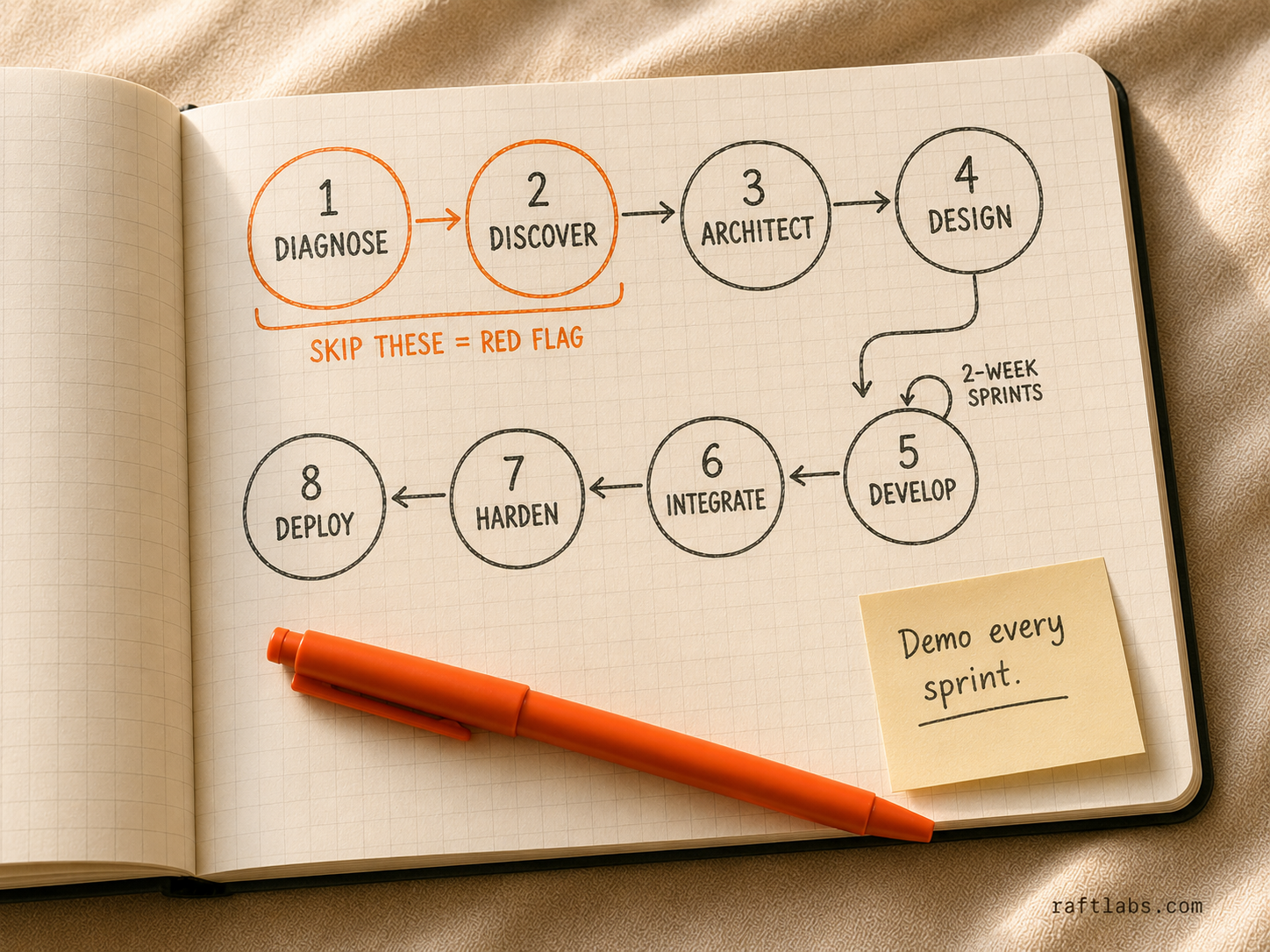
Phase 1: Problem diagnosis
Before design, before architecture, before any code - the vendor needs to understand your actual problem. This means stakeholder interviews, process mapping, and reviewing what's currently broken or manual. The output is a problem statement you sign off on, not a project spec.
RaftLabs starts every engagement with a diagnostic call. The goal isn't to sell a project - it's to confirm we understand the problem well enough to solve it. If the diagnostic reveals that custom software isn't the right answer, we say so.
Phase 2: Discovery and scoping
With the problem defined, the vendor works with you to scope the solution. What does the MVP include? What's deferred to phase 2? What are the success criteria? What are the must-have integrations?
The output of discovery is a documented scope with enough detail to price accurately. Discovery typically takes 1-2 weeks. Any vendor who skips discovery produces proposals that are either padded (to cover unknown risk) or under-scoped (to win on price, then expand).
Phase 3: Architecture and technical design
The engineering lead designs the system architecture. Data model, API design, infrastructure decisions, tech stack selection, security model. This is documented and reviewed with you - not because you're going to make the technical decisions, but because you need to understand what you're building and why.
Architecture affects everything downstream: performance, maintainability, cost to scale, and ease of adding features later. A weak architecture is the most expensive mistake in software development. It's invisible at launch and brutal at scale.
Phase 4: UX and UI design
User experience design precedes frontend development. Wireframes first, then visual design. User flows are mapped. Edge cases are accounted for. The design is reviewed and approved before development begins.
This isn't just aesthetics. Good UX design prevents expensive rework. Building the wrong UI in code costs 3-5x more to fix than catching it in a wireframe.
Phase 5: Development sprints
Code. 2-week sprints. Each sprint has a defined scope - specific features or workflows. Each sprint ends with a demo in a staging environment. Real features, real data where possible, not mockups.
You review every sprint. Feedback goes into the next sprint. There are no surprises at the end of a 12-week engagement, because you've been watching it get built the whole time.
Phase 6: Integration and testing
Connecting to external systems - your CRM, ERP, payment processor, data sources. Each integration is tested independently and then tested as part of the full system. QA runs regression testing across all features, not just the ones built in the last sprint.
Phase 7: Performance, security, and go-live preparation
Load testing. Security review. Penetration testing if required. Database performance optimization. Deployment pipeline setup. Monitoring and alerting configured. Documentation written.
This phase is where many vendors cut corners. Performance problems that weren't caught in testing become production incidents. Security gaps that weren't reviewed become breaches. Don't skip it. Don't let a vendor skip it.
Phase 8: Deployment and post-launch
Go-live. Not with a prayer, but with a plan: a deployment checklist, a rollback procedure, a monitoring dashboard, and a first-response protocol for production issues.
After launch, a professional vendor builds in a warranty period - typically 30-90 days of bug fixing at no additional cost. This isn't charity - it's a sign that the vendor is accountable for what they shipped.
How to avoid the 5 biggest custom software failures
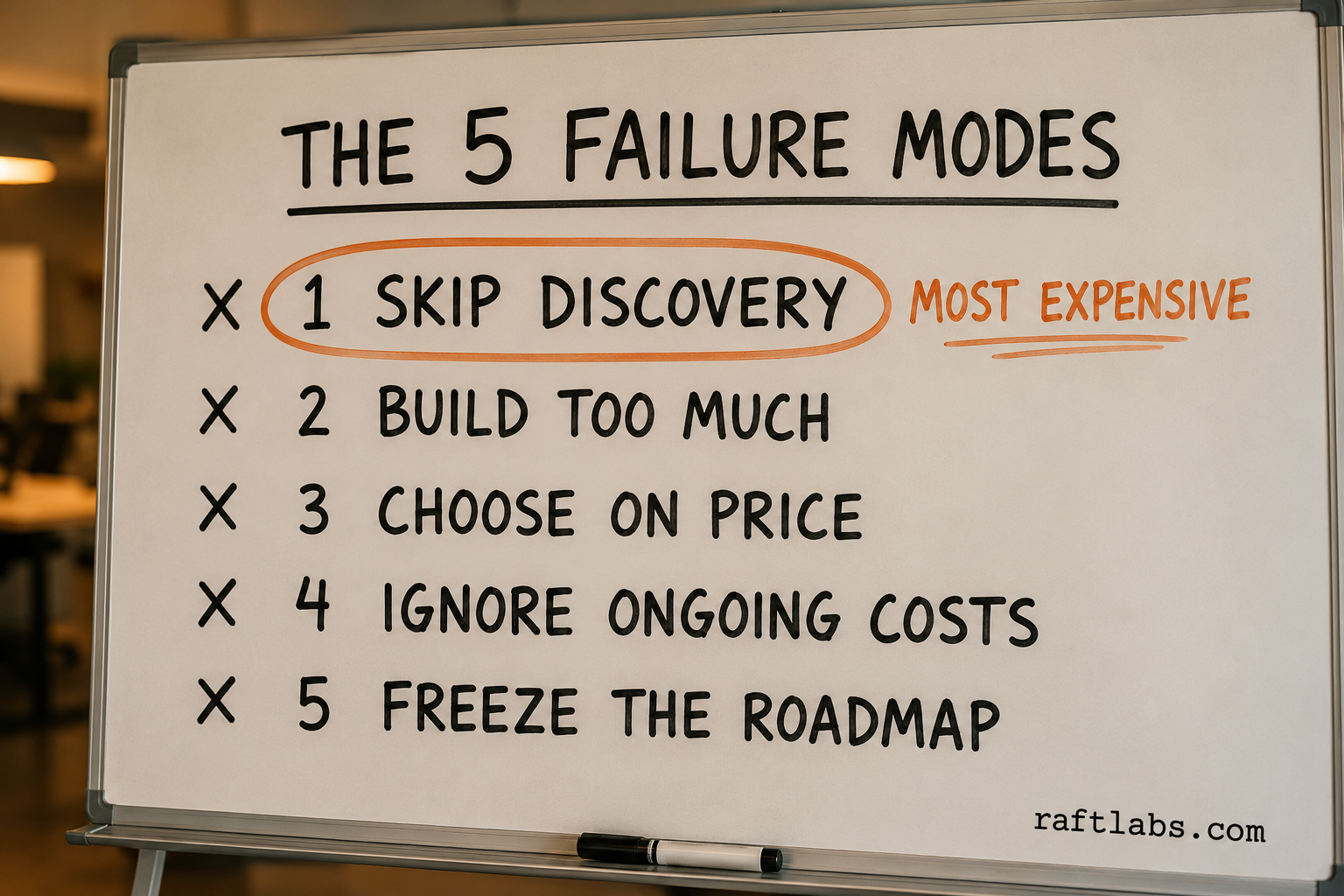
Failure 1: Skipping discovery
You know what you want to build. You tell the vendor. They build it. You launch it. Nobody uses it the way you expected.
Discovery exists because what stakeholders say they want and what would actually solve the problem are often different. A three-week discovery process that uncovers a wrong assumption saves hundreds of thousands of dollars in wasted development.
The fix: insist on a formal discovery phase. Review and approve the problem definition before any code is written.
Failure 2: Building too much too fast
The instinct is to scope everything in the first build. Every feature, every edge case, every "nice to have." The result is a 40-week project that delivers something nobody tested until the end.
Software built in small increments is software you can validate, adjust, and improve. Software built all at once is a bet that everything you designed at the start is still the right thing 40 weeks later. It almost never is. Gallup's State of the Global Workplace report found that disengaged teams cost businesses 23% in lost productivity. That cost compounds fast when a software project misses its target because scope was frozen too early and users never adopted the result.
The fix: build an MVP with the smallest scope that demonstrates real value. Launch it. Learn from real users. Extend it based on what you learn.
Failure 3: Choosing on price
The cheapest proposal almost never results in the cheapest project. Under-scoped proposals produce change orders. Low-cost teams produce code that costs more to maintain, extend, and debug than it cost to write.
The fix: evaluate on value, not price. Ask for the same scope from every vendor and compare at equal scope. Then choose on capability, process, and fit - not hourly rate.
Failure 4: Ignoring post-launch costs
Custom software isn't a one-time purchase. It's an ongoing investment. Infrastructure costs money monthly. Maintenance keeps it secure and functional. New features cost development time. These costs are real and often underestimated.
Realistic ongoing costs for a mid-complexity custom application:
Cloud infrastructure: $500-$5,000/month depending on scale
Third-party API costs: $200-$2,000/month
Maintenance and monitoring: $2,000-$8,000/month (engineer time or retainer)
Feature development: as needed
The fix: build post-launch costs into your business case from day one. A software build that makes financial sense at $200K becomes unattractive if the $5,000/month in ongoing costs wasn't in the model.
Failure 5: Treating the first build as the final product
Software is never finished. The first version teaches you things about your users, your data, and your process that no amount of planning could have surfaced.
Companies that launch and then freeze the roadmap - waiting for it to "stabilize" before adding features - lose the advantage of having built the product themselves. The whole point of custom software is that you can change it. If you're not changing it regularly based on real-world feedback, you're not capturing that advantage.
The fix: plan for a version 2. Budget for a roadmap. Treat launch as the start of a software product lifecycle, not the end of a project.
How to choose the right development partner
Choosing a development partner is a separate decision from deciding to build custom software - and it deserves its own careful evaluation.
The short version of what to look for:
- Diagnostic process - do they ask hard questions before writing a proposal?
- Portfolio fit - have they built something similar to what you need?
- Who actually builds - is the delivery team the same as the sales team?
- IP ownership - is it explicit in the contract?
- Pricing model - fixed-price sprints are the safest model for most engagements
- Communication cadence - demo every two weeks, minimum
- Post-launch support - warranty period plus a defined ongoing support model
The full evaluation framework is in our post on how to choose a custom software development company. That post includes the 10 interview questions to ask vendors and the 5 red flags to watch for.
Questions to ask before you start
Before you issue any RFP or make any vendor calls, work through these questions internally.
1. What is the specific problem we're solving?
Not the solution. The problem. Articulate it as: "Currently, [process] takes [X time / costs $Y / produces Z% error rate] because [root cause]. This costs us [measurable business impact]."
2. What does success look like in 6 months?
Specific, measurable outcomes. Not "more efficient operations" but "onboarding time reduced from 14 days to 3 days" or "manual data entry errors reduced from 12% to under 1%."
3. What does this connect to?
List every system the software needs to read from or write to. This list is the single biggest driver of integration cost and complexity.
4. Who are the users?
Internal team? Customers? Partners? How many? What devices? What's their technical sophistication? This shapes the UX and security requirements significantly.
5. What can't change after launch?
Data model constraints. Regulatory requirements. System interfaces that other departments depend on. These are non-negotiables that the vendor needs to know upfront.
6. What happens if this project takes 6 months longer than expected?
If the honest answer is "we're in trouble," that's important. It means you need a vendor with a fixed-price sprint model - cost and timeline predictability matter. If you have flexibility, you have more options.
Custom software development can be one of the highest-impact investments a business makes. It's also one of the easiest to waste. The difference is usually not the technology - it's whether you started with a clear problem and found a vendor who helped you think before they started building.
If you're at the early stage and want a structured way to think through whether custom software is right for your problem, RaftLabs runs a free 30-minute diagnostic call. No proposal, no pitch - just a direct conversation about your problem and what the right solution looks like.
Ask an AI
Get an instant summary of this post from your preferred AI assistant.
Common questions
- Custom software development is the process of designing and building software specifically for one business, rather than buying a packaged product designed for general use. It includes architecture design, UI/UX, backend and frontend development, integrations with existing systems, QA, and deployment. The result is software that fits your exact workflow, data model, and business rules - something off-the-shelf tools cannot provide.
- Custom software development costs $25,000-$500,000+ depending on scope. A simple MVP (one core workflow, basic UI, limited integrations) costs $25,000-$75,000 and takes 8-12 weeks. A production platform with multiple user roles, third-party integrations, and AI capabilities costs $150,000-$400,000 and takes 20-40 weeks. Enterprise systems with complex compliance, data architecture, and multi-region deployment can exceed $500,000.
- An MVP takes 8-12 weeks. A production-ready platform takes 16-30 weeks. An enterprise-grade system takes 30-52 weeks or more. Timeline is primarily driven by integration complexity (connecting to existing systems), compliance requirements (healthcare, fintech, legal), and the number of user roles and workflows in scope. Vendors who quote 4 weeks for a complex platform are underscoping, not fast.
- Buy off-the-shelf when a SaaS tool solves 80%+ of your problem, when you're early-stage and your workflow will change significantly, when the cost of the SaaS is clearly less than the build cost over 3 years, or when the problem isn't core to your competitive differentiation. Build custom when your process is genuinely unique, when the volume of work makes SaaS costs exceed build costs, when you need integrations no platform supports, or when the product is how you compete.
- RaftLabs has shipped custom software across AI, loyalty, hospitality, fintech, and healthcare. We start with a diagnostic - not a proposal - so you know what you're actually building before you commit. 4.9/5 on Clutch. Fixed-price 12-week sprints, starting at $25K.