How to Choose a Custom Software Development Company
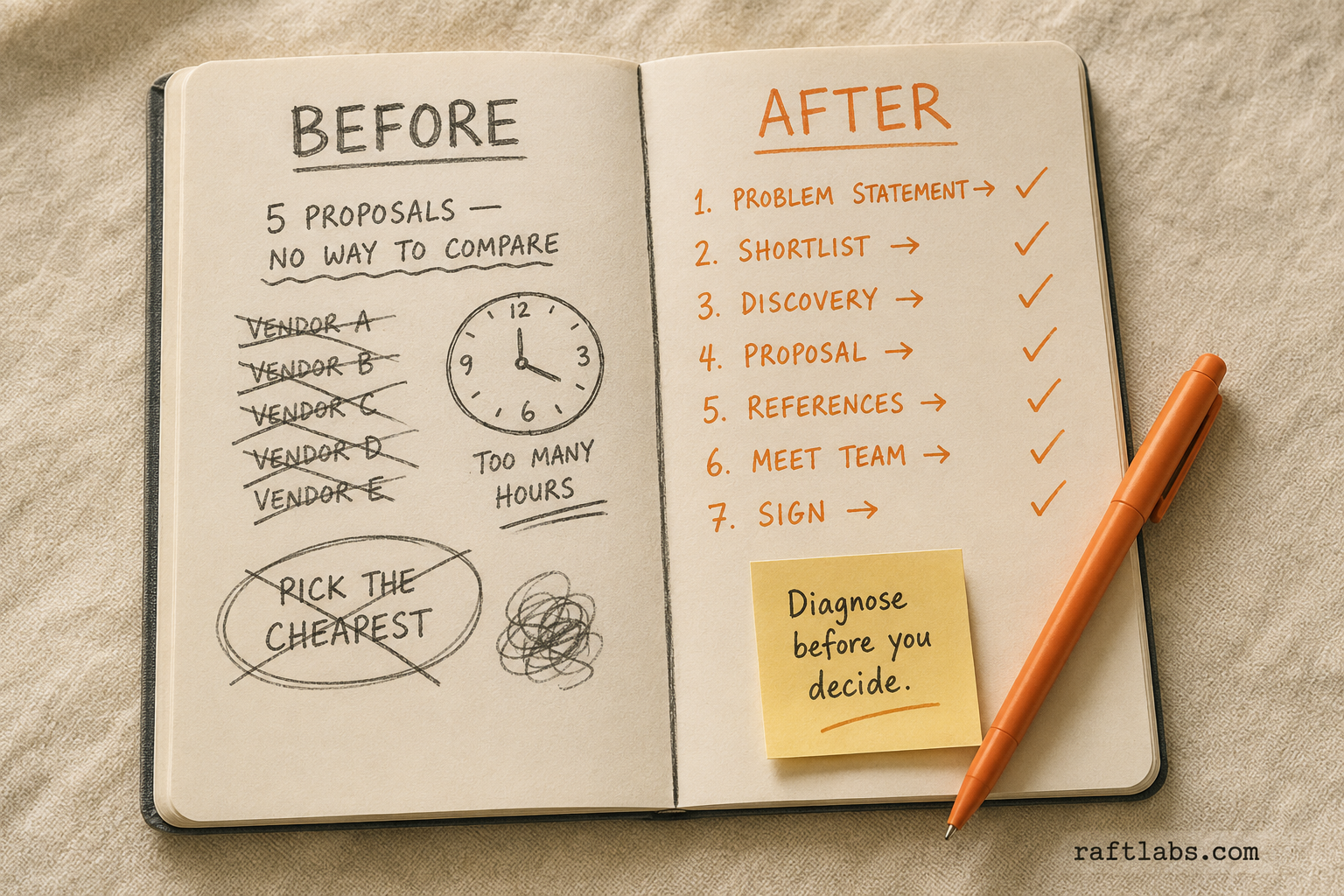
You've got 5 vendor proposals on your desk and no way to compare them - here's the evaluation framework that actually works.

In this article
Short answer
To choose a custom software development company, evaluate eight criteria: whether the vendor diagnoses before proposing, portfolio fit with your domain and complexity, who actually builds (not just who sells), IP ownership terms, pricing model trade-offs, post-launch support, demo cadence, and reference quality. The most important signal is whether the vendor asks hard questions before writing a proposal. RaftLabs starts every engagement with a diagnostic call before any proposal - this is what good looks like.
Key takeaways
- Custom software proposals are hard to compare because vendors solve different problems - some quote what you asked for, others quote what you actually need. The gap is huge.
- Before evaluating vendors, answer two questions: what specific problem needs solving, and is custom software actually the right answer? If you can't answer these, every proposal will be misleading.
- The single most important evaluation criterion is whether the vendor diagnoses before proposing. Any firm that sends a proposal within 24 hours of a discovery call hasn't done the work.
- IP ownership must be explicit in the contract. Ambiguous language about 'work product' is not sufficient. You need full assignment of all code, design files, and technical documentation.
- Ask vendors about failed projects, not just wins. The quality of how a vendor talks about failure reveals more about their operating culture than any success story.
You've done the work. You've decided custom software is what your business needs. You've reached out to five vendors, and now you have five proposals sitting in your inbox.
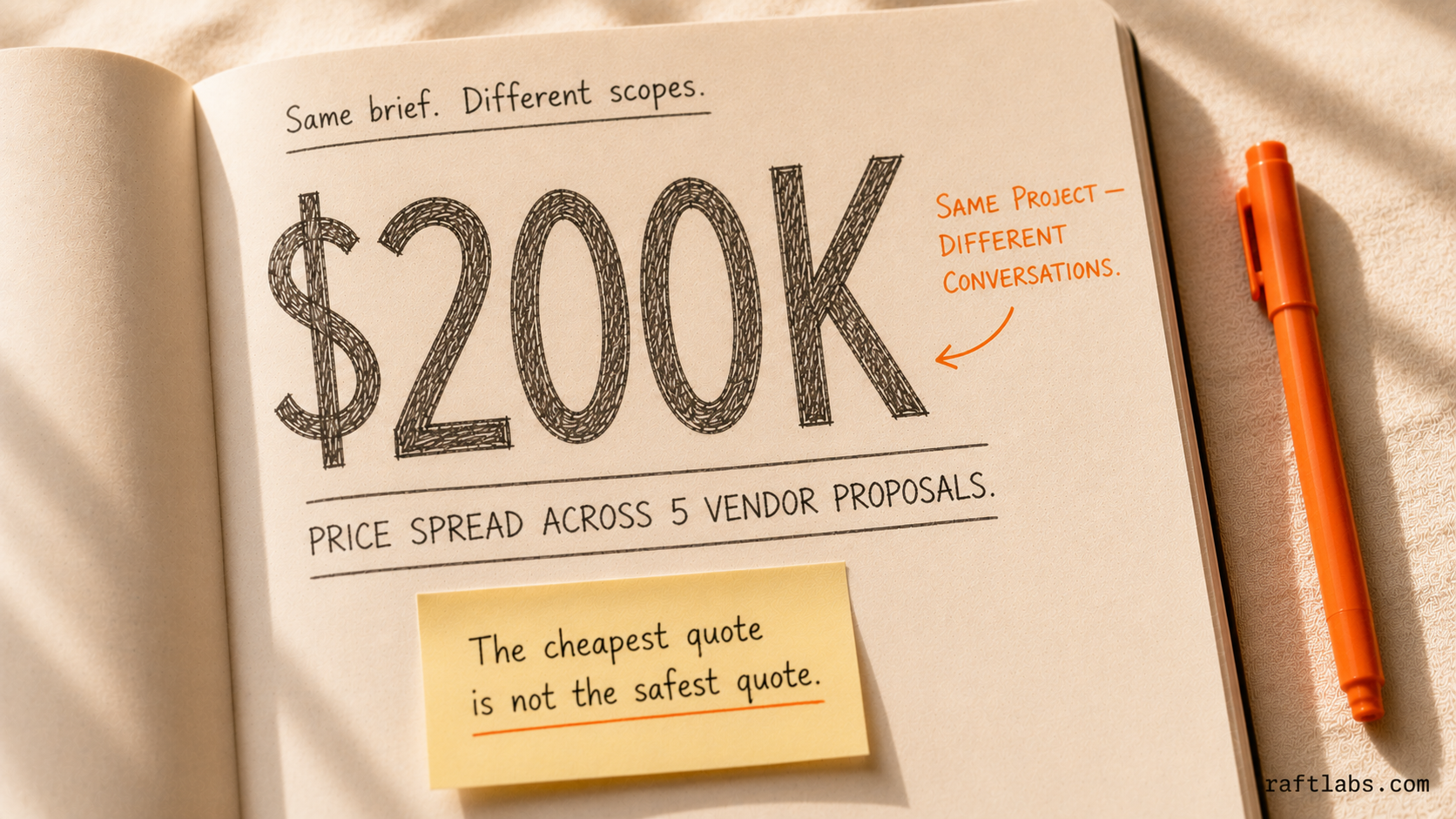
They're all different. Some are long, some are short. The prices vary by $200,000. You have no idea how to compare them. Gartner's 2024 IT Budget Survey found that North American enterprises allocate an average of 23% of their IT budgets to custom software development and modernization. With that much capital at stake, the evaluation process deserves more rigor than most companies apply.
This is the most common situation CEOs and COOs face when buying custom software - and the vendors know it. Confusion at this stage is how bad projects get approved.
This guide gives you a real framework for evaluating vendors. Not a generic checklist, but a structured process you can run yourself before signing anything.
Why custom software proposals are so hard to compare
The reason your five proposals look nothing alike is not incompetence. It's because each vendor solved a different problem.
Vendor A quoted what you described in the first call. Vendor B quoted what you described plus three "nice to haves" they assumed you wanted. Vendor C built in a phase 2 that you never asked for. Vendor D scoped down to MVP. Vendor E priced everything T&M with no ceiling.
None of them necessarily lied to you. But they all had different conversations with different versions of your requirements - because requirements at the early stage are always incomplete, always ambiguous, and always colored by what the vendor thinks they're good at selling.
The result is that comparing proposals is like comparing quotes from five contractors who each visited your house for 30 minutes and never saw the foundation.
This is a solvable problem. But the solution doesn't start with comparing proposals. It starts two steps earlier.
Before you evaluate vendors: two questions to answer first
Question 1: What specific problem needs solving?
Not "we need software." Not "we want to modernize our operations." The specific, measurable problem.
Examples of what this looks like in practice:
"Our sales team spends 4 hours per week manually copying data from our CRM into our invoicing system. We lose $30,000/year in billable time and make data entry errors 12% of the time."
"Our customer onboarding takes 14 days because three departments pass a spreadsheet back and forth. Our churn rate in the first 90 days is 23%, and we know onboarding is the primary cause."
"We have 8 different data sources that tell us different things about inventory. Our ops team makes purchasing decisions on gut feel because the data isn't trustworthy."
When you can articulate the problem at this level of specificity, evaluating vendors becomes dramatically easier. You're not evaluating proposals - you're evaluating whether the vendor's proposed solution actually solves that problem.
Question 2: Is custom software actually the right answer?
This question is uncomfortable because you've already decided the answer is yes. But the most expensive mistake in software is building something you didn't need to build.
Before committing to custom, check:
Is there a SaaS product that solves 80% of this problem for $500/month? (If yes: buy it. Configure it. Customize it with an API if needed. Don't build.)
Could you solve this with automation and integrations between existing tools? (Zapier, Make, or a custom API connector is not a software project.)
Is the problem actually a process problem that software will worsen? (Software amplifies existing processes. If the process is broken, software makes the broken process faster.)
Custom software is the right answer when the problem is genuinely unique, when off-the-shelf solutions create competitive disadvantage, or when the volume of the problem makes a custom tool obviously ROI-positive.
If you've answered both questions - you know the specific problem and you've confirmed custom is right - now you can evaluate vendors properly.
The 8 criteria for evaluating a custom software development company
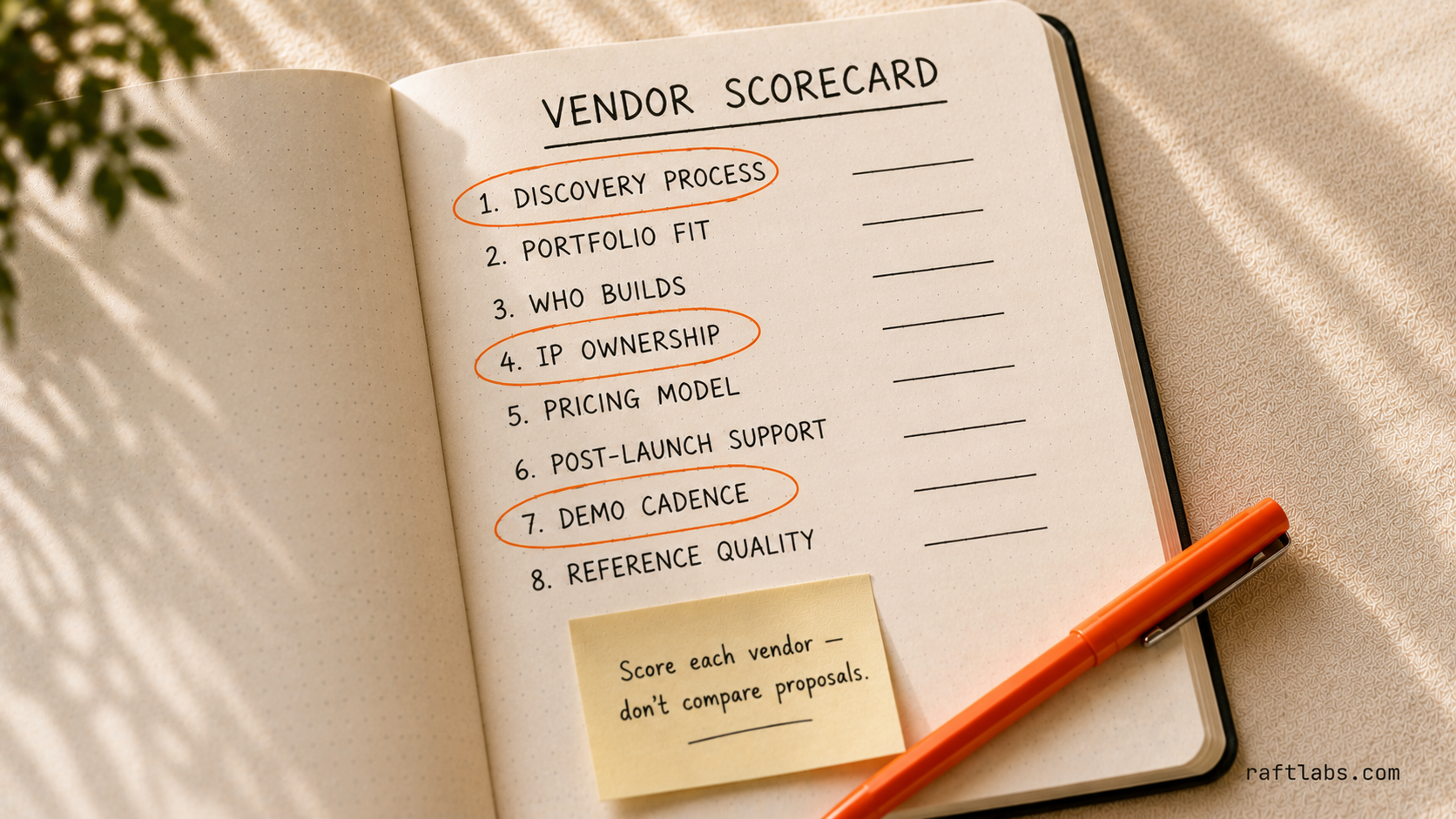
1. Discovery and diagnosis process
This is the most important criterion. Everything else depends on it.
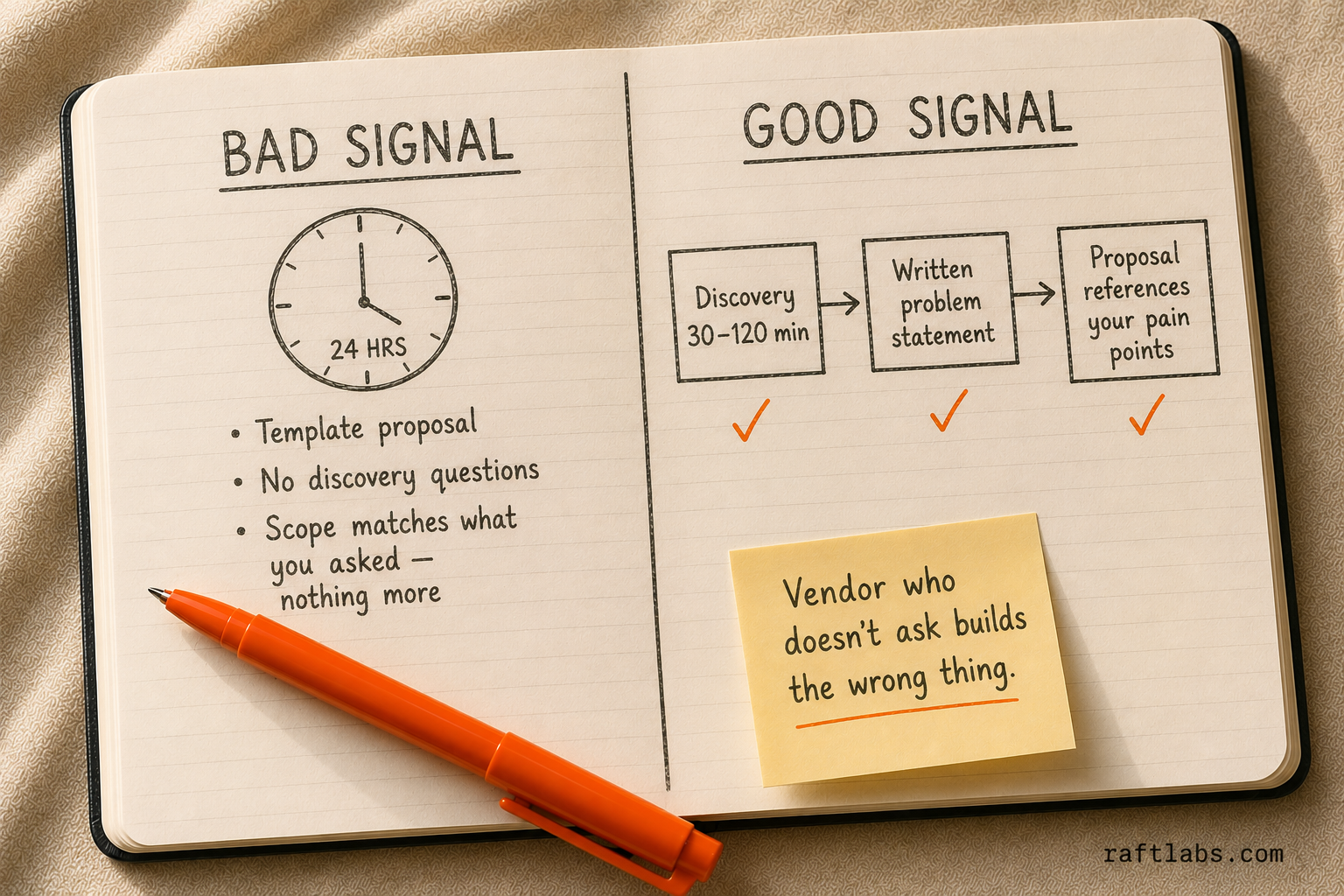
A good vendor will not write a proposal until they understand the problem deeply. This means they ask uncomfortable questions - about your current process, your data, your team's capabilities, your constraints, and your definition of success. They may push back on your assumptions. They may tell you part of what you're asking for is unnecessary.
What good looks like: a structured discovery process (30-120 minutes of questions before any scope estimate), a written problem definition shared back to you for confirmation, and a proposal that references specific pain points from your conversation.
What bad looks like: a proposal in your inbox 24 hours after the first call. A template proposal with your company name inserted. A scope that matches exactly what you described, with no pushback or alternatives.
RaftLabs runs a free 30-minute diagnostic call before any proposal. The output isn't a sales deck - it's a structured assessment of whether we can solve your problem and what the right engagement looks like. That's what a diagnostic-first process should feel like.
2. Portfolio fit
Don't evaluate a portfolio by number of logos. Evaluate it by similarity to your project.
You want to see projects that match your domain (healthcare, fintech, logistics, e-commerce, etc.), your product type (web platform, mobile app, API layer, data pipeline, AI workflow), and roughly your complexity level.
A vendor who has built 50 marketing websites but never shipped a multi-tenant SaaS platform is not the right vendor for your multi-tenant SaaS platform, regardless of how impressive their logo wall looks.
Ask specifically: "Which project in your portfolio is most similar to what we're building? Walk me through the architecture." According to IDC's Worldwide Software Development Services Forecast, enterprise spending on custom software development is growing at 2.3x the rate of packaged software spending. The vendor ecosystem is expanding fast, which makes portfolio fit more important, not less, because more generalist shops enter the market every year.
3. Who actually builds
This is the red flag that burns the most companies.
Many software firms have a senior partner or lead architect who runs the sales process - impressive, experienced, asks the right questions. After the contract is signed, the delivery team is a group of mid-level engineers who have never worked together and have never built anything at your complexity level.
Ask during the evaluation: "Who will be the technical lead on my project? Can I meet them before we sign?" If the vendor hesitates, or if the person they propose for technical lead wasn't involved in the sales process, dig deeper.
At RaftLabs, the architect who assesses your project is on your team for the duration. The person who diagnoses the problem is the person who leads the build.
4. IP ownership
This should be non-negotiable and explicit.
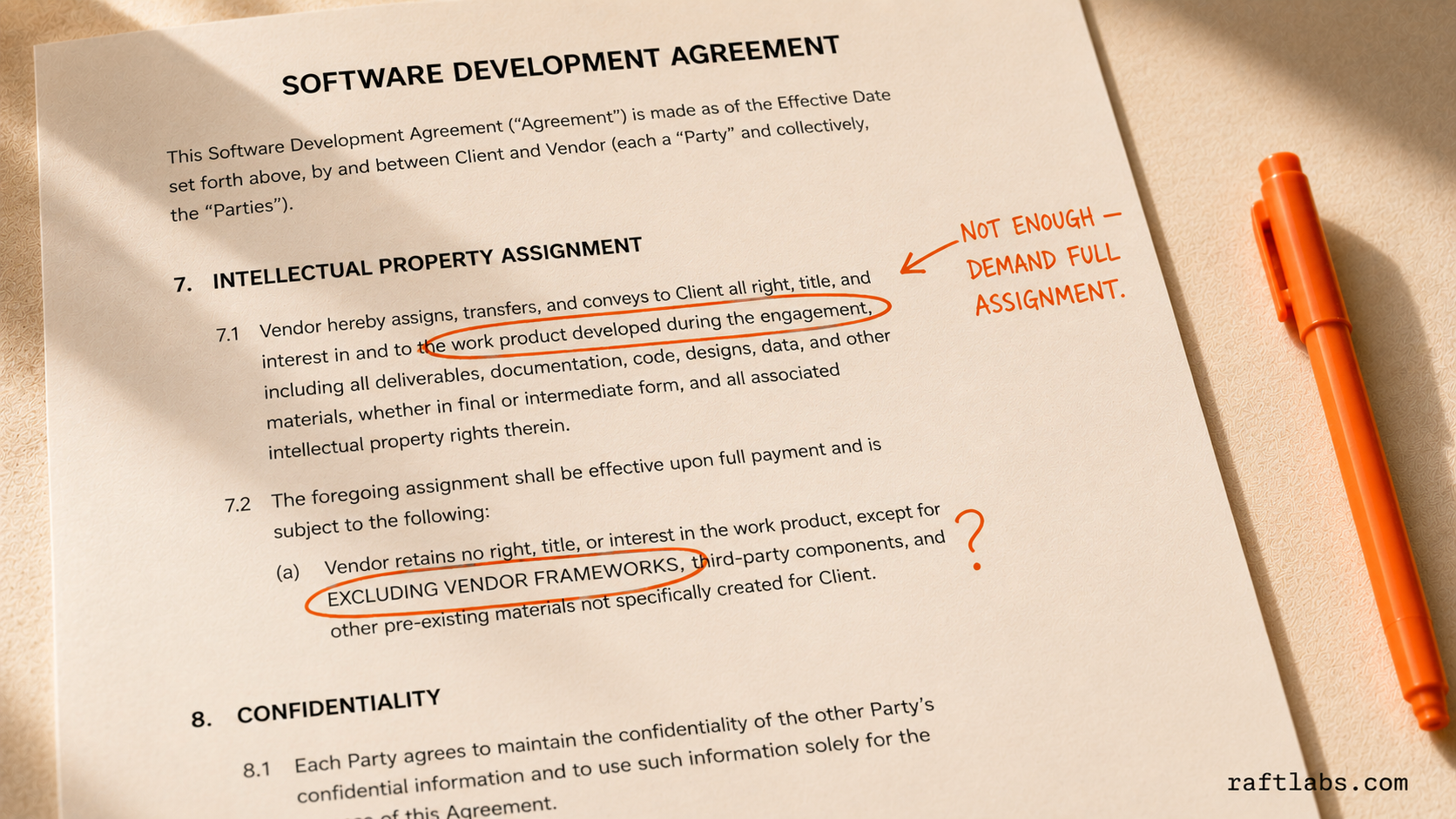
Your contract should state clearly: all code, documentation, design files, and intellectual property created during the engagement are fully assigned to you at completion. No ambiguity. No "work product" language that could be interpreted multiple ways.
Some vendors retain rights to reusable components or frameworks they built prior to your project. This is sometimes reasonable - but it must be disclosed. Ask: "What, if anything, do you retain ownership of from the work you do for us?"
Any hesitation on this question is a deal-breaker.
5. Pricing model
There are two models: time-and-materials (T&M) and fixed price. Each has real trade-offs.
Time-and-materials bills you by the hour or day. Cost is uncapped. You absorb all schedule risk. If the project takes longer than expected (and they almost always do), you pay more. The advantage is flexibility - requirements can change without a renegotiation.
Fixed price locks scope and cost per deliverable. Budget is certain. The vendor absorbs schedule risk. The risk for you is that vendors pad estimates to protect their margin, and that scope changes require formal renegotiations that slow things down.
The model RaftLabs uses - and the one we recommend - is fixed-price sprints. Each sprint (typically 4-6 weeks) has a defined scope and a fixed price. You have budget certainty within each sprint. Scope can evolve between sprints. You're not locked into a 12-month fixed scope that becomes wrong by week 8.
6. Post-launch support and warranty
The engagement doesn't end at launch. Any vendor who treats delivery as the finish line is selling you a short-term relationship.
Ask specifically: "What happens if there are bugs after launch?" A professional firm includes a warranty period - typically 30-90 days of bug fixing at no additional cost. After that, you should have a clear path to ongoing support: a retainer, a defined SLA, or a handoff process to your internal team.
If the vendor has no post-launch support model, that tells you something about how they view their relationship with you.
7. Communication cadence
Two weeks is the maximum acceptable interval between demos. If you're not seeing working software every two weeks, you don't know what you're paying for.
Demos should be against real data, in a staging environment that mirrors production. They should show specific features from the sprint scope - not mockups or wireframes unless that's what was agreed for that phase.
Also ask: "Who is my single point of contact, and how quickly do they respond?" You don't want to file a ticket every time you have a question for your engineering team.
8. Reference quality
References are almost always curated to show wins. Ask better questions.
Ask for a client who had a project that ran over budget or timeline. Ask for a client in a similar domain to yours. And ask the reference these specific questions:
"What went wrong during the engagement, and how did the vendor handle it?"
"If you were starting over, would you use this vendor again? Why?"
"What surprised you - positively or negatively - about working with them?"
The quality of a vendor's failures tells you more than the quality of their successes.
5 red flags in a vendor proposal
Red flag 1: A proposal within 24 hours of a first call
You told them about your problem. They sent you a scope and a price within a day. That means they either didn't do discovery, or they templated the proposal from a previous project. Neither is acceptable. Real discovery takes time.
Red flag 2: Vague IP ownership language
Any contract that says "all work product developed during the engagement" without a full IP assignment clause is ambiguous by design. Push for explicit language: "Client shall own all intellectual property, including but not limited to source code, documentation, designs, and all derivative works, effective upon payment."
Red flag 3: Team bait-and-switch
You meet a senior architect in the proposal phase. The statement of work lists a team of engineers you've never heard of. This pattern is extremely common and almost always leads to delivery problems. Insist on meeting the actual delivery team before signing.
Red flag 4: T&M with no milestone gates
Time-and-materials with monthly billing and no milestone-based checkpoints leaves you with little control if delivery slows. Tie payment to demonstrated progress - specific features in staging, not hours logged.
Red flag 5: A portfolio that doesn't match your complexity
A vendor who has only built marketing sites, Shopify stores, or simple CRUD apps is not the right partner for a multi-tenant platform with complex business logic and third-party integrations. Portfolio fit is not a bonus criterion. It's a prerequisite.
The right order of operations: discovery before commitment
This is how it should work. In practice, many buyers skip steps 1-3 and wonder why the project goes sideways.
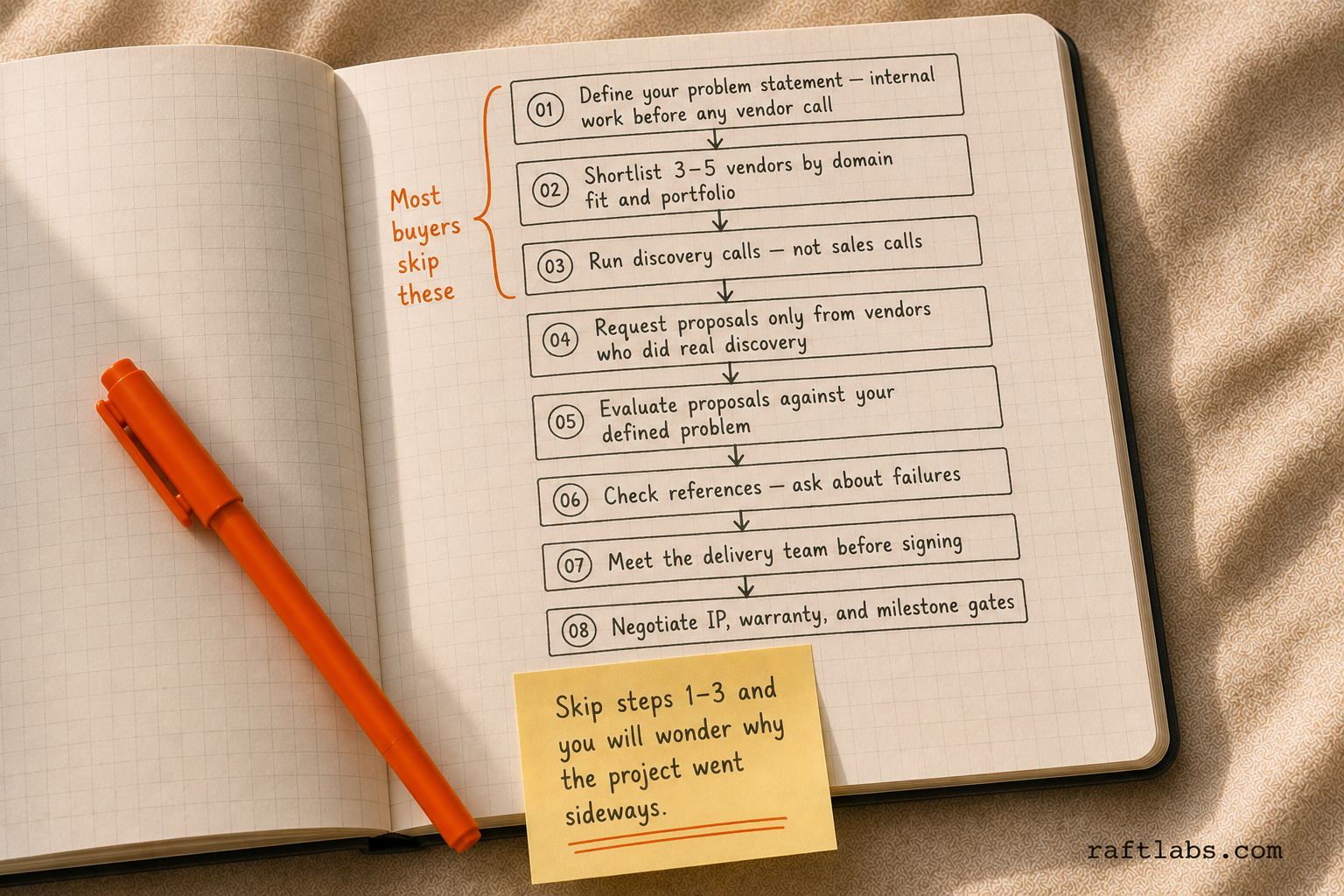
Step 1: Define your problem statement (your internal work, before any vendor calls)
Step 2: Shortlist 3-5 vendors based on domain fit and portfolio similarity
Step 3: Run discovery calls - not sales calls. Ask vendors to walk you through their discovery process. If they skip it and go straight to pitch, take note.
Step 4: Request detailed proposals only from vendors who completed a real discovery process
Step 5: Evaluate proposals against your defined problem, not against each other in isolation
Step 6: Check references - ask the hard questions listed above
Step 7: Meet the delivery team before signing. If the vendor won't allow this, walk away.
Step 8: Negotiate IP, warranty, and milestone gates before committing
10 questions to ask in your first vendor call
Use these verbatim. The answers will tell you almost everything you need to know.
- "What's your discovery process before you write a scope?"
- "Who specifically will lead architecture on my project, and will I have access to them throughout?"
- "Can I meet the delivery team before we sign?"
- "Who owns the IP at the end of the engagement - and is that in writing?"
- "How do you handle scope changes mid-sprint?"
- "Show me a project that missed its original timeline. What happened and what did you do?"
- "What does post-launch support look like - what's covered, what's not, and what does it cost?"
- "How often will I see working demos? What environment are they in?"
- "What's your pricing model, and can you show me an example of how costs evolved on a previous project?"
- "What would make you turn down this project?"
That last question is the most revealing. A vendor with good judgment will have a real answer. A vendor who says "we take every project" has no quality filter.
If you want to see what the right process looks like in practice, RaftLabs runs a free 30-minute diagnostic call before any proposal. It's not a sales call - it's a structured conversation about your problem. We'll tell you honestly if custom software is the right answer and what a realistic engagement looks like. If it's not a fit, we'll tell you that too.
Ask an AI
Get an instant summary of this post from your preferred AI assistant.
Common questions
- Evaluate on eight criteria: diagnostic process, portfolio fit, team composition in delivery, IP ownership terms, pricing model (T&M vs fixed price), post-launch support, communication cadence, and reference quality. The most important of these is the diagnostic process - a vendor who doesn't ask hard questions before proposing is a vendor who will build the wrong thing.
- Ask these ten questions: (1) What's your discovery process before you write a proposal? (2) Who specifically will lead architecture on my project? (3) Can I meet the delivery team before signing? (4) Who owns the IP? (5) What's your process for handling scope changes? (6) How do you handle a sprint that misses its deliverables? (7) Show me a project that went wrong and what you learned. (8) What does post-launch support look like? (9) What's your communication cadence - how often do I see demos? (10) What would make you walk away from this project?
- Five red flags: (1) A proposal within 24-48 hours of a first call with no discovery phase. (2) Vague IP ownership language - 'work product' instead of full assignment. (3) A team composition that changes between sales and delivery. (4) A time-and-materials model with no milestone gates. (5) A portfolio of projects that look nothing like yours in complexity or domain.
- Fixed-price works best when scope is clear and requirements are stable - typically in short delivery sprints (8-12 weeks). Time-and-materials works best when requirements will evolve and you need flexibility. The risk of T&M is uncapped cost exposure. The risk of fixed-price is that vendors pad estimates to protect margins. The best model is fixed-price sprints with a defined scope per sprint - you get cost certainty without locking a 12-month roadmap.
- RaftLabs builds software across AI, loyalty, hospitality, fintech, and healthcare. We start with a diagnostic - not a proposal - so you know what you're actually building before you commit. 4.9/5 on Clutch. Fixed-price 12-week sprints, starting at $25K.