Build vs Buy AI Software: A CTO's Decision Guide for 2026
AWS AI, Azure AI, and GCP Vertex AI cover 80% of common use cases. This guide shows CTOs exactly when custom AI wins on cost, control, and competitive advantage.

In this article
Short answer
Build custom AI when it is your competitive moat and you have proprietary data. Buy AWS AI, Azure AI, or GCP Vertex AI when AI is a commodity feature. A V1 custom AI MVP costs $60K-120K and ships in 12 weeks. RaftLabs works with CTOs at $1M-$100M companies to make that call and deliver it.
Key takeaways
- AWS AI, Azure AI, and GCP Vertex AI cover 80% of commodity use cases. Build custom only when AI quality is your product differentiator or you hit 50K+ API calls per month.
- A V1 custom AI MVP costs $60K-120K. A full production system runs $120K-250K. Ongoing infrastructure and maintenance adds $2K-3K per month.
- The break-even point vs SaaS AI tools is month 16-18. After that, custom is cheaper every month while you retain full data ownership.
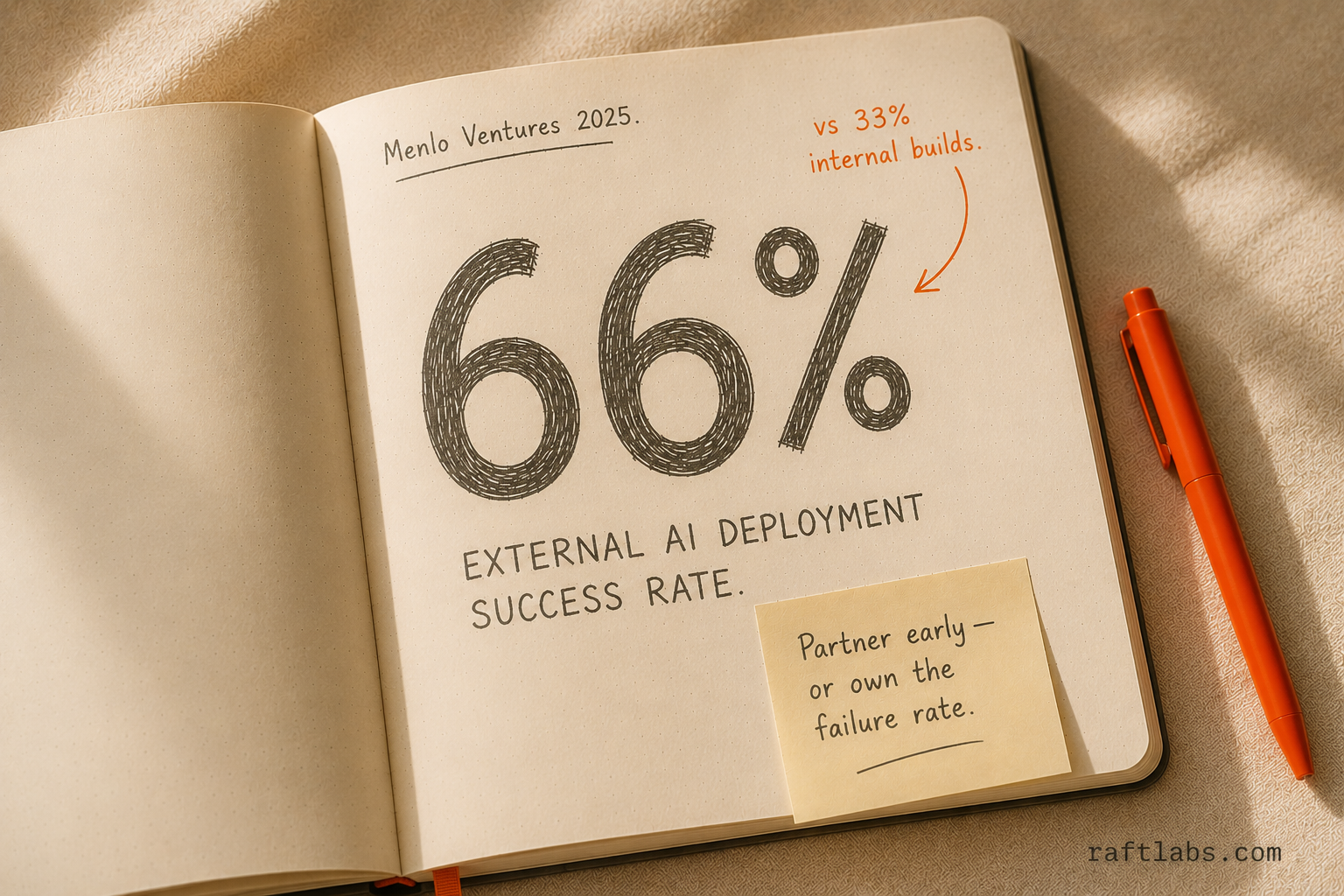
- External AI partnerships achieve 66% deployment success versus 33% for internal builds. Building custom does not mean building in-house.
- Score your use case across 6 dimensions before deciding. A score of 4 or higher means build. Below 4, buy and revisit in 12 months.
You are spending $6,000 a month on AWS AI services. The accuracy is 78%. Your competitor just launched a feature that is clearly trained on proprietary data. Your current vendor cannot get you there, and you know it.
This is the moment the build vs buy AI software decision gets real.
Most CTOs arrive at this point after 12-18 months on a managed platform. The tools worked. Then they hit a ceiling. The question is whether that ceiling is a vendor limitation or a use-case limitation. The answer determines whether you spend the next quarter scoping a custom build or renegotiating a contract.
Here is the cost reality before anything else.
| Phase | What you get | Cost range | Timeline |
|---|---|---|---|
| V1 MVP | Core AI pipeline, single workflow, basic UI | $60K-120K | 8-12 weeks |
| Full production | Multi-workflow, integrations, admin panel, monitoring | $120K-250K | 16-24 weeks |
| Scale | Model retraining, observability, multi-tenant, compliance | $250K-500K+ | 6-12 months |
Ongoing infrastructure and maintenance: $2K-3K per month after launch.
Compare that to AWS AI, Azure AI, or GCP Vertex AI at $2K-8K per month with no upfront cost. The custom build breaks even at month 16-18. After that, you pay less every month and own everything.
The rest of this guide tells you whether you will ever reach that break-even point.
AWS AI, Azure AI, and GCP Vertex AI vs Custom Software
AWS AI (Rekognition, Comprehend, Bedrock), Azure AI (Azure OpenAI, Cognitive Services, ML Studio), and GCP Vertex AI are not bad products. They are excellent for the 80% of AI use cases that are commodity problems: sentiment classification, document OCR, speech transcription, basic image labeling, and general-purpose language generation.
The thresholds where custom software wins:
Accuracy ceiling. Managed services are trained on general datasets. If your business problem requires domain-specific accuracy above 88-90%, you will hit the ceiling of any general-purpose model. Healthcare diagnosis patterns, financial fraud signatures, legal contract clause recognition, industrial defect detection. These require fine-tuning on your data, not a shared model.
Volume economics. AWS AI charges per API call. At low volume that is rational. At 50K-100K calls per month, the math changes. A company processing 80,000 documents per month at $0.05 per document pays $4,000 per month to AWS. A custom pipeline on open-source models (Llama, Mistral, or fine-tuned BERT variants) running on dedicated infrastructure costs $1,200-1,800 per month. Year-one savings after build cost: $16,000-33,000. Year two: $26,000-33,000 with nothing to recoup.
Data residency. AWS AI, Azure AI, and GCP Vertex AI process your data on their infrastructure. For companies in healthcare (HIPAA), financial services (SOC 2, GDPR), defense, or legal services, this is a blocker. Your data cannot leave your environment, which means the managed service is not an option regardless of price.
Proprietary data advantage. This is the most strategic threshold. If you have three or more years of transaction history, client interaction records, domain-specific annotations, or behavioral data that competitors do not have access to, that data is an asset. Plugging it into a managed service shares the output but not the model. Building a custom model trained on that data creates a capability gap that compounds over time. AWS and Azure cannot replicate your proprietary dataset.
Vendor roadmap dependency. When your core product capability is determined by what AWS decides to ship next quarter, you are building on sand. Teams whose AI is a commodity feature can tolerate this. Teams whose AI is the product cannot.
Who Actually Builds Custom AI Software
Not every CTO who asks about custom AI should build it. Here are the operator profiles where building is the right call.
The SaaS product with AI at the core. You are building a vertical SaaS product where the AI quality is the primary reason customers pay. A legal contract review tool. A supply chain demand forecasting platform. A medical imaging analysis product. The accuracy gap between a fine-tuned custom model and a general-purpose managed service is 8-15 percentage points. At this level, that gap is the difference between a product customers trust and one they cancel after the trial.
One team RaftLabs worked with was building an AI-assisted underwriting tool for commercial insurance. Azure AI got them to 74% accuracy on clause extraction. Their underwriters needed 91% to trust the output. A custom model trained on 180,000 historical policies got them to 93%. That 19-point gap was the product.
The high-volume processor. You are processing structured documents, calls, transactions, or events at scale. The per-unit economics of managed services look fine at 5,000 units per month. At 60,000 units per month, the bill is approaching the cost of a mid-level engineer. At 150,000 units, you are paying for two engineers who do not work for you and own none of the infrastructure. Building custom at this volume is not a technical decision. It is a financial one.
The data-rich operator. You have spent years collecting proprietary operational data. Customer behavior, clinical outcomes, fraud patterns, maintenance failure logs. None of your competitors have this data. A managed AI service can process it, but the model insight stays with the vendor. A custom model trained on that data creates a closed-loop advantage. Every new data point makes your model better and your competitors' position relatively weaker.
The regulated industry operator. Healthcare, financial services, government contracting, legal. Your data cannot leave your environment under any circumstances. You do not have the option to use a managed cloud AI service. You build on-premise or on a private cloud that you control. The build vs buy AI software question is answered by your compliance team before your engineering team gets a vote.
V1, V2, V3: What You Are Actually Buying at Each Phase
Most CTOs underspecify the build because they think of AI as one project. It is three projects in sequence, and the cost difference between them is significant.
V1: The working prototype ($60K-120K, 8-12 weeks)
One workflow automated. One model. Basic monitoring. Enough to validate that the AI does what you think it does on real production data.
At this phase you are buying proof. You are not buying a product. The AI pipeline works. Accuracy is measured. The system processes real inputs and produces auditable outputs. Your team can run it. That is the definition of done for V1.
What V1 does not include: retraining pipelines, multi-tenant architecture, admin tooling, audit logging, SLA-grade uptime, compliance documentation, or a second workflow.
V2: Production-ready system ($120K-250K, 16-24 weeks)
Multiple workflows. API integrations with your existing stack. Role-based access. Monitoring dashboards. Model versioning. SLA-grade infrastructure. The V2 is what you deploy to customers or use in internal workflows where downtime has a cost.
Budget: V1 cost plus $60K-130K for the production engineering work. This is where most of the real engineering lives. The model was the easy part. Production infrastructure, observability, and integration surface area are what consume time.
V3: Scaled and self-improving ($250K-500K+, ongoing)
Active learning pipelines that retrain the model as new data arrives. Multi-tenant architecture. Compliance certifications (HIPAA, SOC 2). Fine-grained audit trails. Geographic distribution for latency. Model A/B testing infrastructure.
V3 is where the data moat compounds. The model gets better as you use it. Competitors using managed services do not get that loop. This is the phase where the build decision delivers its maximum return.
Most businesses should get to V2 before asking whether V3 is justified. The companies that skip V1 and V2 and try to build V3 directly are the ones that appear in failure statistics.
Where AI Software Projects Fail
Forrester's 2025 AI predictions found that 75% of firms attempting to build advanced agentic AI architectures internally will fail. That is not an argument against building. It is an argument for building correctly.
Two failure modes explain most of the carnage.
Failure mode 1: Building before validating.
The most common mistake is skipping the managed service validation step. A CTO decides the company needs custom AI, budgets $150K, and eight months later has a system that produces the same accuracy as Azure AI would have for $3,000 a month.
The correct sequence: buy a managed service first, run it for 60-90 days on real data, measure actual accuracy and cost. If the managed service meets your accuracy bar and the cost scales acceptably, keep it. You saved $150K and eight months. If the accuracy is insufficient or the cost ceiling is visible, you now have real data to justify the custom build scope.
"We validated on AWS Rekognition for 10 weeks before committing to a custom computer vision pipeline," said one product VP at a logistics company. "The validation data made the $180K build budget an easy conversation with the CFO."
Failure mode 2: Building in-house without AI production experience.
External AI partnerships achieve 66% deployment success versus 33% for internal builds, according to the Menlo Ventures 2025 State of Generative AI in the Enterprise report. The gap is not about intelligence. It is about production engineering experience: data pipeline architecture, evaluation benchmark design, model drift monitoring, prompt injection defense, cost optimization at scale.
A team shipping its first AI product will spend 60% of its time solving problems that an experienced partner has solved before. That is not waste if you are building the organizational capability. It is waste if you are trying to ship a product and move on.
At RaftLabs, we have delivered AI products across healthcare, fintech, logistics, and MarTech. The patterns that kill projects are well-documented. We design around them before writing the first line of code.
How RaftLabs Builds Custom AI Software
We do not start with code. We start with the question your managed service cannot answer.
Every engagement begins with a two-week diagnostic: we review your data architecture, map the accuracy gap between your current tool and what the business actually requires, model the 36-month cost of buy vs build, and tell you honestly whether a custom build is justified. If it is not, we say so.
When the build is justified, we follow a phased delivery structure that mirrors the V1/V2/V3 framework above. V1 in 10-12 weeks. A working production system, not a demo. Real data, real outputs, real accuracy benchmarks.
Proof from recent work: a healthcare technology company came to us processing clinical notes with Azure AI at 71% entity extraction accuracy. Their clinical workflow required 89%. We built a custom NLP pipeline fine-tuned on 95,000 de-identified clinical notes. Production accuracy: 91%. Delivered in 11 weeks. Monthly infrastructure cost: $1,400 versus their previous $4,200 Azure bill.
The right CTA here is not "let's start." It is "let's find out if building is the right call for your specific situation." If you are at the ceiling of AWS AI, Azure AI, or GCP Vertex AI and the gap is costing you product quality or competitive position, that conversation starts here.
The Build vs Buy AI Software Scorecard
Score your use case before committing. One point per question answered yes.
| Question | Score |
|---|---|
| Is AI quality a primary reason customers choose you over competitors? | 1 |
| Do you have proprietary training data that vendors cannot access? | 1 |
| Will you exceed 50K AI API calls per month within 12 months? | 1 |
| Does your compliance posture prohibit third-party data processing? | 1 |
| Have you already validated with a managed service and hit an accuracy ceiling? | 1 |
| Does your roadmap require AI behavior that no current vendor supports? | 1 |
Score 0-1: Buy. Use AWS AI, Azure AI, or GCP Vertex AI. Revisit in 12 months.
Score 2-3: Hybrid. Buy for commodity workflows. Build the one differentiating pipeline where the managed service is failing you.
Score 4-6: Build. The strategic and financial case is clear. Choose an experienced partner to reduce the 67% failure risk of internal builds.
Cited Statistics
75% of firms attempting to build advanced agentic AI architectures internally will fail. Source: Forrester, Predictions 2025: Artificial Intelligence.
External AI partnerships achieve 66% deployment success versus 33% for purely internal builds. Source: Menlo Ventures, State of Generative AI in the Enterprise 2025.
63% of organizations either do not have or are not sure they have the right data management practices for AI. Source: Gartner, February 2025.
Ask an AI
Get an instant summary of this post from your preferred AI assistant.
Common questions
- Build custom AI when it is a core competitive differentiator, when you have proprietary data that vendors cannot access, when you exceed 50K API calls per month, or when data privacy rules prevent third-party processing. AWS AI, Azure AI, and GCP Vertex AI are excellent for commodity use cases. Build custom only when those tools cannot deliver the accuracy or control your business requires.
- A custom AI V1 costs $60K-120K to build with $2K-3K per month in ongoing infrastructure and maintenance. SaaS AI tools like AWS AI or Azure AI cost $2K-8K per month with no upfront investment. The custom build breaks even around month 16-18. Over three years, building saves $10K-40K while giving you full data ownership and unlimited customization.
- Vendor lock-in is the biggest hidden cost. After 12-18 months of deep integration, migration costs often exceed the original purchase price. Per-seat and per-token pricing scales with your revenue, not your infrastructure cost. You also lose data ownership, which matters the moment you need to train a model on your own transaction history or client records.
- A focused V1 custom AI product takes 8-12 weeks from kickoff to production with an experienced partner like RaftLabs. A V2 with additional pipelines and integrations takes another 6-10 weeks. Internal teams typically need 6-9 months for the same scope because of competing priorities and learning curves.
- Yes, in almost every case. Start with a managed AI service to validate that the use case drives measurable business value. Run that experiment for 60-90 days. If the tool delivers the outcome and cost scales reasonably, keep it. If accuracy is insufficient or the monthly bill is approaching $5K-8K with no ceiling, that is the signal to scope a custom build.